Payroll employment rises by 225,000 in January; unemployment rate little changed at 3.6%
Total nonfarm payroll employment rose by 225,000 in January [2019 average: 175k], and the unemployment rate was little changed at 3.6 percent, the U.S. Bureau of Labor Statistics reported today. (…)In January, average hourly earnings for all employees on private nonfarm payrolls rose by 7 cents to $28.44. Over the past 12 months, average hourly earnings have increased by 3.1 percent. Average hourly earnings of private-sector production and nonsupervisory employees were $23.87 in January, little changed over the month (+3 cents) [+3.3% YoY].
U.S. Productivity Grows As Unit Labor Cost Increase Slows in Q4
Productivity in the nonfarm business sector during Q4’19 increased 1.4% (SAAR) following an unrevised 0.2% Q3 slip. It raised productivity by 1.8% during the last four quarters.
Accompanying the improvement was a 2.8% (4.2% y/y) rise in compensation. It was the largest increase in three quarters and raised y/y growth to 4.2%, its quickest since Q4 2012. Adjusted for price changes, compensation rose 0.3% and a quickened 2.1% y/y.
Unit labor costs increased 1.4% during Q4’19 after a 2.5% rise. The gain pulled the y/y rise to 2.4% which was the strongest gain since early-2018, up from 1.0% in Q4’18.
In the manufacturing sector, productivity declined at a 1.2% rate, off for the third straight quarter. The decline lowered factory sector productivity by 0.7% during the last four quarters, the weakest performance since Q3’17.
Compensation in the factory sector strengthened 4.6% both q/q and y/y. It was the quickest four quarter rise since Q2’09, and up from little change in 2016. Adjusted for price inflation, compensation rose 2.0% q/q and a strong 2.5% y/y. The compensation increase combined with the decline in productivity raised unit labor costs in the factory sector by 5.9%. The 5.3% y/y increase was the strongest four quarter rise in just over 10 years.


VIRUS UPDATE
- China death toll at 636; confirmed cases at 31,161
- Number of new cases reported in China decline for a second day: WHO. “It’s good news, but we caution against reading too much into this,” he said. China reported 3,696 new cases, according to the WHO tally as of late yesterday.
The growth rate and the number of new cases appears to be slowing. (The Daily Shot)

Source: Deutsche Bank Research
Coronavirus Cuts Chinese Tourism, and Luxury Retailers Suffer Chinese tourists are disappearing from major shopping capitals across the U.S. and Europe due to the new coronavirus, exposing how dependent high-end retailers in places such as New York, Paris and Milan have become on visitors from China.
(…) Estée Lauder Cos EL 5.07% . and Capri Holdings Ltd., CPRI -5.91% which owns the Versace and Jimmy Choo brands, warned investors this week their financial results could suffer due to lower sales to Chinese travelers.
A new Galeries Lafayette store on Boulevard Haussmann in Paris, where there are signs in Chinese and a center where tourists can claim value-added tax refunds, was largely empty this week. Normally, more than 1,000 shoppers a day visit the store, many of them Chinese tourists who arrive by the busload after stopping at sights such as the Louvre, a salesman said.
On Milan’s Via Monte Napoleone, almost every shop has hired a Chinese-speaking sales clerk in recent years—but now tourists from China have virtually disappeared. (…)
Almost 170 million residents of China traveled outside the country in 2018, the most recent year for which figures are available, according to the U.N. World Tourism Organization, and they spent about $277 billion. (…)
The U.S. economy overall could lose $10.3 billion in Chinese visitor spending due to the outbreak, according to estimates by the research firm Tourism Economics. Chinese represent 7% of all overseas visitors to the U.S., and they spent roughly $34 billion on travel and transportation services in 2019, including spending in the U.S. and on U.S. airlines, the firm said. (…)
(…) Next month will see a twice-yearly redetermination of energy companies’ borrowing limits by banks that is based on the prices of energy futures.
“If there’s a truly substantial decline in demand with no corresponding cut to supply, then the pace of bankruptcies will accelerate,” predicts Charles Beckham Jr., a Houston-based partner at Haynes and Boone who specializes in restructuring. “We are seeing far less patience among energy investors.” (…)
Russia has rejected a Saudi-led effort to deepen OPEC’s oil-production cuts in response to the deadly coronavirus in China, cartel delegates said.
The group’s failure to reach a consensus is a setback for OPEC’s de facto leader, Saudi Arabia, and its burgeoning alliance with Moscow. (…)
Saudi Arabia had initially backed output cuts of 800,000 to 1 million barrels a day to balance oil markets. But the gathering collapsed Thursday without an agreement, after the Saudis proposed a compromise cut of 600,000 barrels a day, as a temporary measure in the second quarter.
The Saudi proposal had broad support, but the Russian delegation—which holds increasing sway within the group—rejected it on the grounds that it was too early to assess the impact of the virus on global oil demand, said Russian Energy Minister Alexander Novak. (…)
EARNINGS WATCH
We now have 305 S&P 500 companies in, a 70% beat rate (19% miss rate) and a +5.2% surprise factor.
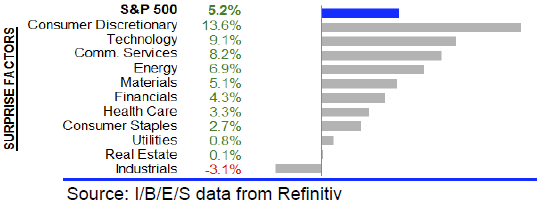
Pre-announcements for Q1 remain supportive but we are starting to hear about the virus impact.
Trailing EPS are now $164.20.