Top China Trade Negotiator to Visit U.S. to Face Tariff Threat
China’s top trade negotiator Liu He will visit the U.S. this week for a new round of high-wire talks, in a sign Beijing is battling to keep negotiations on track after President Donald Trump ratcheted up pressure with plans to raise tariffs on Chinese goods Friday.
Vice Premier Liu will meet with U.S. Trade Representative Robert Lighthizer and Treasury Secretary Steven Mnuchin, on May 9 and 10, according to a statement Tuesday on the Chinese Ministry of Commerce website. At the same time, China is preparing retaliatory tariffs on U.S. imports should Trump carry out his threat, according to people familiar on the matter. (…)
According to two people familiar with the U.S.’s position, China backtracked on committing to legal changes that American officials saw as key to selling the deal domestically as the biggest concession any U.S. administration has ever gotten from China.
This isn’t the first time an apparent agreement faltered. A year ago, Liu told reporters in Washington that talks with Mnuchin, Lighthizer and Secretary of Commerce Wilbur Ross ended with a pledge not to engage in a trade war.
(…) Beijing’s response to the prospect of new tariffs has been reserved, and on Tuesday, Foreign Ministry spokesman Geng Shuang told a news briefing that mutual respect was the basis for reaching a trade agreement.
“Adding tariffs can’t resolve any problem,†Geng said.
“Talks are by their nature a process of discussion. It’s normal for both sides to have differences. China won’t shun problems and is sincere about continuing talks,†he said.
“We hope the U.S. side can work hard with China, to meet each other halfway, and on the basis of mutual respect and equality, resolve each other’s reasonable concerns, and strive for a mutually beneficial, win-win agreement.†(…)
(…) In a commentary published on its WeChat account on Tuesday, People’s Daily warned the US to “not even think about†concessions.
“When things are unfavourable to us, no matter how you ask, we will not take any step back. Do not even think about it,†the commentary said. (…)
Sources said President Xi Jinping earlier vetoed extra concessions proposed by his negotiators. “Xi told them ‘I’ll be responsible for all possible consequences’,†one of the sources said.
Chinese negotiators subsequently presented a tougher proposal to Washington, although it is not clear if they pitched an amended proposal to Xi after the latest round of talks in Beijing last week. (…)
“The latest Politburo meeting did not focus on economic stabilisation as it had done in February. Leaders may feel the impact of tariffs on China’s economy is not as grave as expected,†Chen said. (…)
Best odds are on another extension so that everybody gets a face saver.
The Conference Board Employment Trends Indexâ„¢ (ETI) Increased Slightly in April Recent economic and labor market news suggests no rate cut in 2019
The Employment Trends Index increased slightly in April, but has been moving mostly sideways in recent months,†said Gad Levanon, Chief Economist, North America, at The Conference Board. “In the past month, most economic indicators, including Friday’s job report, came out stronger than expected, essentially eliminating fears of a major slowdown in the US economy.
Still, the behavior of the ETI in recent months suggests that employment will grow more slowly in the coming quarters than it did in the past year, which is to be expected in such a tight labor market. The labor market will continue to tighten, and in such an environment the Federal Reserve is unlikely to cut rates in 2019.â€
April’s increase was fueled by positive contributions from five of the eight components. From the largest positive contributor to the smallest, these were: Percentage of Respondents Who Say They Find “Jobs Hard to Get,†the Number of Employees Hired by the Temporary-Help Industry, Real Manufacturing and Trade Sales, Industrial Production, and Initial Claims for Unemployment Insurance.

The Chemical Activity Barometer (CAB), a leading economic indicator created by the American Chemistry Council (ACC), rose 0.5 percent in April on a three-month moving average (3MMA) basis, the second monthly gain after several weak months. On a year-over-year (Y/Y) basis, the barometer is up 0.3 percent (3MMA).
(…) The diffusion index was steady at 65 percent in April, an improvement over the winter months.(…)
“The latest CAB signals gains in U.S. commercial and industrial activity through mid-2019, but at a slow pace,†said Kevin Swift, chief economist at ACC.
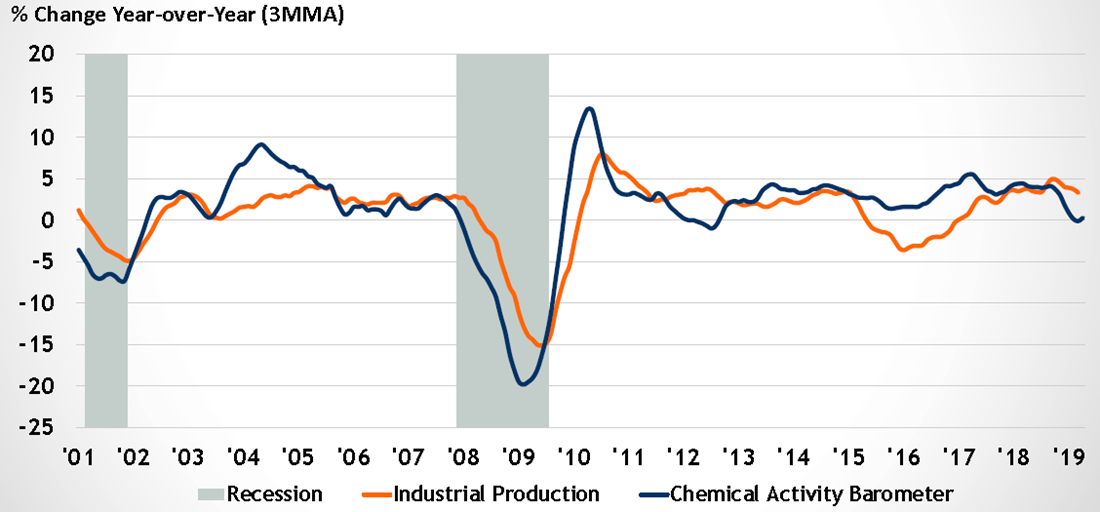
The last 2 months have been pretty strong:

Fed Flags Risky Business Debt as Vulnerability for Financial System The Federal Reserve identified rising sales of risky corporate debt as a top vulnerability facing the U.S. financial system, according to a new report.
(…) Officials for the second time in six months cited potential risks tied to nonfinancial corporate borrowing, particularly leveraged loans—a $1.1 trillion market that the Fed said grew by 20% last year amid declining credit standards. They also flagged possible concerns in elevated asset prices and historically high debt owned by U.S. businesses.
“Borrowing by businesses is historically high … with the most rapid increases in debt concentrated among the riskiest firms amid signs of deteriorating credit standards,†the Fed said in the second iteration of its financial stability report. (…)
Specifically, the Fed warned a downturn could expose vulnerabilities in U.S. corporate debt markets, “including the rapid growth of less-regulated private credit and a weakening of underwriting standards for leveraged loans.†(…)
A separate report released Monday showed some banks eased certain terms, such as credit-line costs and loan covenants, on business loans to medium and large companies in the first quarter. At the same time, banks tightened lending standards for commercial real-estate lending. Banks reported weaker demand for both types of loans in the first quarter, according to the Fed’s senior loan officer opinion survey. (…)
- Too leverage to tighten? IN GODS WE TRUST
Canada’s Housing Will Return to Growth, Central Bank Governor Says Tougher mortgage rules are effective and improving quality of new loans, Stephen Poloz says
(…) Speaking in Winnipeg, Manitoba, he said tougher mortgage rules that came into force at the beginning of 2018 have been effective and continue to improve the quality of new loans. He said Canadians are adapting to the new rules, which require all prospective home buyers to prove they can handle higher interest rates, by choosing less expensive homes or delaying their purchases.
“Some previously frothy markets are still adjusting to a significant shift in price expectations, while other markets appear to be operating in a manner consistent with market fundamentals,†Mr. Poloz said. “As markets stabilize in Toronto and Vancouver, the Canadian housing sector should return to growth overall later this year.†(…)
Concern about the health of Canada’s housing markets was one of several factors the Bank of Canada weighed during its decision last month to keep the key interest rate on hold at 1.75% and to suspend talk of future rate increases. (…)
Mr. Poloz said in his speech on Monday that several changes could improve the flexibility of mortgage markets in Canada and lower risks in the financial system. Possible changes, he said, could include promoting more fixed-rate mortgages of terms longer than five years, developing a private market for mortgage-backed securities and considering different mortgage designs.
-
Chinese companies face surging write-offs After a global investment spree, impairments weigh on tech and energy companies

EARNINGS WATCH
With 392 companies in, the beat rate is 75%, the surprise factor +6.2% and the blended growth rate +0.9% (+2.3% ex-Energy).
Trailing EPS are now $163.65.
Corporate pre-announcements for Q2 are worsening with 38/8 negative/positive vs 31/10 at the same time during Q1’19.
Q2 estimates have edged lower to +1.5% from +1.6% last week.