Trio of Central Banks Surprise Markets With Aggressive Rate Cuts
Central banks in Malaysia, Indonesia, South Korea and South Africa have also reduced policy rates in recent months.
Fed’s Evans Says Trade Headwinds Could Justify Additional Rate Cuts
Evans said the risks have “gone up”, which can justify “more accommodation”, and acknowledged the other central bank moves: “once a substantial number of central banks consider repositioning their monetary policy, it’s natural that other central banks might be thinking that too”.
US agencies barred from buying Huawei equipment Trump administration rule also covers ZTE, Hikvision, Dahua and Hytera
US government agencies from the Pentagon to Nasa will be banned from buying Huawei equipment after the Trump administration implemented a congressional measure to crack down on Chinese companies seen as security threats. A rule issued by the administration bans Huawei, the Shenzhen-based telecoms company, and other Chinese groups from supplying the federal government. It also covers ZTE, a telecoms company; Hikvision and Dahua, manufacturers of surveillance cameras; and Hytera, which produces two-way radios. (…)
China Exports Stage Surprising Turnaround Chinese data show exports rose 3.3% last month, but economists say the reversal will likely be transient
China’s exports rose 3.3% from a year earlier last month, reversing a 1.3% decline in June, data from the General Administration of Customs showed. A Wall Street Journal poll of 13 economists had forecast a drop of 2%.
Shipments to Europe and Southeast Asia—China’s top two trading partners—also bounced back, while the decline in exports to the U.S. eased after President Trump and Chinese President Xi Jinping struck a conciliatory tone on trade at the Group of 20 summit in Japan in June.
Many Chinese exporters have made an effort to diversify their overseas markets in recent months as trade uncertainties loomed. Exports to the Association of Southeast Asian Nations bloc and EU rose 15.6% and 6.5%, respectively, from a year earlier in July, according to official data. (…)
U.S. Customs and Border Protection said it has identified illegal transshipments of Chinese goods in recent months through several countries, including Vietnam, Malaysia, and the Philippines. Data from China’s customs bureau Thursday showed double-digit export growth to these Southeast Asian countries, higher than the outbound-shipment growth to all trading partners.
China’s exports to the U.S. fell 6.5% in July from a year earlier, compared with a 7.8% decline in June, customs data show. Imports from the U.S. fell 19.1% from a year earlier, compared with a 31% drop the previous month. (…)
China also faces the prospect of slackening demand at home: Overall imports continued to slump in July, sliding 5.6% from a year earlier. (…)


But Grizzle’s Chris Wood argues that China’s domestic economy is not falling apart:
(…) nominal GDP growth accelerated last quarter, rising from 7.8%YoY in 1Q19 to 8.3%YoY in 2Q19 (…). Nominal and real retail sales growth rose from 8.6%YoY and 6.4%YoY respectively in May to 9.8% and 7.9% in June, the highest level since March 2018. Urban retail sales rose by 9.8%YoY in nominal terms in June while rural retail sales were up 10.1%YoY. (…) The household survey’s consumption expenditure per capita growth, which includes spending on services, rose from 7.3%YoY in 1Q19 to 7.5% in 1H19 in nominal terms (…). Residential real estate investment rose by 14.3%YoY in June and was up 15.8%YoY in 1H19, compared with 13.4% growth in 2018. (…)
CHINA RETAIL SALES GROWTH
ING gets into the details of China’s exports:
(…) Unusual items appeared to be very supportive to exports. China exported more coal (64% month-on-month), which could be due to a surplus in coal mining, as well as more fertiliser (42% MoM). It even exported more crude oil (56% MoM), which is very unusual because China’s crude exports had fallen 61.8% YoY year-to-date.
It is possible that these exports are going to the Belt and Road economies which, if true, could be the start of a new trend for China’s exports.
The more typical export items put in a fairly average performance. Handsets grew 9% MoM but were down 15.8% YoY YTD and auto-process computers fell 8.0% MoM. Combining the two, we don’t hold a very positive view of China’s exports because these two items usually comprise much of the growth. (…)
Downturn in global auto sector worsens in July
Latest PMI data signalled a deepening downturn in the global automobiles & auto parts sector at the start of the second half of 2019. Output, new orders and employment all contracted at the fastest rates since the global series began in late-2009. Moreover, indices for new export orders and purchasing activity also hit record lows in July. Overall growth of consumer goods output – also including beverages & food and household & personal use products – was the weakest in over three years in July.

Other areas of global manufacturing remained weak in July. Industrial goods, metals & mining, forestry & paper products and technology equipment all recorded further declines in output, and all except the latter posted lower new orders.
Finance-related sectors performed comparatively well in July, occupying three of the top five spots in the growth table, joined by pharmaceuticals & biotechnology and tourism & recreation. The exception was real estate, which posted only a marginal rise in business activity.

In fact, the whole goods sector is in recession. German industrial production sank 5.2% YoY in June. The weakness has spread to the point where non-auto IP is now falling apart.
 Source: Goldman Sachs (via The Daily Shot)
And don’t think the U.S. goods sector is spared:
- The July jobs report showed average weekly hours declining in 7 out of 13 industries. (The Daily Shot)

EARNINGS WATCH
We have 426 reports in (Thursday night), a slipping 73% beat rate, a +5.5% surprise factor and a blended growth rate of +2.7%, up from +0.3% on July 1. The Goods sectors (56% of the Index) are not performing well:

Q3’19 estimates are now –1.1%, down from +0.8% on July 1. Q4: +5.5% vs +7.2%.
Trailing EPS are now $164.26. At 2888, the Rule of 20 P/E is 19.7.

TECHNICALS WATCH
The next several charts are from CMG Wealth updated at the yesterday’s close, except where otherwise noted:
- 13/34–Week EMA Trend Chart

- Volume Demand vs. Volume Supply


Source: Ned Davis Research
-
But Lowry’s Research’s own analysis of supply/demand suggests caution:

- Lowry’s adds that recent market actions have not been supported by strong demand/volume.
- S&P 500 Index 200-day Moving Average Trend
a sell signal occurs when the 200-day MA price line drops from a high point by 0.5% or more. A buy signal occurs when the 200-day MA price line rises from a low point by 0.5% or more.

The 200dma is still rising. The same is observed for the S&P 500 Equal Weight Index, the NDX and NDXE, the NYSE and the W5000. But definitely not for any of the smaller cap indices which are still falling.

-
S&P 500 Index 50-day vs. 200-day Moving Average Cross
Sell signals occur when the 50-day shorter-term moving average trend line drops below the longer-term 200-day moving average trend line. This trend-following process is also in a buy signal.

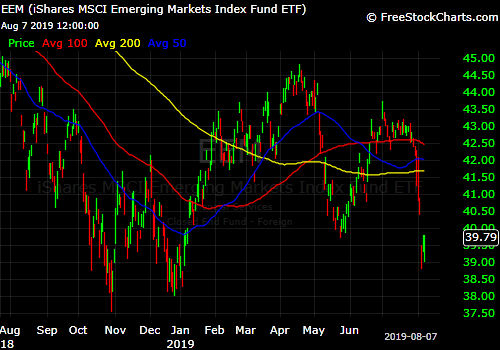
Emerging-Market Stocks Correct Sharply as Trade Battle Flares Investors are fleeing emerging-market stocks and currencies, fearful that an escalating trade war between the U.S. and China will weigh on global growth.
(…) The sudden flight from the boom-and-bust asset class illustrates how drastically investor views shifted as the conflict between Washington and Beijing intensified in recent days. Many now believe the trade battle will likely weigh on global growth for the long term, undercutting the case for owning assets of emerging-market countries, particularly those with deep economic and trade links to China. (…)
 Rosy Bond Ratings, a Financial Crisis Driver, Are Back
(…) In the hottest parts of the booming bond market, S&P and its competitors are giving increasingly optimistic ratings as they fight for market share. All six main ratings firms have since 2012 changed some criteria for judging the riskiness of bonds in ways that were followed by jumps in market share, at least temporarily, a Wall Street Journal examination found. These firms compete with one another to rate the debt of borrowers, who pay for the ratings and have an incentive to pick rosier ones. (…)
The Journal’s analysis suggests a key regulatory remedy to improve rating quality—promoting competition—has backfired. The challengers tended to rate bonds higher than the major firms. Across most structured-finance segments, DBRS, Kroll and Morningstar were more likely to give higher grades than Moody’s, S&P and Fitch on the same bonds. Sometimes one firm called a security junk and another gave a triple-A rating deeming it supersafe. (…)
1 thought on “THE DAILY EDGE: 8 AUGUST 2019”
About 6 months ago central banks were freaking out about exploding inflation and now we have them all freaking out about ZIRP. With so much market manipulation by trump, can’t help but think his main objective is to Make trump wealthy (again); too bad the SEC, DOJ and IRS and so willing to look away!
==> International Monetary Fund director Olivier Blanchard has recently said that higher debt levels might not cost us as much as we thought. And the Federal Reserve has admitted that the trade-off between lower unemployment and higher inflation is so small right now that it can afford to raise rates at a much more measured pace than it had assumed.
https://www.washingtonpost.com/business/2019/01/25/everything-you-need-know-about-theory-that-deficits-dont-matter/?noredirect=on
Comments are closed.