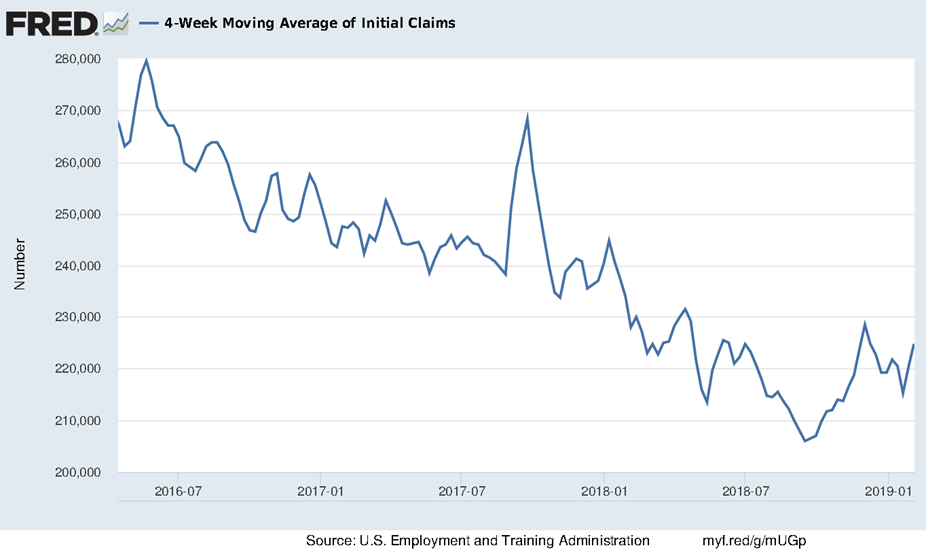
U.S. Jobless Claims Declined Last Week The number of Americans filing applications for new unemployment benefits fell sharply last week but remained higher than before the partial government shutdown that ended Jan. 25.
(…) The four-week moving average of claims, a steadier measure, rose by 4,500 last week to 224,750, matching the highest level since the week of Dec. 8. (…)
Fed’s Bullard Says No Need to Raise Rates Again St. Louis central bank official sees low inflation risk
U.S. Consumer Credit Usage Eases
Consumer credit outstanding increased $16.54 billion (4.9% y/y) to $4.010 trillion during December following a $22.40 billion November rise, revised from $22.16 billion. During the past ten years, there has been a 51% correlation between the y/y gain in consumer credit and y/y growth in personal consumption expenditures.
Nonrevolving credit usage increased $14.83 billion (5.6% y/y) during December. Revolving consumer credit balances increased a lessened $1.74 billion (2.8% y/y) in December.
During Q4’18, student loan debt increased 5.3% y/y, down from a peak 14.7% y/y rise in 2008. Motor vehicle purchase borrowing rose a steady 3.7% y/y. (…)

Global economy loses further momentum at start of 2019
(…) Manufacturing led the slowdown, with factory output rising at the slowest pace in 31 months and slipping closer to stagnation amid an increased rate of decline in worldwide export volumes. However, the service sector likewise reported a weaker rate of expansion, showing the smallest gain since September 2016 as the slowdown broadened out and uncertainty spiked higher.
Other indicators added to the gloomier picture. New orders expanded at the slowest rate since July 2016 and a second successive marginal decline in backlogs of work hinted at the development of spare capacity. (…)


The Global PMI suggests global growth is slipping toward 2.0%. Unlike 2012 and 2016, new business is slipping fast…Goods inflation seems dead for a while. Deflation?

(…) Adding to growing concerns about the strength of the global economy this year, the European Commission slashed its growth forecasts for Germany and Italy, with the latter expected to come close to stagnation. The Bank of England sounded a similar warning on the global economy, saying it expected to see a “sharper and more persistent” slowdown. (…)
The EU forecasts gross domestic product in the 19-member eurozone will grow by 1.3% in 2019 instead of the 1.9% forecast in November. The economy is expected to expand by 1.6% next year, down from 1.7% previously expected. (…)


Pressure Grows on U.S., China to Forge Trade Deal As a deadline approaches for a trade deal, American business figures from Stephen Schwarzman to Hank Paulson are pushing for compromise.
(…) Mr. Trump appeared to reject the Chinese overture, saying Thursday he wouldn’t meet with Mr. Xi before the March 1 deadline. The next time the two men are scheduled to meet is at the late June Group of 20 summit in Japan. (…)
Among those pushing for a deal is Blackstone Group Chief Executive Stephen Schwarzman, who has been phoning Mr. Trump and his senior advisers to warn that the failure to strike a deal will undermine the economy and roil markets, which are anticipating an end to U.S.-China economic hostilities.
Uncertainty about China is weighing on business investment and consumer confidence, Mr. Schwarzman and others are arguing, people familiar with the conversations say.
At the same time, Mr. Schwarzman and other business leaders, including former Treasury Secretary Hank Paulson, are urging senior Chinese officials to make enough concessions to U.S. negotiators to allow Mr. Trump to claim a victory. That includes agreeing to a way the U.S. can enforce the deal should China fall short of its commitments. (…)
Even so, some of Mr. Trump’s outside advisers remain convinced the two sides will reach a deal, even if it is a limited pact that involves mainly purchases and pledges China has already made to gradually open the auto, financial services and other markets.
The two sides could then agree to negotiate further over tougher issues, including Chinese subsidies for domestic companies and revamping Chinese state-owned enterprise so they act more like private companies. (…)
Given the wide gaps in negotiating positions and the pressure on Mr. Trump to make a deal, some trade experts figure he will settle for a partial agreement by March 1 and continue negotiations. (…)
Reuter’s Exclusive: U.S. considers withdrawal of zero tariffs for India
India could lose a vital U.S. trade concession, under which it enjoys zero tariffs on $5.6 billion of exports to the United States, amid a widening dispute over its trade and investment policies, people with close knowledge of the matter said.
A move to withdraw the Generalised System of Preferences (GSP) from India, the world’s largest beneficiary of a scheme that has been in force since the 1970s, would be the strongest punitive action against India since President Donald Trump took office in 2017 vowing to reduce the U.S. deficit with large economies. (…)
The trigger for the latest downturn in trade ties was India’s new rules on e-commerce that restrict the way Amazon.com Inc and Walmart-backed Flipkart do business in a rapidly growing online market set to touch $200 billion by 2027.
That, coming on top of a drive to force global card payments companies such as Mastercard and Visa to move their data to India and the imposition of higher tariffs on electronic products and smartphones, left a broader trade package the two sides were working on through last year in tatters.
The GSP was tied to the trade package and since that deal had slipped further away, the United States was considering withdrawing or scaling back the preferential arrangement, people familiar with the matter said. (…)
1 thought on “THE DAILY EDGE: 8 FEBRUARY 2019”
Low inflation can result in lower productivity and lower employment and thus lower GDP.
==> “Accordingly, the U.S. will likely need faster productivity growth in order to maintain current real GDP growth rates,” he said. “This is a possibility if U.S. investment improves and technological diffusion begins to improve business processes at a faster pace.”
The U.S. labor force growth rate remains close to the 0.5 percent average since 2008, Bullard noted. Meanwhile, he said that the U.S. labor productivity growth rate does not appear at this point to be meaningfully different from the Kahn-Rich low-state value of 1.3 percent.1 “Adding these together suggests a potential growth rate for the U.S. of 1.8 percent, about the same as many private-sector forecasts,” he explained.
https://www.stlouisfed.org/news-releases/2018/10/08/bullard-addresses-us-growth-surprise
Bonus material: ” In fact, it may be more useful to consider the interplay
between the stock market and trend productivity in
the reverse direction. In other words, tracking the trend in
productivity growth may illuminate trends in asset values.
Chart 8 shows how long-term fluctuations in stock market
values (as measured by the S&P 500, adjusted for inflation,
and normalized by hours of work) appear to move in line
with the level of trend productivity estimated from our
original four-variable model. As we have seen, the model
identifies changes in the growth regimes of productivity rela-
tively quickly and therefore could be informative about
future movements in stock prices. Such a result would accord
with the findings of Ludvigson and Lettau (2001), who deter-
mine that consumption expenditure, because it responds
only to “permanent” changes in wealth, predicts movements
in stock prices.
“
Comments are closed.