Trump’s China Brinksmanship The incentives for a deal are overwhelming on both sides.
Yesterday’s WSJ editorial:
(…) Mr. Trump and Chinese President Xi Jinping both want a deal but neither wants to be seen as conceding too much. Mr. Trump needs a deal to remove the trade uncertainty that dozens of CEOs say has slowed business investment. The President’s Sunday claim on Twitter that his tariffs are one reason for the strong U.S. economy is the opposite of reality. The economy is growing despite the tariffs, and U.S. manufacturing jobs have declined this year in part because of China’s slowdown.
Mr. Trump needs a strong economy as he seeks re-election, and a good China deal would double as a foreign-policy success. With change in North Korea and Venezuela looking doubtful, a China trade agreement may be his only foreign breakthrough. It would also fulfill a major 2016 campaign promise.
Mr. Xi arguably needs a deal even more than Mr. Trump. U.S. tariffs have hurt Chinese exports but China also suffers from a domestic debt overhang and misallocation of capital. Liu He, Mr. Xi’s chief economics adviser, understands that China needs more economic liberalization. A trade deal can help rebut nationalists in Beijing who want to maintain the mercantilist status quo.
A collapse of the talks risks a sharper Chinese economic decline and even political instability. Mr. Xi has sold his presidency on a return to Chinese greatness, but the trade brawl is already causing some global businesses to move production from China to other countries. Mr. Xi may want to dominate the world but meantime he needs an economy that provides jobs for millions of new workers each year.
The rub of the talks is that Mr. Xi has to concede more than Mr. Trump does—without being embarrassed in the process. China already has largely free access to the U.S. market and rule of law. China’s main demand is that Mr. Trump lift his tariffs, which is reasonable if China agrees to cease its multiple trade violations. This includes protections for IP, a reduction in tariff rates toward U.S. levels, a reduction in subsidies for state-owned companies, more liberal rules for joint ventures, and an end to cyber theft.
The U.S. also wants enforcement provisions written into the agreement in case China cheats, as it often has before. This includes the right to impose tariffs without a compensating right of China to retaliate. This also seems to be one of the main sticking points.
With an eye on his re-election, Mr. Trump wants a deal that is strong enough to blunt the inevitable criticism from Democrats that he didn’t deliver enough. This would take chutzpah since Democrats have been attacking Mr. Trump’s tariffs. But Democrats like Chuck Schumer and Bernie Sanders are sore that Mr. Trump outflanked them as protectionists, and they’ll attack any deal he strikes. Mr. Trump should win that argument as long as the deal’s details are credible to trade experts and American businesses.
(…) We have entered the storm before the calm if both sides can see through past the threats to their mutual trading self-interest.
The Chinese shouldn’t underestimate how much U.S. opinion has hardened toward their practices across the ideological spectrum. A deal with Mr. Trump may be the best chance the Chinese have to avoid a protectionist eruption against them in Congress.
As for Mr. Trump, repealing his tariffs in return for major Chinese policy changes is well worth the trade. He’ll have won concessions without giving up anything other than the tariffs he said he imposed only as leverage. The alternative could be ugly. China will suffer from an all-out trade war, but so will the U.S. and the Trump Presidency.
(…) “Now we have this whole kind of little bump in the road,” said Dimon. “Sometimes his tweets don’t pan out to be as bad. I don’t think they’ll get the deal done by Friday.” (…)
Dimon said Wednesday on the sidelines of JPMorgan’s annual China summit in Beijing that while he still believes there’ll be an agreement, the odds of “something bad happening” have doubled. He added that he’d rather see no deal than a bad deal.
“It may take a little bit more time, but I think we should do a proper trade deal,” he said. (…)
PMI signals further near-stalling of global manufacturing at start of second quarter
Worldwide PMI surveys indicated that manufacturing once again broadly stagnated in April, with growth of business activity running at its lowest since mid-2016. New order inflows continued at one of the slowest rates since 2012 amid a further decline in worldwide exports.
Weak demand meanwhile pushed price pressures down to the lowest for two and a half years. (…)
Looking into the detail at the sub-indices, global factory output rose only fractionally for a second successive month, registering the second-weakest expansion since June 2016. New order inflows likewise barely rose, having now failed to record any material growth since last November. The flat order book picture is the worst since 2012.
The order book trend has been subdued in particular by weakened global trade flows. New export orders fell in April for the eighth successive month, registering a similar rate of decline to that seen in the prior two months. Although only modest, the rate of decline contrasts markedly with surging worldwide export growth seen at the start of last year.

The lack of new sales meant producers ate into previously-placed orders to maintain production levels. Backlogs of orders fell for a fourth successive month, with the past two months registering the steepest back-to-back monthly falls since the end of 2012.
Falling backlogs tend to be indicative of excess capacity, and often lead to lower job creation. Employment growth consequently fell in April to the lowest since September 2016, with headcounts rising only marginally during the month.
Expectations of future output meanwhile dipped lower, dropping closer to the near seven-year low recorded in February and hinting that the manufacturing soft patch will persist in coming months. (…)


But China’s Services sector offsets weak manufacturing:
The Caixin PMI surveys showed the Chinese economy retaining solid business activity growth at the start of the second quarter, supported by another strong expansion in the service sector. Growth in the coming months is likely to be sustained at this steady pace according to forward-looking indicators, in part as policy stimulus continues to work its way through the economy. (…) (Markit)

Job Openings Outnumber Americans Seeking Work for 13th Straight Month
There were 7.49 million unfilled jobs on the last business day of March, up by 346,000 from February, the Labor Department said Tuesday. Openings increased in transportation, construction and real estate.
Jobs remain plentiful compared with the number of Americans who are unemployed, with 1.28 million more available jobs than unemployed people. Further, the rate at which workers quit their jobs held steady at 2.3% in March for the 10th straight month. (…)
The skill shortage is huge and truly impeding the labor market. New hires have stalled in the last year.
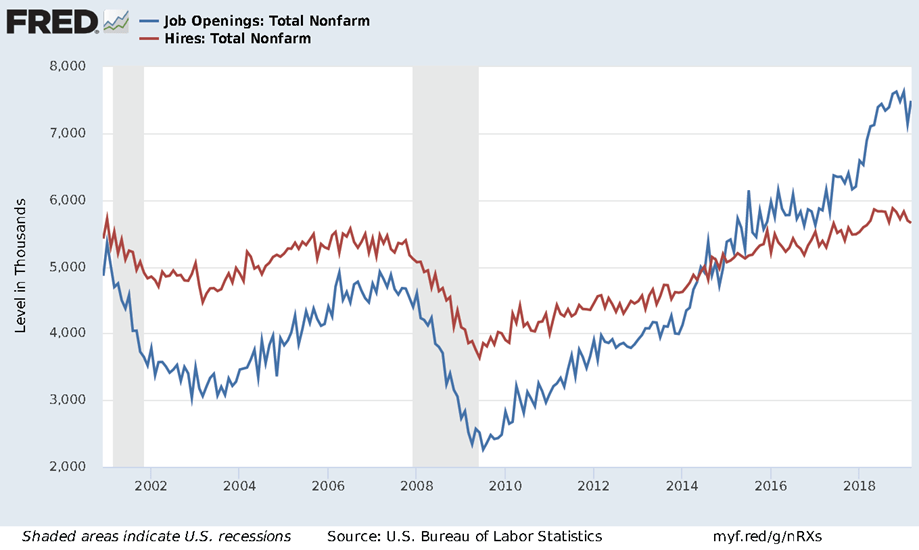
YoY:
- Job openings vs. the number of unemployed Americans: (The Daily Shot)

U.S. Consumer Credit Usage Weakens
Consumer credit outstanding increased $10.27 billion (5.0% y/y) during March, less than the $15.47 billion February addition, revised from $15.18 billion. It was the smallest rise in nine months and lessened three-month growth to 4.4% (AR), down from 5.9% during October. (…) Nonrevolving credit usage increased $12.45 billion (5.6% y/y) during March and by 5.4% (AR) during the last three months. (…) Revolving consumer credit balances were drawn down by $3.18 billion (+3.5% y/y) in March, the first decline in three months. (…)
During Q1’19, student loan debt increased 4.9% y/y, down significantly from 14.7% y/y growth in 2008. Motor vehicle financing grew a slightly higher 4.0% y/y. (…)

U.S. Student-Loan Program Now Runs a Deficit, CBO Estimates Cost to taxpayers could reach billions of dollars over a decade, according to a recent estimate
(…) The Congressional Budget Office said last week the program will cost taxpayers $31.5 billion over the next decade, once administrative costs are factored in. For years, the agency said the program would return a profit. (…)
The losses represent a fraction of overall government spending, but they are mounting. And they are stirring concern within the Trump administration.
Education Secretary Betsy DeVos “is very concerned about the financial health of the student-loan portfolio and its ultimate cost to taxpayers,” said Elizabeth Hill, a spokeswoman for Mrs. DeVos. “That’s why she said last year the country was facing a student-loan crisis and she has devoted extra resources to ensuring the student-loan portfolio is properly assessed and managed.”
Last week, The Wall Street Journal reported that the Trump administration has retained private consultants to estimate potential losses in the $1.45 trillion student-loan portfolio and is weighing selling all or portions of the debt to private investors, according to administration officials familiar with the matter. (…)
Don’t Trade on China’s Terrible Trade Numbers
(…) Up 14% from a year earlier in March, exports crashed in April, down 2.7% from a year earlier.
But the numbers don’t yet add up to a double-dip slowdown. Several one-off factors made data for the first quarter, particularly March, look better than it really was. (…) A big cut in the value-added tax that took effect April 1 probably also caused exporters to rush shipments to retain a higher export-tax rebate, siphoning off some exports from April. (…)
China Defaults Hit Record in 2018. 2019 Pace Is Triple That
Companies defaulted on 39.2 billion yuan ($5.8 billion) of domestic bonds in the first four months of the year, some 3.4 times the total for the same period of 2018, according to data compiled by Bloomberg. The pace is also more than triple that of 2016, when defaults were more concentrated in the first half of the year, unlike 2018. The trend is clear: unless something changes, 2019 will be the new high.
China continues to press banks to extend credit to the private sector, and small and medium-sized companies especially. The latest move came Monday, when the central bank loosened some reserve-requirement rules for lenders. (…)
The bad news is that defaults don’t tell the full story of China’s credit strains. As noted in some of the entries above, borrowers have avoided a strict definition of default by cobbling together payments on bonds within their grace periods. And some issuers have had help from officials. Such practices speak to a greater degree of pain than defaults alone reveal. (…)

Jamie Dimon:
“China can do something that the rest of us can’t do: They can manage industrial policy, fiscal policy, monetary policy in a coordinated way. Which is why we think they can accomplish 6.5 percent growth.”
“They probably have some significant non-performing loan problems at banks but they can handle that.”
EARNINGS WATCH
We now have 414 reports in and the 75% beat has brought the surprise factor to +6.2% and the blended growth rate to 1.2%. Importantly, the ex-Energy growth rate is now +2.5%, from –1.0% on March 29. Also importantly, the main drag is from Comm. Services, Materials and Energy which together account for 15% of the companies and of the earnings. The other 8 sectors show an average 4.4% earnings gain in Q1 and the 5 growers (60% of the companies) are up 7.6%.
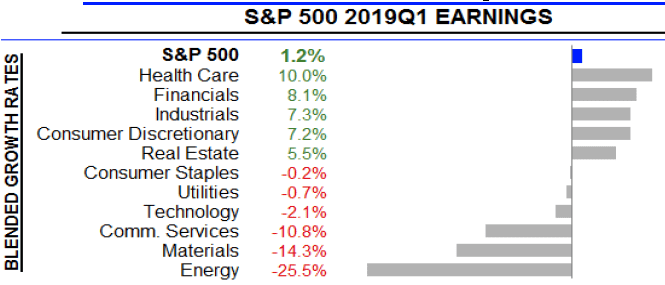
Pre-announcements were better yesterday with 6 positive and 7 negative:

Trailing EPS are $163.65
 THE RULE OF 20 STRATEGY
Yesterday, the Rule of 20 P/E fell below 19.5 when the S&P 500 Index touched 2863 before the close at 2868 (19.52). This triggered an increase in the Rule of 20 Strategy equity allocation from 80% to 90%.
TRULY FASCINATING
You may be long or short Tesla, revere or hate Elon Musk but you should find time to watch this video of Monday’s Tesla Autonomy Day.

Tesla Autonomy Day 2019 – Full Self-Driving Autopilot – Complete Investor Conference Event