US Wage Growth Slows Across the Board, Indeed Index Shows
US wage growth is on track to fall back to pre-pandemic levels by the second half of next year, according to jobs platform Indeed, which built a new index based on salaries for posts offered via its website.
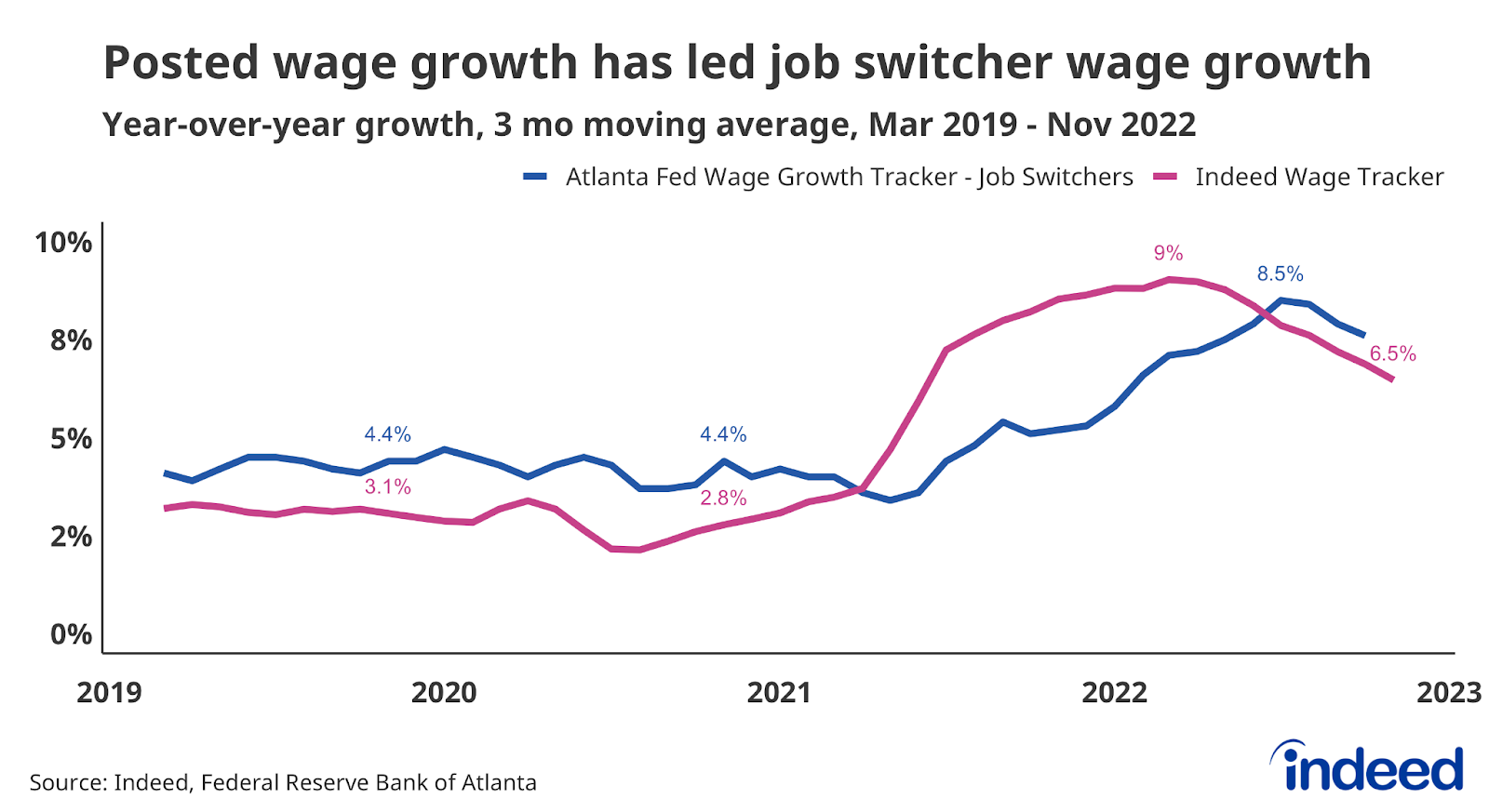
Wages by that measure were up 6.5% in November from a year ago, after peaking at around 9% in March this year, the gauge shows. The slowdown is broad-based, with more than four in five categories of job seeing lower rates of pay growth than they were six months earlier.
“On its current trajectory, posted wage growth would return to its 3-4% pre-pandemic pace by the second half of 2023,” the researchers wrote.
The Indeed tracker focuses on wages and salaries published in job postings rather than money actually paid to workers. That may make it a leading indicator of broader trends in wage growth, Indeed says. (…)
Indeed does not discuss the occupational mix in its index nor if and how it adjusts for compositional changes. It does, however, compare its findings with the Atlanta Fed Wage Tracker which does adjust for compositional changes:
The Atlanta Federal Reserve produces its own Wage Growth Tracker data series measuring pay trends for workers who have switched jobs. The Indeed Wage Tracker seems to have led the Atlanta Fed job switcher series by about three months in capturing pay trends over the course of the pandemic. The Indeed Wage Tracker’s lead is due to lags in the Atlanta series that stem from the length of the hiring process and the time needed for data collection. For example, Indeed’s tracker finds posted wage gains peaked in March 2022, while the Atlanta Fed tracker shows wage gains for job switchers tipping over in July.
The Atlanta Fed Wage Tracker was updated yesterday. I have found no media/blogger coverage so far this a.m. on what the Fed considers its most objective wage tracker after the ECI.
Overall wages are up 6.4% in November (3-m m.a.). The “sharp” slowdown observed in September has stalled. Also, wage growth for job switchers turned back up to 8.1% and is now substantially above Indeed’s 6.5%.
Job stayers also saw an uptick to 5.5%, above April’s 5.3%, putting in doubt what appeared to be a cooling trend from June’s 6.1%.

The last time there was such a gap between switchers and stayers (1999-2001), stayers’ wage growth rate accelerated to peak at 5.2% in April 2001. The recession officially started in March 2001.
In fact, the only periods when wage growth decelerated meaningfully were during and right after recessions. Recall that the Atlanta Fed Wage Tracker is a 3-m m.a.. Here’s the BLS’ rendition of monthly wage trends:

Next week’s FOMC will be very interesting, particularly if the November CPI number (next Tuesday) remains around 0.3% like October’s (+0.27%). Hawks vs Doves! Mr. Powell has clearly painted himself black, warning that “I control the message, that’s my job”.
Indeed adds an interesting factoid:
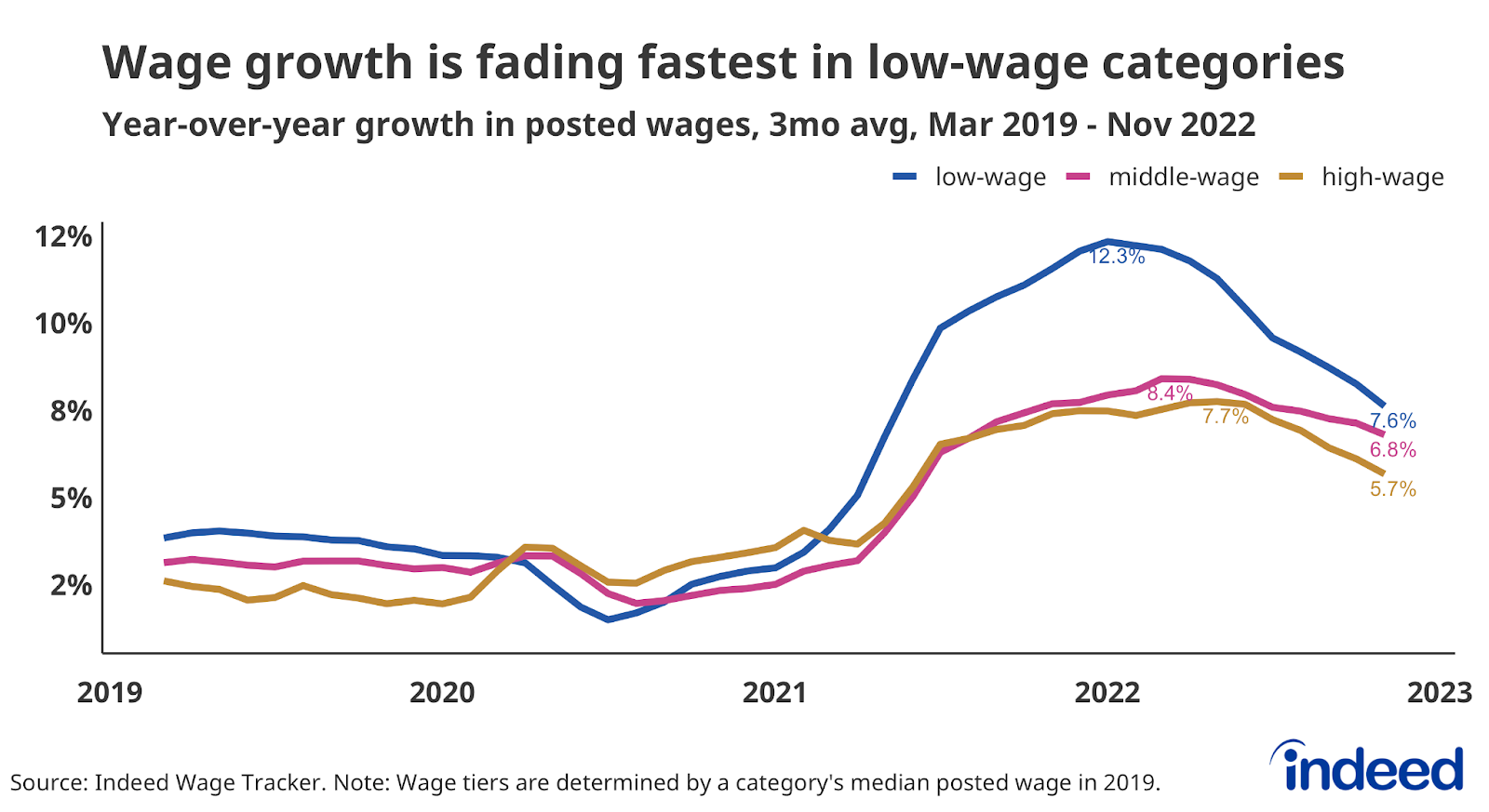
One thing the categories with the fastest posted wage gains have in common is they tended to advertise low wages before the pandemic. When we group jobs into low-, middle-, and high-wage tiers based on advertised pay in 2019, the acceleration and deceleration in posted wage growth during the pandemic have been most dramatic in the low-wage categories, which includes sectors such as Food Preparation & Service and Retail. Posted wage growth for the low-wage group peaked at 12.3% in January and has fallen by almost five percentage points through November.
Timely from Almost Daily Grant’s:
- More than 1,100 staffers within The New York Times Guild walked off the job at midnight today in an ongoing compensation dispute, after union members held dozens of fruitless talks with NYT management since the prior labor agreement expired in March 2021. It’s the Grey Lady’s first such strike since a 1981 work stoppage that spanned fewer than seven hours. “[The Times’] wage proposal still fails to meet the economic moment, lagging far behind both inflation and the average rate of wage gains in the U.S.,” the Guild stated. (…)
- Bloomberg relayed yesterday that Exxon Mobil will dole out 9% salary increases on average next year, with employees who manage to get promoted earning an additional 5%. That package marks the energy giant’s biggest such staff related outlay since 2007, which featured a raging bull market in oil.
- At least 23 states will enact minimum wage increases during 2023 according to the Labor Law Center, including a 10% jump in Florida and 8.6%, 7.6% and 3.3% in hikes in Ohio, New York and California, respectively.
- Staff at the European Central Bank will meet next month to consider walking off the job after the ECB proposed a 4.07% wage increase in January, well below the 10.6% pace of annual Euro Area CPI logged in October.
- Workers at GM-LG Battery Plant in Ohio Vote to Unionize Result a win for UAW, which plans campaigns at slew of U.S. battery factories slated to open in coming years
Employees at the plant voted 710-to-16 in favor of joining the UAW. The Ultium Cells LLC plant, a joint venture between GM and South Korea’s LG Energy Solution Ltd., 373220 -3.01%decrease; red down pointing triangle began operations in late August and employs about 900 people.
For the UAW, securing the right to represent the Ohio factory’s workforce, which is expected to grow to 1,300 people, positions the union to expand its membership further as auto makers prepare to open more than a dozen U.S. battery plants in coming years, labor analysts say.
Car companies collectively are investing tens of billions of dollars to build cell factories that they plan to jointly own and operate with battery manufacturers, potentially creating more than 20,000 new U.S. jobs, mostly across the South and Midwest. (…)
The auto industry’s race to produce more electric vehicles eventually could lead to a loss of jobs within its existing factory workforce, because EVs require fewer parts and less labor to assemble than cars with internal-combustion engines, analysts say. That threat magnifies the importance of the UAW’s efforts to secure a foothold at the future battery plants, said Marick Masters, a professor of business and labor at Wayne State University in Detroit. (…)
Today, wages at the plant range from $15 to $22 per hour, which is less than the roughly $30 per hour that many UAW members make at factories owned by GM, Ford Motor Co. and Chrysler owner Stellantis NV, the three car makers with UAW-represented factory workforces. (…)
Over the past decade, the UAW has faltered in efforts to organize plants run by foreign auto makers. Workers at a Volkswagen AG plant in Tennessee have twice rejected the union’s efforts to represent blue-collar employees. Similar attempts at Nissan Motor Co. also failed. The union hasn’t mounted significant campaigns at EV makers Tesla Inc. and Rivian Automotive Inc., whose workforces remain nonunion. (…)
- U.K. Braces for Biggest Strikes in Years Nurses, ambulance crews and rail workers among those calling for higher wages as inflation chews into earnings
- Bank of England Says Consumer Inflation Outlook Drifts Higher
U.S. Jobless Claims Rise Slightly in Tight Labor Market Number of people seeking unemployment benefits remains historically low despite layoffs at big companies
(…) Layoffs have been concentrated in the technology and media industries and sectors of the economy sensitive to interest rates such as housing and finance. (…)
News organizations, TV networks and entertainment studios, including Warner Bros. Discovery Inc.’s CNN and Paramount Global’s television-production units, have also announced layoffs.
The layoffs haven’t led to a sharp rise in claims figures. It can take several weeks for affected workers to file an unemployment claim. Others may quickly find a new job in a still tight labor market or forgo making a claim. (…)
Continuing claims, which include people who have already received unemployment benefits for a week or more, climbed by 62,000 to 1.7 million in the week ended Nov. 26, Labor Department data showed Thursday. (…)
Economists have been watching continuing claims more closely in recent weeks as they serve as an indicator of how hard it is for people to find work after losing their job. They’ve also been known to hint at upcoming recessions. Although the gauge has been generally rising for the last two months, it’s still near historic lows.
Continuing claims have now strung together the three largest increases since May 2020. (…)

Many recent layoffs were of administrative employees which often receive a package. They are not counted as unemployed until their package benefits expire.
Meanwhile, this helps, but for how long?
Gas Prices Fall Below Last Year’s Average The U.S. average for regular unleaded gasoline has declined to $3.29 a gallon, down about 35% from its peak of about $5 earlier in the year.
The government’s latest fiscal outlook, unveiled on Wednesday, showed it now expects to run a surplus of 16 billion riyals ($4.3 billion) in 2023, nearly double a previous estimate of 9 billion riyals. The economy is still forecast to expand 3.1%. (…)
The kingdom tends to take a relatively conservative view of crude prices in drawing up its budget and doesn’t divulge its assumptions. Al Rajhi Capital estimates that Saudi Arabia is budgeting for Brent oil at around $78 a barrel next year, roughly where the global crude benchmark was trading on Wednesday.
Costco Sales Growth Cools as Consumers Shift Discretionary Spending The warehouse retailer reports a rise in revenue from membership fees
Comparable sales, those from stores of digital channels operating for at least 12 months, rose 7.1% in the quarter ended Nov. 20. That quarterly figure, which excludes currency fluctuations and gasoline sales, hasn’t fallen below 9% over the past two years. Online sales fell 3.7% from the prior year, Costco said.
(…) “It rains on all of us during these tougher times particularly with bigger ticket discretionary items,” said Mr. Galanti. Sales of food and household goods are strong, he said. (…) More high-income shoppers are coming to Costco for lower prices on a per item basis, said Mr. Galanti on the call. (…)
At Costco inventory rose 10% in the most recent quarter, compared with the same period last year. (…)
Overall for the quarter, Costco’s net income rose to $1.4 billion, or $3.07 a share, compared with $1.3 billion, or $2.98 a share, for the prior year.
Inflation Slowed in China as Lockdowns Spread Inflation in China slowed sharply in November as widespread Covid-19 lockdowns battered spending, emphasizing the economic cost of a stringent strategy the government has now begun to relax.
(…) Consumer prices in China last month were up 1.6% from a year earlier, the National Statistics Bureau said Friday. That was the slowest pace since March, well down from October’s 2.1%, but slightly above the 1.5% expected by economists polled by The Wall Street Journal.
Friday’s data showed November food prices up 3.7% from a year earlier, barely half October’s 7.0% pace. Nonfood prices were up 1.1%, while a gauge of consumer-price inflation that excludes volatile categories such as food and energy prices was up just 0.6% from a year earlier. (…)
Producer prices—those charged by companies at the factory gate—fell for the second straight month, down 1.3% from a year earlier, a reflection of weak spending at home in China as well as fading demand for Chinese exports. (…)
World’s Top Money Managers See Double-Digit Stock Gains in 2023 Bloomberg survey shows optimism for year ahead, but worries about stagflation
(…) 71% of respondents in a Bloomberg News survey expect equities to rise, versus 19% forecasting declines. For those seeing gains, the average response was a 10% return.
The informal survey of 134 fund managers incorporates the views of major investors including BlackRock Inc., Goldman Sachs Asset Management and Amundi SA. (…)
The stock market could be derailed again by stubbornly high inflation or a deep recession, however. Those are the top worries for the upcoming year, cited by 48% and 45% of participants, respectively. Stocks could also reach new lows early in 2023, with many seeing gains skewed to the second half. (…)
Last year, a similar survey predicted that aggressive policy tightening by central banks would be the biggest threat to stocks in 2022. (…)

FYI, the excellent Fiera Capital strategist team (AUM of C$158B) has not changed its views: a deep recession remains a 50% probability (Fed-funds at 6.0% and S&P 500 at 2900). A shallow recession (30%) would see the Fed funds at 5.25% and the S&P 500 at 3900. Stagflation (20%) would see the Fed funds at 4.0% and the S&P at 4400. Under no scenario does headline inflation slip below 5%.
China’s disappearing data stokes fears of hidden Covid wave
Cases tend to decline when testing declines. We’ve seen it in the U.S. before.
