Happy and Healthy New Year
Recent posts:
U.S. Consumer Credit Usage Eases
Consumer Credit Outstanding increased $12.53 billion (4.5% y/y) during November after an $18.96 billion October gain, revised from $18.90 billion.
Nonrevolving credit usage rose $14.94 billion (5.0% y/y) in November, the strongest increase in three months. (…)
Revolving credit usage declined $2.43 billion (+2.9% y/y) in November after a $7.92 billion October rise. Credit provided by banks, which makes up 90% of revolving balances, rose a greatly reduced 2.9% y/y. It was growing at a 7.5% y/y pace during the summer of last year. (…)
During Q3 2019, student loan debt outstanding rose a greatly lessened 5.0% y/y. Motor vehicle loan debt outstanding increased a steady 4.0% y/y.

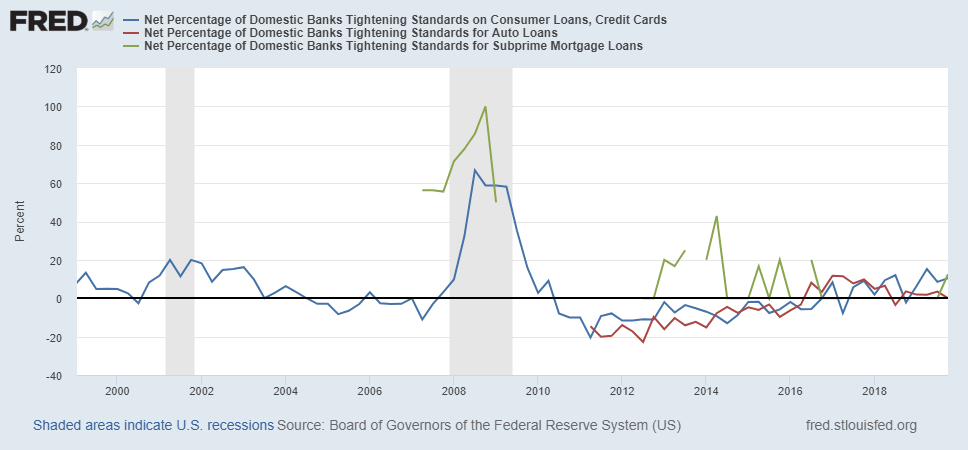
Banks have been tightening consumer credit for 2 years :
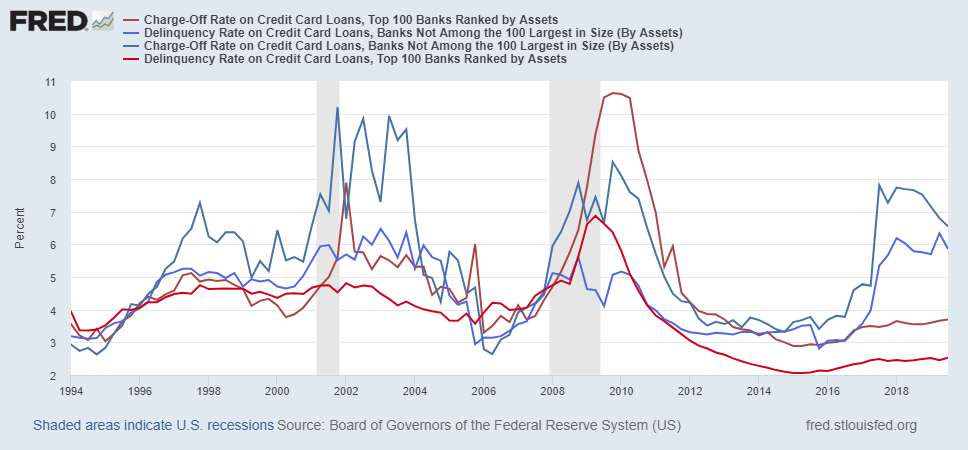
Smaller banks are experiencing credit problems normally seen during and right after recessions:
Upending Bankruptcy ‘Myths,’ Judge Erases $220,000 Student Loan Debt A bankruptcy judge excused a U.S. Navy veteran with a law degree from repaying more than $220,000 in student loan debt, the latest court ruling to lower the barriers to discharging educational debt.
Judge Cecelia G. Morris of the U.S. Bankruptcy Court in Poughkeepsie, N.Y., discharged the law school graduate’s unpaid student loans even though he isn’t disabled or unemployable, saying that satisfying his law school debt in full would impose an undue hardship.
In her ruling, Judge Morris said most bankruptcy professionals and laypeople “believe it impossible to discharge student loans.†She said she would not perpetuate those “myths†and would apply a legal test developed in 1987 “as it was originally intended.â€
The standard, known as the Brunner test, requires borrowers seeking bankruptcy relief from their student debt to show they cannot maintain a minimal standard of living, their circumstances are likely to continue for a significant period and they have made good-faith efforts at repayment. (…)
The difficulty of erasing student loans in bankruptcy has cropped up in Democratic presidential politics. On Tuesday, Democratic presidential candidate Sen. Elizabeth Warren proposed a sweeping overhaul to the consumer bankruptcy system, including ending the rules on obtaining bankruptcy relief from student loans. (…)
The student loan issue is becoming a campaign matter. Given Trump’s views of credit, he could well take the rug off Dems’ feet…
Speaking of debt:
-
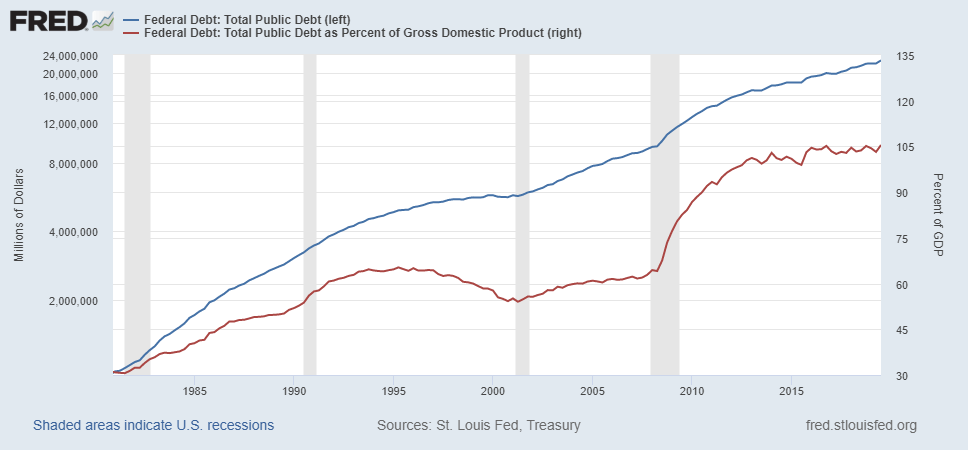
Debt levels in most developing nations hit highest level in 50 years, many in ‘dangerous waters’, World Bank warns
Grant’s Interest Rate Observer reveals that it took 192 years for America to amass the first trillion of government debt and only five months since this past August 1 to tack on the newest trillion to its current $23 trillion.
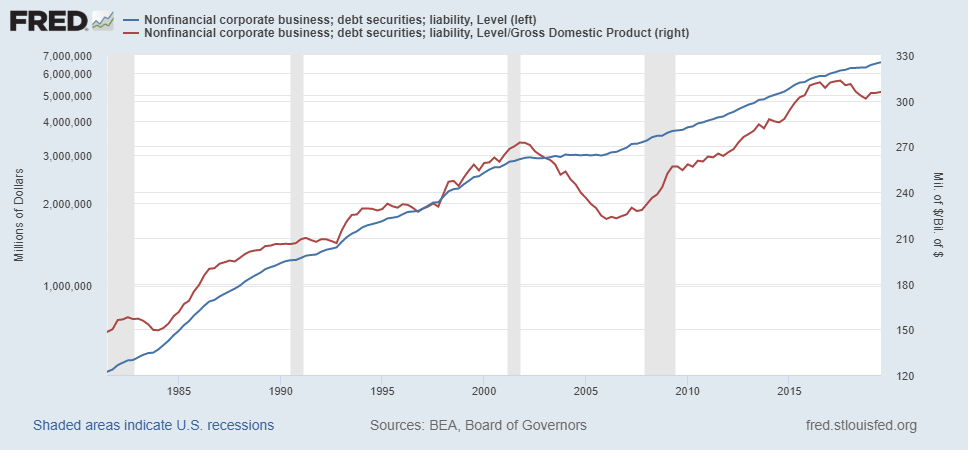
Corporate America is following the lead:
Expectations for a U.S. downturn have jumped since the beginning of 2019, with 97% of CFOs saying that a downturn (either a slowdown or a recession) has already begun or will occur by the end of 2020. Compare that to 88% who said the same about 2020 in the first quarter of last year.
- 43% of CFOs say consumer spending will be strong in 2020, down from the 54% who said the same for 2019. Just 22% expect strong business spending (vs. 32% a year ago).
- CFOs said “trade wars” and “uncertainty” are their 2 top company concerns.

Source: Deloitte (CFO expectations for year-over-year increases.) Chart: Axios Visuals
And yet…

…but…
THE DEAL, PHASE ONE…
China to Send Chief Trade Negotiator to U.S. to Sign Phase-One Deal China’s chief trade negotiator will travel to Washington early next week to sign a phase-one trade deal with the U.S., Beijing said, in its first official confirmation over the signing of a agreement that could help ease bilateral tensions.
(…) In the weeks since Christmas, the two sides have been haggling over the Chinese translation of the text of the agreement, according to people with knowledge of the matter. China’s announcement on Thursday of the signing ceremony suggests that Washington and Beijing have resolved most of the remaining translation issues.
Mr. Liu will lead a 10-member delegation to Washington, the people familiar with the matter said. (…)
President Trump has said he will travel to Beijing at some point to begin negotiations on the second phase of a broader trade pact. Beijing so far hasn’t confirmed such a plan. Instead, Chinese officials have said that any future negotiations would depend on how the phase-one deal is implemented. (…)
Mr. Gao didn’t provide details on China’s commitment to increase its American imports. Instead, he sought to dispel concerns that more U.S. imports would divert China’s purchases from other trading partners.
China will “improve its tariff policy on wheat, corn and other farm products based on the rules of the World Trade Organization,†he said.
That last sentence is key as the WSJ explained on Dec. 31:
Both sides say that any purchases must conform to WTO rules—a requirement that could give China a way to argue that it can’t meet purchase goals. For instance, soybean purchases diverted from Brazil to the U.S. could violate WTO rules.
“The trick is for the agreement to be crafted in a manner that’s ambiguous enough so as not to raise WTO challenges, but is clear enough to satisfy the U.S. that the Chinese government will use the tools available to it to direct farm purchases to the U.S.,†said Mark Wu, a WTO expert at Harvard Law School.
(…) Han Jun, vice minister of agriculture and rural affairs, confirmed to Chinese financial news site Caixin that import quotas for wheat, corn and rice will not increase.
“These are global quotas. We will not adjust them just for one country,†Han told Caixin, according to a CNBC translation of his Chinese-language quotes in an article published Tuesday. (…)
In a lengthy article (The Future of America’s Contest with China) in the January 2020 New Yorker, investigative journalist Evan Osnos wrote :
(…) With a Presidential election a year away, Trump’s trade war was becoming a political liability. The Chinese side was in no rush to resolve it. In September, an American billionaire investor told me that he had advised the President to show progress, if he wanted a strong economy on Election Day. “You have to have a deal done by the end of the year,†the investor said. “If you get a deal in March or April, by then the economy’s already gone.â€
The next month, negotiators abruptly announced what they called “phase one†of a trade deal. The terms, finalized in December, called for both sides to cut tariffs; China also agreed to buy more farm exports, energy, and manufactured goods from the U.S., in return for which Trump would suspend upcoming tariffs. On Twitter, Trump had hailed it as “the greatest and biggest deal ever made for our Great Patriot Farmers in the history of our Country.â€
But the truce did not resolve the core disputes, such as technology transfer, and, outside the White House, it was mostly seen as the end of a wasteful stunt. “Trump was looking for any possible excuse not to put on the tariffs that he had threatened,†[Arthur] Kroeber [the managing director of Gavekal Dragonomics] said, “so he got a promise from the Chinese to buy soybeans and some other stuff, and he packaged this.â€
In China, the deal was greeted warily, with no expectation that it would relieve the standoff. Chinese analysts have described their side’s approach as da da, tan tan—“fight fight, talk talkâ€â€”a pointed expression that Mao used in the nineteen-forties to describe his strategy when Americans pressured him to stop fighting the rival Nationalist Army. Mao always assented to their requests for talks, even as he steadily gained ground on the battlefield. In the end, he won.
Chris Johnson, a former C.I.A. analyst who is now a senior fellow at the Center for Strategic and International Studies, asked a group of Chinese contacts what their government got from Trump’s push for a deal at any price. “Their response was ‘Time,’ †he said. “Reading between the lines, they meant time without new tariffs in the near term, and time to prepare for what they presume is an inevitable larger confrontation.â€
China’s Auto-Sales Slump Continues A total of 20.7 million passenger vehicles were sold in China last year, down 7.4% from 2018
That exceeded the 5.8% drop in 2018.
December was the 18th down month out of the past 19, the group said, with sales off 3.4% from a year earlier.
The slide is likely to continue this month, said Cui Dongshu, the secretary-general of CPCA, with sales down much as 15% from a year earlier. But full-year sales will improve, he predicted, adding that the easing of U.S.-China trade tensions could help consumer confidence recover.
In 2020, the CPCA expects a 1% rebound for the overall auto market. Others are less optimistic—the state-backed China Association of Automobile Manufacturers sees a fall of least 2%. (…)
A measure of inventory levels tracked by the state-backed China Automobile Dealers Association has been above its “warning†level of 50% since January 2018, including 59% last month.
Electric vehicles, which had been a rare bright spot, have been a drag since July, following the expiration of most government subsidies. Sales of new-energy passenger cars, which include electrics, were down for a sixth consecutive month in December, off 15.1%.
For the full year, electric-vehicle sales were still positive, up 5.1% from 2018, partly because of a rush to buy before the subsidies expired. (…)
Trump sees sharp rise in support for economic policies Exclusive FT-Peterson poll shows more than half of US voters believe agenda has helped economy
The FT says that 51% of Americans believe Trump’s policies have either “strongly†or “somewhat†helped the economy, up from 44% in November. Importantly, 43% of independents agreed with 33% were in disagreement.
Trump backs away from military action against Iran US president says Tehran ‘standing down’ and reports no casualties in Iranian strikes on Iraq bases
In Iran, the government says that as many as 80 Americans were killed…â€All is goodâ€. But Iranian militias could strike anywhere, anytime, without Tehran knowing about it.