China Plays Hardball on Trade as Talks Enter New Phase The new hard line taken by China in trade talks came after Beijing interpreted recent statements and actions by President Trump as a sign the U.S. was ready to make concessions.
(…) Adding to the pressure, the U.S. formally filed paperwork Wednesday to raise tariffs on $200 billion of Chinese goods to 25% from the current 10% at 12:01 a.m. Friday. Beijing’s Commerce Ministry responded by threatening to take unspecified countermeasures. At a campaign rally in Florida Wednesday night, Mr. Trump said Chinese leaders “broke the deal” in trade talks with the U.S. (…)
Mr. Liu is now scheduled to lead talks beginning Thursday, a day later than originally planned. He is scheduled to have a one-on-one dinner with U.S. Trade Representative Robert Lighthizer Thursday.
Unlike prior visits, Mr. Liu wasn’t given the title of Mr. Xi’s “special envoy,” suggesting that he doesn’t have the power to make significant compromises. (…)
As talks resume Thursday, one big question mark is whether China will agree to U.S. demands for changes in Chinese law to implement the trade deal. Beijing maintains this would impinge on Chinese sovereignty and take too long to implement, but Beijing had made similar commitments in prior trade deals, including those it signed to join the WTO in 2001. (…)
US upping the ante but China ‘still has trade war cards it can play’
(…) “To increase tariffs would only increase the burden on Chinese customers,” he said. “Instead, China can limit its purchases and stop opening up its market to US firms.” Among the sectors hardest hit under those conditions would be US agriculture, finance, energy and manufacturing, Wang said. (…)
“After so many threats and missed deadlines for concluding negotiations, this ongoing uncertainty is unacceptable to US farmers,” the association’s president Davie Stephens said.
“With depressed prices and unsold stocks forecast to double before the 2019 harvest begins in September, we need the China market reopened to US soybean exports within weeks, not months or longer.” (…)
China could hit back by banning exports of key components, intermediate materials and equipment that US manufacturers depended on for the country’s advanced manufacturing sector.
“The trade war will escalate, and China has many cards at its disposal,” the specialist said. “The US is reliant on components manufactured in China and they will not be able to find substitutes for them. This would mean US consumers would suffer.”
Both sources said China was banking on the resilience of its economy to weather further trade war hits, saying the US’ long economic expansion had peaked and the country would soon start to feel the pinch. (…)
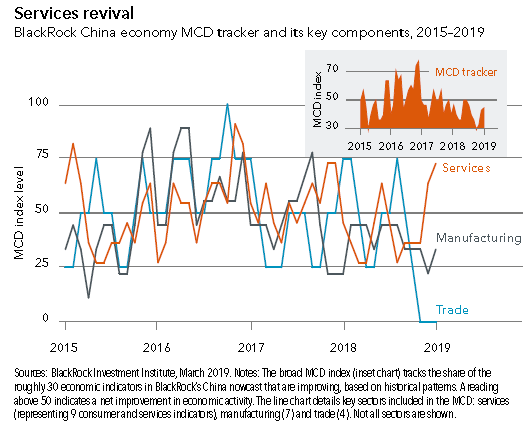
Yesterday, we saw that China’s economy is hanging in thanks to its Services sector. Here’s how BlackRock sees it:
But as The Daily Shot shows, IP has also recovered:

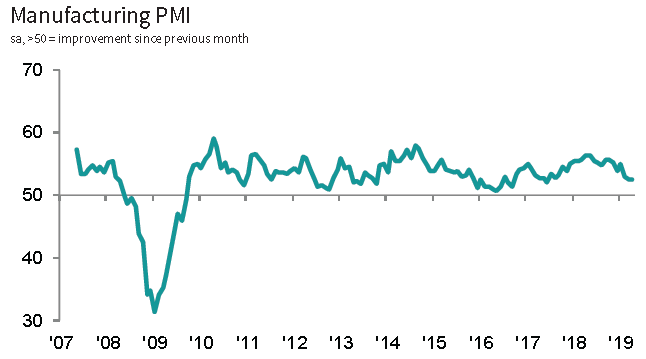
Meanwhile, U.S. manufacturing has lost momentum as Markit illustrates…
…while the ISM new orders index order suggests leaner production ahead (via The Daily Shot)…

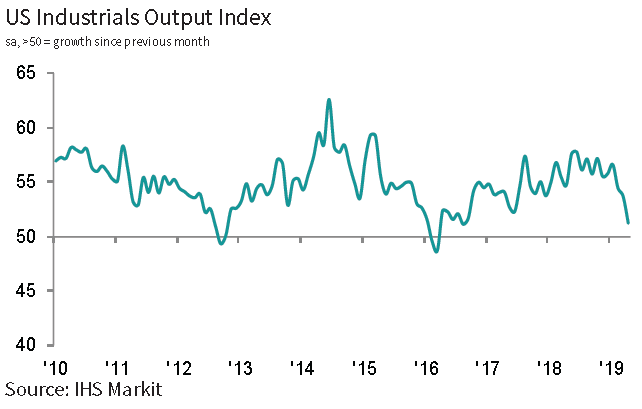
…which Markit says is already happening:
Better not take the economy for granted. Loan demand is weak across the board:

Trump’s Planned China Tariff Hikes Could Cut U.S. Growth in Half
(…) As he dialed up pressure on China over the past year and again in recent days, President Trump has increasingly seized on the idea that his trade wars are boosting U.S. growth and therefore strengthening his hand, according to people familiar with the White House’s internal deliberations, who asked not to be named because of the confidential nature of the talks. (…)
Trump’s threat of a further hike in tariffs effective on Jan. 1 caused companies in the U.S. to advance purchases of goods from China on the target list in the final three months of 2018. This “supply chain padding” helped lead to both a buildup in inventory stockpiles and a narrowing of the trade gap, according to Carl Riccadonna, chief U.S. economist for Bloomberg Economics. The effect was to make “growth appear stronger than meets the eye,” he says, noting that data on final sales, which excludes trade and inventories, had the economy growing at a rate of just 1.4 percent. (…)
Bloomberg’s own economists calculate that a 25 percent tariff on all imports from China would shave 1.5 percentage points off U.S. growth—a cut that would halve the rate seen in the first quarter. (…)
Adam Posen, who leads the pro-trade Peterson Institute for International Economics, says for too long investors, businesses, and even some of Trump’s own advisers have believed that the president might be talked into a change of heart on trade by either wild swings in markets such as those triggered by his most recent tariff salvo or the pain in farm states, most of which he won in 2016. “The upshot of all this is he’s not going to be deterred by the market in the end. He is not going to be deterred by whether this polls well in Iowa,” Posen says. “This is what he genuinely believes—that a mercantilist protectionist trade policy is good for the U.S.”
EARNINGS WATCH
We now have 426 reports in, a 75% beat rate, a +6.2% surprise factor and a 1.2% blended growth rate for Q1 (+2.6% ex-Energy), a forecast that looks increasingly low given that the 426 companies having already reported showed an aggregate +1.9% actual growth rate.
Trailing EPS are now $163.71.
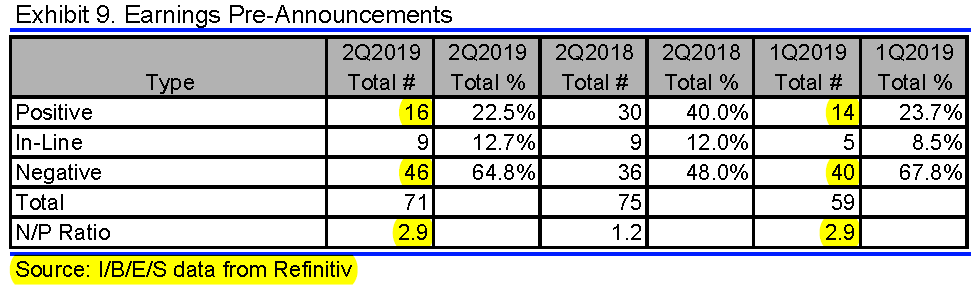
Pre-announcements for Q2 also got better yesterday bringing the N/P ratio to its Q1’19 level:
TECHNICALS WATCH
Equity Trade Signals (From CMG Wealth)
- Ned Davis Research CMG U.S. Large Cap Long/Flat Index: Buy Signal – 100% U.S. Large Cap Equity Exposure
- Long-term Trend (13/34-Week EMA) on the S&P 500 Index: Buy Signal – Bullish for Equities
- Volume Demand (buyers) vs. Volume Supply (sellers): Buy Signal – Bullish for Equities
- S&P 500 Index 200-day Moving Average Trend: Buy Signal – Bullish for Equities
- S&P 500 Index 50-day vs. 200-day Moving Average Cross: Buy Signal – Bullish for Equities
- NASDAQ Index 200-day Moving Average Trend: Buy Signal – Bullish for Equities
- Don’t Fight the Tape or the Fed: Indicator Reading = +1 (Bullish Signal for Equities)
I particularly watch
- 13/34–Week EMA Trend Chart:

- Ned Davis Research computes Volume Demand vs Volume Supply, “a smoothed total volume of declining issues versus a smoothed total volume of advancing issues using a broad market equity index. The performance, reflected in the chart below, is better when Vol Demand is better than Vol Supply. More buyers than sellers. This is a relatively slow-moving but important indicator. The yellow highlights in the next two charts shows the current signal. Currently in a buy signal.”


- But also Lowry’s Research Buying Power vs Selling Pressure indices: This trend needs to stop soon:
