The U.S. Economy Is Accelerating Evidence keeps coming that investment and growth are picking up.
The WSJ Editorial Board:
(…) the Commerce Department on Wednesday made an unusually large upward revision in its economic growth estimate for the first half of the year. Might rising yields on the 10-year Treasury reflect accelerating economic growth?
The Commerce Department raised its GDP growth estimate for the first quarter to 2.5% from 2.1%, as well as for the second to 2.2% from 1.5%. These large revisions reflect newly available data as well as updates to annual benchmarks that include refinements in methodology since 2021.
The upward revisions to real GDP growth stem partly from reduced inflation estimates. But the bigger story is that business investment and consumer spending have been stronger than economists thought.
Business investment was revised up half a percentage point to 9% thanks to higher spending on intellectual property and structures tied to AI. Commerce says data centers drove the increase, while information processing equipment contributed to stronger consumer spending.
Admissions to spectator amusements also buoyed consumer spending during the second quarter. A World Cup dividend? Regardless, higher gasoline prices don’t seem to be restraining consumers. Consumer spending has been growing faster than personal incomes in recent quarters, perhaps in part owing to the wealth effect from a booming stock market. Fidelity recently reported that the number of Americans with more than a $1 million in the company’s 401(k)s surged 19% during the second quarter to a record 769,000.
Americans can thank the AI boom, assisted by the GOP tax bill, for lifting corporate profits and equity prices. Corporate profits in the second quarter rose 20.8% from a year earlier. Even if some company valuations are stretched, increases in stock prices are broader than a couple of years ago when indexes were driven by the so-called Magnificent Seven.
Net exports subtracted 1.1 percentage points from GDP in the calculation, as AI companies imported more chips and equipment for their data center build-out. But this is a positive for U.S. domestic investment and growth. Imports aren’t a sign of economic weakness. (…)
By the way, faster economic growth has buoyed tax revenue, which increased 3% during the first 11 months of this fiscal year. Declines in corporate tax revenue owing to the tax bill were more than offset by income tax revenue, which increased 8% ($189 billion) after accounting for carve-outs for tips, overtime, etc.
The press has been in a panic over the rising yield on the 10-year Treasury, which has crept up 100 basis points this year to 5.29%. The conventional wisdom is that higher energy prices and expectations of more debt issuance are the culprit, but faster growth and competition for capital are contributing. Estimates for third quarter GDP growth have also been rising as September looks strong. (…)
- Growth, Inflation Figures Show Signs of an Economic Pickup Second-quarter GDP got big upward revision and inflation remained firm in August
(…) A key metric of underlying growth trends, real final sales to private domestic purchasers, was also tweaked higher, to 4.6%.
Meanwhile, the inflation metric known as the personal-consumption expenditures price index rose by 3.4% over the past 12 months, the Commerce Department said in a separate report Wednesday, level from a month earlier.
In August alone, price increases accelerated. The overall index rose by 0.3%, and the core version that excludes food and energy prices rose by 0.2%, faster than the July readings.
That acceleration came despite a tweak to the PCE inflation formula that otherwise pulled down annualized inflation readings recorded in recent months. To address mismeasurement concerns, the Bureau of Economic Analysis changed how three price categories are tabulated—legal services, investment services and computer software—and applied the change retroactively. (…)
Upward revisions to the investment category—which includes construction—emphasize how important the build-out of AI infrastructure has been to economic growth. And an increase in estimates of second-quarter consumer spending underscores that with a solid labor market and strong stock returns, household finances have remained in good shape. (…)
Wednesday morning’s data also brought evidence that American shoppers are still in sound financial shape. Consumer spending increased by 0.9%, a fast climb partly driven by more spending at gas stations as gasoline prices rose. Income growth cooled a bit to 0.2%, from 0.3% a month earlier.
- Fed’s Williams Hints Next Rate Increase Can Wait Remarks could reset expectations for central bank’s next move at a meeting in four weeks
A top Federal Reserve official suggested Tuesday that the central bank could wait until December before raising interest rates again, pushing back against market bets on a follow-up increase next month.
The remarks from New York Fed President John Williams carry particular weight because as vice chair of the Fed’s rate-setting committee, he has typically sought to reflect the views of the committee’s center of gravity rather than stake out his own position.
Inflation remains too high, and another rate increase “late this year” might be appropriate, Williams said. But for now, the Fed can likely take time to review additional data before tightening policy further, he said.
“With the policy action we took at our September meeting, there is no need for urgency,” Williams said in a speech in Buffalo, N.Y. (…)
Williams’s relatively precise signals were notable because Warsh has renounced the kind of verbal cues his predecessors used to shape investors’ expectations ahead of policy meetings. That approach carries a risk: If markets come to expect a move officials aren’t prepared to make, the Fed must choose between surprising investors and following through on an increase it might think isn’t necessary. Williams’s comments Tuesday could help the central bank avoid that bind. (…)
Other Fed officials who, like Williams, typically vote with the Fed’s policy consensus, have signaled in recent days that they think rates should rise further, without laying out a particular timeline.
In a speech Tuesday, Fed governor Michael Barr said “further policy adjustments are likely to be needed to ensure inflation comes down to target in a timely fashion,” but didn’t specify his view of the urgency of a further rate increase. Governor Lisa Cook outlined a similar perspective in a speech Monday.
By the time they meet in October, Fed officials will have one more month of labor-market data in hand—the September jobs report, due Friday—and a September inflation update coming in two weeks.
Goldman Sachs: “We are pushing back the second hike in our forecast to December, and we see a strong chance that the FOMC will ultimately conclude that additional rate hikes are unnecessary.”
But Ed Yardeni points out that the 2Y Treasury yield remained 100bps above the federal funds rate today and that Federal funds futures are pricing in three to four 25bps rate hikes over the next 12 months, including roughly two over the next six months.

Ed argues that the inflation genie is not about to find its bottle yet:
The key point is that much of the recent decline in core PCED inflation reflects revised measurement procedures rather than a genuine improvement in underlying inflation.
Indeed, despite the methodological changes, the report’s details point to sticky underlying inflation. Goods PCED inflation rose to 3.6% y/y in August from 3.3% in July, partly reflecting a 4.1% m/m jump in gasoline prices. Tariffs and the AI buildout added further pressure: prices for computers and peripherals surged 3.8% m/m, while toy prices rose 2.0%.
Looking ahead, tariff pass-through and AI-related demand should keep goods inflation elevated, while the renewed rise in oil and refined-product prices in September adds another source of upward pressure.
The supercore inflation rate isolates some of the stickiest and most wage-sensitive parts of the inflation basket. The measure remains well above a pace consistent with the Fed’s 2% target. More importantly, it has been moving higher since October 2025.
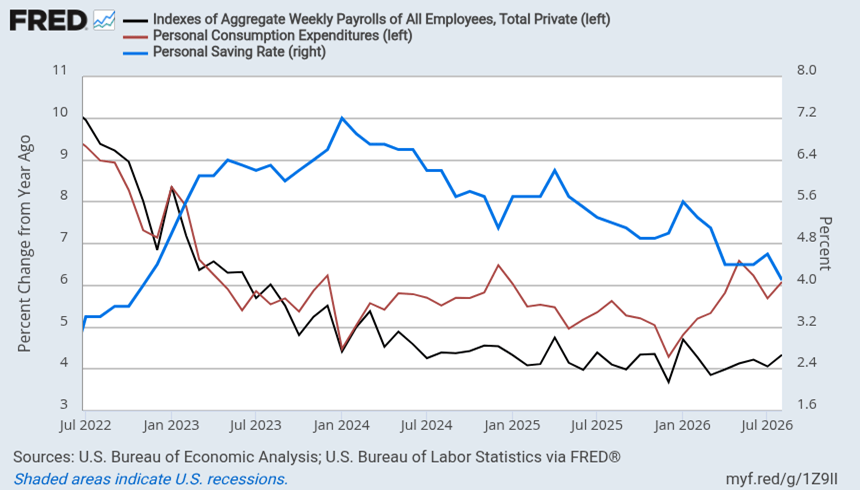
Spending growth accelerated since March 2026, not because income grew faster but because Americans strongly dissaved:
Ed expects this to continue:
The surge in household net worth relative to disposable income is causing consumers, especially Baby Boomers, to reduce their savings rate. August’s saving rate was revised meaningfully higher, but still fell to 4.1%, the lowest since November 2022. We expect it to decline further as more Boomers retire. Their labor income drops to zero when they do so, but their sizable accumulated wealth lets them keep spending.

- The AI wealth effect (Axios)
Americans’ wealth jumped by $12.8 trillion in the second quarter, led by a nearly $11 trillion gain in stock holdings and other financial assets, Axios Markets author Emily Peck writes from new Fed data. That’s the biggest single quarterly increase, in dollar terms, on record.
The AI boom-fueled wealth surge is propelling spending in the U.S. economy. Half of all growth in consumption is being driven by those effects, says Krishna Guha, head of economics at Evercore ISI.
Data: Federal Reserve. (Includes securities held indirectly through mutual funds, defined-contribution pension plans and variable life insurance/annuity products.) Chart: Emily Peck/Axios
AI is the main driver of this reacceleration.
Inflation?
Core PCE rose 0.25% MoM), +3.1% a.r. and 3.0% YoY. The SuperCore PCE (Services ex-shelter) reversed its recent drop on a YoY basis, surging 0.4% MoM to 3.45% YoY.
Some also argue that higher diesel costs will shortly hit consumer inflation.
Diesel prices will not return to normal for more than a year, according to US oil and gas executives surveyed by the Federal Reserve Bank of Dallas. Almost half of those polled expect diesel prices will take more than four quarters to return to 2025 levels, according to the anonymous survey of 100 oil and gas companies. (…)
“Diesel is the mother’s milk of the economy,” said one respondent from an oil and gas support services company. “We are just starting to see the impact on the wider economy.”
Chinese fuel exporters have canceled some oil-product cargoes slated for export in October, as Asia’s top consumer prioritizes domestic supply during an extended period of upheaval in global energy markets.
Shipments including gasoline and diesel have been affected, according to people involved in shipping and purchasing the cargoes, who asked not to be identified as they aren’t authorized to speak publicly. The prompt spread for gasoline and diesel in Asia — the gap between immediately available cargoes and those for purchase next month — stretched higher late Wednesday as traders learned the news, indicating a tighter market.
(…) any interruption to Chinese exports is closely monitored by buyers and traders at a time when the world is grappling with a supply crunch, thanks to disruptions in Russia and the Middle East. (…)
China’s focus has only increased as the Northern Hemisphere heads into winter, with little sign of fuel exports returning to normal in the Persian Gulf or Russia, which has just extended a diesel export ban. (…)
FYI, from Ian Harnett, co-founder and chief investment strategist at Absolute Strategy Research in the FT:
(…) Take a look at the gap between US Treasuries and US markets earnings yield — the earnings per share of companies divided by the share price. While the US 10-year yield is up to more than 5 per cent, the equity market has an earnings yield of only 3.9 per cent, and the dividend yield is back to its 2000 lows at 1.1 per cent.
Even if you include buybacks alongside dividend income, the total equity yield is just 2.6 per cent — again, close to the 2000 lows.
But it is also this divergence in relative valuations where the investment opportunities arise for longer-term investors with patient capital. While bondholders can now get a 5 per cent return if they hold their 10-year Treasuries to maturity, the kind of returns that equity holders might expect over the same 10-year period is close to zero, based on historic precedent as indicated by the cyclically adjusted price-earnings model developed by economist Robert Shiller.
While this still may not be enough of a return premium for some investors, given the excitement surrounding the prospects for AI-related stocks, it does create more optionality for long-run asset allocators to invest in something other than equities.

AI is driving the economy and the stock market, both driving consumer spending but also inflation and bond yields and, perhaps, Fed funds rates. We sure need strong earnings.
But the stock market has also become K shaped as David Rosenberg explains: “The median S&P 500 stock is down more than -15% from the 52-week highs, and yet everyone thinks the stock market has become invincible and impervious to the bond market shock. More than 70% of the S&P 500 is at least -10% below its highs. (…) The KBW Bank Index sagged -1.0% [yesterday] and is down -12.4% from the summertime high.”
Consumer Discretionary, Industrials, Financials, Retail, and Real Estate sub-indices combined are down 8.6% since early August.
MarketWatch concurs:
According to MarketWatch calculations, 80% of S&P 500 companies are at least 10% below their 52-week high — in other words, they’re in a correction — and 39% are at least 20% below.
“So there’s all this rot that’s in the S&P 500, but it’s not in plain sight, [and] you’ve got to wait for the branch to fall off to figure out that the market’s hollow, just like the tree was hollow,” said Gundlach, who is also worried that investors may be facing contagion from a separate set of assets.
“I feel like there’s a direct parallel to all of this in the private markets,” said the investor best known for calling the U.S. housing bust in 2007.
He explained a growing circular investment, in which private-equity firms buy a private-credit unit and then buy an insurer, which in turn buys the loans from the affiliated private-credit company.
Gundlach said those private-equity and private-credit firms keep assuring investors there are no problems, and their quarterly figures often won’t reveal any issues. However, he pointed to one private-credit fund that held assets marked at $100 late last year, then lowered them to between $77 and $78 by the first quarter, meaning the underlying portfolio had dropped in value by nearly 23%. And those funds hold thousands of diversified loans, therefore revealing major, but hidden, losses, he said.
“I think that all these things are creating an awareness that’s building that everything isn’t just fine,” Gundlach said. (…)
He noted that over a dozen prior S&P 500 pullbacks since 2000, the ICE Dollar Index has gained 8% to 10% each time, but after the April correction of 2025 the dollar went down for the first time. “That’s because people realize that we’re in a different regime and so the dollar will not go up in the next recession,” he said. “[I]t will go down.”
Korea Disputes Trump’s Claim It Agreed to Invest in Alaska LNG
South Korea has pushed back on the Trump administration’s announcement that the country would invest $54 billion in a liquefied natural gas project in Alaska, saying it had agreed to do so only if the long-stalled venture proves economically feasible.
“What the Korean government agreed with the US is that the Alaska project will proceed only if it is commercially viable,” Industry Minister Kim Jung-kwan said in a televised briefing on Thursday. Seoul had expressed its regret to US Commerce Secretary Howard Lutnick “that what was reported today went beyond what had been agreed,” he said.
President Donald Trump had earlier said Korea would invest in the Alaska project at a White House event on Wednesday. It was part of a pledge by Seoul to invest $200 billion in American energy projects following last year’s US-South Korea trade deal.
The Alaska LNG venture has struggled for decades to secure the binding long-term contracts and investments needed for it to move forward. The project is massive in scale, requiring the construction of an 800-mile (1,287 kilometer) pipeline across the state. Alaska LNG has, however, signed non-binding sales agreements with companies in countries including South Korea, Japan and Taiwan. (…)
If South Korea does participate in the project, the US has agreed to offer it LNG at favorable prices, Kim said.
Under the broader investment agreement, South Korea has insisted that projects meet a commercial viability test before funds are deployed. The test was a central issue in negotiations over how Seoul’s $350 billion US investment pledge would operate. As well as investing in the American energy sector, Seoul agreed to put $150 billion into US shipbuilding.