MANUFACTURING PMIs
Eurozone: Factory output growth accelerates to four-and-a-half-year high in August
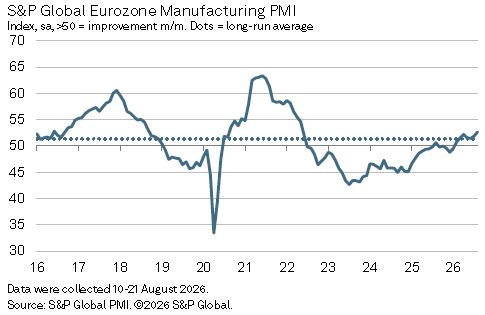
The S&P Global Eurozone Manufacturing PMI increased to 52.7 in August, from 51.9 in July, its highest level since May 2022.
A considerable contribution to this uplift stemmed from the eurozone’s largest economy, Germany, which recorded its best month of manufacturing sector growth in over four years. France also helped lift the overall expansion rate, although this was somewhat offset by a renewed decline in Italy’s goods-producing economy (the first since January). Spain was the only other monitored eurozone country to register a Manufacturing PMI figure in contraction territory, as solid upturns were seen elsewhere.
Manufacturing production growth accelerated across the eurozone for a third successive month in August, marking a sustained uplift in momentum. The rate of expansion was above its survey average and the fastest in four-and-a-half years. Data split by the three main industrial categories revealed that the intermediate goods segment provided the greatest boost to output.
This includes critical industries such as chemicals and metals, as well as electrical equipment and electronic components, suggesting the euro area can also be a beneficiary from the tech supercycle, even if it’s arriving late to the party.
Demand conditions were supportive of growth, as evidenced by a solid rise in the level of incoming new orders. The increase in total sales volumes was the sharpest seen since early-2022. Notably, new export business grew for just the second time in four-and-a-half years. Overseas sales growth was particularly strong in Austria, Germany and the Netherlands.
After slight cutbacks in June and July, eurozone goods producers raised their purchasing activity during the latest survey period. Stocks of purchases continued to fall, however, and at an accelerated rate. August PMI data pointed to ongoing supply-side disruption as average delivery times from vendors lengthened sharply and to a slightly greater extent than in July.
Regarding eurozone manufacturers’ own capacity constraints, the latest survey results showed no such signs as backlogged order volumes were unchanged on the month. Factory employment levels were held broadly steady, which in itself was a relative improvement after more than three years of uninterrupted decline.
The downward path of input price inflation continued in August. Input costs rose at the softest rate in six months, although the rate of increase was still well above that seen before the outbreak of the Middle East war. This also held true for output charges.
That said, the pace of disinflation is starting to level off and the PMI’s price metrics remain well above their pre-war levels, which may just embolden a cautious stance by eurozone monetary policymakers.
Finally, business confidence strengthened again in August, signalling a fourth successive monthly rise in eurozone manufacturers’ growth expectations for the coming 12 months. In fact, the overall level of optimism was above its long-term average.

China: Business conditions in manufacturing improve atstronger rate in August
The headline seasonally adjusted RatingDog China General Manufacturing Purchasing Managers’ Index™ (PMI) posted above the 50.0 no-change mark for the ninth month running in August, indicating an improvement in manufacturing conditions. The current upturn is the longest in five years. The PMI rose to a two-month high of 51.5 from July’s 50.9, and had positive contributions from four components, the exception being employment which was neutral.
New orders placed with Chinese manufacturers rose for the fifteenth consecutive month in August, the longest period of growth since 2018. Firms linked rising orders to improved market conditions, stronger client demand, new clients, export growth and business development. The rate of expansion accelerated since July and was greater than the long-run series average, aided by the fastest rise in new export business in six months.
Stronger pipelines of new work led to a faster increase in Chinese manufacturing production in August. Output has risen for nine consecutive months, and the latest expansion was the strongest since May.
Stronger growth of new orders led to a further increase in the level of outstanding work. Backlogs rose for the seventh month running, and at the fastest rate since March. Meanwhile, stronger output growth led to inventories of finished goods expanding the most since September 2025.
Although new orders and backlogs rose in August, manufacturers held employment steady following increases in June and July. Consumer goods manufacturers continued to raise their staffing levels, but this was offset by lower workforces in the intermediate goods and investment goods sectors.
Firmer demand conditions led Chinese manufacturers to order more inputs in August, having previously cut purchasing in July. This contributed to a build-up of input stocks of purchases for the ninth month running, the longest sequence since 2006-07. Despite rising demand for inputs, suppliers’ delivery times were little-changed compared with July.
August survey data signalled a rise in cost pressures at manufacturers. The rate of input price inflation accelerated for the first time since April, but remained relatively modest. Higher costs reflected rising raw material prices, especially metals and oil, supplier adjustments, market volatility and stronger demand.
Although input prices rose further in August, Chinese manufacturers reduced their output prices for the first time in 2026 so far. This was linked to strong market competition and promotions, though the overall reduction was only marginal.
The 12-month outlook for production in the Chinese manufacturing sector remained positive in August. Optimistic forecasts were linked to rising market and client demand, new product launches, business development, improved macroeconomic conditions, expanded production capacity, technical upgrades and new client acquisitions. That said, the overall degree of confidence was the softest since January.


Japan: New business increases at fastest rate since January 2018
The headline S&P Global Japan Manufacturing Purchasing Managers’ Index™ (PMI) climbed from 54.5 in July to 54.9 in August, signalling an improvement in the health of the sector for the eighth month in a row. Furthermore, the rate of increase was the strongest recorded since April and the second-steepest since January 2022.
Stronger growth in new orders was the principal driver of the improvement in the headline reading. Notably, the amount of new business received by Japanese manufacturing firms increased at the sharpest rate in over eight-and-a-half years.
Panellists reported that sales had been supported by firmer demand conditions, new client enquiries and robust sales for products such as semiconductors and AI-related products.
New export business likewise rose at an accelerated pace that was the quickest since the start of 2018, with firms noting greater demand across North America, Southeast Asia and China in particular.
Goods producers in Japan responded to higher intakes of new work by raising their production levels again in August. Furthermore, the rate of expansion eased only slightly since July and was the second-quickest since February 2014.
Employment across Japan’s manufacturing industry also remained on an upward trajectory as firms looked to expand their operating capacity. Furthermore, the rate of job creation was the fastest seen since February 2018 and solid. Although payrolls rose further, outstanding business continued to increase midway through the third quarter. Notably, the rate of accumulation held close to July’s multi-year record.
Higher output requirements led to a sustained increase in purchasing activity, which rose to the greatest extent since April 2022. However, supply chains remained under notable pressure, partly due to disruption stemming from the war in the Middle East, but also product shortages. As a result, the time taken for inputs to be delivered continued to lengthen at one of the fastest rates seen over the past four years.
Longer lead times limited the rate of inventory growth, with stocks of purchased items rising at a slower and only marginal pace. Meanwhile, stocks of finished goods continued to fall slightly.
The rate of input price inflation across Japan’s manufacturing industry remained historically sharp in August. That said, the latest upturn in costs was the slowest seen since March. Operating expenses increased due to a combination of higher raw material and oil prices, in part driven by the conflict in the Middle East, as well as a weak yen exchange rate, according to panellists. As a result, factories continued to raise their selling prices sharply.
Japanese manufacturing firms were generally optimistic that output will continue to increase over the next year in August. Moreover, the degree of positive sentiment was the highest recorded in six months and above the historical trend. Companies often projected further increases in customer demand, particularly for semiconductors and AI-related technology.

We get the North American PMIs later today but it is clear that
- the AI boom is global
- supply conditions are worsening with rising risks of shortages in critical inputs
- costs continue to be driven by disruptions linked to wars and supplier bottlenecks around the Strait of Hormuz
- output prices keep rising strongly, except in China in spite of strong input inflation
Import prices have sharply accelerated in 2026. IT product prices are obviously exploding but rising commodity prices are also increasingly impacting goods inflation.


(The Daily Shot)
Trump says US will refill Strategic Petroleum Reserve using Venezuelan oil
Trump said in a social media post that the “topping out” process will begin shortly, describing the Venezuelan oil as a “Gift from Venezuela to the People of the United States.”
Well, don’t hold your breadth on this other Trumpism.
Utilizing Venezuelan crude to replenish the depleted SPR faces major physical, logistical, and geopolitical barriers.
- One, the SPR is designed to store light sweet and medium sour crudes. Venezuelan oil is extra-heavy crude (p.5-12 API) and bitumen (like oil sands). This thick, tar-like oil fails the minimum API gravity requirements for the SPR.
- Two, Venezuelan crude is highly “sour,” containing high levels of sulfur (4-5%) and heavy metals. Injecting it directly into underground salt caverns can damage the infrastructure and degrade long-term storage viability.
The WaPo:
Even if the opaque, controversial agreement announced Friday night triggers a surge of investment in oil production, industry insiders and analysts say substantial amounts of new crude would not flow out of Venezuela for years.
That much was evident in the shrug with which oil traders responded to the deal. Prices didn’t come down at all over the weekend. They went up. (…)
“Everyone cheering the Venezuela deal thinks a flood of cheap oil is about to hit and pull gas prices down. It isn’t,” Tracy Shuchart, senior economist at futures trading platform NinjaTrader, posted on X.
“The barrels that could actually move a U.S. pump price are 5 to 15 years out,” she wrote.

Meanwhile, from National Bank Financial:


“Perhaps more important is the trend in refined petroleum products, such as gasoline and diesel. Refining margins have surged as global refining capacity has tightened, partly reflecting Ukrainian attacks on Russian refineries. Thus, even if traffic through the Strait of Hormuz was to eventually normalize, and if crude prices were to ease, the resulting lower crude oil prices may not translate fully into lower prices at the pump or broader energy costs. That matters because the global economy does not run on crude oil itself, but on the refined products derived from it.”

