Goldman Hikes Oil Forecasts Again as ‘Hormuz Shock’ Builds
Brent is set to average $90 a barrel in the fourth quarter, up from a previous outlook for $80, analysts including Daan Struyven and Yulia Zhestkova Grigsby said in an April 27 note. The figure for that period is now “nearly $30 higher than before the Hormuz shock,” they said, adding to recent revisions.
“We estimate that 14.5 million barrels a day of Persian Gulf crude production losses are driving global oil inventories to draw at a record 11 to 12 million barrel-a-day pace in April,” they said. Given that such “extreme inventory draws are not sustainable, even sharper demand losses could be required if the supply shock persists longer,” they added. (…)
“We now assume a normalization in Gulf exports by end-June, versus mid-May prior, and a slower Gulf production recovery,” the analysts said. “The economic risks are larger than our crude base-case alone suggests because of the net upside risks to oil prices, unusually high refined-product prices, products shortages risks, and the unprecedented scale of the shock.” (…)
Morgan Stanley left its Brent forecasts unchanged, expecting futures to average $110 a barrel in the current quarter, $100 in the third, and $90 in the fourth.
For Goldman, Brent was seen at $100 a barrel this quarter and $93 in the third under its new outlooks. Futures were last near $108, on course for a sixth daily gain, potentially the longest winning run in more than a year.

Tariff Inflation
A year after the “Liberation Day” tariff announcements, the data is beginning to clarify its economic effects. This Cato Institute chart shows indexes of domestic and imported goods both turned higher from their previous downtrends.
Why would import tariffs raise the price of domestic goods? That’s what protectionism does. US companies suddenly faced less competition, allowing them to raise prices without losing sales. (Mauldin Economics)
Source: Liz Ann Sonders

‘The damage is done’: global oil crisis has changed fossil fuel industry for ever, IEA chief says
The oil crisis triggered by the Iran war has changed the fossil fuel industry for ever, turning countries away from fossil fuels to secure energy supplies, the world’s leading energy economist said.
Fatih Birol, the executive director of the International Energy Agency (IEA), also said that, despite pressure, the UK should forgo much of its potential North Sea expansion.
Speaking exclusively to the Guardian, Birol said a key effect of the US-Israel war on Iran was that countries would lose trust in fossil fuels and demand for them would reduce.
“Their perception of risk and reliability will change. Governments will review their energy strategies. There will be a significant boost to renewables and nuclear power and a further shift towards a more electrified future,” he said. “And this will cut into the main markets for oil.”
Birol said there was no going back from the crisis: “The vase is broken, the damage is done – it will be very difficult to put the pieces back together. This will have permanent consequences for the global energy markets for years to come.” (…)
As the longtime head of the global energy watchdog, he is one of the most influential voices on governments globally.
Birol also said:
Continuing high fossil-fuel prices could tempt developing countries to turn to coal, but solar was competitive with coal on cost and was growing faster.
Renewables offered a no-regrets alternative and nuclear power was also likely to be increased. Building renewables was an option “I never heard that anybody ever regretted”, he said. “I don’t see any downsides for renewable energy.” (…)
Impacts on fertiliser, food, helium, software and other industries would continue even if the strait of Hormuz reopened.
This crisis was “bigger than all the biggest crises combined, and therefore huge”, he said. “I still cannot understand that the world was so blind-sided, that the global economy can be held hostage to a 50km strait.” (…)
But there will be more significant impacts from this war:
- How quickly and significantly will oil demand decline?

- Renewable energy has become a national security imperative in India, China, Japan and South East Asia, together accounting for nearly 40% of world oil demand, up from 18% in 1980. About 60% of Asia’s crude imports comes from the Middle East.
- Nuclear energy will also find its way into national security policies.
- In effect, “The discussion about renewables [and nuclear] has shifted rapidly from climate and emissions to how they can benefit energy security. The full-scale invasion of Ukraine in February 2022 meant people were finally willing to pay a premium on energy security. That changed it, and this situation in Hormuz has really changed it too.” (Daniel Yergin). In the three years after the full-scale invasion of Ukraine, the EU’s rollout of solar and wind accelerated threefold, according to Fatih Birol, head of the International Energy Agency. EU gas use remains below pre-invasion levels. (FT)
- How will the GCCs react to declining demand? Volume or revenue maximization?
- Iran production was nearly 4Mbd pre-sanctions, now 2Mbd. More supply?
- Middle East producers will do a major rethinking of geopolitics and their industry:
- How will the Strait of Hormuz be managed? Iran with Oman, or Iran with Oman, UAE, Qatar, Bahrein, Kuwait and Iraq? What about Saudi Arabia?
- Will Saudi build another pipeline to the Red Sea? Or is it preferable for all GCCs to link with Iran? Costs/benefits? Geopolitics?
- How will oil explorers deal with heightened uncertainty and unpredictability?
- US influence in the Middle East? The US is the only economic beneficiary of the war it unilaterally started.
- Simply from higher oil and gas prices, US companies’ cashflows jumped some $60bn while GCC’s disappeared and the rest of the world paid up.
- And what about the huge volume displacement from the GCCs to the US. Will Qatar get its LNG markets back?
- “If you are a European or Asian utility and you are signing 20-year contracts, surety of delivery is super important. This has changed the mindset of consumers. You will see a growing desire to sign up US LNG because it is seen as geopolitically safe.” Qatar held a 20% share of the global LNG export market in 2025 (USA: 25%). Qatar was aiming at doubling its production by 2030.
- But so was the US: “The US now wants to almost double its LNG export capacity again in the next five years, and the White House has been pushing countries around the world to commit to buying more. You know what’s going on in the Middle East with Qatar is another example of why you want to get your LNG from a country that you know has a safe, stable supply.” (FT). This will be seen as a totally self-serving war!
- China will resent having been the most directly affected by US war activity in Venezuela and Iran.
This FT chart helps understand the challenges the US could now be facing exporting its energy to “friendly” countries …

… most of which being Europe and Japan. Europe in particular “would worry about being too reliant on US LNG, especially after US officials weaponised energy in trade discussions last month (US warns EU to pass trade deal or risk losing ‘favourable’ access to LNG).
And Japan is actively rethinking its energy policies towards “maximizing nuclear”, “diversifying its geography of supply” including Canada, Mexico and Australia and accelerating “power generated at home” fast-tracking renewable permits.
My humble forecasts:
- Green energy and nuclear investments will explode in Europe and Asia, curbing total oil consumption within 5-10 years.
- The GCCs will expand to include all Middle Eastern producers. Will they maximize volume or revenues? If the latter, oil prices will be higher for longer and the world will pay for this war for a long time.
- The US will be seen responsible for this mess and its global costs. The world will realize what Trump’s executive order “Declaring a National Energy Emergency“, signed on his first day back in office, actually meant: he pledged to usher in an era of “American energy dominance”, with supercharged fossil fuel production, lower domestic prices and higher exports of what he previously described as “freedom molecules” around the world. “Energy security,” he said, would “help our country compete with hostile foreign powers.” (FT) US energy security at the expense of everybody else’s…
- The USA will be a country with relatively limited low-cost renewable energy while demand for higher cost fossil fuels will diminish, risking becoming a relatively high energy cost economy over the longer term.
- US-Israel relationship could change, not to the latter’s benefit.
I bet this chart will have changed very much in 3 years and include many European countries:

Source: Adam Tooze
EARNINGS WATCH
From Refinitiv IBES:
139 companies in the S&P 500 Index have reported earnings for Q1 2026. Of these companies, 81.3% reported earnings above analyst expectations and 13.7% reported earnings below analyst expectations. In a typical quarter
(since 1994), 67% of companies beat estimates and 20% miss estimates. Over the past four quarters, 78% of companies beat the estimates and 17% missed estimates.In aggregate, companies are reporting earnings that are 9.2% above estimates, which compares to a long-term (since 1994) average surprise factor of 4.4% and the average surprise factor over the prior four quarters of 7.1%.
Of these companies, 77.4% reported revenue above analyst expectations and 22.6% reported revenue below analyst expectations. In a typical quarter (since 2002), 63% of companies beat estimates and 37% miss estimates. Over the past four quarters, 73% of companies beat the estimates and 27% missed estimates.
In aggregate, companies are reporting revenues that are 2.1% above estimates, which compares to a long-term (since 2002) average surprise factor of 1.3% and the average surprise factor over the prior four quarters of 1.9%.
The estimated earnings growth rate for the S&P 500 for 26Q1 is 16.1%. If the energy sector is excluded, the growth rate improves to 17.2%.
The estimated revenue growth rate for the S&P 500 for 26Q1 is 9.7%. If the energy sector is excluded, the growth rate improves to 10.2%.
The estimated earnings growth rate for the S&P 500 for 26Q2 is 21.2%. If the energy sector is excluded, the growth rate declines to 18.4%.
Note that the 139 companies having reported so far showed aggregate earnings up 26.8% on revenues up 9.8%. No wonder equities are rising amid world chaos.
However, Factset highlights some large specific surprises:
- The 29 Industrials having reported posted a 12.1% earnings surprise.
- “In the Industrials sector, the positive EPS surprise reported by GE Vernova ($17.44 vs. $1.95) was the largest contributor to the increase in the earnings growth rate for the index during the past week. The (GAAP) actual EPS for GE Vernova for Q1 2026 included $4.5 billion in pre-tax M&A gains.
- Outside of GE Vernova, the positive EPS surprises reported by Boeing (-$0.20 vs. -$0.61), RTX Corporation ($1.78 vs. $1.51), and GE Aerospace ($1.86 vs. $1.60) were also significant contributors to the increase in the earnings growth rate for the index during the week.
- As a result, the blended earnings growth rate for the Industrials sector increased to 16.7% from 2.8% over this period. If this company were excluded, the blended earnings growth rate for the Industrials sector would fall to 6.1% from 16.7%.”
- “In the Information Technology sector, the positive EPS surprise reported by Intel ($0.29 vs. $0.02) was the second-largest contributor to the increase in the earnings growth rate for the index during the past week.
- Outside of Intel, the positive EPS surprise reported by Texas Instruments ($1.68 vs. $1.36) was also a substantial contributor to the increase in the earnings growth rate for the index during the week.
- As a result, the blended earnings growth rate for the Information Technology sector increased to 46.3% from 44.8% over this period.”
- “The Materials sector is reporting the second-largest (year-over-year) earnings growth of all eleven sectors at 33.1%.
- The Metals & Mining industry (+133%) is also the largest contributor to earnings growth for the sector. If this industry were excluded, the blended earnings growth rate for the Materials sector would fall to 3.5% from 33.1%.
Pity nobody seems to have replaced Howard Silverblatt who retired at S&P in January. The “earnings pope” was the source for “normalized earnings”.
This week, half of the remaining S&P 500 companies are reporting.
Trailing EPS are now $283.87 (+6.1% since December 31). Full year 2026e: $326.78. Forward EPS: $342.40e (+14.1% since December 31). Full year 2027e: $380.37
Last week’s revisions were strongly positive:


Factset is first to post on Q2 guidance:
At this point in time, 20 companies in the index have issued EPS guidance for Q2 2026. Of these 20 companies, 11 have issued negative EPS guidance and 9 have issued positive EPS guidance. The percentage of companies issuing negative EPS guidance for Q2 2026 is 55%, which is below the 5-year average of 58% and below the 10-year average of 60%.
At this point in time, 262 companies in the index have issued EPS guidance for the current fiscal year (FY 2026 or FY 2027). Of these 262 companies, 138 have issued negative EPS guidance and 124 have issued positive EPS guidance. The percentage of companies issuing negative EPS guidance is 53%.
Per S&P, Q2 earnings are now seen up 21.2%, impressive until one looks at the details:
- 3 sectors will explode their earnings: Energy (+84.6%), Materials (+30.5%) and IT (+51.6%).
- The other 8 sectors are seen growing their earnings 7.3% on average, down from +8.2% on April 1st and from +8.8% on January 1st.
- 7 of these 8 sectors have seen their Q2 expected growth rate downgraded. Only Utes were ratcheted up a little.
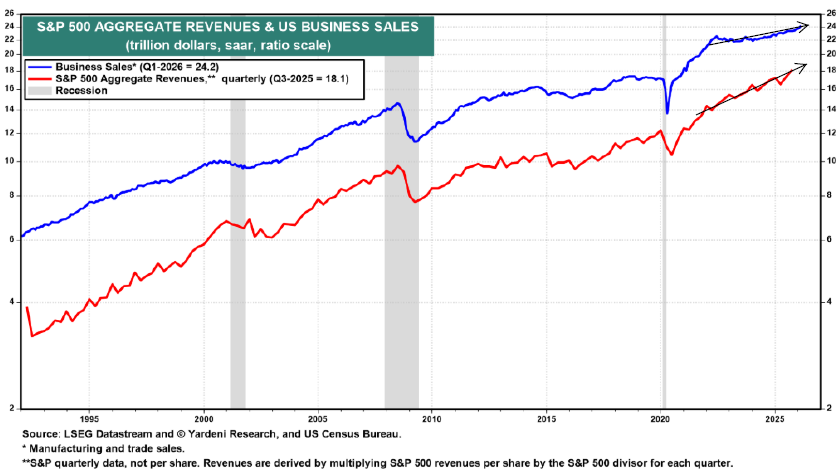
Here’s a visual for 2026 as a whole. Not quite as broad and spectacular as many are saying, is it?


This rally runs deep
(…) headlines have proclaimed the rally to be a return of AI frenzy. This is only true to a degree; what is remarkable about the rally is still its breadth.
It is true that the magnificent seven tech stocks have contributed 60 per cent of the dollar increase in the value of the S&P 500 (in descending order of their contribution, the seven are Nvidia, Alphabet, Amazon, Broadcom, Microsoft, Apple and Meta). But this is partly a function of these companies being very large to begin with.
If you look at percentage gains, it’s been a data centre rally, not an AI rally — and there is a difference. Astonishingly, the top 15 percentage returners in the S&P sell either semiconductors or computer networking equipment. None of the mag seven are in the top 30 in percentage return.
At the margin, investors are betting on jam today (the hardware going into the data centres that are being built right now) before jam tomorrow (the hyperscalers building the AI models themselves).
Lots of stocks that have nothing to do with AI are performing well, too — in sectors from industrials to finance. The 150 components of the S&P that are down since March 30 are tightly clustered in four areas: energy stocks, defensives (staples, healthcare, telecoms), aerospace and defence, and a few software companies considered vulnerable to AI (ServiceNow, Salesforce).
This fits perfectly with a wide, war-is-over-let’s-party rally.
 I have been posting about delays in data center construction which will likely hit conventional media in the next several weeks. Forbes today:
Building new data centers is also increasingly constrained. Last week, Ars Technica reported that there are major delays in building many announced data centers, some of which haven’t even begun construction. They’re also increasingly unpopular and their plans are frequently challenged by local communities.
Uses of AI are increasing. Token demand is booming. But compute capacity is constrained by several bottlenecks impeding data center construction. So token prices are rising to reflect the imbalance and slow demand down until capacity comes on stream, later than planned.
- At 94.15, the NAAIM Exposure Index signals aggressive bullish positioning among active managers, reflecting rising conviction in the US equity outlook. For now, momentum remains firmly on the bulls’ side https://wwwisabelnet.com/?s=sentiment


“I have all the time in the world”.
Procter & Gamble is bracing for a roughly $1 billion hit if oil prices stay elevated and the Iran war disrupts supply chains.
The consumer goods behemoth today [Apr. 24] told investors that the annual cost impact of Brent crude at around $100 per barrel is roughly $1 billion after tax, compared with where it was before the war.
- In that scenario, transportation and logistics costs would rise.
- Inventory delays and storage costs would increase due to supply chain shifts.
- Higher oil prices would push up the cost of raw materials used to make ingredients and packaging, while production costs would increase as some materials become unavailable.
“We [already] see some suppliers just not being able to supply at all. We see some manufacturing facilities that have been compromised by the war,” CFO Andre Schulten said on an earnings call.
“So it’s not just the oil price, it’s also the availability of product and input costs.”
The CFO was asked on the call whether P&G’s ability to handle these disruptions could serve as a competitive advantage. “We’ve seen other players struggle, especially if it’s long supply chains, especially if it’s heavily contract manufactured supply chains,” he said. (Axios)
- “It’s brilliant if they don’t do that,” President Trump told CNBC this week, referring to importers who do not seek a refund. Responding to a question about large companies second-guessing whether to go through the refund process, Trump added: “If they don’t do that, they got to know me very well. … If they don’t do that, I’ll remember them.”
The Pentagon Needed Rare Earths—and Found a Supplier in Malaysia A year after Beijing cut the world off from vital minerals, the West is breaking China’s chokehold
Here, Lynas Rare Earths, an Australian company, has begun pumping out heavy rare earths, the elusive kind that China dominates. (…)
In March 2026, Lynas announced a preliminary $96 million deal in which the Pentagon would purchase Lynas’s rare earths.
And Las Vegas-headquartered MP Materials, backed by billions of dollars in U.S. government support, is planning its own refinery for heavy rare earths that is set to come online later this year.
Last month, Lynas began producing samarium oxide, a difficult-to-source rare earth in high military demand that is used in heat-resistant magnets for jet fighters and missiles. (…)
Rare-earth minerals are already mined outside of China, including Lynas’s, which come from Western Australia. To gain independence from Chinese supplies, the hard part is building refining capacity. It often requires hundreds of stages to separate the rare earths using industrial acids.
For more than a decade, Lynas has had a refinery here in Kuantan, a Malaysian chemical-industry center. But it only produced light rare earths, which tend to be more common, while it sold heavy rare earths to China for processing. Last year, as the U.S.-China trade war was at its peak, Lynas finished a new heavy rare-earths processor in Kuantan. (…)
Heavy rare-earth elements are sprinkled in magnets so they can function at higher temperatures. That is important in cars and planes whose engines run hot.
Lynas and MP Materials are two of the leading Western rare-earths producers, and Washington wants more suppliers. In February, the U.S. International Development Finance Corp. extended $565 million in loans to Serra Verde, which operates a mine in Brazil with significant reserves of heavy rare earths.
Last week USA Rare Earth, a Stillwater, Okla., company that has recently commissioned equipment to make rare-earth magnets, said it would acquire Serra Verde in a deal valued at about $2.8 billion, part of an arrangement that will ensure a steady supply of heavy rare earths to the U.S.
Not everything has gone smoothly with U.S. efforts. Lynas has said there is “significant uncertainty” on whether it will go ahead with an effort to build a rare earth processing facility in Texas, which was allocated $258 million in Pentagon grant funding in 2023. The estimated project costs ballooned because of challenges in handling wastewater.
Instead, Lynas is building out a second, larger heavy rare-earth processing facility in Kuantan, expected to be completed in 2028.
Lynas scored a quick win when it achieved commercial production of samarium last month. The mineral had been refined almost exclusively in China, causing a scramble among defense suppliers last year when China cut off exports in April. A report from the U.S. Geological Survey last year found samarium was the highest-risk mineral for disruption, with shortages potentially costing U.S. industry billions of dollars.
American defense companies face a 2027 government deadline to ensure that no rare earths in their supply chain for magnets come from China. Lacaze said Lynas was supplying its non-Chinese rare earths to Japanese magnet makers that in turn supply the U.S. defense industry.
Still, Lacaze expressed concern that Western nations weren’t doing enough to ensure adequate demand. Military demand for rare earths is relatively small, so she advocated tax credits to induce larger commercial buyers—such as makers of cars and electronics—to choose non-Chinese rare-earth magnets.
Baskaran, the critical-minerals specialist, said the effort to achieve rare-earth independence was still in its early stages. “While momentum is real, translating these announcements into production takes years,” she said.
China Blocks Meta’s $2 Billion Acquisition of AI Firm Manus
China has decided to block Meta Platforms Inc.’s $2 billion acquisition of agentic AI startup Manus, a surprise move to unwind a controversial deal that’s drawn fire for the leakage of technology to the US.
The National Development and Reform Commission ordered the deal’s cancellation in a brief statement Monday. The decision was made in accordance with laws and regulations, the powerful state planner said in a one-line notice, without elaborating. (…)
Manus’s founders got their start in China but relocated their headquarters and key staff to Singapore in 2025. It wasn’t clear, when the deal took place, whether Beijing would exert its authority on a transaction that technically took place beyond its borders.
“The Manus block is a clarifying moment,” said Ke Yan, a tech analyst with DZT Research based in Singapore. “Manus was Singapore-incorporated with founders based here, and it still got pulled back. Beijing’s signal is that what matters isn’t where the legal entity sits.” (…)
Manus was supposed to help Meta — which had been playing catchup — leapfrog into a leading position in the hot sphere of AI agents, or services that use artificial intelligence to execute tasks.
Still, it’s unclear how Meta would unwind the deal. Manus employees have joined Meta, capital has been transferred and the startup’s executives have joined the US firm’s rapidly expanding AI team. Manus staffers have already moved into Meta offices in Singapore, while existing investors including Tencent Holdings Ltd., ZhenFund and Hongshan have received their proceeds, according to people familiar with the matter.
Meta said in a statement that the deal complied with applicable laws and it expected a resolution to China’s investigation, without elaborating. (…)
“Beijing likely views this move as a justified tit-for-tat and mirroring of the export controls, investment restrictions, and counter-tech transfer probes by American authorities over the years,” said Brian Wong, an assistant professor at the University of Hong Kong.
Beijing’s agencies have since moved to discourage a repeat of the Manus maneuver, which was completed with unusual speed. The buyout triggered a Beijing probe into illegal foreign investment and tech exports shortly after its December announcement.
Agencies including the National Development and Reform Commission have told key AI firms including Moonshot AI and Stepfun in recent weeks they should reject capital of US origin in funding rounds unless explicitly approved, Bloomberg News reported last week. Regulators have also decided on similar restrictions for ByteDance Ltd., the owner of TikTok and the most valuable startup in the country.
Those restrictions risk further isolating China’s recovering tech sector from the venture backing that has underpinned it for two decades, much of which was sourced from American pensions and endowments. It follows Beijing’s decision to restrict “red chips” — a type of Chinese company incorporated overseas — from seeking initial public offerings in Hong Kong, threatening to upend a decades-old playbook that helped Chinese companies tap foreign capital by floating overseas.
The overarching intent of the restrictions is to prevent US investors from taking stakes in sensitive sectors where national security is a priority. The twin moves suggest that regulators are worried about a leakage of homegrown technology abroad as Chinese-founded startups and companies explore international opportunities. In the wake of the Manus acquisition, many academics decried the loss of a valuable asset to the US. Many worried that the deal would encourage other startups to follow suit. (…)
It remains unclear what other action Beijing will take following its investigation. Manus co-founders Xiao Hong and Ji Yichao had been barred from leaving China, the Financial Times reported in March.
The FT has the inside story:
Inside China’s probe of Meta’s ‘conspiratorial’ $2bn Manus deal
Beijing branded Meta’s $2bn acquisition of Manus a “conspiratorial” attempt to hollow out the country’s technology base, triggering a multi-agency effort to contain fallout from the deal.
According to two people who later learned of the outcome, the assessment was made by China’s National Security Commission, a body led by President Xi Jinping. Its reports are usually reviewed directly by senior Communist Party leaders.
The opinion, reached shortly after the deal was announced in December 2025, thrust what was a landmark tech exit into the centre of China’s tech and national security agenda. Chinese regulators have since mobilised across multiple agencies to review the transaction, drawing in bodies including the National Development and Reform Commission, the commerce ministry and China’s antitrust watchdog, according to people familiar with the matter.
Officials are examining the deal using a range of tools, from export control rules to foreign investment and competition laws, the people said. (…)
When Manus shut down its China operations and relocated to Singapore last summer, regulators including the NDRC reviewed the move and concluded it did not warrant strict controls, according to people with knowledge of the matter.
Officials at the time judged the company did not possess core technology currently under export control and that its capabilities could be easily replicated, the people said.
That earlier assessment is now under renewed pressure as political scrutiny intensifies, forcing regulators to revisit the case and seek fresh legal grounds to justify intervention.
One person familiar with the process said officials were under pressure to “correct” their earlier judgment.
In March 2025, Manus launched a product that quickly went viral, becoming one of the first to showcase so-called “agentic” AI capable of carrying out complex, multi-step tasks. (…)
The hype proved shortlived. Within weeks, critics dismissed Manus as a “wrapper” with no proprietary technology, arguing it simply operated models made by companies such as Anthropic and Alibaba by breaking down prompts into sub-tasks.
Despite the scepticism, the company raised $75mn in April from investors including US venture capital firm Benchmark, reaching a valuation of $500mn. Revenue climbed to nearly $100mn, driven largely by subscriptions, as its user base grew to surpass 1mn.
In June, Manus shut down its China operations and relocated to Singapore, where it could more easily access US-developed AI models and attract overseas capital.
The move drew a backlash on Chinese social media. “Manus abandons its home country after leveraging cheap and quality Chinese engineers to develop its product,” read one widely shared post on Weibo at the time.
In December, Meta agreed to acquire Manus for $2bn. The deal came together at unusual speed — within two weeks of initial contact — prompting one investor to question whether the offer was genuine.
Neither party informed the Chinese regulators before the deal was announced, said a person involved in the process. (…)
A few days after the deal was announced, China’s Ministry of Commerce began an initial review, examining whether the transaction violated the country’s technology export controls. People familiar with the matter said the early assessment did not find clear breaches.
The position shifted after the National Security Commission’s intervention. Its report, which characterised the deal as “conspiratorial”, was circulated among senior leaders and triggered a broader review involving many agencies.
Some of Manus’s Chinese investors who sold their shares to Meta have since held preliminary discussions about unwinding the deal to address regulatory concerns, according to three people with knowledge of the talks.
Any such decision would ultimately rest with Manus and Meta, they added. An unwinding would be complex, as Meta has already integrated Manus into its ads management tools.
While it is common for Chinese technology companies with international clients to establish operations or headquarters in Singapore, a clean break from China followed by a rapid sale to a US buyer is rare.
Beijing’s ultimate aim is to prevent domestic tech companies from following a similar model in future.
But officials are divided over how far to go. Some warn that aggressive measures, such as unwinding the deal or pursuing personal liability, could send a chilling signal to China’s tech sector and lead to the departure of AI workers.
“We cannot fully control talent flows,” said one person close to a regulator involved in the case. “[The regulators] want to make sure the unconventional routes are closed, but normal business activities are encouraged so our tech entrepreneurs and companies can continue to thrive on the global stage.”
Commerce ministry spokesperson He Yadong said in early April: “The Chinese government supports enterprises in conducting cross-border business and technological co-operation as needed. Such activities should comply with Chinese laws and regulations and follow legal procedures.”
Meta said: “The transaction complied fully with applicable law. We anticipate an appropriate resolution to the inquiry.”
China warns EU over proposed ‘Made in Europe’ law Beijing threatens unspecified retaliation over fears that bill to strengthen bloc’s industry will hurt its companies
China has warned the EU that it will take “countermeasures” if its companies are hurt by a proposed new European law aimed at bolstering the bloc’s industry against cheaper imports.
The law is one of the EU’s most serious attempts yet to push back against Chinese high-tech imports and their perceived threat to important local industries, such as automotives. The EU aims to raise manufacturing’s share of the bloc’s GDP to 20 per cent by 2035, from 14.3 per cent last year. (…)
China’s commerce ministry said in a statement on Monday that the proposed EU law, known as the Industrial Accelerator Act, meant Chinese investors “will suffer discrimination, which runs counter to basic market economy principles such as commercial voluntariness and fair competition”.
The law “runs counter to the important consensus of Chinese and European leaders on properly handling frictions and differences, seriously affecting Chinese enterprises’ expectations for investment in Europe”, the ministry said. China “is willing to conduct dialogue and communication with the European side on this matter”, it said.
But if the EU “ignores China’s suggestions . . . China will have no choice but to take countermeasures”, it warned, without elaborating. The law is seen as the EU’s answer to decades of practices in China requiring foreign companies to invest alongside joint-venture partners and transfer their technology to local manufacturers.
As Chinese manufacturers have acquired technology and been able to make higher-value products, rivals in Europe complain that they can no longer compete.
The OECD has calculated that manufacturers in China receive subsidies that amount to between three and nine times those available to their rich-world counterparts.
China’s trading partners accuse it of generating record trade surpluses by over-subsidising production, leading to a flood of goods into foreign markets that is deindustrialising local manufacturing.
Beijing has rejected claims its industries are suffering from overcapacity and portrays itself as a pillar of globalisation, as the US has introduced tariffs and the EU has moved to protect sectors from what it argues is unfair competition.
The EU’s new law will place restrictions on foreign investments of more than €100mn from countries with more than 40 per cent of global production in strategic sectors including batteries, solar panels and nuclear power.
These investments will have to ensure at least 50 per cent of workers are from the EU, that local companies are involved in the manufacturing process and companies transfer technological knowhow to European partners. (…)
In its statement, China’s commerce ministry also said the act violated a range of WTO principles and international agreements governing intellectual property rights and subsidies.
“It will drag down the EU’s green transition process, damage fair competition in the EU market and bring new shocks to multilateral trade rules,” the statement said.
It said the EU should delete “discriminatory requirements against foreign investors, local content requirements, mandatory transfer of intellectual property rights and technology requirements, public procurement restrictive policies, and other content”.
2026 Midterms Update
Here’s an update on the midterm elections with ~6 months remaining. Bottom lines up front:
Democrats’ midterm prospects are surging.
Republicans could still turn things around and have sufficient resources. But time is running out.
The GOP will need (1) a strong reversal of prevailing economic pessimism over affordability, (2) a feel-good wave of patriotic enthusiasm (via success in Iran / troops coming home / America’s 250th) and (3) “scorched-Earth” campaign ads that “paint Democrats as out-of-touch elites who want open borders, are soft on crime and are wrong on whatever the hot-button cultural issue of the moment becomes.” (NYT)


BTW:
Mid-Terminal Seasonality: then there’s also the tendency for the coming months to be a bit choppy and weak during mid-term election years. (Callum Thomas)
Source: @ThierryBorgeat

TRUMP VS XI!
China Edges Past U.S. in Global Approval Ratings
This Gallup poll is both revealing and highly consequential, particularly since the latest results are based on surveys conducted in more than 130 countries, before the U.S. withdrawal from 66 international organizations in January and the outbreak of war with Iran in late February.
While neither country commands broad support, China surpassed the United States in global approval ratings in 2025, with a median of 36% approving of China’s leadership, compared with 31% for the U.S. China’s five-percentage-point advantage over the U.S. is the widest Gallup has recorded in China’s favor in nearly 20 years.
The recent shift reflects a decline in U.S. ratings alongside an increase for China. Median approval of U.S. leadership fell from 39% in 2024 to 31% in 2025, returning to earlier lows, while China’s approval rose from 32% to 36%.
At the same time, disapproval of U.S. leadership rose to a record-high 48%, while China’s disapproval rating remained flat at 37%.

Approval of U.S. leadership declined by 10 points or more in 44 countries between 2024 and 2025, while it increased by a similar amount in only seven. The declines were concentrated among U.S. allies, including many NATO partners.
Germany led the world in declines; its approval of U.S. leadership fell by 39 points, followed closely by Portugal (down 38 points). Several other long-standing U.S. partners — including Canada, the United Kingdom and Italy — also showed substantial decreases.
U.S. standing improved by more than 10 points among Israelis, marking an exception among U.S. allies. Approval of U.S. leadership in Israel, which surged after the October 2023 Hamas attack and then fell sharply in 2024, rebounded to 76% in 2025 after Trump’s return to the White House — a 13-point increase, among the highest levels globally.
Overall, China’s move ahead of the U.S. more broadly reflects a decline in U.S. ratings rather than an increase in China’s ratings. Approval of China’s leadership increased by double digits over the past year in 23 countries (versus 44 showing a similar decrease for the U.S.). However, many of China’s increases occurred in countries where U.S. approval fell, including allies such as the U.K., Spain, Italy and Ireland.
Looking at net approval — the percentage who approve minus those who disapprove — provides a more complete view of global sentiment toward the U.S. and China.
2025 was only the second year on record in which both Washington and Beijing registered negative net approval ratings worldwide. China’s median net approval of –1 was barely negative, while the median net approval of –15 for the U.S. was its lowest on record, marginally below the –13 measured in 2020.
In 2025, as both approval and disapproval shifted for the U.S. and China, the percentage expressing no opinion reached some of the lowest levels seen in the past two decades. This suggests that global views of both powers are becoming more defined, with more people forming clear opinions in both positive and negative directions.
Grouping countries by their relative net approval figures offers a clearer picture of alignment strength. Countries with a gap above 50 points in either direction are classified as strongly aligned; gaps of 30-49 points indicate aligned; 10-29 points, weakly aligned; and 0-9 points, contested.
Despite China’s overall lead in net approval, most countries do not have a strong preference for one power over the other. Last year, 8% of countries were strongly aligned with China, compared with 5% strongly aligned with the United States. Alongside the 30% of countries with no clear alignment, another 40% are only weakly aligned to either power: 32% to China and 8% to the U.S.
China leads the U.S. on three leadership approval statistics: global median approval (36% vs. 31%), net approval (–1 vs. –15), and relative net approval (54% of countries aligned vs. 16%). Yet Beijing’s advantage over Washington tells only part of the story.
Nearly half of all countries surveyed last year (45%) delivered negative net approval ratings to both powers, meaning more people disapproved than approved of each. Fewer than one in three countries (29%) gave positive net approval ratings to both. Aside from 2020, when fewer countries were surveyed because of the pandemic, this is the most negative the world has been toward both powers in two decades.
The shifting perceptions of U.S. leadership over the past two decades reflect a world that has moved toward a more multipolar order. Many countries, particularly U.S. allies, may be open to balancing relationships across major powers than aligning clearly with one.
For policymakers in some allied countries, this may make alignment with the U.S. more politically sensitive, even as engagement with China appears somewhat more acceptable. For businesses and investors, it signals a less predictable environment, where public sentiment may shape market access, regulation and partnerships.