The enemy of knowledge is not ignorance, it’s the illusion of knowledge (Stephen Hawking)

It ain’t what you don’t know that gets you into trouble. It’s what you know for sure that just ain’t so (Mark Twain)

Invest with smart knowledge and objective odds

THE DAILY EDGE: 22 APRIL 2020

Virus Update

image

image

A graphic with no description

A graphic with no description

  • New York to Ease Coronavirus Rules by Region to Reopen State Economy Businesses in different parts of New York state will reopen on separate schedules, Gov. Andrew Cuomo said Tuesday, as upstate elected officials and employers made the case for a regional approach to easing coronavirus restrictions
  • Almost all major U.S. metropolitan areas are seeing improvements in their outbreaks, said Deborah Birx, a top health official on the Trump administration’s coronavirus task force. She spoke after data showed that the nationwide infection tally had accelerated. Cases appear to be flattening in areas including Chicago and Boston, while New Orleans is back to its baseline for infections, Birx said at the daily White House briefing. Philadelphia, Houston, Atlanta and Nashville are also among cities improving, she said. The Washington, D.C., region is one where “we don’t see a decline yet,” Birx said.
  • Sydney’s famous Bondi Beach will reopen next week for swimming and surfing. That’s after Australia’s government said Tuesday that lockdown measures have led to a “sustained and consolidated” slowdown in new coronavirus cases.
  • France’s testing weakness shows challenges of lifting lockdowns Macron wants to loosen curbs in mid-May but scientists first want capacity trebled
  • David Rosenberg calculates that when/if a vaccine is found, we would need 300 million doses (600M for 2 shots). He says That American vaccine plants produce between 5 to 10 million doses a year. Then, there are syringes. Better get in line now…2 meters apart.
  • The U.K. only has half the testing capacity of other European countries such as Switzerland when it comes to running Roche Holding AG’s most efficient equipment for Covid-19 tests, Chief Executive Officer Severin Schwan said on a call with reporters. Countries struggling to scale up pandemic screening failed to invest enough in health-care infrastructure for decades, he said. “They are just not able to ramp up because they don’t have the know-how, they don’t have the personnel, because they simply don’t have the capabilities,” Schwan said. “Which is not surprising, because you cannot just start up a lab on a green field out of nothing.” Among those who did invest, he cited Germany, South Korea and Singapore.
  • In developing its antibody test, Schwan said, Roche scrutinised some existing products for reliability before rejecting them. “It’s a disaster. These tests are not worth anything, or have very little use,” Schwan told reporters on a conference call. “Some of these companies, I tell you, this is ethically very questionable to get out with this stuff.” Schwan said there were about 100 such tests on offer, including finger-prick assays that offer a quick result. The Basel-based company declined to specify which rival tests it had studied, but said it was not referring to tests from established testing companies.
  • US health agency warns against drugs touted by Trump Covid-19 patients alerted mix of antimalarial medicine and antibiotic poses serious risks
  • U.S. Adversaries Are Accelerating, Coordinating Coronavirus Disinformation, Report Says The State Department has assessed that Russia, China and Iran are mounting increasingly intense and coordinated disinformation campaigns against the U.S. relating to the outbreak of the new coronavirus, according to an internal report.
  • Chinese Ambassador to U.S. Urges ‘Serious Rethinking’ of Ties

(…) “I think I should be hoping for more than just a pause in tensions, but really a serious rethinking of the very foundations of this important relationship,” Cui Tiankai said in response to a question on U.S.-China ties during a Bloomberg New Economy webcast on Tuesday. (…) Missouri this week sued the Chinese government for what it alleged was covering up the extent of the coronavirus epidemic. (…)

“Hopefully this pandemic will teach all of us a good lesson,” he said, adding that the relationship should “be based on a more realistic, forward-looking foundation.” (…)

Cui added that China’s development has not come at the expense of the U.S., saying China wants “nothing to do with U.S. domestic politics, we can’t even make sense of it,” in response to a question on who China would prefer to win the presidential election in November. (…)

PANDENOMICS

1. Our Coronavirus China Industrial Activity Tracker Fully Recovered to +1%, While Our Coronavirus US Industrial Activity Tracker Hovered at -19%. Data available on request.

2. Our Coronavirus Consumer Activity Tracker Rose in China, but Declined Further in the US. Data available on request.

Goldman Sachs

Global CEOs see U-shaped recession due to coronavirus: survey

Global business leaders are preparing for a drawn-out U-shaped recession due to the impact of coronavirus and many fear their companies won’t survive the pandemic, a survey of thousands of chief executives showed on Wednesday. (…)

Around 60% of chief executives are preparing for a U-shaped recovery – a long period between recession and an upturn – compared with 22% who predict a double-dip recession, according to an April 15-19 poll of 3,534 chief executives from 109 countries conducted by YPO, a business leadership network.

The survey found that 11% of chief executives see coronavirus as a risk to the survival of their firm, while a further 40% say the pandemic poses a severe threat. (…)

Business leaders in the hospitality and restaurant sectors were the most vulnerable with 41% of executives saying their firms were at risk of not surviving, while 30% in aviation and 19% in wholesale and retail sales feared they may go under, the survey found. (…)

Almost two-thirds of business leaders forecast a negative impact on earnings to continue for more than a year, while a quarter expect their workforce to be down by more than 20% a year from now. (…)

So, 60% U-shapers and 22% double-dippers. Not much space left for V-shapers.

What are the current lockdown restrictions and when will they be lifted or re-evaluated?
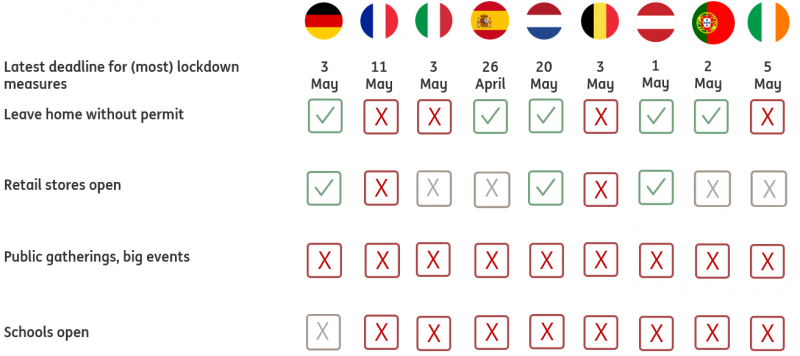
 Source: ING Research
ING Research
‘Scary Time’ for American Middle Class as Office Jobs Disappear A tsunami of job losses, which began in restaurants, hotels and factories, is now reaching white-collar America.

Bundesliga set to become first big league to restart in pandemic German football to resume in May offering blueprint for rivals

Trump Administration Weighs Aid for Oil Companies Possible conditions include producers offering ownership stakes or oil reserves to the government

The Trump administration is considering offering federal stimulus funds to embattled oil-and-gas producers in exchange for government ownership stakes in the companies or their crude reserves, according to people familiar with the matter. (…)

But it faces long odds given likely opposition from congressional Democrats to using stimulus funding for the oil industry.

Separately, Texas regulators declined to act Tuesday on a proposal to limit state oil production, even as the U.S. shale industry scales back anyway. The Railroad Commission of Texas, which regulates the oil-and-gas industry in America’s largest oil-producing state, deferred until May 5 a decision on whether to make operators curtail production for the first time since the 1970s. (…) We need to make darn sure when we make the motion that it fits legal requirements,” said commissioner Wayne Christian. (…)

“We will never let the great U.S. Oil & Gas Industry down,” the president wrote. He said he wants the plan “so that these very important companies and jobs will be secured long into the future!” (…)

“Obviously the energy business is very important to the U.S.,” Mr. Mnuchin said, adding, “this has national security issues, but different.” (…)

Critics of the oil industry say it doesn’t deserve a government bailout. Many consider the oil industry a contributor to climate change, and say producers ran up irresponsible debt and paid gaudy executive salaries even while returning scant profits. (…)

EARNINGS WATCH

We now have 68 reports in. Surprise! 65% beat rate with 7 of 8 sectors having reported showing positive surprise. Only Financials negatively surprised (-19.9%)

Still, the 68 companies having reported had aggregate earnings down 25.6% on a 2.6% revenue gain. The current blended growth rate for Q1 is –13.6%, from –4.7% on Apr. 1. Q2 estimates are for –29.9%, Q3 –15.8% and Q4 –7.2%.

Trailing EPS are $158.65. Full year EPS estimates: $140.05, down 14%. Here’s the V-shaped EPS pattern unseen by two-thirds of the executives in the above mentioned survey.

image

The Rule of 20 P/E is now 19.5 at today’s pre-opening of 2765.

THE DAILY EDGE: 20 APRIL 2020

Virus Update

image

image

A graphic with no description

  • Spain’s new coronavirus cases and deaths leveled off on Monday as the government maintains a strict lockdown. There were 4,266 new infections in the 24 hours through Monday, pushing the total above 200,000, according to Health Ministry data. The number of fatalities rose by 399, compared to Sunday’s 410, to 20,852.
  • Confirmed coronavirus cases rose by 4,268, a 10% increase overnight, Russian consumer health watchdog Rospotrebnadzor said. That is down from a record 6,060 new cases reported on Sunday.
  • The number of daily coronavirus cases in Singapore topped 1,000 for the first time since the pandemic began as the city-state recorded 1,426 new infections on Monday, taking its total to more than 8,000. Of the new cases, “the vast majority” are work permit holders living in foreign worker dormitories spread across the island, while 16 cases are Singaporeans or permanent residents, the ministry said.
  • That contrasted with Hong Kong, which had no new virus cases for the first time since March 5. Earlier, South Korea reported 13 new cases, after marking a two-month low of only eight additional infections on Sunday.
  • China confirmed 27 additional virus cases, 17 of which came from overseas. The country reported 54 asymptomatic cases.
  • The number of confirmed coronavirus cases in Germany increased at a quicker rate for a third day and by the most in seven days as the nation prepares for a relaxation of some restrictions on public life. Beginning today, Europe’s biggest economy will ease lockdown measures, in place for the past month.
  • Mexican Mogul Resists Coronavirus Restrictions Ricardo Salinas Pliego compares Covid-19 lockdowns to jail; his TV network disputes deputy health minister’s advice
South Korea’s New Coronavirus Twist: Recovered Patients Test Positive Again More than 160 South Koreans have tested positive a second time for the coronavirus, a development that suggests the disease may have a longer shelf life than expected.

Many had volunteered for re-examination after exhibiting symptoms such as coughing. Others submitted to extra testing on little more than a hunch despite not showing symptoms. So far, these patients—all of whom needed to twice test negative before leaving medical supervision—haven’t spread the virus to others, local health officials say.

The initial belief, according to South Korean doctors directly involved with a government review, is that the virus has “reactivated” in the patients, meaning the disease went dormant and came back. The research remains ongoing and inconclusive. The Seoul government’s report will take at least a month to complete, they say. (…)

“Maybe it comes and goes. We don’t know.” (…) China, Japan and India have also reported cases of recovered patients testing positive again. (…)

The World Health Organization, which has been in touch with Seoul officials, acknowledged earlier this week that not all recovered patients appear to have the antibodies to stave off a second infection.

The cases occurred an average of 13.5 days after patients were discharged, according to South Korea’s Centers for Disease Control and Prevention, lowering the likelihood they had the bad luck of crossing paths with the illness for a second time. (…)

Tuesday, local governments received guidelines from South Korea’s CDC advising that discharged patients be under quarantine for 14 days while their symptoms are monitored. (…)

“Based on our monitoring of patients, we believe it’s most likely that a dormant particle of the virus was reactivated,” Dr. Min said. (…)

“It’s clear that we don’t fully understand what it means to have immunity against this virus,” said Keiji Fukuda, a former WHO official who worked extensively on the H1N1, avian flu and other recent major outbreaks.

New York Fed Leader Says U.S. Recovery Unlikely to Be Swift ‘I don’t see the economy being back to full strength by the end of the year,’ John Williams says

(…) “Even as the pandemic passes, even as the restrictions are relaxed gradually over time, people may take quite a while before they are willing to get back on airplanes, on trains, or go to the theater or go to concerts or things like that,” Mr. Williams said. “So there are some risks it takes longer to get that recovery for the economy than just what happens in terms of the formal restrictions that are in place.” (…)

“Even as a pandemic passes through and the economy comes back, I expect demand to be weak and therefore needing strong monetary support, fiscal policy support as well, to get our economy back to full strength over the next couple of years.” (…)

Mr. Bullard said it’s a “very unlikely outcome” that the U.S. central bank would buy stocks as a means to support the economy. He noted that the equity market hasn’t suffered from liquidity issues, and probably wouldn’t get much lift from central bank purchases. (…)

Europe Is Taking a Harder Look at China After Virus Suspicions

(…) The European Union’s position on China has been relatively measured, but leaders are beginning to call for a more thorough examination of its activities amid accusations Beijing has covered up the true scale of the epidemic. American intelligence officials are said to have concluded that China concealed the extent of its outbreak and under-reported the number of cases and deaths. (…)

We seem to be near a point when President Trump asks that China must pay for the world pandemic. Could be pretty messy.

Flotilla of Saudi Oil Threatens to Worsen U.S. Supply Glut A fleet of tankers full of Saudi oil is slowly making its way to the U.S. Gulf Coast, threatening to worsen an already historic oversupply of crude.

(…) These tankers were loaded in March and early April when Saudi Arabia was pursuing a strategy of increasing its output to drive down prices and increase its share of key markets.

(…) the 20 tankers holding a combined 40 million barrels of crude are still headed to ports in Louisiana and Texas, according to shipping sources and market intelligence firms Vortexa Ltd. and Kpler Inc. They are due to arrive in Texas and Louisiana through late May.

“This is the American energy producers’ Pearl Harbor. We know the ships are coming in, and yet nobody is doing anything about it,” said Kirk Edwards, president of West Texas oil company Latigo Petroleum LLC. “Every barrel they’re bringing in on those ships backs out a barrel of oil produced here in the Permian Basin.” (…)

President Trump is monitoring the situation and has said all options are available in stabilizing energy markets, a senior administration official said. (…)

VALUETILITY

The S&P 500 cratered 34% over 5 weeks and recovered 29% in less than a month, leaving the index down 15% in total. In the process, the Rule of 20 P/E declined from a 15% overvaluation (22.9) to a very 20% undervaluation (15.9) and closed on April 17 at fair value (20.1) using trailing earnings that have yet to drop seriously. On forward earnings of $147.33, down 16% from February, the Rule of 20 P/E is 8% overvalued.

Since 1957, there has been only one other such quick snap back episode in equity valuation: December 2018-February 2019:

image_thumb1

Prescient or Pollyannaish?: Explaining the Market’s Rally Worst-case scenarios look less likely, but investor hopes for economic rebound might be premature

(…) While output is still contracting sharply, incremental news on both the economy, such as jobless claims, and the pandemic isn’t as bad as feared. The most dire scenarios for both look much less probable than a month ago. That reduction in uncertainty, however slight, has been enough to reinvigorate risk appetites.

(…) a few months ago the pandemic was expected to peak in the “late summer. Now it looks like it will peak before the summer even begins, because social distancing has proved pretty effective. The social-distancing measures made the second quarter worse, but pulled forward when we thought it would recover.” (…)

Aggressive fiscal and monetary-policy stimulus have also reduced the probability of worst-case scenarios. (…)

The fiscal and monetary stimulus will prevent a lot of companies from going bankrupt but won’t prevent sales and profits from being hammered—probably by more than Wall Street analysts now expect. Economists expect output to be down 7% in the current quarter from a year ago, the steepest year-over-year drop in over 70 years, yet analysts expect profits to fall only 27%. That’s less than half the steepest drop experienced during the last recession, in a quarter when output fell 3%. (…)

But many workers won’t be able to pick up where they left off. If 30% of the 22 million people to claim jobless benefits in the last four weeks have been permanently laid off, that alone would translate into a four-percentage-point boost to the unemployment rate.

With so few precedents and still so little data, the range of scenarios for the economy is wide. Investors seem to be counting on the better ones.

Charlie Munger: ‘The Phone Is Not Ringing Off the Hook’

(…) Overall, Mr. Munger made it clear that he regards this as a time for caution rather than action. (…)

“Well, I would say basically we’re like the captain of a ship when the worst typhoon that’s ever happened comes,” Mr. Munger told me. “We just want to get through the typhoon, and we’d rather come out of it with a whole lot of liquidity. We’re not playing, ‘Oh goody, goody, everything’s going to hell, let’s plunge 100% of the reserves [into buying businesses].’”

He added, “Warren wants to keep Berkshire safe for people who have 90% of their net worth invested in it. We’re always going to be on the safe side. That doesn’t mean we couldn’t do something pretty aggressive or seize some opportunity. But basically we will be fairly conservative. And we’ll emerge on the other side very strong.”

Surely hordes of corporate executives must be calling Berkshire begging for capital?

“No, they aren’t,” said Mr. Munger. “The typical reaction is that people are frozen. Take the airlines. They don’t know what the hell’s doing. They’re all negotiating with the government, but they’re not calling Warren. They’re frozen. They’ve never seen anything like it. Their playbook does not have this as a possibility.” (…)

“This thing is different. Everybody talks as if they know what’s going to happen, and nobody knows what’s going to happen.” (…)

“I don’t think we’ll have a long-lasting Great Depression. I think government will be so active that we won’t have one like that. But we may have a different kind of a mess. All this money-printing may start bothering us.” (…)

“I don’t have the faintest idea whether the stock market is going to go lower than the old lows or whether it’s not.” The coronavirus shutdown is “something we have to live through,” letting the chips fall where they may, he said. “What else can you do?” (…)

Guggenheim’s Minerd Sees Chance of S&P Falling as Low as 1,200 “The market at this level based upon where earnings are doesn’t represent any kind of intrinsic value,” Minerd said. “It is being entirely propped up by liquidity.”

Bets against the stock market have risen to their highest levels in years as short-selling against the SPDR S&P 500 Trust, the biggest exchange-traded fund tracking the broad index, rose to $68.1 billion last week.

Bondholders Reject Argentina’s Debt Restructuring Proposal A group of bondholders has rejected a proposal from Argentina to restructure tens of billions of dollars in foreign debt, raising the likelihood that the South American nation could enter into default as early as next month