From MIT Technology Review:
A leaked scientific report jointly prepared by Israel’s health ministry and Pfizer claims that the company’s covid-19 vaccine is stopping nine out of 10 infections and the country could approach herd immunity by next month.
The study, based on the health records of hundreds of thousands of Israelis, finds that the vaccine may sharply curtail transmission of the coronavirus. “High vaccine uptake can meaningfully stem the pandemic and offers hope for eventual control of the pandemic as vaccination programs ramp up across the rest of the world,” according to the authors. (…)
The draft report confirms that the vaccine is able to cut covid-19 illness and deaths by more than 93% and also provides the first large-scale evidence that the vaccine may prevent most infections, including those that don’t cause symptoms. (…)
The new findings are broadly consistent with separate announcements in recent days from two of Israel’s large health organizations, Maccabi Healthcare Services and Clalit Health Services, which together care for 80% of Israelis.
On February 14, Ran Balicer, chief of innovation and research at Clalit, the largest Israeli HMO, said that evidence collected on 1.2 million members “shows unequivocally that Pfizer’s coronavirus vaccine is extremely effective in the real world a week after the second dose.” (…)
Because Israel tests people fairly comprehensively, the researchers were also able to estimate that the vaccine was 89.4% effective in preventing any detectable infection at all, including asymptomatic infections. (…)
That finding, which is new, suggests that the vaccine could strongly suppress transmission of the virus between people and could help bring the outbreak to an end, a possibility Pfizer and the Israeli researchers say they are closely watching. (…)
But Topol cautioned that the current study is “not conclusive on its own” and that ruling out asymptomatic transmission will require more frequent testing, a type of study that Pfizer is also undertaking. Another unknown, says Topol, is whether or not protection from the vaccines wanes with time. (…)
Lab research has suggested that vaccines should be just as effective against B.1.1.7 [“British” variant] as against the earlier strains, and the real-world experience in Israel is overwhelmingly confirming this. (…)
(…) “The economy is a long way from our employment and inflation goals,” Mr. Powell said in testimony to the Senate Banking Committee, a statement he has repeated in recent weeks. (…)
Mr. Powell said Tuesday that inflation could be somewhat volatile over the next year and might rise due to a potential burst of spending as the economy strengthens. But that, he said, would be a “good problem to have” in a world where economic and demographic forces have been pulling inflation down for a quarter of a century.
He said he wouldn’t expect inflation to reach “troubling levels,” and wouldn’t expect any increase in inflation to be large or persistent.
“Inflation dynamics do change over time but they don’t change on a dime, and so we don’t really see how a burst of fiscal support or spending that doesn’t last for many years would actually change those inflation dynamics,” he said. (…)
Mr. Powell said the Fed monitors several measures of the labor market’s health, including the percentage of the population that is employed. That share was 57.5% in January, down from 61% before the pandemic.
“When we say maximum employment, we don’t just mean the unemployment rate,” he said. “We mean the employment rate.” (…)
The math:
- the unemployment rate is up from 3.5% to 6.3% or +2.8%. But the participation rate declined from 63.4% to 61.4% or 4.3 million people. To return to a 3.5% unemployment rate requires 4.5 million new jobs at constant participation and another 5.2 million at the Jan. 2020 participation rate. Total: +9.7 million jobs.
- the employment rate is down from 61.1% to 57.5% or -3.6%. But the civilian population increased 1.3 million. To return to a 61.1% employment rate requires +9.4 million additional jobs at the current civilian population level.
- Since January 2020, 9.0 million jobs were lost in service-producing industries and 0.9 million in goods-producing industries.

Noting that asset bubbles triggered recessions in 2001 and 2007-09, Sen. Pat Toomey (R., Pa.), the top Republican on the panel, asked Mr. Powell if he sees a link between elevated asset prices and the Fed’s easy-money policies.
“There’s certainly a link,” Mr. Powell said. “I would say, though, that if you look at what markets are looking at, it’s a reopening economy with vaccination, it’s fiscal stimulus, it’s highly accommodative monetary policy, it’s savings accumulated on people’s balance sheets, it’s expectations of much higher corporate profits…. So there are many factors that are contributing.”
The Federal Housing Finance Agency (FHFA) House Price Index increased 1.1% m/m in December following an unrevised 1.0% m/m gain in November. This was the seventh consecutive month in which house prices had risen by 1.0% or more. Prior to this seven-month run, this index had risen 1% or more in only five months in the series history dating back to January 1991.
Compared to a year ago, house prices were up 11.4%, the highest annual rate of increase in the series history. Over the past seven months, house prices rose 16.6% annualized, also their highest seven-month advance ever. For Q4, house prices were up 3.8% from Q3 and 10.8% from Q4 2019, both series records. This was the 38th consecutive quarter in which house prices have risen. House prices rose in all 50 states in Q4 from a year earlier. For all of 2020, prices rose 7.7%. The all-transactions quarterly index increased 2.1% q/q in Q4, its largest rise since Q2 2017.
House prices rose in each census division in December from November and also from a year ago. Seasonally adjusted monthly house price changes in December from November ranged from +0.8% in the West North Central and South Atlantic regions to +1.7% in the East South Central region. The 12-month changes ranged from +8.8% in the West South Central division to +13.7% in the Middle Atlantic region.

Good thing that mortgage rates dropped from 3.7% to 2.8%. But following a 12% jump in prices, it would not need much of a rate rise to kill affordability. Ten-year bond yield have risen from 0.5% in the summer to nearly 1.4%…


(…) If mortgage rates begin to increase at a faster pace, some borrowers could be discouraged from attempting to buy a home during the crucial home-selling months of March through June. In a typical year, more than 40% of annual home sales are made during this period, according to the National Association of Realtors. (…)
 (CalculatedRisk)
(…) “It’s the U.S. bond market pulling up global bond yields, and in some cases in ways that are moving faster than they’d like,” said Ethan Harris, Bank of America Corp.’s head of global economic research. “If you’re in countries outside the U.S., you’re looking at this as kind of an unwelcome import.” (…)
The jump in U.S. yields threatens to drag up other markets, challenging the policies of the ECB, Bank of Japan and Bank of England, Krishna Guha and Ernie Tedeschi of Evercore ISI told clients in a report this week. That’s a worry for those policy makers whose focus remains more on stoking growth than containing any nascent inflation pressures. (…)
Europe’s factories raise goods prices as supply bottlenecks bite Manufacturers are passing rising cost on to clients, fuelling inflation in the eurozone
Biden to Address Chip Shortages With Executive Action President Biden plans Wednesday to order a broad review of supply chains for critical materials from semiconductors to pharmaceuticals and rare-earth minerals, aiming to spur domestic production while strengthening ties with allies.
(…) “To be competitive and strengthen the resilience of critical supply chains, we believe the U.S. needs to incentivize the construction of new and modernized semiconductor-manufacturing facilities and invest in research capabilities,” the letter [from a group of associations representing technology companies, the automotive industry and other business interests] read. “We believe the need is urgent and now is the time to act.” (…)
The executive order is expected to call for a 100-day review of supply chains for four areas: semiconductors, used in products from cars to phones, large-capacity batteries used in electric vehicles, pharmaceuticals and rare-earth elements that are key to technology and defense. For example, neodymium is needed for the solid-state lasers used to designate missile targets. (…)
The government will seek to encourage domestic production with incentives such as job-training programs and businesses loans, in addition to using the federal procurement process for more American-made purchases. It will also explore limiting some imports, officials said, without providing specifics. (…)
While the executive order Mr. Biden is to sign is long-term, the White House has been working to address the chip shortage, officials said, including asking allies and manufacturers for help. (…)
“Right now, semiconductor manufacturing is a dangerous weak spot in our economy and in our national security. That has to change,” Mr. Schumer said, citing the auto industry. “We cannot rely on foreign processors for the chips. We cannot let China get ahead of us into production.”
Hence Taiwan…
China Faces European Obstacles as Some Countries Heed U.S. Pressure Some European countries are starting to block Chinese involvement in their economies, drawing closer to positions advocated by the U.S. amid growing anxiety in Europe over China’s increasingly aggressive geopolitical posture.
(…) Governments from the Baltic to the Adriatic seas have recently canceled public tenders that Chinese state-owned companies were set to win, or are moving to ban Chinese companies from investing or contracting in their countries.
The shifts have been prompted by a mix of national-security concerns and disappointment with the performance of Chinese contractors, say officials involved in the decisions. Several of the canceled projects fell within China’s world-wide infrastructure initiative, Belt and Road, which has disappointed several participating countries.
The shift is largely taking place in smaller European countries, adding to tensions within the European Union, where big countries still largely favor maintaining business links with China. (…)
China underestimated the “Russia factor,” said Andreea Brinza, vice president of Bucharest-based think tank the Romanian Institute for the Study of the Asia-Pacific. European countries dominated by Moscow during the Cold War have lingering strategic concerns, and as most of them rely on U.S. security guarantees, they want to show which side they are taking in trade disputes between Washington and Beijing, she said. (…)
“We are choosing the Western technosphere. We are not choosing the Chinese technosphere,” said Laurynas Kasciunas, chairman of the Lithuanian parliament’s national-security and defense committee, which oversees a national-security review board that had recommended banning Nuctech.
Such policy reversals remain a minority amid extensive Chinese business activity across the EU. Chinese direct investment into the bloc has declined since a peak in 2016 because of new European limits and Chinese restrictions on financial outflows. But public-procurement wins in Europe by Chinese companies—mostly state-owned—have ballooned recently, according to a Wall Street Journal analysis of public data.
In response, the EU last year issued guidelines for weeding out bidders from outside the bloc that offered extraordinarily low prices and launched a study on the impact of foreign subsidies in Europe, covering areas including procurement and corporate acquisitions. New EU rules on member states’ screening of foreign investments for potential national-security consequences took effect in October, and many EU countries have adopted national versions. (…)
Tax Hikes for High Earners Are on the Table in Some States Governors in New York, Minnesota and elsewhere urge higher income and capital-gains taxes to fortify pandemic-weakened budgets
(…) Unlike the federal government, states generally can’t borrow to plug budget holes. After accounting for existing federal aid, states might need to come up with about $56 billion in spending cuts or revenue increases to balance their budgets through the fiscal year that ends in most states in June 2022, according to an estimate from Moody’s Analytics. (…)
RISK ON!
The GS “Risk appetite” indicator printing a new high

Risk off!
Investors pulled $465 million from Ark Investment Management’s flagship product, the ARK Innovation ETF (ticker ARKK), in the latest trading session for which flow figures are available, according to data compiled by Bloomberg.
They also withdrew $202 million from the ARK Genomic Revolution ETF (ARKG) and $119 million from the ARK Next Generation Internet ETF (ARKW).
While those flows are a fraction of Ark’s assets under management — its ETFs held more than $60 billion as of last week — the exodus is unprecedented in the short history of the firm, which Wood founded in 2014. The outflow from ARKK was more than treble its previous record. (…)

John Authers:
(…) Absolute Strategy suggests that the 1950s-style experience of loose fiscal policy combined with accommodative monetary policy could spur nominal economic growth and deliver a dynamic rotation into value:

How Jeffrey Gundlach Gets Ready for Higher Rates
(…) To Gundlach, the expected inflation increase “is a real game changer.” In a recent CNBC appearance, he noted that inflation “has been subdued for 20 years.” And since Federal Reserve Chair Jerome Powell has stated that the central bank will hold down short rates for at least two more years, longer rates will continue to chase inflation higher, making the curve even steeper. Buoying that trend is Powell’s expressed willingness to allow inflation to run above the Fed’s 2% target without central bank intervention.
(…) according to Gundlach, signs of incipient growing inflation are already here: He pointed out that “agricultural prices have been depressed for years, and now are rocketing higher.” Over the past 12 months ending in January, food prices rose 3.8%, the largest hike for any category in the CPI. Energy, lower for the 12-month period, had major jumps in the past two months, 5.1% and 7.3%, as oil prices began escalating again.
(…) Gundlach thinks that the 10-year T-note will move up to 2% by year-end. And if inflation exceeds the 10-year’s yield in the future (which it does now slightly), then he believes the bond will go above 2.5%. (…)
To DoubleLine, there are some compelling plays available to counter any inflation. Like leveraged loans (bank lending to highly indebted companies), which suffered badly during the early 2020 crunch. (…) As these instruments have floating rates, they are a good inflation hedge, DoubleLine stated in a commentary. And with the steepening curve, they yield close to 4.5%, not bad in a time of generally low rates.
The size of the nation’s debt load, federal plus personal, corporate, etc., worries Gundlach. “We can’t pay it back,” he said in a conversation about the economy on Fox Business. The only way to do it, he said, is “debasing the liabilities through more inflation.” (…)
Amid such scarifying times as ours, Gundlach recommends a variation of what’s called the “barbell strategy.” It’s a concept that was first voiced by statistician Nassim Nicholas Taleb and last year received Goldman Sachs’ endorsement: Namely, invest in extremes to let your portfolio better weather any turbulence, like pairing cyclical and defensive stocks.
Gundlach’s model portfolio, which he described in a DoubleLine webcast last month, seeks to protect against both inflation and deflation. For a time during the Great Recession and sporadically ever since, Wall Street and the Fed have had bouts of fear over deflation. At the moment, inflation appears much more likely. His asset allocation is to divide one’s holdings into four categories:
- Long-term Treasurys. These guard against deflation. If the value of other assets shrinks, then the debt obligations of the richest and most powerful nation on earth will be, as they long have, the haven for investors. Thus, the government bond prices will lift.
- Cash, also a deflation. As stocks, bonds, commodities, and other assets lose value, the amount of cash needed to buy them falls. So cash becomes more valuable.
- Stocks, an inflation. Stocks didn’t fare well amid the double-digit inflation of the 1970s, yet those were extreme circumstances. Usually, corporate earnings keep pace with inflation, and stock prices are strongly connected to profits. For Gundlach, the best prospects are emerging market stocks, especially Asian names. In the US, he’d go for energy and financial services shares.
- Bitcoin, gold, real estate. The last two are storied hedges in times of inflation. Bitcoin, certainly, is new on the scene. Gundlach suspects it now may be in a bubble that could burst: The virtual currency has more than quadrupled in price since August, and is now is at $48,992. Gundlach, though, suspects that Bitcoin, known as “digital gold,” would function well when the CPI heads north.
Today’s environment has an unreal aspect, in Gundlach’s eyes. “We’re not in Kansas anymore,” he said. Getting by in an Oz-like world, he believes, will not be easy.


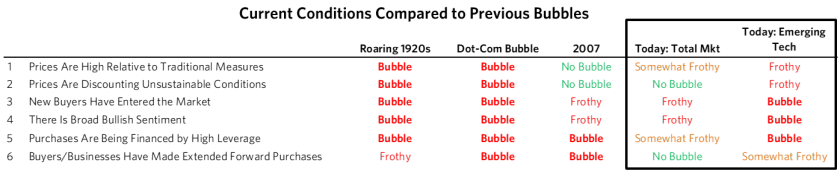
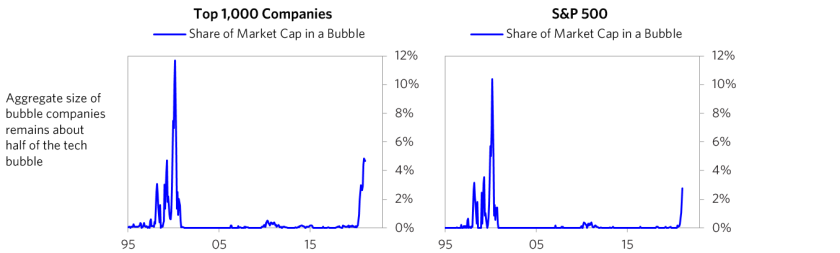
There is a very big divergence in the readings across stocks. Some stocks are, by these measures, in extreme bubbles (particularly emerging technology companies), while some stocks are not in bubbles. The charts below show the share of US companies that these measures indicate being in a bubble. It is about 5% of the top 1,000 companies in the US, which is about half of what we saw at the peak of the tech bubble. The number is smaller for the S&P 500 as several of the most bubbly companies are not part of that index.