The enemy of knowledge is not ignorance, it’s the illusion of knowledge (Stephen Hawking)

It ain’t what you don’t know that gets you into trouble. It’s what you know for sure that just ain’t so (Mark Twain)

Invest with smart knowledge and objective odds

THE DAILY EDGE: 11 AUGUST 2021

CPI for all items rises 0.5% in July; shelter, energy, food, new vehicle indexes rise

The Consumer Price Index for All Urban Consumers (CPI-U) increased 0.5 percent in July on a seasonally adjusted basis after rising 0.9 percent in June, the U.S. Bureau of Labor Statistics reported today. Over the last 12 months, the all items index increased 5.4 percent before seasonal adjustment. (…)

The index for all items less food and energy rose 0.3 percent in July after increasing 0.9 percent in June. Along with shelter and new vehicles, the indexes for recreation, for medical care, and for personal care increased in July. The index for used cars also increased in July, but the 0.2-percent advance was much smaller than in recent months. The index for motor vehicle insurance declined in July, and the index for airline fares fell slightly.

The all items index rose 5.4 percent for the 12 months ending July, the same increase as the period ending June. The index for all items less food and energy rose 4.3 percent over the last 12 months (…).

image

image
image

Core CPI is up 8.6% a.r. in the last 4 months, 7.8% a.r. in the last 3 months and 7.4% in the last 2 months. July’s +0.3% MoM will likely please many noflationists. CPI-Shelter is up 0.4% MoM in July, +5.4% a.r. in the last 2 months following +3.1% a.r. in the first 5 months of the year.

Fed’s Evans Open to Reducing Asset Purchases Later This Year ‘A few more employment reports’ could provide confirmation that economy is meeting goals, says Chicago Fed leader

Chicago Fed President Charles Evans said he expected recent employment gains to continue, which would allow the Fed to declare that the economy has achieved the “substantial further progress” it laid out last December.

“I’d like to see a few more employment reports” before making that determination, Mr. Evans told reporters during an online news conference. “We’re coming upon a time where it’s definitely going to be appropriate to start” reducing the pace of asset purchases. (…)

Mr. Evans said he expects the unemployment rate to fall to 4.5% by year’s end and the Fed’s preferred inflation gauge, excluding volatile food and energy categories, to end the year around or slightly above 3%. Mr. Evans said he expects that core inflation gauge to decline to around 2.1% by the end of next year. (…)

“I’m going to be very regretful if we sort of claim victory on averaging 2% and then we find ourselves in 2023 with about a 1.8% inflation rate, sustainable, going forward. That would be a challenge for our long-run framework,” he said. “We ought to be willing to average inflation above 2%—frankly, well above 2%.”

But Mr. Evans conceded that there is significant uncertainty around the path of inflation. “I don’t have strong confidence in what the sustainable inflation data are going to look like next year,” he said.

  • The back-to-school shopping season is already hitting supply-chain speed bumps. Consumers are finding that items like backpacks, lunchboxes and other staples of the season are in short supply, the WSJ’s Suzanne Kapner reports, as retailers struggle to keep shelves stocked amid factory closures in Asia, port congestion and other bottlenecks across logistics networks. The early reports are casting a cloud on the first big marker in a critical fall shopping season for retailers leading up to the end-of-year holidays. Merchants including Target and Staples are betting that parents will snap up items they didn’t purchase last year, when schools went remote. The National Retail Federation is projecting record back-to-school spending this year.
U.S. Productivity Has Moderate Advance in Q2

Nonfarm business sector productivity rose 2.3% SAAR in Q2 2021 (1.9% y/y), following a 4.3% SAAR advance in Q1 (4.1% y/y), which was revised from 5.4%. The Action Economics Forecast Survey had looked for a Q2 increase of 3.4%.

Real output grew at a 7.9% pace in Q2 (15.8% y/y) after 8.4% growth in Q1 (1.3% y/y); the Q1 quarterly growth rate was not revised. Hours worked rose at a 5.5% rate in Q2 (13.6% y/y) following a 4.0% gain in Q1, revised from 2.9%. Hourly compensation rose at a 3.3% pace in Q2 (2.0% y/y), after 1.4% in Q1 (6.4% y/y). The resulting change in unit labor costs was at a 1.0% annual rate in Q2 (0.1% y/y) after a 2.8% rate of decline in Q1 (2.3% y/y). The Action Economics Survey showed an expected increase of 1.2% in Q2.

Productivity in the manufacturing sector increased 6.9% (6.8% y/y) in Q2 following a decrease at a 1.3% rate in Q1 (2.2% y/y), revised from a 0.1% rise. Compensation per hour in total manufacturing rose 4.9% (0.6% y/y), following a 0.6% increase in Q1. Unit labor costs in manufacturing fell at a 1.9% pace in Q2 (-5.8% y/y) after advancing 1.9% in Q1.

Durable goods manufacturing productivity rose 4.6% (12.4% y/y) after 0.8% in Q1. Productivity in nondurable goods manufacturing rebounded at a 7.8% pace in Q2 (1.3% y/y) after a decline at a 2.7% rate in Q1.

image

In the last cycle, productivity jumped out of the recession and levelled off for several years. Manufacturing productivity appears to be oddly strong during this reopening phase.

fredgraph - 2021-08-11T073427.085

If productivity does not hold, the 7.3% jump in hourly compensation since Q1’20 will sting:

fredgraph - 2021-08-11T072518.871

unnamed - 2021-08-11T080536.457

FactSet; Chart: Axios Visuals

(…) Productivity growth could slow further in the current quarter. That is because even though the U.S. economy continues to grow at a decent clip, so too does the job market. The story goes like this: In the initial stages of the recovery, demand grew much faster than businesses were able, or willing, to hire. Existing employees worked like crazy and output per hour rose as a result. It wasn’t sustainable—people can only work so hard—and now employment is catching back up.

This is something like the scenario the Congressional Budget Office envisions. In projections released last month, it forecast that productivity growth would slow markedly next year, essentially bringing the level of output per hour back to the trend it was on before the pandemic. (…)

But the CBO’s projections, as Robert Barbera, director for the Center for Financial Economics at Johns Hopkins University has pointed out, may be far too dour. If productivity growth merely slows to its pre-pandemic pace, rather than dropping below that as the CBO forecasts, GDP could grow more quickly without running against its speed limits, he says.

Moreover, it seems a stretch to think that the productivity-enhancing adaptations that businesses and workers have adopted during the course of the pandemic aren’t going to stick. Some of them could even have a lot more room to run. (…)

Then there is the reality that a tight labor market could lead businesses to sniff out ways to increase productivity that they might not have if workers were easier to come by. (…)

China auto sales tumble for a third straight month in July

The world’s biggest auto market saw sales drop 11.9% from the same month a year earlier to 1.86 million vehicles, according to data from the China Association of Automobile Manufacturers (CAAM).

For the first seven months of the year, China’s vehicle sales have jumped 19% as the market recovered from pandemic lows. CAAM said that rebound is set to peter out with sales for the rest of 2021 expected to be below relatively high year-ago levels, although the market is still expected to log growth overall on an annual basis. (…)

One bright spot in July was continued strong sales of new energy vehicles, which more than doubled to 271,000. (…)

Shifty Coinbase Drops Promise of Token’s Cash Backing That Wasn’t True

First Tether, now this:

For months, a visitor to the website of Coinbase Global Inc., the largest U.S. cryptocurrency exchange, would see that the company offered a stablecoin called USD Coin with a simple premise: For every dollar offered to investors, there was $1 “in a bank account” to back it.

That promise was important for the stablecoin, which unlike Bitcoin has a set price and can be redeemed by users for regular currency. It helped USD Coin grow to be the world’s second-largest stablecoin, with $28 billion in assets.

But when Circle Internet Financial Inc., Coinbase’s partner in offering the coin, disclosed USD Coin’s assets for the first time last month, it turns out the promise wasn’t true.

According to a disclosure in July, the assets actually include commercial paper, corporate bonds and other assets that could experience losses and are less liquid if customers ever tried to redeem the stablecoin en masse. (…)

Stablecoins have come under increasing scrutiny from the government in the past few months as U.S. investors pour money into the market. As of last week, such coins held $117 billion. (…)

(…) With DeFi apps attracting billions in investor funds, they’ve also become frequent targets of attacks. This year, DeFi-related hacks made up more than 60% of the total hack and theft volume of crypto attacks, up from 20% in 2020, according to crypto security company CipherTrace. At $156 million, the amount netted from DeFi-related hacks in the first five months of 2021 already surpasses the $129 million stolen in DeFi-related hacks throughout all of 2020, CipherTrace said.

About $80 billion is locked in DeFi applications, making them an attractive target, according to tracker DeFi Pulse.

  • A group of companies that operated the BitMEX crypto exchange will pay $100 million to settle the first big U.S. anti-money laundering case. (Bloomberg)
China Anti-Graft Watchdog Calls for Business Drinking Curbs China should reduce business drinking and replace it with “correct values,” the Chinese Communist Party’s anti-corruption watchdog said in a commentary on a sexual assault case involving employees with Alibaba Group Holding Ltd.

THE DAILY EDGE: 10 AUGUST 2021

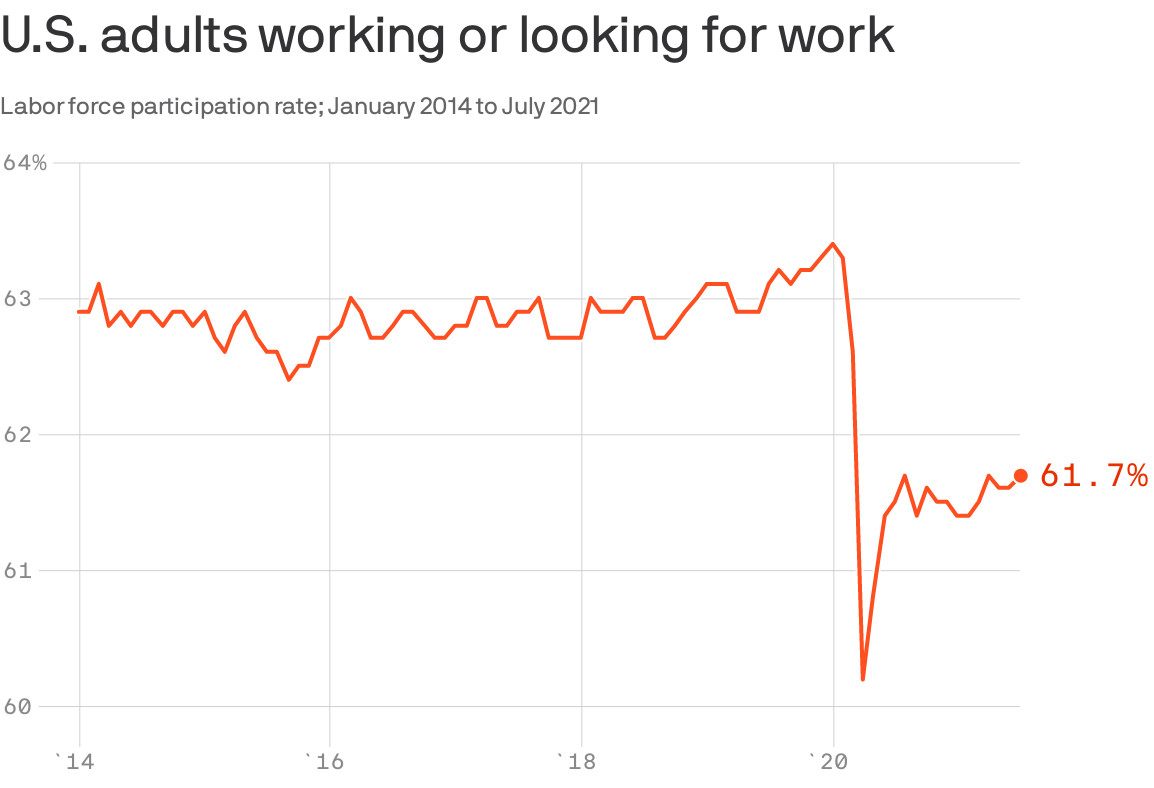
Available Jobs Outnumber Unemployed Americans Seeking Work Unfilled job openings rose by 590,000 to a seasonally adjusted 10.1 million in June, the highest level since record-keeping began in 2000, the Labor Department said.

Unfilled job openings rose by 590,000 to a seasonally adjusted 10.1 million in June, the highest level since record-keeping began in 2000, the Labor Department said Monday. The increase was driven by industries such as professional and business services, retail and the accommodation and food services, as pandemic restrictions continued to ease that month and consumers were more willing to dine out and travel. (…)

Some economists say the recent disparity might be due to a skills or geographic mismatch between workers and available jobs. Data released Monday showed openings were revised higher in May to exceed unemployment that month as well, and the gap between openings and jobless people widened in June. (…)

Monday’s Labor Department report showed the highest rate of job openings in June was in the South. Broadly, the labor market in the South, where business restrictions were less severe, has recovered from the pandemic more fully than the rest of the country. The West and Northeast, which includes New York and California where some restrictions were in place into June, had the lowest rate of job openings.

fredgraph - 2021-08-10T054803.796

The good news is that hires have finally jumped well above (+12.4%) their pre-pandemic levels.

fredgraph - 2021-08-10T055527.297

The jobs are there but nobody cares!

Data: Bureau of Labor Statistics, FRED; Chart: Axios Visuals

fredgraph - 2021-08-10T074453.329

The math from the above chart is simple: real GDP = labor market growth x output per worker (productivity). For employment to grind its way to pre-pandemic levels during the next 12 months, it needs 500k new jobs per month = +4% labor force growth. Add 2-3% productivity growth = +6-7% GDP growth. If no productivity growth, watch inflation rise and profit margins decline…

  • The scramble for warehouse workers is getting more intense, and more expensive. Walmart is offering special bonuses to many of its warehouse employees to work every hour they are scheduled and giving temporary pay raises to some employees, the WSJ’s Sarah Nassauer reports, as the retail giant ramps up for the holiday shopping season amid a tight labor market and stretched supply chains. Some workers have been offered $1,000 over four weeks for not skipping any scheduled shifts during the second half of the summer. The spending signals that companies are growing more concerned that this year’s big shipping disruptions and delays along with a worker shortfall will leave them unprepared to benefit this fall from strong consumer demand. U.S. warehousing operators have added nearly 130,000 jobs in the past year, by the Bureau of Labor Statistics measure, including 10,700 in July during a robust month for employment growth. (WSJ
  • During private discussions [at a recent meeting with Treasury Secretary Janet Yellen in Atlanta], some executives bemoaned the fact they still can’t fill open positions even after wages were increased, according to a person familiar with the conversation. The consensus among employers was that higher pay is here to stay. (Bloomberg)
  • Speaking of scramble for workers, hotels must be desperate:
image
NY FED’S SURVEY OF CONSUMER EXPECTATIONS
  • Median one-year-ahead inflation expectations were unchanged at 4.8% in July while median inflation expectations at the three-year horizon increased slightly to 3.7% from 3.6%, its highest reading since August 2013.

image

  • Median one-year-ahead expected earnings growth rose 0.3 percentage point in July to 2.9%, its fourth consecutive increase and a new series high. The increase was driven mostly by respondents with no more than a high school degree and with annual household incomes under $50,000.
  • Median household spending growth expectations retreated slightly from a series high of 5.2% reached in June to 5.1% in July.
Small Business Optimism Dips in July as Labor Shortage Remains Biggest Challenge

The NFIB Small Business Optimism Index decreased in July to 99.7, a decrease of 2.8 points, reversing June’s 2.9-point gain. Six of the 10 components declined, three improved, and one was unchanged.

  • Sales expectations over the next three months decreased 11 points to a net negative 4% of owners.
  • Owners expecting better business conditions over the next six months decreased eight points to a net negative 20%.
  • Earnings trends over the past three months decreased eight points to a net negative 13%.

image

image

image

U.S. Consumer Credit Posts Record Increase in June

Consumer credit outstanding surged $37.7 billion during June (4.2% y/y) following a $36.7 billion May increase, revised from $35.3 billon.  A $22.0 billion June rise had been expected in the Action Economics Forecast Survey. The $18.9 billion April rise was revised from $20.0 billion. The ratio of consumer credit outstanding-to-disposable personal income of 24.1% in June compared to 24.0% during all of last year and 25.9% during 2019.

Nonrevolving credit usage grew $19.8 billion (5.5% y/y) in June following a $27.6 billion May rise, revised from $26.1 billion. (…)

Revolving consumer credit balances jumped $17.9 (-0.2% y/y) after a $9.1 billion May rise, revised from $9.2 billion. (…)

image

Fed’s Bostic Urges Faster Bond Taper as Economy Strengthens

Federal Reserve Bank of Atlanta President Raphael Bostic said the central bank should move to taper its asset purchases after another strong month or two of employment gains, and proceed with that scaling-back process faster than in past episodes. (…)

My sense is if we are able to continue this for the next month or two I think we would have made the ‘substantial progress’ toward the goal and should be thinking about what our new policy position should be.”

“Right now I’m thinking in the October-to-December range, but if the number comes back big” as with the last report “or maybe even a little bigger, I’d be open to moving it forward,” Bostic said. “If the number really explodes, I think we would have to consider that.”

Bostic is a rotating member on the Fed’s policy-setting committee through year-end. He’s staked out a more hawkish position than some of his colleagues. For interest rates, he said that he anticipates the first increase “very late” in 2022.

At a separate event Monday, Richmond Fed President Thomas Barkin also said he sees progress in the economy toward the central bank’s goals.

“I think it is fair to say on the price side we made substantial progress, maybe more than substantial progress,” Barkin said at an event in Roanoke, Virginia. “I believe there is still more room to run in the labor market.” (…)

Chip Shortage Keeps CIOs and Other Tech Leaders Scrambling Across the economy, corporate tech leaders are dealing with dwindling supplies of the physical building blocks of IT

(…) “We’re seeing 10- to 12-week delivery times for laptops and computing devices,” said Sue Workman, chief information officer at Case Western Reserve University in Cleveland. “Those used to take a day or two.” (…)

From schools to financial firms and grocery stores, the world-wide chip shortage—which comes amid soaring prices for silicon wafers, and the resins and metals used in their manufacture—is rippling through supply chains. It is causing tech-hardware manufacturers to idle factories, vendors to put orders on hold and has left enterprise IT customers in limbo, industry analysts say.

Across the economy, chief information officers and other tech leaders are dealing with dwindling supplies of the physical building blocks of IT, items like liquid crystal displays, images sensors, integrated circuits and processors, said Mario Morales, group vice president for enabling technologies and semiconductors at industry research firm International Data Corp.

“Suppliers are operating at full capacity and are not expected to catch up until the end of this year,” Mr. Morales said. (…)

TECHNICALS WATCH

The last several days merely maintained the uncertainty: large caps logged in new highs on reduced volume but smaller caps kept their divergent trend intact. Even the NASDAQ cannot show more 52-week highs than lows in July despite rising 35% in the last year and nearly 4% in July.

Ned Davis Research published a technical warning two weeks ago:

For the past several months, our thesis for the U.S. stock market for the rest of 2021 has not changed. Macro and fundamental factors are in the process of transitioning from their most bullish readings in years to being in zones in which the stock market has struggled. Sentiment has been reflecting excessive optimism for months. Technicals, on the other hand, had remained bullish, thanks to broad participation from most sectors.

Recently, two developments have caught our attention. First, the market seems to have suddenly realized our concern that recent explosive economic and earnings growth numbers are not repeatable. (…)

Second, since early May, a few chinks in the technical armor have begun to show. Small-cap and cyclical Value leadership has given way to FANMAG stocks carrying the cap-weighted popular averages. More recently, relative strength tables have been dominated by risk-off sectors. Bond yields have tumbled below 1.2%.

As a result, the percentage of stocks in the NDR Multi-Cap universe above their 50-day moving averages has fallen from 78% on April 26 to 29%. The percentage above their 200-day has fallen by less, from 92% to 67%. (…)

When cyclical breadth has been better than defensive breadth, the S&P 500 has risen at a 11.0% annualized pace (chart, left). When defensive breadth has been better, gains have been smaller, at 4.8% per year. The rotation into defensive sectors is a warning sign of more challenging market conditions. (…)

Since July 2015, when FANMAG has been outperforming the rest of the market by at least 10% points over the previous six months, the S&P 500 has been essentially flat (-0.2% per year) versus 25.6% per annum when the spread has been less than 10%.

FANMAG stocks have proven to be a defensive place to hide when pandemic fears increase. The combination of FANMAG relative strength and better defensive breadth versus cyclical breadth is a reflects defensive positioning amid weakening breadth. (…)

Any future rallies will require broader participation for technical indicators to avoid joining macro and fundamental ones in warning of a major peak.

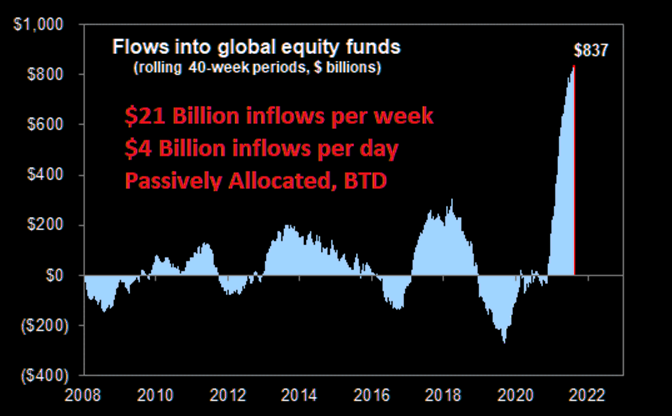
There has been 187 US equity trading days from November 1st to today. This was the start of positive vaccine developments. Since November 2020, there have been +$837 Billion worth of global equity inflows in 40 weeks. This is +$21B worth of inflows every week or +$4.2B worth of buying per day.

EARNINGS WATCH

From Refinitiv/IBES:

Through Aug. 6, 443 companies in the S&P 500 Index have reported earnings for Q2 2021. Of these companies, 87.4% reported earnings above analyst expectations and 9.7% reported earnings below analyst expectations. In a typical quarter (since 1994), 66% of companies beat estimates and 20% miss estimates. Over the past four quarters, 83% of companies beat the estimates and 14% missed estimates.

In aggregate, companies are reporting earnings that are 16.4% above estimates, which compares to a long-term (since 1994) average surprise factor of 3.9% and the average surprise factor over the prior four quarters of 20.1%.

Of these companies, 87.1% reported revenue above analyst expectations and 12.9% reported revenue below analyst expectations. In a typical quarter (since 2002), 61% of companies beat estimates and 39% miss estimates. Over the past four quarters, 74% of companies beat the estimates and 26% missed estimates.

In aggregate, companies are reporting revenues that are 4.6% above estimates, which compares to a long-term (since 2002) average surprise factor of 1.1% and the average surprise factor over the prior four quarters of 3.5%.

The estimated earnings growth rate for the S&P 500 for 21Q2 is 93.1%. If the energy sector is excluded, the growth rate declines to 77.7%. The estimated revenue growth rate for the S&P 500 for 21Q2 is 23.5%. If the energy sector is excluded, the growth rate declines to 19.2%.

The estimated earnings growth rate for the S&P 500 for 21Q3 is 29.8%. If the energy sector is excluded, the growth rate declines to 23.3%.

image

image

image

Costs pressures suggested by some macro trends have yet to meaningfully impact S&P 500 companies. In truth, revenue growth rates between 10-20% surely help offset many rising costs.

image

Companies across a range of industries are facing inflationary pressures caused by factors including higher commodity prices, supply chain hiccups and high demand for shipping capacity. Many of them are responding by raising prices, but often that isn’t enough to offset the impact of cost pressures and transportation challenges. (…)

[Mattel Inc.], which operates its own plants but also relies on external manufacturers, is benefiting from a recent cost savings and efficiency program which helped reduce the number of different items it sells, or stock-keeping units, by about 35%, according to Mr. DiSilvestro. “If you have a third less SKUs to think about, it does reduce the complexity and enables us to be more efficient,” he said, adding that Mattel is watching its input costs and margins. (…)

Changing the packaging of a product can help the company [Hershey] raise prices, Mr. Voskuil said. Hershey is also taking a close look at its contracts with vendors and its manufacturing plants in search of potential improvements, he said. (…)

E.l.f. [Beauty Inc.], which has raised prices, has noted improvements around the availability of shipping containers in recent weeks, Ms. Fields said. “Capacity is opening up, but the cost is still pretty high,” she said. The company expects that elevated costs for transport will continue to affect its profit margin, according to Ms. Fields.

E.l.f.’s gross margin declined by about 3.4 percentage points to 63.8% in the past quarter compared with the prior-year period, in part driven by higher transportation costs.

Delta Wave Goes Coast-to-Coast in U.S., Showing Variant’s Force

The U.S. Covid-19 wave that started in low-vaccination states in the Ozarks and Deep South has now engulfed the country, with cases and hospitalizations at their highest since February.

Thirty-eight states have transmission levels considered high by the Centers for Disease Control and Prevention, meaning they’re posting at least 100 cases per 100,000 residents or have positivity rates of at least 10%. The other 12 states and the nation’s capital have transmission rates that are considered substantial, the second-worst category.

The latest U.S. wave began in low-vaccination states. Intensive-care units are now swamped with virus patients in Florida, Louisiana and Mississippi.

But the faster-spreading variant is finding its way even into states that outperformed in the vaccination campaign and have enforced strong mitigation measures. Twenty-three states and the nation’s capital have seen their seven-day average cases increase at least 50% in the past week, including such highly vaccinated states as Vermont, Washington state and Hawaii, according to CDC data.

unnamed - 2021-08-10T070601.232

(CalculatedRisk)

image

From J.P. Morgan Asset Management:

The most important divergence to watch right now is between reported COVID cases and COVID deaths. Clearly, the Delta variant is threatening to the unvaccinated population. Many states in the U.S. are dealing with devastating surges, and China and Israel are enforcing new restrictions despite having mature vaccination programs. 

However, the example of the United Kingdom provides compelling evidence that the vaccines are powerful tools that will allow the global economy to normalize barring a new vaccine resistant variant. At this point, it seems like the UK is through the worst of the Delta case surge without a large surge in either hospitalizations or deaths. The primary reason: over 95% of its age 50+ population is already vaccinated.

Even though vaccination rates are relatively low in certain areas of the United States, 90% of people aged 65+ have received at least one dose of a vaccine. Delta will likely delay full economic normalization (due to supply shortages emanating from Asia) and lead to responses such as vaccine mandates and a delayed return to the office for some companies, but we have powerful tools to combat the most destructive COVID outcomes. Booster shots will likely play a very important role in economic normalization in the developed countries in 2022.

image
Canada Reopens U.S. Border to Fully Vaccinated Americans

(…) The U.S. didn’t reciprocate. Although Canadians can continue to fly to the U.S. for nonessential purposes, as they have been permitted to do throughout the pandemic, they are not allowed to cross at the land border Confused smile.

Canada plans to extend its reopening to include fully vaccinated tourists from other countries, and not just the U.S., beginning in early September. (…)

It’s the economy, stupid!