Total nonfarm payroll employment rose by 943,000 in July, and the unemployment rate declined by 0.5 percentage point to 5.4 percent, the U.S. Bureau of Labor Statistics reported today. Notable job gains occurred in leisure and hospitality, in local government education, and in professional and business services. (…)
The change in total nonfarm payroll employment for May was revised up by 31,000, from +583,000 to 614,000, and the change for June was revised up by 88,000, from +850,000 to +938,000. With these revisions, employment in May and June combined is 119,000 higher than previously reported.
Nonfarm payroll employment in July is up by 16.7 million since April 2020 but is down by 5.7 million, or 3.7 percent, from its pre-pandemic level in February 2020.
In July, the average workweek for all employees on private nonfarm payrolls was unchanged at 34.8 hours.
The labor force participation rate was little changed at 61.7 percent in July and has remained within a narrow range of 61.4 percent to 61.7 percent since June 2020. The participation rate is 1.6 percentage points lower than in February 2020. (…)
In July, average hourly earnings for all employees on private nonfarm payrolls increased by 11 cents to $30.54 [+4.0%], following increases in the prior 3 months. Average hourly earnings for private-sector production and nonsupervisory employees also rose by 11 cents in July to $25.83 [+4.7%].
U.S. Initial Unemployment Insurance Claims Decrease Modestly
Initial claims for unemployment insurance were 385,000 in the week ended July 31, down from 399,000 the prior week. That earlier number was revised from 400,000 reported last week. The four-week moving average was 394,000, down slightly from 394,250 the prior week. In fact, the last ten weeks have averaged 393,000, with a range of 368,000 to 424,000. The Action Economics Forecast Survey consensus for the latest week was 390,000.
Initial claims for the federal Pandemic Unemployment Assistance (PUA) program rose modestly to 94.476 in the July 31 week from 93,060 the week before; that earlier week was revised downward from 95,166 reported before. The PUA program provides benefits to individuals who are not eligible for regular state unemployment insurance benefits, such as the self-employed. Given the brief history of this program, these and other COVID-related series are not seasonally adjusted.
Continuing claims for regular state unemployment insurance in the week ended July 24 fell 366,000 to 2.930 million from 3.296 million the week before. That earlier number was revised from 3.269 million. In the July 24 week, the associated rate of insured unemployment decreased from 2.4% the prior week to 2.1%. This was the lowest rate since the same amount for March 21, 2020, just as the pandemic was emerging.
Continued claims for PUA declined 89,180 in the week ended July 17 to 5.157 million. Continued PEUC claims rose modestly by 12,324 to 4.246 million, a second weekly increase after four declines. The Pandemic Emergency Unemployment Compensation (PEUC) program covers people who have exhausted their state unemployment insurance benefits.
In the week ended July 17, the total number of all state, federal, PUA and PEUC continued claims was 12.975 million, down 181,251 from the week before. As noted last week, this maintains the recent lower level of overall unemployment insurance claims, which is down from a high of 33.228 million in the third week of June 2020. These figures are not seasonally adjusted.
(…) Boomer retirements more than doubled in 2020 from the previous year, according to an analysis from the Pew Research Center. Some quit work sooner than planned, taking advantage of surging stock prices and home values; others did so under duress, having lost jobs in the recession and facing little prospect of finding employment again. (…)
Concerns about Covid contagion have incentivized businesses to ramp up investments in hardware and software that cut down on interactions between employees and customers. According to a research note from Oxford Economics, 45% of the 7 million jobs the U.S. was still missing as of June are vulnerable to automation, led by food service, retail sales, and manufacturing. “The technology was available 10, 15 years ago already, but it wasn’t adopted, and now it’s been adopted,” says Stefania Albanesi, an economics professor at the University of Pittsburgh. “It’s unlikely that we’ll just go back to how things were before.” (…)
Drug overdose deaths jumped 30% in 2020, to a record 92,183, according to the Centers for Disease Control and Prevention; about three-quarters were a result of opioids. (…)
for women in particular, Covid has fundamentally shifted the balance between work and child care, perhaps in a lasting way. The rate of workforce participation for women in June was 56.2%, well below this century’s high-water mark of 60.3%. “Moms came home more than dads to take care of kids, and I think we’re going to see that some of those people that dropped out realized: ‘You know what? This new way of life, we can get by like this,’ ” says Grieser of Emsi Burning Glass. (…)
Infrastructure Bill to Add $256 Billion to Deficits, CBO Says Congress’s nonpartisan scorekeeper found that the roughly $1 trillion infrastructure bill would widen the federal budget deficit by $256 billion over 10 years, countering negotiators’ claims that the price tag would be covered.
Members of the bipartisan group that negotiated the infrastructure bill, which would provide roughly $550 billion in spending above expected federal levels, had said they expected the analysis from the Congressional Budget Office to differ from their own. They have said that some of the measures they are using to cover the cost of the bill, including repurposing Covid-19 aid, wouldn’t count the same way toward CBO’s official estimate. (…)
“The new spending under the bill is offset through a combination of new revenue and savings, some of which is reflected in the formal CBO score and some of which is reflected in other savings and additional revenue identified in estimates, as CBO is limited in what it can include in its formal score,” the pair said. (…)
One of the biggest discrepancies between the CBO score and lawmakers’ estimates of the cost lies in the Covid-19 aid. Lawmakers had said they would save roughly $210 billion by repurposing those funds, while the CBO score gives lawmakers credit for reducing outlays by roughly $13 billion over 10 years with the cuts.
Another shortfall stems from the estimated economic growth the package could spur. Lawmakers said the bill could generate $56 billion in revenue based on new economic growth it generates. The CBO didn’t estimate the macroeconomic impact of the bill in the cost estimate released Thursday. (…)
Marc Goldwein, senior vice president and senior policy director for the Committee for a Responsible Federal Budget, said the CBO score doesn’t account for the impact that authorized future spending could have on the deficit, too. He estimated the bill will ultimately increase deficits by $350 billion over 10 years. (…)
EARNINGS WATCH
We now have 427 reports in, an 88% beat rate and a +16.4% surprise factor. The lowest surprise factor was in Materials at +6.3%. On revenues, the beat rate is 87% and the surprise factor +4.7% (lowest: Industrials +2.8%).
Trailing EPS are now $182.03, up 15% from the end of May! Twelve-month forward EPS are now $205.46, up 7.3% from the end of May. The S&P 500 index is up 5.2% since.

Q3 estimates are +29.8%, up from +24.7% on July 1.
Q4 estimates are +21.5%, up from +17.3% on July 1.
Full year 2021: $200.22e.
Full year 2022: $218.72e, +9.2%.

- Uber, Lyft Drive Investors Away Ride-hailing companies have spent dearly to compete for the same riders; now they are spending to compete for the same drivers
(…) Lyft said it significantly increased its investments in incentives and sign-on bonuses to boost its driver base in the second quarter, expecting elevated incentives to continue into the third quarter. But Uber appears to have been more aggressive. While the company reported overall revenue that beat Wall Street’s estimate, it also lost 58% more than analysts had forecast on an adjusted Ebitda basis. (…)
Both companies have raised prices on U.S. ride-hailing transactions amid the pandemic. But fresh Edison Trends data show for the week ended July 19, Uber’s consumers spent 24% more on transactions than they did the comparable week last year, while Lyft’s consumers spent 35% more. (…)
- Auto parts maker Magna trims revenue forecast as chip shortage weighs
- The market research firm Strategy Analytics estimated that, on average, the global wholesale price for phones grew 5 percent between April and June. Laptop, TV, and accessory prices have also spiked. One investment research firm told the Wall Street Journal that HP alone had raised the price of printers by more than 20 percent over the course of a year. (Vox)
- We expect the direct impact of the Delta variant on the US economy to consist mainly of a delay in the final steps of reopening, rather than a major reversal. But many Asia Pacific economies have imposed tighter restrictions that in some cases have included factory closures, raising the risk of negative spillovers at a time when supply chain disruptions are already at record levels. (GS)
Everyone Else Gets Fed Up U.K. inflation leaves policy makers in a bind if the U.S. Federal Reserve won’t act, too.
From the WSJ Editorial Board:
Of all the central bankers in the world, we’d least like to be Andrew Bailey of the Bank of England. His unenviable task is figuring out how—or whether—to rein in accelerating inflation in the United Kingdom without help from the Federal Reserve or the European Central Bank. Faced with this conundrum, he punted again at a Thursday policy meeting. (…)
If Mr. Bailey had the luxury of setting policy solely on the basis of developments within the British economy, this would be reckless. Britain is one of the developed world’s standouts in its recovery from the pandemic and lockdowns. Although GDP remains well off its pre-pandemic levels and growth was hobbled by the lockdown earlier this year, other indicators are popping back to life. Employment in some regions now exceeds the pre-pandemic level, and the unemployment rate is falling while job vacancies and hours worked shoot up. Consumer-price inflation is 2.4% year-on-year and climbing.
But he doesn’t have that solo luxury. His peers in the eurozone, Japan and especially the U.S. are determined to press ahead with their own pandemic policies even as their economies enter the post-pandemic phase of reopening and recovery. Were Mr. Bailey to shift toward normalization before anyone else, it’s hard to predict the consequences.
A particular concern might be hot-money inflows from global investors desperate for yield. This would raise concerns about an uncontrolled appreciation of the pound, with unpredictable price effects given the U.K.’s mix of imports and exports. It’s hard to blame Mr. Bailey for not being eager to find out what those effects might be. (…)
As for how to know when the time is here, it’s a quaint idea but this would be a great moment for renewed coordination among central banks. It’s becoming clearer that none of them will be able to normalize alone, and with inflation accelerating around the world none of them can afford not to act. What’s left is to decide they’ll start normalizing policy together.


Issuance has almost been fully swallowed by QE over the past 90 days… 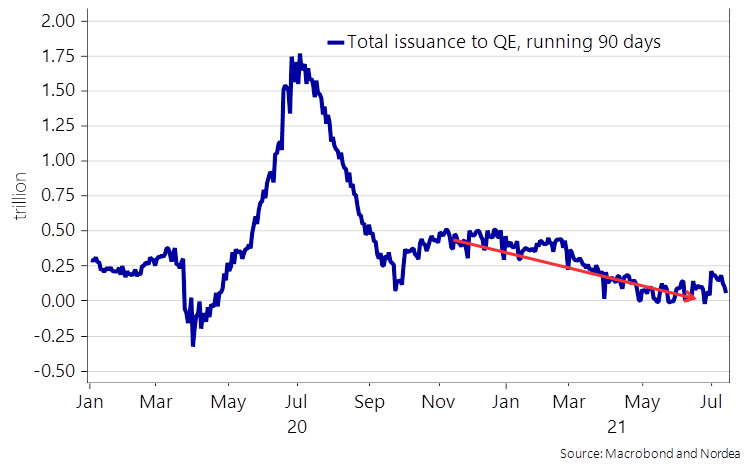
COVID-19
Transmission Rates
Centers for Disease Control and Prevention via the NYT
(…) Recent data from Pfizer Inc. and BioNTech SE shows the efficacy of their shot declines about 6% every two months, which suggests boosters may be needed broadly, one of the people said.
Pfizer plans to ask U.S. regulators this month to authorize booster shots of its two-dose vaccine, arguing that a third shot may be needed to protect against the evolving virus.
Moderna Inc. said on Thursday that it expects people who received its two-dose vaccine to need a third shot in the fall to keep strong protection against newer variants of the coronavirus. Moderna Chief Executive Stéphane Bancel said the company expects to ask the FDA to authorize its booster shots in September. (…)
A small but growing number of vaccinated people are testing positive for Covid-19, but almost none of them are dying or requiring hospitalization.
China’s Corporate Crackdown Is Just Getting Started. Signs Point to More Tumult Ahead. Chinese regulators are pushing businesses to do more to serve the Communist Party’s goals—rattling markets in the process. Investors, analysts and company executives say it isn’t over yet.
(…) The government’s far-reaching ambitions under Xi Jinping promise serious and often unpredictable implications for business, these people say—and keeping foreign investors happy isn’t a priority. (…)
China’s biggest private companies have benefited from years of lax regulatory oversight, he said, and it will take a long time for authorities to address it.
Since November, Chinese regulators have taken more than 50 actual or reported actions spanning antitrust, finance, data security and social equality, a July 29 roundup by Goldman Sachs Group Inc. shows—more than one move a week. (…)
On Tuesday, a Chinese newspaper affiliated with state news agency Xinhua criticized online gaming as “opium for the mind.” The article raised concerns that Tencent’s popular games could be swept up into a broader regulatory crackdown. (…)
The same day, the Communist Party’s top propaganda department, which has control over what books, movies and games are released, issued a new rule to limit the role of algorithms in content distribution, a move that could rein in the growth of companies such as ByteDance Ltd. and Tencent. (…)
Particularly worrisome to some investors and company officials is that regulators themselves don’t seem to know where it all ends. (…)
“These are policies at a much higher level, driven by matters such as national security and common prosperity. The CSRC can try to mollify the market with assurances but these national policies are beyond their control,” he said. (…)
(…) Take China’s Communist Party at its word. For decades, foreign investors have told themselves a comforting story. China was no longer truly Communist, after late paramount leader Deng Xiaoping embraced markets in the late 1970s and kicked off the country’s spectacular economic rise. The wealth and growth generated by capitalist techniques had converted the government and people. While the ruling party continued to wrap itself in the rhetoric of Communism, its members knew they were paying lip service to a bankrupt ideology, or so the thinking ran. The era of such creative ambiguity is over. With a true believer holding the reins of power, there can be no doubt that China’s rulers mean what they say.
(…) regulators in developed democracies don’t generally abolish a $100 billion industry overnight. (…) Investors may reasonably have considered that companies allowed to sell shares overseas and operate for years unmolested (New Oriental was listed in New York in 2006) were legitimate businesses in good standing with the state. (…)
Chinese Communist ideology declares that capitalism is a stage human society will pass through, to be replaced by socialism and ultimately communism. This idea goes back to the writings of Karl Marx, who claimed to have discovered the universal laws governing human history. (…)
Markets, viewed through this metaphysical lens, are mere tools to be deployed as needed by the shapers of history. That’s a contrast with capitalist countries where markets and the laws that govern them are regarded, often with reverence, as something outside of ourselves, to which participants have no choice but to conform. (…)
This dichotomy implies some differences in behavior by China — such as, dare we say, unilaterally declaring that successful industries employing tens of thousands of people shouldn’t exist, at least as for-profit entities listed on foreign stock markets. And then hastily convening talks with investment banks and fund managers to try to limit the damage once the fallout has spread to the rest of the market. (…)
The “equity risk premium” is a nebulous concept to pin down numerically, but the logic is clear. The higher the risk of a company or market, the higher the return that investors should demand to compensate them. A market that suddenly erases an entire industry’s profits is, ipso facto, riskier than one that doesn’t.
(…) the laws of mathematics are proving quite immutable, too.
Right! But how about billion $ valuations for companies unable to show a profit year after year after year…
Of course, temporary is in the eye of the beholder. Over the five years through 2020, Uber grew revenues to $11.1 billion from $3.8 billion. Over that stretch, the company racked up an aggregate $18.3 billion worth of “adjusted Ebitda” losses and burned through an aggregate $17.1 billion of cash, equivalent to roughly half its combined top line over that stretch. (ADG)
“(…) absolutely no one has attempted to lay out a financial analysis making such a [profitability] case. Not the company, not Wall Street analysts, not academics — no one.” (Hubert Horan, a transportation industry expert told Refinery29 last month)



 Travelling today. Monday’s typical topics (earnings, technicals) will be posted tomorrow.


