The enemy of knowledge is not ignorance, it’s the illusion of knowledge (Stephen Hawking)

It ain’t what you don’t know that gets you into trouble. It’s what you know for sure that just ain’t so (Mark Twain)

Invest with smart knowledge and objective odds

THE DAILY EDGE: 30 MARCH 2021

Vaccines Become a Race Against Time as CDC Warns of Covid Surge

The U.S. could soon go the way of Europe, with a burgeoning resurgence of the coronavirus, as states loosen restrictions and more contagious variants become increasingly prominent, the nation’s top public health official warned. (…)

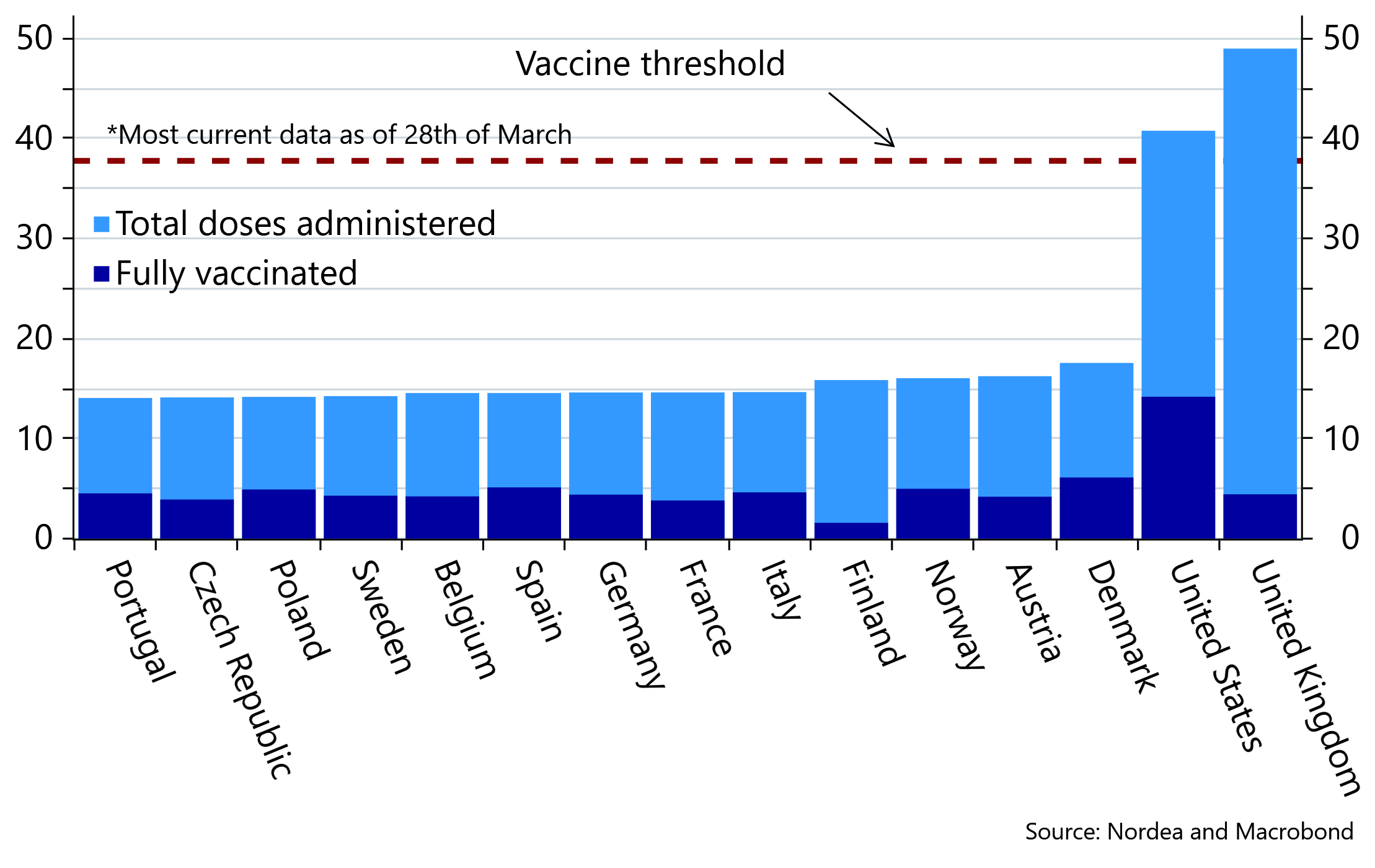
While the U.S. races to vaccinate its population — almost 29% have received at least one dose — the virus could still push ahead, experts said. Each time it infects a new person, the possibility increases of additional mutants that could spread faster or evade vaccines. (…)

B.1.1.7, a contagious strain that first surfaced in the U.K., now makes up about 26% of all sequenced viruses, Walensky said Monday. The CDC has previously projected it could become the dominant coronavirus strain in the U.S. by March. It is “probably less forgiving and more infections will occur,” Walensky said on Monday. (…)

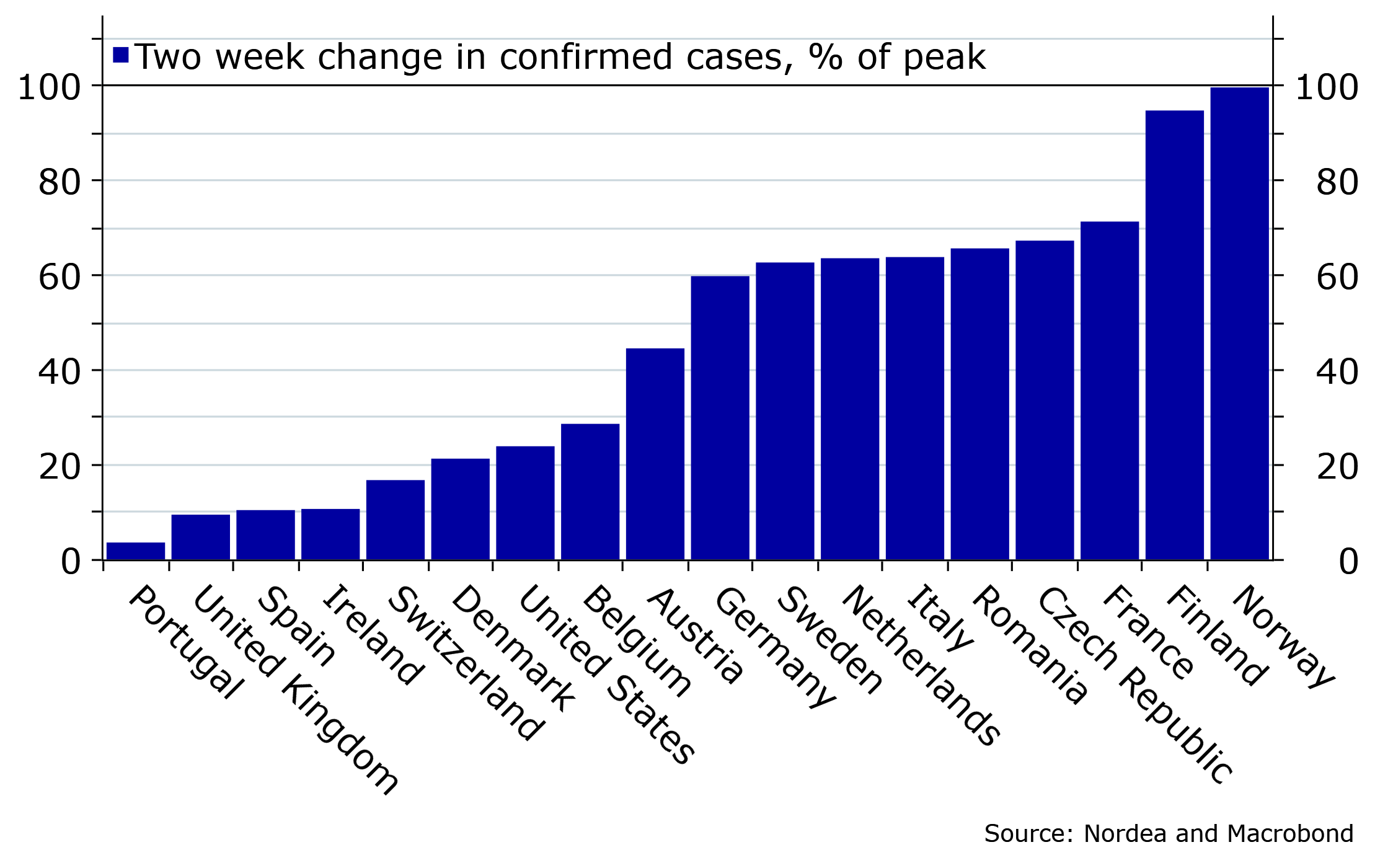
Daily case totals have surged to the highest levels since November in France, where doctors have warned that shortages of ICU beds loom. Italy, Germany and other countries are also seeing increases. So far deaths are well below levels from previous waves of the pandemic, however.

In the U.K., meanwhile, both cases and deaths have plunged to the lowest levels since September. The country has been Europe’s leader in vaccination, with shots given to more than half of the adult population. (…)

Bloomberg

Change in cases over the past two weeks as % of peak of the pandemic
Covid-19 vaccines from Pfizer Inc. and Moderna Inc. effectively prevented coronavirus infections, not just illness, with substantial protection evident two weeks after the first dose, government researchers said.

Two doses of the vaccines provide as much as 90% protection against infection, according to data from U.S. Centers for Disease Control and Prevention study published Monday.

The study adds to evidence that new vaccines made with messenger RNA technology actually reduce the spread of the virus in real-world conditions. An earlier study in Israel found a single dose of the Pfizer vaccine reduced infections by as much as 85%. (…)

Doses administered and fully vaccinated people as percent of population
China, Long a Source of Deflation, Starts Raising Prices for the World Rising raw-materials costs and unrelenting supply-chain constraints are prompting many Chinese exporters to increase prices for the goods they sell abroad, raising fears it may add to global inflationary pressures.

(…) Rene de Jong, director of Resysta AV, an outdoor furniture manufacturer based in the southern Chinese city of Foshan, said he plans to raise prices by around 7% on new orders this summer. (…) “In my nearly 25 years in China, I’ve never seen anything like this. I’ve never seen shipping costs like this before while steel and aluminum prices shot through the roof,” he said, adding that the company’s profit margins are under pressure.

Other Chinese exporters raising prices include apparel businesses and a toy wholesaler who told The Wall Street Journal his company has raised prices for new orders across the board by 10% to 15% since the beginning of March. (…)

Prices for imports from China to the U.S. rose 1.2% over the past year, the fastest increase since 2012, with most of the increase coming in the three months ending in February, according to data from the U.S. Bureau of Labor Statistics. (…)

Not an obvious problem just yet:

fredgraph - 2021-03-30T060937.310

On the other hand:

Saudi Arabia is prepared to support extending oil cuts by OPEC and its allies into June and is also ready to prolong its own voluntary cuts to boost prices amid a new wave of coronavirus lockdowns, a source briefed on the matter said on Monday. (…)

“They don’t see demand as yet strong enough and want to prevent prices from falling,” the source said. (…) A source familiar with Russia’s thinking said on Monday Moscow would support extending cuts again while seeking another small rise in production for itself.

On the other hand:

JPMorgan, Salesforce Join List of Firms Dumping Office Space Rise of remote work means demand for office space could be permanently lower for some companies

(…) At the end of 2020, 137 million square feet of office space was available for sublease across the U.S., according to CBRE Group Inc. That is up 40% from a year earlier and the highest figure since 2003. (…) But this time many of the companies ditching real estate are doing well financially; they say they need less space because they plan for more employees to work at least part time from home even after the pandemic is over. (…)

Office rents for more expensive space, including concessions, fell around 17% over the past year in New York and San Francisco and 13% nationwide, according to real-estate firm JLL.

Sublease space usually comes with an additional 25% discount, said David Falk, president of the New York tri-state region at real-estate services firm Newmark. And since firms can sublease on short notice, rising sublease availability can serve as an early indicator of the true state of the office market. (…)

In previous years, tech companies often leased more space than they needed at the time to be prepared for growth, JLL’s Mr. Ryan said. This practice, dubbed space banking, has left some with too much office space that they are now trying to get rid of. (…)

And the suburbs aren’t immune either. A number of companies are looking to get rid of call centers and other back-office facilities in cheap locations, Mr. Ryan said. (…)

FROM GROWTH TO VALUE TO TRASH

Bloomberg’s John Authers:

(…) By Bloomberg’s measurement, pure value is having its strongest performance relative to momentum since 2018. A brief rebound for big tech stocks earlier this month has been canceled out:

Value is its highest relative to Momentum in four years

(…) The problem may now be that value companies are being bought as though they are completely interchangeable with stocks that do well in conditions of high inflation. They aren’t. In the following graph, Andrew Lapthorne, chief quantitative strategist of Societe Generale SA, compares his “inflation” basket of global stocks, mostly from the resources sector, that will do best during periods of inflation, with the Russell 2000 Value index, which covers U.S. small-caps that look cheap. There are no stocks that are in both, and yet their performance has been identical over the last six months as money has poured into small-cap value ETFs:

relates to Derivatives Don't Cause Market Crises, People Do

To look at the same phenomenon another way, one line in the following chart shows the Solactive Global Copper Mines index (as sensitive to rises in commodity prices as just about any companies on Earth) relative to the MSCI All-World index, and the other the Russell 2000 Value. The performance has been almost identical:

Small U.S. value stocks are being treated as a pure play on inflation(…) The rally of the last 12 months has in many ways been a “dash for trash,” in which companies with weak balance sheets did better as fears of a widespread bankruptcy crisis receded.

Another way to capture this is through the “quality” factor, which has various definitions but which generally refers to stocks with clean balance sheets and reliable profitability. Such stocks did predictably well during the Covid scare a year ago, and have performed shockingly badly since then, as illustrated by this chart from Mike Wilson, U.S. equity strategist at Morgan Stanley:

relates to Derivatives Don't Cause Market Crises, People Do

High-quality stocks now look extremely cheap compared to low-quality stocks, then. Wilson also compares quality stocks to the U.S. market as a whole going back to 1984, and reveals that the virtues of a strong and stable company have never been less in demand:

relates to Derivatives Don't Cause Market Crises, People Do(…) interest cover for smaller companies looks barely better than at the worst points of the last two bear markets, as this chart from Lapthorne of SocGen shows:

relates to Derivatives Don't Cause Market Crises, People Do

Just so you know:image

image_thumb1

EQUITIES: LONG-TERM FORECASTS

U.S. stock prices will double over the next decade, as pandemic-induced policy changes and an increasingly desperate hunt for real returns push investors to equities, Sanford C. Bernstein strategists said.

The S&P 500 index will reach 8,000, up from its 3,971 close on Monday, Inigo Fraser-Jenkins and Alla Harmsworth wrote in a note. (…)

“We are in a totally new policy environment where there is a case for higher (but not too high) inflation and also the possibility that real rates remain low,” Fraser-Jenkins said in an email (…)

“Rates may not respond as quick to inflationary signals,” the Bernstein analysts wrote in the note. “This leaves us with the prospect of persistent low real yields which can justify market valuations.” (…)

  • Richardson Wealth warns about valuations:

image

  • KKR pounds the table:

We think that we are in the early stages of an economic recovery that will look quite different from that which occurred starting in 2009. We think that nominal growth will run above trend for the foreseeable future, driven by a stronger than expected consumer and a rebound in non-tech related capital expenditures. While we expect cyclical inflation, we remain in the camp that a secular increase in inflation is not upon us.

From a portfolio construction perspective, we advocate for more of a cyclical bias that favors pricing power and is connected to global growth and hard assets. Financials, Loans, and higher quality Emerging Markets should all benefit. All forms of collateral-based cash flows should be owned in size. By comparison, government bonds should be underweighted in global portfolios, particularly in the United States

In terms of our concerns arising from global growth being too hot, we think that the biggest risk is that investors don’t lean in enough to what our macro models are saying about future growth and return prospects. We do not typically make these type of table pounding statements, but the early indications across the global capital markets in 2021 suggest that we are at the early stages of a secular change in portfolio construction that warrants attention from all globally oriented asset allocators and macro traders.

image

Credit Suisse Bid for Tidy Archegos Fix Ends With Banks Brawling

(…) Given Archegos’s size, unwinding its positions could generate losses of around $2.5 billion to $5 billion for the industry, depending on how hard it is to liquidate holdings, JPMorgan Chase & Co. analyst Kian Abouhossein wrote in a note to clients. (…)

  • The question now is whether the implosion at Archegos will have knock-on effects. It could do this by creating equity losses at other funds that force them to make adjustments. Or, more damagingly, it could radiate out through the problems created for the banks who lent to them. By the close of trading Monday, it looked as though major contagion had been avoided. It is always possible that more losses will pop up in unexpected places. (John Authers)
  • But many hedge funds have exposure to the same basket of stocks as Hwang’s family office and with the U.S. economy rebounding, some of the speculative capital that ploughed into Chinese shares is exiting.
  • Another major bank joined the list of firms warning of potential losses. MUFG’s securities arm estimates a loss of about $300 million tied to an unidentified U.S. client. It’s indeed linked to Archegos, a person familiar said. (BB)

The other question is why bankers continue to heavily deal with people like Hwang:

Prime brokers shook off concerns about Archegos as they eyed lucrative lending

Concerns?

  • In late 2008, the Wall Street Journal said Tiger Asia suffered losses from shorting Volkswagen AG (…). Hwang’s Tiger Asia finished down 23% in 2008.
  • In 2012, he agreed to pay $44 million to settle with the Securities and Exchange Commission over insider trading of Chinese bank stocks.
  • In 2014, Hong Kong banned him for four years and slapped him with a HK$45.3 million fine ($5.3 million).
  • In this case, Bloomberg reported that Archegos had used derivatives contracts with brokers known as swaps to gain substantial additional leverage. That meant that the firm didn’t have to disclose its holdings in regulatory filings, since the positions were on the banks’ balance sheets.

FYI: U.S.-based long-short hedge funds are still 201% leveraged, only 9% lower than January’s decade-high. (…) Friday’s margin call was not an isolated event. More pain is in store for those who have embraced the same strategies. (Bloomberg)

US to make it easier for diplomats to meet Taiwanese officials Plan to loosen restrictions on contacts with Taipei threatens to provoke China

THE DAILY EDGE: 29 MARCH 2021

PENT-UP OR SPENT-UP?

Friday’s consumer spending release did little to tilt the debate one way of the other as bad weather in much of the U.S. likely kept many consumers indoors.

Interestingly, however, after 12 months, Wages and Salaries are back to their pre-pandemic level, even with 9.5 million fewer people working. By comparison, it took 40 months to revisit the October 2008 peak during the GFC which cost 8.7 million jobs at its worst point. Considering that 8.4 of the 9.5 million fewer working people are in Service-Providing sectors, the economic re-opening should bring Wages and Salaries closer to the trend line by the end of 2021. If so, labor income could be up as much as 8.0% YoY by the end of the year.  

fredgraph - 2021-03-27T110141.342

Consumer spending, which tends to closely track labor income, was down 1.0% MoM in February and is 0.6% below pre-pandemic levels. Spending on Goods declined 3.0% MoM in February following its 8.4% jump in January. It has declined in 4 of the past 5 months but is still up 5.5% annualized (nominal) for the period.

image

Taking into account Federal rescue money, disposable income is up 5.0% YoY during one of the worst recession. KKR estimates that the average American household’s disposable income rose 4.6% in 2020 and will rise another 4.8% in 2021 despite the surge in unemployment. Add $2.5 trillion in extra savings by the end of 2021 (17% of pre-pandemic annual consumption spending) and one can only conclude that the consumer sector will remain a driving force for the economy for several years.

imageNot all of those dollars will get spent at once, but we do think they will support a multi-year expansion. Much of the extra savings have built up at the high end, as lockdowns have curtailed upper-income spending on travel and leisure. Excess savings should help catalyze big-ticket discretionary spending amid reopening.

At the lower end, high and sustained consumer demand could encourage employers to accept paying higher wages to attract hard-to-find labor as the economy re-opens. This is not only true in specialty manufacturing or in transportation. Many restaurant and retail groups have announced higher wage rates to retain and attract qualified workers. Last week:

Darden [Restaurants] said Thursday that starting next week, hourly restaurant employees will earn at least $10 an hour, including tips, instead of the federal minimum wage [$7.25] or state minimum wage. The company is planning to raise that floor to $11 per hour in January 2022, and $12 an hour in January 2023. The change will impact about 20% of hourly workers, according to the company. The move comes at a time when Darden is trying to attract workers. Our greatest challenge right now is staffing,” Darden CEO Eugene Lee said on a call with analysts. (…) Staffing up is “our number one priority right now,” Lee said.

In reality, Americans will emerge from the pandemic in great financial shape:

  • total disposable income is up well above inflation;
  • swollen bank accounts and credit card balances down 12%;
  • much lower interest rates on most other debt.

fredgraph - 2021-03-28T071042.511

fredgraph - 2021-03-28T071330.545

Thanks to “stimmy” checks and unprecedented money printing, real disposable income is set to have its biggest increase ever in any given six-quarter period, says Credit Suisse. The firm expects U.S. consumption to surge an “extreme” 10% this year, triggering a significant jump in new orders and new hiring—all of which is highly inflationary. This month, in fact, U.S. manufacturers reported the sharpest rise in new orders since 2014, according to IHS Markit.  (Via US Funds)

real disposabble income having perhaps its best six-quarter stretch ever

The other debate is about inflation. Larry Summers on Bloomberg last week:

“If you were looking to un-anchor inflation expectations, having the Fed chair say the Fed’s going to have a new regime and is no longer sure that overheating the economy leads to inflation, and having the administration say we’re in an entirely new progressive era where policy is going to differ radically from what it has been for the last 40 years — those would seem like the best things you could do if you were trying to un-anchor expectations,” he said.

KKR’s Henry McVey:

If there was ever a time to talk about inflation, now is that time. We have record money supply growth, a dovish Fed, and a new Secretary of Treasury who may be even more dovish than the current Fed chair. (…) inflation risk is clearly the issue most heavily weighing on investors’ psyches.

But Friday’s data release did nothing to boost inflation expectations:

A key measure of inflation was mostly muted in February. The price index for personal-consumption expenditures, the Federal Reserve’s preferred inflation gauge, rose 1.6% last month from a year before, the Commerce report showed. That was slightly faster than the 1.4% annual rise in January, and the largest year-over-year increase since February 2020.

After excluding volatile food and energy components, however, the so-called core index was up just 1.4% in the year ended in February, which was slower than the 1.5% year-over-year increase in January.

fredgraph - 2021-03-28T071946.664

The Atlanta Fed’s Underlying Inflation Dashboard:

unnamed - 2021-03-28T094601.717

PCE Durable Goods prices, still up 1.0% YoY (+3.3% per the CPI), declined 0.1% in February and have declined in 4 of the last 6 months. Market-based core PCE prices are not accelerating and are up only 1.4% YoY in February, essentially unchanged during the last eight months.

image
fredgraph - 2021-03-28T080229.552

Curiously, CPI-Durables did not drop in March and April 2020 unlike PCE-Durables, largely explaining the current gap in YoY measures. In the last 5 months, prices of PCE-Durables are off 0.25% while prices of CPI-Durables are flat.

fredgraph - 2021-03-28T080541.471

Investor angst is really focused on goods inflation given rising commodity prices, supply and supply chain issues and very low inventories. But the evidence so far does not support runaway goods inflation, perhaps because merchants have been able to offset these cost increases with higher volume and increased productivity.

S&P 500 companies reported revenues up 2.7% in Q4’20, materially above expectations, particularly for consumer-sensitive sectors. Q1’21 revenues are seen up 8.6% (+10.1% ex-Energy). Profits, up 3.8% in Q4’20, are forecast up 23.9% in Q1’21, again materially above previous expectations.

image

Now, Goldman informs us that since “it takes several quarters for upstream costs to be reflected in consumer prices, overall core PCE inflation probably does not yet fully reflect higher commodity costs and industrial goods prices. (…) upstream input prices tend to lead core goods prices by 2-6 quarters.”

If so, the hit to inflation, or to profit margins, should begin in Q2 or Q3. So far, corporate pre-announcements for Q1 are better than they were for Q4’20. It will be interesting to hear forward guidance in the next few weeks.

Meanwhile, the economy is gradually re-opening (charts from GS and US Global Investors):

image

TSA Checkpoint Crossing Hit a new post-pandemic high

Fridges, microwaves fall prey to global chip shortage A global shortage of chips that has rattled production lines at car companies and squeezed stockpiles at gadget makers, is now leaving home appliance makers unable to meet demand, according to the president of Whirlpool Corp in China.

Economists bullish on Biden’s $3T infrastructure plan (Axios)

Economists are becoming positively giddy about the potential for economic growth this year as President Biden and Congressional Democrats look set to push forward a $3 trillion infrastructure bill.

“Stimulus helps build the bridge for the recovery to reach the other side, but an investment in infrastructure is the fuel to jump start the economic engine,” Beth Ann Bovino, U.S. chief economist at S&P Global, says in an email.

  • S&P predicts Biden’s infrastructure plan will create 2.3 million jobs by 2024, inject $5.7 trillion into the economy — which would be 10 times what was lost during the recession — and raise per-capita income by $2,400.

Economists at Goldman Sachs again revised up their outlook for growth this year in a Sunday note to clients, predicting real consumption will grow by 9.5% in Q1 and 12.5% in Q2, citing retailer reopenings, the reversal of winter storm effects and a decline in new COVID-19 infections.

  • Further, they note that OpenTable restaurant reservations are nearing 70% of normal nationwide and are back above their pre-crisis level in Texas.
  • They also anticipate the pace of fiscal support to U.S. consumers will accelerate by $1 trillion on an annualized basis (or 5% of GDP) for March and the second quarter, relative to the previous six months.
Faster Inflation Is Coming. How Bad Will It Be? (Mohamed A. El Erian)

(…) While economists and the Fed would view a spike in inflation through a longer lens, markets might well end up living more in what Bloomberg’s Jonathan Ferro labels “the moment” — that is, reacting in the short term by rapidly taking bond yields higher and risking to destabilize stocks and other risk assets that have benefited enormously from the widespread market confidence in continuing ample and predictable liquidity injections. Coming at a time of excessive and, in some cases, irresponsible risk-taking, this could have adverse economic spillovers.

Such effects would be felt well beyond the U.S. Already, European Central Bank officials have complained about the “undue tightening” of euro-zone financial conditions because of higher U.S. bond yields. This has also contributed to a slowly widening cycle of interest rate increases by central banks in emerging economies. (…)

With that comes the risk of higher market volatility and, on the political front, the prospects of more heated congressional deliberations on economic and social well-being that could make subsequent fiscal packages harder to pass quickly notwithstanding their importance for a lasting U.S. recovery.

House Prices Are Inflating Around the World Pandemic-related stimulus, ultralow rates and changes in buyer behavior are turbocharging markets from Europe to Asia

In the 37 wealthy countries that make up the Organization for Economic Cooperation and Development, home prices hit a record in the third quarter of 2020, according to OECD data. Prices rose almost 5% on the year, the fastest in nearly 20 years.

(…) “It is clear that rising [house] prices of between 5% and 10% annually, depending on the market we are talking about, are not sustainable in the long run,” said Karsten Biltoft, assistant governor at the [Danish] central bank. (…)

Property prices are up 16% over the past year in the city of Shenzhen, for example. In New Zealand, authorities recently tightened mortgage lending standards, with median home prices climbing 23% in February from a year earlier to a record.

In Sydney, where property prices also recently hit records, new mortgage demand is so high that some banks are struggling to keep up, said Christian Stevens, senior credit adviser at mortgage brokerage Shore Financial. (…)

As in the U.S., much of the buying globally is being driven by real demand rather than speculation, with families looking to upgrade to larger properties in suburban areas as they work more from home. (…)

Canada’s central bank governor, Tiff Macklem, said in February there were early signs of “excess exuberance” in the Canadian housing market, with prices up 17% on an adjusted basis over a one-year period, according to the Canadian Real Estate Association. Mr. Macklem said officials would be monitoring the situation closely, but dismissed taking measures to rein in sales, saying the economy needed all the support it could get. (…)

In early March, the chairman of China’s main banking regulator said he was worried about a possible correction in home prices, which could threaten banks’ stability.

Europe’s housing prices have kept climbing despite a much bleaker economic outlook than in the U.S. or China. In part that is because governments have kept supporting families with salary subsidies and moratoriums on loan repayments. It is also because interest rates remain extraordinarily low, with mortgage rates averaging 1.35% across the eurozone. (…)

(…) Farmland values rose during 2020 as soaring grain prices last fall revived farmers’ fortunes, according to February reports from three regional Federal Reserve Banks. Land prices in the Chicago Fed region, which covers parts of Illinois, Indiana, Iowa, Michigan and Wisconsin, climbed 6% last year, the largest such increase since 2012, the bank said.

Many agricultural lenders surveyed by the banks expected farmland values to rise this year as well. A March survey of Iowa farmland specialists showed a statewide average of farmland values was up nearly 8% since September, according to Iowa’s chapter of the Realtors Land Institute. (…)

Competition among U.S. farmers for land is fierce partly because there is less to go around. (…) Fewer, bigger farmers now dominate the country’s remaining 900 million acres, with 75% of farmed cropland controlled by about 13% of farms, the data show. (…)

China Helped Rev Up, Then Slow Down, the Commodities Boom Nearly a yearlong bull run among industrial metals is faltering as the unwinding of a stimulus in China slows demand, underscoring the increasingly pivotal role its state-led economy plays in global commodity booms.

(…) China, which accounts for as much as 60% of the world’s resource consumption, has in recent weeks pulled back from its investment-led playbook, as policy makers refocus on containing bad loans and retooling the economy onto a consumer-led footing. Amid fresh concern that some battery-making metals could be globally oversupplied, benchmark metals fell in March from records a month earlier—nickel by 18%, cobalt 13% and copper 9%. (…)

Among the most tightly supplied of such metals globally is copper. But even so, copper imports to China had eased by December off midyear highs, down 9% that month compared with November. Imports of lithium-cobalt oxide, the bluish-gray crystal used in rechargeable battery electrodes, were down 14% for the year compared with 2019. Nickel ore imports in 2020 fell 30% year over year. (…)

In early March, nickel prices, which had soared for months on China’s projected battery demand, plummeted 9% in a single day, hours after Chinese metal producer Tsingshan Holding Group announced plans to cheaply supply large volumes of nickel matte, a battery ingredient, to Chinese battery makers—damping industrywide expectations of battery-grade nickel shortages.

Also weighing on prices: U.S. miners are racing to develop new supplies of lithium, in part to lessen dependence on China, which analysts estimate controls around half the world’s lithium output and makes three-quarters of its lithium-ion batteries. (…)

“Can China continue to demand the same amount of commodities? To me, the answer is no, because its structural growth is coming down,” Ms. Garcia-Herrero said. “This doesn’t bode well for supercycle.”

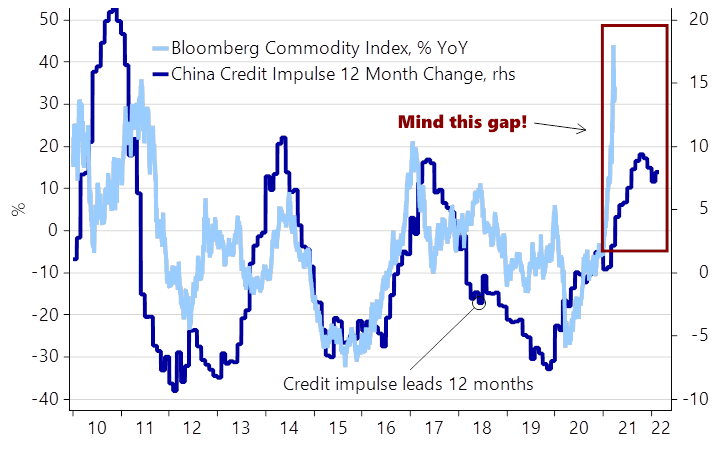
Is the so-called commodity super cycle running on fumes already?

(Nordea)

Lower commodity prices would help the “inflation transitory” team:

relates to Bull Market Interrupted Is a Bearish Script for Stocks
imagefredgraph - 2021-03-29T083537.253
Pandemic Accelerates Retirements, Threatening Economic Growth The proportion of older workers participating in the labor force is hovering at its worst level since the onset of the coronavirus pandemic, potentially impairing economic growth.

The labor force participation rate—the proportion of the population working or seeking work—for Americans age 55 and older has fallen from 40.3% in February of 2020 to 38.3% this February—representing a loss of 1.45 million people from the labor force.

The participation rate initially fell much more for prime-age workers, those between ages 25 and 54, from 82.9% in February last year to 79.8% in April, but has since jumped 1.3 points, to 81.1% in February of this year. By contrast, participation for older workers has shown no rebound from last spring. (…)

fredgraph - 2021-03-29T072912.527

Many of these workers appear to have retired and thus may not return even when the public-health crisis is over. The proportion of the working-age population not in the workforce due to retirement rose to 19.3% in the fourth quarter of 2020 from 18.5% a year earlier, just before the pandemic, according to government data compiled by the Federal Reserve Bank of Philadelphia.

That is roughly 2.4 million workers who left the labor force due to retirement since the pandemic’s onset, more than double the number who did so in 2019, according to Ms. Boussour’s analysis. (…)

That decline is especially worrisome because it comes as an aging population has already been holding down growth in the U.S. labor force. Economic output depends on the number of workers and how productive each worker is. Thus, the decline in participation, if not reversed, could weigh on growth. (…)

There will be impacts on growth but also on productivity and wages.

Suez Container Ship Is Partially Freed Engineers partially freed a wedged ship blocking the Suez Canal and tug boats were working to straighten its course, an effort that could soon reopen the vital trade route and end days of global supply disruptions.

Ninja MARGIN CALL

Stock Futures Drop as Banks Warn of Losses S&P 500 futures edged lower after Archegos Capital unwound billions of dollars in holdings, triggering concerns that banks who dealt with the firm could face sharp losses.

(…) Global investment banks Credit Suisse Group and Nomura Holdings on Monday said they could incur substantial losses from dealings with a U.S. client. Neither bank named its respective client. Shares in some global banks fell as investors grew worried that more financial intermediaries may struggle to recoup money loaned to this client. (…)

Morgan Stanley, Goldman Sachs Group and Deutsche Bank unloaded large blocks of shares for Archegos last week. According to people familiar with the fund, the highly leveraged Archegos took big, concentrated positions in companies and held some positions via swaps. Those are contracts brokered by banks. (…)

(…) Much of the leverage used by Hwang’s Archegos Capital Management was provided by banks including Nomura Holdings Inc. and Credit Suisse Group AG through swaps or so-called contracts-for-difference, according to people with direct knowledge of the deals. It means Archegos may never actually have owned most of the underlying securities — if any at all.

While investors who build a stake of more than 5% in an U.S.-listed company usually have to disclose their position and future transactions, that’s not the case with stakes built through the type of derivatives apparently used by Archegos. The products, which are made off exchanges, allow managers like Hwang to amass stakes in publicly traded companies without having to declare their holdings. (…)

While the margin calls on Friday triggered losses of as much as 40% in some shares, there was no sign of contagion in markets broadly on Monday. (…)

As well as their secrecy, equity swaps and CFDs grew in popularity among hedge funds because they are exempt from stamp duty in high-tax jurisdictions such as the U.K. Banks like them because they can make a large profit without needing to set aside as much capital versus trading actual securities, partly a consequence of regulation imposed in the aftermath of the global financial crisis.

Regulators in Europe have begun clamping down on CFDs in recent years because they’re concerned the derivatives are too complex and too risky for retail investors. In the U.S., CFDs are largely banned for amateur traders. (…)

TECHNICALS WATCH

My favorite technical analysis firm remains positive while acknowledging that continuing short-term gyrations could be unnerving to many. Selling pressure has increased since Mid-February even with rising equity prices. Not problematic so far but an indication that more investors are finding reasons to trim exposure.

But the “broadening market” theme seems at risk:

The latest data points on retail trading from Charles Schwab show that retail trading activity has declined for the 3rd consecutive week, down 7% last week, following 13% and 5% declines in the prior two weeks. Trading activity is now 30% below late January peak levels on Charles Schwab’s platform. MS QDS team report that their retail proxy metrics indicate that option volume is down and premium spent on calls via small orders (odd lots) is also down recently. Perhaps, we may have seen the peak of the retail hand in markets, as businesses are slowly beginning to re-open and people go back to work they will have less time / fewer resources to sit at home and undoubtedly trade. (The Market Ear)

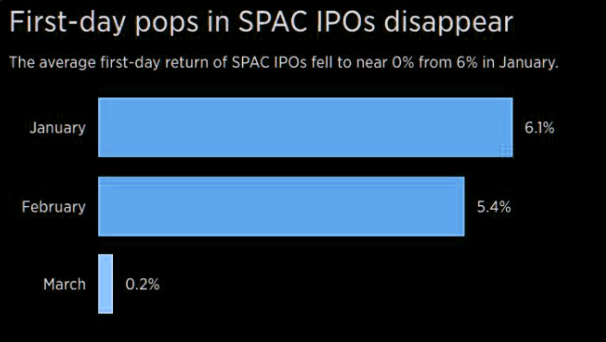
  • Gone with the wind – SPAC first day pops.

(…) “I don’t know what the f— I’m doing,” a young man said in a TikTok video in January. “I just know I’m making money.” He added that he’d been trading stocks for only three days, but “just like that, made $300 for the day.” In the next few weeks that young man, Danny Tran, racked up roughly 500,000 followers on TikTok.

At the WallStreetBets forum on Reddit, the online chat community, comments like “I can’t read” and “I have no idea what I’m doing” are common. Users insult each other’s—and their own—intelligence as terms of endearment and badges of honor. In February, commenters on WallStreetBets called themselves “stupid,” “idiot” or related terms 3,550 times, according to TopStonks.com, which tracks stocks mentioned on Reddit and other sites. (…)

As of March 23, 95.9% of the slightly more than 3,000 stocks in the Wilshire 5000 Total Market Index had a positive total return over the prior 12 months, according to Wilshire. No other one-year period has come close to that since the end of February 2004, when 93% of stocks had positive 12-month returns. (…)

The expected value of a lottery ticket is generally less than 65 cents on the dollar. Casinos, sports-betting websites and online gaming outfits take less “vigorish” as their cut, but on average the house always wins. Most bettors know that, but no one minds—because the hope of winning is so exciting, no matter the odds.

Now that just about anybody can trade commission-free, gambling on stocks offers a much better chance of making money than other kinds of wagers.

(…) A stock is much more fun than a lottery ticket, which is static and which assures that you will almost always lose.” (…)

“The majority of the time I’m winning, with barely any knowledge, so it’s been a fun process,” he says. “Knowing what you’re doing would always be good, but in this market anything is possible.” (…)

Note Summertime,

And the livin’ is easy

Fish are jumpin’

And the cotton is high Note

TESTING, TESTING!

ARKK

TESTING?

U.S. fears China attack on Taiwan (Axios)

“The US is concerned that China is flirting with the idea of seizing control of Taiwan as President Xi Jinping becomes more willing to take risks to boost his legacy,” the Financial Times reports (subscription).

  • A senior U.S. official told the FT the Biden administration had reached the conclusion after assessing Chinese behavior during the past two months.

An invasion of Taiwan, the self-governed island claimed by Beijing, would force the U.S. to decide whether to go to war with China to defend an implicit ally.

  • After a show of force by Chinese bombers off Taiwan just after President Biden took office, the State Department said: “We urge Beijing to cease its military, diplomatic, and economic pressure against Taiwan.”

Adm. John Aquilino, nominee to head U.S. forces in the Pacific, warned the Senate Armed Services Committee this week that the threat to Taiwan “is much closer to us than most think,” CNN reported.

Adm. Philip Davidson, current head of the U.S. Indo-Pacific Command, testified earlier this month that the Chinese military is building up offensive capability, making the threat to Taiwan “manifest during this decade — in fact, in the next six years.”