Signals More Aggressive Path The Federal Reserve raised its benchmark rate to between 3% and 3.25%, and projected it will rise to at least 4.25% by year’s end. Most Fed officials expect higher unemployment over the next year, implying rising recession risks.
Nearly all of them expect to raise rates to between 4% and 4.5% by the end of this year, according to new projections released Wednesday, which would call for sizable rate increases at policy meetings in November and December.
“We have got to get inflation behind us. I wish there were a painless way to do that. There isn’t,” Fed Chairman Jerome Powell said at a news conference after the rate decision.
Officials’ projected that rate rises will continue into 2023, with most expecting the fed-funds rate to rest around 4.6% by the end of next year. That was up from 3.8% in their projections this past June. (…)
“There is a message here that rates will stay higher for longer, and this message is really sticking with market participants,” said Blerina Uruci, U.S. economist at T. Rowe Price. (…)
To limit further confusion on Wednesday, Mr. Powell prefaced his answers to reporters’ questions with a disclaimer. “My main message has not changed at all since Jackson Hole,” he said. (…)
“No one knows whether this process will lead to a recession or, if so, how significant that recession will be,” he said. “We certainly haven’t given up the idea that we can have a relatively modest increase in unemployment. Nonetheless, we need to complete this task.” (…)
It sounds like the Fed is done with forecasting, having learned the perils, particularly in such a complicated world.
“That’s not where we expected or wanted to be,” he said. “Our expectation has been that we would begin to see inflation come down largely because of supply-side healing. By now we would have thought that we would have seen some of that. We haven’t.”
Hence the data dependency. He again said, clearly aiming at investors, that the FOMC will not be influenced by one-month data. They are looking at trends in core PCE inflation on 3-6-and 12-month intervals “currently showing 4.8%, 4.5% and 4.8% annualized respectively.”
He listed 4 conditions for an easing in inflation:
- job openings need to decline significantly with rising unemployment;
- inflation expectations must remain well anchored;
- the various supply shocks will abate;
- real yields must be positive across the yield curve.
Speaking of supply, rising interest rates can have pernicious effects:
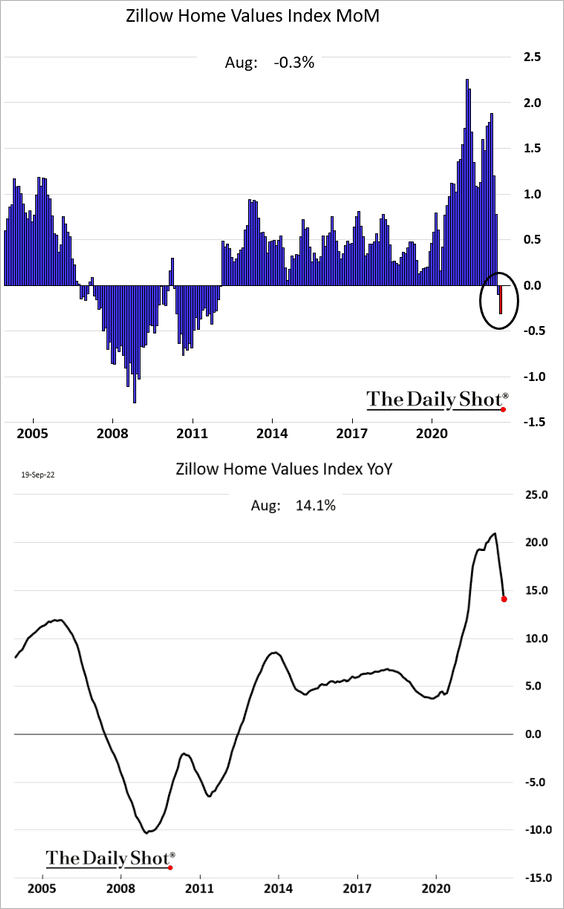
- After Years of Low Mortgage Rates, Home Sellers Are Scarce Many homeowners locked in the “golden handcuffs” of low mortgage costs find it too daunting to sell their homes now that rates are so much higher.
(…) the number of newly listed homes in the four weeks ended Sept. 11 fell 19% year-over-year, according to real-estate brokerage Redfin Corp. That is an indication that sellers who don’t need to sell are staying on the sidelines, economists say. (…)
According to the U.S. Census, the total percentage of homeowners mortgage in the U.S. is 64.8%. Curiously, it may take a meaningful decline in mortgage rates to boost the supply of homes along with demand.
• 4.800 mil. in August, lowest since May ’20; 4.820 mil. in July (revised up from 4.810 mil.).
• Existing single-family home sales drop for the seventh consecutive month while condo & co-op sales rebound following six straight m/m declines.
• Regional sales patterns are mixed: sales in the Midwest fall for the fourth successive month; sales in the South hold steady; sales in the Northeast and the West rebound.
• Median price falls for the second consecutive month to the lowest level since March; broad-based regional price declines: prices in the South and the West fall for the third straight month while prices in the Northeast and the Midwest fall for the second successive month.

- U.S. mortgage interest rates reach 6.25%, highest level since October 2008
- Workers’ Changing Attitudes Tighten Labor Market The Covid pandemic has altered what job conditions, hours, and pay workers are willing to accept.
(…) The effect is to make labor scarcer and more expensive than ordinary economic indicators show. (…)
The unemployment rate, at 3.7%, is similar to levels of 2019, but far more jobs are vacant. The share of the working-age population either working or looking for work—the “participation rate”—dropped sharply with the pandemic and hasn’t fully recovered, especially for those over age 54. And that may understate the decline in the supply of labor. Since 2013, surveys by the Federal Reserve Bank of New York have asked how many hours respondents preferred to work. (…)
They reckon that by the end of 2021, based not just on how many people were available but how many hours they preferred to work, there were far fewer potential hours available to employers than before the pandemic. (…)
Much of the change in willingness to work “is driven by historically high worker bargaining power driven by high demand, a global pandemic and huge labor shortages,” Ms. Şahin said in an email. “An unemployment rate of higher than 6% could reverse these views on work pretty quickly.”
Sales Managers Index: Main U.S. Business Activity Indicators Look Positive in September. But Price Inflation Worsens
Both the Market Growth and Sales Growth Indexes, registering index levels of 52.6 and 53.3 respectively, reflected a more buoyant environment than seen for some time. The former reaching an 8 month high and the latter a 7 month high.
Business Confidence rose to a 4 month high, but despite a positive index reading of 50.7, remains too close for comfort to the 50 “no growth” line. And the one real negative, overall staffing levels remained low compared with one year ago.
The Sales Managers Index, summarising these trends, jumped from below the 50 “no growth” level to well above the line.
The Prices Index rose from 54.5 to a worrying 56.6, indicating the continuing presence of high price inflation in producer markets generally. Price inflation has very definitely not yet been vanquished.

Tomorrow we get the flash Purchasing Managers Surveys.
High Energy Prices in Europe Push Manufacturers to Shift to the U.S. The Ukraine war is driving up costs in Europe, while relatively stable prices and green-energy incentives are luring companies to the U.S.
As wild swings in energy prices and persistent supply-chain troubles threaten Europe with what some economists warn could be a new era of deindustrialization, Washington has unveiled a raft of incentives for manufacturing and green energy. The upshot is a playing field increasingly tilted in the U.S.’s favor, executives say, particularly for companies placing bets on projects to make chemicals, batteries and other energy-intensive products. (…)
BOE Unveils Half-Point Hike as Three Push for Bigger Move
Switzerland [75bps] and Norway [50 bps]raise interest rates to curb inflation
Vietnam Central Bank Surprises With Rare Policy Tightening
Operation Twist Will Hasten Impact of Indonesia’s Rate Hikes [50 bps]