(…) Overall consumer prices increased a seasonally adjusted 0.2% in June from the prior month, compared with May’s 0.1% gain. Core consumer prices climbed 0.2%, just slightly above their pace in February 2021 at the start of the inflation surge. A more narrow measure of inflation that excludes goods, housing and energy was essentially flat in June from the prior month, according to Wall Street Journal calculations. (…)
Facts:
- CPI +0.18% MoM for June (+3.0% YoY) after +0.12% (+4.1%)
- Core CPI +0.16% MoM for June (+4.8% YoY) after +0.44% (+5.3%)
- Core Goods -0.1% MoM (+1.3% YoY) after +0.6% in April and May.
- Core Services +0.3% moM after +0.4% in April and May.
- CPI “Essentials” (food, energy, rent) +0.33% MoM in June (+4.1% YoY) after 0% in May
John Authers: Getting So Much Better, But Not Enough to Stop a Rate Hike
(…) Breaking down year-on-year inflation into its component elements shows that energy now has a negative impact, after fuel costs drove the spike in 2021. That’s not surprising. More impressively, core goods inflation, running hot at the beginning of last year, has dwindled almost to nothing. And core services, the source of the greatest current anxiety, is also ticking down. This is close to exactly what the Fed would have wanted to see:

(…) In short, this looks much less like a “head fake” (as colleague Jonathan Levin puts it) toward lower inflation than then previous alarms of the last two years. (…)
What does the Fed itself think about all of this? On Wednesday, it released its latest Beige Book, filled with impressionistic reports from its research teams across the country. It’s a long and detailed read, but computer techniques are getting ever better at scanning big blocks of text to produce some quantified numbers. This chart of the word counts in each Beige Book this decade comes from Oxford Economics:

Concern about inflation is abating, as are worries about wages, while talk of recession is (thankfully) limited. The chart does suggest that the Fed’s employees are picking up persistent concerns about the availability of credit. But in general, this analysis is exactly in line with the current perception of the Fed’s stance: That it doesn’t believe it needs to raise rates much more, is genuinely hopeful that a recession can be avoided, and the possibility of a credit incident poses the greatest risk to that outlook.
Meanwhile, the bond market, which only last week saw an epic jolt to bring the two-year yield above 5% for the first time in more than decade, seems implicitly to be betting on a downturn. (…)
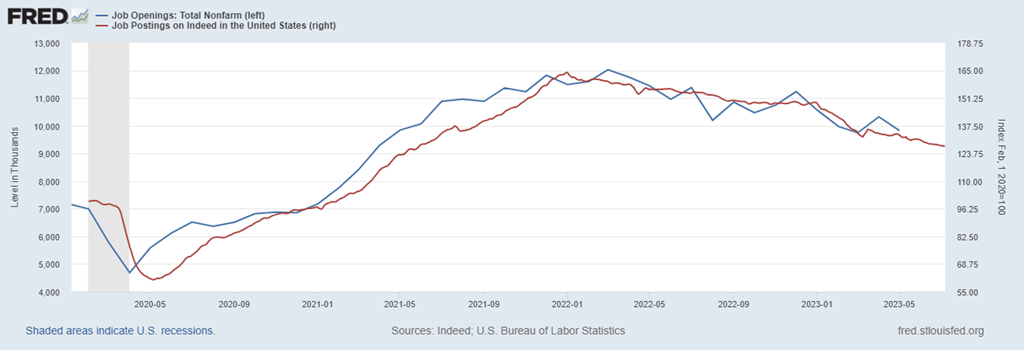
Real consumer demand has stalled since January but the recent uptick in real aggregate payrolls suggest stronger demand in H2.

- “Consumer spending continued to stabilize in June. Bank of America aggregated total credit and debit card spending per household declined by 0.2% year-over-year (YoY) , in line with the YoY rate in May.” (@MikeZaccardi)

Credit card use is biased towards goods.
Core CPI monthly growth fell back to its pre-pandemic range, along with core services. But we have seen monthly head fakes before:


CPI services is intimately correlated with wages, still rising 4.5-5.0%.

GS: “Today’s report is consistent with our view that Fed tightening is in its final innings. We continue to expect a final 25bp hike at the July FOMC meeting to 5.25%-5.5%, followed by unchanged policy for the remainder of the year.”

Ed Yardeni:
Investors have turned from fearful to fearless in recent months as the economy has proven to be resilient to the Fed’s tightening of monetary policy while inflation has continued to moderate. We can see their fearlessness in the S&P 500 VIX, which is highly correlated with the percentage of bears in the Investors Intelligence weekly survey of stock market sentiment. Both are down to pre-pandemic lows.
 Now that everyone is so bullish, we have to conclude that the technicals are looking increasingly dicey from a contrarian perspective. Meanwhile, the fundamentals continue to be bullish as they confirm a disinflationary soft-landing scenario. We would welcome a mini-correction down to the 50-day moving average of the S&P 500. If instead, the index jumps above its bull-market channel, we may have to contend with a melt-up situation. For now, we are sticking with our 4600 yearend target for this year.
(…) The back-to-back rate rises represent a sharp pivot for Canada’s central bank, which in January declared a pause on further tightening on the belief that a series of aggressive, rapid-fire increases in borrowing costs would damp inflation and employment through the year.
Bank of Canada Gov. Tiff Macklem said the central bank is prepared to raise interest rates further should inflation fail to moderate as forecast. (…)
Macklem added that ahead of Wednesday’s decision, senior officials discussed holding rates steady and waiting for further data. In the end, Macklem said, officials agreed interest rates needed to go higher and “the cost of delaying action was larger than the benefit of waiting.”
The central bank said in a statement explaining the rate decision, and an accompanying economic forecast, that downward pressure on inflation is at risk of stalling. This decision comes as households continue to spend on goods and services at a solid pace buoyed by a strong labor market, population growth fueled by immigration and accumulated savings during the Covid-19 pandemic. Canada recorded the fastest economic growth among the Group of Seven economies in the first quarter, at a 3.1% annual rate, or above the central bank’s forecast for 2.3% expansion. (…)
It envisages inflation cooling from its current 3.4% level to 2% in mid-2025, or six months later than previously expected. The central bank said it expects inflation to hover around 3% for the next 12 months. (…)
“Underlying price pressures appear to be more persistent than anticipated,” the bank said, adding a recent survey of executives suggesting businesses still intend to raise their prices more frequently than normal. (…)
Canada’s unemployment rate has climbed, to 5.4% in June from 5.0% in April. Macklem said the jobless rate “remains historically low,” and that the current pace of annual wage growth, between 4% and 5%, needs to moderate further to help hit the 2% inflation target.
The central bank said it expects economic activity to slow, although recent data covering retail sales and other indicators “suggest more persistent excess demand in the economy.” It forecasts annualized economic growth of 1.5% in the second quarter, or above its earlier 1% estimate, and then growth to average 1% through the second half of this year and first half of 2024, as higher interest rates reduce the amount of after-tax income available to households.
The central bank also expects growth from exports to weaken as higher rates elsewhere in the world, especially the U.S., kick in and weaken global demand. (…)
Xi Jinping Chokes Off Crucial Engine of China’s Economy Foreign direct investment in China fell to $20 billion in the first quarter from $100 billion a year earlier, hurting an already struggling economy.
Desperate for capital and with their economies struggling, China’s cities are wooing Western businesses with previously unavailable goodies. Beijing has labeled 2023 the “Year of Investing in China” and local officials have embarked on promotional tours overseas to drum up interest from investors.
That effort is running headlong into President Xi Jinping’s national-security agenda, with its focus on fending off perceived foreign threats. That has made any Chinese investment a potential minefield for foreign firms.
A Xi-led campaign this year has hit Western management consultants, auditors and other firms with a wave of raids, investigations and detentions. Meanwhile, an expanded anti-espionage law has added to foreign executives’ worry that conducting routine business activities in China, such as market research, could be construed as spying.
The perception that doing business in China has become much riskier is choking the flow of capital into an economy already struggling with weak private investment and consumption, as well as soaring youth unemployment. (…)
The tug of war is leaving financially distressed cities and townships across China in the lurch. Mired in debt and struggling to create jobs after three years of Covid-19 restrictions, many are in dire need of capital. (…)
A trade official in Chengdu, the capital of southwestern Sichuan province, recently embarked on an investment-promotion trip to Europe. He returned empty-handed. “In my 20 years of trying to get investments from Europe, this was the first time we didn’t get to sign even one memorandum of understanding,” the official said.
A senior official in a county of southern Guangdong province, which earlier this year set a goal of attracting nearly $300 billion in investment in the next five years, told a visiting American trade group recently that the county would reward any U.S. corporate “decision maker” investing there 10% of the value of the promised deal, according to people briefed on the matter. (…)
Recent surveys by business groups in China have shown American, German and other European companies pausing expansion or reducing investment in China. (…)
What’s mandarin for “You can’t have your cake and eat it, too”?
The National Council for Social Security Fund, which oversees about $417 billion according to the latest available figures, has advised asset managers that handle its money to sell some bonds including those from riskier LGFVs and private developers after a review, people familiar with the matter said, asking not to be identified discussing private information. Several of them mentioned that bonds from LGFVs in Tianjin, a debt-saddled northern port city, were singled out.
The recent Sino-Ocean Group Holding Ltd.’s debt rout raised the pension fund’s concerns as one of its biggest asset managers holds a large position in the state-backed developer’s debt, the people said. That triggered the request for a health check of their exposure to riskier LGFVs and builders, if relevant bond prices are below 95% of face value, the people added.
The move underscores the difficult balancing act facing Chinese authorities as they try to defuse risks in the credit markets without destabilizing the financial system. While offloading weaker bonds may help the state pension protect the value of its investments, it risks heightening market concerns about the health of LGFVs and developers at a time when Beijing is trying to restore confidence in the world’s second-largest economy. (…)


 Matt Klein (The Overshoot) makes the surprising observation that


 (CBO)
(CBO)