Fed Needs to Cool Off Hot Job Market, Ex-Chair Bernanke Says
The Federal Reserve needs to cool off the overheated labor market to tame inflation, though it’s not clear how far unemployment must rise to achieve that, according to former Fed Chair Ben Bernanke and ex-International Monetary Fund Chief economist Olivier Blanchard.
While a steep run-up in goods prices was the main impetus to the surge in inflation over the last 2 1/2 years, the impact of a “very tight” job market is growing and is likely to prove more persistent, they wrote in a paper to be presented at the Brookings Institution on Tuesday. (…)
The argument that Bernanke and Blanchard lay out in their paper about the evolution of inflation jibes with that put forward by Fed Chair Jerome Powell last week.
In a joint appearance with Bernanke at a May 19 Fed conference, Powell played down the significance of the job market in the 2021 inflation spike.
“By contrast, I do think that labor market slack is likely to be an increasingly important factor in inflation going forward,” Powell said.
As he has before, Powell zeroed in on the persistence of inflation in a grab bag of services — everything from health care and education to haircuts and hospitality — where labor costs are a high proportion of the cost of doing business.
Powell gave a clear signal at the conference that he is inclined to pause interest rate increases next month, saying the Fed has already tightened credit a lot and thus could now afford to look at how the economy evolves.
The Fed chair has previously voiced hopes that the labor market can be brought into better balance more through a drop in job vacancies than through a big increase in unemployment. (…)
“With labor-market slack still below sustainable levels and inflation expectations modestly higher, we conclude that the Fed is unlikely to be able to avoid slowing the economy to return inflation to target,” Bernanke and Blanchard wrote in their paper.
“The extent of that slowing will depend however on the evolution of certain structural features of the labor market, notably the efficiency of the process of matching workers with jobs,” they added.
If job postings on Indeed are any indication (through May 12), the BLS metric for nonfarm openings will flatten out after its steep drop in Q1.

Retailers Near Restocking as Inventory Paring Winds Down Freight operators are hoping a shift for big store owners fuels a shipping rebound heading into the fall
Big retailers are signaling they are nearly done paring back their excess inventories and are preparing to fill their shelves with new merchandise this fall, potentially brightening prospects for freight carriers looking for revived restocking to drive a shipping rebound.
Target’s inventories at the end of the last quarter were 16% lower than the same period a year ago and Walmart cut inventories in its U.S. store operations by 9% over the past year, slashing hundreds of millions of dollars of goods from their balance sheets and suggesting space is opening up in their jammed supply chains.
Target Chief Operating Officer John Mulligan said on an earnings conference call Wednesday that the overstocking that weighed on the company last year was “in the rearview mirror” and that the retailer was turning toward getting fresh merchandise into stores for the fall.
“In terms of inventory, we’re in good shape,” Walmart Chief Executive Doug McMillon said on a Thursday earnings conference call. “In-stock is improving, and excess inventory keeps coming down. We see it in the numbers, and I’m seeing it on store and [Sam’s Club] visits.”
Inventories at U.S. general merchandise stores expanded 1.2% in March, according to Census Bureau figures, after pulling back over several months from a record high last August. (…)
Before the pandemic, retailers and wholesalers inventories (dash lines) were about equal. It looks like retailers have since put more of the burden on wholesalers which now carry 20% more stock:

Speaking of inventories:
Biden’s Billion-Dollar Oil Trade Faces a Big Test Washington awaits bids to refill crude reserves with modified price proposal
(…) Now the agency is learning that replenishing those stockpiles at the lower rate it wants—between $67 to $72—is more difficult, despite prices sliding near those levels at various points this year. On Monday, benchmark U.S. crude closed at $71.99 a barrel, within Washington’s window to buy. (…)
The Biden administration, which previously said it aims to buy 60 million barrels, has suggested it is in no hurry to refill the SPR without maximizing taxpayer returns. If successful, the new request for proposals could offer a blueprint for additional purchases. (…)
The Energy Department’s second try at buying up to 3 million barrels of sour crude, with proposals due May 31 and contracts expected to be awarded June 9, swaps its previous pricing approach for one based on differentials. That could help suppliers more accurately forecast costs and help limit potential losses.
Government officials asked companies to propose offers on sour-crude differentials. That figure factors in the average spread between West Texas Intermediate, the U.S. crude benchmark, and an American sour crude gauge known as Mars in the three days after notice of the award.
Those benchmarks were separated by 98 cents as of Friday, according to price-reporting agency Argus Media, meaning companies’ financial risk in the event of market choppiness could be in cents, rather than dollars, per barrel.
“In theory, the same problem still remains because dealers have to hold this differential for two weeks while waiting for the decision,” said Bouchouev, a longtime trader. “However, the differential is significantly less volatile than the oil price.”
For now, the more pressing question for Biden’s potential oil trade may be whether prices stay within the Energy Department’s target range.
Wall Street was bullish on oil late last year, but many analysts more recently slashed forecasts as Western economies slowed, Russia continued pumping out crude and China’s appetite for energy failed to push prices higher.
(…) “I keep advising them that they will be ouching — they did ouch in April,” Saudi Energy Minister Prince Abdulaziz bin Salman said at the Qatar Economic Forum in Doha on Tuesday. “I would just tell them: Watch out!” (…)
The Organization of Petroleum Exporting Countries and its allies, a 23-nation bloc known as OPEC+, will meet on June 3-4 in Vienna to review production policy for the second half of the year.
While several delegates have said there’s no need for further action now as curbs already in place will help tighten global markets, Prince Abdulaziz has been known for orchestrating surprise interventions.
“We have to be vigilant, we have to be proactive — as we in OPEC+ has been saying for quite some time,” he said. (…
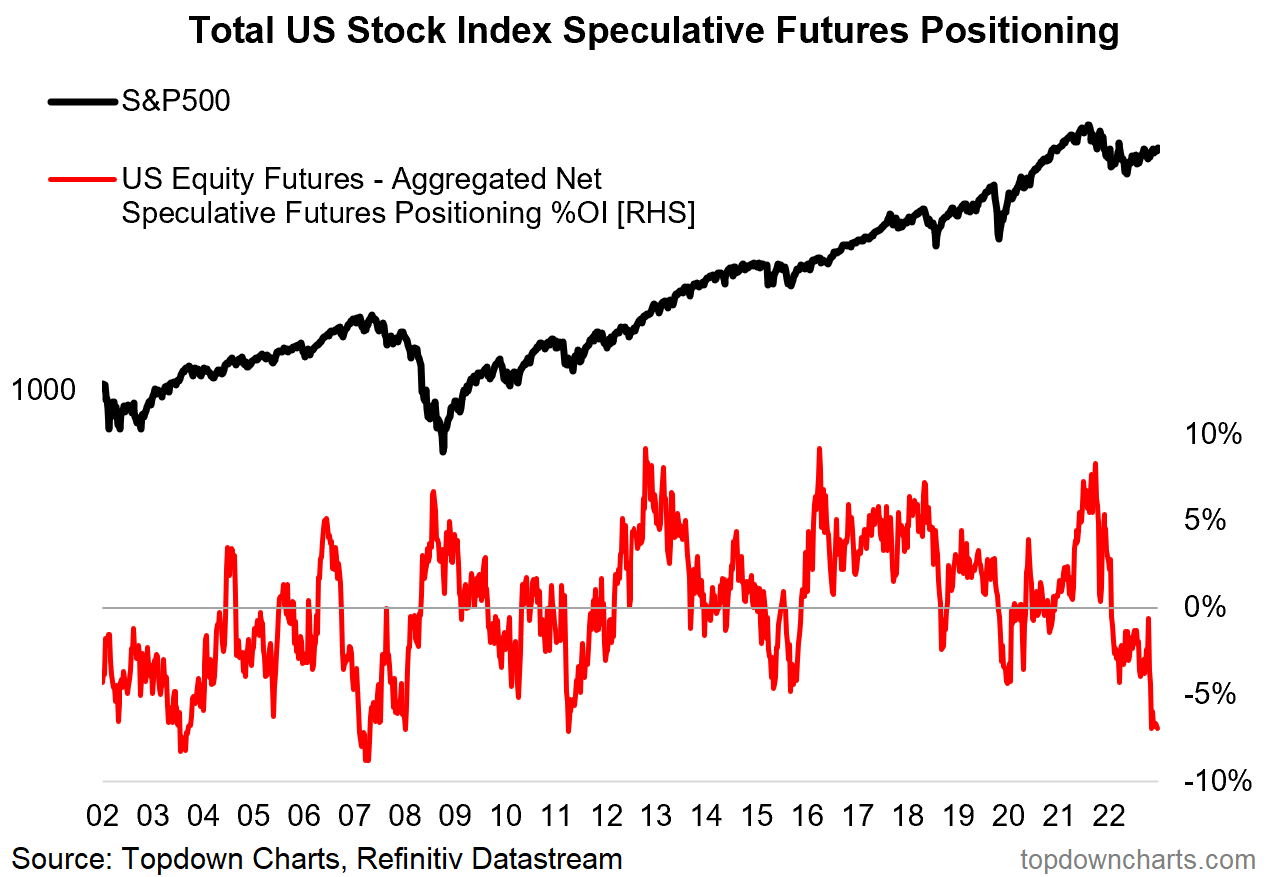
Funds have turned the most bearish in more than a decade across a slew of oil contracts.
“Current speculative positioning is so extreme as to make a response from key OPEC members likely,” analysts Paul Horsnell and Emily Ashford at Standard Chartered Bank Plc said in a report on Monday. “We think the latest data has increased momentum toward a defensive cut.” (…)
From Oilprice.com:
- According to S&P Platts, global air travel has finally returned to pre-pandemic levels this month as total commercial flights per day averaged 105,682 in the first two weeks of May, up 20% year-on-year.
- Global jet fuel demand, however, is expected to remain below 2019 levels for now as efficiency gains and a slower rebound in long-haul travel, especially in Asia, limit the consumption upside for the fuel.
- IATA estimates that new airplanes trigger fuel efficiency gains of around 2% per year and the pandemic has seen a widespread drive to replace older aircraft.
- With international seat capacity now 10% below 2019 same-month levels, attesting to flights being on average shorter than before, a full jet fuel demand recovery to 8 million b/d isn’t expected until 2027.

A Housing Bust Comes for Thousands of Small-Time Investors They were offered the benefits of owning apartment-building rentals without any of the work, in real-estate investments that have already left some people empty-handed.
(…) From 2020 through 2022, real estate syndicators reported raising at least $115 billion from investors, according to a Wall Street Journal analysis of Securities and Exchange Commission filings.
So far, defaults have been rare. But real-estate analysts and property investors anticipate a wave of foreclosures ahead.
Congress in 2012 opened the door to the syndicators with a law that made it easier to market real-estate investments online. The law, intended to open financial opportunities to lower-income people, greatly expanded the reach and audience for syndicator deals.
Syndicators largely favored apartment complexes in the South and Southwest, where real-estate prices were lower, rents were rising and housing regulations were generally looser. Many of these locales had fewer renter protections, which made it easier to evict tenants and raise rents.
The rental-market boom made millions for syndicators and their investors through rising rents and escalating property values. Average rent for a one-bedroom apartment in Phoenix has increased 37% since January 2021, driven by pandemic migration and a limited housing supply, according to the rental listing site Zumper. (…)
Syndicator investors have few legal protections, said Joan MacLeod Heminway, a securities-law professor at the University of Tennessee in Knoxville, Tenn. Unlike public companies, syndicators in many cases aren’t required to give regular updates on their buildings’ financial performance, she said. As limited partners, investors have no say over spending. Some who lost their investment never knew the properties were in trouble until they were near foreclosure. (…)
Many syndicators are racing to either raise funds or sell properties before tipping into foreclosure. Most hold balloon-payment loans that require repayment when they come due this year or next. Those syndicators face large payouts when getting new, more affordable property loans will be difficult. Even firms with multibillion-dollar portfolios have used syndication to buy apartment buildings that no longer make enough money to cover debt payments, bond documents show.
“The bubble is going to start popping if these guys can’t get out of these deals in time,” said Ralls, of Acora Asset. Lenders also risk heavy losses. (…)
IMF says it no longer expects UK recession this year
China Has a Youth Unemployment Problem Because Grads Are Waiting for Nonexistent Jobs Many economists say the problem reflects a jobs mismatch that could defy government solutions for years.
Joblessness among young people aged 16 to 24 rose to a record of 20.4% in April, significantly higher than a few months ago and far above the prepandemic rate of 13% or lower in most of 2019.
The rise was all the more surprising given that urban unemployment overall fell to 5.2% in China as of April, compared with 6.1% a year earlier.
Some economists believe the job market for young people will get worse before it gets better, with a record 11.6 million college students set to graduate this summer.
A central problem, economists say, is that China isn’t creating enough of the high-wage, high-skill jobs that are sought after by its expanding base of educated young people, many of whom have loftier expectations than previous generations.
Rather than trade down for lower-wage jobs, many young people are opting to wait for more opportunities, even though such opportunities might not be available. (…)
If China fails to supply a generation of young people with work, it could put pressure on wage growth and slow down Beijing’s desire to build an economy driven more by consumption. It could also undermine social stability, if more young people become dissatisfied. (…
The economy overall is becoming more oriented toward services. However, many of the services jobs created during the past decade are lower-end roles, such as delivery drivers and restaurant waiters, which don’t necessarily attract university graduates, said Rory Green, head of China and Asia research at TS Lombard, a research firm. (…)
A survey by Zhaopin.com, an online recruitment platform, shows that around 30% of college students graduating this summer desire to work in the internet, telecommunications and education sectors, despite regulatory crackdowns in recent years that roiled many of those industries and left private employers wary of adding staff. (…)
Many are going back to school for more advanced degrees. A record 4.7 million undergraduate students signed up for exams to compete for 1.2 million spots in graduate schools this year. In 2021, nearly one-third of universities in Shanghai already had more graduate students than undergraduate students, according to a state media report.
Young people who delay entering the workforce or abandon job searches aren’t counted as job seekers in official statistics, according to Nancy Qian, a professor of economics at Northwestern University. If they were counted, the actual jobless rate would be even higher, she said. (…)
Citi Says Buyers Plow $21 Billion Into US Stocks Positioning is increasingly “one-sided,” the bank strategists wrote.
(…) The weekly flow of new longs was one of the largest seen in recent years, it added.
“The momentum is clear, and positioning is increasingly one-sided. Longs outnumber shorts by more than 9 to 1,” said Citi strategists led by Chris Montagu. “The few remaining shorts are all in loss, but a short squeeze is not likely to significantly impact markets.”
That echoed with Goldman Sachs Group Inc.’s prime brokerage unit data: Hedge funds that make both bullish and bearish equity wagers have snapped up US shares for two straight weeks, with total purchases reaching the fastest pace since October. (…)
For the rally to carry on, investors might want to see a broadening of risk taking.


John Authers: Is the S&P FANG’d Out? Debt Isn’t the Only Ceiling A breakout past 4,200 meets resistance as this rally’s dependence on the tech giants makes allocators nervous.
(…) Breakouts from a range can have a big impact on market psychology. So can failed breakouts.This matters. There is a dose of nerves about taking it to those levels. Further, Wall Street’s strategist community is braced for the S&P 500 to fall from here by the end of the year.
My Bloomberg colleague Lu Wang keeps a regular score-sheet of estimates. Her latest poll of 23 strategists, published at the end of last week, found an average end-year prediction of 4,017, with a median of 4,000. Analysts’ forecasts tend to be dragged upward by strong performance, but they are still at this moment predicting a decline of almost 5%. So the flirtation with a new high hasn’t yet created too much optimism among asset allocators. (…)
To be clear, it’s very unusual for smaller caps to trail so badly if stocks have really hit rock bottom and moved on to the first stage of a bull market. Indeed, if last October’s lows for the S&P 500 really were the trough, this is an unprecedentedly narrow recovery, owing almost everything to a small group of stocks. The following statistics are from Jonathan Krinsky of BTIG LLC:
Of the nine meaningful drawdowns since 1995, the average percentage of Russell 3000 stocks trading above their 200-day moving average at the 150-day mark post the bottom was 70% (min 56%, max 88%). As of the 150-day mark following the Oct. ’22 low, it was just 36%. In other words, it would be by far the weakest breadth this far off a major bottom of any new uptrend over the last ~30 years.
Generally, when markets embark on a durable advance, they need far more stocks to join in. (…)
There are lots of other things going on at present, of course, but the current nerves over the 4,200 level stem in large part from a rally that many didn’t expect, focused in a few companies that the active management community had missed out on. It’s rational for them to try to strengthen their competitive position when they’re judged against their peers by piling into those stocks — even though many still believe that they are too expensive, and that the stock market has come too far, too fast.
As investing is often about predicting the actions of others, a decisive close above 4,200 might make it rational to pour even more into the market. It’s common to call the rally after the Global Financial Crisis the most hated in history. This one might well now be running it close, at least among active managers.
Charts from Ed Yardeni, FYI:


The S&P 500 index of U.S. shares will slip marginally between now and year-end as past interest rate hikes, troubled regional banks and weak earnings weigh on sentiment, according to strategists in a Reuters poll.
They see the benchmark index (.SPX) ending the year at 4,150, down slightly from Monday’s close of 4,192.63, but still up about 8% from the end of 2022, based on the median forecast of 43 strategists polled by Reuters during the last two weeks. (…)
The latest poll forecast for the S&P 500 is down slightly from the 4,200 year-end 2023 target in a February Reuters stocks poll. (…)
At the same time, the S&P 500’s forward 12-month price-to-earnings ratio is now at 19 compared with 17 at the end of 2022 and a long-term average of about 16, according to Refinitiv data.
“Historically, when you’ve seen this level of valuation, it’s normally associated with re-acceleration in earnings and also an outlook for double-digit earnings growth going forward. We don’t see that happening,” said Nadia Lovell, senior U.S. equity strategist at UBS Global Wealth Management, which has a 3,800 year-end S&P 500 target. (…)
In 2024, the S&P 500 will end at 4,500.
- PE groups sell stakes at discount on expectations valuations will stay low ‘Follow-on’ share offerings have rebounded even as prices have languished below IPO heights
BTW:

 Goldman Says Treasury Will Drop Under Its Cash Minimum June 8-9