The enemy of knowledge is not ignorance, it’s the illusion of knowledge (Stephen Hawking)

It ain’t what you don’t know that gets you into trouble. It’s what you know for sure that just ain’t so (Mark Twain)

Invest with smart knowledge and objective odds

YOUR DAILY EDGE: 20 May 2025

Note: Canadian readers may have missed yesterday’s post. Worth reading in my humble opinion.

China Accuses US of Undermining Trade Talks With Warnings Against Huawei Chips

(…) The Commerce Department said in a statement last week that it was issuing guidance to make clear the use of Huawei Ascend chips is a breach of the US government’s export controls. The agency said it would also warn the public about “the potential consequences of allowing US AI chips to be used for training and inference of Chinese AI models.”

The US Commerce Department’s has since changed its wording to say the agency was issuing guidance about “the risks of using PRC advanced computing ICs, including specific Huawei Ascend chips,” stripping the “anywhere in the world” reference. The formal Commerce guidance, dated May 13, says using Huawei’s Ascend chips “risks” violating export controls.

Those updates weren’t enough to appease Beijing, which said Monday it had “negotiated and communicated with the US at all levels through the China-US economic and trade consultation mechanism, pointing out that the US’s actions seriously undermined the consensus reached at the high-level talks between China and the US in Geneva.”

While Chinese authorities noted the US had “adjusted” the wording of its guidelines around Huawei chips, it maintained it was still a “discriminatory measures” and demanded that the US “correct its mistakes.” (…)

China’s chief trade negotiator Li Chenggang attacked export controls on AI-related chips at the Asia-Pacific Economic Cooperation meeting last week in South Korea, saying a certain country was over-stretching the idea of national security, according to an official who attended the session. US Trade Representative Jamieson Greer responded it was a measure to protect domestic manufacturing capabilities, the official said. (…)

Fed Officials Signal Rates Likely to Stay on Hold Until at Least September

Two Federal Reserve officials, including New York Fed chief John Williams, suggested policymakers may not be ready to lower interest rates before September as they confront a murky economic outlook.

“It’s not going to be that in June we’re going to understand what’s happening here, or in July,” Williams said Monday at a conference organized by the Mortgage Bankers Association. “It’s going to be a process of collecting data, getting a better picture, and watching things as they develop.”

The Fed’s next three meetings are in June, July and September. (…)

If the Trump administration’s ongoing trade negotiations drag on, “that starts to push much further into the summer, in which case we won’t actually know what the true effects are going to be for several months after that,” Bostic told Bloomberg’s Michael McKee.

Earlier Monday, Bostic noted policymakers would need to wait “three to six months” to see how things settle. He said it’s still possible that trade talks could move forward more quickly, lowering tariffs more than forecast.

“In that case we may be able to pull forward some of our actions, because there may not be as much that we need to do in terms of managing the price level,” he said.

Williams continued to stress that uncertainty was hindering not only policymakers, but also firms and households as they struggle to predict how tariffs and other policies from the Trump administration will reshape the US economy. (…)

Fed Vice Chair Philip Jefferson also emphasized a wait-and-see approach at the Atlanta Fed’s 2025 Financial Markets Conference Monday. He said it’s important for the Fed to make sure any potential increase in prices doesn’t evolve into a sustained rise in inflation.

“Given the level of uncertainty that we’re facing right now, I believe that it is appropriate that we wait and see how the policies evolve over time and their impact,” Jefferson said, adding that monetary policy is in a “very good place.”

Minneapolis Fed President Neel Kashkari — also speaking on Monday — noted the US economy was on solid footing in the early part of this year, and that the central bank has made a lot of progress on lowering inflation. He said tariffs, however, have thrown policymakers a “curve ball,” leaving policymakers on hold for now.

“There’s a lot of uncertainty that we’re trying to navigate,” Kashkari said. “It’s really just wait and see until we get more information.”

Chinese Smartphone Exports to US Plunge to Lowest Since 2011

Chinese shipments of Apple Inc.’s iPhone and other mobile devices to the US dived to their lowest levels since 2011 in April, underscoring how the threat of US tariffs choked off the flow of big-ticket goods between the world’s two largest economies.

Smartphone exports slid 72% to just under $700 million last month, sharply outpacing an overall 21% drop in Chinese shipments to the US, detailed customs data showed on Tuesday. That highlighted the way the Trump administration’s tariffs campaign — peaking with 145% levies on Chinese goods — is disrupting tech supply chains and diverting electronics elsewhere. (…)

Last year, the three biggest US imports from China were smartphones, laptops and lithium-ion batteries, while liquid petroleum gas, oil, soybeans, gas turbines, and machines to make semiconductors were some of the most valuable US exports to China. (…)

BTW:

image

Goldman Sachs sees US domestic demand stalling, starting now:

This from Apollo:

image

Meanwhile:

Moody’s downgrade of the US credit rating from Aaa to Aa1 appears to have been influenced by the pending fiscal package. While we do not believe the downgrade would force any holders of Treasury securities to sell, it highlights the deteriorating fiscal outlook and comes at a time when markets are already attuned to fiscal risks. That said, Moody’s projection that the deficit will reach 9% of GDP in 2035 is roughly 2pp larger than our own.

Even though the bill would expand the deficit by slightly more than expected over the coming year, the effect is nevertheless much smaller than the increase in tariff revenue we expect. (GS)

image

Jamie Dimon Says Tariffs Might Inflict More Economic Pain Than Investors Realize The JPMorgan CEO warns of complacency in the markets at the bank’s investor day

JPMorgan CEO Jamie Dimon said Monday he didn’t think the full impact of tariffs had passed through to the broader economy and warned that the stock market could slump as companies reckoned with the new costs for goods and supplies.

Dimon made the remarks during the bank’s investor day in New York, where he said the risks of an economic slowdown were underappreciated and said even the scaled-back level of President Trump’s tariffs were “pretty extreme.” (…)

“It’s an extraordinary amount of complacency,” Dimon said, noting that the last time the country saw 10% tariffs on all trading partners was 1971. (…)

Dimon said Monday that he thought stock markets could sell off by around 10% as companies lower their earnings estimates and investors reappraise the value of U.S. stocks. He also warned about a credit crunch that could ensnare companies used to easy financing.

“American asset prices, I still think they’re kind of high,” Dimon said. “I think credit today is a bad risk.” (…)

“We have what I consider almost complacent central banks that think they are omnipotent,” Dimon said. “They just set short-term rates.”

He also said it was unknown how other countries would respond to Trump’s tariffs and that some are already starting to cut trade deals with other nations.

(…) Ursula von der Leyen, the president of the European Commission [said] “We in Europe stick together”. (…)

While the new security pact was a key aim of Starmer’s government when it took office last July, both the U.K. and the EU have intensified efforts to lock in new trade ties in recent months, as they seek to protect European companies from the impact of the Trump administration’s tariff hikes.

Brexit hasn’t worked out as its supporters hoped and is now unpopular in the U.K., with just three in 10 Britons saying it was a good idea to leave the EU, according to a poll by YouGov earlier this year. Since Brexit, U.K. exports to the EU have fallen 21% while imports have dipped 7%, according to the U.K. government. (…)

In the wake of Brexit, Britain had hoped to clinch a free-trade deal with the U.S., but that hasn’t happened. Earlier this month, Britain completed a trade deal with India. It then became the first country to reach a trade deal with the U.S., which removed some but not all of the tariffs Trump placed on U.S. trading partners in April.

The EU completed a preliminary deal with the biggest South American economies in January and has set its sights on a trade agreement with India by the year’s end.

Following up on Dimon’s statement that “credit today is a bad risk”, Almost Daily Grant writes (my emphasis):

Thus, domestic bank lending to private credit firms, buyout shops and other nonbank financial institutions (NBFIs) reached $1.2 trillion over the 12 months through March, Fitch Ratings found late last week, up a whopping 20% year-over-year. That dwarfs the 1.5% rise in commercial loan balances during the same stretch and compares to a 7% average annual commercial lending growth rate since 1947. 

Noting that such a rapid pace can portend future credit trouble, Fitch also relayed that the banks have generally secured ample collateral against those facilities, which should serve to keep a lid on defaults in the event of broad financial stress.

Good thing, as a recent analysis from the International Monetary Fund found that more than 40% of private credit borrowers posted negative free cash flow in 2024, up from 25% three years prior. Increased bank lending to NBFIs “could make the financial system more vulnerable to high levels of leverage and interconnectedness,” the IMF warned.

Yet for now at least, the private credit party continues apace, spurring intense competition to evaluate those transactions. Financial data firm Morningstar is working to muscle into the direct-loan ratings business, CEO Kunal Kapoor told Bloomberg Friday, pointing out that money managers are not obliged to consult ratings from at least two of the three major agencies, as is the case in public credit. “It’s a level playing field, and the rules have not been written in a way to favor the incumbents,” Kapoor said.

Indeed, a growing share of private loans feature no rating at all, analysts at UBS relayed last week, a phenomenon which could serve to pressure the rating agencies’ business model. The tally of such newly-issued, ungraded transactions topped 160 last year, UBS found, up from fewer than 10 in 2019, and is potentially poised to rise further as lenders look to allocate some $575 billion in so-called dry powder.

Some who do seek the rating agency imprimatur are particularly selective. The Wall Street Journal reports that credit firms that bundle collections of loans into collateralized loan obligations “are often able to choose the ratings provider for such issues,” a dynamic that invites conflicts of interest as the issuer pays for the evaluation while “the resulting grades can significantly affect the marketability of the rated securities.” 

One private credit industry executive likened the arrangement to students selecting the teacher who grades their work, quipping thus to the WSJ: “the only difference is, teachers aren’t paid based on giving out A’s.”

Retail Investors Drive Surge

It’s been six days in a row. Last week, both the S&P 500 and Nasdaq 100 recorded perfect weeks, recording gains each day. (…)

What’s driving this? Bank of America’s Fund Managers Survey showed US equity allocation dropping to a two-year low. That’s evidence that stocks drew their strength from sources other than smart money or institutional investors:

Instead, look to the might of retail investors buying the dip. On Monday, when the S&P 500 initially tumbled 1% in reaction to the Moody’s downgrade, retail investors’ made $4.1 billion in net purchases of US stocks by midday to erase the losses, according to JPMorgan’s Emma Wu. Quite a counterbalance. (…)

Retail investors probably don’t have enough firepower to keep the rally going, so institutional investors will have to join from the sidelines. If there’s a cue to that effect, it lies in the analysis by HSBC Bank’s Duncan Toms, which shows institutional sentiment and positioning still sending the strongest contrarian buy signal since 2022. (…)

Retail investors probably don’t have enough firepower to keep the rally going, so institutional investors will have to join from the sidelines. If there’s a cue to that effect, it lies in the analysis by HSBC Bank’s Duncan Toms, which shows institutional sentiment and positioning still sending the strongest contrarian buy signal since 2022.

The outcome of the tax bill currently under House consideration could be the next game changer. Glenmede’s Jason Pride argues that the “decently large” bill could deliver a “stimulative” impact that would be harder for share institutional investors to ignore. (Although bond investors might also find it hard to ignore, which could be a problem…)

Trump’s deference to Putin stunned European leaders on call

Ukrainian President Zelensky and five other European leaders joined a conference call with President Trump immediately after his call with Vladimir Putin on Monday hoping to hear that Putin had agreed to a ceasefire — or the U.S. would impose penalties on him for refusing to do so.

  • Instead, Trump said Putin had agreed to negotiate, stressed the U.S. wouldn’t be involved in those negotiations, and pushed back against the idea of imposing sanctions on Putin at the current time, two sources who were on the call and a third source briefed on the call told Axios.

Trump gave the impression he was getting closer to withdrawing from the issue altogether. Some leaders on the call seemed “surprised” or “shocked,” the sources said.

  • “I think something’s going to happen. And if it doesn’t, I just back away and they’re going to have to keep going. Again, this was a European situation, and should have remained a European situation,” Trump told reporters in the Oval Office several hours after his calls. (…)
  • Trump told the group Putin will present a “peace memo” with his terms for a ceasefire and for ending the war. A source on the call said Trump told Zelensky and the European leaders he asked Putin to present “something people can agree to” and not a proposal that will be rejected immediately.
  • Zelensky said previous rounds of negotiations with Putin, including last week, didn’t produce anything and stressed that if Trump doesn’t push, Putin won’t move, the sources said.

Leaders on the call seemed surprised that Trump seemed relatively content with what he heard from Putin, and presented it as a new development, even though the Russian leader did not seem to have changed his position at all, the sources said.

Trump told the group that Russia and Ukraine can conduct bilateral direct negotiations without any third party mediators because the parties best understand all the details of the conflict. (…)

On the call, Finland President Alexander Stubb asked Trump what the next steps were. “I don’t know. Someone has to come out and say whether the negotiations are going well or badly, and then we’ll decide what to do,” Trump said.

One thing is clear: “I think something’s going to happen. And if it doesn’t, I just back away and they’re going to have to keep going. Again, this was a European situation, and should have remained a European situation,”

FYI:

Putin thanked Trump for supporting the revival of direct talks between Russia and Ukraine, emphasizing that such dialogue was essential for progress. He stated, “We have reached an understanding with the U.S. president that Russia will suggest and is prepared to collaborate with the Ukrainian side on a memorandum regarding a potential future peace agreement, outlining several positions including the principles of resolution and the timeline for a possible peace treaty”

Putin reiterated that Russia’s position in the negotiations remains unchanged and centers on “eliminating the root causes” of the war. He stated, “Russia’s stance is unmistakable. What is essential to us is addressing the fundamental causes of this crisis”

Putin did not agree to an unconditional or immediate ceasefire. Instead, he indicated that any truce would depend on reaching agreements that address Russia’s core demands. Kremlin spokesperson Dmitry Peskov clarified there was “no timeline” for a ceasefire or for preparing a memorandum.

Putin’s conditions for peace continue to include Ukrainian acceptance of the loss of Crimea and four eastern regions, demilitarization of Ukraine, a permanent ban on NATO membership, and the so-called “denazification” of Ukraine. These demands have been repeatedly rejected by Kyiv.

“I would like to emphasize that, overall, Russia’s stance is transparent. Our primary goal is to eliminate the underlying causes of this crisis. We simply need to identify the most effective methods to progress towards peace.”

Clearly, no end in sight for this “European situation”. Trump will now address other “more important” matters.

YOUR DAILY EDGE: 19 May 2025

ECONOMY WATCH

The May 11 liberation from April 2nd “Liberation Day” cheered equity investors. The relief from a de facto China-USA goods embargo caused most economists and strategists to reduce their recession odds, critical after looking at this chart:

image

My usual digging below the surface everybody sees reveals early signs of economic stress from hard and soft data:

The preliminary May sentiment index declined to 50.8 from 52.2 a month earlier, according to the University of Michigan. That was lower than all but one estimate in a Bloomberg survey of economists.

Nearly three-fourths of respondents spontaneously mentioned tariffs [from 60% in April], indicating trade policy continues to dominate consumers’ views of the economy. The topic crosses partisan lines, including a notable share of Republicans bringing it up.

image

The survey was conducted between April 22 and May 13, a period that ended just after the US and China agreed to temporarily reduce tariffs on each other while they negotiate a trade deal. (…)

Consumers expect prices to rise at an annual rate of 7.3% over the next year [+6.5% in April], the highest since 1981, data released Friday showed. They saw costs rising at an annual rate of 4.6% over the next five to 10 years, the highest since 1991. (…)

The contrast between sentiment and actual spending is also showing in some parts of the survey. The measure of buying conditions for large items improved slightly, although only a small share of consumers expect to continue to spend as usual if prices increase further.

The survey also showed the expectations index declined nearly a point to 46.5, an almost 45-year low. The current conditions gauge retreated 2.2 points to 57.6.

Consumers’ views of their current personal finances dropped to the lowest since 2009. Financial expectations slid to a fresh record low.

While nearly two-thirds of Republican respondents offered unsolicited comments about tariffs, their overall sentiment remains elevated in comparison to Democrats and political independents.

image

  • Job postings on Indeed through May 9 keep declining, down 2.8% since the last JOLTS data (March) suggesting the recent pause in JOLTS decline may have ended. Postings are down 4.6% YtD. The latest NFIB survey revealed that “the proportion of small business owners expecting the economy to improve dropped six points on month, as did job openings at surveyed firms, highlighting the growing economic uncertainty and weakening labor market.”

image

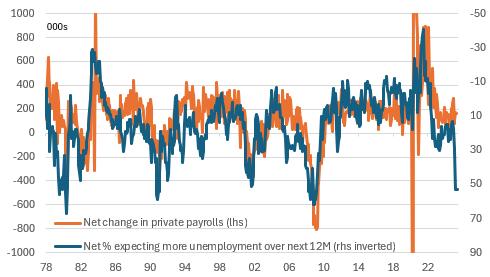
  • Americans are particularly worried for their job, and that should worry us, not only because it often leads hard employment data, but it also can incite spending caution:

Households expect unemployment will climb

Source: Macrobond, ING

Source: Macrobond, ING

  • The April jobs report was reassuring at the establishment level but the household survey showed signs of deterioration. The median duration of unemployment continues to rise, and the share of long-term unemployed workers rose to 23.5% in April, the highest share in three years. It is taking longer for unemployed workers to find new jobs.
  • Internship postings are 11% below their April 2024 levels.
  • “The Federal Reserve believes that there has been a breakdown in the relationship between sentiment and spending, but the chart below of the Conference Board measure suggests it is still pretty good. Moreover, the scale of the falls in confidence are significant and we would have to say the risks to spending are going to be skewed to the downside for a while.” (ING)
  • Spending and sentiment link remains robust

    Source: Macrobond, ING

    Source: Macrobond, ING

  • AI may not be helping currently (Axios)

Alphabet and Microsoft have both said that AI now writes or assists 30% or more of their code. “I might argue we’ve seen peak employment in the Magnificent 7,” Jeffrey Bussgang, a venture capitalist at Flybridge Capital Partners, told me in April. “We may see that all of these companies never grow headcount again. That they just grow 20-30% a year of revenue with flat headcount.”

It’s clear from mentions of generative AI in recent earnings calls that a lot of companies are already using the technology to make their operations more efficient, especially for coding, research, customer service and marketing.

A few examples:

  • Intuit in February: “We’re also seeing improved coding productivity with up to 40% faster coding using GenAI code assistance.”

  • Expedia in May: “Our marketing team is using generative creative AI both to make their marketing more effective, and also to save time.”

  • Coca-Cola in February: “This year, for the first time, our Coca-Cola Christmas ad was created with generative AI, combining emerging technology with human creativity, which allowed us to produce the ad faster and at a lower cost.”

  • Palantir in May: “We’re not talking about co-pilots that make you 50% more productive, we’re talking about agents that make you 50 times more productive.”

Global uncertainty around tariffs and the macroeconomy could further speed this kind of AI adoption. Uncertainty tends to weaken hiring and some research suggests that downturns prompt firms to invest more in IT — both because they have more spare capacity and because they want to make their operations more efficient. Companies that might otherwise be expanding and hiring may opt to keep their options open, and pursue the relatively cheap, flexible path of pushing AI efficiency.

“Talking to tech firms I have repeatedly heard discussions about reducing hiring or absolute headcount because of AI,” says Nicholas Bloom, an economist at Stanford. “Absolutely the macro situation will make this worse. Business sentiment has taken a dive with the tariff chaos and broader DOGE churn. So firms are slowing on hiring.”

It’s too soon to know whether automation is proceeding faster because of macro uncertainty, and what that would mean for jobs like coding. But if AI proves capable of automating work cheaply and is spurred on by companies’ reluctance to hire in the face of uncertainty, it could amount to a sort of perfect storm for some segments of the labor market. “Winter is not coming yet,” says Bloom. “But this is a worrying few whiffs of snow.”

Microsoft CTO Kevin Scott previously said he expects 95% of all code to be AI generated by 2030.

  • The Atlanta Fed Wage Growth Tracker has stabilized at the 4.3% level. Job switchers are no longer getting premium wages. Indeed Wage Tracker was at 3.0% in April down from 3.4% in January.
  • NY Fed’s Business Leaders Survey:

    Business activity continued to decline in the region’s service sector in May, according to firms responding to the Federal Reserve Bank of New York’s Business Leaders Survey. The business climate index remained firmly negative at -51.7, suggesting the business climate continued to be considerably worse than normal. Employment held steady, and wage growth slowed. Supply availability worsened significantly. Firms were again quite negative about the outlook, with nearly half expecting activity to decline in the months ahead.

image

Note how expectations (black) have dropped well below zero. Very rare for services… The survey was conducted between May 2 and May 9, before Trump’s major backtrack on China. Was it enough to alleviate fears? Only 21% of surveyed firms expected activity to increase. The index for employment and capex were negative.

Expectations were for prices paid to rise faster than prices received:

image

image

  • Import prices rose 0.1% in April, against consensus expectations for a decline. Import prices ex-petroleum rose +0.4%, also above expectations. Note teh numerous changes in price trends:

Prices for nonfuel imports increased 0.4% in April following a decrease of 0.1% in March. Higher prices for capital goods, nonfuel industrial supplies and materials, consumer goods, and automotive vehicles drove the advance.

All imports excluding food and fuels rose 0.5% in April.

Import prices for nonfuel industrial supplies and materials
increased 0.8% in April, after ticking up 0.1% in March. Higher prices for major nonferrous metals, finished nonmetals, and finished metals shapes and advanced manufacturing more than offset lower prices for chemicals in April.

Prices for the major finished goods import categories were up in April. Import prices for capital goods increased 0.6%, the largest monthly advance since the index rose 0.9% in January 2022. The April advance was led by higher prices for computers, peripherals, and semiconductors and for scientific and medical machinery.

The price index for automotive vehicles rose 0.2% in April, the largest 1-month advance since October 2024.

Import prices for consumer goods increased 0.3% in April, the first monthly advance since October 2024.

All these increases were in spite of import prices from China decreasing 0.1% in April, the fifth consecutive monthly decline. The index last increased on a monthly basis in October 2022. The decrease in April was driven by lower miscellaneous manufacturing prices.

Import prices from the European Union increased 0.6% in April.

April’s core PPI declined 0.1% but core goods PPI rose 0.4% after +0.3% in each of February and March. Last 3 months annualized: +4.1% following +2.0% in the previous 8 months when monthly gains were limited to 0.1-0.2%.

There are clear price pressures in the pipelines.

Walmart, the king of low prices and a Goliath negotiator, warned last week that it plans to raise prices this month and early this summer, when tariff-affected merchandise hits its store shelves.

“The magnitude and speed at which these prices are coming to us is somewhat unprecedented in history,” Walmart Chief Financial Officer John David Rainey said in an interview.

Shoppers could see prices rise by the end of May, “and then certainly much more in June,” Walmart CFO John David Rainey said today in a CNBC interview.

“We’re wired for everyday low prices, but the magnitude of these increases is more than any retailer can absorb,” Walmart CFO John David Rainey told CNBC today.

“Well, if you’ve got a 30% tariff on something, you’re likely going to see double digits [in price increases],” he later told Yahoo Finance.

Hopefully, services inflation will be subdued enough to offset coming goods inflation. Slowing wages and lower oil prices are helping here.

Currencies normally move around with interest rate differentials. For example, when the Fed keeps interest rates higher for longer because of higher inflation, the US dollar goes up.

Since the trade war started, this relationship has broken down. Now the dollar is driven by forces other than interest rate differentials, and the chart below suggests EURUSD should be trading closer to parity.

In other words, the dollar is about 10% weaker than interest rate differentials would have suggested.

image

U.S. Loses Last Triple-A Credit Rating Moody’s downgrades the U.S. government, citing large fiscal deficits and rising interest costs

The U.S. has lost its last triple-A credit rating.

Moody’s Ratings downgraded the U.S. government on Friday, citing large fiscal deficits and rising interest costs.

Expanding budget deficits mean U.S. government borrowing will rise at an accelerating rate, pushing interest rates up over the long term, Moody’s said. The firm said Friday that it didn’t believe that any current budget proposals under consideration by lawmakers would do anything significant to reduce the persistent gap between government spending and revenues.

The move strips the U.S. of its last remaining triple-A credit rating from a major ratings firm, following similar cuts by Fitch Ratings in 2023 and S&P Global Ratings in 2011. Moody’s downgraded the U.S. to Aa1, a rating also held by Austria and Finland.

For the first time in history, the US does not hold a triple-A credit rating from at least one of the three big agencies.

“Successive U.S. administrations and Congress have failed to agree on measures to reverse the trend of large annual fiscal deficits and growing interest costs,” Moody’s wrote in a statement. (…)

At the margin, the Moody’s downgrade could put pressure on the market for U.S. Treasurys, which has already been hit by expectations for greater borrowing and stubbornly high inflation. (…)

For years the U.S. was one of a select group of nations rated triple-A by Moody’s, but the rise of debt levels around the world has pared that figure to 11.

Moody’s shifted its outlook on U.S. debt to stable, noting the nation “retains exceptional credit strength such as the size, resilience and dynamism of its economy and the role of the U.S. dollar as global reserve currency.” (…)

Rep. French Hill (R., Ark.), chairman of the House Financial Services Committee, said that the downgrade was “a strong reminder that our nation’s fiscal house is not in order.” House Republicans, he said, “are committed to taking steps to restore fiscal stability, address the structural drivers of our debt, and foster a pro-growth economic environment.”

MarketWatch adds:

(…) Moody’s said mandatory spending, including interest expense, is projected to rise to around 78% of total U.S. spending by 2035, from around 73% in 2024. If the 2017 Tax Cuts and Jobs Act is extended, which is the firm’s base-case scenario, it would add around $4 trillion to the federal fiscal primary deficit, which excludes interest payments, over the next decade, Moody’s said.

The downgrade comes on the same day the House Budget Committee failed to advance a sweeping tax and spending bill that is the centerpiece of President Donald Trump’s legislative agenda, underscoring deep divisions within the Republican caucus.

“Over the next decade, we expect larger deficits as entitlement spending rises while government revenue remains broadly flat. In turn, persistent, large fiscal deficits will drive the government’s debt and interest burden higher,” Moody’s said. It expects U.S. fiscal performance to deteriorate “relative to its own past and compared with other highly rated sovereigns.”

Moody’s said that while Treasury assets remain in high demand, higher yields since 2021 have raised the interest burden on U.S. debt — with interest payments set absorb around 30% of revenue by 2035, versus 18% in 2024 and 9% in 2021.

“While we recognize the U.S.’s significant economic and financial strengths, we believe these no longer fully counterbalance the decline in fiscal metrics,” Moody’s said.

Richard Bernstein Advisors last year illustrated the significance of a downgrade:

Chart 8 shows the spread between the US 10-Year T-Note and the 10-Year German Bund. Prior to the downgrade of US debt in 2011, Treasury and Bund yields traded within a range. However, the US 10-Year has sold at a consistent yield risk premium since the debt downgrade. At times, the US’s risk premium exceeded 200bp!

Low absolute interest rates obscured the penalty Americans were paying when the US became a lower quality credit. However, if the US had been a higher quality credit, yields on government debt, municipal debt, mortgages, car loans, and credit cards would have been even lower.

Although some believe a day of debt reckoning looms for the US, the reality is debt crises are slow and insidious. To that point, the US economy has been over the past 13 years consistently penalized for our lack of budgetary prudence.

There is nothing conservative about the budget reconciliation bill emerging from the House. Even by Washington’s ever-declining standards of fiscal responsibility, this budget stands out as a dereliction of duty. By subverting rules meant to promote sound management, it takes today’s alarming projections of government deficits and makes them much worse, creating a ticking time bomb.

As things stand, federal debt held by the public — which is at its highest point since 1946 — is already slated to rise from about 100% of gross domestic product this year to 117% by 2034. And that’s before the new budget pours fuel on the fiscal fire.

The new plan, as written, includes another round of tax cuts and spending increases that would push the debt-to-GDP ratio to 125%. And that’s essentially a best-case scenario, because it presumes full employment through the next decade. If an economic downturn occurs and is accompanied by fiscal stimulus, the debt ratio would rise sharply higher.

In addition, the budget perpetrates a fraud on the American taxpayer — by calling a tax cut or spending increase temporary at the accounting stage while quietly planning to make it permanent. The bill for that sleight of hand will eventually come due, and when it does, the debt ratio will rise higher still. (…)

The process has further to go, and the House plan isn’t a done deal — but it would be foolish to bet that prudence is about to make a comeback. Congress seems intent on finding out just how far this irresponsibility can be pushed. Without a course correction, taxpayers — and the nation’s economic strength and stability — will bear the consequences.

The FT noted the White House reaction:

The White House dismissed the downgrade and lashed out at Mark Zandi, Moody’s chief economist.

“Nobody takes his ‘analysis’ seriously. He has been proven wrong time and time again.”

Zandi was not an author of this report and works for Moody’s Analytics, a separate part of the company that is not part of its ratings business.

Meanwhile, the world may be changing:

Carney, Mexico’s Sheinbaum agree to start working more closely together in face of U.S. tariffs

(…) Mr. Carney and Ms. Sheinbaum spoke by phone on Thursday. In a summary of the call, the Prime Minister’s Office said the pair assigned “senior officials to immediately work to find opportunities to deepen bilateral relations” via the U.S.-Mexico-Canada Agreement, or USMCA.

“We’re going to protect that critical partnership in the face of global economic shocks,” Mr. Carney wrote on X. Ms. Sheinbaum tweeted that she congratulated Mr. Carney on his election victory and “we agreed on the importance of the USMCA for the three nations.” (…)

USMCA comes up for review next year and Mr. Trump has said he wants to extensively renegotiate it. In a White House meeting with Mr. Carney last week, Mr. Trump also suggested he might do away with the deal entirely.

On Friday, Mr. Trump cryptically suggested that more worldwide tariffs may soon be coming. Next week, he said, his treasury and commerce secretaries “will be sending letters out” telling countries “what they’ll be paying to do business in the United States.” (…)

Ildefonso Guajardo, a former Mexican economy minister who oversaw USMCA negotiations during Mr. Trump’s first term, said his close relationship with Chrystia Freeland, the then-foreign affairs minister who led talks for Canada, was key during negotiations.

The two countries successfully pushed back on U.S. demands to strip out nearly all of the deal’s enforceability provisions, for instance, as well as Mr. Trump’s demand for guaranteed U.S. content in all North America-made cars.

“The strategy of the U.S. was to bilateralize things – divide and conquer. Chrystia and I always exchanged information on areas where Canada and Mexico had common interests,” he said. (…)

Mr. Guajardo also argued in favour of sharper retaliation on Mr. Trump for violating the USMCA with the tariffs.

“The countries that have responded aggressively are the ones that have a seat at the table. With China, he had to do the moonwalk back and back and back,” he said, referring to Mr. Trump’s abrupt scaling back of tariffs on Beijing after the country hit back hard with tariffs of its own. “He will not treat you with respect unless you respond.”

China now top buyer of Canadian oil shipped on Trans Mountain pipeline amid U.S. trade war

China has emerged as the top customer for Canadian oil shipped on the expanded Trans Mountain pipeline, ship tracking data showed, as a U.S. trade war has shifted crude flows in the year since the pipeline started operating. (…)

Canada is the world’s fourth-largest oil producer, but its main oil-producing province of Alberta is landlocked with limited access to tidewater ports. That means the bulk of Canadian oil – about 4 million barrels per day or 90 per cent – is exported to the U.S. via pipelines that run north-south.

The $34-billion Trans Mountain is Canada’s only east-west oil pipeline, carrying oil to the Pacific Coast where it can be loaded onto tankers for export. The expansion, which began operations on May 1, 2024, tripled the pipeline’s capacity to 890,000 barrels per day and opened opportunities for Canadian oil along the U.S. West Coast and in Asian markets.

While oil is currently exempt from U.S. tariffs, Canada has sought to diversify its exports due to brief U.S. duties on its crude and Mr. Trump’s threats to annex the country. (…)

China’s top spot as the TMX buyer defies some early expectations that the U.S. would be the biggest buyer of crude shipped via the pipeline, which is owned by the Canadian government.

Many expected its barrels to land on the West Coast versus Asia, which has access to cheaper Russian oil.

However, Mr. Trump’s protectionist policies have in recent months made Canada more attractive to Chinese buyers, said Philippe Rheault, director of the China Institute at the University of Alberta.

China has also been reluctant to be over-reliant on Russian energy supplies, Mr. Rheault said. (…)

Other nations taking Canadian crude include South Korea, Japan, India, Brunei, and Taiwan, ship tracking data showed. (…)

The pipeline is expected to be 84 per cent full this year, and ramp up to 92 per cent in 2027.

Its operator, Trans Mountain Corp, has said it is looking at expansion projects that could add between 200,000 and 300,000 bpd of capacity to the system.

Given China’s increased desire to find new, stable supplies of crude, the bulk of any additional capacity on TMX is likely to go to Asia rather than the U.S. West Coast, said Skip York, chief energy strategist with Turner, Mason & Company. (…)

Recall that Canada’s ticker oil is what U.S. Midwestern refineries need. U.S. oil production is lighter oil.

Trump claims victory on squishy Saudi investment promises (Axios)

The Saudis agreed to buy nearly $142 billion of military equipment and services from U.S. defense contractors, nearly double the Kingdom’s entire 2025 defense budget.

  • Saudi Arabia also agreed to purchase gas turbines from GE Vernova, planes from Boeing, and to invest in U.S. companies via new private equity funds.
  • By the end of his trip to the Gulf, which includes stops in Qatar and the UAE, Trump is hoping to obtain more than $1 trillion worth of deals and economic commitments.

An itemized list provided by the White House doesn’t come close to $600 billion.

  • Instead, it works out to $282.8 billion — nearly 30% of which involves private-sector tech investments “in both countries.” Some of those are from U.S. companies like Google and Oracle.
  • The remainder seems to fall under the unenumerated umbrella of “many other deals,” which may include Nvidia’s new agreement to sell chips to Saudi Arabia.
  • The White House declined to provide more granular information when contacted by Axios, but reiterated the headline number.

Even if all $600 billion were accounted for, which it isn’t, that doesn’t necessarily mean there will be $600 billion of investment.

  • Trump secured $450 billion via a similar Saudi pledge in 2017, but it didn’t all materialize.
  • The same goes for some other high-profile investment promises during Trump’s first term, such as $10 billion from China’s Foxconn to build a factory in Wisconsin. To date, less than $1 billion has been invested in that project.

Saudi Arabia also could be hampered by its own economic challenges, such as low oil prices and a growing budget deficit.

There’s an old Arabic saying that there are no taxes on words. A corollary may be that there are no political penalties on vague investment promises.

Goldman Sachs tallies inbound US investment announcements:

The second Trump administration has highlighted that its economic policies are driving “trillions of dollars in new investment in U.S. manufacturing, technology, and infrastructure,” largely because tariffs should incentivize domestic production.

Companies have indeed announced plans to invest over $2tn in the US, while foreign governments have announced an additional $4.2tn in investment. Applying guidance on timing (and assuming the average announced investment horizon for companies that did not provide guidance), company-level investment announcements imply an uplift to annual GDP of more than 1.5%, with foreign investment adding another 2.5%.

These announcements therefore signal an upcoming surge in US investment, if taken at face value.

The ultimate investment impact from these announcements will depend on 1) whether the promised investments actually materialize, 2) whether they correspond to investment as measured in the national accounts, and 3) whether this investment is incremental to current spending trends.

On 1), evidence from the first Trump administration suggests that most projects announced from 2017-2020 were ultimately completed, although several higher-profile projects fell short of their goals. For example, Foxconn’s promise to invest $10bn and create 13k jobs in Wisconsin was subsequently scaled back to only $672mn and 1,454 jobs. That said, our retrospective examination of similar promises during President Trump’s first term suggests that 80% (dollar-weighted average) were realized.

On 2), some of the larger recent investment announcements do not appear to reflect investment as measured in the US national accounts. Apple has promised to invest $500bn (or $125bn/year) in the US over the next four years but only spent $10.0bn on capex and $31.4bn on R&D globally in 2024. Nvidia has similarly promised to invest $500bn (or $125bn/year) despite spending only $3.0bn on capex and $12.9bn on R&D last year. The large gaps between promised and current investment suggest that some companies include spending not relevant for GDP—i.e., partnerships, acquisitions, intermediate inputs, and the cost of goods sold—in headline totals.

Similarly, country-level announcements have generally not provided full details on US investment plans, although this week’s announcement from Saudi Arabia included plans for a $20 billion investment in AI data centers and energy infrastructure, and Qatar’s announcement included $8.5bn of investment in critical energy infrastructure and $1bn in quantum technologies.

In addition, both Saudi Arabia’s and Qatar’s announcements highlighted specific purchases of US goods ($142bn in defense purchases from Saudi Arabia; $96bn in aircraft purchases from Qatar) that would boost US GDP via exports but not raise US investment.

Still, the lack of detail on specific projects for the bulk of these foreign investment announcements suggests that they are most likely to boost investment indirectly by lowering the cost of capital.

To estimate the GDP-relevance of the investments, we manually collect details of investment plans and restrict to specific physical investment and/or R&D projects. Under these more restrictive assumptions—which exclude investment plans that are more aspirational and less likely to provide a direct GDP contribution—we estimate a $135bn increase in annual investment.

On 3), many of the announced projects appear to overlap with previously planned US investment and therefore are not necessarily incremental to the current investment trend. We provide two pieces of evidence to support this view.

First, Exhibit 3 compares the increases in investment implied by recent announcements with changes in equity analyst consensus company-level capex and R&D forecasts since President Trump’s election. Exhibit 3 also shows industry-level forecast revisions (green dotted lines) over this period to facilitate comparison with changes in broader trends related to shifts in the overall outlook

This exercise demonstrates that these announcements have not driven major upgrades to equity analyst capex forecasts, with a near-zero correlation between the size of investment announcements and consensus revisions. Discrepancies are particularly large for the information technology sector (where headline promises likely include spending not typically classified as investment; see discussion above) and for pharmaceuticals (where sectoral tariffs could provide an incentive to onshore production, although some of the investment in US production is likely driven by tax policy changes from President Trump’s first term rather than tariffs).

Second, our GS equity analysts that cover companies that have announced investments generally see a limited signal in these announcements. As shown in Exhibit 4, 69% see recently announced investments as mostly overlapping with prior plans, 25% see partial overlap, while only 6% see them as mostly new.

image image

In contrast to company-level announcements, investment promises from the United Arab Emirates, Saudi Arabia, Qatar, and Japan could provide a material incremental increase if they materialize.

Announced investments would significantly increase Japan’s exposure to US assets and far exceed existing US investments for UAE, Saudi Arabia, and Qatar. While we are skeptical that most of the investment from these countries will directly boost investment and GDP (although announced purchases of US goods would; see discussion above), we do see more potential for increased capital provision to put downward pressure on the cost of capital. These calculations suggest country-level promises are less likely to overlap with previously-planned investment than company-level announcements.

Our results imply that the increase in investment from these announcements will likely fall well short of the headline numbers, although there is admittedly uncertainty around their precise impact.

Our estimate of announced investments tied to specific projects ($135bn/year or 0.4% of US GDP) likely provides an upper bound for the near-term investment uplift, since some might not materialize and much of it was already planned. Assuming an 80% completion rate (in line with announcements from President Trump’s first term) reduces the investment uplift to around $110bn. Further shaving by the share our equity analysts see as “mostly overlapping with prior plans (69%) reduces the net impact to around $30bn annually. That said, increased capital provision from Japan, UAE, and Saudi Arabia could provide upside to these estimates.

Taken together, our estimates suggest a moderate uplift to annual investment of $30-135bn (or 0.1%-0.4% of US GDP) over the next few years is a reasonable guess for the new investment generated by recent announcements, while announced foreign purchases of US goods could add another $50bn (0.1-0.2%) to annual US GDP if they materialize. Though not negligible economically, such increases would fall well short of the recent headlines.

BTW:

Will Anyone Take the Factory Jobs Trump Wants to Bring Back to America? President has pledged to bring more factory work back to U.S., but many manufacturing jobs are already going unfilled

(…) America has nearly half a million unfilled manufacturing jobs, according to the U.S. Labor Department. Nearly half of manufacturing companies say their biggest challenge is recruiting and retaining workers, according to a survey this year by the National Association of Manufacturers. (…)

Many manufacturers find that worker retention can be as challenging as recruitment, and that new hires frequently quit for less-taxing or better-paid employment. (…)

Services jobs can also be challenging. Can Apple be reasonably expected to assemble its iPhones in the USA where wages are much higher than in India?

EARNINGS WATCH

461 companies in the S&P 500 Index have reported revenue for Q1 2025. Of these companies, 62.3% reported revenue above analyst expectations and 37.7% reported revenue below analyst expectations. In a typical quarter (since 2002), 62% of companies beat estimates and 38% miss estimates. Over the past four quarters, 62% of companies beat the estimates and 38% missed estimates.

In aggregate, companies are reporting revenues that are 1.0% above estimates, which compares to a long-term (since 2002) average surprise factor of 1.3% and the average surprise factor over the prior four quarters of 1.2%.

The estimated earnings growth rate for the S&P 500 for 25Q1 is 14.3%. If the energy sector is excluded, the growth rate improves to 16.3%.

The estimated revenue growth rate for the S&P 500 for 25Q1 is 4.9%. If the energy sector is excluded, the growth rate improves to 5.3%.

The estimated earnings growth rate for the S&P 500 for 25Q2 is 5.9%. If the energy sector is excluded, the growth rate improves to 7.8%.

Trailing EPS are now $251.52. Full year 2025: $263.84e. Forward EPS: $269.93e.

Guidance is positive and analysts are revising up …

image

image

image

… but really only in the tech world. In fact, Q2 earnings growth rates are down in all but 3 sectors in the past 2 weeks (Real Estate, Tech and Comm Services). The average Q2 growth in the other 8 sectors is –2.6%, down from –1.0% 2 weeks ago.

image

So the S&P 500 has rallied by 19% from its April low and is back into positive territory. But the Magnificent 7 index has rebounded by 28% (still down 5% YtD) while the S&P 493 has returned 4% YtD. The S&P 400 index of mid-caps has fallen by 2% and the small-cap Russell 2000 index has fallen by 6%.

image image

Goldman Sachs reckons that

the valuation premium of the Magnificent 7 relative to the S&P 493 has fallen to the lowest levels since 2019 despite 1Q results demonstrating the group’s continued earnings outperformance. Antitrust is a key risk for the performance of the Magnificent 7. Cases and investigations are currently ongoing in both the US and Europe regarding Alphabet, Apple, Microsoft, and Meta. (…) the Magnificent 7 beat earnings estimates by 27%. Partly as a result of strong 1Q results, consensus 2025 earnings estimates for the Magnificent 7 are roughly in line with where they began the year, while estimates for the remaining 493 stocks in the index have been revised down by 4%.

Currently, the Magnificent 7 trades at an NTM P/E of 28x in aggregate vs. 20x for the S&P 493, a 43% valuation premium that ranks in the 30th percentile relative to the past decade.(…) Furthermore, recent headlines around Apple’s ambitions for an AI-powered search engine sent Alphabet’s stock price down 7%, a reflection of the risk from competitive pressures within the cohort.

Note that NVDA reports May 28.

Other interesting charts from GS:

image image

imageimage

Other charts FYI:

Source:  Topdown Charts

Source:  @WillieDelwiche

Lastly: Global EV milestone (Axios)

EVs are slated to reach one-fourth of global car sales this year despite trade and policy question marks, Axios’ Ben Geman writes from a new International Energy Agency report. EV sticker prices are getting more competitive with gas-powered models as battery costs fall, but gaps persist in key markets outside China.

IEA sharply cut its U.S. EV growth estimate as Trump 2.0 officials and congressional Republicans reverse Biden-era subsidies and rules.
The agency now sees EVs with 20% of the light-duty market — sedans, vans, SUVs and pickups — in 2030. That’s less than half of its projection in last year’s analysis.

A stacked column chart showing the quarterly global sales of electric cars from Q1 2021 to Q1 2025. There has been a steady upward trend from 1 million sales to a peak of almost 6 million in Q3 2024. More sales have been made in China than anywhere else, followed by Europe, the United States and the rest of the world.

Data: IEA. Chart: Jacque Schrag/Axios