Nirvana: “Bad news is good news because it brings on policy moves. Good news is good news because it lifts earnings.” (Ed Hyman)
In October, lower oil prices were a sign of weak global growth and markets dropped.
One month later, falling oil prices are making central bankers so scary that inflation expectations will decline that they are almost panicking.
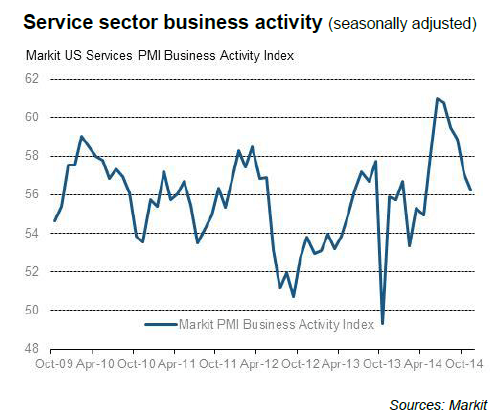
Yet, global growth is slowing as per the recent PMIs and retail sales. And China also seems to be weaker than expected.
But central bankers’ magic will take care of all that…and economists are all in the same bandwagon.
(…) lower oil prices, if maintained, will themselves boost global GDP by 0.5-1.5 percent next year. Furthermore, the global fiscal drag that has dampened the recovery in the past four years has now virtually disappeared.
It may not be enough to spell the end to secular stagnation, but the new policy mix should point to a somewhat better year for growth in the developed economies in 2015 – perhaps even in the euro area, where pessimism has recently become quite extreme. (…)
But aggressive action by the central banks has been unable to offset fully the tightening in fiscal policy that all the major economies have embarked upon since 2010. The easy monetary/tight fiscal stance has emerged everywhere, though with somewhat different timing from one major economy to another. Its success has been limited:

On the fiscal side, there is little doubt that the US and Japan have now stopped tightening budgetary policy for at least a couple of years. In the euro area, the originally planned tightening in 2014 and 2015 has also now been replaced by a neutral stance, due to delayed consolidation in France and Italy.
 More surprisingly, there is market chatter that some Anglo-Saxon policy makers returned from the G20 meetings in Australia last weekend speculating that the fiscal policy stance in the euro area might even be eased in the next year or two. Reportedly, they were optimistic that the Juncker plan for €300 billion of extra investment will have some substance, and that the gap before this plan takes effect could even be filled with an emergency fiscal easing of (say) 1 per cent of GDP in 2015 and 2016.
This sounds improbable, based on what is being said in public, but the Germans might conceivably have decided that a controlled fiscal easing in the euro area would be preferable to open-ended purchases of sovereign debt by the ECB, which they would not fully control. We may discover more at the next European summit on 18-19 December.
Turning to global monetary policy, the oil shock is clearly having a major impact on central bank thinking. Initially, many economists said that central banks would “look through” the decline in headline inflation, because core inflation would not be changing. In fact, however, they have shown themselves to be very worried that the drop in headline inflation will, this time, unhinge inflation expectations, increasing the risk of getting stuck in a deflation trap.
The Bank of Japan moved first, attributing its latest monetary easing directly to the effects of lower oil prices. On Friday, ECB President Draghi, in his most explicitly dovish speech ever, said that inflation expectations are “excessively low” and that reported inflation must be raised “without delay … as fast as possible”. Lower oil prices seems to have increased his sense of urgency considerably. Even the Federal Reserve, which is normally very resistant to placing too much emphasis on headline inflation rates, seems concerned about persistent “lowflation”.
Finally, the interest rate cuts by the People’s Bank of China on Friday may not be a big deal in themselves, but they do suggest that the drop in headline inflation will lead to generally lower rates in the emerging world as well. Apart from lower inflation, the exchange rate effects triggered by monetary easing in Japan and the euro area are causing many other countries to act.
So the oil shock is directly boosting global growth, and is also triggering a further major monetary easing, just as fiscal tightening is becoming neutral. Without engaging in irrational exuberance, it seems quite possible that, for the first time in half a decade, global growth forecasts for 2015 will need to be revised upwards, not downwards.
(…) If anything, today’s unexpected interest-rate cut by China’s central bank and a comment by the European Central Bank’s president implying that more monetary easing is needed reflect weakness, not strength. This can be seen in the reduced forecasts for economic growth worldwide and, in the case of the euro zone, signs that the region is on the verge of price deflation.
Central-bank anxiety about economic growth won’t matter much to markets in the short-term. After all, investors have been conditioned to bet that monetary stimulus will boost financial-asset prices. And while investors recognize that central banks haven’t been able to do much to deliver a growth breakthrough, this doesn’t matter much in the short-term as long as central banks are willing to lower rates or use other stimulus tools at every sign of weakness.
 Beyond the immediate market exuberance, investors would be well advised to keep three points in mind as they prepare for further central-bank support.
— With every new round of central-bank leverage, markets are increasing their bet on two untested phenomena. The first is immaculate growth, or the idea that central banks might succeed in establishing new growth engines even though they don’t have the tools to do so; and the second is the effectiveness of untested measures aimed at limiting the collateral damage from excessive risk-taking.
— Not all central banks are increasing monetary stimulus. Most notably, the U.S. Federal Reserve is likely to continue diverging from the ECB and others, easing its foot off the accelerator (albeit really carefully). This divergence will likely emerge as a more important theme in 2015 that will require adjustments that go beyond just dollar strengthening — and that could cause volatility.
— Considerable risk-taking in the financial markets has yet to be matched by a willingness by corporations to take on more risk. Even companies with plenty of cash on their balance sheets generally prefer to use it for dividends, share buybacks and defensive acquisitions. Until that changes, and unless sales and earnings growth accelerate, markets will struggle to validate inflated financial-asset prices.
Markets are right to welcome additional support from central banks. But in doing so, investors shouldn’t lose sight of the longer-term issues. So in taking on additional risks, they should remain liquid too, retaining the ability to be flexible.
Meanwhile, in the real world:
(…) Even so, Dutch central bank chief Klaas Knot said on Nov. 18 that he is “rather skeptical” of QE. Bundesbank President Jens Weidmann and ECB Executive Board member Sabine Lautenschlaeger, a former Bundesbank official, are among other policy makers who have signaled opposition to such a move.
ECB Vice President Vitor Constancio, speaking in Florence on Nov. 22, suggested officials are in no rush to act immediately as existing measures start to take effect.
“In the first quarter of next year, we have to assess if indeed the programs are contributing to a pace of increase of our balance sheet that is compatible with the sort of expectation that we have,” he said. “If not, then we have to consider other options.”
ECB Governing Council member Ewald Nowotny, who in October is said to have opposed a program to buy ABS on concerns over balance-sheet risk, today backed Constancio’s slower approach.
“I personally think we should have a steady-hand policy and monitor, firstly, how the economy development really is, and secondly, what the effects are of the measures already taken,” Nowotny, who heads Austria’s central bank, said in Vienna. (…)
Retail sales advanced 1.7 percent from a year earlier in October, the same rate as in September, the Federal Statistics Service in Moscow said today in a statement. Unemployment rose to 5.1 percent from 4.9 percent, matching the median estimate in a Bloomberg survey of 16 economists.
Fixed-capital investment shrank 2.9 percent after a 2.8 percent decline in September and wages adjusted for inflation increased 0.3 percent.
“One of the most striking aspects of the recent slowdown in the Russian economy is that the previously resilient consumer sector has weakened sharply,” Liza Ermolenko, an economist at London-based Capital Economics Ltd., said in a note. “It is likely to remain extremely weak over the coming years, providing a much smaller prop to growth than it did over the past decade.”
A continuing decline in prices could curb foreign-asset purchases by the governments of Bahrain, Oman, Saudi Arabia, United Arab Emirates, Qatar and Kuwait and put a drag on the post-Arab-Spring construction growth that has benefited multinational contractors.
Such a reconsideration could have implications for global asset markets, for regional politics and for the pace of a development boom into which governments have pumped hundreds of billions of dollars and from which many foreign companies have profited. (…)
Government spending by the Middle East’s oil exporters jumped above $700 billion in 2011 and grew by about 15% annually until this year, when estimates show the rate of increase slowing, according to the Institute of International Finance. (…)
The scale of the coming budget problem is biggest in Saudi Arabia, the Gulf’s leading economy. Saudi Arabia spent $265 billion last year, according to International Monetary Fund estimates. If it doesn’t alter fiscal policy, it is on pace to run a budget deficit amounting to 1.4% of economic output next year, despite its enormous wealth.
Saudi Arabia needs oil to trade at about $97.50 a barrel this year to sustain its spending without running a deficit or tapping reserves, according to the IMF. (…)
Spending also has ballooned in the U.A.E., where Abu Dhabi pledged last year to build $90 billion of projects through 2017—many of them with the help of foreign companies. Bahrain, Qatar, Oman and to a lesser extent Kuwait have been on spending sprees, too. (…)

Loan ‘Guarantee Chains’ in China Prove Flimsy As China’s economy slows, guarantee chains—in which companies pledge to back loans to other companies—are wreaking havoc.
(…) Guarantees played a large role in fueling China’s rapid debt expansion over the last six years. About a quarter of the $13 trillion in total outstanding loans as of the end of October was backed by promises from other companies, individuals and dedicated guarantee companies, often undercapitalized, to pay up if the borrower defaults.
Lenders outside the traditional banking system—so-called shadow bankers—also embraced guarantees, seeing them as a way to assure nervous investors that their funds were secure and to circumvent government restrictions on lending to certain types of businesses.
Reliance on these guarantees is now backfiring, regulators and analysts say, resulting in a surge of bad loans that banks had assumed were insured and threatening financial contagion.
The China Banking Regulatory Commission said in a notice to banks in July that bankruptcies in these “guarantee chains” could “trigger regional financial crises.”
It singled out the Yangtze and Pearl River deltas—the heart of China’s export and entrepreneurial sectors—as areas most at risk. (…)
Really nothing to worry about.
However, a number of participants noted that economic growth over the medium term might be slower than they currently expected if the foreign economic or financial situation deteriorated significantly. (FOMC)