Today: China surprises. Draghi keeps talking. U.S. keeps rolling.
Markets Rally on Draghi, China Heavyweight central banks gave a strong message of support to markets, prompting a rally around the world.
(…) The initial move came after Mr. Draghi said in a speech in Frankfurt it was necessary to bring eurozone inflation up to the ECB’s target “without delay.”
While the ECB chief has hinted in the past that the central bank could increase the scope and size of its asset purchases—possibly to include government bonds—some analysts said his warnings about low inflation have been getting firmer.
“There was certainly more of a sense of urgency than there has been,” said Lyn Graham-Taylor, a strategist at Rabobank. (…)
More WSJ Draghi (my emphasis):
European Central Bank President Mario Draghi sent a strong signal Friday that the central bank is ready to “step up the pressure” and expand its stimulus programs if inflation fails to show signs of quickly returning to the ECB’s target.
In a speech to a banking conference, Mr. Draghi said the ECB was prepared, if needed, to expand its purchases of assets, which raises the amount of money flowing in the economy.
“We will continue to meet our responsibility—we will do what we must to raise inflation and inflation expectations as fast as possible, as our price stability mandate requires of us,” Mr. Draghi said.
“If on its current trajectory our policy is not effective enough to achieve this, or further risks to the inflation outlook materialize, we would step up the pressure and broaden even more the channels through which we intervene, by altering accordingly the size, pace and composition of our purchases,” Mr. Draghi added.
From the FT:
(…) Mr Draghi signalled that the ECB was unlikely to act next month, saying policy makers still expected the central bank to achieve the €1tn boost through its existing measures – the purchase of asset-backed securities and covered bonds – which have just been implemented.
However, he expressed concern that low inflation was starting to affect expectations. It was “essential” to bring back inflation to target and “without delay”. At 0.4 per cent, headline inflation is just over a fifth of the ECB’s target of below but close to 2 per cent.
The ECB president flagged the fall in core inflation to 0.7 per cent as particularly worrisome, saying it was indicative of weaker demand. (,,,)
Though the weakness of the eurozone’s recovery is well acknowledged, there are concerns that buying sovereign bonds will do little to ease high unemployment or boost growth.
A poll of more than half of respondents at the European Banking Congress, where Mr Draghi was speaking, found quantitative easing would not boost the eurozone’s economy. Mr Draghi was less sceptical.
While there were question marks over how strong the effect would be, there was little doubt that asset purchases would lift prices for riskier assets, he said. (…)
“Indeed, given our relatively greater reliance on banks as a source of finance, these balance sheet effects could work particularly through the bank lending channel. On the bank side, rising asset prices would free up capital resources for additional lending,” he said.
“While on the side of firms and households, an improvement in net worth combined with a general improvement in economic prospects and hence future earnings, can expand their capacity to borrow.”
Mr Draghi also suggested the purchases would weaken the euro, by leading investors to swap euro-denominated instruments for higher-yielding assets available in other currencies.
That’s the whole policy: buy enough assets to artificially boost prices. This wealth effect will do the trick. And the weak euro…
Bernanke did exactly that, but the U.S. has a much stronger economy and banking system. This is Europe after all.
Oh! We are still not sure in the Bundesbank is clear with the plan.
Sorry, I forgot Russia and Ukraine…
China Cuts Interest Rates China cut lending rates for the first time in more than two years, in an acknowledgment that its piecemeal efforts to bolster its flagging growth have failed.
The surprise move by the People’s Bank of China on Friday comes amid wide expectations that China could miss its annual growth target of about 7.5%. (…) The PBOC said it cut its benchmark one-year loan rate by 0.4 percentage point to 5.6%. This marks China’s first reduction in lending rates since July 2012.
The PBOC also cut its benchmark one-year deposit rate by 0.25 percentage point to 2.75% and gave banks greater flexibility in setting deposit rates, allowing them to offer interest of 1.2 times the benchmark rate instead of 1.1 times. Such a move could help banks attract deposits, potentially giving them the ability to lend more.
China’s Financial System Shows Fresh Signs Of Stress Banks Charge Sharply Higher Borrowing Costs Ahead of Share Offerings, Tax Payments.
China’s financial system is showing fresh signs of stress, as banks charge each other sharply higher borrowing costs to satisfy surging cash demand for a number of new share offerings and tax payments.
Short-term borrowing costs have been rising Friday, after relatively mild signs of a cash squeeze surfaced Thursday afternoon, when regulators unexpectedly extended the day’s trading hours by half an hour. The extended hours were an apparent effort to give some borrowers and lenders more time to reach deals, interbank market traders said.
The weighted average of China’s seven-day repurchase agreements, a benchmark for short-term borrowing costs in China’s interbank market, rose to 3.48% Friday from 3.28% at Thursday’s close. (…)
Although the magnitude of banks reaching for funds still pales before the kind of severe cash crunches that the country’s money market suffered last year and earlier this year, analysts said they expect the central bank to inject more funds into the system soon to avoid the repeat of similar crises. (…)
Existing-Home Sales Rise Sales of existing homes rose in October to their highest level in a year, the latest sign of the U.S. housing recovery shaking off the shock of last year’s jump in mortgage rates.
Sales of previously owned homes climbed 1.5% last month to a seasonally adjusted annual rate of 5.26 million, the National Association of Realtors said Thursday. September’s sales pace was revised up slightly to 5.18 million.
It was the sixth time in seven months that sales rose from the prior month. Sales in October were up 2.5% from a year earlier, the first time this year that sales rose instead of fell on an annual basis. Last month’s sales pace was the highest since September 2013.
In October, existing-home sales rose in the Northeast, Midwest and South but declined in the West, according to the Realtors group.
The inventory of homes available for sale was up 5.2% last month from a year earlier. At the current sales pace, it would take 5.1 months to exhaust the supply of homes on the market. (Chart from Haver Analytics)

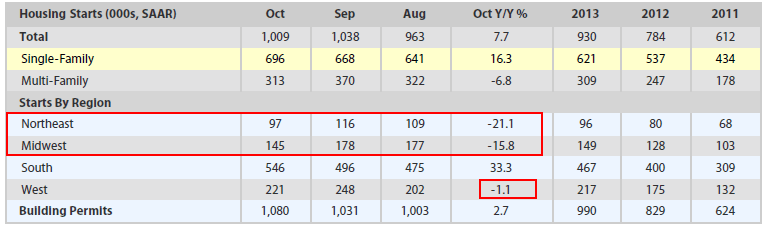
Rental Apartment Construction Is At a 27-Year High New figures offer the latest reminder of an apartment boom.
Construction of multifamily housing units—those with five units or more—is running at its strongest 12-month pace since 1989. Moreover, the share of those units being constructed as rentals is at its highest since record-keeping began in 1974. More than 93% of units in buildings with at least two units are being constructed as rentals.
Multifamily construction is now higher than it was during the peak in the previous housing cycle, reached in 2006. But back then, far more of these units were being built as condominiums, not as rentals.
This means that the number of rental units in multifamily buildings built over the last 12 months—around 330,000 units had begun construction as of October—is the highest since 1987.

After Recession, Home-Remodeling Is on the Rise

U.S. Consumer Prices Unchanged in October
The consumer-price index was unchanged in October from a month earlier, the Labor Department said. Core prices, which exclude volatile food and energy components, rose a seasonally adjusted 0.2%.
From a year earlier, consumer prices were up 1.7%, the third consecutive month at that pace, while core prices rose 1.8%.

Philly Fed Hits a 21 Year High


Conference Board Leading Economic Index Increased Again in October


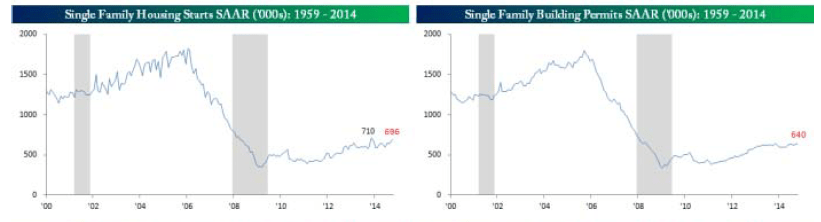
 That said, don’t think there is national recovery. It’s all happening in the South a this