The enemy of knowledge is not ignorance, it’s the illusion of knowledge (Stephen Hawking)

It ain’t what you don’t know that gets you into trouble. It’s what you know for sure that just ain’t so (Mark Twain)

Invest with smart knowledge and objective odds

THREE-STARRED EQUITIES

What is really striking with this equity market is the lack of enthusiasm after such a spectacular 5-year bull run. Many have quipped that it is the most hated bull market ever. It is clearly the least popular bull ever if judged by the anemic trading volumes even after the bull has run without any meaningful correction for over 18 months. In the good old days, everybody and their grand-mother would be in the market now. This is in marked contrast to past recoveries when Americans regained their taste for stock trading within two years of financial shocks.

image

Unlike institutional investors who routinely buy and sell equities, the general public, especially the late-comers, are mainly equity buyers. Arriving late to the party and generally less informed, they often help push valuations beyond reasonable. To be fair, “ordinary folks” are not alone showing little enthusiasm for the aging bull. Surveys of professional investors reveal much cautiousness toward equities.

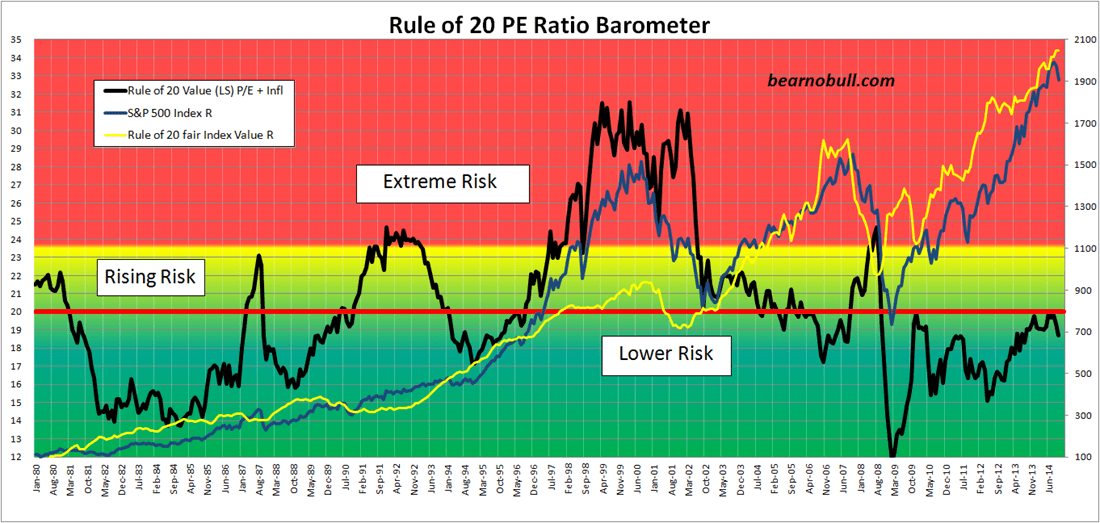
Look at the Rule of 20 P/E Barometer chart (click to enlarge). The Rule of 20 has been and remains the most dependable tool to assess whether equities are overvalued or not taking inflation into account (see Understanding The Rule Of 20 Equity Valuation Barometer). After showing that equities were deeply undervalued in early 2009 and twice again since, the barometer (black line) has refused to cross the “20” fair value line four times since 2010, a phenomenon previously unsighted except between 1963 and 1966 when equities surfed along the the fair value line. In all other 8 bull episodes since 1956, investors merrily bought equities well through fair value.

image

Bearnobull.com spends considerable time monitoring sentiment, especially the sentiment embedded within the media headlines and narratives which are the main feeders of the collective greed and fear generally responsible for market extremes. While the media have finally clearly moved into the bull camp, volume is not catching up and equity valuations remain stuck just below “fair value”. So far in 2014, equities have been rising solely on earnings, refusing to trade above “fair value”, even though the economic and financial narratives are suggestive of higher P/Es. Consider:

  • The U.S. economy is clearly accelerating on more solid fundamentals: steady and broad employment growth, contained inflation, rising bank loans, improving capex, record earnings and margins.
  • Housing, the only weak spot remaining, should also get better as lending standards are gradually softened and unemployment declines.
  • The economy is not strong enough to push the Fed to raise interest rates anytime soon. The Eurozone woos also help in this regard, even contributing to keep global long-term interest rates low.
  • China is not imploding, seemingly capable of sustaining a reasonably stable 7.5% growth rate with low inflation.
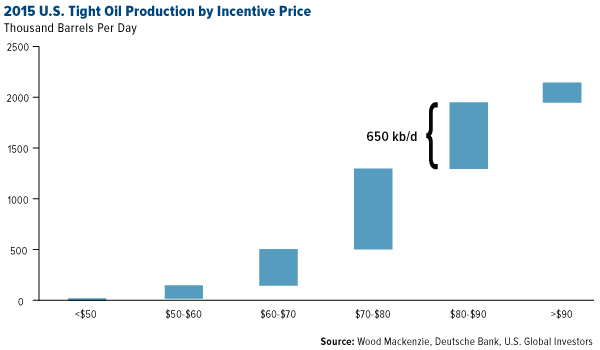
  • Geopolitical worries persist without triggering lethal economic nor financial damage. Oil prices remain pretty stable in these circumstances, thanks in large part to the important production gains in politically safe regions of the world.

For North American equity investors, this narrative is perhaps as good as it gets. Not too hot, not too cold, just a good, steady outlook. For foreign investors, the U.S. is an island of stability with solid fundamentals and a strong currency. If corporate America has been able to grow earnings 53% since 2010, admittedly a tough period for the average American, it can surely do at least as well if things get better without getting unbearingly hot for the Fed. Most of the fears present early in the year have dissipated: there is no economic summer swoon, inflation is where the Fed wants it but no higher, interest rates remain low and profit margins are not mean-reverting just yet. As I wrote in early June in Showtime!

It is thus showtime for earnings and margins, showtime for the economy and showtime for P/E multiples. The earnings show is actually underway and getting better, drawing a larger crowd. If margins actually break out and enter the show, the crowd should keep growing, especially if the economy also gets in the act.

But the big show, the one with fireworks, is the powerful spectacle of rising earnings, rising margins and rising confidence (P/Es), a combination not sighted for over a decade but which is typical of end-of-cycle shows.

The fact is that the performers have all showed up, in great shape, and the show is on.

But the crowd is not coming. The P/E boosters are staying put. Why?

Because this is only a three-star rated show.

Everything is star rated nowadays and everybody check the ratings before buying anything. Many even read the associated reviews. Equity markets are no exception in this new world of total transparency and widely available information. In previous bull markets, the megaphones were the traditional media and the stock brokers. The good old cheerleaders, the crowd boosters!

Nowadays, investors have easy and ready access to a much wider and totally free-speaking pool of information. This new breed of commentators has amassed much following and, for some, a lot of credibility in recent years. They also have as good a platform, if not even better, than traditional media have for their own often biased viewpoints. CNBC’s audience is back to its 1997 levels, continuing to slip throughout the bull market. Meanwhile, websites such as Mauldin Economics and Zerohedge have reached the mainstream, providing investors with alternative, albeit not necessarily unbiased, opinions on what’s going on in the investment world.

Large traditional media no longer control the financial news and opinions landscape, a clear win for investors, in as much as they maintain an adequate balance in their info sources.

But in this world where people have become accustomed to rely on user ratings for just about everything, it may be impossible for equity markets to receive much more than a 3-star rating given the number and diversity of the raters. That is unless the bull stays for so long that everything bearish eventually gets thumbed down, a scenario so far challenged by Zerohedge which continues to attract a wide following despite its continuing clear bias toward everything ursid.

Another impediment is the general lack of trust people have on just about everybody and everything associated with the one-percenters, a sentiment that many media are prone to fuel. The perception is strong that this is but a rigged game, led and manipulated by selfish bankers and hedgers, supported by leaders clueless of everything economic and financial other than where the party donations originate.

Who can blame them?

Take our youth: more than 4 years after the trough, youth unemployment remains at levels that used to be recession highs. Entry-level house prices is unaffordable and credit access is very limited. Even if they wanted, this internet-savvy group is out of equities for quite a while.

Take our middle class: the real median household income in the U.S. is 6% below its 2000 level and many must take 2 jobs to make ends meet. House prices, their main source of savings, remain 15-20% below their 2007 peak. They also hear that higher taxes for the middle-class is the only way out for the Federal Government while also reading that their pension fund may be hugely underfunded. Terribly burned in 2000-02 and again in 2007-08, those who may have the means to invest are obviously highly sensitive to widespread suggestions that we are in yet another market bubble.

Take our seniors: squeezed by ZIRP and other Fed-acronymed policies, they have crowded out many job outlets, taking in low wages to make up for income lost forever. Those who may have the means lack the investment horizon. They just can’t afford another crash, another bear, not even a so-called “healthy correction” for that matter. Only a one-percenter can qualify a 10-20% correction as “healthy”.

The remaining potential investors read the credible and well-articulated new media. One day, they may read David Rosenberg and be inclined to positively respond to his well-supported 5-star equity market rating. The next day, they get John Mauldin’s write-ups, his own and those of his numerous-also-cautious friends, all convincing one or two-star ratings. Worse, they may stumble on John Hussman, the last truly outspoken bear out there. He’s giving zero star to equities in well written material, doing it weekly for better effect.

When still unsure, these potential buyers read Zerohedge highlighting “Nobel prize winner” Robert Shiller’s discouraging CAPE chart or this other “Nobel prize winner” Nouriel Roubini, the latter often being presented in a more sarcastic way given his history of being on the wrong side of the trade. Unsurprisingly, potential investors go on simply reinvesting into their money market or bond fund, thinking that if all these apparently bright people can see things so differently, how can they themselves trust the future.

How about the 1%, those with the swelled surplus investable money. They were Ben Bernanke’s original targets to do the asset re-marking job under ZIRP. They sure responded as expected. Will they keep going given current valuations?

Not if they listen to some of their peers such as Carl Icahn, always on the prowl for undervalued companies, who is voicing his concerns over equity valuations.

Not if they get the gist of the most recent gathering of luminaries of economics, investment management and policy making at the so-called annual Camp Kotok. The FT somehow read the final review accompanying the 3-star rating participants just tagged on all financial markets:

(…) the mood was one of cautious economic optimism. (…) What was notable was that these [economic] forecasts, broadly in line with consensus, do not translate into enthusiasm for any particular investment theme.

Taking the median forecasts, campers only estimated 2,010 on the S&P 500 [in June 2015], barely 4 per cent upside. As for bonds, a forecast 10-year Treasury yield of 3.02 per cent suggests a difficult year ahead as prices slide; gold and oil both look flat.

Not if they read the venerable and highly respected Jeremy Grantham who, even though he calculates that U.S. equities are 65% overvalued, is nonetheless willing to keep on playing Bernanke’s Gambit:

The bull market may come to an end any time (…). But I believe it probably (i.e., over 50%) will not end for at least a year or two and probably not before it reaches a level in excess of 2,250 on the S&P 500. (…) I am sure it will end badly. But given this regime of the Federal Reserve and given the levels of excess at other market peaks, I think it would be different to end this bull market just yet.

Surely, a target in excess of 2250 (+15%) on the S&P 500 should earn 4 stars. But what about the 65% current overvaluation? What about the fifty-fifty odds? Grantham is a mean-reverter. If equities are 65% overvalued and there is a 40-50% probability that it “will end badly” sooner than later, my own probability-adjusted math suggests 2 stars at best. Mr. Grantham admits that GMO is not putting any new client money in equities however, which squarely disqualifies him as a “verified purchaser”.

Who is he trying to convince flashing a 15% probable upside against an eventual 65% mean-reverting minimum downside on a simple coin toss?

Certainly not the 99-percenters who have likely had enough advice from their leaders already. They diligently consumed when George Bush begged them to support the economy after 9-11 They got even more indebted after regulators allowed lenders to be more lenient and let bankers masquerade their junk into Triple-A securities. They kept buying houses with subprime mortgages well after Ben Bernanke’s numerous reassuring comments between 2005 and 2008.

And they have been at wars that were not supposed to wars. They watched their elected elite act like selfish spoiled kids even when America’s well being was in jeopardy.

How do you think they react when they read about recent M&A activity and corporate buybacks at such elevated valuation? Maybe they say “heck, these rich CEOs and CFOs are not buying with their own money now, why would I let them buy with what remains of my savings?”

So they read Mrs. Yellen who has yet to stumble. She says equities are expensive. How refreshing! She also says interest rates will remain low for “a considerable time”. That’s the way to go: rates are through the floor but risk averters would rather earn nothing than potentially lose money under the advice of these rich people living in their own, so different world.

So they buy bond funds, junk and all, totally oblivious to the fact that bonds may actually be the most overvalued asset class around. Totally unaware that bond funds, contrary to individual Treasuries or corporates, have no maturity and, as such, never return capital at par. My guess is that Mrs. Yellen, who knows a lot more about bonds than equities, also needs low long-term rates for as long as possible. Eyes wide shut!

(From The Blog of HORAN Capital Advisors)

Last June, I raised the possibility that the summer show would be so enticing that P/E ratios would rise through “fair value”. I have yet to prove right on the second part. Some may say that the geopolitical environment, Europe’s slowdown or simply summer itself are not conducive to equity revaluations. Maybe, but I am getting doubtful, even willing to murmur “this time is different”…I can almost see Business Week front paging “THE END OF GREED!” like if that could ever happen.

It may not be the end of greed, but it could be the revenge of the suckers.

If so, U.S. equities are in fact fully valued rather than fairly valued under the Rule of 20. The Rule says that fair P/E is 20 minus inflation and that the Rule of 20 P/E (actual P/E + inflation) fluctuates between 15 and 25, which it has usually done during the last 90 years. If we now believe that equities will not venture much into the 20-25 Rule of 20 P/E area, it necessarily follows that 20 is “fully valued”.

If so, the risk/reward equation for the next 6 months gets a lot less appealing: Assuming inflation stays at 2.0%, “full value” P/E is 18.0x trailing earnings. Trailing 12-m EPS are now $112.05 for a full value of 2015, only 4% above current levels. Looking out through Q3 and Q4 earnings seasons, trailing EPS could rise by 3% after Q3 and another 3.6% after Q4 if current estimates are met. Still using 18.0x trailing EPS, the S&P 500 would be fully valued at 2075 after Q3 and 2150 after Q4. That would provide a 7% gain over the next 9 months or so.

Not bad, especially in a ZIRP world, but not great considering that it assumes that there is no nasty surprise and we stick to full valuation à la 1963-66.

The risk side is firstly technical: it assumes that the S&P 500 Index drops to its 200-day moving average (1860). That is a 4% decline, pretty much offsetting the current 4.4% “undervaluation” (the Index is sitting on its 100-d. m.a.).

Secondly, we must assess the more fundamental downside risk, one that says that markets (and valuations) normally fluctuate, à la “every cycle but 1963-66”. During the current bull, the Rule of 20 P/E twice dropped back to the 15-16 level: March-August 2010, June 2011-May 2012, both 15-20% corrections. A setback to the 16x Rule of 20 P/E level (14x P/E) implies a similar 15-20% correction.

Probabilities of such a correction?

  • Less than 50% given profits trends and the improving economic background and how dip buyers have behaved in the past 18 months, stepping in before the rout got worse than 6-8%.
  • More than 20% given that we are approaching September and October during a Presidential mid-cycle. Equities have yet to perform their usual Presidential mid-cycle correction (perfect batting average since 1962), unless the 6% late January decline counts as a mid-cycle bust.

This is a game of probabilities which are admittedly highly suggestive. I try to use odds that are fact supported but I also insert my own personal bias based on my own personal financial situation and objectives which may be different than yours.

Using 25% probability of a 15% correction and a 75% probability of reaching 2150 before March 2015, the weighted outlook is +4% (5-6% total return) on the S&P 500 Index.

Three stars, at best!

NEW$ & VIEW$ (12 AUGUST 2014)

The reasons why oil prices stay cool. Earnings estimates about to get a boost?

SMALL BUSINESS OPTIMISM TICKS UP SLIGHTLY

July’s Optimism Index technically rose 0.7 points to a reading of 95.7. There was little change in the 10 Index components other than outlook for expansion and business conditions which accounted for the small gain in the Index. Even though these improved, they still remain historically low.

image

The net percent of all owners (seasonally adjusted) reporting higher nominal sales in the past 3 months compared to the prior 3 months fell 1 point to a net negative 3 percent, still one of the very best readings since 2007. Thirteen percent cited weak sales as their top business problem, one of the lowest readings since December, 2007, the peak of the expansion.

image

image
image
Higher Housing Costs Aren’t Likely to Fade Soon, Cleveland Fed Study Says

Is a recent uptick in housing inflation a fluke? Not really, say researchers at the Cleveland Fed. (…)

German Gloom Hits Euro

The euro slid Tuesday after a slump in German economic sentiment further fueled worries that the economic standoff with Russia over the conflict in Ukraine is hurting Europe’s economy.

Germany’s ZEW index of economic expectations fell to 8.6 in August from 27.1 in July, its lowest level since December 2012. The survey of analysts and investors is the latest sign that geopolitical tensions are hurting sentiment in Germany, ahead of data Thursday that are expected to show a contraction in Europe’s largest economy.

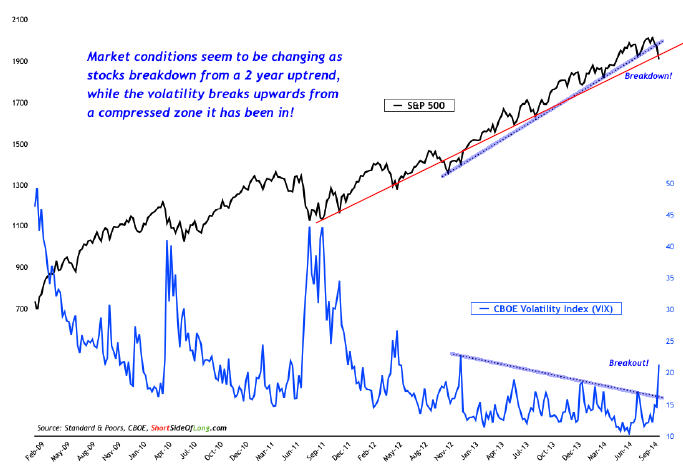
If you missed this this chart from The Short Side Of Long, here it is again:

Henkel Warns Political Tension Spoils Trading Outlook Germany’s Henkel has warned that trading conditions are looking tough amid rising political tensions in Ukraine and the Middle East as the maker of Persil detergent and Schwarzkopf shampoo reported a 5.5% rise in second-quarter net profit.

Henkel’s sober outlook comes as other European consumer-goods groups have recently highlighted the challenge of more sluggish-than-expected growth in emerging markets. Depreciating local currencies have also helped crimped returns for European and U.S. companies in some major economies while the crises in Ukraine and Middle East have rubbed off on demand for household products in those regions.

IEA Lowers 2014 Oil Demand Growth Forecast World oil demand will rise less than previously thought in 2014, due to a lower outlook for the global economy and demand growth in the second quarter falling to its lowest level in more than two years, the IEA energy watchdog said.

World oil demand will rise less than previously thought in 2014, due to a lower outlook for the global economy and demand growth in the second quarter falling to its lowest level in more than two years, the West’s energy watchdog said Tuesday.

In its monthly oil-market report, the International Energy Agency—which advises industrialized nations on oil policies—trimmed its projection for growth in global demand this year to 1 million barrels a day, down 180,000 barrels a day, citing weaker-than-expected demand in the second quarter.

“Remarkably low oil deliveries in both Europe and North America helped slash this report’s estimate of global demand growth for the second quarter of 2014 to less than 700,000 barrels a day year-over-year — a low of more than two years,” it said.

This second quarter drop, weak refining activity in the industrialized nations of the Organization for Economic Cooperation and Development in June and an “apparent sudden stop in Chinese crude imports” to build their stock inventory countered the threat to the market and supplies posed by mounting geopolitical risks in the oil-producing world, the agency said.

“Despite armed conflict in Libya, Iraq and Ukraine, the oil market today looks better supplied than expected, with an oil glut even reported in the Atlantic basin,” the report said.

Output from the Organization of the Petroleum Exporting Countries rose by 300,000 barrels a day in July to a five-month high of 30.44 million a day a day, as Saudi Arabia raised production and supplies recovered in Libya, the report said.

Production in the kingdom, the world’s largest exporter and OPEC’s de facto leader, rose by 230,000 barrels a day in July to 10.01 million barrels, the highest level since September, while Libya almost doubled its production to 430,000 barrels a day, the IEA said. That offset declines in Iraq, Iran and Nigeria.

The Atlantic market is currently well supplied so that incremental Libyan barrels are having a hard time finding buyers, the IEA said. “Many in the market seem more focused today on potential short-term downward price pressures from a further increase in Libyan production,” it said. (…)

Outlook for demand for crude from OPEC’s 12 members, or “call on OPEC,” in the second half of this year will reach 30.8 million barrels a day, higher than last month’s estimate.

The agency estimates that the call on OPEC will average 29.9 million barrels a day, down from 30 million barrels a day this year.

Demand, however, is expected to accelerate by 1.3 million barrels a day in 2015 as the global economic conditions improve, the Paris-based IEA said. That is 90,000 barrels a day lower than its previous forecast due to weaker economic growth in China and Russia and raised expectations for non-oil power sector use in Japan.

A Happy Earnings Season

See anything bizarre on this chart?

Thumbs up This a.m.: First Call earnings revisions up are above 50%, highest since 2012.

Bank Profits Near Record Levels U.S. banks in the second quarter reported the industry’s second-highest profit in 23 years, despite stiff headwinds, thanks largely to improved credit quality.

U.S. banks posted $40.24 billion in net income during the second quarter, the industry’s second-highest profit total in at least 23 years, according to data from research firm SNL Financial. The latest profits are just below the record $40.36 billion recorded in the first quarter of 2013.

(…) overall loan growth increased at its fastest quarterly pace since the financial crisis, topping $8 trillion in total loans outstanding for the first time since SNL began tracking the data in 1991. Commercial lending rose at an annualized 12.6% rate in the second quarter. Growth in consumer lending, particularly student lending, auto loans and credit cards, also has picked up, to about 6% from 3% a year ago. (…)

So-called provision expenses fell to $6.59 billion in the second quarter from $7.61 billion in the first quarter and $8.53 billion in the second quarter of 2013.

Big banks are still releasing some of those reserves, an action that pumps up profits. The four largest U.S. banks—J.P. Morgan Chase, Citigroup, Bank of America Corp.BAC +0.13% and Wells Fargo—released a total of $2.25 billion of reserves in the second quarter, up about 20% from the first quarter.

One important measure of bank profitability is return on equity, or the amount of profit a bank generates as a percentage of shareholders’ equity. RBC Capital Markets analyst Gerard Cassidy notes that the 20 largest banks he covers reported a median return on equity of 9.3% in the second quarter, up from 8.4% in the first quarter. But a return on equity below 10% “is one of the biggest obstacles to higher stock valuations,” he said.

So far, the results haven’t impressed investors, who remain concerned about a range of headwinds facing the industry, from growing regulatory costs and stubbornly low interest rates to steep slowdowns in mortgage lending and securities-trading revenue. Such issues have weighed on other measures of bank health, such as the returns lenders generate on their equity. (…)

Regional banks reported the strongest growth in commercial and industrial lending during the second quarter. Cleveland-based KeyCorp, for example, posted a 13.4% increase in commercial, financial and agricultural loans from the year-earlier period, to $26.4 billion, helping to drive a 5.5% gain in loans overall.

Citigroup Inc. C -0.12% delivered a 3.7% gain vs. the year before in total loans outstanding. Wells Fargo & Co. and J.P. Morgan Chase JPM -0.04% & Co. logged gains of 3.6% and 2.9%, respectively.

 KRB KRE

Welcome to the World of ‘Pension Smoothing’ A government accounting maneuver to pay for road repairs, subways and buses will allow many U.S. businesses to delay billions of dollars in pension contributions for retirees.

President Barack Obama on Friday signed a $10.8 billion transportation bill that extends a “pension-smoothing” provision for another 10 months. In short: companies can delay making mandatory pension contributions, but because those payments are tax-deductible some businesses will pay slightly higher tax bills, which will help pay for the legislation.

Companies with 100 of the country’s largest pensions were expected to contribute $44 billion to their plans this year, but that could be slashed by 30% next year, estimated John Ehrhardt, an actuary at consulting firm Milliman. (…)

The bill essentially allows companies to base their pension liability calculations on the average interest rate over the past 25 years, instead of the past two. The 25-year average is larger, because interest rates were much higher before the financial crisis.

The accounting technique doesn’t actually reduce companies’ obligations to retirees. Instead, it artificially lowers the present-day value of future liabilities by boosting the interest rate companies use to make that calculation. (…)

The Third Iraq War (WSJ)

(…) Bombing is an act of war, and Mr. Obama has already sent 800 troops or military advisers to Iraq. Weare at war again in Iraq, for the third time in 25 years. And the main question now is whether the Commander in Chief will fight it vigorously enough to defeat the jihadists who have become the main threat to the region and America. (…)

The U.S. weekend bombing raids seemed to stop the ISIS advance against the Kurds, but the Pentagon and White House badly misjudged its strength. (…)

ISIS recaptured a northern Iraq town from the Kurds on Monday and it could be regrouping for a run at the oil city of Kirkuk or Erbil, the Kurdish capital. This is not one of those al Qaeda offshoots that Mr. Obama so casually dismissed in January as “a JV team” wearing “Lakers uniforms.” This is jihadist army.

The main U.S. strategic priority now should be rolling back and defeating ISIS so it can’t establish a terrorist caliphate. Such a state will become a mecca for jihadists who will train and then disperse to kill around the world. They will attempt to strike Americans in ways that grab world attention, including the U.S. homeland. A strategy merely to contain ISIS does not reduce this threat.

A strategy to roll back ISIS would also make it easier to solve Iraq’s political disputes. Sunni sheikhs in western Iraq won’t cooperate with even an accommodating new Shiite prime minister if they know Baghdad can’t protect them. Ditto for the Kurds. (…)

War-weary America has to show its steel in Iraq (FT)