The enemy of knowledge is not ignorance, it’s the illusion of knowledge (Stephen Hawking)

It ain’t what you don’t know that gets you into trouble. It’s what you know for sure that just ain’t so (Mark Twain)

Invest with smart knowledge and objective odds

NEW$ & VIEW$ (11 AUGUST 2014)

Earnings season recap. More debate on economic slack.

U.S. Productivity Rises at 2.5% Pace in Second Quarter

Nonfarm labor productivity, or output per hour worked, advanced at a 2.5% seasonally adjusted annual rate from April through June, the Labor Department said Friday. The gain failed to offset the 4.5% decline in the first three months of the year, the largest quarterly drop since 1981.

From a year earlier, productivity advanced 1.2%. That is only slightly ahead of the 1% average rate recorded in 2012 and 2013, and well off the better than 3% gains in the first year of the recovery. The pace of productivity gains the past two years have coincided with annual economic growth of a little better than 2%. Meanwhile, unit labor costs, a gauge of inflationary pressures, rose at a 0.6% annual rate in the second quarter following a 11.8% leap in the first quarter. From a year earlier, unit labor costs are up 1.9%, essentially in line with other inflation measures.

One bright spot in Friday’s report came in manufacturing. Productivity in the sector rose at a 3.6% pace during the second quarter and is up 2.1% from a year earlier. Both gains easily outpace the broader business sector. Meanwhile, unit labor costs in manufacturing have largely been contained, up 0.8% from a year earlier.

Comp. data have been quirky and noisy lately. Taking a 4Q moving average, one finds that comp. per hour was up 2.1% Y/Y in Q2.

Decline in ‘Slack’ Helps Fed Gauge Recovery

All are signs of an economy still healing from a deep downturn that created lots of economic slack: the gap between the resources we have and those we are using.

By many measures, such slack has narrowed considerably, but not completely, even five years after the recovery began. Conditions aren’t quite back to what was normal before the 2008 financial crisis.

Job Market Tilts Toward Workers as U.S. Enters Virtuous Cycle The balance of power in the job market is shifting slowly toward employees from employers.

(…) Americans who have been hunting for employment for more than six months are finding they’re having better luck landing a job, while people who had given up looking are returning to the labor force to resume their search.

Companies, meanwhile, are beefing up their in-house recruiting teams and increasingly using complicated computer algorithms to scour the Web for prospective job candidates. (…)

Employers in general have been “pretty stubborn” about increasing wages, said Jeffrey Joerres, executive chairman of ManpowerGroup (MAN), a Milwaukee-based staffing company with $20.3 billion in revenue last year. That may be about to change as the pool of available candidates shrinks.

“You can see a little anxiety among employers,” he said. “I can feel the inflection point is coming.”

Michael Durney, chief executive officer of Dice Holdings Inc. (DHX), agrees.

“I think you’re going to start to see wage inflation,” said Durney, whose company provides specialized websites that match employers with potential employees in industries such as technology and financial services. (…)

Businesses also are more inclined to hold onto staff. Conversions — giving full-time jobs to the temporary employees Manpower provides — are at a three-year high, according to Joerres. (…)

Express Employment had almost 90,000 job orders from employers in June, up from 62,000 a year earlier, Funk said.

More noise for Mrs. Yellen…

The WallStreetExaminer blog supports the doves as it deciphers the non-seasonally adjusted numbers to check on wage pressures:

Employment Cost Increases By SectorThe year over year gain in actual employment costs for all civilian workers was, are you ready for this–2%! That, indeed, is the highest it has been since 2011, when it spent the 2nd through 4th quarters rising at rates of 2-2.25%. Last year it never got above 1.9%. It’s a breakout! Or maybe not quite. This number is still within the same range of growth rates that it has been since the second quarter of 2010.

The gain, such as it was, was driven by gains of more than 2% in 6 major employment sectors. On the other hand, 4 broad sectors rose by less than 2%, and they can’t seem to get out of their own way. 3 of them have been wallowing below 2% since early 2011 and all 4 have been since early 2012.  Here’s a breakdown of the actual, not seasonally adjusted annual rate of gain by major sector.

Here’s how it looks on a graph.

Employment Costs By Sector- Click to enlarge

Before you get all outraged about government workers leading the increases, note that they got screwed in 2011 and 2012, falling below private sector workers for more than a year. The current surge looks like catch-up for that time when they were not getting raises. At about 16% of the workforce the government sector may be big enough that had it not been for this apparently compensatory increase, the total aggregate number for all employees may not have made it to a new 2 year high.

Another notable factor is that the 5 sectors that rose less than 1.75% comprise more than half of all US workers. The majority of US workers are experiencing compensation increases that do not even keep up with CPI, which we know, in addition, to be understated. (…)

Among the stronger sectors, Construction AND Extraction showed a gain of 2.1%. The problem there is that all of the gain is due to Extraction. Extraction means mining, and oil and gas production. Extraction is booming, while construction–not so much. In June, the BLS reported a year to year to year increase of 4.64% in average weekly earnings for mining and oil and gas extraction workers. But construction workers got virtually nothing, showing a gain of 0.24%. According to BLS data, there are approximately 850,000 employees in mining and oil and gas extraction. There are more than 6 million construction employees. How the BLS averaged those two together to come up with a 2.1% overall increase is beyond my ability to comprehend. I am the simple one.

So when you break these numbers down, recognizing the catching up of government workers which is probably temporary, and the likely overweighting of gains in mining and oil and gas extraction, that leaves just 4 sectors barely above a 2% increase.

One is Transport workers. They account for less than 3% of the US workforce. Their year to year increase is still below the peak levels of the past two years. The current uptick does not yet indicate that they’ve turned the corner.

Likewise those in another sector gaining more than 2%, Sales, saw an increase that remains well below the peaks of the past 2 years. Finally, managers and professionals and office and administrative workers have been flatlining at a 2% rate of increase for 2 years. There’s no breakout there either.

Looking at the 4 weaker sectors comprising the majority of US workers, the idea of a turn there is ludicrous.

Overall, private sector workers and those in education are not keeping pace with inflation, and the recent gains for non-education government workers could prove transitory. Considering the trends of the actual data in all of these major sectors, there’s no breakout here. The corner has not been turned. (…)

Good analysis. However, don’t forget that wages are a very lagging indicator. I side with David Rosenberg’s analysis which finds that

50 million American workers are in industries that are already at full employment. That is 35% of the workforce. A year ago, that number was zero. And 35% of the private workforce is also now in the process of enjoying accelerating wage growth. What is holding back the aggregate data are two sectors facing relentless downward pressure -construction and financial services.

But we have reached a critical mass where a rising share of the labour force is beginning up against a supply wall -wage growth for a significant and rising minority, enough to spin the dial on national income and spending is on the mend.

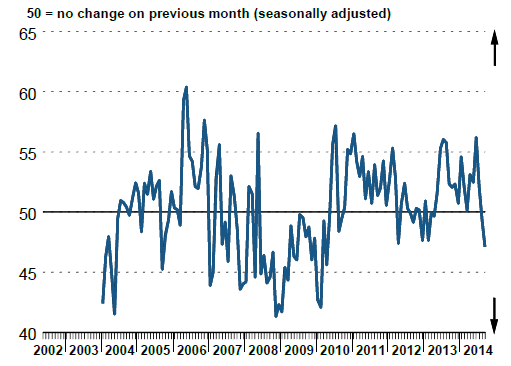
OECD Indicators Point to Slowdown in Germany

(…) But the outlook for Germany appears to be weakening, with the country’s leading indicator falling again during June in what the OECD said was a sign of “growth losing momentum.” After a strong first quarter, many economists estimate that the German economy contracted in the second quarter, in part because of an unusually large number of days being lost to vacation. (…)

The OECD said its leading indicators for France and Italy continue to point to stronger growth, as they have done for a number of months. However, those pickups have yet to materialize, leaving Spain as the only major euro-zone economy to enjoy a significant acceleration over recent quarters. (…)

image
image

Sarcastic smile Where’s Italy’s recession on these charts?

Italy’s Problem Is Europe’s Problem

(…) Italy’s paralysis is all the more striking given the strengthening recovery in countries that have undertaken reforms. Spain is now the fastest growing economy in the euro zone, expanding by 0.6% in the second quarter. Citigroup expects the Greek economy to grow this year by 1.1%; Unemployment in Portugal has been falling for almost two years to 13.9% from a peak of 17.5%; Cyprus should return to growth in 2015, far sooner than predicted at the time of its financial collapse last year. (…)

That is why Italy’s stalled economy is a challenge for the European Central Bank too. For the past year, the ECB has come under growing pressure to embark on large-scale purchases of government bonds to address the euro zone’s low inflation rate. (…)

Germany adds to eurozone worries

Official data, due to be published on Thursday, are expected to show that growth in the eurozone stagnated in the second quarter. Economists polled by Reuters forecast growth of just 0.1 per cent between April and June, compared with 0.2 per cent in the first three months of the year.

German Economy Backbone Bending From Lost Russia Sales

Sad smile Leading to this chart from The Short Side Of Long:

China Loosens Monetary Conditions in Test of Credit Power

China loosened monetary conditions last quarter at the fastest pace in almost two years, a Bloomberg LP gauge showed, testing the waning effectiveness of credit in supporting economic growth.

Bloomberg’s new China Monetary Conditions Index — a weighted average of loan growth, real interest rates and China’s real effective exchange rate — rose 6.71 points to 82.81 in the second quarter from the previous three months. That’s the biggest jump since the July-September period of 2012, with May and June’s numbers the first back-to-back readings above 80 since January 2012.

New yuan loans in July will be a record high for that month, according to a Bloomberg News survey of analysts before data due by Aug. 15, suggesting officials are keeping the credit spigot open even as debt risks mount. While consumer inflation below the government’s goal allows room for more easing, economic data will determine how far policy makers go. (…)

China Inflation Tame in July

The consumer-price index rose 2.3% on year, in line with economists’ forecasts and unchanged from the previous month, according to data released by the National Bureau of Statistic. Prices rose 0.1% from a month earlier.

The CPI rose 0.1% M/M in July.

Meanwhile, the producer-price index, which tracks the prices paid to companies at the factory gate, has been stuck in deflation for more than two years, thanks to a combination of falling prices for raw materials and excess capacity in many Chinese industries.

The index logged a 29th straight month of declines in July, falling 0.9% year-over-year. But that is still mild compared to drops of 2% or more seen earlier this year. 

CANADA: Surprisingly negative jobs report supports low-rate stance

Statistics Canada’s monthly tally of hiring and firing produced a net gain of 200 positions last month, as a 60,000 increase in part-time jobs marginally outweighed a 59,700 plunge in full-time positions.

Canada’s unemployment rate dropped to 7 per cent from 7.1 per cent, but only because more than 35,000 people gave up looking for work, according to StatsCan’s report, released Friday in Ottawa. (…)

StatsCan estimates there were 17,820,900 people working in July, only 0.7 per cent more than a year ago. The labour participation rate, which measures the percentage of the population either working or seeking work, dropped to 65.9 per cent, the lowest since October 2001. Employment in goods-producing industries has shrunk by 56,000 positions this year, reducing the headcount to its lowest since January 2012, according National Bank Financial.

Speaking of National Bank Financial, their group of fine economists again provide the more insightful stuff:

Full-time employment has been particularly weak in Canada with a cumulative loss of 4,000 jobs so far in 2014. As today’s Hot Charts show, an unprecedented divergence has recently emerged between our country and the U.S. when it comes to full-time job creation: whereas the U.S. is growing at a robust 2% clip on a
year/year basis, Canada is actually contracting. What’s behind the weakness? The goods-producing industries has seen the destruction of 92,000 jobs over the past year with more than half of those losses coming from construction – the sector that spearheaded the rebound in job creation after the last recession.

As shown, a 3.7% annual drawdown in construction headcounts is extremely rare outside recessions. Is this development a harbinger of a much bigger slowdown in Canadian economic activity? We do not think so. For one, available data still point to a marked acceleration in real GDP in the coming months. For another, we doubt that the recent pace of layoffs in the construction industry can be maintained at a time when the value of new building permits is surging (we hit a record high in June). Should the upcoming report on new home starts show a level of around 180,000-to-200,000 units in July, a rebound in construction jobs could be in
store as soon as August.image

EARNINGS WATCH

Factset:

Overall, 446 companies in the S&P 500 have reported earnings to date for the second quarter with 73% reporting actual EPS above the mean EPS estimate. This percentage is slightly above the trailing 1-year average (72%). In aggregate, companies are reporting earnings that are 4.2% above expectations, which is also above the trailing 1-year (+3.2%) average. As a result of these upside earnings surprises, the earnings growth rate for the S&P 500 has improved to 8.4% today from 4.9% on June 30 and from 6.8% on March 31.

In terms of revenues, 64% of companies have reported actual sales above estimated sales and 36% have reported actual sales below estimated sales. The percentage of companies reporting sales above estimates is well above both the 1-year (55%) average and the 4-year average (57%).

The blended revenue growth rate for Q2 2014 is 4.3%, which is above the estimated growth rate of 2.8% at the end of the quarter (June 30).

In aggregate, companies are reporting sales that are 1.7% above expectations. This surprise percentage is well above the 1-year (+0.6%) average and the 4-year (+0.6%) average.

All ten sectors are reporting higher earnings relative to a year ago. Five of the ten sectors are reporting double-digit earnings growth, led by the Telecom Services and Health Care sectors. On the other hand, the Financials sector is reporting the lowest earnings growth of all ten sectors.

At this point in time, 80 companies in the index have issued EPS guidance for the third quarter. Of these 80 companies, 56 have issued negative EPS guidance and 24 have issued positive EPS guidance. Thus, the percentage of companies issuing negative EPS guidance to date for the third quarter is 70% (56 out of 80). This percentage is above than the 5-year average of 64%.

But well below the 6-quarter average of 79%.

Analysts expect earnings growth for the S&P 500 for the second half of 2014 to be in the same range as the 8.4% growth currently being reported for Q2 2014. For Q3 2014 and Q4 2014, analysts are predicting earnings growth rates of 7.1% and 9.9%.

Note that the estimated growth rate from Q3 was cut from 9.0% on June 30 to 7.1%, in spite of these facts:

  • Q2 actual EPS growth of +8.4% is 4.2% above expectations and shared across all sectors with 5 of the 10 sectors recording double digit growth in Q2.
  • Q2 actual revenue growth of +4.3% is 1.7% above expectations.
  • Margins keep growing. Q2 margins at 10.2% leapt above the previous 5Q highs.

image

S&P’s database of 452 company reports shows a 66% beat rate and a 21% miss rate, the former being in line with recent years while the latter is much lower than the 24.7% average of the past 8 quarters. Interestingly, only 3 of the 10 sectors meaningfully better the average beat. Excluding Health Care (82%), IT (73%) and Materials (70%), the beat rate drops to 61%.

Q2 EPS are expected to come in at $29.56, up from the suspicious $29.18 last week and +12.1% Y/Y. Revenues are up 5.8% Y/Y, a marked acceleration from Q1’s +3.4% and Q4’13’s +0.5%.

S&P also says that margins rose nicely form 9.5% in Q2’13 to 10.1% this year, another record.

Trailing 12-month EPS should total $112.05 after Q2, up a significant 12.9% Y/Y. Q3 and Q4 estimates receded a little to $30.21 (+12.2% Y/Y) and $32.38 (+14.6%) respectively.

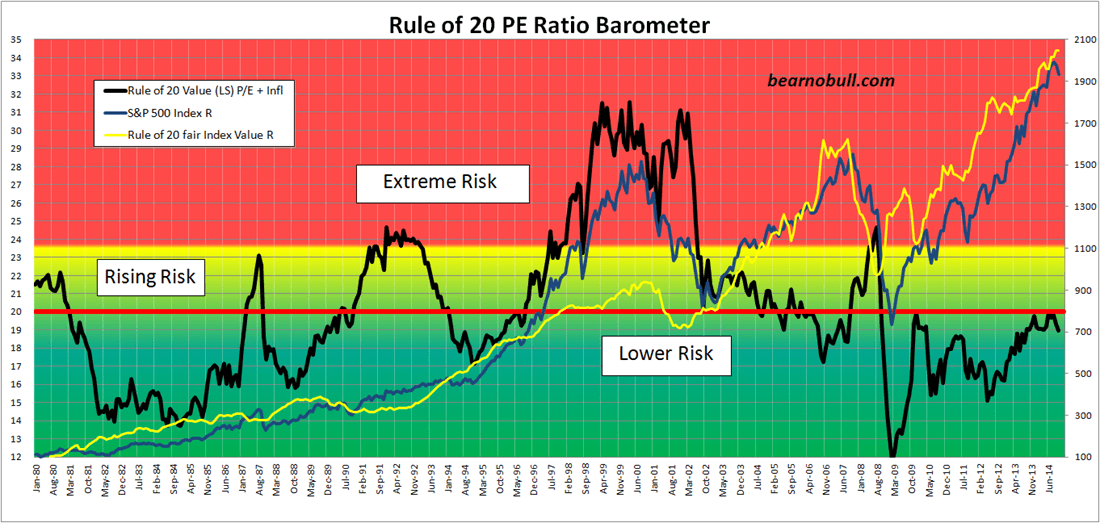
In all, this will end up as a pretty good earnings season. The bears have little meat to feed on as revenues have accelerated, margins keep rising and guidance is not deteriorating. At 1932, the S&P 500 Index is selling at 17.2x trailing EPS, a clear premium on the average (and median) of 13.7x since 1927, 1953 and 1983. Only if you are using data since 1993 (18.5) can you affirm that equities are cheap. At your own risk however!

The more dependable Rule of 20 P/E is at 19.2, a mere 4% below the “20” fair value (2020 on the S&P 500 Index).

image

The latest Investors Intelligence survey revealed that bulls fell sharply to 50.5% from 55.6% a week ago. It noted that the latest reading is almost out of the caution territory and represents a decline over 12 points from the multi-year high of 62.6% in mid-June. It added that the spread between the bulls and bears contracted to 33.4% from 39.4% in the last survey and nearly low enough to shift to a neutral.

I will come back to that shortly. 

A 1.4-acre property in Lake Tahoe sold on Thursday for $1.6 million in bitcoins, joining a handful of other real-estate transactions that used the virtual currency.

NEW$ & VIEW$ (8 AUGUST 2014)

U.S. Jobless Claims Fall to 289,000 New applications for unemployment benefits fell last week to this year’s second-lowest level, a new sign of an improving labor market.

Initial claims for unemployment benefits decreased by 14,000 to a seasonally adjusted 289,000 in the week ended August 2, the Labor Department said Thursday.

The four-week moving average of claims, which smooths out weekly volatility, decreased by 4,000 to 293,500. That marked the best four weeks of claims data since February 2006.

Thursday’s report showed the number of workers continuing to draw unemployment benefits fell by 24,000 to a seasonally adjusted 2.5 million in the week ended July 26. Those figures are reported with a one-week lag.

How Low Can Jobless Claims Go?

The two longest stretches of economic growth in the last half century were the booms in the 1980s and 1990s. And jobless claims today are now near the lowest levels reached in those historic expansions.

Pointing up The decline in jobless claims is even more striking when the size of the workforce is taken into account. For most of the late 1980s the U.S. had under 100 million workers covered by the unemployment insurance program. Today, it’s more than 130 million. Unlike unemployment, which is a share of the workforce, jobless claims are a raw number, unadjusted for the growing workforce.

When the economy’s growing size is taken into account, jobless claims are not just at the lowest level of the year, or the lowest of the recovery. They’re near the lowest on record. By this measure, a further decline in jobless claims would put the U.S. labor market in truly uncharted territory. (…)

Note that job openings are back to their 2006 peak level:

image
Credit-Score Math Recalculated A change in how the most widely used credit score in the U.S. is tallied will likely make it easier for tens of millions of Americans to get loans.

Fair Isaac Corp. FICO -1.19% said Thursday that it will stop including in its FICO credit-score calculations any record of a consumer failing to pay a bill if the bill has been paid or settled with a collection agency. The San Jose, Calif., company also will give less weight to unpaid medical bills that are with a collection agency. (…)

The changes are expected to boost consumer lending, especially among borrowers shut out of the market or charged high interest rates because of their low scores. (…)

As of July, about 64.3 million consumers in the U.S. had a medical collection on their credit report, according to data from credit bureau Experian. And of the 106.5 million consumers with a collection on their report, 9.4 million had no balance—and won’t be penalized under the new credit-score system. (…)

Some experts said the new model for FICO scores walks a fine line: It loosens standards without overstating the creditworthiness of borrowers. Fair Isaac said it ran studies to determine how likely borrowers are to repay their debts if they had a stellar credit record with the exception of such collections. (…)

Fair Isaac will begin rolling out the new scoring model, named FICO 9, to credit bureaus this fall and to lenders later this year.

Fair Isaac releases new scoring models every few years, and it is up to lenders to choose which ones to use. The new score will likely be adopted by credit-card and auto lenders first, says John Ulzheimer, president of consumer education at CreditSesame.com and a former Fair Isaac manager.

Mortgages are likely to lag, since the FICO scores used by most mortgage lenders are two versions old. (…)

More than half of all debt-collection activity on consumers’ credit reports comes from medical bills, according to the Federal Reserve. Such activity results in lower credit scores for consumers, meaning that lenders are more likely to be cautious in extending credit.

The number of U.S. consumers struggling with medical debt has been surging. As of 2012, 41% of U.S. adults, or 75 million people, had trouble paying medical bills, up from 58 million in 2005, according to a report released last year by the Commonwealth Fund. (…)

Consumer Borrowing Posts Slower Growth in June  Consumer borrowing outside of mortgages climbed at the weakest rate in four months in June, raising questions about Americans’ confidence and economic well-being.

Americans’ total outstanding debt—excluding home loans–rose at a 6.48% annual rate in June from a month earlier to $3.21 trillion, the Federal Reserve said Thursday. That marked the slowest rise since February. (…) Consumer debt rose at a 7.8% pace in the second quarter after climbing 6.7% in the first three months of the year. (…)

Credit-card use eased in particular in June. Revolving credit, reflecting total credit-card balances, climbed at a 1.3% pace in June after rising 2.4% in May and 12.3% in April.

Non-revolving credit—generally auto loans and student loans–increased at a 8.43% rate in June, a solid gain but down from the prior month’s 9.32% increase. Many Americans have been replacing aging cars after holding off such purchases during the recession and early in the recovery. Student debt also has grown as Americans rely less on savings to cover college and graduate-school costs. (Chart from Haver Analytics)

U.S. Small-Business Owners’ Optimism Continues Slow Rise

Wells Fargo/Gallup Small Business Index

Hotels: Occupancy up 4.5%, RevPAR up 11.0% Year-over-Year

Right now it looks like 2014 will be the best year since 2000 for hotels. (CalculatedRisk)

Federal Reserve finds US households are unwell

The Federal Reserve has just released its first “Report on the Economic Well-Being of U.S. Households“. It provides some useful context for the ongoing debates about the income distribution and excess savings.

A few particularly dispiriting highlights:

  • Among Americans aged 18-59, only a third had sufficient emergency savings to cover three months of expenses.
  • Only 48 per cent of Americans could come up with $400 on short notice without borrowing money or sell something.
  • 45 per cent of Americans save none of their income.

Pointing up Also noteworthy is the demographic breakdown of how people expect to retire, based on their current age. Young people are optimistic they will be able to stop working when they get older and live off their nest egg, while those on the verge of retiring are much more likely to expect having to toil for the rest of their lives:

The insufficient savings of many older Americans helps explain why the labor force participation rates of people aged 55 and older has steadily increased over the past quarter-century even as the labor force participation rates of those aged 25-54 has fallen over the same period.

Another interesting tidbit regards the impact of student debt: 44 per cent of people with outstanding education burdens “reported avoiding medical treatment because they could not afford it, compared with 30 percent of people without student loans.” This seems to corroborate the intuition that excessive borrowing for degree programs of dubious value could depress consumption among a subset of the population for many years. (Whether this would have significant macro impact is less obvious. See Cardiff’s post from June.)

Pointing up The last datum we want to highlight has to do with housing: About half of American renters aged 18-59 would rather be homeowners but cannot afford the down payment required to get a mortgage. We suspect that many of those renters would have been homeowners in 2004-2006 because minimum down payments were much lower then, even though house prices and interest rates were both somewhat higher. (…)

Amusingly, the National Association of Realtors, which regularly publishes a Housing Affordability Index, does not consider down payments when calculating the cost of housing, only home prices and mortgage rates. (Tip of the hat to the WSJ’s Josh Zumbrun for catching that.) The renewed cautiousness of lenders regarding down payment requirements may help explain why the Fed’s efforts to goose the housing market by lowering borrowing costs haven’t been as successful as some might have predicted a few years back.

China Exports Surge China’s exports surged while imports fell in July. The news was largely welcome in an economy that has been struggling to regain momentum, but negative import growth highlights continued weak domestic demand.

According to figures released by the General Administration of Customs on Friday, exports expanded 14.5% year-over-year, nearly double the 8% growth forecast by 15 economists in a Wall Street Journal survey and a sharp increase from the 7.2% year-over-year increase recorded in June.

Imports, meanwhile, fell 1.6% during the same period, following a 5.5% on-year expansion in June. The survey predicted a 3% rise.

Strong exports—fueled by double-digit growth to the U.S., the EU, Southeast Asia and Hong Kong—dovetailed with similar strong export growth for Taiwan and South Korea, as those economies order more Chinese components for use in their own export industries, analysts said.

France’s Slow Growth to Continue

France’s economy will grow 0.2% in the third quarter from the second, the Bank of France said in its monthly business climate survey. That follows the same quarterly expansion in the second quarter, according to the central bank’s previous survey.

Confused smile Eurozone recovery on track, says Draghi

Mr Draghi acknowledged that eurozone momentum had weakened in the second quarter and a rise in political tensions would inflict more damage. But he maintained that a weak recovery would continue and longer-term inflation expectations remained anchored to the central bank’s target of below but near 2 per cent.

The ECB president urged governments to boost the recovery, blaming a lack of labour market reform and excessive business regulations in Italy for the eurozone’s third-biggest economy returning to recession. Mr Draghi also countered calls from François Hollande, France’s president, for more central bank action, saying it would do little unless Paris tackled structural economic flaws.

OPEC July Output at Highest for Five Months

In its monthly oil market report, the Organization of the Petroleum Exporting Countries said Libya’s production rose by 200,000 barrels a day last month, bolstering the group’s output by 167,000 barrels a day to total 29.9 million barrels a day. (…)

However, despite last month’s uptick, ongoing turmoil in the country has dented hopes of further improvements in its level of oil production.(…)

Meanwhile a deterioration of the security situation in Iraq has for months shut in production in the country’s north. Although the bulk of the country’s oil fields in the south have so far remained safe, concerns have risen this week about the semiautonomous region of Kurdistan.

“Until recently, OPEC’s hopes were pinned particularly on Iraq, as it was to shoulder two-thirds of the oil cartel’s future production increases. However, the country is now sliding increasingly into chaos,” analysts at Commerzbank CBK.XE -1.00% said in a note. (…)

Crude oil rises as Obama authorises air strikes Afren first oil group to partially suspend operations in northern Iraq

image

EARNINGS WATCH

We now have 91% of the S&P 500’s market cap (433 companies) in and EPS is on track to rise 9.2% Y/Y according to RBC Capital. Earnings ex-Financials have surprised by 4.1% so far. Revenues have beaten by 1.4%.

S&P should update its database this weekend. I should thus be able to update the official scorecard next Monday.

SENTIMENT WATCH

Bearish sentiment, or the expectation that stock prices will fall over the next six months, spiked seven percentage points to 38.2% in this week’s survey conducted by the American Association of Individual Investors. That represents the highest mark of the year and a level last seen in August 2013. AAII releases the results of its Internet survey—which asks its members to register their bullish, bearish or neutral views—early each Thursday.

Bullish sentiment came in at 30.9%, marking only the second time in 2014 that bears have exceeded bulls in this particular survey.

With bullish sentiment now exceeding bullish sentiment by 7.34 percentage points, this is only the second time this year that bears have outnumbered bulls. (Bespoke Investment)

Unfortunately, the AAII sentiment data is not the most useful (see INVESTOR SENTIMENT SURVEYS: DON’T BE TOO SENTIMENTAL!). The II survey is somewhat better on the bullish signals but we are far from there as this Yardeni chart shows:

image

More bears are needed! BTW:

European Stocks Enter Correction