Did you miss Monday’s FEAR post?
(…) The Treasury market is looking intimidating again, and politicians should take notice, as should everyone else.
This selloff is more complicated and ominous than some. It’s also not limited to the US. Bond markets in the bigger European economies are also testing a high made late in 2023. There was a belief that policy rate cuts, made by all the main central banks, would ensure that remained the peak. It’s now coming into question. (…)
Fears of rising inflation, which eats away at the value of future income streams from the bonds, logically raises yields. Inflation expectations as gauged by the breakeven point between fixed and inflation-linked bond yields have ticked up of late, but in the bigger picture they remain remarkably stable. This shows the implicit expectations for the next five years, and for the five years after that (a measure the Fed cares about a lot). They suggest that the bond market is still confident that inflation is back in the bottle:

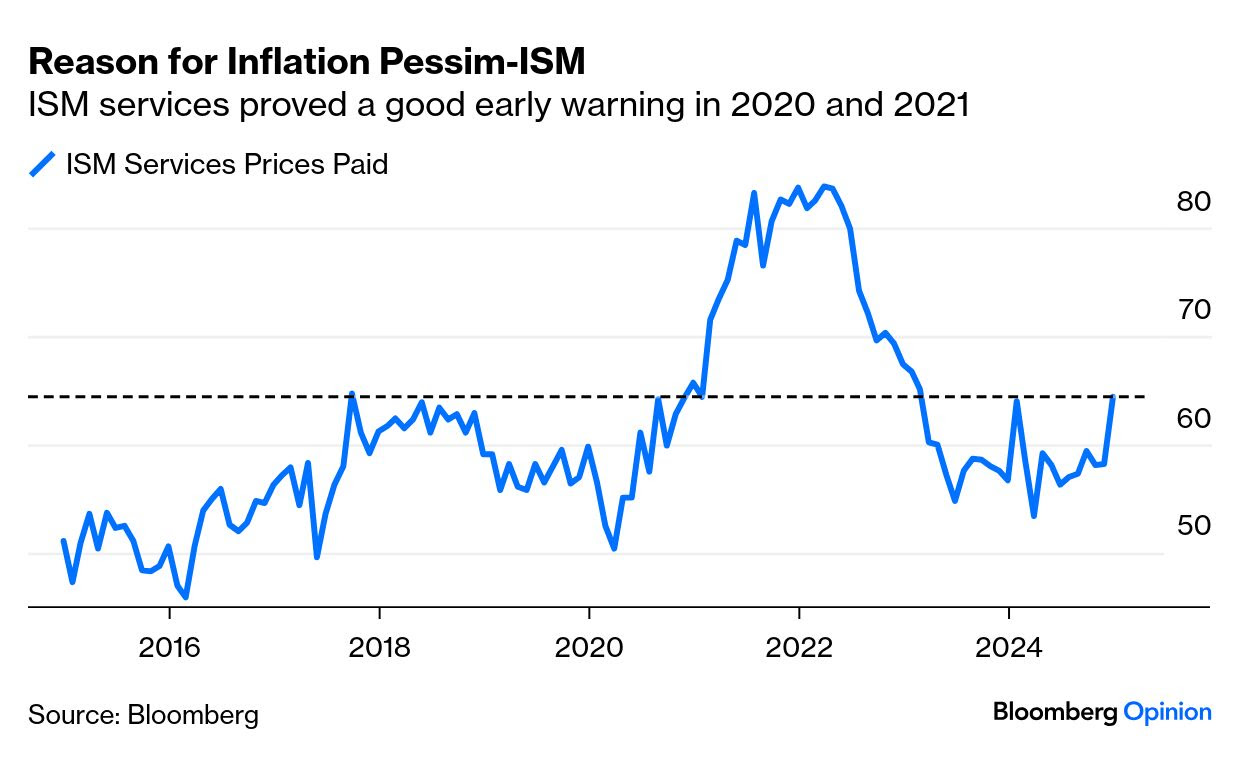
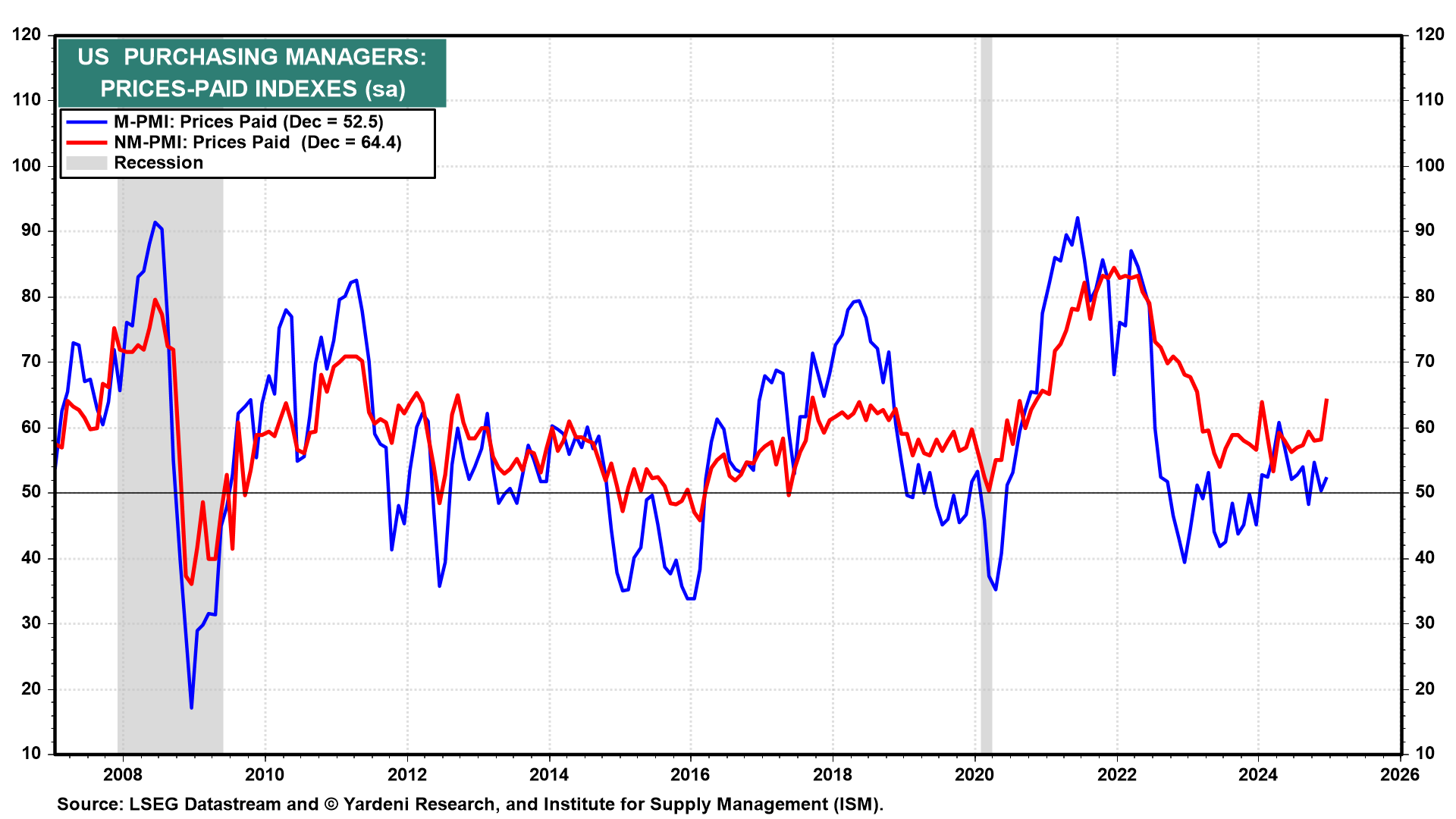
The latest data, with the last readings on unemployment and inflation for 2024 due on Friday and next Wednesday, do give reason for concern. The Institute of Supply Management’s survey of the services sector showed a sharp increase in the proportion of managers complaining about rising prices paid. As inflation is currently centered almost entirely in services, that is a problem. Moreover, this measure in hindsight provided a great early warning in 2021 that inflationary pressure was brewing:
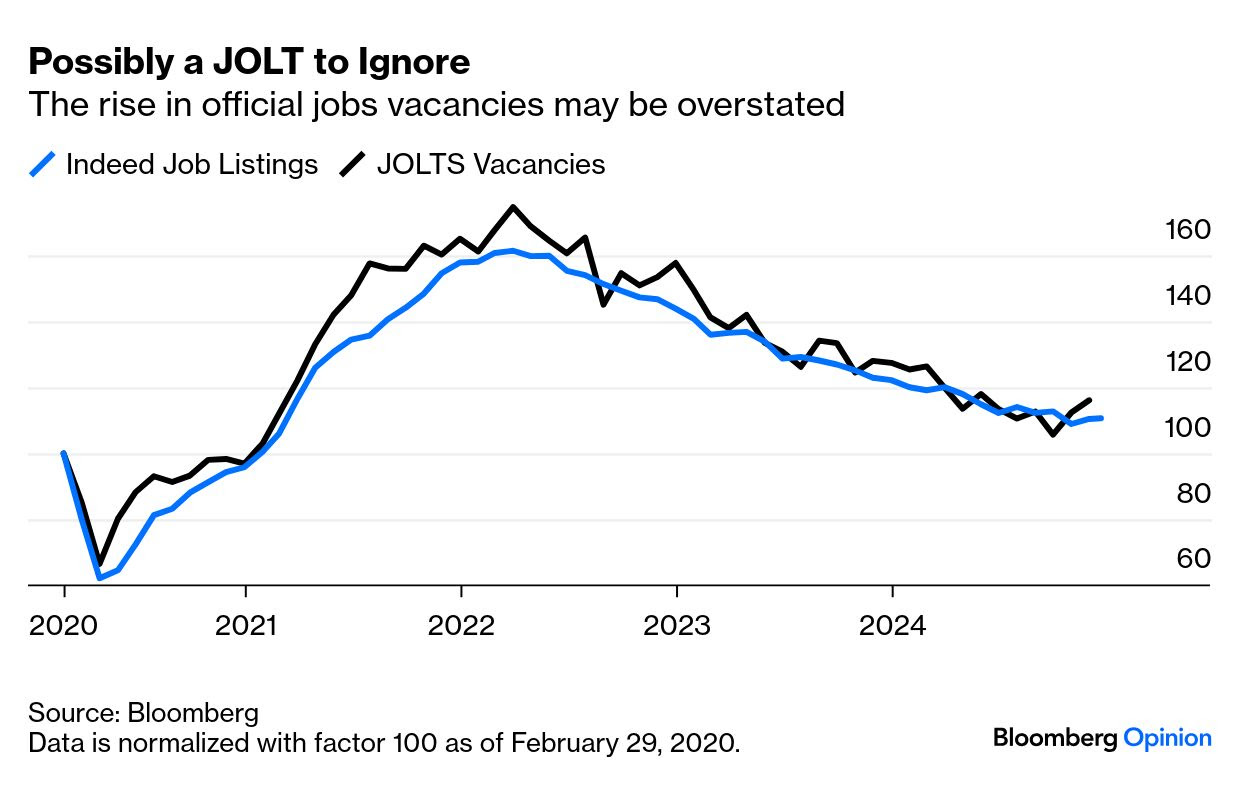
Meanwhile, there has been a surprisingly strong jump in the number of US vacancies recorded in the JOLTS (Job Openings and Labor Turnover Survey). However, Samuel Tombs of Pantheon Macroeconomics points out that this number is noisy (as Richard Abbey noted yesterday), and that data on job openings from the Indeed web-based recruitment site suggest that vacancies are stabilizing. During this decade, the Indeed measure has provided a smoother ride while working as an excellent early warning for the JOLTS:
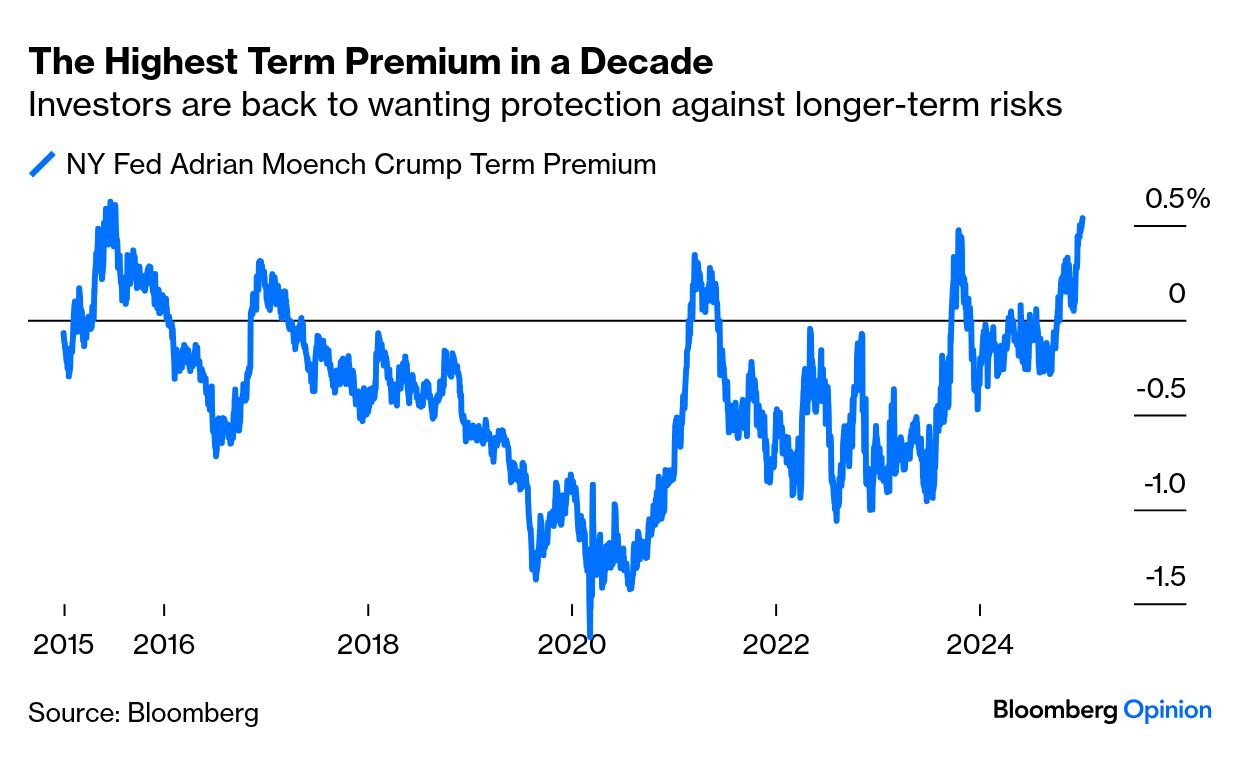
So if this isn’t a straightforward recalibration of expectations for the Fed and inflation, why the rise in yields? It’s best to look to the term premium, an infuriating concept that refers to the extra yield investors require to take the risk of lending long into the future, and with it the risks that interest rates will change over that time. Colleagues Mike Mackenzie and Liz Capo McCormick have a nice explainer here. The point of the concept is to explain any rises or falls in yields that can’t be put down directly to the Fed. Interestingly, after a long period when the term premium was negative, it’s now its highest in almost 10 years (according to the Adrian Moench Crump term premium maintained by the New York Fed that is the most widely followed measure):
Why is it rising? Some political risk is in there. A Republican clean sweep has raised the threat of fiscal irresponsibility; bond markets prefer gridlock. The policy uncertainty that surrounds the return of Trump will naturally prompt investors to demand a higher term premium.
Beyond that, there are the forces of supply and demand. Companies have celebrated the new year with a splurge of new issuance, which naturally tends to raise the yields that all bonds must offer. The Treasury under Janet Yellen has raised far more of its debt through very short-term borrowing than usual. That has the effect of reducing the supply of longer bonds and, therefore, reducing their yield. The Trump nominee to succeed her, Scott Bessent, wants to shift back toward longer-term issuance, which will naturally increase supply and hence tend to drive up yields. Investors can see this coming.
The most important issue may be the secular trend. For decades after Paul Volcker tamed inflation in the early 1980s, the 10-year yield trended downward in the most predictable and important pattern in global finance. Whenever the yield rose to threaten the pattern, a crisis — Black Monday, the Orange County derivative disaster, the bursting of the dot-com bubble, the Global Financial Crisis — would erupt, and yields would drop. That is over. And while it’s never wise to make too much of drawing lines on charts, this latest rebound in yields suggests that a new trend is taking shape, as I’ve indicated here:
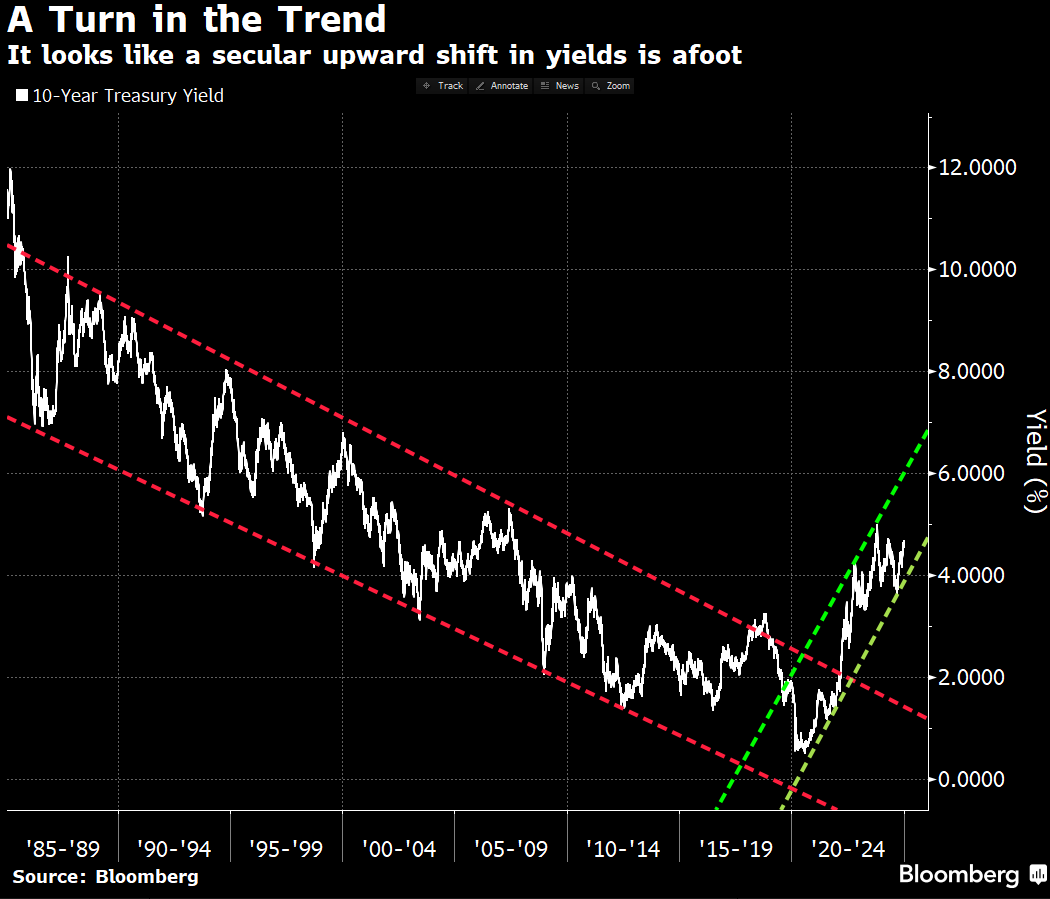
Demographics can explain this, as can what appears to be a return to inflationary psychology and worries about whether the US fiscal situation is sustainable. The point for now is that the balance of forces is pushing yields upward. The downward trend was in many ways the governing force of international capital markets for more than three decades; it might make sense to get used to the notion that yields will tend to trend up, not down, for the foreseeable future, and change conduct accordingly.
About the November JOLTS:
The November JOLTS report offered another tentative sign of labor demand stabilizing. Job openings at the end of November rose to a six-month high of 8.1 million, consistent with the recent leveling off in Indeed job postings. That said, turnover metrics suggest both employees and employers remain in a holding pattern. The share of workers in November voluntarily quitting their job fell back to its cycle low of 1.9%. Meantime, employers remain reluctant to let go of existing workers, but also reluctant to bring on new workers. The layoff rate, at 1.1% in November, remained just below its pre-pandemic average, but the hiring rate fell back to 3.3% and is still hovering near levels unseen in more than a decade. (…)
On trend, both JOLTS and Indeed overall job postings are roughly 10%-11% above their pre-pandemic marks. The sideways trend in small business hiring plans through the second half of last year and their post-election jump has further allayed some fears of continued cooling in labor market conditions. That said, signs of stabilization in labor demand are still tentative. New job postings from Indeed continue to slow sharply and were just 7.4% higher in December than in February 2020. A year ago in December 2023, new job postings were still 43% higher than their pre-pandemic level.
The rise in job openings paired with November’s 161K increase in unemployment resulted in a small uptick in job openings per unemployed person to 1.13 from 1.12 in October. This leaves one of the Fed’s favorite metrics of balance in the labor market cooler than 2018–2019 levels but still above the 1.00 ratio that indicates there are more jobs available in the economy than workers currently seeking employment. (…) (Wells Fargo)


November’s jump in Job Openings looks suspicious vs Indeed’s more recent data (through Dec. 20):

Monday’s Services PMI from S&P Global said that “a rise in staffing levels ended a four-month sequence of job cuts, but it was still only modest.” The ISM Services employment component edged down (-0.1pt to 51.4).
The ISM also revealed that “The prices-paid index jumped from 58.2 in November to 64.4 in December.”
S&P Global’s was more informative and reassuring:
There were further signs of cost pressures moderating in December as the pace of inflation eased for the third consecutive month to the weakest since last February. Input prices still increased markedly, however, and at a pace that was faster than the pre-pandemic average. A number of respondents mentioned higher shipping costs, while others reported wage pressures.
In response to higher input costs, companies increased their own selling prices. The rate of inflation remained modest, despite quickening slightly from that seen in November.
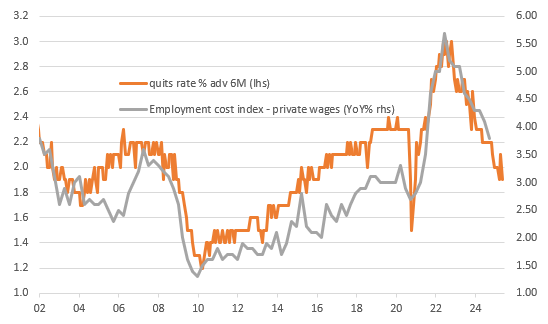
Quits rate versus employment cost growth
Source: Macrobond, ING
Ed Yardeni:
The Bond Vigilantes aren’t buying the Fed’s esoteric narrative that the federal funds rate (FFR) needs to be cut because the so-called neutral rate of interest is much lower than the prevailing 4.33%. What matters more to them is that inflation in the core services components of the CPI and the PCED remains sticky well above 2.0%. Long-term yields may continue rising until the Fed acknowledges the economy’s strength and officially hits the FFR pause button.
Real 10-Y yields (1.81%) are almost back to 2.0%. Seems decent to me but productivity better be present…

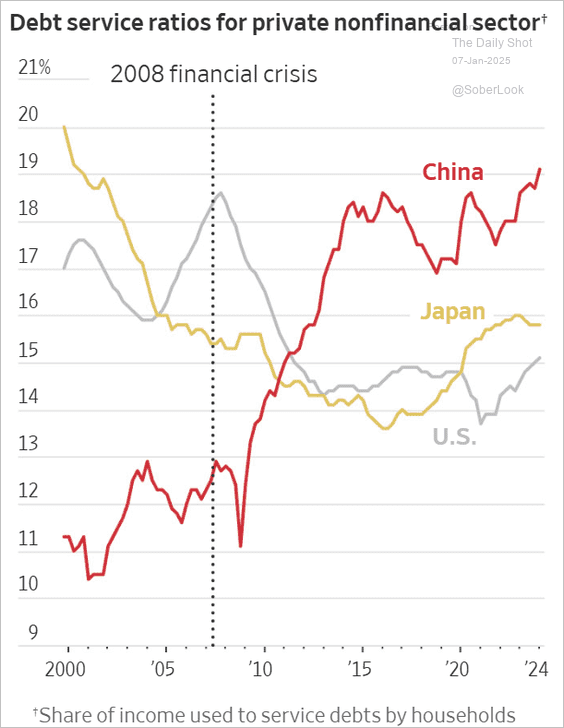
Markets Sound Alarm Over Deflationary Spiral in China Investors are increasingly concerned that China risks sliding into an economic malaise that could last decades.
Investors in China’s $11 trillion government bond market have never been so pessimistic about the world’s second-largest economy, with some now piling into bets on a deflationary spiral mirroring Japan’s in the 1990s.
Yields on Chinese sovereign bonds maturing in 10 years have tumbled in recent weeks to all-time lows, creating an unprecedented 300-basis-point gap with US peers, despite a slew of economic stimulus measures announced by President Xi Jinping’s government.
The plunge, which has dragged Chinese yields far below levels reached during the 2008 global financial crisis and the Covid pandemic, underscores growing concern that policymakers will fail to stop China from sliding into an economic malaise that could last decades.
If the bond market is right, the implications would be profound. An extended bout of deflation would hobble one of the world’s biggest economic growth engines, add new strains on social stability in the second-most populous country and exacerbate capital outflows that led to a record exodus from Chinese financial markets at the end of last year.
In a sign of how seriously investors are taking the risk of Japanification, China’s 10 largest brokerages have all produced research on the neighboring country’s lost decades. Richard Koo, an economist well-known for drawing parallels between the two countries, said he has been approached by Chinese companies and think tanks to share his views. Goldman Sachs Group Inc. this week said Japan’s case offers a “valuable playbook” for Chinese stock investors who’ve been rattled by the worst start to a year in nearly a decade.
While an echo of post-bubble Japan is far from certain, the similarities are hard to ignore. Both countries suffered from a real estate crash, weak private investment, tepid consumption, a massive debt overhang and a rapidly aging population. Even investors who point to China’s tighter control over the economy as a reason for optimism worry that officials have been slow to act more forcefully. One clear lesson from Japan: Reviving growth becomes increasingly difficult the longer authorities wait to stamp out pessimism among investors, consumers and businesses. (…)
“The bond market is already telling the Chinese people: ‘you are in balance sheet recession’,” said Koo, chief economist at Nomura Research Institute. The term, popularized by Koo as a way to explain Japan’s long struggle with deflation, occurs when a large number of firms and households reduce debt and increase their savings at the same time, leading to a rapid decline in economic activity. (…)
Regardless of one’s views, Japan’s fate during the lost decades between 1990 and 2010 offers a stark warning for investors in Chinese assets.
The Nikkei 225 index lost more than 70% of its value over that period, compounding the pain of banks and companies as debt-to-equity levels ballooned. It took the benchmark more than 30 years to reclaim its 1989 peak, a feat achieved last year only after a lengthy period of extraordinary monetary stimulus, a paradigm shift in corporate governance, and a long-awaited revival in inflation. (…)
Some, like veteran emerging-market investor Mark Mobius, believe China has the tools to avoid following Japan’s fate. “Since the government has an outsized control over the economy, they have the ability to implement financial measures designed to reduce or even eliminate many of the negative elements,” he said. (…)
Japan’s economy only started to respond positively once policymakers “finally began to directly transfer funds to the people’s pockets,” rather than plow money into infrastructure and companies, said Jesper Koll, an expert director at Monex Group Inc., who has been researching Japan for decades. It “took basically 20 years before politicians learned that lesson — I hope China’s leaders have learned this lesson and have the wisdom to boost the people’s purchasing power.”
China Expands Consumer Subsidies to Boost Spending as Tariff Risk Looms Markets seemed unimpressed by the move, extending declines in early afternoon
The National Development and Reform Commission, China’s top economic planner, said Wednesday that the government will include more products in its home appliance trade-in program in 2025, extending state subsidies to microwave ovens, water purifiers, dishwasher and rice cookers.
Consumers who buy new mobile phones, tablets and smart watches will also qualify for a 15% subsidy for products priced at less than 6,000 yuan, or about $819. Total subsidies will be capped at 1,500 yuan per person per year [$200], according to an official notice. (…)
While the Chinese leadership has hinted that more fiscal support will come for the country’s wary consumers, little details have been revealed so far, with all eyes on March’s annual legislature session where lawmakers are expected to approve a stimulus package that includes more aggressive government borrowing.
Besides support for consumer products, the government will also allocate some funds to provide discounted loans for companies to upgrade their equipment, a senior official told reporters at a press briefing on Wednesday. (…)
@WSJ
AI CORNER
AI Startup Anthropic Raising Funds Valuing It at $60 Billion Amazon-backed OpenAI rival was valued at $18 billion last year
The deal would make Anthropic the fifth-most valuable U.S. startup after SpaceX, OpenAI, Stripe and Databricks, according to data provider CB Insights. It was valued last year at $18 billion in a round led by Menlo Ventures.
Anthropic is the latest in a string of artificial-intelligence startups that have seen their valuations skyrocket amid a dealmaking frenzy over the past few months.
OpenAI raised $6.6 billion in an October round that nearly doubled its value to $157 billion.
Two other startups, Elon Musk’s xAI and Perplexity, subsequently raised money at substantially increased valuations.
Investors are excited about the potential of generative AI to transform how people work and live and largely unconcerned that most AI startups are losing money because of the high costs of the technology and intense competition.
Tech giants including Meta Platforms and Alphabet’s Google are also investing billions to build their own AI capabilities. (…)
The startup’s annualized revenue—an extrapolation of the next 12 months’ revenue based on recent sales—recently hit about $875 million, one of the knowledgeable people said. Most of that has come from sales to businesses.
OpenAI told investors when closing its October round that it expected to generate $3.7 billion in revenue last year, in large part from sales of the premium version of ChatGPT to consumers.
FYI:
Anthropic: 68x revenues
OpenAI: 42x revenues
Nvidia: 19.3x forward revenues, 29.6x EV/Ebitda, 35.5x EPS with ebitda margins of 64%, net margins of 56% and return on capital of 74%.
 This is a good time to read Howard Marks’ latest memo: On Bubble Watch
DeepSeek Shows Necessity Is The Mother of Invention
The Information writes that the latest update (December 26) to Chinese quant trading firm High-Flyer Capital Management’s DeepSeek Large Language Model had scores on popular benchmarks that in some cases beat models from OpenAI, Anthropic and Meta. By comparison, Meta said it trained its Llama 3 405B model, released in July, using 16,000 H100s, which are more expensive to run than the H800 chips.
High-Flyer says it used just 2,048 Nvidia H800 chips and spent $5.5 million to train the model. The H800 is a dumbed-down version of the H100 chip that U.S. authorities allow Nvidia to sell in China.
Despite restrictions on the sale of advanced Nvidia chips in China, researchers there have been able to make do with weaker and older-generation chips. Their success proves once again that necessity is the mother of invention—and that American researchers probably aren’t getting as much out of Nvidia’s hardware as they could be.
- A Chinese model will surpass leading American AI: Speaking of China, models from the country have been seriously impressing American AI researchers. It doesn’t seem like export restrictions on Nvidia chips have been making much of a dent in the country’s progress, as Chinese researchers have simply gotten more creative with using older Nvidia chips. I believe that in 2025, an AI model from a Chinese lab will surpass leading models in the U.S. on popular leaderboards like LMSYS’ Chatbot Arena. Whether or not it’ll get picked up by AI developers, though, is a different question, given censorship in these models.
President-elect Donald Trump’s calls to take control of Greenland, Canada and the Panama Canal reflect his fascination with a 21st-century version of an old idea—that great powers should carve out spheres of influence and defend their economic and security interests by imposing their will on smaller neighbors.
In a press conference Tuesday, Trump outlined a second-term foreign policy agenda that rests not on global alliances and free trade but on economic coercion and unilateral military might, even against allies.
With the Panama Canal and Greenland, he suggested he could use force to take them over. With Canada, he suggested he would hit the U.S.’s northern neighbor with extreme tariffs, leaving it no choice but to submit to annexation. (…)
If Trump does even a portion of what he described—each of which is extremely unlikely—it could mean far-reaching changes in America’s global role, emboldening adversaries and forcing allies no longer assured of Washington’s backing to seek new security and economic arrangements, analysts said. (…)
Asked by a reporter if he would commit to not using military force or economic pressure in his quest to acquire the territories, Trump replied “No, I can’t assure you on either of those two. But I can say this, we need them for economic security.” (…)
“China and Russia are looking at all this like, ‘Go ahead, Mr. Trump, keep talking.’” (…)
Trump’s vow to annex Canada is bluster aimed at gaining leverage before trade negotiations with Ottawa, some advisers say. His threat to take back the canal is a ploy to secure lower prices for U.S. ships sailing through Panama, and his fixation on acquiring Greenland is about gaining access to rare-earth minerals and denying them to China, they add. (…)
To anyone alarmed that Trump might actually do what he says, they point to his pledge during his first run for the White House to make Mexico pay for the wall he wanted to construct along the U.S. southern border—an idea that he stopped talking about as the difficulties of making it happen became clear and other issues took priority. (…)
Some of his advisers acknowledge a sale is unlikely, but an expansion of U.S. presence on the island, through economic investments and a larger military footprint, is a possibility, they say. A decades-old treaty between Denmark and the U.S. gives the Pentagon access to an Arctic base in southern Greenland with an airfield, as well as radar and other equipment used for detecting possible missile launches.
Trump’s advisers are interested in expanding that U.S. presence to counter the growing influence of China and Russia in the Arctic, and believe Washington could negotiate a relationship similar to that enjoyed by tiny island nations in the Pacific, called a compact of free association.
Such an agreement would allow the State Department to negotiate expanded economic and military ties without Denmark surrendering sovereignty. Congressional approval would be required for any such compact. (…)
The waterway is currently administered through the state-run Panama Canal Authority, but two of its seaports have long been run by a Hong Kong-based company, an arrangement Trump says is unacceptable.
The Panama Canal “was built for our military,” and “we gave the Panama Canal to Panama, we didn’t give it to China,” he said. “They have abused that gift.” (…)
Amending the Canadian constitution to dissolve the country and join the U.S. would require unanimous approval from Canada’s Senate, House of Commons and provincial legislatures. A December Leger poll showed only 13% of Canadians want their country to become America’s 51st state, with 82% opposed. Both chambers of the U.S. Congress would also need to authorize a new state. (…)
Advisers close to Trump acknowledge that annexation of Canada is unlikely, and instead suggest the comments are rooted in Trump’s aggressive negotiating style, particularly at this time of transition in Canada, where he seeks to put the incoming prime minister on notice. (…)
FYI: On this day: Panama regains the Panama Canal
On December 31, 1999, the United States officially handed the Panama Canal over to Panama’s government, ending a long saga that had started a century and a half earlier. (…)
In his first State of the Union address in 1902, President Roosevelt made it clear that the canal was a top priority for his administration.
“No single great material work which remains to be undertaken on this continent is of such consequence to the American people as the building of a canal across the Isthmus connecting North and South America,” he told Congress. “It is emphatically a work which it is for the interest of the entire country to begin and complete as soon as possible; it is one of those great works which only a great nation can undertake with prospects of success, and which when done are not only permanent assets in the nation’s material interests, but standing monuments to its constructive ability.”
In 1903, the United States supported a bloodless revolution in the Colombian province of Panama after the Colombian government rejected a U.S. treaty to acquire land in Panama to build the canal. The United States Senate offered $10 million for the land; the Colombian government wanted $25 million.
As the Colombian government sent troops to put down the rebellion, a U.S. warship, the Nashville, appeared with a contingent of Marines off the Panamanian coast, along with other U.S. naval vessels. The next day, Panama declared independence and Roosevelt quickly recognized Panama as a Republic and offered it protection.
Philippe Bunau-Varilla, a French citizen, acted as Panama’s agent and negotiated a new canal treaty with Secretary of State John Hay, which was ratified by the Senate in February 1904. The United States government gave the $10 million offered to Colombia to the Panamanians as part of a new treaty. It also supplied a constitution to Panama that gave the American government the right to “intervene in any part of Panama, to reestablish public peace and constitutional order.” (…)
Did you miss FEAR?
Also FYI:
The name “Gulf of Mexico” dates back to the Spanish exploration of the region in the 16th century. It is believed that the name was derived from a Native American city called “Mexico”. This naming occurred during the early period of Spanish colonization when conquistadores were mapping and naming geographical features in the New World.
During the early 1500s, Spanish explorers were the first Europeans to extensively chart and document the gulf. They initially referred to it as “Golfo de Nueva España” (Gulf of New Spain) or “Golfo de México. The Spanish maintained exclusive control over the region for more than 150 years, which helped solidify the use of the name.
The name “Gulf of Mexico” first appeared on maps in the 16th century. This cartographic representation played a crucial role in establishing and perpetuating the name internationally. Over time, as more European powers became involved in the region, the Spanish name was adopted and translated into other languages.
It’s important to note that the name “Mexico” in “Gulf of Mexico” does not refer to the modern nation-state of Mexico. Instead, it relates to an indigenous city that bore the name “Mexico”. This connection to pre-colonial Native American geography adds a layer of historical depth to the gulf’s nomenclature.
The International Hydrographic Organization (IHO), of which both the United States and Mexico are members, is responsible for standardizing the naming of seas, oceans, and navigable waters worldwide. Any name change would require agreement from this international body, not just unilateral action by the U.S.
While the U.S. does not have a specific law protecting the Gulf of Mexico’s name, changing it would likely require:
- Approval from the U.S. Board on Geographic Names (BGN)
- Congressional action
- Diplomatic negotiations with Mexico and other Gulf countries
Even if the U.S. were to officially change the name domestically, other countries are not obligated to recognize or use the new name. The Library of Congress, for example, does not change a country’s name unless it is recognized by the BGN, which in turn often follows State Department guidance on such matters.
The name “Gulf of Mexico” has been in use for over four centuries and holds significant historical and cultural value. Changing it could face strong opposition from various stakeholders, including historians, cultural groups, and the general public.In conclusion, while it is technically possible to attempt a name change, the legal, diplomatic, and practical barriers make it an extremely challenging and unlikely proposition. (Perplexity.ai)


 Non-food CPI inflation rose to +0.2% yoy in December from 0.0% yoy in November. After excluding food and energy prices, core CPI inflation edged up to +0.4% yoy in December (vs. +0.3% in November). Our core goods inflation measure edged up to +0.2% yoy in December (vs. +0.1% yoy in November). Services inflation also inched up to +0.5% yoy in December from +0.4% yoy in November. (GS)
 Better than DOGE, here’s how to cut the U.S. health care costs per the NY Post via ADG:
