The enemy of knowledge is not ignorance, it’s the illusion of knowledge (Stephen Hawking)

It ain’t what you don’t know that gets you into trouble. It’s what you know for sure that just ain’t so (Mark Twain)

Invest with smart knowledge and objective odds

YOUR DAILY EDGE: 7 January 2025

Did you miss Monday’s FEAR post?

SERVICES PMIs

USA: Renewed rise in employment as output growth strengthens

The seasonally adjusted S&P Global US Services PMI® Business Activity Index rose for the second month running in December, reaching a 33-month high of 56.8 following a reading of 56.1 in November.

image

Companies indicated that client demand had improved, with customers more willing to commit to new projects following the outcome of the Presidential Election.

In line with the picture for business activity, the rate of expansion in new orders also reached the fastest since March 2022 in December. New business was up rapidly in the final month of the year, extending the current sequence of growth to eight months.

A further increase in new business from abroad was registered, although the pace of expansion eased from that seen in November and was much weaker than the growth in total new orders.

The strength of the rise in overall new business meant that backlogs of work accumulated again in December, the third time in the past four months in which this has been the case.

Efforts to limit the build-up in backlogs of work and respond to strong growth of new orders led service providers to take on extra staff at the end of 2024. A rise in staffing levels ended a four-month sequence of job cuts, but it was still only modest.

There were further signs of cost pressures moderating in December as the pace of inflation eased for the third consecutive month to the weakest since last February. Input prices still increased markedly, however, and at a pace that was faster than the pre-pandemic average. A number of respondents mentioned higher shipping costs, while others reported wage pressures.

In response to higher input costs, companies increased their own selling prices. The  despite quickening slightly from that seen in November.

Service providers expect the incoming administration to strengthen business conditions in 2025, leading to growing confidence in the year-ahead outlook for business activity. In fact, optimism was the strongest in a year-and-a-half and above the series average as 44% of firms expressed a positive outlook. Marketing efforts are also predicted to help boost activity over the coming year.

Chris Williamson, Chief Business Economist at S&P Global Market Intelligence

“The US economy ended 2024 on a high according to the latest business surveys. Business activity in the vast services economy surged higher in the closing month of 2024 on fuller order books and rising optimism about prospects for the year ahead.

“Expectations of faster growth in the new year are based the anticipation of more business-friendly policies from the incoming Trump administration, including favorable tax and regulatory environments alongside protectionism via tariffs.

“The improved performance of the service sector has more than offset a continued drag on the economy from the manufacturing sector, meaning the survey data point to another robust expansion of the economy in the fourth quarter after the 3.1% GDP growth seen in the third quarter.

“The strong service sector PMI reading for December sets the US economy up for a good start to 2025 but, with growth as strong as this, it’s understandable that policymakers are taking a more cautious approach to lowering interest rates. However, a key focus in the coming months will be the potential vulnerability of the economy to any major change in the interest rate outlook, especially as financial services activity has been an important engine of growth in late 2024, partly on the anticipation of a further lowering of borrowing costs.”

image

The Composite PMI is as strong as it gets even without contribution from manufacturing.

image

What if the latest surge in manufacturing new orders is sustained?

image

Since the pandemic, manufacturing new orders ($ values) are up 27% but production (black line, units) is unchanged. All prices…

image

… and imports:

image

Goldman Sachs

Yet, construction spending on manufacturing tripled (red line above). All data centers! No humans, no widgets, all cloud data!

image

If there is a multiplier effect from these expenditures, it must be through increased productivity. See the AI Corner below.

But the bond market is not sharing equity investors’ enthusiasm, is it?

The Fed has cut interest rates 100 basis points since September, and over the same period, 10-year interest rates are up 100 basis points. This is highly unusual. Is it fiscal worries? Is it less demand from abroad? Or maybe Fed cuts were not justified? The market is telling us something, and it is very important for investors to have a view on why long rates are going up when the Fed is cutting.

image

Since the Fed started cutting interest rates in September, financial conditions have eased with a rise in the stock market, a tightening of credit spreads, a decline in the VIX, a rise in inflation expectations, and an appreciation of the US dollar.

The charts below show the net effects of these developments on GDP and inflation using a model of the US economy that is similar to the Fed’s model, FRBUS.

The bottom line is that Fed cuts and associated developments in financial markets will boost GDP over the coming quarters by 1 percentage point and boost inflation by 0.5 percentage points.

In short, there are significant tailwinds in the pipeline to growth and inflation coming from the Fed having started to cut interest rates and the associated easing in financial conditions.

Combined with the ongoing fiscal outlook, we continue to worry more about the upside risks to growth, inflation, and interest rates over the coming quarters. (Apollo)

image

image

Eurozone economy contracts marginally in final month of 2024

After signalling the first decline in services output across the single-currency union for ten months in November, the HCOB Eurozone Services PMI Business Activity Index bounced back above the neutral 50.0 threshold to 51.6 in December (49.5 previously). This therefore pointed to a renewed upturn in output across the services sector, albeit one that was moderate and weaker than the survey average (52.6).

The rejuvenation in growth was achieved with little support from new sales, as new business intakes rose only fractionally. Nonetheless, this was the first month since August that demand for euro area services improved. Increased sales were a reflection of domestic client appetite, as new export business shrank for a nineteenth straight month.

Backlog reductions were a means for firms to expand activity, latest data suggested, as outstanding order volumes decreased in December. Euro area services companies remained in hiring mode, stretching the current period of job creation to nearly four years. That said, the rate of employment growth was only fractional and among the softest seen over this sequence.

Sustained hiring came amid a pick-up in firms’ expectations for growth in the coming year. Albeit stronger than November’s 14-month low, the level of optimism was historically subdued.

Services prices continued to rise at a quicker rate in December. Both input costs and output charges saw their rates of inflation accelerate for the third month running to reach five- and seven-month highs, respectively.

The seasonally adjusted HCOB Eurozone Composite PMI Output Index posted in sub-50.0 contraction territory again in December, marking a second successive monthly decline in economic activity across the euro area. At 49.6, the index was up from November’s 48.3, indicating a deterioration that was not only softer than the previous month, but just marginal overall.

image

Notably, the eurozone’s contraction in December was entirely manufacturing-led as services activity bounced back. However, with the expansion in services limited to just a modest pace, it was more-than-offset by a sharp drop in factory production.

As was the case in November, the big-three eurozone economies of Germany, France and Italy all posted reductions in business activity during the final month of 2024. France was the weakest-performing, followed by Germany, while Italy saw just a marginal decrease in output. The other nations with Composite PMI available, Spain and Ireland, bucked the contraction trend and posted continued expansions in economic activity. Notably, private sector output in Spain rose at the fastest pace since March 2023.

Demand for euro area goods and services declined once again as 2024 came to an end, marking seven straight months of falling new orders. As was the case with output, services companies saw new business intakes rise (albeit only fractionally), but a sharp and accelerated fall in factory sales meant the overall trend in new orders remained a downward one. Euro area companies also received little support from their customers in export* markets, with demand from non-domestic clients decreasing, stretching the current sequence of decline that has been ongoing for almost three years.

Employment across the single-currency market subsequently fell in December, with firms reducing their workforce capacity. In fact, the rate of job shedding was the joint-sharpest in four years (matching that seen in October). Job shedding was again exclusively driven by the manufacturing sector as a fractional and slower uptick in headcounts at services firms failed to counteract factory retrenchment.

Nevertheless, despite lower staffing numbers, eurozone companies were able to reduce their volumes of work-in-hand (i.e. orders received but awaiting completion) during December. Backlogged work has fallen in every month since April 2023.

December survey data signalled an acceleration of price pressures across the euro area. Input costs rose at a pace that was the fastest since July and stronger than the pre-pandemic survey average. Eurozone factories recorded no change in their expenses, whereas services companies saw a notable uptick. Charge inflation for the two monitored sectors combined likewise quickened and hit a four-month high. The composite data did however mask discounting by goods producers, with more aggressive price setting in the services industry driving overall output charge inflation up.

Lastly, the latest survey data showed an improvement in business sentiment, with expectations for growth in the coming year picking up to their strongest since September. That said, when compared with the historical average, confidence remained subdued.

China: Services activity expands at quickest pace since May

The seasonally adjusted headline Caixin China General Services Business Activity Index posted 52.2 in December, up from 51.5 in November. This extended the period of expansion to two years. Moreover, the rate of business activity growth accelerated from November to the fastest since May.

image

The acceleration of services activity growth was in line with the trend for new business. Incoming new work rose to extend the current period of growth to two continuous years and at a rate that was the fastest in five months. According to service providers, promotional efforts and better underlying demand supported the latest increase in new sales. Sales growth was notably supported by higher domestic demand as new export business declined for the first time since August 2023 amid softening foreign interest.

On the back of faster new business inflows, outstanding work accumulated again. The pace of growth was the fastest in the current five-month sequence in December but remained marginal. Meanwhile, employment fell for the first time since August even with intensifying capacity pressures. This was attributed to both resignations and redundancies according to panellists, with some firms mentioning cost concerns.

Indeed, cost inflation intensified in the latest survey period. Panellists often mentioned rising input material and wage costs had contributed to stronger cost pressures. This marked the first rise in the rate of cost inflation for three months, though it remained only marginal overall. As a result of rising cost pressures, average selling prices increased for the first time since June as Chinese service providers sought to share rising cost burdens with clients.

Finally, sentiment in the Chinese service sector remained positive at the end of 2024 as firms were generally hopeful that business development efforts and supportive government policies can support sales growth in 2025. That said, the level of business confidence eased to the second-lowest since March 2020, ranking just above September’s level. Some businesses expressed concerns over rising competition and the negative effect outlook for international trade.

Commenting on the China General Composite PMI® data, Dr. Wang Zhe, Senior Economist at Caixin Insight Group said:

“In December, the Caixin China General Composite PMI was 51.4, down 0.9 points from the previous month while remaining in expansionary territory for the 14th straight month. Both the manufacturing and services sectors saw increased output, with growth in demand at the composite level outpacing supply for the first time in four months.

“Employment contracted across the board. Price levels were weak, marked by a decelerating increase in input costs while output prices went from growth to decline, dragged by the manufacturing sector. Meanwhile, market optimism weakened.

“Since late September, the synergy of existing policies and additional stimulus measures has continued to act on the market, producing more positive factors. The economy in general remains stable, on the path to achieving the main goals set for 2024.

“That said, it is worth noting that prominent downward pressures remain, with tepid domestic demand and mounting unfavorable external factors. Meanwhile, employment remains sluggish and profit margins have been squeezed, leading to a decline in market optimism. In December, some of the Caixin manufacturing PMI survey’s gauges declined, suggesting more time is needed to assess the consistency and effectiveness of previous policy stimulus.

“The external environment is expected to become more complex this year, requiring early policy preparation and timely responses. In addition, future policy efforts should focus more on increasing household income and improving people’s livelihoods, with particular attention paid to increasing socially disadvantaged groups’ ability and willingness to spend.”

image

China’s December Home Sales Stay Flat in Sign of Stabilization Value of new-home sales from biggest developers is unchanged

The value of new-home sales from the 100 biggest real estate companies for the month remained unchanged from a year earlier at 451.4 billion yuan ($61.8 billion), compared to a 6.9% on-year drop in November, according to preliminary data from China Real Estate Information Corp. Sales gained 24.2% from a month earlier.

For all of this year, sales from the top 100 builders slumped 28.1%, compared to a 16.5% drop in 2023. (…)

Morgan Stanley expects China real estate sales to drop 12% next year, and home prices to decrease by high single digits in percentage terms from November’s level. Fitch Ratings said prices could fall by 5% in 2025 and new-home sales to decline 10% by area.

China gives government workers first big pay bump in a decade to boost economy

  • Millions of government workers get wage hikes to boost spending
  • Immediate payout may inject $12-$20 billion into fragile economy
  • First nationwide civil servant pay raise in China since 2015
Euro-Zone Inflation Rebounds But Won’t Derail ECB Rate Cuts

Consumer prices rose 2.4% from a year ago in December, up from 2.2% in November and matching the median estimate in a Bloomberg poll. The increase was largely driven by energy costs, which climbed for the first time since July, Eurostat said.

Core inflation, which strips out such volatile components, stood at 2.7%. In the services sector, price growth edged up to 4%. (…)

A separate report from the ECB showed that inflation expectations of consumers increased in November. (…)

Concern about inflation in the services sector remains, however. It’s been stuck at about 4% for more than a year, largely due to rising wages, which play a greater role in that part of the economy than elsewhere.

The ECB doesn’t see this situation persisting. Workers’ pay grew at a slower pace in the third quarter, and early indicators point to a softening in the jobs market. (…)

FYI: Natural gas prices are now more than 50% higher than a year ago, and oil prices are no longer falling. As such, energy will be a significant upward risk to inflation in the first quarter.

AI CORNER

AI Coming To Vegas, Baby, Vegas!

Ed Yardeni is about my age so he remembers the dot.com era when investors blindly bid up shares of any company taking dot com language.

The Q4-2024 earnings reporting season is about to start, led by the big banks. We expect that during their conference calls, company managements will discuss how AI may be starting to boost their productivity. In effect, they’ll be trying to convince investors that every company is now a technology company either producing AI hardware and software or using them.

The AI excitement will be palpable this week. As Vince Vaughn famously said: “Vegas, baby, Vegas.” The Consumer Electronics Show, or “CES” for short, kicks off Monday evening in Las Vegas and runs through Friday, January 10. It will undoubtedly be mostly all about AI. (…)

On December 9, Google’s stock price rebounded off its 200-day moving average after the company announced that Willow, its latest quantum computing chip “demonstrates error correction and performance that paves the way to a useful, large-scale quantum computer”. The press release didn’t specify how long the way might be to get there. When we do get there, quantum chips might replace GPU chips to power AI software.

When AI is combined with quantum computing, science fiction will no longer be fiction. It’s hard to predict the impact of this development on our economy and society. However, it will probably be bad news for blockchain and the cryptocurrencies that depend on it because encryption codes will be easy to hack. For now, that possibility isn’t stopping bitcoin’s ascent.

During the upcoming earnings reporting season, we expect to hear lots of guidance about the likely impact of AI on earnings. The question is whether the spending on AI technologies is showing signs of paying off in higher corporate profit margins.

Industry analysts are currently estimating that S&P 500 operating earnings per share rose 8.2% y/y during the last quarter of 2024. We are expecting a 10.0% increase. During the four quarters of 2025, the analysts are expecting double-digit increases: Q1 (11.0%), Q2 (10.8%), Q3 (12.0%), and Q4 (16.8%). That’s a 12.5% increase in 2025.

We are forecasting a 17% increase because we expect the S&P 500 profit margin to rise to a record high this year.

In my yesterday post FEAR:

But profit growth is not that strong outside of Tech and Communication Services. These 2 sectors are expected to show combined earnings up 22.6% in 2024 on revenues up 12.8%. The other 9 sectors combined: +4.1% on revenues up 3.0%.

Yet, analysts see the same 9 sectors earnings up 11.8% in 2025 on revenues rising 11.7%. Most of this growth is expected to come from Health Care (+20.8%) and Industrials (+19.8%).

One has to wonder how analysts are incorporating the potential Trump administration policies on health care costs and import tariffs at this time.

FYI, in March 2024, analysts expected Health Care revenues to rise 13.5% in 2024. It now looks like +8.3%, but they are expecting +13.4% in 2025.

Industrials revenues were expected to grow 11.2%. It now looks like –3.9%, but they are forecasting +14.7% for 2025.

I would not bet much on these 2025 numbers…

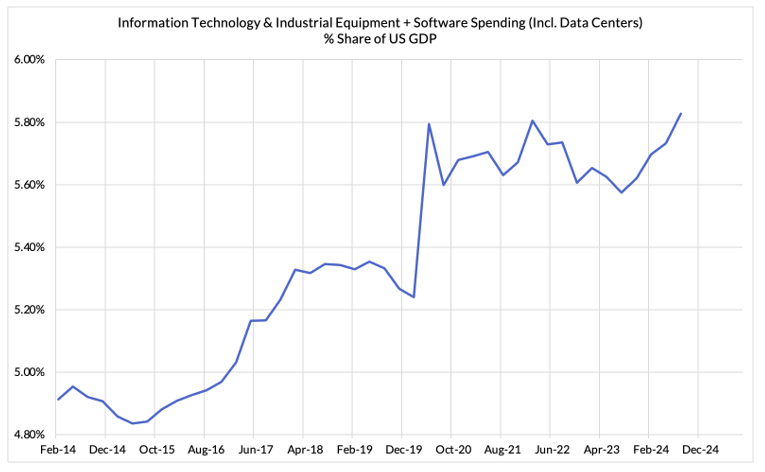
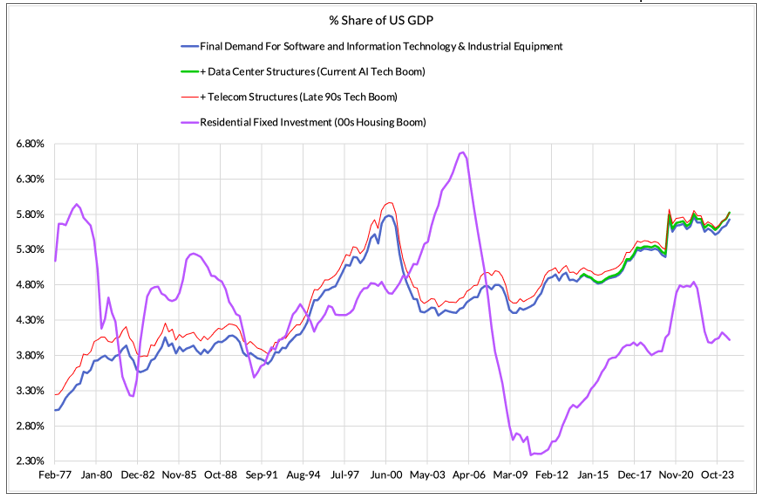
(…) If you focus on the expenditures for software, technology hardware, industrial equipment and data center structures at the heart of the AI boom, you’re looking at nearly 6% of US GDP as of the third quarter of 2024. That number is likely to rise further in the coming quarters. If so, we would surpass the share of GDP that the tech-industrial-telecom boom of the late 1990s reached at its peak back in 2000:

Source: Skanda Amarnath

If recent and upcoming months to be banner ones for capital expenditures, as megacap-tech firms have been guiding, we are likely to see it show up in the relevant GDP components, albeit with a potential lag. At something close to 7% of the US economy at the end of 2025, it’s plausible and arguably even likely, that the AI boom would be on a par with the share of the US economy housing investment represented at its 2005 peak. (…)

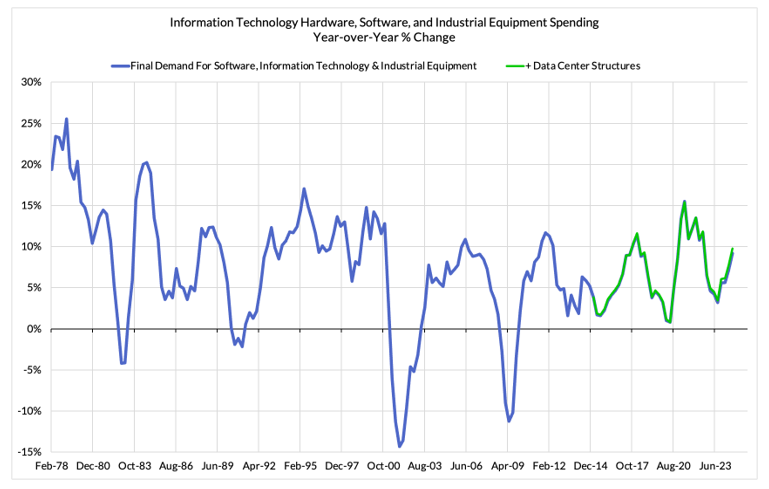
Unlike aggregate consumption, which is a large share of the US economy but very smooth and relatively acyclical, AI-relevant GDP components have exhibited more volatility in the not so distant past.

Source: Skanda Amarnath

As of now, the aggregate of software, tech hardware, industrial equipment, and data center expenditures is growing at a 10% clip. While the future is always uncertain, it’s at least plausible that the growth rate swells further over the next two to five quarters. A rising share of GDP alongside an accelerating growth rate would mean higher real GDP contributions from these segments, in the short run at least.

Source: Skanda Amarnath

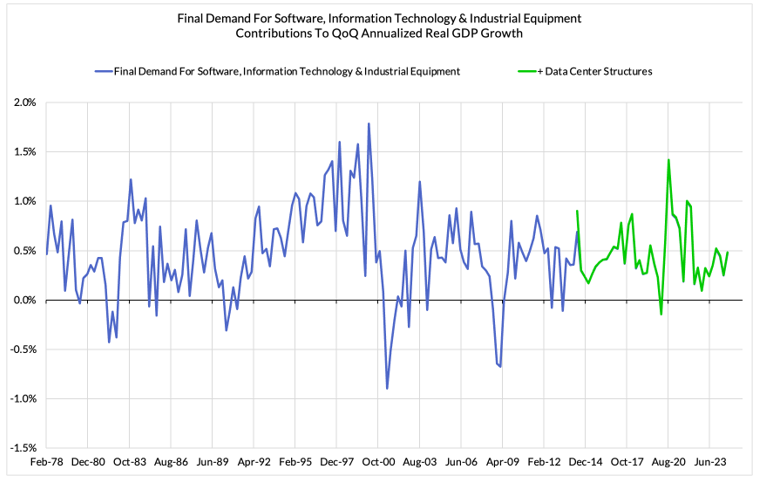
In the third quarter of last year we saw these segments contribute 0.5% to real GDP growth. It’s not a number to sneeze at but also meaningfully lower than the 1-1.2% contribution to real GDP growth seen in the late 90s tech boom. (…)

So much of the rise in IT-relevant GDP segments up until this point has been subtle. The fact that information technology spending went through a one-time level shift up during the pandemic, means it’s back at a share of US GDP not seen since the late 1990s. (…)

Source: Skanda Amarnath

A third year above 2% productivity growth would likely force the Fed to raise its estimates of potential GDP growth. And while I would disagree with drawing a conclusion that it should necessarily imply a higher neutral rate of interest (r*), plenty of other FOMC members have suggested otherwise. Booming AI investment in 2025 has the chance to be yet another catalyst to push up both short- and longer-run expectations for Fed policy.

The other side of the coin to booming tech investment in the coming quarters is that we see subsequent analogues to the 2000-2003 downturn. Contrary to the common conception of it being a shallow recession lasting less than a year, the hangover from the late 1990s tech boom involved persistent multi-year declines in the labor market (as evidenced by the prime-age 25-54 employment rate), real business fixed investment, and the stock market. (…)

For the time being, the AI boom is poised to be a real economy tailwind through much of 2025. In the process of pushing up activity, new bottlenecks may grow more acute, just as we’re already seeing with transformers and the state of the US electricity grid.

Contingently, the more acceleration and outperformance we see in the coming few quarters, the greater the risk of future investment overhangs and real economy weakness. Timing these types of cycles is indeed a mug’s game, but it’s all the more reason to pay close attention in this space.
From Evercore ISI:

Surge in AI mentions across Corporate America, strong Hyper-Scaler Capex, and record Google searches reflect large enthusiasm over AI. Adoption remains muted, though nearing Inflection.

AI has moved beyond chatroom queries, integrating into workplaces and leveraging tools to produce goods and services. Generative AI propels physical and digital automation forward with breakthroughs in Inference Time Reasoning, communication, and training data capabilities.

Freed from hardcoded rules, AI-infused Autonomous Agents can now tackle a broader set of tasks. While oversight remains critical to ensure accuracy, AI’s newfound ability to “think” then “act” underpins our confidence in a 2025 adoption inflection base case.

I am using Perplexity.ai many, many times daily, and my usage keeps rising as I query on all kinds of matters. Googling is mostly out for me. For $20/month for the Pro version, a bargain for me given the jump in productivity. If you wish, use this referral, we will both save $10! https://perplexity.ai/pro?referral_code=9IL19U5E

Taking the stage at the annual CES conference in Las Vegas, Huang showed “physical AI” tools that he said would help robots learn using simulated environments that closely mimic the real world. That could bring more automation to warehouses and factories and boost a humanoid-robot market that the company said could be worth $38 billion in the next couple of decades. (…)

Among Huang’s other announcements:

  • Nvidia will make a personal AI supercomputer called Project DIGITS. It will be a desktop computer with a version of its latest Blackwell AI chip inside, and will start at $3,000. The computers are aimed at AI researchers and data scientists, allowing them to work on AI models without having to tap Nvidia’s cutting-edge AI chips housed in data centers.
  • New AI “blueprints” that make it easier to create and deploy AI agents to do things such as analyze video feeds and generate blog posts. One of Nvidia’s blueprints has users feed in multiple PDF files from which it creates a podcast “narrated in a natural voice,” according to a company release.
  • A new generation of graphics chips for videogamers. The hardware, which costs up to about $2,000, enhances resolution and framerates for the most demanding games in part by leveraging AI, executives said. The chips are to be available for desktop computers this month, with laptops coming in March.

The FT has a lot more:

  • Cracking the technological challenges involved in deploying robots at scale will pave the way to “the largest technology industry the world has ever seen”, said Huang.
  • Nvidia said the field of robotics had reached a technological tipping point, as AI accelerates and fine-tunes the process of simulating the physical world and generating the vast amounts of data needed to train robots. In the next two decades, the market for humanoid robots alone is expected to reach $38bn, according to the company.
  • Nvidia announced a suite of foundational AI models on its new Cosmos platform, which developers can use for free to generate data and build their own models. Nvidia said the foundation models, which it said were trained on 20mn hours of video data, were as fundamental a technological development as the large language models that underpin apps such as OpenAI’s ChatGPT. It pairs with Nvidia’s Omniverse platform, which is used to run simulations of the physical world. “What [those models] are doing for language, we can now do for understanding the physical world,” Rev Lebaredian, Nvidia’s vice-president for Omniverse and simulation technology, told the Financial Times. While data on the physical world is much harder to gather and process than text, Lebaredian said “it’s a necessary part” of the company’s mission. “The big takeaway [from Huang’s CES speech] is that this moment is going to be a special one,” he added. “I think this year is an inflection point where we’re going to see this acceleration of physical AI and robotics.”
  • Nvidia also unveiled a collection of foundation models for humanoid robots, called the “GR00T Blueprint”, which it said would “supercharge” the development of robots, as well as new tools for developing and testing fleets of factory and warehousing robots and training autonomous vehicles. Autonomous vehicles “will be the first multitrillion-dollar robotics industry”
 Tencent Shares Decline After US Adds Company to Chinese Military Blacklist Firms on Chinese military list face reputational damage

The US has blacklisted Tencent Holdings Ltd. and Contemporary Amperex Technology Co. Ltd. for alleged links to the Chinese military, targeting the world’s biggest gaming publisher and top electric-vehicle battery maker in a surprise move weeks before Donald Trump takes office.

CATL, a major supplier to Tesla Inc., joined Tencent on a Federal Register of entities deemed to have ties with the People’s Liberation Army. Both companies protested their inclusion as a mistake, saying they have no ties with the military. (…)

While the Pentagon’s blacklist carries no specific sanctions, it discourages US firms from dealing with its members. (…) And the agency added oil major Cnooc Ltd. and Cosco Shipping Holdings Co., both of which have been previously targeted by Washington. (…)

Tencent, China’s most valuable company, has big investments in or deep ties to developers from Fortnite studio Epic Games Inc. to Activision Blizzard Inc. The company founded by billionaire Pony Ma is considered one of the pioneers of the internet and private sector in China, creating a so-called everything app that Elon Musk has held up as a model for X.

During the first Trump administration, the US government sought to ban WeChat — a messaging service that’s evolved into a payment, social media and online services platform — on grounds that it jeopardized national security. (…)

In August, lawmaker Marco Rubio — nominated to become US secretary of state in the Trump administration — asked the Pentagon to target CATL because of its potential to become a vital supplier to the PLA. (…)

CATL accounted for over one-third of global battery shipments in the third quarter of 2024, according to Seoul-based SNE Research, more than double that of runner-up BYD Co. Several US companies, including Ford Motor Co., source from the Chinese firm. (…)

The Chinese firm said it was “a mistake” to include its name on the Defense Department list. It said in a statement that it’s not engaged in military-related activities, was privately founded and became a publicly listed company in 2018. (…)

Some Chinese firms have successfully fought to get removed from the US list. In 2021, smartphone giant Xiaomi Corp. managed to reach an agreement with the US government that set aside its designation as a Chinese military company. Last year, Advanced Micro-Fabrication Equipment Inc. was removed, doing away with a label the firm described as an “irrational” designation. (…)

The Chinese military company list stems from an order signed by Trump in late 2020 that barred American investment in Chinese firms owned or controlled by the military. It was part of a broader effort to rein in what the US had described as Beijing’s abusive business practices.

The Defense Department noted in the Federal Register filing that companies included on the list are entitled to request reconsideration.

In the same statement, the department removed several firms from the list, including AI firm Beijing Megvii Technology Co., China Marine Information Electronics Co., China Railway Construction Corp., China State Construction Group Co., China Telecommunications Corp. and ShenZhen Consys Science & Technology Co.

The companies on the list include General Dynamics, Boeing Defense, Space & Security, Lockheed Martin and Raytheon Missiles & Defense.

China is also banning the export of dual-use items to these companies starting on Thursday, the ministry said.

Ozempic economics: How GLP-1s will disrupt the economy in 2025 Weight loss drugs are saving lives, shrinking waistlines and shaking up the economy.

(…) As of May, roughly 1 in 8 American adults had tried GLP-1 receptor agonists (GLP-1s for short). This percentage has almost certainly grown since then, as telehealth companies, “medi-spas” and compounding pharmacies have aggressively marketed GLP-1 prescriptions.

We’re only just beginning to learn the full universe of effects for this class of drugs. Originally developed to treat Type 2 diabetes, GLP-1s were soon discovered to be effective in treating obesity and managing weight loss. Now there’s an ever-growing list of other potential uses (on- and off-label), including for treating heart disease, sleep apnea, Alzheimer’s, substance abuse and maybe even gambling addiction. (…)

Spending on GLP-1s is skyrocketing. (…) Perhaps this is unsurprising given that more than 40 percent of Americans are clinically obese. The United States spent an estimated $40 billion on all GLP-1 meds in 2024, with spending projected to triple by 2030.

Consumers are spending less on food and alcohol. The average household with at least one family member on a GLP-1 is spending about 6 percent less on groceries each month within six months of adoption. That translates to about a $416 reduction in food and drink purchases per household a year. Spending reductions are even greater for high-income households, according to a new study by researchers at Cornell University and Numerator.

Other consumer-facing industries are being transformed, too. For example, rapid weight loss has encouraged some patients to replace their wardrobes. The clothing rental company Rent the Runway recently reported that more customers are switching to smaller sizes than at any time in the past 15 years. Airlines could save significant money on fuel if passengers slim down en masse, a financial firm projected. Life insurers could cash in, too, given the many mortality risks linked with chronic obesity.

(…) helping Americans lose weight has the potential to make the public much healthier — and reduce spending on other (costly) care.

Research suggests most patients who were prescribed these meds stop taking them within a year. Some stop because they’ve successfully reached their goal weight. But many others report stopping because of costs, unpleasant side effects, drug shortages or squeamishness about needles.

Obesity-related disabilities, absenteeism, “presenteeism” (that is, showing up but not performing your best), and premature death all have enormous social and economic costs. Which means that making Americans healthier can make the labor market healthier, too, especially if interventions occur while patients are young and have many working years left. (…)

FOMC 101

From Wells Fargo:

  • 12 voters, currently 5 hawks, 4 doves, 3 neutral (all chair-related)
  • 8 non-voting members who may influence discussions: 4 hawks, 1 dove, 3 neutral.
  • 20 total: 9 hawks, 5 doves, 6 neutral.

Gosh! I can’t avoid wondering how the Fed, which could not figure out rentflation and the wealth effect, will be able to grasp how AI and Ozempic will impact the economy.

Wait, no worries, they keep saying they are data dependent, i.e. backward looking… Winking smile

FEAR

The only thing we have to fear is fear itself” (FDR)

Real power is, I don’t even want to use the word, fear.” (Donald J. Trump to Bob Woodward in 2016)

I fear the “word of the year” will be “fear”.

  • President-elect Donald Trump threatened 25% tariff on all imported products from Canada and Mexico. The tariff would remain in effect until Canada and Mexico stop the flow of illegal drugs and illegal immigrants into the U.S..
  • Trump seeks 60% additional tariffs on China.
  • Trump threatened tariffs if EU doesn’t buy more oil and gas from the U.S..

Is all this a calculated bullying bluff seeking economic and/or non-economic gains, or a genuine shift toward economic isolationism under Trump’s “America First” program?

There is some real hip shooting here.

Canada’s main exports to the U.S. are energy, primarily crude oil, forestry products and cars.

  • Canadian oil is the source of 24% of U.S. refinery output.
  • The main car brands Canada exports to the USA are:
  1. Ford
  2. General Motors (GM)
  3. Stellantis (including Chrysler)
  4. Toyota
  5. Honda
  • Some 30% of U.S. lumber consumption is imported, most of it from Canada.

Increased tariffs would thus primarily hurt American companies and consumers. The U.S. currently imposes a 2.5% import tax on passenger cars and automotive parts from Japan.

Given the highly integrated nature of the auto industry, parts and components may cross Canadian-U.S.-Mexican borders as many as 8 times before final assembly.

The EU is already buying the lion’s share of US oil and gas exports, and no additional volumes are currently available unless the United States increases output or volumes are rerouted from Asia, another big consumer of U.S. energy.

China has had time to prepare for another round of tariffs tit-for-tat. Its reaction could be more assertive and effective this time around. In fact, it has already started with its recent measures on exports of critical minerals and drones and investigations on prominent companies such as PVH Corp. (Calvin Klein, Hilfiger) and Nvidia.

Fear is also a tool in U.S. politics, often used to threaten elected officials performing their civic duties.

Any member of the House or Senate who votes for this outrageous spending bill deserves to be voted out in 2 years!” (Elon Musk)

Chip Roy is just another ambitious guy, with no talent. By the way, how’s Bob Good doing? I hope some talented challengers are getting ready in the Great State of Texas to go after Chip in the Primary. He won’t have a chance! (Donald J. Trump)

FYI, Bob Good (R-VA) lost a primary challenge against a Trump-endorsed candidate in the June 2024 primary.

Senator Rounds, you are up for reelection in 2026. If you vote against any of Trump’s nominees a primary challenge wouldn’t be hard” (Turning Point USA founder Kirk on X).

Those who oppose reform will lose their primary/election. Period.” (Elon Musk)

Being told Joni Ernst and Lindsay Graham are trying to end Pete Hegseth … Pete Hegseth is the redline. If you vote against him, primaries will ensue.” (Activists in Iowa writing on X)

The conservative group Heritage Action also announced last week that it would launch a $150,000 digital campaign targeting Senate Republicans in Alaska, Maine, Louisiana, Iowa, North Carolina, Kentucky, Indiana, Utah and South Dakota who are on the fence about supporting Trump’s nominees.

Congresspeople must now decide if they vote on the basis of what’s best for the country or what’s best for them personally.

“Can you image what the next two years are going to be like if every time that Congress works its will and then there’s a tweet? Or from an individual who has no official portfolio, who threatens members on the Republican side with a primary and they succumb?” Neal said in a fiery floor speech Thursday night.

“This institution has a separate responsibility based on the separation of powers,” he warned.

Musk didn’t like this at all, apparently, and replied in his new favorite way: a threat to buy Neal out of his seat.

“Oh … forgot to mention that I’m also going to be funding moderate candidates in heavily Democrat districts, so that the country can get rid of those who don’t represent them, like this jackass,” Musk wrote.

The ally of President-elect Trump made the comments in response to a clip of a floor speech from Rep. Richard Neal (D-Mass.), the ranking member of the Ways and Means Committee, who slammed Musk’s threat to primary Republicans if they supported an earlier bipartisan spending proposal this week.

There are no friends, no allies anymore. Only supreme objectives that must be achieved, any which way, no debating accepted.

When did we see a similar movie before?

This time, the arms are fear and money.

It can work both ways, however:

In his Nov. 7 congratulatory message to Trump, Xi offered a veiled warning about engaging in economic fights with China. “History tells us that both countries stand to gain from cooperation and lose from confrontation,” Xi said.

About a week later, Xi used a meeting with President Biden in Peru to warn Trump not to challenge Beijing on major issues the two powers are at odds over, including China’s sovereignty claim over Taiwan, human rights, its party-state system, or what Xi calls China’s “right to development”—a reference to U.S. restrictions on Chinese access to Western chips and other technologies.

These “four red lines,” Xi told Biden, “can’t be challenged,” according to China’s official account of the meeting.  (WSJ)

In Peru, Xi inaugurated a deep-water port that will boost China’s trade with Latin America, adding to China’s significant investments in Africa.

In late 2024, while Trump was threatening tariffs to long-time allies such as Canada, Mexico, the U.K., the EU and Japan, often to achieve non-economic objectives, Xi met with leaders of 10 major international economic organizations, highlighting that, against the “America First” U.S. policy, China is taking “leadership for global economic stability, prosperity and openness, and opposes all forms of protectionism.”

The rapidly evolving area of artificial intelligence also displays significant differences between the U.S. and China. American companies such as Google, Apple, Amazon, Microsoft and Meta, are building closed LLM models to protect their current high market shares. Chinese companies are all into opensource models.

In AI, the cutting edge is reasoning models. There are currently 4 reasoning models in the world, OpenAI o1, DeepSeek, QwQ and Marco 01. The last 3 are Chinese, all roughly equivalent or superior (and cheaper to build and operate).

Sometimes, it almost gets funny…

In August 2020, the Trump administration argued that TikTok’s data collection “threatens to allow the Chinese Communist Party access to Americans’ personal and proprietary information”.

On August 14, 2020, Trump issued another executive order giving ByteDance 90 days to sell or spin off its U.S. TikTok business.

“According to the order, TikTok’s “data collection threatens to allow the Chinese Communist Party access to Americans’ personal and proprietary information — potentially allowing China to track the locations of Federal employees and contractors, build dossiers of personal information for blackmail, and conduct corporate espionage.”

The Justice Department has argued that Chinese control of TikTok poses a continuing threat to national security, a position supported by most U.S. lawmakers.

But just recently, national security suddenly took a back seat:

“I think we’re going to have to start thinking because, you know, we did go on TikTok, and we had a great response with billions of views, billions and billions of views,” Mr. Trump told the crowd at AmericaFest, an annual gathering organized by conservative group Turning Point.

“They brought me a chart, and it was a record, and it was so beautiful to see, and as I looked at it, I said, ‘Maybe we gotta keep this sucker around for a little while,’” he said.

Mr. Trump met with TikTok’s CEO on Monday. Mr. Trump said at a news conference the same day that he had a “warm spot” for TikTok thanks to his campaign’s success on the app.

It is unclear how Mr. Trump would go about undoing the TikTok divestiture order, which passed overwhelmingly in the Senate.

… or not so funny…

China has issued a directive to the country’s brokerage firms as it aims to change perceptions of its flagging economy: monitor speeches by top economists and fire them if necessary.

Chief economists at Chinese brokerages must “play a positive role in interpreting government policies and boost investor confidence,” the industry watchdog Securities Association of China (SAC) told its members last week, according to the state-run financial newspaper Securities Times.

However, if the individuals have “repeatedly triggered reputational risk over inappropriate commentaries or behaviors” within a certain period of time or caused “major negative impacts,” the company shall “severely deal with the person until termination of employment,” said the notice, without elaborating on the definition of inappropriate comments. (Source: asia.nikkei.com)

… or definitely not funny:

Trump signals plans to use all levers of power against the media

For many years, Donald Trump repeatedly threatened to sue the press but often didn’t follow through. When he did, he almost always lost.

But Trump’s recent settlement with ABC News and a cascade of lawsuits and other complaints against media entities from him and his allies signal a ramped-up campaign from the president-elect. Together, the actions have spurred concerns that his efforts could drastically undermine the institutions tasked with reporting on his coming administration, which Trump has promised will take revenge on those he perceives as having wronged him. (…)

Trump said he planned to continue suing the press. “It costs a lot of money to do it, but we have to straighten out the press,” he said at a news conference at his Mar-a-Lago Club in West Palm Beach, Florida. (…)

ABC News’s decision to settle has sent shudders through the media industry and the legal community that represents it. (…) ABC and Disney executives decided to settle not only because of the legal risks in the case but also because of Trump’s promises to take retribution against his enemies. (…)

Disney’s ABC operates more than 230 affiliate television stations nationwide, some relying on the Federal Communications Commission for license renewals. Trump has repeatedly talked about pulling the federal licenses from television stations that broadcast news about him he doesn’t like and said last year that he plans to bring the FCC under presidential authority.

Disney and many other media companies are already planning potential merger activity that executives hope passes muster with the antitrust division of the Justice Department, which is poised to be run by Trump loyalist Pam Bondi. (…)

But legal experts say Trump has taken attacks on the press to an entirely new level, softening the ground for an erosion of robust press freedom.

“The Fake News Media should pay a big price for what they have done to our once great Country,” Trump posted on Truth Social in September in an attack on NBC News.

Experts in polarization said that Trump’s posture toward the press has eroded trust in the Fourth Estate. From the Oval Office, he can do even more.

“My concern is what he does when he has the power of the U.S. government in his hands,” said Liliana Hall Mason, a political science professor at the University of Maryland. “It looks to me like all the guardrails have been removed, and we are in for a presidency unlike any we’ve experienced before.”

Corporate officers need to balance their own personal political/moral inclinations with an objective assessment of what President Trump might do for the country’s economy and for their respective companies in a world where being friends or not can be more consequential than it normally is.

They also might reconsider some business practices after the murder of UnitedHealthcare CEO. The reaction to his killing has revealed a deep distrust of the health insurance industry and its treatment of patients in need of critical care.

Investors also need to try to objectively analyze the pros and the cons of a likely turbulent presidency. Some of the potential pros are easy to list:

  • growth and profits could be lifted by deregulation and tax cuts, corporate and individual.
  • improving the efficiency and productivity of government.

But so are the fears:

  • tariffs: good or bad?
  • immigration policies and labor availability and cost
  • environment?
  • foreign policy (America First, China, NATO, Russia-Ukraine, Israel-Iran-Palestine).

Amid much uncertainty, investor fear is understandably totally focused on equity valuations, with many indicators flirting with historically high levels while sentiment measures suggest rampant complacency, if not irrational exuberance.

Is the fear of heights justified?

The S&P 500 forward P/E has been above 20 during only 3 periods since 1957. One was neutral (July 1997-June 2002: –4% from start to finish), one was disastrous (May 2007-November 2008: –41%) and one was fantastic (April 2020-June 2022: +55%).

image

We can discuss at length the various possible explanations but at the end of the day it gets pretty simple: S&P 500 profits were flat in the first period, dropped 37% in the second and jumped 36% in the third.

Simple enough!

It gets even simpler if I add that each periods featured a recession, a mild one in 2001, a nasty one in 2008 and a very short one (3 months!) in 2020.

Lastly, each recession occurred after Fed tightening, and the Fed just finished tightening, or so it seems…

Chair Powell during his December 18 presser: “I think it’s pretty clear we’ve avoided a recession. (…) the U.S. economy has just been remarkable. (…) So, I feel very good about the economy.”

Investors see no reason to think otherwise at this time: in aggregate, Americans are wealthy, employed and spending merrily; the 500 bps rise in interest rates has had little effect on GDP growth and inflation seems to be in check amid a productivity boom that could last several years.

Comparisons with the dot.com era should be tempered by the fact that the S&P 500 is a fundamentally higher-quality index today: higher margins, better, well-established and profitable leaders and lower net leverage, non only debt-wise but also operationally as most of the leaders are asset light and generate large amount of free cash.

So what’s to fear?

  • Tariffs. We don’t know how much, on what and when. And we don’t know the reactions. So we can’t assess the potential impact on growth, inflation and profits.

The most fearful thing about the coming tariffs brawl is that Trump is totally wrong about the history of tariffs:

September 2024 during a town hall in Warren, Michigan:

We’re going to use tariffs very, very wisely. You know, our country in the 1890s was … probably the wealthiest it ever was, because it was a system of tariffs. And we had a president — you know McKinley, right? You remember Mount McKinley? And then they changed the name. He was really a very good businessman, and he took in billions of dollars at the time, which today it’s always trillions, but then it was billions and probably hundreds of millions. But we were a very wealthy country, and we’re going to be doing that now.

Factchecking from various sources:

McKinley was not a businessman. He was a lawyer turned politician, elected to Congress in 1877 and only became president in 1897.

McKinley, the congressman, became chairman of the House Ways and Means Committee and was responsible for framing a new tariff bill. He believed that a protectionist tariff had been mandated by the people through the election and that it was necessary for America’s wealth and prosperity.

In addition to the protectionist debate, politicians were concerned about the high revenue accruing from existing tariffs. After the American Civil War, tariffs remained elevated to raise revenue and to cover the high costs of the war. By the early 1880s, the federal government was running a large surplus. Both parties agreed that the surplus needed to lessen but disagreed about whether to raise or lower tariffs to accomplish the same goal.

The Democrats’ hypothesis stated that tariff revenues could be reduced by reducing the tariff rate. Conversely, the Republicans’ belief was that by increasing the tariff, imports would be lessened, and total tariff revenues would drop. The debate would be known as the Great Tariff Debate of 1888.

“The Republican campaign orators and pamphleteers say that the various import duties levied by Congress are paid by the foreigners who send goods to America, denying that the price of any article which may be called a necessary expense will be increased to Americans by the operation of the new tariff law.”

The Tariff Act of 1890, commonly called the McKinley Tariff, became law on October 1, 1890. The tariff raised the average duty on imports from 38% to 49.5%.

“Let the facts, which are multiplying every day, tell who it is that pays the onerous tariff taxes. They will answer that the American people pay these taxes and that the burden of them rests most heavily upon the poor, inasmuch as there are very few of the necessities of life the prices of which are not increasing on account of the McKinley tariff.” (NYT)

The Act removed tariffs on sugar, molasses, tea, coffee, and hides but authorized the President to reinstate the tariffs if the items were exported from countries that treated U.S. exports in a “reciprocally unequal and unreasonable” fashion. The idea was “to secure reciprocal trade” by allowing the executive branch to use the threat of reimposing tariffs as a means to get other countries to lower their tariffs on U.S. exports.

The Tariff Act was a major topic of fierce debate in the 1890 Congressional elections. The tariff was not well received by Americans who suffered a steep increase in prices. The 1890 tariff was also poorly received abroad. Protectionists in the British Empire used it to argue for tariff retaliation and imperial trade preference.

Inflation was particularly high on what the NYT called “necessaries” such as farm products (+6-8%), textiles (+4%), metals and metal products (+6%), building materials (+5%) and “miscellaneous” (+11%) per BLS research.

In the 1890 election, Republicans lost their majority in the House with their number of seats reduced from 171 to 88.

In the 1892 presidential election, Harrison was soundly defeated by Grover Cleveland, and the Senate, House, and Presidency were all under Democratic control. Lawmakers immediately started drafting new tariff legislation, and in 1894, the Wilson-Gorman Tariff passed, which lowered US tariff averages.

Trump’s contention that the 1890s were “probably the wealthiest ever because it was a system of tariffs” also does not verify.

The U.S. experienced rapid growth after the end of the Civil War in 1865. Reconstruction, railroad construction and the related boom in farming and manufacturing carried the economy until 1892 when the unemployment rate reached 3.0%.

After exploding 70% between 1885 and April 1890, the U.S. equity markets became very volatile, losing 16% in the following 7 month before roaring back 33% until the end of 1892.

The Depression of 1893 was one of the worst in American history with the unemployment rate exceeding ten percent for half a decade. Equities lost 25% in the first 7 months of 1893, back to their mid 1886 level.

The National Bureau of Economic Research estimates that the economic contraction began in January 1893 and continued until June 1894. The economy then grew until December 1895, but it was then hit by a second recession that lasted until June 1897.

Estimates of annual real gross national product (which adjust for this period’s deflation) are fairly crude, but they generally suggest that real GNP fell about 4% from 1892 to 1893 and another 6% from 1893 to 1894. By 1895 the economy had grown past its earlier peak, but GDP fell about 2.5% from 1895 to 1896. During this period population grew at about 2% per year, so real GNP per person didn’t surpass its 1892 level until 1899.

Tariffs did not cause the depression but having lifted the general level of prices for necessities, they reduced discretionary income at an inopportune time.

BTW, the 1890s also coincided with the end of the Gilded Age, a period known for extreme wealth inequality.

***

The Smoot-Hawley Tariff Act of 1930 had a significant negative impact on the U.S. and global economy, exacerbating the effects of the Great Depression.

The Act dramatically reduced international trade:

  • It raised import duties on over 20,000 imported goods, increasing tariffs from an average of 40% to nearly 60%.
  • U.S. imports decreased by 66% from 1929 to 1933.
  • U.S. exports fell by 61%.
  • Overall world trade declined by approximately 66% between 1929 and 1934.
  • At least 25 countries responded by increasing their own tariffs on American goods.
  • Countries that retaliated against Smoot-Hawley reduced their imports from the United States by an average of 28–32%.
  • Even countries that merely protested the Act reduced their imports from the U.S. by 15–23%.
  • The Act highlighted the dangers of protectionist trade policies, leading to a shift towards free trade agreements in subsequent years.
  • It resulted in a transfer of tariff-setting authority from Congress to the executive branch, as lawmakers sought ways to quickly reverse the tariffs.(!)

The fear is thus about the amplifier effect a tariff war could have if and when the economy slows.

But the amplifier is not what it used to be, particularly if higher tariffs are limited to goods, which now account for 31% of total personal expenditures.

By comparison, the late 1890s and 1920s saw a marked increase in the importance of goods in the American economy, driven by industrialization, technological innovation, and changing consumer patterns. While services continued to play a role, the production and consumption of material goods dominated economic growth and societal changes during these periods.

Other fears:

Apollo Management’s Torsten Slock has a list of 12 risks for 2025 markets (with my comments):

1- Tariffs coming (90% probability). Incoming Treasury Secretary Scott Bessent’s views on tariffs align with Trump’s overall strategy but suggest a more nuanced and potentially less disruptive approach to their implementation. His perspective may provide some reassurance to markets and trading partners while still maintaining tariffs as a central component of the incoming administration’s economic toolkit.

2- Nvidia earnings disappoint inflated expectations (90%): No doubt that will happen. But when? Hyperscalers are clearly in a race to secure positions in AI which is still in early adoption mode. KKR reckons that

the Magnificent 7’s Capex and R&D spending has increased to nearly 20% of total U.S. spend, compared to only 3.6% in 2011. The good news, though, is that Capex intensity is not so outsized that we think there is the potential for these companies to pull back in the coming quarters. While the absolute dollars spent today are massive relative to past cycles, capex intensity (relative to sales) does not look outsized.

Importantly, most of these companies run with negative net debt and they continue to show strong top line growth and healthy margins. As a result, we view this backdrop differently than what we saw during the telecom/technology bust of 2001. Our second point is that we expect more global expansion linked to AI in the coming years, especially in Asia. Asia’s data center footprint is a fraction of the U.S. footprint.

 image image

The likely explosion in AI inference demand could be constrained by energy availability.

Power availability has become a primary consideration in data center site selection and contributes to the uneven distribution of data centers globally, with fewer facilities in regions lacking reliable power infrastructure. In some areas, power unavailability is driven by limitations in interconnecting to the transmission grid rather than generation capacity.

As demand continues to grow, particularly driven by AI and cloud computing, addressing power constraints will be crucial for the industry’s sustainable expansion.

The Trump administration’s plan to deregulate energy production, transportation, and transmission to make America ‘energy safe/independent’ will no doubt help.

Chinese data centers used 130 billion kWh of electricity in 2022, and they are expected to use 380 billion kWh per year by 2030. To avoid breaking the carbon budget, the Chinese government’s set policy goal is to power new data centers with 80% green energy by 2025.

That’s a gargantuan shift from the status quo — 70% of the electricity currently consumed by China’s data centers is supplied by coal. Non-fossil-fuel energy sources are reportedly still prone to outages.

Nonetheless, it is estimated that the scale of China’s data center market reached nearly 250 billion yuan in 2023, and is expected to reach the trillion level in 2025.

Nuclear energy is seen as a necessity in meeting green energy demand in the 2030s.

Over 30 governments are collaborating with the IAEA to incorporate nuclear power into their energy strategies. Currently, over 60 new reactors are under construction worldwide, and 300 more are in the planning/proposed phase. China is committing $440 billion to the construction of 150 new reactors, which will add 150 gigawatts (GW) of capacity over the next 15 years. This expansion surpasses the total nuclear capacity built worldwide in the past 35 years. (KKR)

3- US economy reaccelerates and animal spirits come back (85%): Have animal spirits left?

4- M&A/IPO activity rebounds (75%): Not a risk, a certainty.

5- Fed stops talking about r-star (70%): Is anybody really listening?

6- US inflation accelerates in Q1, driven higher by a strong economy, tariffs, restrictions on immigration, and seasonal factors (40%): Productivity and low oil prices could save us all from this real threat. Tariffs will likely be raised gradually and “responsibly”. Trump should know he was elected because the lower income segment of the population hated the recent inflation bout. He will seek to protect his very slim margin in Congress in the next midterm elections.

7- Fed raises interest rates in 2025 (40%): Productivity could save us all from this real threat.

8- US 10-year interest rates move above 5% before mid-year (40%):  Productivity could save us all from this real threat.

9- Probability of a recession in Germany (40%): Manufacturing is in a deep recession and December new orders posted the sharpest drop in three months. Can services save the economy amid political chaos. Services employment has been cautiously cut since July, and new business has been shrinking slowly since September. If this trend continues, a recession in this sector seems likely per S&P Global. But with negotiated wages up 8.8% in the third quarter per the Bundesbank, real wages are strong. But Germans are not Americans when it comes to consumption.

10- China outright recession in 2025 (33%): Me: zero percent. But probably below 5% growth given the nature of the problems. On Dec. 24, missed by many, Reuters informed us that

Chinese authorities have agreed to issue 3 trillion yuan ($411 billion) worth of special treasury bonds next year, which would be the highest on record, as Beijing ramps up fiscal stimulus to revive a faltering economy. The plan for 2025 sovereign debt issuance would be a sharp increase from this year’s 1 trillion yuan and comes as Beijing moves to soften the blow from an expected increase in U.S. tariffs on Chinese imports when Donald Trump takes office in January. The proceeds will be targeted at boosting consumption via subsidy programmes, equipment upgrades by businesses and funding investments in innovation-driven advanced sectors, among other initiatives, said the sources.

11- Fiscal crisis in US (10%): Does anybody care about the U.S. fiscal challenges?

12- Probability of US recession (0%): On jan. 2, 2024 I wrote: “I don’t have a crystal ball but my sense is that solid consumer and construction spending will keep the economy humming, with the risk tilted on the high side. I would be surprised if core inflation rests outside of a 3-4% range.” Right on growth, surprised on core PCE inflation (2024 range 2.6-3.1%, 2.8% in November).

Still no crystal ball but solid consumer and construction spending will keep the economy humming, with the risk tilted on the high side. Inflation between 2.5-3.5%.

Other fears: geopolitics, oil, USD: unpredictable at this time.

Bear fear anybody?

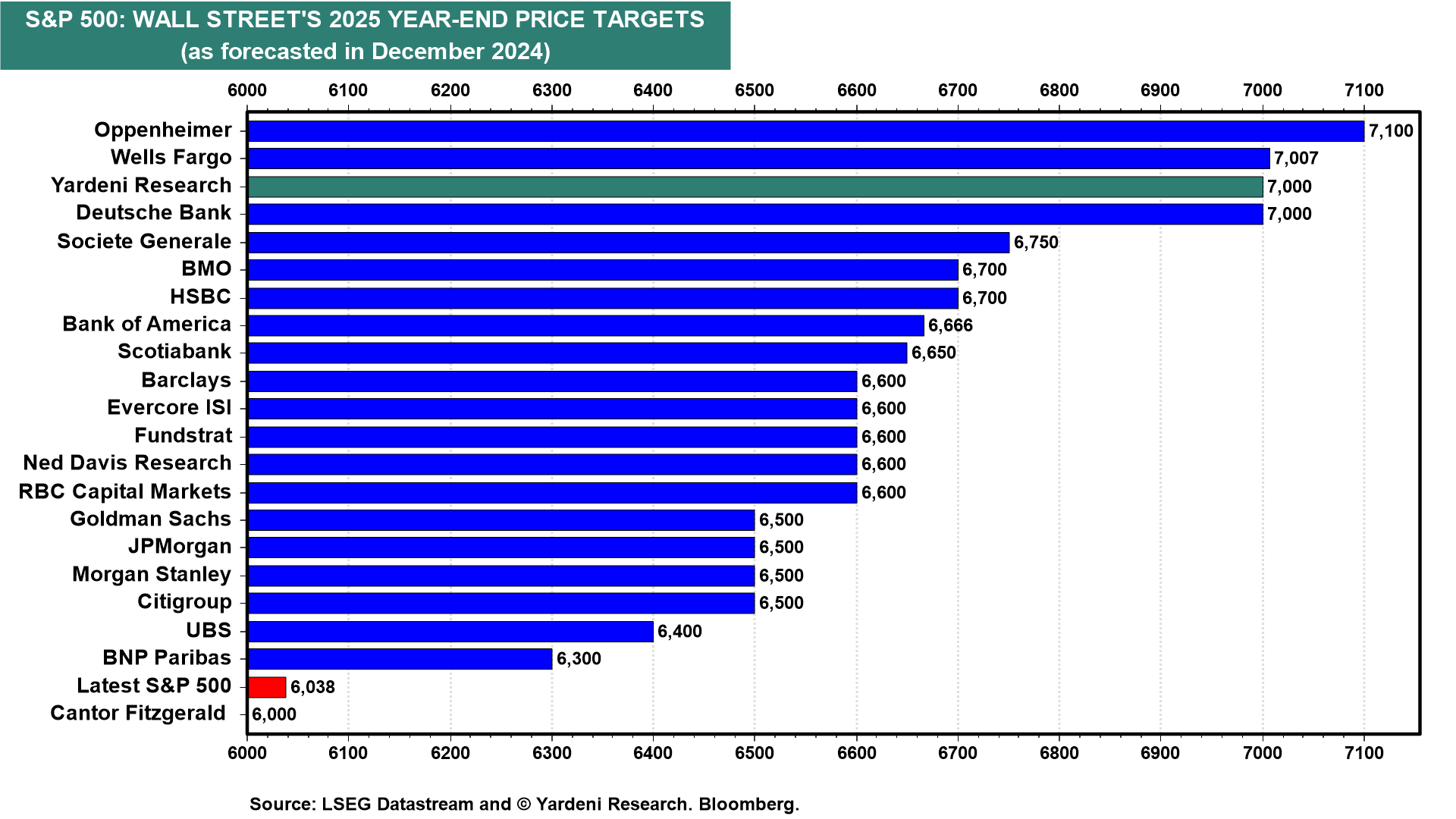
Strategists have rightly learned that stocks usually go up, and the average outlook in Bloomberg data is always positive. But the average point estimate is rarely particularly insightful and frequently proves a total flop. (…) strategists on average were relatively bullish throughout the dot-com bust and ahead of the 2008 financial crisis. More recently, they expected a relatively good year in bear-market 2022 and failed to foresee the go-go years of 2023 and 2024. Go figure. Strategists just don’t have crystal balls, and they sure can’t predict recessions or pandemics. They’re a collection of fallible humans trying to deliver on an impossible task. (Bloomberg’s Jonathan Levin)

image

  • KKR says that “we are just over two years into the recovery, compared
    to an average of around 5.5 years.” In 1968 and 1973, the Fed was aggressively tightening to fight inflation, leading to recessions in 1970 and 1973-74.

image

A survey of current predictions indicates very low probabilities of a recession in 2025. J.P. Morgan’s David Kelly offers his basic scenario and details all the uncertainties around it to conclude:

It should be stressed that all of this is highly speculative. We do not know the details on any of these policies or how aggressively the new administration will pursue them. That being said, on a very rough forecast, none of this spells disaster for the economy or markets in the short run and equities could directly benefit from a further reduction in the corporate income tax.

However, it does suggest that, barring a recession, long-term Treasury yields and mortgage rates are more likely to drift up than down from here. Moreover, further weakening our already stressed public finances adds long-term risk to any investment scenario.

  • The decennial cycle says 2025 will be great. The chart below depicts the pattern of the DJIA by decade from 1897 onward, showing the average pattern of all years ending with the same digit.

Dow Jones Industrial Average, 10-year cycle, since 1897

Dow Jones Industrial Average, 10-year cycle, over the past 124 years

Source: Seasonax

As can be seen, the stock market does appear to be following a 10-year cycle. In the first half of the decade – i.e., in the years ending in “0” up to the years ending in the digit “4” – stocks posted almost no gains on average; by contrast, they tended to rally significantly in the second half.

DJIA stocks delivered an exceptionally strong average performance in years ending in the digit “5”. The average gain amounted to 26.8%. This corresponds to more than one third of the entire average 10-year return! However, in years ending in 7, strong slumps frequently occurred.

Another fear of heights: profit margins

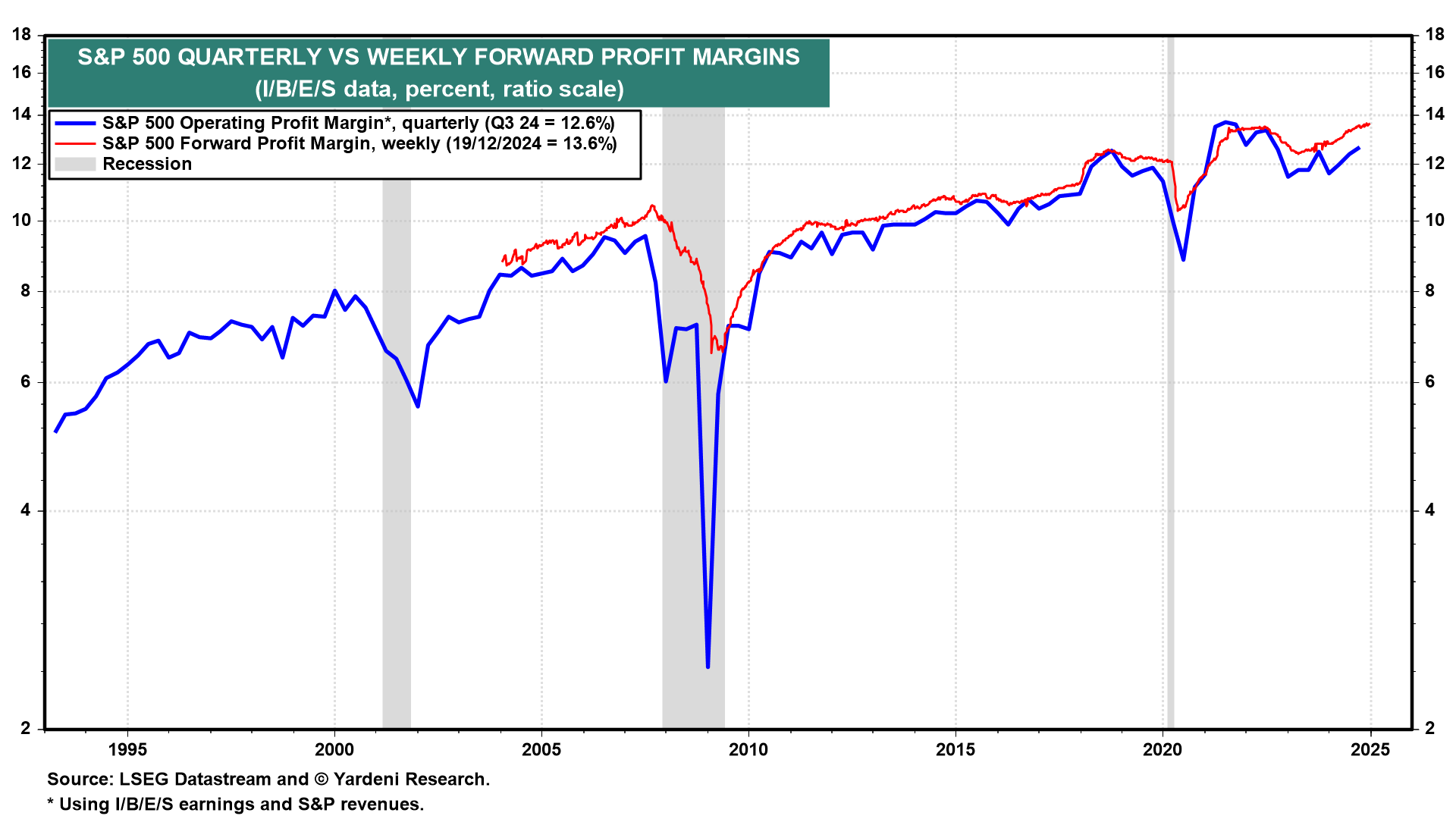
The S&P 500 forward profit margin rose to a record 13.6% during the December 19 week. That’s a full percentage point above the Q3-2024 actual profit margin of 12.6%. We expect that President Trump will cut the corporate tax rate again from 21% to 15% later next year, which should boost the profit margin by at least half a percentage point. His cut in this rate from 35% to 21% in early 2018 boosted the margin by a full percentage point. (Ed Yardeni)

KKR argues that

Outside of the top 12 mega-cap Tech/AI stocks, operating margins are actually still below pre-COVID levels. Given the combination of above-potential GDP growth, strong labor productivity, and deregulation, we see ample room for improvement.

image

We continue to view the revival in labor productivity growth as the ‘secret sauce’ to a more durable earnings recovery, as it raises potential GDP and facilitates higher non-inflationary growth. Businesses can invest more without overheating the economy and pay workers higher wages without degrading margins, so long as better productivity keeps unit labor costs contained. This backdrop is a ‘Regime Change’ from the post-GFC ‘secular stagnation’, when productivity slumped to multi-decade lows on the back of tepid aggregate demand, tame inflation, and low rates.

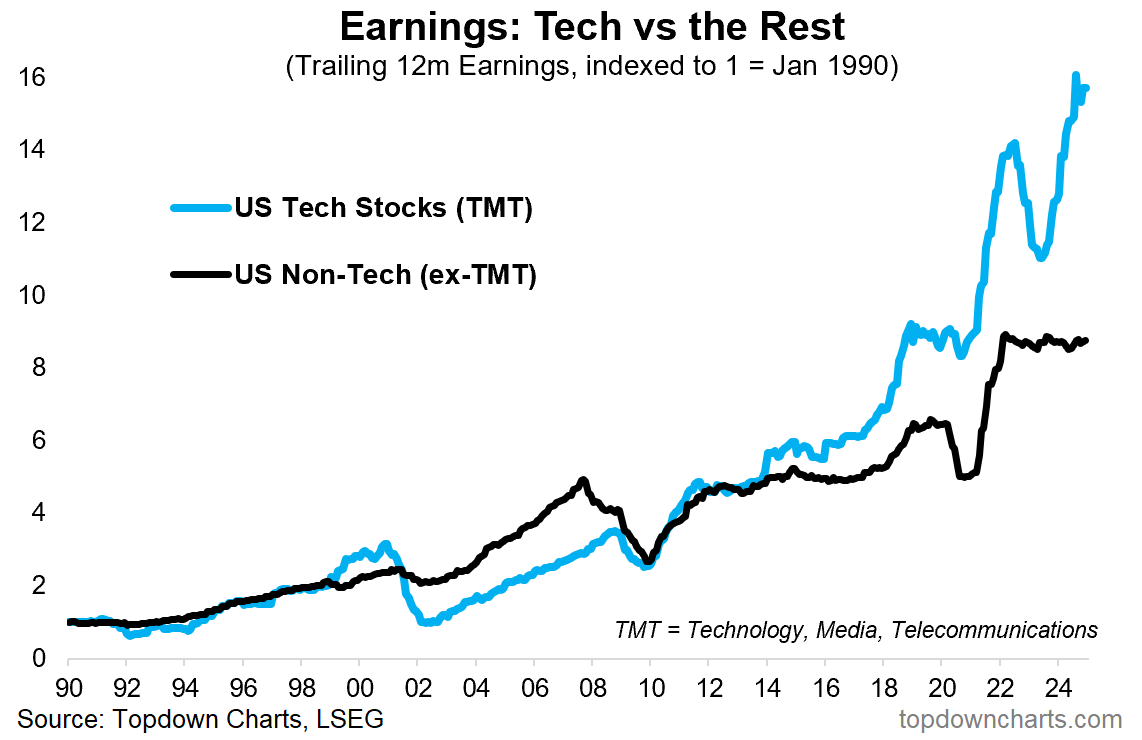
In a world of slow inflation, nominal revenues necessarily grow slowly and margins become more significant contributors to profit growth. This Topdown chart reflects non-tech companies’ margins problems and largely explains the rising concentration in the S&P 500 index.

Productivity does not seem to be equally distributed…

Fear the panda bear?

It looks like equity investors care less and less about the bond market. The 100bps jump in 10-Y yields to 4.6% since mid-September came along a 10% jump in the S&P 500 Index.

image

Treasuries investors are worried about something that high yield investors are ignoring. A strong economy is good for profits and leveraged companies, but not so for inflation, particularly with higher tariffs coming.

image

Some fearmongers argue that China is setting up its response to a Trump tariff attack, selling part of its large holdings of U.S. Treasuries. But China’s holdings of Treasuries peaked in 2016 (Trump?) and have steadily declined since, having found strong appetite for safe greenback investments in Europe after the Brexit vote (June 2016) and the official exit in January 2020.

Looking at Ed Yardeni’s chart above, Treasury investors should be more concerned of the USD going forward than of China.

That said, we must admit that the USD currently finds little competition fundamentally from other major currencies, does it?


(Ed Yardeni)

Fear the Fed feeding the bear?

Jay Powell says “We don’t guess, we don’t speculate and we don’t assume.”

But they move. In the same year, the Fed switched its focus away from inflation to the labor market, only to realize that labor demand was still strong and that inflation was still a problem.

Mohamed El-Erian in the FT calls it the flip-flop Fed: “ in just the past five months, the Fed’s actions have ranged from no cut (end of July), to a jumbo 0.5 percentage point “re-calibration” cut (mid-September), to a 0.25-point cut amid a seemingly “nothing-to-see-here” pace (early November), to the upending of earlier forward policy guidance and economic interpretations (mid-December).

He also notes the rising divergence within the FOMC:

The updated “dot plot” of economic projections of policymakers shows a striking range of estimates for where the Fed should take rates by the end of this cycle, from under 2.5 per cent to almost 4 per cent.

A persistent lack of strategic policy anchoring helps explain the current policy confusion. The Fed became excessively data-dependent after its big inflation mistake in 2021-22, when it wrongly assumed price spikes were transitory. As a result, policy goes in whatever direction the latest data is blowing, leading to about-turns.

The Fed risk is that, in spite of evidence that the U.S. economy is strong and strengthening, interest rates are set to be cut another 50bps amid already easy financial conditions.

Productivity is better be very present because demand is. Corporate CFOs are pretty upbeat, not about to rein in spending and wage and price increases:

image

It’s rare that the Fed cuts interest rates when profits growth is as strong as it currently is. Because profits growth spurs employment and capex, the combination of the Fed cutting rates and accelerating profits could provide a very powerful boost to the already strong economy.

Deglobalization will probably spur secular inflation because production will move from more efficient to less efficient locales. Tariffs, if enacted, will likely add to shorter-term inflation because of the lack of domestically produced substitutable goods. Tariffs could stymie overall economic growth as would a large and sizable consumption tax, but higher prices would precede and could actually cause weaker economic growth.

If we are correct and nominal growth proves stronger than is current consensus, then the Fed might have to reverse course and raise rates during the second half of 2025. Such a reversal might increase market volatility because most economic forecasts currently suggest the Fed will continue to cut rates throughout 2025 and into 2026.

The current market is at least somewhat speculative, and speculation thrives on excess liquidity. If the Fed were to shift to a tightening bias, investors might see some of the markets’ risk-taking fervor subside. (RBA)

But profit growth is not that strong outside of Tech and Communication Services. These 2 sectors are expected to show combined earnings up 22.6% in 2024 on revenues up 12.8%. The other 9 sectors combined: +4.1% on revenues up 3.0%.

Yet, analysts see the same 9 sectors earnings up 11.8% in 2025 on revenues rising 11.7%. Most of this growth is expected to come from Health Care (+20.8%) and Industrials (+19.8%).

One has to wonder how analysts are incorporating the potential Trump administration policies on health care costs and import tariffs at this time.

FYI, in March 2024, analysts expected Health Care revenues to rise 13.5% in 2024. It now looks like +8.3%, but they are expecting +13.4% in 2025.

Industrials revenues were expected to grow 11.2%. It now looks like –3.9%, but they are forecasting +14.7% for 2025.

I would not bet much on these 2025 numbers…

My word of the year? Caution!

Sentiment reflects itself on valuation.

Since the 2022 lows, the S&P 500 Index forward earnings are up 13% and the forward P/E 47%, from 15.4 to 22.6. In effect, increased valuation is responsible for some 70% of the Index appreciation since the 2022 low. A repeat is doubtful.

Meanwhile, the forward P/E of the S&P 500 Technology sector rose from 20 to 30 times (+50%) and that of the Comm. Services rose from 15 to 20 times (33%), meaningfully contributing to the increase in the total Index P/E.

Using Ed Yardeni’s data, virtually all of the total S&P 500 P/E advance since the 2022 low came from the “Megacap-8”.

Can sentiment get any better?

Sentiment is worrisome because investors appear to be universally very bullish. In some cases, even historically so. Equity allocations are high, portfolio betas are high, and investors are shunning diversification for concentration.

The Conference Board’s Consumer Confidence Survey shows individual investors are the most bullish they’ve been in the roughly 40-year history of the survey. Diversification is no longer viewed as a risk-reduction tool, but rather as a hindrance to performance. That could be a precarious sentiment backdrop given the potential for increased volatility in the 2nd half of 2025.

Asset managers are also very bullish. CFTC data shows that asset managers have the second most extreme net-long position in the history of the data. Although these data are not necessarily useful for market timing, it does further support the notion that investors are very bullish.

Such universal bullishness among both private clients and institutions should be a cautionary note for any investor with even a small contrarian streak. (RBA)

The only sure prediction: it won’t be a tranquil year.

Happy and healthy new year.