The enemy of knowledge is not ignorance, it’s the illusion of knowledge (Stephen Hawking)

It ain’t what you don’t know that gets you into trouble. It’s what you know for sure that just ain’t so (Mark Twain)

Invest with smart knowledge and objective odds

THE DAILY EDGE: 20 August 2024

Jobs, Consumer Watch

Warning Signs Flash in a Labor Survey as Fed Officials Watch for Weakness The New York Fed’s labor market survey showed cracks just as Jerome H. Powell, the Fed chair, prepares for a closely watched Friday speech.

Americans are increasingly worried about losing their jobs, a new survey from the Federal Reserve Bank of New York released on Monday showed, a worrying sign at a moment when economists and central bankers are warily monitoring for cracks in the job market.

The New York Fed’s July survey of labor market expectations showed that the expected likelihood of becoming unemployed rose to 4.4 percent on average, up from 3.9 percent a year earlier and the highest in data going back to 2014.

In fact, the new data showed signs of the labor market cracking across a range of metrics. People reported leaving or losing jobs, marked down their salary expectations and increasingly thought that they would need to work past traditional retirement ages. The share of workers who reported searching for a job in the past four weeks jumped to 28.4 percent — the highest level since the data started — up from 19.4 percent in July 2023.

The survey, which quizzes a nationally representative sample of people on their recent economic experience, suggested that meaningful fissures may be forming in the labor market. While it is just one report, it comes at a tense moment, as economists and central bankers watch nervously for signs that the job market is taking a turn for the worse. (…)

More from the report:

Experiences

  • Among those who were employed four months ago, 88% were still employed, a series low since the start of the survey and down from 91.4% in July 2023. The rate of transitioning to a different employer increased to 7.1%—the highest reading since the start of the survey—from 5.3% in July 2023. The increase compared to a year ago was primarily driven by women.
  • The proportion of individuals who reported searching for a job in the past four weeks increased to 28.4%—the highest level since March 2014—from 19.4% in July 2023. The increase was most pronounced among respondents older than age 45, those without a college degree, and those with an annual household income less than $60,000. (…)
  • Satisfaction with wage compensation, nonwage benefits, and promotion opportunities at respondents’ current jobs all deteriorated relative to a year ago. Satisfaction with wage compensation at the current job fell to 56.7% from 59.9% in July 2023. Satisfaction with nonwage benefits fell to 56.3% from 64.9%. And satisfaction with promotion opportunities dropped to 44.2% from 53.5%. (…)

Expectations

  • The expected likelihood of moving to a new employer increased to 11.6% from 10.6% in July 2023, while the average expected likelihood of becoming unemployed rose to 4.4% from 3.9% in July 2023. The current reading is the highest since the series started in July 2014.
  • The average expected likelihood of receiving at least one job offer in the next four months increased to 22.2% from 18.7% in July 2023. The average expected likelihood of receiving multiple offers in the next four months rose to 25.4% from 20.6% in July 2023. (…)
  • The average expected likelihood of working beyond age 62 increased to 48.3% from 47.7% in July 2023, and versus a series low of 45.8% in March 2024. The average expected likelihood of working beyond age 67 increased to 34.2% from 32% in July 2023, partially reversing the steady declining trend observed in the series since the onset of the pandemic.

Yesterday, I posted these 2 charts suggesting a stabilizing labor market as characterized by Jay Powell last month:

  • Indeed job postings suggest rising labor demand since June (Indeed data through August 8).

image

Goldman Sachs:

The July employment report was soft, as payroll growth slowed sharply and the unemployment rate rose to 4.3%. More recent data have somewhat alleviated labor market concerns, however, as the employment component of the nonmanufacturing ISM index returned to expansion territory for the first time since November 2023 and initial jobless claims have edged back down.

Furthermore, our estimate of underlying job gains (146k/month) remains near its breakeven pace and our jobs-workers gap continues to signal that there are still 1.1mn more open jobs than unemployed workers seeking to fill them. We therefore forecast that firm labor demand and continued labor force expansion on the back of still-elevated (albeit slowing) immigration will lead job growth to average around 145k/month for the remainder of 2024, and we expect that the unemployment rate will edge down to 4.2% by end-2024.

From The Transcript:

  • “We did not see a step down and our outlook for the back half of the year is really for more of a continuation of what we’ve seen. Even in the first couple weeks of August here, things have been remarkably consistent. So I know everyone is looking for some piece of information that maybe indicates further weakness with our members and our customers, we’re not seeing it…So far, we aren’t experiencing a weaker consumer overall” — Walmart ($WMT ) CFO John D. Rainey 
  • “Well, in our consumer base of 60 million customers spending every week, what you’re seeing is they’re spending at a rate of growth of this year over last year, for July and August so far, about 3%. That is half the rate it was last year at this time. And so the consumer has slowed down. They have money in their accounts, but they’re depleting a little bit. They’re employed, they’re earning money, but if you look at- they’ve really slowed down. So the Fed is in a position they have to be careful that they don’t slow down too much.” — Bank of America ($BAC ) CEO Brian Moynihan

But 3% YoY growth in nominal retail sales (black) is no “real slowdown” in real terms when inflation goes from +2.0% to –0.6%  or when CPI-Durables goes from 0% to –4.0%.

image

China Unleashes Rapid Drop in New-Home Prices With Relaxed Curbs At least 10 cities relaxed, removed new home price guidance

In Beijing, a sudden 18% price cut in May at a mid-sized residential project on the city’s outskirts has forced adjacent new developments to follow suit, according to people familiar, who requested not to be named because the matter is private. Near the southern border, the Shenzhen government approved a 29% cut in unit prices for a complex compared with a year ago, according to other people familiar.

After intervening for years, at least 10 city governments have relaxed or scrapped new-home price guidances to let market demand play a bigger role, according to China Index Holdings Ltd. and public statements.

While it’s mostly smaller cities that have announced the moves, the examples in Beijing and Shenzhen show that even bureaucrats in megacities are starting to relax prices on a case-by-case basis.

The move is expected to drive more developers to cut prices as they benchmark against the second-hand market that’s seen a much steeper decline. That will help remove longstanding market distortions created by government meddling, even if it keeps some buyers on the sidelines as they wait to see how far new-home values will fall. (…)

For years, China’s housing authority tinkered with the price range at which new homes were sold through a “pre-sales permit.” The approach kept new-home prices in the biggest cities in check since late 2016 following a property frenzy. But when second-hand homes went into freefall, the arrangement kept new-home values abnormally resilient. That in turn made it even harder for companies to sell their inventory. (…)

New-home values have declined about 7.2% from June 2021, about half of the 13.6% drop seen in existing-home prices.

Prices of second-hand homes in Shenzhen, once China’s least affordable city, have plunged 37% from a peak in May 2021, according to Centaline Group. They’ve tanked by about 27% in Beijing, Shanghai and Guangzhou from their respective peaks.

The bargains pushed Shenzhen’s existing-home sales in July to the highest by monthly volume in more than four years, according to the city’s biggest real estate agency Leyoujia. The same month, its new-home sales shrank 11% by units from a month earlier. (…)

Many of the cash-strapped developers, who have been in default for more than a year, are counting on sales to reassure debt holders and fight off liquidation.

At least 20 Chinese developers have faced wind-up petitions, according to data compiled by Bloomberg. Dexin China Holdings Co. in June became the latest builder to receive a liquidation order from a Hong Kong court, following China Evergrande Group and Jiayuan International Group Ltd.

In addition, about 80 out of the top 200 real estate companies operating in China have been mired in default, according to data compiled by Bloomberg. More could follow as new-home sales haven’t fully recovered, China Real Estate Information Corp warned in note on Aug. 8. (…)

This will be unsettling for Chinese for a while but improved affordability and the gradual elimination of the inventory overhang will help stabilize prices and restore sentiment. The PBOC survey of urban depositors shows that the share of households expecting falling house prices reached a new high of 24% in Q2 from 10% on average pre-pandemic.

The latest proposal would allow local governments to fund their home purchases by issuing so-called special bonds, the proceeds of which are currently restricted to uses including infrastructure and environmental projects, the people said, asking not to be named discussing private information. Local governments have already used more than half the 3.9 trillion yuan ($546 billion) quota for special bond issuance this year; it’s unclear what portion of the remainder might be directed toward home purchases if the plan is approved. (…)

Only about 8% of the 580 billion yuan available from existing rescue funds has been tapped so far, including a high-profile initiative to backstop home purchases with central bank funding, according to Bloomberg Intelligence.

That’s partly because the expected return from turning unsold homes into affordable housing has stayed below the cost of funding for many local-government borrowers. Rental yields in China’s tier-1 cities averaged just 1.4% in 2023, compared with the central bank’s relending rate of 1.75%, Macquarie Group Ltd.’s economists wrote in May, citing data from Centaline Property Agency. The city of Beijing has recently issued one-year special bonds at 1.65%.

China had 382 million square meters of unsold homes as of July, equivalent to about the size of Detroit, according to official data. The crisis has dragged down everything from the job market to consumption and household wealth over the past two years. President Xi Jinping unveiled sweeping goals last month to bolster the finances of China’s indebted local governments and give them more autonomy in regulating local property markets, though public details of the initiatives have so far been limited.

While state buying of housing inventory is widely seen as a key step toward easing the housing glut and boosting developers’ finances, the central bank’s initial funding is just a fraction of the 1 trillion yuan to 5 trillion yuan that some analysts estimate is needed to address the supply-demand mismatch. (…)

Separately, the Ministry of Natural Resources said in June that it is working with the National Development and Reform Commission to roll out a policy that would allow local governments to buy land using special bonds. (…)

China plans ‘bigger, stronger’ social security fund to aid ageing society

China will beef up its 2.88 trillion yuan ($406 billion) social security fund, making it “bigger and stronger” to help support its rapidly ageing population as the number of new births and younger workforce to support its seniors shrinks. (…)

Ding said the fund will improve and expand the scale of pension fund investments, “actively disclose important financial information to the public” and carry out investments in an “open and transparent manner.”

The disclosures aim to stabilise people’s expectations of old age care, he said. (…)

First concrete steps to improve China’s safety net.

Meanwhile, there are other steps showing China’s broad policy relaxations to boost growth. This is from Almost Daily Grant’s:

A new day of Sino-American collaboration is at hand, as the U.S.-China Financial Working Group hammered out cooperation agreements late last week pertaining to systemically important banks, cross-border payments and monetary policy, among other topics. 

Conversations were “professional, pragmatic, candid and constructive” according to a summary from the People’s Bank of China, allowing “the financial management departments of both sides to maintain timely and smooth communication channels and reduce uncertainty [during] financial stress events.”

Pointing up Renewed efforts by the Middle Kingdom to attract foreign capital colors that regulatory alliance, as state media revealed Friday that Beijing will permit unfettered overseas investment in its lynchpin manufacturing realm, while likewise relaxing strictures across other politically sensitive sectors.  That bulletin comes two days after a Ministry of Commerce convened-powwow with representatives from 20 foreign firms including Siemens, SAP, Lego and Medtronic to streamline planned projects within the world’s second-largest economy, with the South China Morning Post reporting that the government invited those companies to get started “at their earliest convenience.”

Informing that conciliatory stance: inbound foreign direct investment summed to RMB 539.47 billion ($75.2 billion) over the first six months of the year, state compiled data show, down 29.6% from the same period a year ago.  Similarly, China’s direct investment liabilities in its balance of payments – a measure of foreign direct investment which includes retained earnings – tumbled by nearly $15 billion during the second quarter according to the State Administration of Foreign Exchange (SAFE) following a $5 billion decline from January to March, putting that metric on pace for its first ever annual decline in a data series stretching to 1990.

At the same time, outbound investment reached a record $71 billion over the three months through June, representing a near 80% jump from the $39 billion logged in the second quarter of 2023. In response to “surging appetite” for overseas securities, Reuters relays that banks and asset managers are “scrambling” to bypass state-mandated quotas, reflecting the “latest sign of investors’ lack of confidence in local assets.”

Indeed, international investors have pulled a net $12 billion from mainland equities since the start of June according to data from the Hong Kong stock exchange, leaving that metric in a net outflow since the start of 2024.  That has never happened over a full year period since China introduced the Stock Connect trading link, which allows foreign investors to access the market, in 2014.

By way of response, local authorities likewise turn to a well-worn playbook. As the Financial Times reports today, daily data showing foreign investment flows on the Stock Connect are no longer available for viewing, with that information now restricted to quarterly updates.

To little surprise, that decision did not garner universal applause. “While the data provided by global exchanges often vary, the lower transparency will not help attract foreign investment, especially in an emerging market,” Gary Ng, senior economist at Natixis, told the pink paper. “Investors may wonder why it is no longer offered and find it more challenging to justify entry into China.”

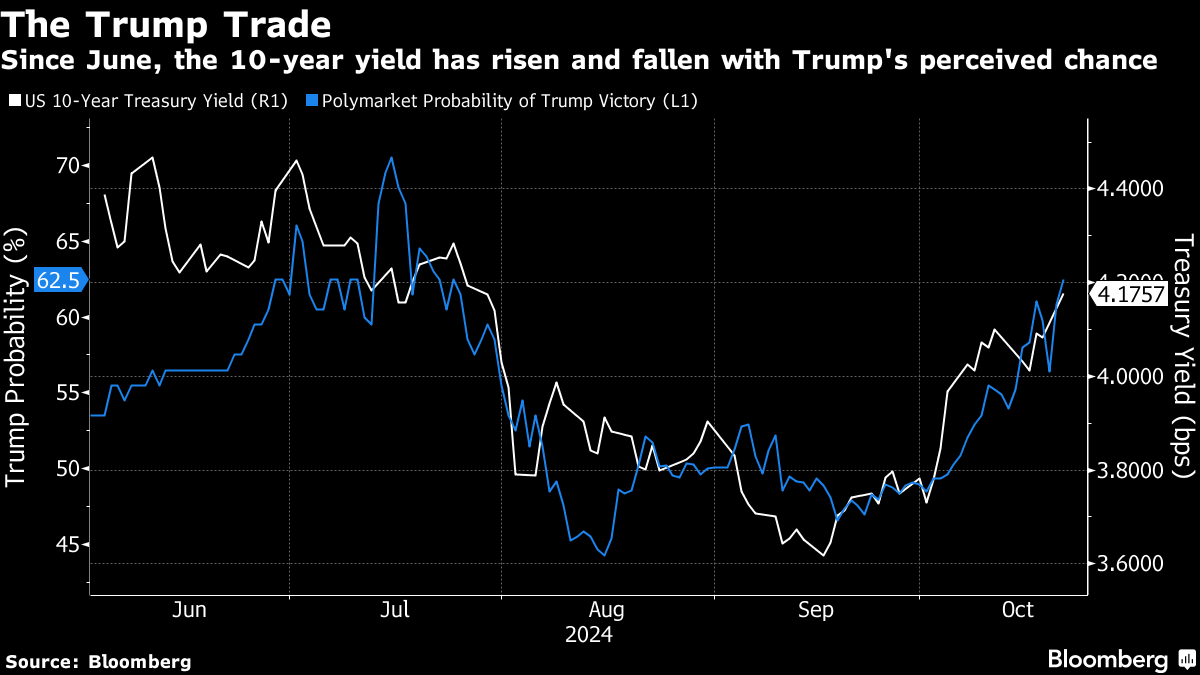
Harris proposes raising the corporate tax rate to 28%, rolling back a Trump law

(…) If enacted, the policy would raise hundreds of billions of dollars, as the nonpartisan Congressional Budget Office has projected that 1 percentage point increases in the corporate rate corresponds to about $100 billion over a decade. It would also roll back a big part of former President Donald Trump’s signature legislation in 2017 as president, which slashed the corporate tax rate from 35% to 21%.

Trump, meanwhile, recently said he would cut taxes even further if elected president, including on businesses [to 15%?]. (…)

Republicans are sure to object to a 28% corporate tax rate, meaning Harris may need Democrats to control the House and Senate in order to get it through Congress. But a potential President Harris would have some leverage over the GOP for negotiations on tax policy, as many other portions of the Trump tax cuts expire at the end of 2025, which will lead to a major debate in Congress next year about which parts to extend. (…)

image

(Polymarket)

THE DAILY EDGE: 19 August 2024

Jobs, consumer watch

From the NY FRB Survey of Services

(…) The employment index remained positive for a sixth consecutive month, though it fell five points to 7.0. The wages index came in at 33.3, a level similar to the prior few months, indicating that wage increases were steady. Both the prices paid and prices received indexes were similar to the prior two months, suggesting price increases held steady.  (…)

Indeed job postings suggest rising labor demand since June. Next JOLTS could surprise again.

image

Confirming my own Consumer Watch findings, Goldman Sachs’ proprietary quantitative measure of sentiment around discussions of the consumer on earnings calls “suggests that sentiment around the consumer actually improved sequentially this earnings season and reached its highest level since 2022, suggesting that investor fears appear to rest on overweighting the more negative anecdotes from this earnings season.”

image

Housing Starts Fell Sharply in July

Total housing starts fell 6.8% during July, a sharper than expected decline driven entirely by yet another pull-back in single-family starts. After out-performing over the past few years, single-family construction is now turning lower amid softening conditions in the new home market.

By contrast, multifamily starts improved for the second consecutive month in July. However, multifamily permits declined and gave back much of June’s large gain, which suggests that multifamily development remains weak despite firming apartment market conditions and prospects for lower financing costs in the near future. (…)

Source: U.S. Department of Commerce and Wells Fargo Economics


Pointing up “The sharp July decline in the South (-101k) more than led the overall decline (-91k) and was likely driven by Hurricane Beryl, while extreme heat may have also weighed on starts in the West (-36k). Starts also declined in the Midwest (-3k) but increased in the Northeast (+49k).”

Construction was started on an annualized 279,509 units in July, according to data released Friday by the Canada Mortgage and Housing Corp. That’s the highest level since June 2023, and exceeded the 245,000 units expected by economists. Starts rose 15.7% from the previous month, and the increase was mostly in multi-unit buildings. (…)

The country’s chronic shortage of homes has been further aggravated by an influx of temporary residents that has driven population growth to one of the highest levels among developed countries. (…) At the end of last year, CMHC estimated Canada needs to build at least 3.5 million additional housing units by 2030 to restore affordability.

US Office Market Shows Bottoming Signs, Moody’s Analytics Says Sellers are finally capitulating, volumes have steadied

A years-long price decline for US offices could soon be ending as sales volume has stopped falling and large properties are being resold well below prior deal values, according to Moody’s Analytics.

“We are seeing signs that the market is beginning to function in a healthier way,” the firm said in a report dated Thursday. “A significant increase in price discovery paired with reaching a bottom in transaction volume means we could be nearing a bottom in office pricing.”

While “significant pain” has yet to occur and distressed offices will need liquidation at likely significant losses, the report added, “Owners and lenders are in a much-better position to evaluate potential losses today — which is the first step necessary to the market recovering.” (…)

EARNINGS WATCH

From LSEG IBES:

463 companies in the S&P 500 Index have reported earnings for Q2 2024. Of these companies, 78.8% reported earnings above analyst expectations and 16.2% reported earnings below analyst expectations. In a typical quarter (since 1994), 67% of companies beat imageestimates and 20% miss estimates. Over the past four quarters, 79% of companies beat the estimates and 16% missed estimates.

In aggregate, companies are reporting earnings that are 4.5% above estimates, which compares to a long-term (since 1994) average surprise factor of 4.2% and the average surprise factor over the prior four quarters of 7.3%.

Of these companies, 59.2% reported revenue above analyst expectations and 40.8% reported revenue below analyst expectations. In a typical quarter (since 2002), 62% of companies beat estimates and 38% miss estimates. Over the past four quarters, 62% of companies beat the estimates and 38% missed estimates.

In aggregate, companies are reporting revenues that are 1.1% above estimates, which compares to a long-term (since 2002) average surprise factor of 1.3% and the average surprise factor over the prior four quarters of 1.2%.

The estimated earnings growth rate for the S&P 500 for 24Q2 is 12.5%. If the energy sector is excluded, the growth
rate improves to 13.3%.

The estimated revenue growth rate for the S&P 500 for 24Q2 is 5.4%. If the energy sector is excluded, the growth rate declines to 5.1%.

The estimated earnings growth rate for the S&P 500 for 24Q3 is 5.8%. If the energy sector is excluded, the growth rate improves to 7.3%.

image

image

image

Trailing EPS are now $232.60. Full year 2024e: $242.46. Forward EPS: $258.31e. Full year 2025e: $279.32.

image

image

Amid historically high earnings multiples, analysts are clearly setting a very high bar for EPS growth through 2025. Revenues are seen accelerating in a deflationary setting with profit margins rising incessantly.

image

Goldman Sachs is more reserved on margins:

Our 2025 forecast is below both the bottom-up and top-down consensus estimates. Our forecast for 4% sales growth is slightly below the consensus bottom-up estimate (5%). Analysts also expect net profit margins will expand by 128 bp, compared with our more modest forecast of 24 bp. Our 2025 EPS estimate of $256 (+6% growth) is 8% below bottom-up consensus of $279 (+15% growth) and 5% below top-down consensus of $269 (+12% growth).

Sales growth should decelerate modestly in 2025 to 4% from 6% in 2024. Nominal GDP growth and the strength of the US dollar are the most important drivers of corporate revenue growth.

Our economists expect nominal US GDP growth will equal 4% in 2025, compared with 5% in 2024. Our FX strategists expect the USD will weaken on a trade-weighted basis in 2025, supporting the revenues of firms with international sales exposure. Consensus bottom-up forecasts for a sharp acceleration in sales growth for the median S&P 500 non-Energy stock, which is more sensitive to economic growth and less international-facing, appear slightly too optimistic.

Our top-down model indicates that aggregate S&P 500 profit margins will continue to expand in 2025, but by less than consensus expects.

The key drivers of company margins include revenue growth and the difference between price and input cost inflation. If sales grow as we expect, operating leverage will lift margins. While price hikes have been slowing, so has the growth rate of input costs such as wages.

Index margins are also rebounding from margin contraction in 2023. Our macro model nonetheless suggest more modest margin expansion than in consensus forecasts. We expect S&P 500 net margins will reach 11.7% in 2025, slightly below the mid-2022 record of 12.0% and well below the consensus estimate of 12.8%.

image

Significantly, recent conference calls reveal that labor costs are no longer pressuring corporate P&Ls. BTW, Goldman this weekend trimmed the probability of a US recession in the next year to 20% from 25%, citing last week’s retail sales and jobless claims data.

 image image

image

Unsurprisingly, business sales are intimately linked with nominal GDP growth:

image

U.S. nominal GDP grew 5.4% and 5.2% YoY in Q1 and Q2 respectively, significantly outpacing business sales, up 0.6% and 2.1% respectively. This growth gap is not unusual and is generally due to YoY swings in oil prices which directly impact oil companies revenues.

image

In turn, business sales are intimately linked with S&P 500 revenues growth (Ed Yardeni). More stable oil prices should help close the growth gap in Q3 and Q4 but analysts’ 5.9% revenue growth rate for 2025 seems high.

image

Goldman monitors S&P 500 revenues ex-Energy deflated by the GDP price deflator (ex-energy).

On this basis, real revenues rose 2.4% year-on-year in Q2, roughly in line with the pace of Q1 and the average over the last six decade but down from +4.6% in 2023Q4. This adds to our conviction that economic activity is rising roughly in line with our estimate of short-term potential GDP growth.

image

Real revenue growth of 2.5% (60-year average) and inflation in the 2.0-2.5% range (current GDP deflator: +2.3% a.r.) get S&P 500 revenues ex-E rising 4.5-5.0%.

Goldman’s more subdued forecasts for both revenues and margins look more reasonable, suggesting that revisions might be downward in coming quarters.

[Recent earnings] revisions have been less negative than the typical historical pattern. Bottom-up estimates usually are revised down over time. 3Q and 4Q 2024 EPS estimates have been cut by 3% and 1%, respectively, since the start of earnings season. But 2024 EPS estimates have only been reduced by 2% since last March, compared with the historical average of -6% at this point in the calendar year. Similarly, 2025 EPS estimates have been raised by 1% since March 2024, versus the average of -2%.

image

The macro outlook creates two-way risks to our EPS forecasts, but the bulk of these risks appear skewed to the downside. Prediction market odds of a Democratic sweep are now slightly above odds of a Republican sweep (28% vs. 24%). Our economists expect a Republican sweep would likely lead to the extension of some of the corporate tax provisions of the 2017 TCJA that are set to expire in 2025. Other tax cuts would also be possible, although they would be unlikely to rival the magnitude of the 2017 reforms.

In contrast, a Democratic sweep could result in corporate tax increases. Every 1 pp change in the statutory domestic corporate tax rate should shift S&P 500 EPS by slightly less than 1%, assuming no changes to other parts of the tax code such as the global minimum tax or buyback excise tax.

This somewhat dated Morgan Stanley chart (Oct. 25, 2023) shows the correlation between revisions and equity price trends:

image

Is it like 2000 again?

From the GMO Focused Equity team:

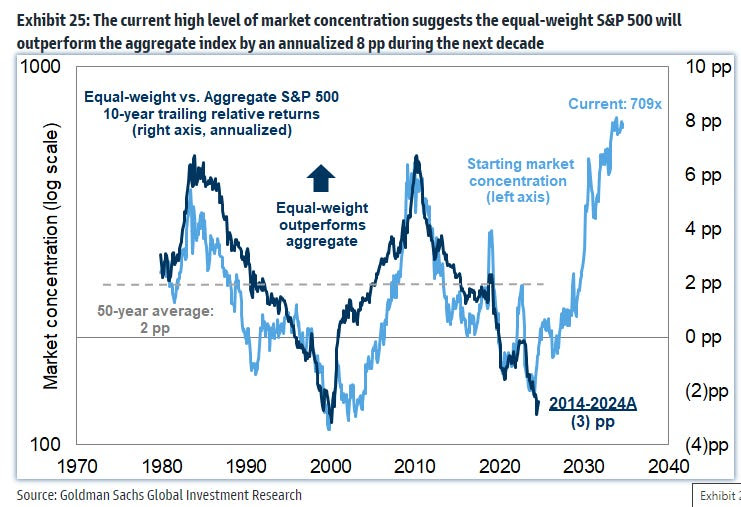
(…) Investment returns ultimately come from three sources: earnings growth, dividends received, and change in the earnings multiple. Our approach could be summarized as taking care of fundamentals by focusing on quality while controlling valuation risk by seeking to avoid overreach on the earnings multiple.

If we compare today’s markets with the market top in 2000, we see less to fear today on both the fundamentals and the multiples. In 2000, the top-10 stocks comprised five telecom companies, two networking beneficiaries, a software business, an oil company, and a holding company. At the June 2024 quarter end, we have five cloud tech businesses, two chip companies, a pharmaceuticals company, an oil company, and a holding company.

In 2000, the price-to-earnings ratio of the top 10 was 60x. Market participants were intoxicated by the ongoing communication revolution and heady fundamental returns of 22% per annum for the group over the preceding five years. The valuation was simply too rich. Even if the fundamental return expectation of 19% p.a. had been delivered and stock prices held, the top 10’s multiple would have still exceeded 25x by 2005.

In reality the outcome was starkly different – the fundamental return was a relatively puny 8% p.a. for the group, with earnings falling at the telecom companies after what turned out to have been disastrous capital allocation in 3G spectrum auctions. Total returns were famously poor.

Perhaps unsurprisingly, the stellar performer of the group – the only one to deliver a positive return – was the companyth e furthest from the TMT epicentre, Exxon.

2024’s top 10 have delivered similarly impressive fundamental returns of 19% p.a. since 2019, but the set-up is rather different to 2000, with a median P/E of 27x. If today’s top 10 were to deliver on 19% fundamental return expectations and prices were to stay the same this time around, the multiple would collapse to 12x by 2029. Implicitly, investors expect less from the mega-caps now than they did in 2000. In a real sense, the stakes are lower today.

A final “then and now” observation relates to the quality of the two top 10s. GMO’s longstanding systematic quality metric that we use for idea screening was in active service in 2000 (as were the writers of this piece). Based on an assessment of the level and stability of profitability, alongside balance sheet strength, 2000’s top 10 were barely better than the median business.

By contrast, today’s top 10 sits squarely in the high-quality camp, with the midpoint just shy of the 10th percentile globally. That fits well with our fundamental assessment of quality – most of the current crop have stronger barriers to entry, interesting optionality (e.g., in AI and digitalization), and a better record in capital allocation, too.

None of this is intended to be determinative and we are not making another “X-then-Y” case. We are pointing out that in an important way the stars have aligned differently this time around, even if the market is superficially similar from a technical perspective. In the short term, it’s anyone’s guess. But looking further out, whether today’s mega-caps turn out to be great or less-than-great investments will be a result of the evolution of their fundamentals and the consequent impact on their valuation multiples.

Unlike in 2000 when we held only a nonmaterial weight in the top 10, we invest with confidence in a number of these companies today.

What is different from 2000 is the importance of passive investing, boosting demand for the largest weights. The reverse will eventually happen…

BofA Global Research

AI CORNER

https://www.youtube.com/watch?v=7PMUVqtXS0A

Very interesting interview with Eric Schmidt. David asked Perplexity.ai to summarize it but still a great watch:

Based on the search results, here are the key points Eric Schmidt discussed regarding Nvidia, the chip industry, LLMs, agents, and technical aspects of AI:

1. Nvidia’s dominance:
   – Schmidt admitted he had underestimated Nvidia’s CUDA software ecosystem, which is now crucial for running major AI models[6].
   – He emphasized Nvidia’s key role in AI infrastructure, predicting massive investments flowing to the company[1][7].

2. AI investments and infrastructure:
   – Schmidt revealed that major tech companies are planning unprecedented investments in AI infrastructure, potentially reaching up to $300 billion[1][2].
   – He suggested that a significant portion of this investment would go to Nvidia for AI training chips[1][2].

3. AI agents and context windows:
   – Schmidt discussed the potential impact of large context windows, AI agents that can learn and improve themselves, and text-to-action capabilities[5].
   – He predicted these technologies would have a massive impact on the world, potentially surpassing the effects of social media[5].

4. LLMs and AI development:
   – Schmidt noted that the gap between frontier AI models and the rest of the field appears to be widening[2][5].
   – He compared the current state of AI to the early days of electricity, suggesting that realizing its full potential will require time and significant organizational innovation[6].

5. Chip industry and competition:
   – Schmidt mentioned Nvidia’s upcoming B200 chip, which is so advanced it requires clean room conditions for assembly[7].
   – He noted that competitors like AMD are struggling to compete with Nvidia’s ecosystem, particularly in software[7].

6. AI stack and future developments:
   – Schmidt described a future where large context windows, self-improving AI agents, and text-to-action capabilities would converge, leading to rapid development in AI applications[5].
   – He suggested that these advancements could enable the creation of complex applications, like a TikTok competitor, in a matter of minutes[5][6].

7. Technical challenges:
   – Schmidt highlighted the massive computational power required for AI development, mentioning that the U.S. might not have enough power to support these efforts alone[5].
   – He discussed the potential need for partnerships with countries like Canada or Arab nations to access necessary resources for large-scale AI projects[6].

Overall, Schmidt’s comments paint a picture of rapid advancement in AI technology, with Nvidia playing a central role in providing the necessary hardware and software infrastructure. He emphasized the increasing importance of large-scale computing power and the potential for AI to dramatically reshape various industries and applications.

Based on the search results, Eric Schmidt had several key points to make about China, competition, geopolitics, and technology:

1. Urgent need for U.S. action:
Schmidt emphasized the necessity for the U.S. to take decisive action in competing with China technologically, stating, “We have to do whatever it takes”[1]. He believes the U.S. is currently unprepared for the challenges ahead in the AI competition with China[4].

2. China’s strategic plan:
According to Schmidt, China has a strategic plan to dominate crucial sectors such as semiconductors, AI, clean energy, and biotech[1]. He noted that China announced its intent to master and eventually dominate these areas, which he sees as the engine for trillions of dollars of new businesses and global markets[4].

3. Technological leadership gap:
Schmidt stated that the U.S. is “one or two years ahead of China, not five or 10” in AI development. He pointed out that China is well ahead in areas like face recognition[2].

4. Global platform dominance:
Schmidt emphasized that the competition with China is now about “global platform dominance” rather than traditional military assets. He believes that the country controlling global platforms will gain advantages in both national security and economics[4].

5. Specific technological concerns:
He highlighted China’s progress in quantum communications and its efforts in quantum computing, expressing concern about potential threats to encryption and secure communications[4].

6. U.S. strategy and allies:
Schmidt advocated for a “global competitiveness strategy” for the West to win technological battles. He stressed the importance of working with Pacific partners and suggested that India has become the U.S.’s most important ally in the tech race, as he believes the U.S. has “lost” China in terms of technological cooperation[1][3].

7. European challenges:
Schmidt was critical of Europe’s tech innovation environment, particularly Brussels’ regulatory approach. He saw limited hope for European tech prospects, mainly in France[3].

8. Urgency and organizational approach:
He stressed the need for urgency in U.S. policy, regardless of whether it focuses on public funding or private-sector initiatives. Schmidt believes that to compete effectively, the U.S. needs to organize itself around these technological challenges[4].
In summary, Schmidt views the technological competition with China as a critical geopolitical issue, emphasizing the need for urgent and strategic action from the U.S. to maintain its technological leadership and global influence.

Our own research led by David suggests that China is actually ahead of the U.S. in LLMs. We also think unwise to invest in companies investing in LLMs: there will be blood. Wiser to do bookend investing in AI: infrastructure (chips, equipment, energy) and apps.