The enemy of knowledge is not ignorance, it’s the illusion of knowledge (Stephen Hawking)

It ain’t what you don’t know that gets you into trouble. It’s what you know for sure that just ain’t so (Mark Twain)

Invest with smart knowledge and objective odds

THE DAILY EDGE: 16 August 2024

Retail Sales Is Counterprogramming the Job Report

Retailers increased sales more than twice as fast as the consensus had estimated in July. That is true whether describing headline retail sales (+1.0% vs. 0.4% expectation) or the measure that excludes autos and gas (+0.4% vs. 0.2% expectation). Perhaps the most remarkable development though is that control group sales, a favored tool for predicting PCE spending in the GDP report, increased 0.3% in July. Coming on the heels of a 0.9% gain in the prior month, the upshot is more solid goods spending than most forecasters, ourselves included, had expected.

Less than two weeks ago, broad-based weakness in the July jobs report sent global financial markets into a tailspin and re-ignited fears of U.S. recession. (…) Today’s retail sales report is the latest development on this theme. That spending momentum in July positions spending for a solid third quarter. (…)

Source: U.S. Department of Commerce and Wells Fargo Economics

As was widely expected, the place where sales picked up the most was the largest category: auto dealers. A slump in June set up July for a solid gain of 3.6%. This is made somewhat more impressive by the fact that the CPI report showed auto prices are actually down over the past year. Some old familiar friends have returned to auto dealerships to help move inventory including more attractive financing terms, manufacturer rebates and dealer incentives.

Elsewhere, stores reported broad-based gains across most store types. The only categories that were down were clothing, sporting goods and miscellaneous. If one were to judge only from consumer company earning announcements, little of this makes sense. (…)

Labor market data have grown in importance as the Fed has shifted its focus back to the jobs market, and by extension the health of the consumer matters. Even though inflation and employment are the sole mandates, the Fed cannot afford to look past consumer behavior.

Source: U.S. Department of Commerce and Wells Fargo Economics

We’ve long held the view that continued consumer resilience depends on income growth as savings are no longer in excess and access to affordable credit has dwindled. With retail sales having held up through July, it somewhat walks back the urgency for an aggressive Fed pivot. Yet retail sales are limited in their growth signal as they mostly cover goods consumption and are subject to large monthly revisions. The more comprehensive personal income and spending report out later this month will be key to gauging consumer resilience, but the July retail report was a positive economic development. It’s the latest reminder that its tough to bet against the US consumer.

This was indeed a strong report confirming that the American consumer keeps buying goods, setting the stage for a possible reversal of the “weakish” June employment report.

My proxy for retail inflation (0.35 CPI-Durables + 0.65 CPI-Nondurables) was –0.01% MoM in July after –0.5% in each of the previous 2 months. If so, real sales rose 1.0% MoM in July following +0.7% in May and +0.3 in June.

This is booming demand!

Can this make sense given consumer companies conference calls apparently complaining of slow demand?

Part of the reason may be that many companies fail to adequately monitor prices and volumes.

Another reason is that the media have emphasized the weaker comments. Here’s Goldman Sachs on its own monitoring:

Similar to previous quarters, several companies have noted that consumers of their products remain under pressure from the macroeconomic environment and that this pressure has led to weaker sales. This experience is not universal, however, as other companies continue to see resilient consumer spending. Two common points of discussion that have also persisted this quarter relate to the affordability or value of a company’s offerings and the disparities between consumers in low vs. high income cohorts.

Yesterday, Walmart’s CEO Doug McMillon said “So far, we aren’t experiencing a weaker consumer overall.” He should know, including about the lower rung of the income spectrum. Notice that he said “so far”, which includes the first half of August for which he‘s got daily numbers.

  • “Things have been remarkably consistent — I know everyone is looking for some pieces of information that maybe indicates further weakness with our members and our customers. We’re not seeing it,” CFO John David Rainey later added.

Of the 71 S&P 500 consumer centric companies having reported Q2 by August 9, 69% beat earnings estimates, by 5.4% on average. Consumer Staples missed their revenue estimates by 0.5% to +1.6% but Consumer Discretionary companies grew revenues 4.7%, 0.8% better than forecast. Walmart actually raised its revenue guidance yesterday.

Also yesterday, initial claims fell for the second consecutive week, by 23,000 in total to 227,000 for the week ended August 10 and continuing claims also fell 7,000 to 1.864 million in the week ended August 3. The mini-summer seasonality seems alive increasing the odds that July’s weakish employment report was due to temporary factors.

Goldman Sachs’ survey of conference calls reveals that “Company commentary this quarter regarding hiring plans and the labor market largely reflects a healthy labor market.”

image

But if demand for goods is so strong, why is manufacturing not stronger and why are goods prices deflating?

One, because the vast majority of goods Americans consume are imported. U.S. real imports of goods are up 5.3% YoY in Q2 and 20% from their pre-pandemic level.

Two, because imported Chinese goods have deflated 3.8% since Q2’22 and, although they stopped falling in February, they have yet to show any uptick through July.

U.S. based goods-producing sector has seen no benefit from booming retail sales post-pandemic.

image

In all, higher interest rates did not reign spending in like in previous such episodes but inflation slowed mainly because goods have been deflating, mainly thanks to China.

image

As shown yesterday, overall import prices have recently stopped deflating along with shipping costs. And we might get higher tariffs this fall.

Maybe, the two most important inflation indicators for the U.S. are Chinese domestic demand and the USD.

China’s faltering growth revives cash vouchers talk

(…) A top-level policy meeting in July pledged an incremental tilt towards consumer stimulus, in what analysts saw as an official admission the previous toolkit wasn’t working as intended.

An article in state media this week revived an idea implemented in the United States and elsewhere during the pandemic but resisted in Beijing.

China Daily, citing three economists from government-backed think tanks, said the government “should consider additional direct support to consumers worth at least 1 trillion yuan ($139 billion) — either cash or vouchers.”

That sum is equivalent to 0.8% of last year’s GDP. (…)

Li Daokui, director of Tsinghua University’s Academic Center for Chinese Economic Practice and Thinking, was quoted as saying “it was advisable” that the consumption coupons be issued during the week-long National Day break in October. (…)

THE DAILY EDGE: 15 August 2024

July CPI: No Bad News Is Good News

The July CPI data were largely in line with expectations. Both headline and core CPI increased by 0.2% in July (0.15% and 0.17%, respectively), just a basis point or two off from our forecast going into the release. The details of the report contained a few surprises.

Core goods prices fell more than we expected, led by another large (-2.3%) decline in used vehicle prices.

Core services inflation was a bit hotter than anticipated, led by rebounds in inflation for housing, recreation and communication services.

The broad narrative of continued disinflation remains unchanged. Headline CPI fell below 3% year-over-year for the first time since March 2021. Core CPI declined to 3.2% year-over-year, the slowest pace since April 2021 and roughly half the 6.6% peak hit in September 2022. Furthermore, the annualized pace of core CPI inflation over the past six and three months has been 2.8% and 1.6%, respectively.

Today’s data leave the FOMC in a holding pattern and do not settle the 25 bps or 50 bps debate for September. As we go to print, markets view September as roughly a coin flip between the two outcomes. The continued steady slowdown in inflation, when paired with the rise in the unemployment rate and deterioration in other labor market indicators, leads us to believe the FOMC will want to move quickly towards a more neutral policy stance in the months ahead.

As a result, we expect a 50 bps rate cut at the September FOMC meeting, but the decision ultimately may be determined by the August employment report to be released on September 6 and the August CPI report to be released on September 11. Chair Powell’s expected speech at the Jackson Hole conference on August 23 looms large as the FOMC weighs the balance of risks to its dual mandate.

Source: U.S. Department of Labor and Wells Fargo Economics

(…) Unlike core goods, core services inflation sprang back in July (+0.3%) after increasing just 0.1% in June. The pickup was tied in part to somewhat firmer growth in primary shelter prices.

Rent of primary residences jumped 0.5% in July, which was stronger than the 0.4% average monthly gain in the first half of the year and looks unlikely to persist with the BLS’s more-forward looking measure of new tenant rents having slowed sharply in recent quarters. Owners’ equivalent rent also increased at a faster pace than June, but the 0.36% rise still points to slowing on trend when compared to the first half average increase of 0.43%.

Ex-housing, core services inflation picked up due to a smaller drop in the volatile travel category. The remaining portion of core services (i.e., ex-shelter and travel) rose 0.2% again in July as a drop in medical care prices was offset by rebounds in motor vehicle insurance, recreation and communication services. (…)

A bottoms-up approach to inflation forecasting suggests more housing and other services disinflation is on the way. From a top-down perspective, a weakening labor market and more price-conscious consumers also suggest a bit more disinflation is in the pipeline.

With both the CPI and PPI data in hand for July, we estimate both the headline and core PCE rose 0.13% last month. Core PCE inflation was just 0.12% in July 2023, so the 12-month change would remain at 2.6%, but if realized, this outcome would nonetheless highlight the resumption of progress in lowering inflation with the three-month annualized pace slipping back below 2% (1.8%). (…)

ING adds:

The chart below shows that we have had three consecutive readings below 0.17% MoM for core inflation and that the 3M annualised rate is now just 1.6%. The Fed has told us they won’t wait for the YoY rate to hit 2% (currently 3.2%) before cutting interest rates, because if they do that the risk is they have left rates too high for too long. This would mean a greater chance of an undershoot in late 2025 / early 2026. (…)

US core CPI metricsSource: Macrobond, ING

Source: Macrobond, ING

The one area of real disappointment was housing with primary rents up 0.5% MoM and owners’ equivalent rent up 0.4%. Recent numbers had been tracking more in line with private surveys on housing costs, so the re-acceleration today is a surprise. The market has seemingly moved to reduce the pricing of a 50bp cut in September on the back of this. (…)

Housing costs MoM% re-accelerate

Source: Macrobond, ING

Source: Macrobond, ING

For now we favour a 50bp to start off as the Fed plays catch-up to the data before reverting to 25bp moves thereafter. However, the jobs report, published on 6 September is critical for this view. A soft payrolls and another move higher in the unemployment rate and then a 50bp move looks assured. A strong jobs number and perhaps a dip in the unemployment rate back to 4.2% and it will be a 25bp cut.

  • Excluding shelter, the headline and core inflation rates were only 1.8% and 1.7% YoY in July as Ed Yardeni illustrates:

image

  • “There is now a waiting game for the shelter CPI inflation rate to decline to the inflation rate in new tenant rent, as disinflation in new rents slowly but surely permeates the CPI calculation of rent. Shelter CPI inflation should soon soon decline from 5.1% y/y in July closer to 4.0% in coming months.”

image

Actually, Ed’s chart is not up-to-date as the BLS New Tenant Rent Index did turn negative YoY in Q2 (-1.1%). But the better series is the All Tenant Rent Index (black) which clocked at +4.0% in Q2, right where Zillow has been all year.

image

CPI-Rent is still at 5.1% YoY in July when it surprisingly rose 0.42% MoM following 3 months below 0.4% (avg. +0.29%), actually outpacing Zillow. This heavyweight series seems hard to contain.

image

Lastly on the CPI, goods deflation continues to help overall inflation but producer prices bounced back in July…

image

… along with import prices (yellow) and container rates (white).

image

And we might get higher tariffs this fall.

The next chart highlights one reason why deglobalization likely means higher secular inflation. Tariffs can sometimes be a tool used to protect under-utilized domestic production, but the US lacks enough productive capacity to meet demand so tariffs have directly contributed to higher prices. If deglobalization does indeed continue, then secular disinflation seems behind us. (RBA)

image

Mission not quite accomplished just yet!

China’s Economy Fails to Pick Up After Worst Stretch in Five Quarters Slow consumption and disappointing investment drag on growth.

A surprise slowdown in fixed-asset investment to 3.6% in the first seven months of the year was among the biggest takeaways from data released on Thursday. Retail sales beat expectations largely on a seasonal uptick — boosting China’s stock market — though they remained far below pre-pandemic growth. Industrial production softened slightly even as it continued to outpace consumption. The offshore yuan held onto early losses after the data. (…)

Other Details of Economic Data:

  • Industrial output rose 5.1% in July from a year ago, down from June’s increase of 5.3%
  • Retail sales increase 2.7% in July, rebounding from 2% in June

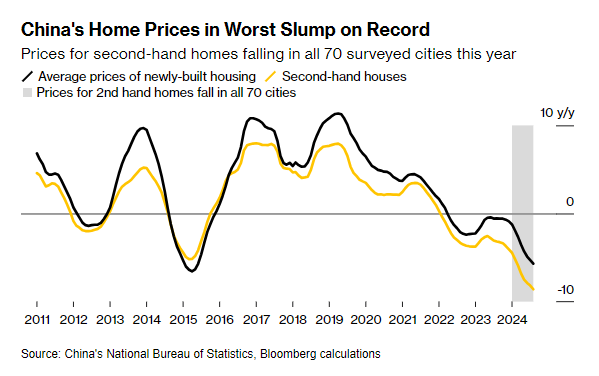
The housing slump showed little sign of reversing, even though the pace of its fall stabilized. Home prices dropped at a largely unchanged rate on a month-on-month basis but declined faster in annual terms. New home starts continued to plunge at a clip of around 20% from a year ago.

Overall investment expanded 1.9% in July from a year ago, worse than the 3.7% gain in the previous month, according to Goldman Sachs Group Inc. calculations.

A breakdown of the figures shows a deceleration in infrastructure investment expansion in the January-July period from the first six months of the year. Private firms’ investment also deteriorated and posted no change from a year ago. (…)

Equity markets reacted positively to the better retail sales growth rate, +2.7% vs +2.0% YoY. But Goldman Sachs estimates that seasonally adjusted sales declined another 0.8% MoM after –2.0% in June. Sinking more slowly but still sinking fast.

AI CORNER

Google just announced its Pixel 9.0 AI powered handset, beating Apple by a few weeks. Gemini Live will be available to all Android users. From the Google presentation:

The new Gemini assistant can go beyond understanding your words, to understanding your intent, so you can communicate more naturally. It can synthesize large amounts of information within seconds, and tackle complex tasks. It can draft messages for you, brainstorm with you, and give you ideas on how you can improve your work.

With your permission, it can offer unparalleled personalized help, accessing relevant information across your Gmail Inbox, your Google calendar, and more. And it can reason across personal information and Google’s world knowledge, to provide just the right help and insight you need, and its only possible through advances we made in Gemini models over the last six months.

It’s the biggest leap forward since we launched Google Assistant. Now we’re going to keep building responsibly, and pushing to make sure Gemini is available to everyone on every phone, and of course this starts with Android. (…)

Gemini can handle these kinds of complex personal queries within Google’s own secure cloud, without sending any of your personal data to a third-party AI provider you may not know or trust. And for some of the most sensitive use cases, like summarizing audio from a phone call, or suggesting a helpful reply to an encrypted text message, we’ve pioneered on-device generative AI with Gemini Nano. It’s the first time a large multimodal AI model has been optimized for a mobile device, so the data never leaves your phone.

With Gemini deeply integrated with Android, we’re well on our way to rebuilding the OS with AI at the core. The new Gemini assistant brings the benefits of AI to billions around the world, while helping to keep your personal information secure and private. Android is truly leading the way towards AI for everyone.

From my query to Perplexity.ai:

The new Google Pixel 9 series introduces several innovative AI features that enhance user experience across various tasks:

  1. Gemini Personal AI Assistant: Gemini replaces Google Assistant as the default voice assistant, offering a more sophisticated interaction experience. It integrates deeply with Google apps and Android, providing assistance with tasks such as checking schedules, finding details from emails, and more. Gemini Live, a conversational experience, allows users to have free-flowing conversations with the assistant.
  2. AI-Enhanced Photography and Video: The Pixel 9 series includes features like “Add Me,” which uses augmented reality to include the user in group photos, and “Magic Editor,” which allows users to reimagine photos using generative AI. The upgraded telephoto lens and Video Boost on the Pixel 9 Pro models enable high-quality zoom up to 20x.
  3. Pixel Studio: This new app allows users to create images using text prompts, leveraging an on-device diffusion model and a cloud-based text-to-image model. It’s designed for easy creativity and sharing.
  4. Pixel Screenshots: This feature helps organize and recall information from screenshots using AI. Users can search for screenshots through simple text prompts, making it easier to find saved information.
  5. Call Notes and Summaries: Call Notes saves a summary of phone conversations, while Call Summary provides detailed overviews of calls. These features ensure users can easily recall important details from their calls.
  6. AI-Powered Weather Reports: The Pixel Weather app uses AI to provide customized and accurate weather forecasts, allowing users to prioritize information like UV index or air quality

TechCrunch tested Gemini Live: “In my experience, these low latency, verbal features feel much more natural than texting with ChatGPT, or even talking with Siri or Alexa. I found that Gemini Live responded to questions in less than two seconds, and was able to pivot fairly quickly when interrupted. Gemini Live is not perfect, but it’s the best way to use your phone hands-free that I’ve seen yet.”

McKinsey discusses the enterprise world:

According to a recent McKinsey survey, 65 percent of organizations are now using gen AI, and many businesses are already seeing material benefits from it, write McKinsey’s Alex Singla, Alexander Sukharevsky, and coauthors.

[Gen AI] can serve as a creative assistant that can spark ideas for writing projects, art concepts, technical issues, and more. Need to draft text, code, or design something? Gen AI can provide examples to kickstart your projects.

If you’re stuck on understanding a concept or need information, it can explain, summarize, or point you to the right resources. In technical fields, it can even simulate scenarios, generate data, or help model complex systems.

Pointing up New Andre Ng interview. David says “Ng stands out amongst commentators on AI. His scholarly knowledge of AI and computer science is supplemented by a long experience of applying AI in commercial applications.”