EDGE AND ODDS’ Almost DaiLY CHAT (a totally AI generated chat on the day’s post courtesy of Google’s NotebookLM): October 15, 2024
(…) Some analysts say Biden should be wary of Netanyahu’s assurances about its attack.
“This wouldn’t be the first time he’s floated what Biden wanted to hear, then did an about face when he got blowback from the right,” said Frank Lowenstein, a State Department official in the Obama administration, adding that hard-liners in the Israeli government “are still pushing for an attack on the nuclear sites, or at least the oil facilities.” (…)
The U.S. signaled its support for Israel’s plans Sunday when it announced it was sending a missile-defense system designed to shoot down ballistic missiles to Israel. The decision marked a significant step in American efforts to bolster Israel’s defenses, putting U.S. soldiers on its territory.
The U.S. Army-operated Terminal High Altitude Area Defense, known as Thaad, is expected to begin arriving in the coming days, along with roughly 100 soldiers to operate it.
Bloomberg’s account:
Israel said it’s weighing the Biden administration’s misgivings over its planned counter-strike on Iran, after a report suggesting Prime Minister Benjamin Netanyahu may spare Tehran’s nuclear and energy facilities to limit potential escalation.
The Jewish state, though, also asserted it’s free to act how it sees fit after more than a year of battling Iranian proxy groups on its borders and fending off two direct long-range attacks from the Islamic republic, whose regional clout and nuclear aspirations Netanyahu casts as an existential threat. (…)
CHINA’S “WHATEVER IT TAKES MOMENT”
Behind Xi Jinping’s Pivot on Broad China Stimulus A bevy of bad news prompted action from the leader—but not a full U-turn
After resisting calls to take forceful steps to prop up the economy for two years, Xi relented in late September and ordered a barrage of interest-rate cuts and other measures to put a floor under growth.
But Xi didn’t give his economic mandarins a blank check. According to officials and government advisers close to decision-making, he wanted to bail out indebted Chinese municipalities on the brink of collapse and revive the stock market, without veering too far from his focus on letting the state drive China’s transformation into an industrial and technological powerhouse.
For Xi, the officials and advisers say, the near-term goal isn’t to massively stimulate demand but to fend off a brewing financial crisis—or “derisking,” in official lingo, thereby helping to stabilize the overall economy and achieve the 5%-or-so growth target for this year. (…)
The shift, tactical rather than strategic, is centered on the central bank and the state coffer providing liquidity support for local governments and big banks, the backbone of funding for the Chinese economy.
Another focus of the policies is to rescue China’s stock market, which has been on a losing streak for nearly four years. The People’s Bank of China is taking the unprecedented step of encouraging brokerage firms, insurers, and listed companies to tap central-bank or commercial-bank funding to buy stocks.
Support for household consumption has mainly come from a reduction in mortgage rates, part of a new push to arrest the multiyear downturn in the property market. Analysts estimate that the cut can save homeowners about 150 billion yuan, roughly $21 billion, in interest payments, a meager relief given the trillions of dollars in annual household consumption in China. (…)
“There is a severe shortage of cash among local governments,” said one of the people familiar with the situation. “Something has to be done to avoid a full-blown crisis.” (…)
The breadth of the easing measures taken by the central bank surprised even some financial officials in Beijing.
Notably, Pan Gongsheng, governor of the People’s Bank of China, announced plans to set up a facility aimed at guiding commercial banks to lend to listed companies for the purpose of share buybacks.  (…)
(…)
For investors and analysts, the ensuing trading frenzy has become reminiscent of what became known as the “Uncle Xi bull market” of 2015, when a government push to encourage stock investing resulted in an epic stock rally in the first half of that year. A big question now is whether the gains will take hold—or turn into a crash just as the 2015 market boom did. (…)
The Finance Ministry’s briefing on Saturday reignited hopes that some sizable fiscal support is in the offing.
“The unprecedented series of press conferences by Xi’s policy team demonstrates that Xi now recognizes that China’s economy is on the wrong track,” said Andy Rothman, China strategist at Matthews Asia, a U.S.-based fund manager, “and that a pragmatic course correction is urgently needed.” (…)
During his press conference on Saturday, Finance Minister Lan Fo’an indicated that a new round of fiscal support from the central government will be focused on backfilling local-government budget shortfalls, helping localities swap maturing debt for new borrowing, and beefing up the capital base of major state banks.
Absent from the measures are any significant moves to boost consumption. People close to the ministry say such measures are in the works but nothing substantial is imminent. (…)
The officials and advisers close to Beijing’s decision-making say the central government is putting budget constraints on some heavily indebted localities in exchange for them getting funding support from the center. While the move shows an attempt at much-needed financial discipline from Beijing, it could also lead to those localities reducing spending, potentially worsening the nation’s deflationary problems. (…)
Yesterday I wrote:
The Chinese government is now serious: it recognizes the size and scope of the problems and has adopted its own “whatever it takes” policies.
But so far, it has only thrown cash to the problems: more loans or loan guarantees to local governments, capital boosts to banks and large purchases of equities.
-
Local governments are expected to use the cash to buy the huge housing overhang from developers. This has been tried earlier this year on a smaller scale, only to find few actual transactions because the bids are deemed too low. Then there is the problem of what to do with those unfinished homes. Local governments are not housing developers.
-
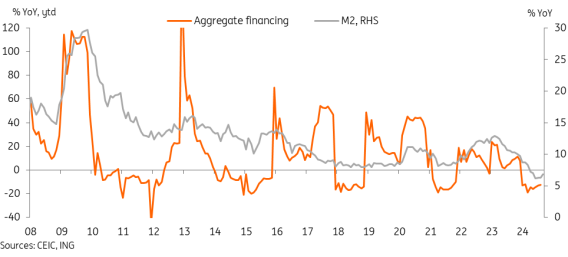
Banks may be willing to lend but they need willing borrowers. Business and consumer confidence is at a historical low, not only on the economy but on the government itself. The healing will be slow.
-
China has but a flimsy social safety net. Chinese were saving some 29% of their income pre-Covid. It’s now 33%.
-
Artificially boosting equity markets may help confidence and create the beginning of a wealth effect but only for a very tiny slice of the population. For most Chinese, the 15-25% decline in their real estate investment has deflated their long-term dreams. The latest data offer no hope of a stabilization, let alone a recovery.

-
Deflation is a real risk as shown above, complicating the necessary consumption revival. How many cash vouchers will be needed to restart demand?
-
The PBOC keeps cutting interest rates but inflation keeps declining, leaving real rates around 2.0%, the same as in 2021.
China Weighs $853 Billion Debt Swap to Rescue Local Governments Local bonds said to be issued through 2027 as part of stimulus
China is considering allowing local authorities to issue as much as 6 trillion yuan ($853 billion) in bonds through 2027 mainly to refinance their off-balance-sheet debt, people familiar with the matter said, a key part of the government’s plan to shore up the world’s second-largest economy.
Officials are weighing the proposal to let provincial-level governments replace so-called hidden debt — borrowing through companies and other financing vehicles — with new official bonds carrying lower interest rates, people familiar with the matter said, asking not to be identified discussing private information. The International Monetary Fund estimated these entities held over 60 trillion yuan of debt as of last year. (…)
While the debt swap wouldn’t address market calls for more central government borrowing and consumer stimulus, it would help free up cash at local governments to spend on everything from employee salaries to construction projects. (…)
David Li Daokui, a professor at Tsinghua University in Beijing and a government adviser, told Bloomberg Television that a debt swap that helps local governments pay back their delayed payments to companies and employees would be the “biggest economic stimulus,” putting the amount at 10% of gross domestic product.
Local governments’ expenditures — including spending on infrastructure — have shrank to 36% of GDP from 41% previously because they’re running out of cash, Li said in an interview Monday.
“Local governments have been using short-term debt and loans to finance 20-year, 30-year, long-term infrastructure projects,” he said, referring to the borrowing binge through financing vehicles, known in short as LGFVs. “So it is irrational, even crazy or draconian, for local governments to pay back their debt in the coming one or two years. This is a self-inflicted wound.” (…)
Simply making hidden debt visible…
A price war is spreading among offices, which are offering ever lower rents to retain tenants eager to move to cheaper towers. Others are resorting to giving out subsidies to lure back companies.
China’s office market predicament stems from an economic slowdown and a swelling supply. Major cities that were immune to challenges weighing on the commercial real estate sector abroad — such as rising interest rates and work from home — are now facing the strain. That’s adding to woes for developers and investors still contending with an unprecedented housing slump. (…)
“Insufficient leasing demand under economic weakness is a systematic issue hindering an office recovery,” said Lu Ming, a research director at Colliers International Group Inc. “When vacancy stays at an elevated level, such as above 20%, it’s hard to see office rents reaching a bottom in the near term.” (…)
It’s not just individual buildings that are emptying. Beijing’s city-wide vacancies jumped to 20.6% in the second quarter, the highest in at least 15 years, Colliers data show. In suburban Tongzhou, an emerging financial district that sought aspiration from London’s Canary Wharf, 65% is empty, Cushman & Wakefield Plc said. (…)
Shanghai office vacancies climbed to 21.5% in the third quarter, the highest in about two decades, according to CBRE Group Inc. They risk rising further this year on a supply pipeline that’s set to be the highest in five years. (…)
Across China’s major cities, net absorption of office space — a measure of occupancy — has only recovered to less than half of the pre-pandemic level in the first half, according to CBRE.
Weaker leasing demand has prompted developers to delay the construction and delivery of new stock. (…)
All this in an economy growing 4-5%!!
Single-day second-hand home sales in Shanghai exceeded the 1,000-unit threshold for the first time in four months yesterday, thanks to the latest real estate supporting policies introduced by the Chinese central government.
Some 1,334 pre-owned houses changed hands in Shanghai yesterday, according to the eastern Chinese city’s official data platform. (…)
During the seven-day National Day holiday ended Oct. 7, over 2,130 second-hand homes were sold in Shanghai, doubling the figure from a year earlier, according to data from Centaline Property’s local branch.
Shanghai’s second-hand home market continued to recover after the holiday, with sales in the following five working days nearing 900 units, up more than 60 percent from the five working days before the holiday, according to the Linping Residential Big Data Research Institute.
The total number of pre-owned home sales in Shanghai reached 7,949 units this month as of Oct. 13, up 7.7 percent from the same period in September and more than 75 percent from a year earlier. (…)
Even though the number of second-hand houses sold in Shanghai is increasing, the overall transaction volume remains insufficient, so there are no conditions for price increases, insiders told Yicai, adding that it will take some time for prices to rise again. (…)
IMF Warns Rise In Government Debt Could Be Sharper Than Anticipated If budget policies are unchanged, the IMF estimates that large increases in borrowing by the U.S., China and others will drive a rise in government debt to $100 trillion this year
Government debts are set to match the annual output of the global economy by the end of this decade, and could cross that threshold much sooner if economic growth is weaker or interest payments are higher than expected, the International Monetary Fund said Tuesday.
In its twice-yearly report on government finances, the Fund said spending cuts and tax rises of an unprecedented size would be needed over the coming five to seven years to stabilize or reduce debt.
“It’s time for governments to get their house in order,” said Era Dabla-Norris, deputy director for fiscal affairs at the IMF. “For all countries, a strategic pivot is needed to reduce debt risks.”
If budget policies are unchanged, the IMF estimates that large increases in borrowing by the U.S., China and others will drive a rise in government debt to $100 trillion this year, equivalent to roughly 93% of the world’s annual production of goods and services. The Fund expects government debt to rise further, and almost match annual world output by the end of the decade.
But that could happen sooner if government projections underestimate the rise in debt, as they have done in the past. The IMF said government debts tend to be six percentage points of economic output higher than anticipated after three years. (…)
In an extreme scenario, government debt could hit 115% of global output in 2026, while U.S. government debt could reach 150% of the country’s gross domestic product. According to the Fund’s calculations, U.S. government debt started the century at less than 60% of GDP, a proportion that has more than doubled already. (…)
In addition to the U.S. and China, the IMF expects to see increases in government debt in Brazil, France, Italy, South Africa and the U.K.. It said delaying action in those countries will make the cuts in spending and tax rises needed to stabilize borrowing even larger.
The new French government Thursday unveiled a budget that aims at narrowing France’s deficit to 5% of economic output by the end of 2025, and 3% by 2029 from 5.5% in 2023.
As it is, the IMF estimates that average cuts in spending and tax rises of between 3% and 4.5% of gross domestic product will be needed to stop the rise in debt at “high probability.” Those adjustments are larger than planned, and also larger than previous adjustments. (…)
Uncertainty about the future path of U.S. budget policy is likely to have a big impact on other governments, the IMF said. Increasingly, changes in the interest rates that governments pay are driven not by changes in their own circumstances, but by changes to the outlook for U.S. budget policy and the interest rates set by the Federal Reserve. (…)
But while spending pressures are on the rise, the Fund noted that “political redlines on taxation have become more entrenched.” (…)
Countries are likely to default more frequently on their foreign currency debt in the coming decade than they did in the past due to higher debt and an increase in borrowing costs, agency S&P Global Ratings warned in a report on Monday.
Sovereigns’ credit ratings overall have also weakened globally in the past decade. (…)
S&P Global Ratings analyzed defaults over the past two decades and found that developing countries are now relying more heavily on government borrowing to ensure foreign capital inflows. But when that reliance was paired with unpredictable policies, a lack of central bank independence and shallow local capital markets, trouble repaying often followed.
Higher government debt and fiscal imbalances prompted capital flight, which in turn intensified balance-of-payment pressures, depleted foreign exchange reserves and eventually cut off their ability to borrow – essentially a doom spiral that led to default.
It also warned that debt restructurings are taking significantly longer now than in the 1980s – with big consequences. (…)
Interest payments in soon-to-default countries tended to approach or even exceed 20% of government revenue in the year before default, and the countries also typically entered recession, while inflation rose to double digits, making life tougher for people there. (…)
In case you wonder, I found that the U.S. federal government interest payments are now 11.9% of revenues. They reached 14.1% in 2007 and 22.2% in 1998.
AI CORNER
Google Backs New Nuclear Plants to Power AI Startup Kairos Power plans to build small reactors to help supply electricity to the tech company’s data centers, in a first-of-its-kind deal in the U.S.
Google will back the construction of seven small nuclear-power reactors in the U.S., a first-of-its-kind deal that aims to help feed the tech company’s growing appetite for electricity to power AI and jump-start a U.S. nuclear revival.
Under the deal’s terms, Google committed to buying power generated by seven reactors to be built by nuclear-energy startup Kairos Power. The agreement targets adding 500 megawatts of nuclear power starting at the end of the decade, the companies said Monday.
The arrangement is the first that would underpin the commercial construction in the U.S. of small modular nuclear reactors. Many say the technology is the future of the domestic nuclear-power industry, potentially enabling faster and less costly construction by building smaller reactors instead of behemoth bespoke plants.
“The end goal here is 24/7, carbon-free energy,” said Michael Terrell, senior director for energy and climate at Alphabet’s Google. “We feel like in order to meet goals around round-the-clock clean energy, you’re going to need to have technologies that complement wind and solar and lithium-ion storage.” (…)
Last month, Constellation Energy and Microsoft strucka deal to restart the undamaged reactor at Pennsylvania’s Three Mile Island, the site of the country’s worst nuclear-power accident. Earlier this year, Amazon purchased a data center at another Pennsylvania nuclear plant.
The 500 megawatts of generation that would be built by Kairos for Google is about enough to power a midsize city—or one AI data-center campus.
The agreement answers questions that have bedeviled smaller-reactor designs: What customer would pay the higher price for a first-of-a-kind project? And who would order enough to get an assembly line started? The concept, which remains to be proven, is that building the same thing over and over in a factory would drive down costs.
Kairos plans to deliver the reactors between around 2030 and 2035. Financial terms weren’t disclosed, but the companies entered into a power-purchase agreement, similar to those used between corporate buyers and wind- and solar-energy developers. (…)
Instead of water, which is used in traditional reactors, the Kairos design uses molten fluoride salt as a coolant. The units for Google will include a single 50-megawatt reactor, with three subsequent power plants that would each have two 75-megawatt reactors, Kairos said. That compares with about 1,000 megawatts at reactors at conventional nuclear-power plants.
Kairos will have to navigate complex approvals through the U.S. Nuclear Regulatory Commission, but already has clearance to build a demonstration reactor in Tennessee, which could start operating in 2027. (…)
Nearly 20% of U.S. power comes from nuclear plants, but the pipeline of big, new projects has been halted because of high costs and long timelines. (…)
In the near term, analysts expect more natural-gas-fired power plants to be added to fuel the country’s appetite for data centers, new manufacturing, heavy industry and transportation.
See also: Power Play
Ryan Xu was a dream customer for Germany’s automakers. The Guangdong-based entrepreneur and her husband own a Porsche 911 and a Mercedes-Benz G-Class and were among the first buyers of the electric Porsche Taycan.
But her views on German cars have soured as Chinese consumers increasingly favor tech refinement over traditional selling points like horsepower and handling. The software systems in the Taycan, which costs well over $100,000, were “terrible,” the 36-year-old mother of three said. It was “just an electrified Porsche — and that’s it.” (…)
After dealing with braking and other quality issues, the Xu family sold their Taycan and bought an ET5 from Chinese brand Nio Inc. The car was about a third cheaper than a Mercedes EQE, which Xu also considered, but offered a more luxurious interior design, smooth voice controls, and greeted their kids by name as they climbed in.
“German cars can hardly match” that level of technology, said Xu, who runs a business with her husband. Mercedes, BMW and Audi “can hardly be seen as luxury cars now.” (…)
While German automakers still control nearly 15% of the Chinese market, that’s down from a quarter before the pandemic and worse yet, their share of EVs is less than 10%. Without a quick turnaround, the slump risks turning into a rout and tipping German’s Big Three into an existential fight. As it is, VW, Mercedes and BMW are each only worth about half of BYD’s stock-market value. (…)
Even more than other international peers, Germany’s automakers have gone all in on China. While some rivals have cut their losses, the Germans aren’t giving up, shifting more resources in an effort to claw back market share. But it looks like an uphill fight as Beijing actively seeks to build up its own manufacturers. (…)
As a group, Germany’s carmakers operate a network of over 40 factories — more than in their homeland. That’s too much investment to simply give up on — and explains why they oppose the European Union’s plans to levy tariffs on China’s cheap electric cars. (…)
A few weeks after the auto show, VW Chief Executive Officer Oliver Blume ousted the head of software unit Cariad in the latest effort to accelerate and improve technology. Alongside new Chinese partnerships for autonomous driving, infotainment and user experience, VW also invested in Guangzhou-based Xpeng to underpin a plan to build cars using the startup’s EV expertise.
After a profit warning in September, one of the first actions by Mercedes CEO Ola Källenius was to fly to China to check on progress in reshaping its presence there including tapping CATL for batteries and Tencent Holdings Ltd. for digital services. BMW responded by joining forces with Great Wall Motor Co. to build EVs for its Mini brand.
The cumulative result is that German cars will become progressively less German in their largest market. The expansion is also exactly the opposite of the government’s aim to reduce exposure to China, according to Gregor Sebastian, an analyst at Rhodium Group.
Clinging to their position in China is “a huge gamble,” he said, noting that the German state might need to bail them out if it all goes wrong. “They’re hoping they’re too big to fail.” (…)
EVs are essentially large ipads on wheels. It’s the software, stupid!
New EV manufacturers built their own software from A to Z while legacy manufacturers attempt to fit their old, limited software into EVs and plug add-ons or third-party software hoping they will integrate smoothly. They just don’t.
TRULY AMAZING:
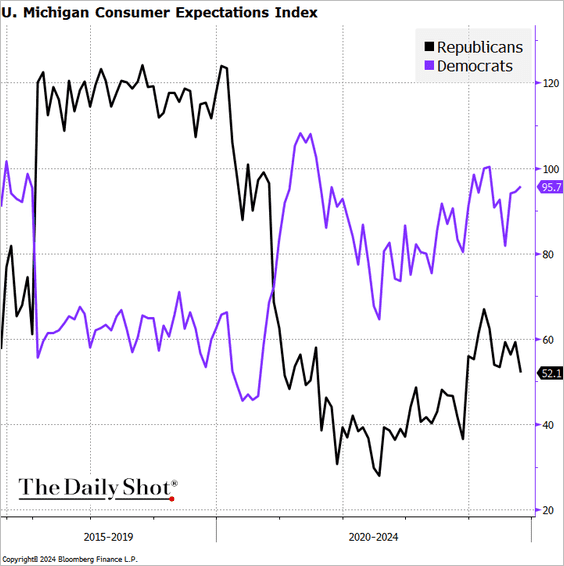
This chart shows the U. Michigan consumer expectations index by party affiliation. (The Daily Shot)
 Source: @TheTerminal, Bloomberg Finance L.P.
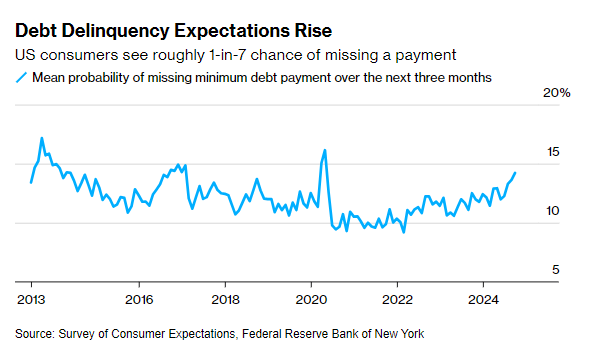

 Speaking of consumer confidence, LVMH yesterday told analysts:


 Shanghai’s Daily Pre-Owned Home Sales Exceed 1,000 Units for First Time in Four Months