The enemy of knowledge is not ignorance, it’s the illusion of knowledge (Stephen Hawking)

It ain’t what you don’t know that gets you into trouble. It’s what you know for sure that just ain’t so (Mark Twain)

Invest with smart knowledge and objective odds

THE DAILY EDGE: 8 April 2024

Airplane Note: I am travelling in Asia until April 24. Limited equipment and different time zones will limit the frequency and depth of my postings.

Brisk Hiring Bolsters Fed’s Cautious Stance on Rate Cuts U.S. added 303,000 jobs in March, significantly more than the expected 200,000.

The unemployment rate slipped to 3.8%, versus February’s 3.9%, in line with expectations.

Average hourly earnings rose 4.1% from a year ago, the smallest gain since June 2021. (…)

Fed Chair Jerome Powell in recent months has signaled, however, that he no longer regards strong hiring as something to fear. That is because the labor force has been growing steadily, largely due to a strong rebound in immigration. As a result, brisk hiring isn’t stoking concern on Powell’s part that the economy is at significant risk of overheating.

“The economy actually isn’t becoming tighter, which it ordinarily would. It’s actually becoming a little looser, and you’re seeing inflation come down—very unusual situation,” Powell said on Wednesday. (…)

A few Fed officials have said there is no need to consider lowering rates pre-emptively. Given the “meaningful risks” that inflation runs at closer to 3% than the Fed’s 2% goal, it is “much too soon to think about cutting interest rates,” said Dallas Fed President Lorie Logan in remarks Friday.

Traders continue to walk back expectations for interest-rate cuts this year. Interest-rate futures now imply that one or two quarter-point cuts are more likely to the market than the three forecast by Fed officials in March. (…)

Private education and healthcare added 88,000 jobs last month, while leisure and hospitality added 49,000. Combined, the two have accounted for 1.5 million of the 2.9 million jobs the U.S. has gained in the past year. (…) Relative to the trend during the five years before the pandemic, there are some 2.7 million fewer jobs in those sectors than might have been expected. (…)

Source: U.S. Department of Labor and Wells Fargo Economics

Other facts:

  • Employment growth has gathered speed in each month of the year (+256K in January, +270K in February and +303K in March).
  • The three-month average pace of payroll gains (276K) is running at its strongest pace in a year.
  • The workforce participation rate rose to 62.7% from 62.5% the prior month, its highest level since November.

Wells Fargo pretty much echoes the current consensus on wages and inflation:

Average hourly earnings (AHE) picked up slightly in March (+0.3%) and over the quarter (4.4% annualized). However, on a year-over-year basis, wage growth slipped to nearly a three-year low of 4.1% in a sign inflationary pressures from the jobs market continue to gradually subside. With fewer workers quitting their jobs and businesses reporting that they are having an easier time filling positions, we expect wage growth to slow a bit further in the months ahead, although wage gains do not need to ease much further to allay concerns over inflation.

The Fed’s preferred measure of labor costs, the Employment Cost Index, currently suggests compensation cost growth has returned to a pace that is nearly consistent with the central bank’s 2% inflation goal after accounting for labor productivity growth.

Source: U.S. Department of Labor and Wells Fargo Economics

On the other hand, labor income keeps growing at more than  5% (+5.3% in Q1, +5.9% in March), sustaining overall consumer demand (never mind savings and the wealth effect) and potentially boosting retail sales (goods) growth back up.

image

According the recent PMI surveys, the inflation battle is not over:

Some companies indicated that cost considerations had led them to hold off on hiring.

In fact, higher wages were a key factor behind the latest increase in input costs, according to respondents. Panellists also reported rises in transportation and material prices. As a result, input costs increased sharply during the month, with the rate of inflation accelerating to a six-month high. The latest rise was also sharper than the series average as 23% of companies recorded inflation over the month.

In turn, the pace of output price inflation also quickened markedly from that seen in February to the fastest since July 2023 as companies passed higher input costs through to their customers. As with input prices, the rise in charges was also faster than the average since the survey began in 2009.

Rates of both input cost and output price inflation quickened, and were at six- and ten-month highs respectively. Sharper price rises were seen in both monitored sectors.

The sustained upturn is being accompanied by renewed upward price pressures, however, with wage growth in particular driving costs higher. Rising raw material and fuel prices are also adding to cost burdens, which is in turn driving average selling prices for goods and services higher at a rate not seen since July of last year. Both manufacturers and services providers alike are seeing intensifying cost and selling price inflation rates, which is likely to feed through to higher consumer price inflation in the near term.

Worldwide PMI survey data compiled by S&P Global found average prices charged for goods and services to have risen globally at the fastest rate for ten months in March. The rate of inflation has now accelerated for two successive months, after having cooled to a 39-month low in January.

Although still running well below the highs seen during the pandemic, the upturn in the PMI selling prices index from 53.5 in February to 53.8 in March indicates that inflationary pressures remain elevated by historical standards.

By comparison, this index averaged just 51.2 in the decade preceding the pandemic; a time when global consumer price inflation averaged 2.7%. The current PMI readings are consistent with global inflation running close to 4%. Note also that the PMI data tend to lead changes in the annual rate of consumer price inflation by around six months, providing a valuable steer on the likely near-term path of inflation.

With this in mind, the suggestion from the PMI is that global inflation looks likely to remain sticky at an elevated level by historical standards as we head into mid-year.

The main area of stubborn price pressure remains the service sector, which reported the steepest price rise for eight months globally in March, the rate of increase running well ahead of the average seen prior to the pandemic.

Manufacturing prices rose for an eighth successive month in March, in a further sign that the disinflationary impact from falling goods prices has faded, but the rate of increase moderated slightly to a pace just below the pre-pandemic ten-year average.

Looking at the anecdotal evidence provided by PMI respondents globally, the main reason cited for charging higher prices was the need to pass on higher labour costs amid upward pressure on wages and salaries. These labour cost pressures hit an eight-month high, running at close to four-times the long-run average.

However, March also saw some renewed upward pressure on prices from both raw material costs and strengthening demand, the latter adding to firms’ pricing power. Energy, in contrast, remained a downward driver of prices on average globally.

The steepest rates of selling price inflation were recorded in the UK and the US in March, although directions of travel varied. While the rate of increase slowed in the UK, albeit remaining similar to that seen in the prior eight months, the rate accelerated sharply in the US to hit a ten-month high.


And now, oil prices are up 20% YtD.

Ed Yardeni:

We might have to increase the [20%] odds of a 1970s-like scenario [second peak in inflation] if the price of oil continues to rise. Our very good friend Steve Soukup posted an April 6 article titled “Saudi Arabia and the Tale of Two Presidents.” You should read it. The basic thesis is that the Saudis might like to see President Joe Biden lose to Donald Trump. So they might do whatever they can to boost the price of oil before the November election. Both the Saudis and Russians started reducing their output last summer. (…)

The price of oil has also been rising on mounting geopolitical risks (…). A direct confrontation between Israel and Iran would rapidly boost the price of a barrel of Brent crude oil over $100.

Meanwhile, the price of gold is soaring in new high territory (chart). Another wage-price spiral attributable to rising oil prices would be very reminiscent of the Great Inflation of the 1970s, when the price of gold soared. (…)

US Consumer Borrowing Rises, Driven by Credit-Card Balances

Total credit rose $14.1 billion after a revised $17.7 billion gain in January, according to Federal Reserve data released Friday. The median estimate in a Bloomberg survey of economists called for a $15 billion increase.

Revolving credit, which includes credit cards, climbed $11.3 billion in February. Non-revolving credit, such as loans for vehicle purchases and school tuition, increased $2.9 billion. (…)

Total credit expanded at a 3.4% annual rate in February after growing 4.2% the month prior.

Canada Unemployment Rate Jumps to 6.1% in March The number of employed working-aged people dipped by 2,200 from the month before

Employment nationally slipped by 2,200 in March from the month before, the first decline since a similar dip last July, while the unemployment rate was 0.3 percentage point higher at 6.1%, Statistics Canada reported Friday.

The jobless rate was well above the 5.9% expected by economists and at a full percentage point ahead of a year earlier is the highest since November 2017, outside a bump-up in unemployment at the start of 2022 when workplaces were again struck with a new strain of Covid-19.

When calculated using U.S. Labor Department methodology, Canada’s unemployment rate was 0.2 point higher at 5.2%. That contrasts sharply with stronger-than-expected 303,000 jobs growth in the U.S. in March and the slip in the unemployment rate to 3.8%. (…)

The labor force grew 57,700 last month but the employment rate, the proportion of the working-age population that is employed, was down for a sixth straight month to 61.4%, 0.9 percentage point lower than a year earlier. (…)

Average hourly wages for permanent employees rose 5.0% from a year earlier, matching the advance economists anticipated and up from 4.9% growth the prior month.

Statistics Canada’s survey showed the weakness in employment was entirely on the back of a pullback in self-employment, which offset modest rises in the numbers of both private and public sector workers. Canada’s public sector has been a big driver of recent hiring, and compared with a year earlier the segment has added some 202,000 jobs where the private sector has increased by 141,000. (…)

NBF:

The just-released March employment report revealed an unprecedented quarterly increase in Canada’s working-age population: a whopping 300,000 people in Q1 2024 (or 3.7% annualized). Economists, businesses, municipalities, and even our own central bank are struggling to calibrate business plans or policies against a demographic unknown.

As today’s Hot Chart shows, based on current population numbers, we estimate that Canada’s population is on track to reach just under 41.5 million people this year. As shown, this is well above even the most aggressive scenario published by Statistics Canada (most forecasters have historically based their projections on the intermediate scenario). Recall that in its January MPR, the Bank of Canada projected population growth of 2% in 2024.

The current path is at least 3%, or 50% faster than the BoC assumed. As Canada’s famed demographer David Foot once said, “demographics explain two-thirds of everything.” With that in mind, we can’t wait to see what the BoC will forecast next week, as there are currently no Statcan scenarios to guide us.

image

EARNINGS WATCH

The beat goes on!

The usual 20 early reporters are in: the beat rate is 90% with a surprise factor of +13.4% for actual earnings growth of 42.9% on revenues up 4.7%. This from 11 consumer-centric companies and 5 ITs.

image

Overall, 112 S&P 500 companies have issued quarterly EPS guidance for the first quarter. Of these companies, 79 have issued negative EPS guidance and 33 have issued positive EPS guidance. The number of companies issuing negative EPS guidance is above the 5-year average of 58 and above the 10-year average of 62. In fact, this quarter ties the mark with Q2 2019 and Q1 2016 for the second-highest number of S&P 500 companies issuing negative EPS guidance for a quarter since FactSet began tracking this metric in 2006. The record-high number is 82, which occurred in Q1 2023.

Seven sectors have seen more companies issue negative EPS guidance for Q1 2024 compared to their 5-year averages, led by the Industrials (14.0 vs. 7.7), Information Technology (25.0 vs. 20.4), Consumer Staples (7.0 vs. 2.7), and Health Care (12.0 vs. 8.4) sectors.

The percentage of companies issuing negative EPS guidance is 71% (79 out of 112), which is also above the 5-year average of 59% and above the 10-year average of 63%. This quarter marks the second-highest percentage of S&P 500 companies issuing negative EPS guidance since Q3 2019 (72%), trailing only Q1 2023 (75%).

01-s&p-500-negative-eps-guidance-number-of-companies

At this point in time, 263 companies in the index have issued EPS guidance for the current fiscal year (FY 2024 or FY
2025). Of these 263 companies, 141 have issued negative EPS guidance and 122 have issued positive EPS guidance.
The percentage of companies issuing negative EPS guidance is 54% (141 out of 263).

Goldman Sachs:

Consensus expects 3% year/year EPS growth for the aggregate S&P 500 index, a deceleration from the 8% growth posted in 4Q earnings season. This quarter’s expected growth rate is the highest pre-season bar set by consensus since 2Q 2022. Notably, aggregate results have exceeded pre-season EPS growth estimates in each of the previous four quarters by an average of 4 pp.

S&P 500 margins are expected to sequentially trough in 1Q. Bottom-up consensus expects the S&P 500 will post 10.9% net margins in 1Q, a 28 bp sequential contraction but a 2 bp yr/yr expansion. Energy, Materials, and Health Care are each expected to post yr/yr margin contractions of greater than 100 bp. The 10 S&P 500 stocks with the largest market caps are expected to expand margins by nearly 400 bp year/year while the remaining 490 firms in the index will see margins fall by 57 bp.

The 10 largest S&P 500 companies are expected to grow sales by 15% year/year and post EPS growth of 32%. In contrast, the remaining 490 firms are expected to grow topline by just 2% year/year and deliver EPS growth of -4%.

Upward EPS revisions for the largest stocks have meant revisions for the index have been better than average. Since mid-2023, S&P 500 consensus 2024 EPS has been cut by just 1% compared with -6% at this point in the average year since 1985. Excluding the 10 largest stocks – which have had their EPS estimates raised by 18% – revisions are in line with the historical average (-6%, Exhibit 6).

Another record:

image

  • Dwindling magnificence: From the Magnificent 7, to the Fab Four two weeks ago and now to the Magnificent 3:

image

The 13-34 week EMA trends now have 2 downs, 5 ups, some quite extended:

TSLA

image

APPL

image

GOOG

image

META

image

AMZN

image

NVDA

image

MSFT

image

  • Who Owns Stocks:  We should probably expect the red part to go up as life expectancy goes up (went from about 75yrs to almost 80yrs over that period — that’s about 5 more years of compounding!). The younger crowd made a bit of a comeback as the pandemic stimulus made stocks cool again. But the 40-54 years cohort has been squeezed the most — perhaps due to rising house prices meaning mortgage payments take priority over saving and investing (maybe also people having kids later in life). (Callum Thomas)

Source:  @KobeissiLetter 

FYI

Auto Americans bought a record 1.2 million EVs in 2023, according to Cox Automotive’s Kelley Blue Book. That’s 7.6% of the total U.S. new-vehicle market, up from 5.9% in 2022.

  • But EVs’ share fell back to 7.1% in the first three months of 2024.
  • Cox is sticking with its forecast for 10% EV share by the end of 2024. Throw in hybrids and plug-in hybrids, and Cox says “electrified” vehicles could comprise almost 24% of new car sales by then. (Cox Automotive is part of Cox Enterprises, which also owns Axios.)

THE DAILY EDGE: 4 April 2024

Airplane Note: I am travelling in Asia until April 24. Limited equipment and different time zones will limit the frequency and depth of my postings.

U.S. Services PMIs

S&P Global: Growth of activity sustained at end of first quarter

The seasonally adjusted S&P Global US Services PMI® Business Activity Index ticked down to a three-month low of 51.7 in March from 52.3 in February. That said, the index remained above the 50.0 no-change mark and therefore signalled a rise in business activity for the fourteenth consecutive month.

image

The rate of growth in new orders also eased in March, to a modest pace that was the slowest since last November. Growth of total new orders was restricted by a second consecutive monthly fall in new business from abroad. The reduction in new export orders was only slight, but the most pronounced since September last year.

Those firms that saw total new orders increase often reported that successful advertising campaigns had helped to boost client interest. Some respondents also indicated that their customers had been more willing to commit to new projects during the month.

Marketing activity is also expected to help generate gains in sales volumes during the year ahead, supporting confidence in the 12-month outlook for business activity. The prospect of improving economic conditions was also behind the positive outlook as 42% of respondents predicted an increase in activity over the coming year. Sentiment was slightly stronger than in February.

Softer growth of new orders meant that firms were able to work through outstanding business again in March. Backlogs of work have now decreased in eight of the past nine months. The latest fall was modest, but slightly faster than in the previous month.

Service providers continued to expand their staffing levels in response to higher new business volumes, the forty-fifth successive month of job creation. The latest increase was only slight, however, and the weakest since last November. Some companies indicated that cost considerations had led them to hold off on hiring.

In fact, higher wages were a key factor behind the latest increase in input costs, according to respondents. Panellists also reported rises in transportation and material prices. As a result, input costs increased sharply during the month, with the rate of inflation accelerating to a six-month high. The latest rise was also sharper than the series average as 23% of companies recorded inflation over the month.

In turn, the pace of output price inflation also quickened markedly from that seen in February to the fastest since July 2023 as companies passed higher input costs through to their customers. As with input prices, the rise in charges was also faster than the average since the survey began in 2009.

image

Looking at business trends across the combined manufacturing and service sectors, the S&P Global US Composite PMI Output Index registered 52.1 in March, down marginally from 52.5 in February but still pointing to a solid monthly increase in overall business activity. Manufacturing production rose at the fastest pace in almost two years, but growth of services activity waned.

image

New orders across both sectors combined increased modestly and at a softer pace than in February, with the rate of expansion in overall new business held back by a lack of growth in exports. New business from abroad was unchanged in March.

Employment continued to rise, helping firms to reduce their backlogs of work.

Rates of both input cost and output price inflation quickened, and were at six- and ten-month highs respectively. Sharper price rises were seen in both monitored sectors.

Finally, business confidence picked up from the previous survey period and was in line with the series average.

Chris Williamson, Chief Business Economist at S&P Global Market Intelligence, said:

“The US service sector reported a further rise in business activity in March, adding to signs that the economy enjoyed robust growth in the first quarter. Combined with an acceleration of growth in the manufacturing sector, the latest services PMI data point to GDP having risen at an approximate 2% annualized rate in the first three months of the year.

“Confidence in the outlook for the coming year has also lifted higher, which should help to sustain solid growth into the second quarter.

“The sustained upturn is being accompanied by renewed upward price pressures, however, with wage growth in particular driving costs higher. Rising raw material and fuel prices are also adding to cost burdens, which is in turn driving average selling prices for goods and services higher at a rate not seen since July of last year. Both manufacturers and services providers alike are seeing intensifying cost and selling price inflation rates, which is likely to feed through to higher consumer price inflation in the near term.”

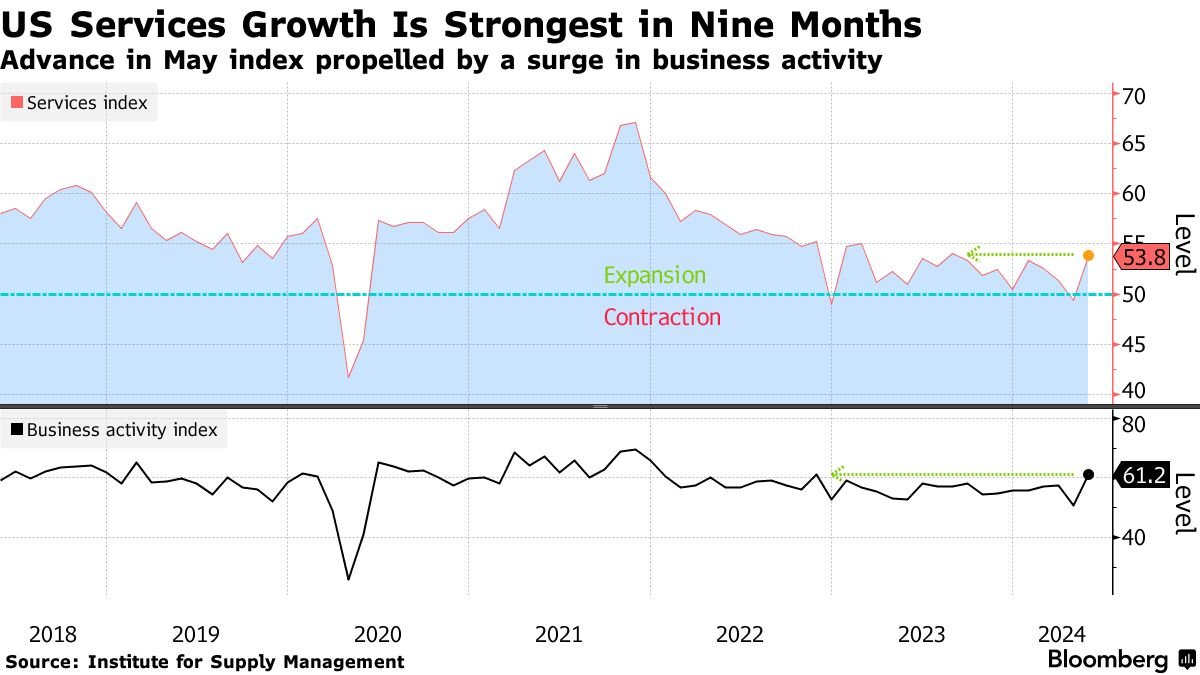
ISM reports cooling activity and inflation in the service sector

The March ISM services index is weaker than expected, falling to 51.4 from 52.6 and coming in below the 52.8 consensus. Out of the 52 forecasts submitted to Bloomberg, only one person predicted anything weaker than this outcome – remember that vehicle sales (yesterday) came in below everyone’s expectations and construction spending (Monday) came in below everyone’s expectations, but the strength in the ISM manufacturing survey has dominated the commentary and market direction since its release Monday morning.

The details show business activity holding steady at decent levels, but new orders cooled below the six-month average while employment remains in contraction territory as the backlog of orders fell markedly. Importantly, the prices paid component slowed meaningfully to a four-year low, although the press release noted that “respondents indicated that even with some prices stabilizing, inflation is still a concern.”

The ISM reports don’t have the predictive qualities of old

With both the manufacturing and the services ISM employment components coming in below 50 – indicating falling employment levels – this should in theory mean a soft payrolls print on Friday (the consensus is 213k), but the report has a mind of its own and doesn’t correlate with anything right now. The chart below shows how the ISM employment components used to be a very good predictor of what payrolls would do, now they couldn’t be further apart – we are at levels suggesting payrolls should actually be falling outright to the tune of perhaps 50k.

ISM employment components versus non-farm payrolls changes (000s)

Source: Macrobond, ING Source:

Source: Macrobond, ING

Likewise, the chart below shows how the headline indices from the ISM for manufacturing and services used to be a good indicator for where GDP growth would be heading, but again the relationship has failed since the pandemic. The ISMs are at levels historically consistent with the economy expanding at a rate below 1% year-on-year, not the 3%+ figure that official data tells us.

ISM headline indices versus GDP growth (YoY%)

Source:

The Fed needs to see cooling inflation and weaker jobs to be confident of being able to cut rates

These data discrepancies make the Federal Reserve’s job that much harder. For now, the market is leaning in the direction of things being too hot for substantial interest rate cuts with June seeing only a 60% chance of a 25bp rate cut. For the Fed to be comfortable to cut at that meeting we are likely going to need to see at least two 0.2% month-on-month core CPI prints between now and then (next week’s consensus forecast for March’s figure is 0.3%) with payrolls growth slowing towards 150k per month rather than the 236k averaged over the previous 12 months.

Note that the ISM is much weaker than the S&P Global on employment (ISM employment in contraction territory for the third time in four months) and prices/inflation. The media and most economists/pundits are focused on the ISM. Wrongly in my view.

March CPI Preview: Early-Year Strength in Inflation Noise or Signal?

Headline CPI likely rose by 0.4% for a second straight month, which would push the year-over-year rate up to a six-month high of 3.5%. Excluding food and energy, we estimate prices rose 0.3%—a tick softer than in January and February but similar to the pace averaged in Q4, in a sign underlying progress remains stubbornly slow. We suspect core goods fell back into deflation territory in March. Core services inflation, however, was likely little changed as a further moderation in shelter costs was offset by a pickup in services ex-housing.

Looking beyond March, we expect inflation to move lower this year. However, progress will be more of a grind ahead. A rebound in commodity costs have turned food and energy from tailwinds to headwinds. Meantime, supply chain strains are no longer easing. While we believe core goods prices have some additional room to fall over the next few months as earlier benefits of supply chain normalization feed through to prices, services prices will need to cool more markedly to keep overall inflation on its downward path. We expect to see a further moderation in shelter costs help drive the year-over-year rate of core CPI down from 3.8% at present to 3.3% in Q4, although progress is likely to be harder to discern when measured by the PCE deflator, the Fed’s preferred inflation gauge. (…)

Source: U.S. Department of Labor, Bloomberg Finance L.P. and Wells Fargo Economics

The Wells Fargo economists thus explain their optimism on housing inflation:

Housing inflation likely continued its gradual downward trend. After popping back up in February, rent of primary residences likely slowed in March. In addition to apartment vacancies climbing and private sector measures of “spot” rental rates having subsided sharply, the U.S. Department of Labor’s New Tenant Rent Index (NTRI) shows a steep slowdown for renters changing housing units. The moderating trend in rental rates should also help to keep a lid on owners’ equivalent rent growth; we look for another 0.4% rise in this component in March after it turned heads in January with a 0.6% increase.

Source: U.S. Department of Labor, CoStar Inc. and Wells Fargo Economics

The spectacular drop in the NTRI YoY growth rate is eye-catching, but new rents are less than 10% of all rents. The BLS also computes an All-Tenant-Regressed-Rent-Index which was still up 5.3% YoY in Q4’23 (last datapoint, next update April 10) after rising 1.54% QoQ or 6.2% annualized, up from +0.9% QoQ in Q3’23 (3.7% a.r.).

Powell Still Sees Room for Fed to Cut Rates This Year Federal Reserve Chair Jerome Powell said stronger-than-anticipated economic activity hasn’t changed the Fed’s expectation that declining inflation will allow for rate cuts.

Powell pointed to signs that labor-market conditions are less tight than they have been in recent years, a view that has eased concerns that paychecks and prices might rise in tandem. (…)

“The recent data do not…materially change the overall picture, which continues to be one of solid growth, a strong but rebalancing labor market, and inflation moving down to 2% on a sometimes bumpy path,” he said. (…)

Bloomberg’s account indicates that Mr. Powell is less solid about the bumps:

(…) He reiterated his expectation that it will likely be appropriate to begin lowering rates “at some point this year.”

“On inflation, it is too soon to say whether the recent readings represent more than just a bump,” Powell said Wednesday in a speech at Stanford University in California. “We do not expect that it will be appropriate to lower our policy rate until we have greater confidence that inflation is moving sustainably down toward 2%.” (…)

During the fireside chat, Powell detailed the outsized role supply-side factors like population growth have had in the inflation recovery. While it’s unclear if such factors will continue to reduce price pressures going forward, the Fed chair seemed optimistic.

“There may be more supply-side gains to be had,” he said. “Surveys of businesses still show difficulties in hiring people, difficulties in getting the inputs they need for their businesses — so, there’s some more benefit there.” (…)

Maybe he had not read the morning’s PMI surveys:

Some companies indicated that cost considerations had led them to hold off on hiring.

In fact, higher wages were a key factor behind the latest increase in input costs, according to respondents. Panellists also reported rises in transportation and material prices. As a result, input costs increased sharply during the month, with the rate of inflation accelerating to a six-month high. The latest rise was also sharper than the series average as 23% of companies recorded inflation over the month.

In turn, the pace of output price inflation also quickened markedly from that seen in February to the fastest since July 2023 as companies passed higher input costs through to their customers. As with input prices, the rise in charges was also faster than the average since the survey began in 2009.

  • Raphael Bostic said he expects just one trim, in the fourth quarter.

CANADA: Service sector activity falls again in March

Canada’s services economy recorded another month of falling activity and new business during March amid reports of subdued market demand. Firms were subsequently able to comfortably keep on top of overall workloads and saw little need to recruit additional staff, the net result being a stagnation of employment. Operating expenses, however, continued to rise sharply, underpinned by increased wage costs. Competitive pressures restricted the degree to which costs were passed on to clients.

Closely linked to the decline in activity was a drop in levels of incoming new work. Anecdotal evidence pointed to client hesitancy in committing to new work given the uncertain economic environment. Lower consumer confidence and high prices were also noted. Overall, levels of new work have now fallen for eight months in a row, though the latest contraction was the weakest since last September. Volumes of new export business also fell in March, in line with a trend that has been apparent for nearly five years.

Poor trends in activity and new business discouraged recruitment activity in March. Following two months of modest growth, employment numbers stalled. (…)

According to the latest data, input prices rose steeply and at a faster pace than in February. Sharp inflation was partially linked to high fuel prices and suppliers increasing their charges.

Similarly, service providers sought to raise their own average sales prices in March. A net increase in average output charges extended the current period of inflation to three years. However, the degree to which prices rose was the lowest in 2024 so far. Some panellists noted that competitive pressures restricted pricing power.

 image image

Euro-Area Inflation Inches Toward 2% With Focus on June Cut Consumer prices rose annual 2.4% in March

Consumer prices rose an annual 2.4% last month, down from 2.6% in February, in line with a Bloomberg Economics Nowcast model. Analysts predicted an increase of 2.5%. A measure excluding volatile items such as food and energy also eased more than anticipated, to 2.9%. (…)

Bloomberg Economics’ Nowcast for April points to a reading of 2.1%.

While a key compensation gauge showed some moderation at the end of 2023, salaries continue to expand by more than 4%. That’s sustaining price pressures in services, where labor has an outsized impact on final costs. Inflation in that sector remained at 4% in March, while the rate for non-energy industrial goods fell to 1.1%.

Oil Advances Near $90 as OPEC Sticks With Its Production Cuts

Brent rose to within one cent of the $90-a-barrel psychological level on Wednesday after OPEC and its allies didn’t recommend any changes to their existing output cuts at an online ministerial review meeting. The move means roughly 2 million barrels a day of curbs will be in place until the end of June. (…)

Crude has pushed higher this year, with Ukrainian attacks on Russian energy infrastructure and Middle East tensions supporting prices. OPEC+’s curbs have been tightening the market, while there have been patches of disruption elsewhere, including an early-year deep freeze in the US and a recent curb to exports by Mexico. (…)