Fed Signals Cuts Are Possible but Not Imminent as It Holds Rates Steady The central bank abandons formal guidance that had kept hikes on the table since last raising rates in July.
(…) “It’s a highly consequential decision to start the process” of lowering interest rates “and we want to get that right,” said Fed Chair Jerome Powell at a news conference. “We’ve made a lot of progress on inflation. We just want to make sure that we do get the job done in a sustainable way.” (…)
“I don’t think it’s likely that the committee will reach a level of confidence by the time of the March meeting” to justify a rate cut, “but that’s to be seen,” he said. (…)
Powell said Wednesday the Fed might be slower to cut rates or drag out the process if inflation proved to be more persistent. It could cut rates sooner and faster if the labor market weakened or there was “very, very persuasive lower inflation,” he said. (…)
“We want to see more good data. It’s not that we’re looking for better data,” Powell said. “Are the last six months flattered by factors that are one-off factors that won’t repeat themselves? We don’t think so. But that’s the question…we have to ask.” (…)
About inflation specifically:
So we have six months of good inflation data. The question really is: That six month of good inflation data, is it sending us a true signal that we are, in fact, on a path—a sustainable path down to 2 percent inflation? That’s the question. And the answer will come from some more data that’s also good data. It doesn’t—it’s not that the six-month data isn’t low enough; it is. It’s just a question of can we take that with confidence that we’re moving sustainably down to 2 percent. (…)
But you can—and you know this—you can look behind those numbers and you can see that a lot of it’s been coming from goods inflation, for example. And goods inflation running significantly negative, it’s a reasonable assumption that over time—because inflation will flatten out, probably approximate zero—that would mean the services sectors would have to contribute more. So, in other words, what we care about is the aggregate number, not so much the composition.

(Wells Fargo)
Mr. Powell acknowledged that monetary policy has been and is “well into restrictive territory, and we’ve been seeing the effects on economic activity and inflation.”
And yet:
So I think, whereas a year ago we were thinking that we needed to see some softening in economic activity, that hasn’t been the case. So I think we look at—we look at stronger growth—we don’t look at it as a problem. I think at this point we want to see strong growth. We want to see a strong labor market. We’re not looking for a weaker labor market.
With strong growth and a strong labor market, “the case is likely that it [inflation] will continue to come down”.
US Labor-Cost Gauge Cools in Sign of Easing Inflation Pressures Employment cost index increases at slowest pace since 2021
A broad gauge of US labor costs cooled by more than forecast in a fresh sign of easing inflation pressures that give Federal Reserve officials room to cut interest rates this year.
The employment cost index, which measures wages and benefits, increased 0.9% in the fourth quarter, the smallest advance since 2021, after rising 1.1% in the prior three-month period, according to Bureau of Labor Statistics figures released Wednesday. (…)
Compared with a year earlier, the ECI was up 4.2%, the smallest annual advance since the end of 2021. Still, that’s well above the typical pace seen in the years before the pandemic. (…)
Wages and salaries for civilian workers also rose 0.9% in the fourth quarter and were up 4.3% from a year earlier for the smallest annual increase since 2021. (…)

 (
(Focusing on the service sector, labor costs growth remains in 4.0% range but is not accelerating.

Yesterday’s release of eurozone inflation data also shows services inflation stuck around 4%:

(Goldman Sachs)
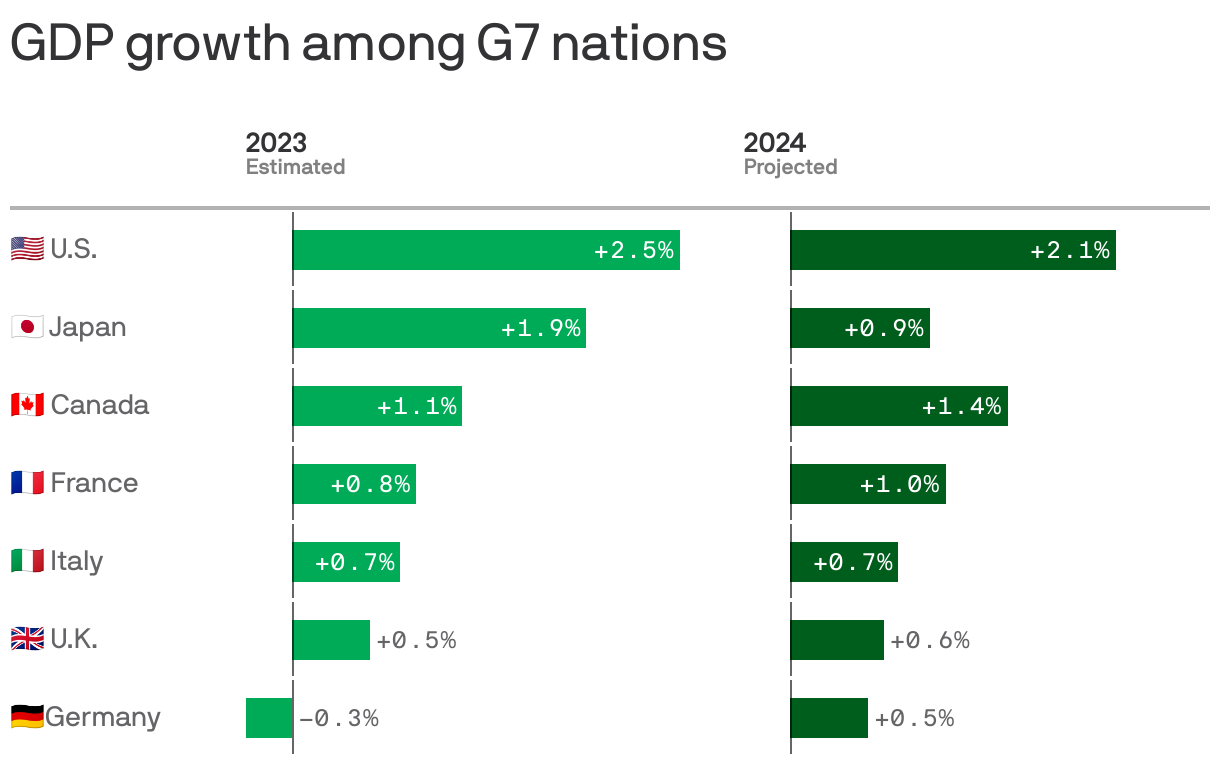
Canada: GDP avoids contraction in the last months of 2023
After having contracted in the third quarter, it appears that GDP has evaded a similar fate in the final three months of the year. Data for November and preliminary figures for December indeed hint at 1.2% annualized expansion in Q4. This below-potential figure nonetheless follows a relatively tepid period for the Canadian economy; November saw the first output expansion since May and thus broke a lethargic streak the length of which had not been seen since the
2008-2009 financial crisis and the 2015-2016 slowdown attributable to the oil supply shock.Despite the slight economic rebound to end the year, population growth remains stunning. As such, GDP as measured on a per capita basis contracted for a 10th consecutive month on a year-over year basis.
Looking at what drove growth in November, the goods producing sector was the standout. It recovered some lost ground and rose at its fastest pace in 10 months on broad-based gains. Despite a manufacturing PMI in contraction territory, the sector saw healthy growth in November due to the resumption of
activities following shutdowns/maintenance in plants.Looking on the services side, it was more of a mixed bag. While growth stemmed in part from the transportation segment which rebounded following strikes in the Saint-Lawrence seaway it was also limited by educational services as strikes in Quebec commenced in the month.
Information and cultural services also saw a rebound in the month following 5 months of pullbacks as the SAG-AFTRA strike ended and businesses in the industry spun up productions. Looking ahead, we continue to expect the Canadian economy to contract in the first half of 2024, as it has yet to feel the full effects of past rate hikes and interest rates remain restrictive, particularly in real terms.

Eurozone manufacturing downturn cools in January
The HCOB Eurozone Manufacturing PMI, compiled by S&P Global, rose to 46.6 in January, up markedly from 44.4 in December to its highest level in ten months. While still below the 50.0 no-change mark – as has been the case since July 2022 – and therefore indicative of a further deterioration in manufacturing sector conditions, the headline index signalled a softening of the downturn for the third successive month.
All five components of the Manufacturing PMI exerted a positive directional influence in January. Indices for new orders and output (which combined, account for 55% of the PMI) each increased by over two points at the start of the year. Although they were indicative of further month-on-month contractions, the rates of decline were their weakest for nine months in both instances. A slower rate of deterioration was also seen in new orders from external sources, with export sales falling by the weakest margin since last April.
Nevertheless, January survey data showed substantial spare capacity at eurozone factories, as evidenced by yet another sharp monthly drop in backlogs of work. This was despite the rate of depletion cooling for a third month in succession. Further reductions to employment were made, extending the current period of job shedding that began last June, but cuts to workforce numbers were the softest in four months.
Eurozone manufacturers were less aggressive with purchasing reductions during January. After registering some of the steepest contractions in the survey history during the second half of 2023, input buying fell at the weakest pace since last March. Inventory levels declined further in January, although a softer reduction in pre-production stocks contrasted with a quicker decline in holdings of finished goods.
Sustained (albeit slower) inventory drawdowns remained deliberate, anecdotal evidence showed, with the weak prevailing demand environment a key motivator for firms to hold less stock. This was despite renewed supply chain disruption, caused by the rerouting of ships away from the Suez Canal. According to the latest survey data, suppliers’ delivery times lengthened for the first time in a year.
As for prices, January saw sustained declines in input costs and output charges, with rates of decrease accelerating for the first time since last July and last September respectively.

Beijing Pledges More Fiscal Support as Economy Stumbles
(…) Fiscal expenditure in 2024 will be maintained at the necessary intensity and fiscal transfers to local governments will remain at certain levels, officials from the Ministry of Finance said at a press conference on Thursday, signaling more financial support from Beijing to local governments struggling with piling debt.
Authorities will set a reasonable size for government investment, Vice Finance Minister Wang Dongwei said at the briefing, adding that the ministry will increase the amount under the central budget.
China’s Finance Minister Lan Fo’an said earlier this month that Beijing will boost fiscal spending this year to better support domestic demand. (…)
The People’s Bank of China provided 150 billion yuan ($20.9 billion) worth of low-cost funds for lending to housing and infrastructure projects last month, stepping up support for the economy.
The outstanding amount of the PBOC’s Pledged Supplemental Lending program to policy-oriented banks 3.4 trillion yuan at the end of January, according to a central bank statement Thursday.
The PSL program is seen as an important tool for Beijing to support the economy and mitigate the impact from the worst property downturn on record. The cheap central bank money is for policy banks to lend to projects, which could help alleviate the decline in construction activities.
The PBOC increased the quota of PSL funds by 500 billion yuan for the so-called “major projects,” which include building government-subsidized housing and renovating run-down inner city districts, according to an article published by the central bank last month. It injected a net 350 billion yuan in December, which was the largest since November 2022. (…)

CHINA MANUFACTURING PMI: Manufacturing sector expansion holds steady in January
The headline seasonally adjusted Purchasing Managers’ Index™ (PMI) posted 50.8 in January, unchanged from December, and pointed to a further mild improvement in business conditions. The health of the sector has now strengthened for three successive months, to mark the longest period of continuous improvement for two-and-a-half years.
Chinese manufacturing companies signalled an expansion of output for the third month running in January. The rate of growth was little-changed from December and, though modest, was among the fastest recorded over the past year-and-a-half. Firms often mentioned raising output due to firmer market conditions and higher sales.
Overall new business increased for the sixth successive month, though the rate of growth slipped to the slowest since last October. The softer rise in total sales was despite a renewed improvement in foreign demand. New export orders increased for the first time since last June, albeit marginally.

In line with rising business requirements, manufacturers expanded their purchasing activity in January. Whilst modest, the rate of growth was the best recorded since last August. Inventories of purchased inputs and finished items also increased at the start of the year, though rates of accumulation were only slight in both cases.
Supply chain performance improved for the third time in the past four months, albeit fractionally. Firms often mentioned that suppliers had sufficient capacity to deliver orders in a timely manner.
Capacity pressures at manufacturing firms in China were also relatively muted, as highlighted by a back-to-back decline in unfinished workloads. This led firms to trim their workforce numbers again at the start of the year. However, the rate of job shedding moderated notably from December and was the weakest recorded in five months.
The softer drop in employment coincided with an improvement in business confidence around the 12-month outlook for production. The degree of positive sentiment was the most pronounced in nine months, and supported by forecasts of stronger global demand conditions, planned investment, new product releases and efforts to expand into new markets.
Finally, prices data indicated that inflationary pressures remained muted at the start of 2024. Average inputs costs increased at a marginal pace that was the slowest in five months. At the same time, efforts to attract and secure new business prompted manufacturers to cut their own selling prices slightly in January.


Modest deterioration in Japanese manufacturing conditions in January
At 48.0 in January, the headline au Jibun Bank Japan Manufacturing Purchasing Managers’ Index™ (PMI®) rose fractionally from 47.9 in December to signal a further modest deterioration in the health of the sector.
Total new work decreased for the eighth month running in the latest survey period, and at a sharp rate overall. Weak domestic and global economic conditions were cited as key headwinds to new order intakes. Lower export sales, especially in Mainland China and the wider Asia-Pacific region, also held back total new orders at the start of the year. (…)

ASEAN manufacturing sector sees renewed improvement in operating conditions at start of 2024
Printing above the neutral 50.0 threshold for the first time in five months, the headline S&P Global ASEAN Manufacturing Purchasing Managers’ Index™ (PMI®) rose from 49.7 in December to 50.3 in January. The latest reading signalled only a slight improvement in the health of the ASEAN manufacturing sector, however.
Output rose for the twenty-eighth month running in January, and at the quickest pace since last August. The upturn was supported by firms working through backlogs, which fell for the seventh successive month, as new orders declined again.
Demand weakness was particularly notable across export markets, and this led overall new orders to decline for the fifth straight month. That said, the rate of contraction was the softest seen over this period and only marginal. Turning to employment, for the second time in three months payroll numbers were left unchanged, thereby reflecting a hesitancy across firms to commit to new hires.

New York Community Bancorp Stock Plunges 38%, Reigniting Fears for Regional Banks NYCB built up capital after acquiring most of the failed Signature Bank in last year’s crisis.
Shares of New York Community Bancorp plummeted 38% Wednesday after the company swung to a fourth-quarter loss and slashed its dividend to shore up capital following its purchase of the assets of the collapsed Signature Bank.
The company swung to a loss of $252 million, or 36 cents a share, at the end of December. That was compared with a profit of $172 million, or 30 cents a share, in the same period a year earlier. Analysts expected earnings of 27 cents a share for the fourth quarter.
Loan losses surged, and the bank set aside millions of dollars more to prepare for future potential losses. (…)
As part of its steps to bolster those capital and liquidity levels, the company cut its quarterly dividend to 5 cents a share, from 17 cents a share. (…)
In the fourth quarter, deposits at NYCB were down 2% from the previous quarter, driven by a $1.8 billion decrease in custodial deposits related to the Signature transaction.
“In the spring, it was deposits running out the door,” said Casey Haire, an analyst at Jefferies. “This is preparing to be a $100 billion bank and credit risk.”
NYCB said more of its property loans have started to sour. The bank also piled into its reserves for potential losses, particularly in the commercial-property space that has come under stress. (…)
Net charge-offs surged to $185 million from $1 million a year earlier, driven by two loans in that space. One was an office loan that had gone bad after an updated valuation in the third quarter. The other was a co-op loan that wasn’t in default but that the bank expects to sell in the first quarter.
“I don’t see systemic issues within their loan portfolio that I’m overly concerned about,” said Mark Fitzgibbon, head of financial services research at Piper Sandler. “It felt like this was a cleanup quarter…the company said we’re going to rip the Band-Aid off all at once.”
The US commercial real estate market has been in turmoil since the onset of the Covid-19 pandemic. But New York Community Bancorp and Japan’s Aozora Bank Ltd. delivered a reminder that some lenders are only just beginning to see the pain.
New York Community Bancorp’s decisions to slash its dividend and stockpile reserves sent its stock down a record 38% and dragged the KBW Regional Banking Index to its worst day since the collapse of Silicon Valley Bank last March. Tokyo-based Aozora Bank plunged more than 20% after warning of a loss tied to investments in US commercial property. In Europe, Deutsche Bank AG more than quadrupled its US real estate loss provisions to €123 million ($133 million) in the fourth quarter from a year earlier.
The concern reflects the ongoing slide in commercial property values coupled with the difficulty predicting which specific loans might unravel. Setting that stage is a pandemic-induced shift to remote work and a rapid runup in interest rates, which have made it more expensive for strained borrowers to refinance. Billionaire investor Barry Sternlicht warned this week that the office market is headed for more than $1 trillion in losses. (…)
“Banks’ balance sheets aren’t accounting for the fact that there’s lots of real estate on there that’s not going to pay off at maturity.” (…)
Banks are facing roughly $560 billion in commercial real estate maturities by the end of 2025, according to Trepp, representing more than half of the total property debt coming due over that period. Regional lenders in particular are more exposed to the industry, and stand to be hurt harder than their larger peers because they lack the large credit card portfolios or investment banking businesses that can insulate them.
Commercial real estate loans account for 28.7% of assets at small banks, compared with just 6.5% at bigger lenders, according to a JPMorgan Chase & Co. report published in April. (…)
The Aon Center, the third-tallest office tower in Los Angeles, recently sold for $147.8 million, about 45% less than its previous purchase price in 2014. (…)
New York Community Bancorp said its increase in charge-offs were related to a co-op building and an office property. (…)
New York Community Bancorp, which acquired part of Signature Bank last year, said Wednesday that 8.3% of its apartment loans were considered criticized, meaning they have an elevated risk of default.
At the end of last year, the Federal Deposit Insurance Corp. took a 39% discount when it sold about $15 billion in loans backed by rent-regulated buildings. In another indication of the challenges facing these buildings, roughly 4.9% of New York City rent-stabilized buildings with securitized loans were in delinquency as of December, triple the rate for other apartment buildings, according to a Trepp analysis based on when the properties were built. (…)
“The percentage of loans that banks have so far been reported as delinquent are a drop in the bucket compared to the defaults that will occur throughout 2024 and 2025,” said Aviram. “Banks remain exposed to these significant risks, and the potential decline in interest rates in the next year won’t solve bank problems.”
Jefferies: “”We believe NYCB has several idiosyncratic characteristics, but the result and reaction are reminders of risks that remain in the regional banking space.”
A New Global Tax Is About to Raise Billions. The U.S. Is Missing Out. The 15% global minimum tax is here, and it is raising corporate tax payments—just not in the U.S., where Congress hasn’t changed tax law to conform with an international deal.
Johnson & Johnson, Baxter International and Zimmer Biomet are all warning investors that the 2021 international tax deal will make them pay higher taxes this year as Switzerland, South Korea, Japan and European Union countries implement the accord.
U.S. companies that enjoyed single-digit tax rates in some foreign countries now must pay at least 15% in each. But even though Treasury officials were crucial in forging the international accord and President Biden has pushed to implement it, Congress hasn’t changed U.S. tax law to conform to it. Republicans generally oppose the global deal, contending that Biden administration negotiators gave away too much of the U.S. tax base.
So for now, the U.S. isn’t directly collecting any money from domestic or foreign companies because of the deal.
J&J is forecasting a roughly 1.5-percentage-point increase in its tax rate. (…) Other companies pointing to potentially higher taxes in 2024 include Johnson Controls, Henry Schein, Teleflex, Enovis, Edwards Lifesciences and Methode Electronics. (…)
Thirty-six countries have implemented the deal or have new rules in progress, and businesses with global revenues exceeding €750 million—equivalent to about $810 million—could pay new taxes on profits.
The Organization for Economic Cooperation and Development, which spearheads the minimum tax project, recently estimated that businesses altogether will pay additional taxes of between $155 billion and $192 billion annually, an increase of between 6.5% and 8.1% from current tax payments. Some analysts looking at company projections have said it could be lower.
The U.S. created a minimum tax on companies’ foreign income in 2017, but it applies to their global profits, not country-by-country as required by the international deal. The U.S. created a second minimum tax in 2022, but that, too, doesn’t align with other countries’ levies. China also hasn’t implemented the agreement.
American companies are facing higher tax bills even though the U.S. hasn’t changed its rules. That is because the deal allows countries to make global companies operating in their jurisdictions pay at least 15% there. So Switzerland can make U.S. and Japanese companies pay 15% tax on their Swiss operations.
In many cases, American companies have already maxed out U.S. foreign tax credits. So paying more abroad won’t reduce their U.S. taxes. Instead, they effectively will pay taxes in two countries on the same income.
Meanwhile, the U.S. isn’t benefiting directly. The rules say countries can require that their home companies pay 15% in every country where they operate. So South Korea can ensure that a South Korean company pays 15% in the U.K., the U.S. and France. If it doesn’t pay enough in those countries—for instance, because U.S. research incentives lower its tax rate there—it must pay more to South Korea, not the U.S.
The OECD estimates that the U.S. will get some new revenue even without implementing the global deal. That is because some companies may shift operations and profits to the U.S. as tax rates become more similar around the world.
“I’m not seeing so much of that actually happening yet,” said Jason Yen of Ernst & Young. (…)


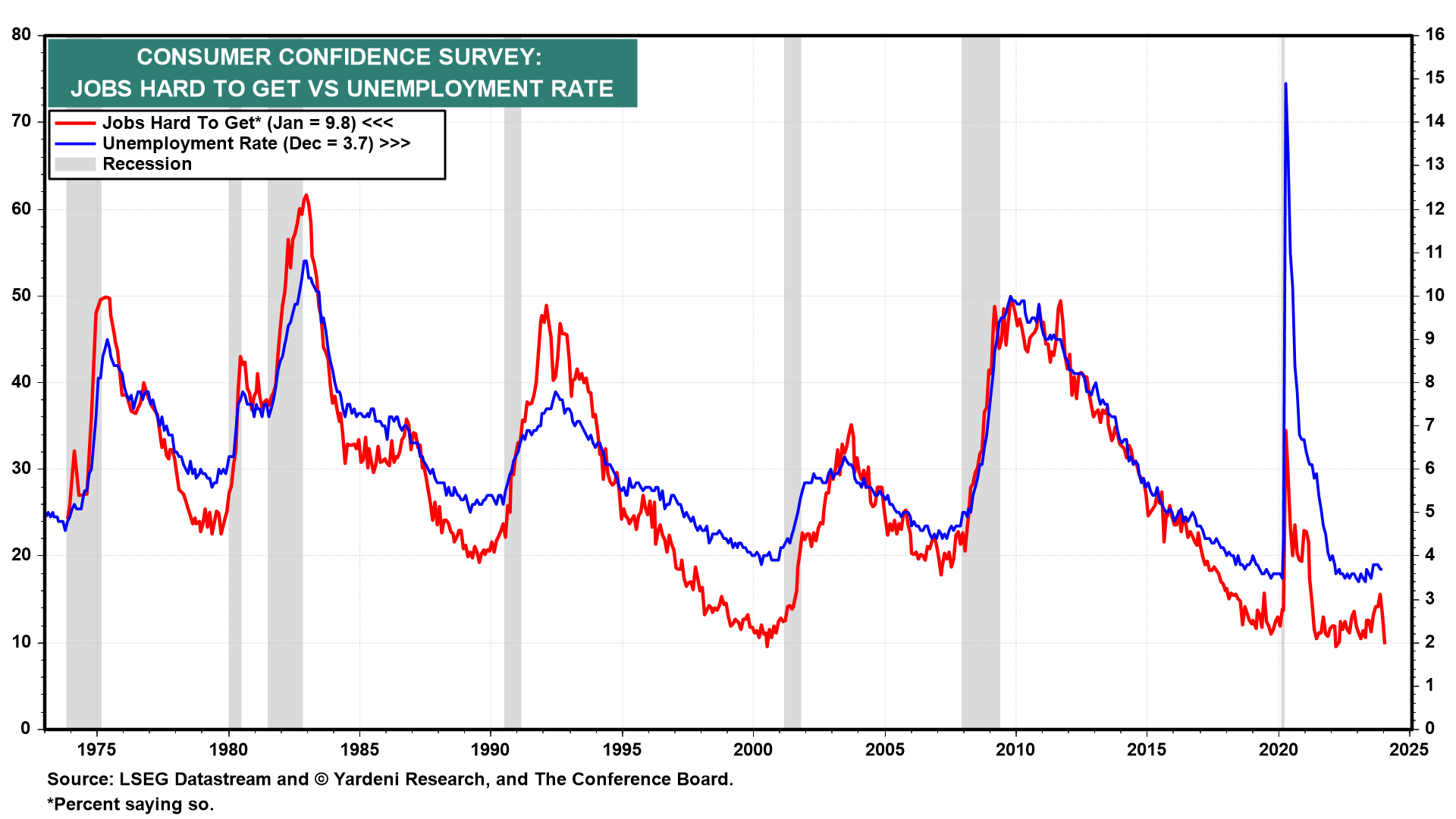
 The survey’s “jobs plentiful” series jumped to 45.5% during January.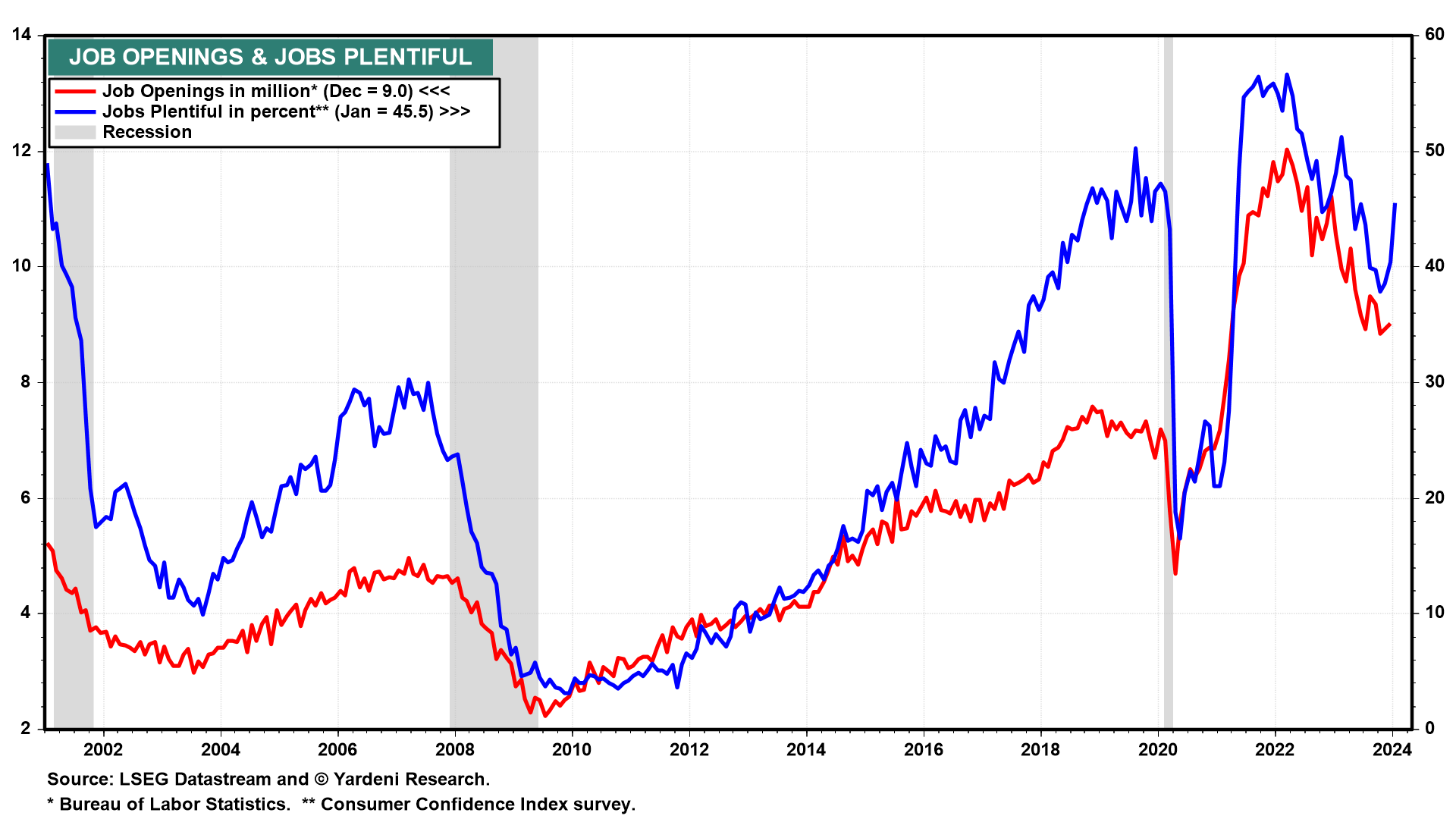

 But
But  Even more important: “New business expanded for the third successive month at US companies in January, with the rate of growth quickening to the sharpest since June 2023. The upturn in new orders was broad-based, as manufacturers registered the first rise in new sales since October 2023, and the fastest uptick since May 2022. Service providers reported the strongest gain for seven months.”



 Musk’s $55 Billion Pay Package Voided, Threatening World’s Biggest Fortune