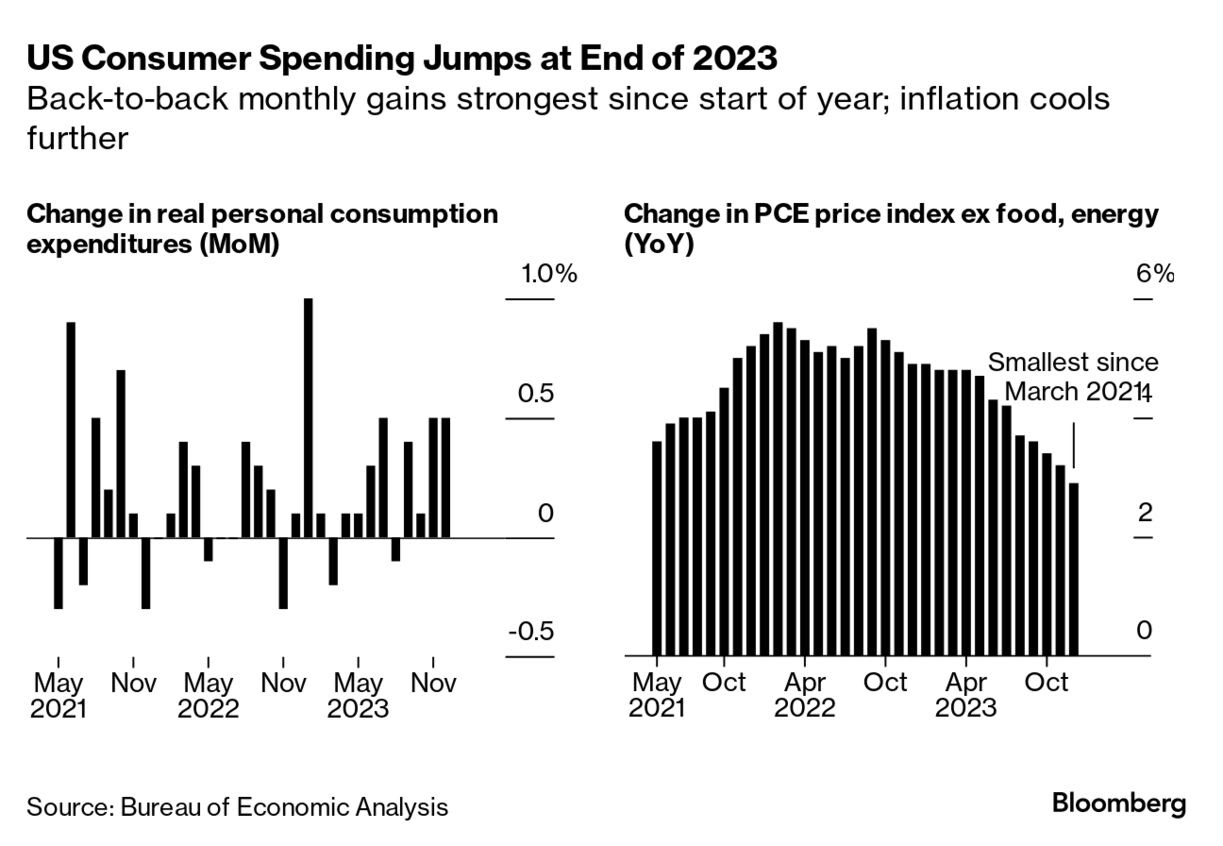
Fed’s Preferred Inflation Gauge Cools on Robust Spending Core PCE index eased to 2.9% last month, lowest since 2021
From a month ago, it advanced 0.2%.
Inflation-adjusted consumer spending climbed 0.5% in December for a second month, the biggest back-to-back increase in nearly a year. That was fueled by another strong advance in wages and salaries. (…)
Core PCE inflation, on a six-month annualized basis, registered at 1.9% in December, trailing the Fed’s 2% target for a second month. (…)
Policymakers pay close attention to services inflation excluding housing and energy, which tends to be more sticky. That metric slowed to a 3.3% pace from a year earlier, the softest since early 2021. (…)
On an inflation-adjusted basis, outlays for goods climbed 1.1%, the most in nearly a year, the report showed. Services spending slowed somewhat.
Real disposable income, the main supporter of consumer spending, advanced 0.1%, the smallest in three months and held back by weak dividend income. That helped push the saving rate to the lowest in a year. (…)
In brief, accelerating demand/growth, slowing inflation.
The demand/spending side is easy to understand:
- Labor income is rising 5-6% vs 4% pre-pandemic (dash line)…

- … as wage growth stabilized at 4% annualized amid slowing employment.

- Monthly data reveal that growth in both jobs and wages accelerated in November and December …

- … right when inflation “disappeared”!

While the Fed was aggressively tightening, “well into restrictive territory” per Jay Powell, consumer spending on “highly cyclical” durable goods jumped at a 8.2% annualized rate in H2’23 (+8.0% a.r. in Q4, +16.5% a.r. in Nov/Dec.).

So how could inflation “disappear” when demand was so strong, actually accelerating?
- Non-fuel import prices have been negative YoY since March 2023 after exploding in 2020-22. Since most U.S. consumer goods are imported, this largely explains the goods deflation experienced in 2023. Durable goods prices have declined every month since last June, –4.6% annualized in H2’23. Chinese goods import prices have been deflating all of 2023 and were down 3.0% YoY in December.
- The U.S. dollar jumped 13% between mid-2021 and the end of 2023, further reducing import costs.
- Oil prices are down 37% since their peak in June 2022. On a YoY basis, WTI prices dropped 18.1% in 2023. Natural gas prices are down 78% since their August 2022 peak and 61% YoY in 2023. Significantly lower energy costs (heating, cooling, lighting, transportation, manufacturing) helped protect corporate margins last year, alleviating the need to raise prices to offset other cost increases, such as labor.
The end result is that PCE-Goods prices stalled between Q3’22 and Q4’23 with Durables prices down 2.6% during the period. On a YoY basis, PCE-Goods prices were unchanged in Q4’23 after +6.1% in Q4’22 and PCE-Durables were down 2.2% after +2.7% in Q4’22.
Meanwhile, PCE-Services prices rose 5.7% during the same period, +4.2% YoY in Q4’23, after +5.8% in Q4’22.
Hence, the decline in total PCE inflation from +5.9% to +2.7% from Q4’22 to Q4’23 was largely due to the stabilization in goods prices, itself largely due to deflating durable goods.
In truth, this so-called American “immaculate disinflation” is really the result of the U.S. having imported deflating goods with a strong currency coupled with very significant corporate cost reductions from much lower energy prices.
In truth, the Fed’s policies had little, if anything, to do with this recent disinflation, other than, perhaps, higher interest rates having prevented demand from exploding even more…
In fact, inflation on domestically produced goods was +2.6% in December 2023, having meaningfully de-linked from imported core goods inflation (–1.5%) since spring 2022.

Fed policies likely impacted services prices through slower wage gains although collapsing energy costs also played a key role on services inflation last year.

Looking forward:
- As seen above, while quarterly employment growth slowed measurably in 2023, wage gains stabilized at the 3.5-4.0% range. The inversion of the trend lines in 2023 likely reflects sharply lower energy costs passed on to consumers.

- However, monthly wage growth accelerated at year-end, pulling services inflation (including “supercore”) up in stride.

- Services inflation needs to slow below 0.3% monthly because goods inflation looks less amicable going forward.
- core import prices rose 1.5% annualized the last 2 months of 2023. Note that even though they declined 2.8% since their spring 2022 peak, core import prices are still 9.7% above their pre-pandemic level. Demand does impact inflation.
- Core domestic goods prices flattened since October but remain up 18.8% since February 2020. Reshoring seems to be having an impact judging by the apparent recent and growing divergence between the volume of goods consumed vs imported. At the margin, import prices could become gradually less impactful on U.S. inflation.

- The USD has stabilized in 2023.
- So have oil and natural gas prices.
Last week’s S&P Global’s Flash PMI was instructive:
- The Manufacturing PMI which spent most of 2023 below 50 rose from 47.9 to 50.3 in January, helping push the Composite PMI to 52.3 from 50.9.
- New business expanded for the third successive month at US companies in January, with the rate of growth quickening to the sharpest since June 2023.
- The upturn in new orders was broad-based, as manufacturers registered the first rise in new sales since October 2023, and the fastest uptick since May 2022 as strong Christmas sales have no doubt brought overall inventories in much better shape entering 2024.
- Service providers reported the strongest gain in new orders for seven months.
- Manufacturers raised their output prices at the steepest rate since April 2023.
- Thankfully, service providers signalled the slowest rise in output charges in the current sequence of inflation which began in June 2020 amid efforts to price competitively and drive new orders. The Fed, and financial markets, will need this to continue if goods deflation is behind us.
This Goldman Sachs 6m-%-change chart illustrates the effect goods deflation had on total core inflation. The Fed should humbly recognize how little impact it had on this “immaculate disinflation” period.

In fact, the 4th quarter data is totally at odd with any notion that monetary policy has been and is still “well into restrictive territory”. Wells Fargo:
Almost Everything Coming Up Roses
Data released this week garnered further optimism that the economy can power through the Federal Reserve’s efforts to corral inflation—an endeavor the Fed could increasingly be construed as achieving. Economic activity ended the year on better footing than expected.
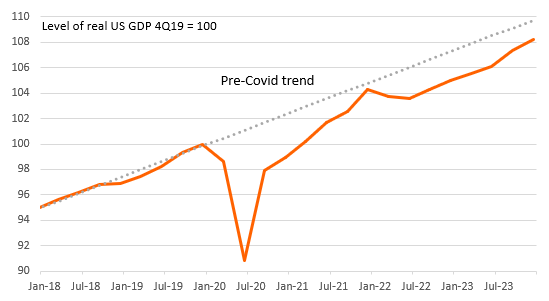
GDP in the fourth quarter expanded at a 3.3% annualized rate, topping expectations for a more run-of-the-mill 2.0% increase. While Q4’s advance marked a slowdown from the third quarter’s 4.9% pace, drivers were broadly based.
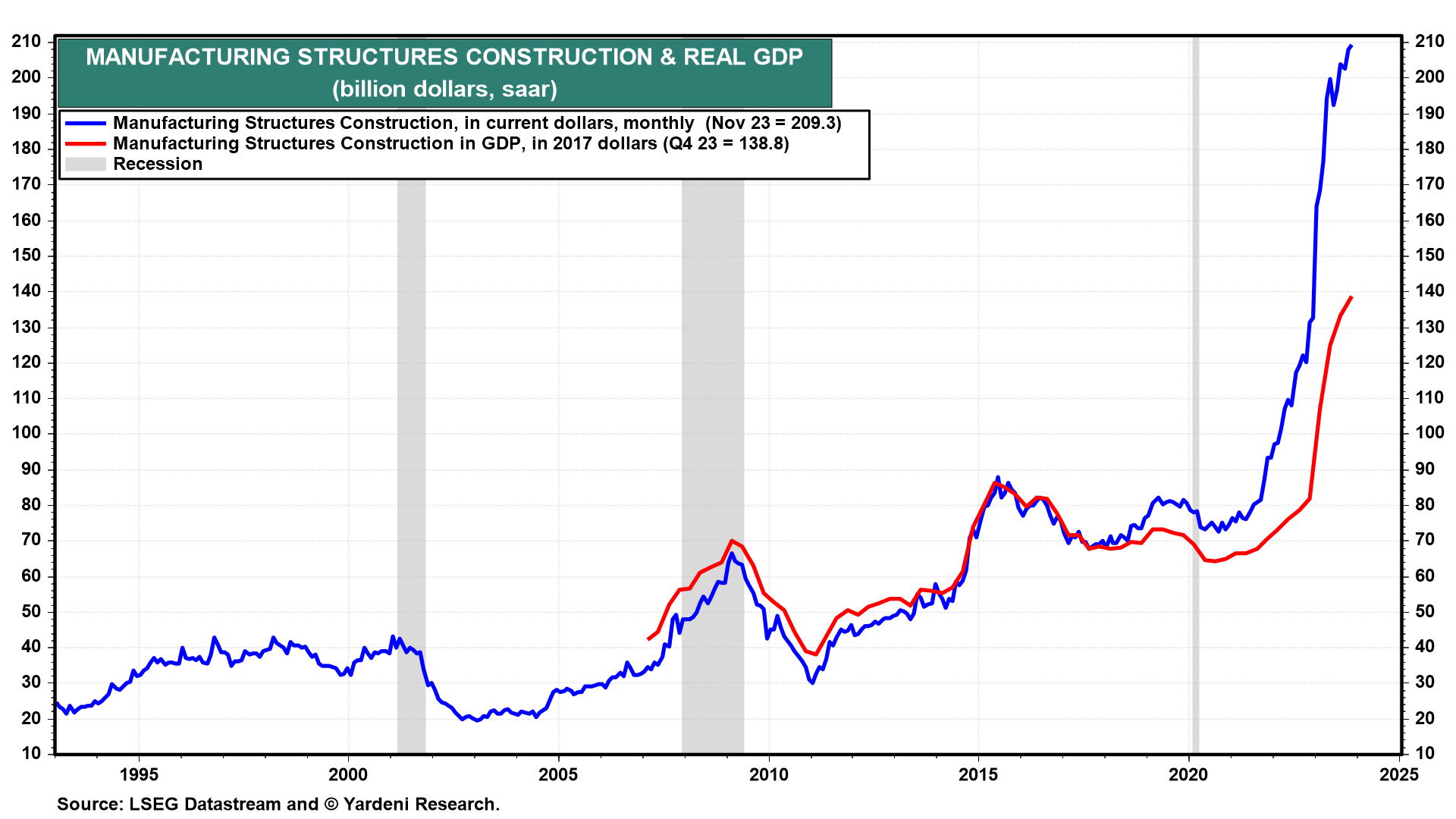
Residential investment notched a second straight increase in a sign housing activity has bottomed, while government spending plowed ahead at a 3.3% clip. Business investment also picked up over the quarter, including a rebound in equipment spending.
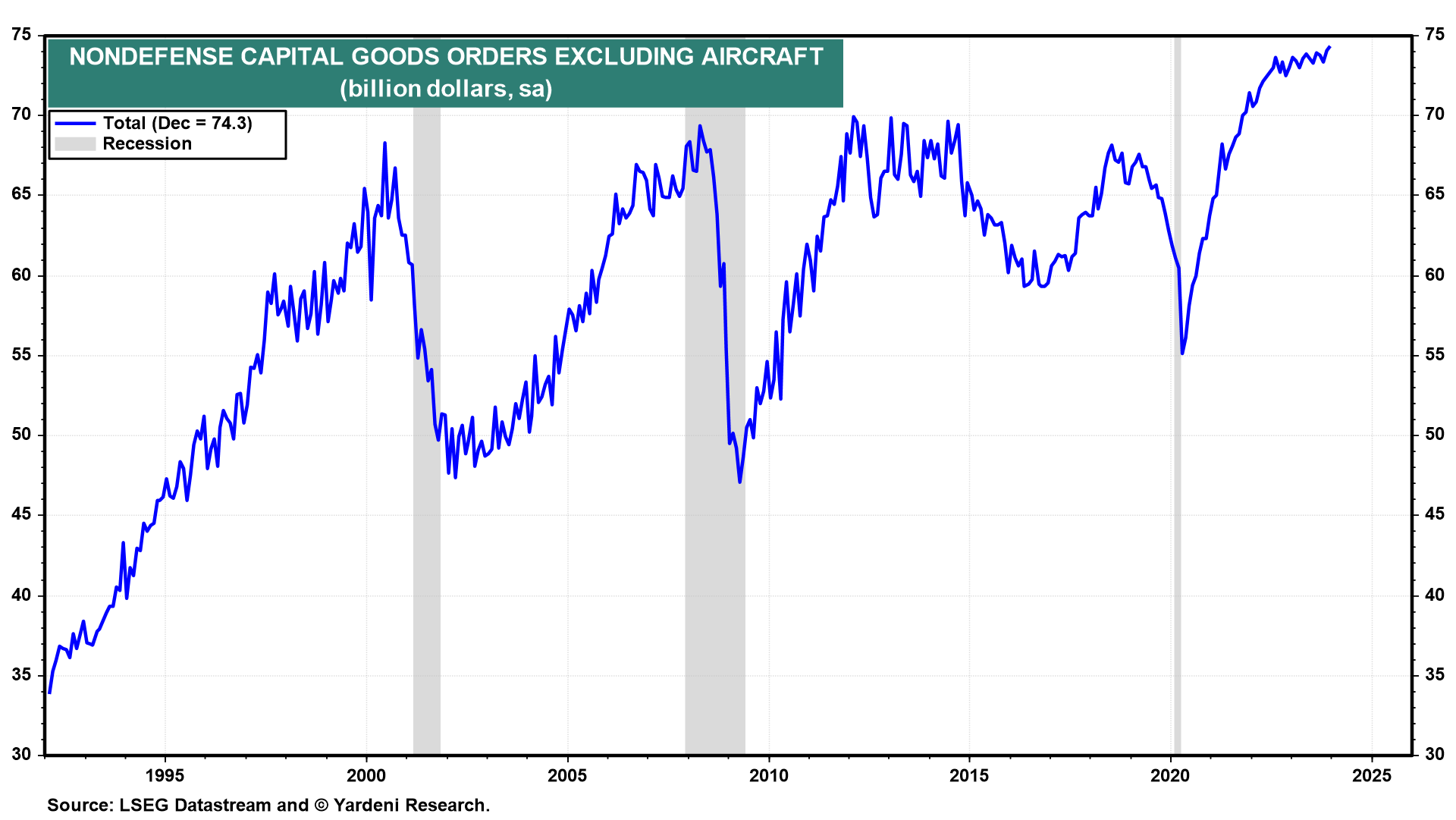
December orders of durable goods, also released this week, signaled capex growth should continue in the near term. Nondefense capital goods orders excluding aircraft came in a bit stronger than anticipated and, at a three-month average annualized rate of 1.5%, is rising at the fastest pace since last June.
Beyond fixed investment, businesses signaled optimism in activity in the months ahead with a faster pace of inventory accumulation in the final quarter of 2023. The stronger inventory build gave a lift to Q4 GDP and contributed to the upside surprise. Trade also lifted the headline more than expected amid a meaningful pickup in export activity.
The U.S. consumer, however, continues to be the stalwart of growth. Real consumer spending grew 2.8% annualized in Q4, barely slowing from the third quarter’s impressive 3.1% showing.
December’s data showed spending wielding more momentum through the final month of the year. Personal outlays adjusted for inflation rose 0.5% as consumers splashed out for goods (up 1.1%) and continued to defy expectations that further growth in services (up 0.3% in December) would come at the expense of longer-lasting “things.” (…)
- @RBAdvisors: “Inflation is a lagging indicator (so is the #Fed). So while it’s good inflation is heading toward 2% the LEADING indicators are accelerating. The #inflation story might not be over.”

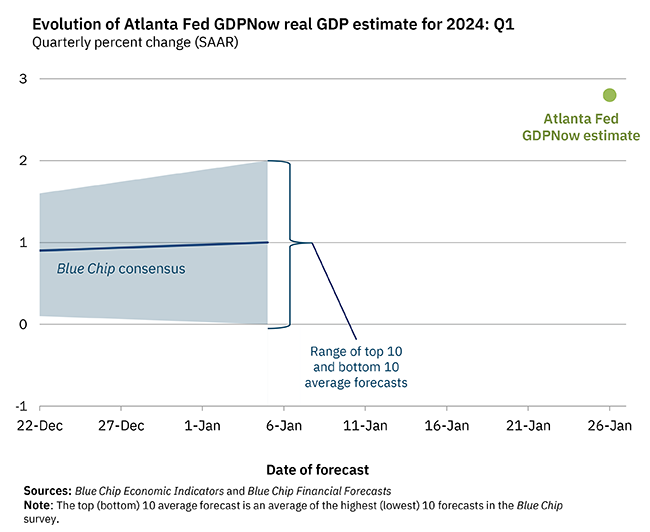
- Initial Estimate of First-Quarter GDP Growth Is 3.0 Percent On January 26, the initial GDPNow model estimate for real GDP growth in the first quarter of 2024 is 3.0 percent.
The WSJ Nick Timiraos:
Plummeting Inflation Raises New Risk for Fed: Rising Real Interest Rates Central bank feels pressure to cut interest rates as falling inflation raises real cost of borrowing
(…) If inflation has sustainably returned to the Fed’s 2% target, then real rates—nominal rates adjusted for inflation—have risen and might be restricting economic activity too much. This means the Fed needs to cut interest rates. The question is, when and by how much? (…)
Fed officials are likely to take a symbolically important step this week by no longer signaling in their policy statement that rates are more likely to rise than fall. Ditching this so-called tightening bias would affirm that officials are entertaining lower rates in the coming months.
Normally, the Fed cuts interest rates because economic activity is slowing sharply. Not this time: Growth remained surprisingly robust through the end of last year. Rather, they are mulling whether softening inflation means real interest rates will be unnecessarily restrictive if they don’t act. (…)
[But] Several officials have said they want to avoid at all costs cutting rates only to have to raise them again. (…)
The argument for lowering rates sooner goes like this: Fed officials raised rates rapidly to a 22-year high and telegraphed plans to keep them there for a while because they worried it would take years for inflation to fall back to their target. But inflation has fallen much faster than they expected. Prices excluding food and energy rose at a 1.9% annualized rate between July and December, down from 4% in the previous six-month period.
“We made a very aggressive tightening. Look not only at the supply that came back but also the demand that came down last year,” [!!!] said Esther George, who served as president of the Kansas City Fed from 2011 until last year. There is potentially “a lot of room” to cut rates before they are in neutral territory again. (…)
Evergrande Set for Liquidation as China Property Crisis Drags On
China Evergrande Group received a liquidation order from a Hong Kong court, setting off a daunting process to carve up the biggest casualty of a property crisis that’s upending the world’s second-largest economy.
The ruling on Monday from Hong Kong Judge Linda Chan is the latest twist in a saga that saw Evergrande amass more than $300 billion of liabilities during China’s debt-fueled property boom, before turning into the poster child of a market bust that shows few signs of ending. The builder was valued at just $275 million on Monday before trading in its shares was halted, down more than 99% from its peak.
Evergrande’s collapse is by far the largest in a crisis that has dragged down China’s economic growth and led to a record spate of defaults by developers. The liquidation will be a test case of the legal reach of Hong Kong courts in China, where most of Evergrande’s assets reside. Any new management will also need to navigate asset sales in an industry lacking liquidity and confidence. (…)
Policymakers may have to balance competing priorities as they try to shore up investor confidence while ensuring unfinished homes get built and the financial system remains resilient to the property industry’s woes.
“The market will pay close attention to what the liquidators can do after being appointed, especially whether they can achieve recognition from any of the three designated PRC courts” under a 2021 arrangement between China and Hong Kong, said Lance Jiang, restructuring partner at law firm Ashurst. “The liquidators will have very limited powers of enforcement over onshore assets in mainland China if they cannot get such recognition.”
While Hong Kong’s courts have issued at least three wind-up orders for other Chinese developers since the crisis began in 2021, none comes close to Evergrande in complexity, asset size, and the number of stakeholders. There are also few signs that the liquidation of smaller peers Jiayuan International Group and Yango Justice International Ltd., a unit of Yango Group Co., are moving forward much. (…)
Any court-appointed liquidator is likely to face a tricky process. Most Evergrande projects are operated by local units, which could be hard for the offshore liquidator to seize. More than 90% of the company’s assets are located in mainland China, according to a court filing. (…)
“The macroeconomic impact should be limited as the liquidation itself is unlikely to exert more pressure on the battered property sector,” said Gary Ng, senior economist at Natixis SA. “However, it will worsen sentiment as investors will be worried that there is a snowball effect on other pending cases.”
EARNINGS WATCH
We have 124 reports in: The beat rate is 78% and the surprise factor broadly positive at +4.2%.
The actual earnings growth for those 124 companies was 1.1% on revenues up 3.8%. The revenue beat rate is 62%.


Trailing EPS are now $220.33. Full year 2024e: $242.61.

Finally!!!
From Almost Daily Grant:
Better late than never? The Securities and Exchange put the clamps on special purpose acquisition companies Thursday, approving new regulations designed to enhance disclosure requirements and discourage conflicts of interest, eliminating the so-called regulatory arbitrage which allowed companies coming public via merger with those blank check firms to issue sunny operating forecasts to investors without the legal liabilities associated with conventional IPOs.
“Just because a company uses an alternative method to go public does not mean that its investors are any less deserving of time-tested investor protections,” commented SEC chair Gary Gensler.
That arguably-belated enforcement response follows a supersonic boom in the category, as nearly 900 SPACs raised a total of $246 billion over the two years through 2021 according to data firm SPACInsider, orders of magnitude above the formerly niche asset class’s cumulative pre-Covid output.
Suffice it to say, investors would have been well advised to steer clear. All but 27 of the 401 blank check firms that found a corporate dance partner since the start of 2021 have seen their share price decline, while a selection of 10 SPACs featured in the Dec. 25, 2020 Grant’s Interest Rate Observer analysis “Short this index,” have lost well over 90% on an equal-weight basis.
Meanwhile, 21 so-called de-SPACs, or operating businesses that merged with those blind pools, filed for bankruptcy last year (including three in the Grant’s gauge), wiping out what had been a combined $46 billion in market capitalization. Nearly 44% of SPAC-affiliated firms issued going concern warnings in 2023 annual reports according to data from research outfit Hudson Labs.
In turn, the upbeat outlooks that predominated during the boom have aged less than gracefully. Citing the London Stock Exchange Group, Reuters Breakingviews relayed last fall that a subset of 126 SPACs which collectively projected $97 billion in revenues for 2023 were tracking at barely half of that run-rate as of October. Some hype-heavy categories bore an even more tenuous relationship with reality, as CNBC found that same month that a quintet of space exploration-focused SPACs which collectively forecast a $1.6 billion top line for last year were instead on pace to log less than $100 million. “Everyone should have seen this cliff coming.” Usha Rodrigues, SPAC-focused law professor at the University of Georgia, told Bloomberg.
Though the SPAC conflagration leaves a trail of unfulfilled promises and broad-based capital destruction in its wake, some punters continue to carry the torch. Thus, Digital World Acquisition Corp. (ticker: DWAC), the shell company which announced plans to merge with Trump Media and Technology Group in fall 2021, saw shares rip higher by 193% over the six sessions through Tuesday as the former President-cum-reality star scored a pair of victories in the Republican primary, pushing the shell’s market capitalization to as high as $8 billion.
For context, the Truth Social platform – Trump Media and Technology Group’s centerpiece asset – generated less than $5 million in revenue over the first nine months of 2023 while operating in the red. Average trading volumes for DWAC since Monday stand at 16.7 million shares, compared to roughly 600,000 shares of daily turnover on average over the 52-weeks through last Friday. “The market has gone full bonkers,” Julian Klymochko, chief executive officer of Accelerate Financial Technologies, advised Bloomberg. “Shares do not reflect any fundamental intrinsic value of Truth Social, but they are more of a ‘trading sardine,’ or tool of speculation.”
The biggest, best, most beautiful tool.