U.S. Productivity Declines and Drives Labor Costs Higher in Q1
Nonfarm business sector labor productivity declined 7.5% (-0.6% y/y) in Q1’22 following a 6.3% gain in Q4’21, revised from 6.6%. The Action Economics Forecast Survey expected a 4.5% decline.
Output fell 2.4% (+4.2% y/y) last quarter following a 9.0% increase while hours rose 5.5% (4.8% y/y) after gaining 2.5% in Q4.
Compensation rose 3.2% (6.5%) last quarter after a 7.4% Q4 rise, revised from 7.5%. The combination of falling productivity and higher compensation propelled the rise in Q1 unit labor costs to 11.6% (7.2% y/y) following a 1.0% Q4 rise. The Action Economics Forecast Survey expected an 8.4% rise.
In the manufacturing sector, Q1 productivity rose 0.7% (1.7% y/y) after a 0.6% easing in Q4, revised from -0.1%. Output rose 5.7% (5.2% y/y) and hours-worked rose 5.1% (3.5% y/y).
Manufacturing compensation rose 2.8% (3.5% y/y) after a 1.1% rise. Unit labor costs rose 2.1% (1.8% y/y) after increasing 1.7% in Q4’21.
Omicron is distorting the stats. Services output dropped while manufacturing output jumped. Upon normalization, manufacturing ULC should resume their trend. I would not be so sure about services, however.

The key question is whether growth in hourly compensations will merge towards the red line (manufacturing) or the blue line (total, mainly services).

This next chart could offer clues:

ECB doves put to flight as interest rates set to rise in July Shift in stance by policymakers follows calls for action to counter soaring inflation
CHINA
“We think the Chinese economy at this moment is in the worst shape in the past 30 years.” That plainly-worded warning came from Weijian Shan, chairman at Hong Kong based private equity firm PAG, the Financial Times reported last week. (ADG)
China Property Loan Growth Slowest on Record as Sector Struggles
Outstanding loans in the property sector grew 6% to 53.2 trillion yuan ($8 trillion) at the end of March from a year ago, the slowest pace of expansion since data began in 2009, according to a statement released Friday by the People’s Bank of China. The growth rate was down from 7.9% at the end of 2021.
Residents’ mortgages rose 8.9% to 38.8 trillion yuan from a year ago, slowing from the 11.3% increase at the end of last year, while outstanding property development loans grew after dropping for three straight quarters.
China’s home sales slump deepened in April, with preliminary data from the China Real Estate Information Corp showing an almost 60% decline in sales by the top 100 developers. The drop came with major cities such as Shanghai and Changchun under lockdown, and consumers stayed away even as purchase restrictions were loosened in more than 60 cities. (…)
The sector’s persistent downturn has prompted the central bank to step up its support for several distressed developers by loosening loan restrictions to ease a cash crunch last month, Bloomberg reported. That comes after the central bank called on banks to boost real-estate lending in the first quarter.
Chinese cities are moving toward regular mandatory free testing for Covid-19, an approach that would cost the government 1.8% of gross domestic product if it’s rolled out to more places, according to an estimate from Nomura Holdings Inc.
Testing 70% of the population every two days would amount to 8.4% of China’s fiscal expenditure, Nomura economists led by chief China economist Lu Ting wrote in a note. That’s based on the cost of a single-person polymerase chain reaction, or PCR, test of 20 yuan.
The spending could “crowd out” other government expenditure in areas such as infrastructure, the economists wrote, adding that “there are also opportunity costs, as people have to spend time every two days to take the test.”
The benefits of regular mass tests would be limited by the greater-infectiousness of the omicron variant of coronavirus, according to Nomura. As a result cities will continue to face frequent lockdowns and intercity travel will remain limited, it said.
Other economists estimate the cost of mass testing will be smaller and the benefits could be more stimulatory for the economy. If China’s wealthiest cities, home to 30% of its population, introduced regular mass testing, the costs could amount to 0.2% of GDP over the second half of this year, economists at Goldman Sachs Group Inc. led by Hui Shan said in a report. (…)
Regular government-funded PCR testing with a negative test result required to enter public places could prevent lengthy lockdowns, reducing the drag on GDP growth from Covid Zero policies this year to 1.6 percentage points, the Goldman economists said. (…)
The cost to test half of China’s population every two days for a year would be about 900 billion yuan ($135 billion), according to Bloomberg calculations based on a cost of 8 yuan per test. That would be about 0.8% of 2021’s nominal GDP. (…)
However, despite evidence of economic damage from the virus policy, the standing committee of the Communist Party’s Politburo, the top political body, said on Thursday the Covid Zero approach was “scientific and effective.”
Yet, the government continues to refuse Western mRNA vaccines that have proven far superior to Chinese vaccines against Omicron. Whatever it takes!
Russia Struggles to Find New Buyers for Commodities as Europe Severs Links
(…) European Union officials this week are preparing a sixth round of sanctions that aim to undercut Russia’s energy exports. Among the proposals are a phased ban on Russian oil purchases as well as sanctions on service providers, such as ship insurers, that would stifle Russian crude shipments to other parts of the world.
The new infrastructure that Russia needs to transport the exports that Europe used to buy will take years to build. It is experiencing difficulties chartering ships to transport its oil as insurers and banks fear the impact of sanctions. Major trading houses, meanwhile, are cutting their Russian business. It is also uncertain how much of Russia’s commodities big buyers such as China would be willing to buy, as Beijing looks to diversify its suppliers. (…)
Russia grew in recent decades into a leading exporter of a range of commodities to the world, akin to a giant gas station and mining pit for international buyers. Disruptions in the trade amid already tight global markets would further fuel inflation in the West. (…)
Another problem for Russia is that some insurance underwriters are refusing to deal with vessels carrying Russian crude, arguing that the compliance risks are too high, Mr. Katona said. The next round of European sanctions could make it even tougher on insurers to do business with Russian oil, according to EU diplomats. (…)
MMC Norilsk Nickel PJSC hasn’t been sanctioned, and its palladium and nickel, two metals that are essential to greener transportation, are in massive demand. But it still has struggled with logistics, its oligarch chief executive, Vladimir Potanin, has told Russian television.
Palladium is transported by plane, but the closure of the skies around Russia has made getting it out of the country harder, while European ports have refused to unload the company’s cargo, Mr. Potanin said. A company spokesperson declined to comment further.
Global Bonds Hammered Ahead of Jobs Report Global bonds extended declines on escalating concern that U.S. job data will show the Federal Reserve needs to be more aggressive with rate hikes to contain inflation.

BofA’s Mike Harnett:
Every asset class saw outflows in the week prior to the Federal Reserve’s meeting, with real estate posting its biggest outflow on record — $2.2 billion — and investors piling into safe havens like U.S. Treasuries, BofA said, citing EPFR Global data through Wednesday.
“Paralysis rather than panic best describes investor positioning,” Hartnett wrote, saying the market is grappling with how to price in inflation and slowing growth.
Hartnett noted that the average entry point for $1.1 trillion in inflows to the S&P 500 since January 2021 was 4,274 index points, meaning that investors are “under water but only somewhat” for now, with the gauge at around 4,147 points.
Yesterday registered the first 90% down day since last November but total volume was not strong enough to suggest capitulation. Small caps underperformed again.
John Authers: A Brontosaurus Moment Is Finally Waking Up Markets The volatility of recent days reflects a slow-moving realization of the pain from inflation. Three eras are coming to an end.
(…) The bottom line is clear enough — elevated inflation and the growing reaction to it in monetary policy are causing a steady increase in bond yields and a steady fall in share prices. Along with that, we have a rising dollar and rising commodity prices. How far we’ll go remains in doubt, but the direction is as clear as ever, even after two bizarre days of trading. (…)
“This was the biggest decline of the S&P in the first four months of trading since I was one year old, in 1939,” [Jeremy Grantham] said. “There’s a huge gap between perception and reality. The reality is that this is about as rapidly as any market comes down. And there are no rallies as spectacular as bear market rallies.”
Back in the summer of 2007, Grantham warned that the stock market was like a brontosaurus, whose brain and nervous system were so inefficient that it would take a long time to realize that it had been bitten in the tail. Sure enough, subprime lenders began to go bankrupt in early 2007, and the stock market didn’t collapse until the fall of 2008. This time around, sauropod stocks are still taking their time to adjust to rising interest rates and high inflation. But they’re getting there. (…)
In this century, fear of deflation and malaise came to be seen as the great problem. Now, inflation is back, and sentiment is being driven by the slow and steady brontosaurus-like discovery that it really isn’t very nice. “They’re beginning to experience that inflation is a bad idea,” Grantham said, “but it’s taken them six months to get there.” (…)
Grantham is convinced that this is the fifth great bubble of the modern era, following the U.S. in 1929, Japan in 1989, the dot.coms in 2000, and the Global Financial Crisis in 2008. With the exception of 2000, when the economy muddled through initially with only a relatively minor slowdown, all saw an immediate recession. The difference between 2000 and the others was that it was far more concentrated. U.S. tech stocks were absurdly overpriced but much of the economy was still reasonably valued. In the other bubbles, real estate prices were high, as they are now. Proportionate increases in mortgage rates on the scale we are currently witnessing therefore look very dangerous. “2000 showed you can just about skate through a stock market event,” said Grantham, “but Japan and 2008 showed you can’t skate through a housing crisis.”
The U.S. isn’t the only place with over-inflated housing prices. Cities like Vancouver, Toronto, Sydney and London all look similarly vulnerable to an increase in rates. On the face of it, the doubling of mortgage rates, and therefore mortgage interest payments for countries like the U.K., where variable-rate mortgages are still popular, makes a very dangerous combination with house prices that are inflating almost as fast as they did before the great U.S. housing bust that started in 2006.
Nothing is inevitable. If inflation reduces further and faster than now expected, central banks won’t have to inflict so much pain. On existing economic trends, however, the directions are clear, and disquieting. It will take major economic surprises to divert them. (…)
Perhaps it makes sense to view this economic moment as the end of three separate eras. Reopening has gone far enough to end the brief and bizarre two years of Covid; the low-rates and low-inflationary environment that has been in force since the GFC in 2008 also seems to be coming to an end; and much more disturbingly, the ever-declining yields and tamed inflation since the time of Paul Volcker also look to be over. Combining the three, it’s hard to tell in real time what effects are happening. Reopening from Covid is one thing, but returning to the 20th century, as Grantham put it, took far more imagination than many of us have, because it involves moving beyond our own personal experience. (…)
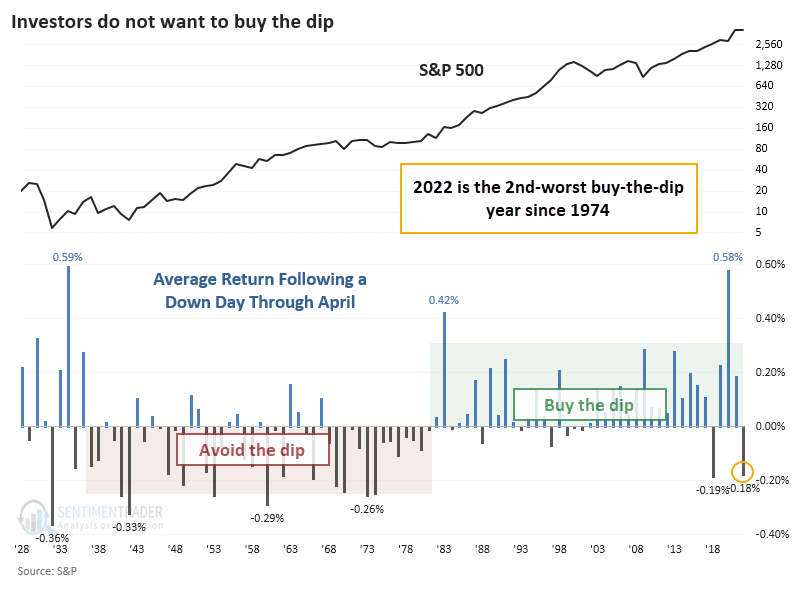
This is the worst year since 1932
The most important index in the world has returned an average of -0.18% after a down day through April. It’s just as bad when we look at returns following up day, which averages -0.16% this year. The only year in history when the S&P saw such negative returns following both up and down days is 1932.
Such a lack of buy-the-dip activity is how investors behaved throughout much of the 1930s to 1970s, with only very rare cases since.
Also from SentimenTrader:
- Optimism toward Natural Gas is soaring, and our Optimism Index has risen above 66. Natural gas can continue to run following such a reading, but traders should watch for potential topping action. Our Backtest Engine shows that the contract was higher 6 months later only 12% of the time after comparable sentiment readings.
- The Dollar Index (DXY) has jumped by 10% over the last 6 months. After similar surges, the dollar most often continued to rally in the weeks ahead. Commodities and stocks tended to struggle after these surges, as did oil and copper.
Morgan Stanley:
Though some observers believe the hawkish Fed and investors’ flight to the relative safety of the dollar amid geopolitical strife is driving the rise, Morgan Stanley’s Global Investment Committee thinks today’s currency dynamics may be more complicated, with divergent central-bank actions also driving relative weakness in other currencies. To understand this dynamic, consider:
- Japan, where the central bank is implementing “yield-curve control”—an effort to actively manage borrowing costs across different maturities—alongside money-printing to engineer higher structural inflation and a path away from nearly 40 years of deflation. Accordingly, the yen recently tumbled to a 20-year low against the dollar.
- Europe, where weakness has emerged in the euro, as the risk of recession grows around the Russia-Ukraine war and as the European Central Bank tries to delay inevitable monetary tightening.
- China, where implementation of zero-COVID policies has weakened the outlook for an economic recovery and pushed its central bank toward easing policy, causing the yuan to depreciate.
The implications of a stronger dollar for financial markets and the economy are also more complex than many realize, making the path ahead riskier for investors and policymakers alike:
- The typical investing playbook for a strong U.S. dollar may not work well in today’s market. For instance, commodities usually move inversely to the dollar, so theoretically we should see prices fall. But we haven’t. Instead, commodities-based inflation remains significant, due to the dual supply shocks caused by COVID-19 and Russia’s invasion of Ukraine. A strong dollar also tends to bode ill for emerging markets that are dependent on dollar-denominated debt by making it harder for these regions to service this debt. Today, however, many emerging-market regions are in excellent fiscal shape, with plenty of foreign-exchange reserves. In fact, those that supply fuel, fertilizer, food and metals, as is the case for much of Latin America, actually stand to benefit from the global supply squeeze. And in equities, many investors today are favoring defensive stocks and not names that would typically benefit from a strong dollar, such as retailers and homebuilders.
- The soaring dollar adds risks for the Fed as it seeks to tame inflation without slowing the economy into a recession. In the near term, the stronger dollar may bolster the purchasing power of companies and consumers when it comes to imports, thus helping ease inflationary pressures. But the dollar’s strength can also hurt U.S. exports and the translation of overseas profits by U.S companies, posing headwinds to growth. Longer term, the currency’s strength may help further tighten financial conditions, just as the Fed is shrinking its balance sheet and international flows into the U.S. market could be slowing in line with recoveries elsewhere.
In short, continued U.S. dollar strength could complicate the outlook for the economy and markets, implications that may be underappreciated by investors at the moment. We think investors should watch real yield differentials for signs that the U.S. dollar is peaking and consider rebalancing international exposure, especially in equities. The U.S. dollar may peak in the next three to six months, and a tailwind may develop, enhancing regional market recoveries.
EARNINGS WATCH
The Q1 earnings season is coming to a close and even though investors don’t bother these days, earnings will eventually matter again. I will report more thoroughly next Monday but here’s ysterday most important earnings data:
Twenty-one additional companies have guided so far vs 3 months ago, 14 guided down and 6 up. Compared with last year at the same time, the N/P ratio has tripled.

 China Orders Government, State Firms to Dump Foreign PCs It’s one of Beijing’s most aggressive efforts so far to eradicate key overseas technology.
China has ordered central government agencies and state-backed corporations to replace foreign-branded personal computers with domestic alternatives within two years, marking one of Beijing’s most aggressive efforts so far to eradicate key overseas technology from within its most sensitive organs.
Staff were asked after the week-long May break to turn in foreign PCs for local alternatives that run on operating software developed domestically, people familiar with the plan said. The exercise, which was mandated by central government authorities, is likely to eventually replace at least 50 million PCs on a central-government level alone, they said, asking to remain anonymous discussing a sensitive matter.
The decision advances China’s decade-long campaign to replace imported technology with local alternatives, a sweeping effort to reduce its dependence on geopolitical rivals such as the U.S. for everything from semiconductors to servers and phones. It’s likely to directly affect sales by HP Inc. and Dell Technologies Inc., the country’s biggest PC brands after local champion Lenovo Group Ltd. (…)
The push to replace foreign suppliers is part of a longstanding effort to wean China off its reliance on American technology — a vulnerability exposed after sanctions against companies like Huawei Technologies Co. hammered local firms and businesses. That initiative has accelerated since 2021, when the Chinese central government quietly empowered a secretive government-backed organization to vet and approve local suppliers in sensitive areas from cloud to semiconductors. (…)
The campaign will be extended to provincial governments later and also abide by the two-year timeframe, the people said.
Lenovo could dramatically boost sales on Beijing’s order that central government agencies and state-backed companies replace foreign-branded computers, as reported by Bloomberg News. This would amount to more than 50 million PCs over the next two years. The nation’s No. 1 PC maker relies on U.S. chips, but has set up its own chip-making unit and invested in at least 15 semiconductor design firms. (…)
The latest government directive is likely to cover only PC brands and software, and exclude hard-to-replace components, including microprocessors, the people said. China will mostly encourage Linux-based operating systems to replace Microsoft’s Windows. Shanghai-based Standard Software is one of the top providers of such tools, one person said.
Certain agencies, including state-owned media and cybersecurity bodies, may continue to buy advanced foreign equipment under special permits as they always have, one of the people said. But that permit system could be tightened in future, the person said.
Looks like a very big deal to me!!!


 Outperforming the Fed’s forecasts is not a particularly spectacular achievement… I would have preferred to know how accurately the model forecasts actual inflation.


