U.S. Consumers Boosted Spending in March Household spending rose 1.1% in month as consumers stepped up spending on services
(…) Adjusting for inflation, consumer spending rose 0.2% last month, driven by higher services spending. Household spending also rose at a faster rate than inflation from a year earlier. (…) Spending on durable goods declined for the second month in a row, led by lower spending on vehicles.
“The consumer’s fine, they’ve got loads of money,” said Ian Shepherdson, chief economist at Pantheon Macroeconomics, pointing to savings accumulated during the pandemic, and adding that “the consumer is set up for a pretty decent second quarter.”
Personal income, a measure that includes wages and government assistance, climbed 0.5% from the prior month. That was a slower rise than overall inflation, which increased 0.9% on the month in March, according to the Commerce Department. Some Americans tapped their savings to offset cost increases. The savings rate fell to 6.2% in March, the lowest in nine years. (…)
Overall inflation, as measured by the Commerce Department’s price index, rose 6.6% in March from a year earlier, an acceleration from February, but when excluding volatile food and energy costs—the Federal Reserve’s preferred gauge, annual inflation cooled slightly, rising 5.2% last month from a year earlier. (…)
““The consumer’s fine, they’ve got loads of money”. Only a Wall Street economist can say something like that in times like these.
- Real disposable income has declined in 7 of the last 8 months at a 2.6% annual rate.
- At this rate, the average American’s real DPI will be back to its pre-pandemic level in May, having lost to inflation all his gains from employment, wages and stimmies.
- Aggregate payroll income is up 11.1% from February 2020 but inflation is up by the same percentage. Real payroll income declined in 2 of the last 3 months and dropped 0.8% MoM in March.
- Aggregate savings are indeed quite high but they are also being eroded by inflation, 11% since February 2020, and are concentrated in the higher income segment. As Hoisington Management’s Lacy Hunt calculates, some 170 million Americans have seen their income trail inflation in the last year. None of these are Wall Street economists.
The savings rate was 6.2% in March down from 6.7% and 6.8% in January and February respectively. The sharp drop in the savings rate merely kept total spending up 0.2% in real terms in March as consumers kept swapping goods consumption for services, a process that will continue for a while.
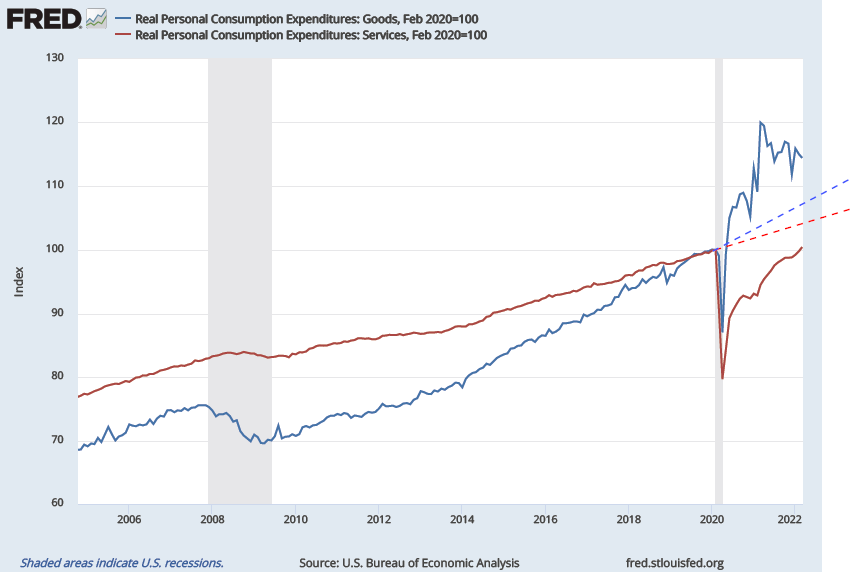
To get back to pre-covid trends, spending on services would need to rise 3.6% while spending on goods has to decline 6.6%, the net effect being flat total spending. During the past 12 months, real goods are down 4.6% while real services are up 6.2%. Total expenditures are up 4.7% over the two years while the savings rate dropped from 8.3% to 6.2%.
What can we reasonably expect going forward?
- Employment is growing by about 585k per month, about 0.4% MoM. By June, the number of employed Americans should be back to its February 2020 level. Note that the participation rate is still 1% below its pre-covid level so the U.S. is still missing more than 1.5M workers. Will they come back, adding 0.08% per month to employment growth to about 0.5% per month.
- Average weekly hours are about in line with their 2019 level when unemployment was where it is now. No contribution from that.
- Wages are growing about 0.4% MoM per the latest employment cost index.
In all, on current trends, payrolls should grow 0.8% monthly compared with +0.6% in the last 3 months and +1.0% in the 3 months previous, or +0.8% in the last 6 months on average. Not a bad trend.
The main problem is inflation, the red bar below, rising 0.9% per month during Q1, up from +0.7%/m during Q4’21 and +0.4%/m during Q3’21.

The next problem is rising interest rates increasingly impacting the housing market as well as mortgage refinancings.
The last problem, which most economists regard as the likely savior, is the 6.2% savings rate. Over the last 63 years, the savings rate has been lower only 17% of the time, the majority of which occurred during the equity and housing bubbles when many Americans borrowed heavily to speculate.

This is a game of probabilities. I have yet to know one person who has consistently forecast the elusive savings rate with any degree of accuracy. Add that the savings rate is positively correlated with inflation (+0.32), meaning that Americans tend to save more when inflation, and normally interest rates, are rising.
Given current trends in payroll income, the U.S. consumer economy is flirting with recession: real consumption expenditures have grown a scant 0.36% in total since last October, or 0.07% per month! This while the savings rate declined 1.1% from 7.3% to 6.2%.
Saying that “the consumer is set up for a pretty decent second quarter” carries low odds in my book. Unless inflation slows rapidly.
Core inflation measures are showing encouraging signs but are still rising at a 3-4% pace. Supply chain problems are also not going away anytime soon, judging by China’s growing Omicron problem.

If the concern is the risk of a consumer recession, core inflation is not at the core of Americans’ shrinking spending power. People eat and drive daily from a real paycheck eroded by total inflation, not showing any signs of abating just yet, is it?

The core of the inflation threat comes from services, showing strong signs of accelerating under pressure from rising wages:

Unlike goods prices, services prices never decline and are intimately tied to labor costs which also never decline and are in a clear accelerating mode that now goes beyond the pre-pandemic trend:

Total compensation jumped 1.6% in Q1, a 6.6% annualized rate while the wage component was rising 1.3% QoQ, or 5.2% a.r..

Note how Goldman Sachs finds that compensation growth is “firm across industries” but highlights trends in services labor costs:
The Employment Cost Index rose 1.42% (qoq sa, not annualized) in Q1, above consensus expectations. Wages and salaries (+1.22%) and benefits (+1.81%) both increased. Private wages and salaries excluding incentive-paid occupations, the key underlying measure included in our wage tracker, increased by 1.38% (sa by GS).
Employment cost inflation was also strong on a year-over-year basis, as overall compensation growth (+4.5%), private ex-incentive wages and salary growth (+5.2%), and overall wages and salaries growth (+4.7%) remained elevated.
Quarterly compensation growth was firm across industries, led by strength in accommodation and food services (+2.0%), real estate and rental services (+2.0%), wholesale trade (+1.9%), and administrative and support services (+1.9%). Our composition-corrected wage tracker—which adjusts median weekly wages and average hourly earnings to control for workforce composition—now stands at +5.4% in Q1 (vs. +4.7% in Q4).
Consumers shifting their spending towards services will only exacerbate the problem…until the FOMC succeeds in taming wage pressures which can only be done by reducing labor demand which only happens in recessions.

“I don’t think you’ll hear anyone at the Fed say that that’s straightforward or easy. It’s going to be very challenging,” Mr. Powell recently said of the attempt to perform a soft landing.
Also, in prerecorded remarks (i.e. well thought out) at a separate conference last Thursday morning, Mr. Powell told us of his resolve to bring inflation down:
Chair Volcker understood that expectations for inflation play a significant role in its persistence. He therefore had to fight on two fronts: slaying, as he called it, the ‘inflationary dragon’ and dismantling the public’s belief that elevated inflation was an unfortunate, but immutable, fact of life.
He had to stay the course.
This is when the market started to tank.
From Moody’s:
(…) The unemployment rate is close to its pre-pandemic rate and signs point to it falling even further over the next few months. This complicates the Fed’s job. There has never been an increase in the unemployment rate of more than 30 basis points, on a three-month moving average basis, that wasn’t associated with a recession. Once the labor market overshoots full employment, it is extremely difficult for the Fed to pull off a soft landing, since the overshoot would then require the unemployment rate to rise.
In that situation, returning the unemployment rate to its full employment level without a recession would be challenging. (…)
The Fed’s Summary of Economic Projections has real GDP growth of 2.2% next year and 2% in 2024. This is above its estimate of potential GDP growth of 1.8%. To cool inflation, the Fed will likely need GDP growth closer to 1%, if not lower, in each of the next two years.
Therefore, the Fed will want financial market conditions to tighten further to help take some of the steam out of the economy. Reducing GDP growth in each of the next two years via tighter financial market conditions is possible. Our past work has shown that a 10% decline in the S&P 500 plus a 100-basis point increase in the 10-year Treasury yield reduces GDP growth over the course of a year by roughly 1 percentage point. (…)
Me on April 25:
Since this blog focuses on odds, I looked at how many times since 1947 annual GDP slowed below 1.5% without a recession or resulting in a recession. Only once, in 2011 (the red line below is at 1.25% YoY growth).

Why the focus on recessions?
Because recessions kill earnings and equity markets by 34% over 388 days on average. The S&P 500 is down 14% so far over 125 days.

I am not making predictions here, just presenting the facts to help assess the odds and manage risk accordingly.
In the January 7, 2022 Daily Edge (Risk Down…) I detailed all the signs of a general de-risking process that had been there for a while and concluded with “But it may not be “risk-off” just yet. The largest caps keep pulling the wagon, so far.“
On Monday April 25, I updated the risk down process: the S&P 500 had just moved into correction mode (-11.3%) and was displaying worrisome trends in its moving averages. “Just about everything is in a bear market with investors clinging to the higher quality and liquidity. For how long?”
Last Friday, the S&P 500 index 100dma crossed through the now declining 200dma and closed well through the 4200 level.

If the large caps are the last shoe to really drop, the S&P 500 Large Cap Index – 13/34–Week EMA Trend Chart is flashing red again. Steve Blumenthal is kind enough to offer 10 equity indicators, 7 are red and 2 are flashing yellow.

My favorite technical analysis firm, spot on throughout this topping process, says that we need to wait until supply is exhausted (capitulation) and signs of bargain hunting becoming more apparent.
Admittedly, a 14% drawdown is significant, particularly given that 244 of the S&P 500 stocks are in a bear market, down 20% or more and another 67 are in a 15%+ severe correction. Only 103 S&P 500 stocks are down less than 10% from their 52w high.
But bargains don’t spring out easily: the median P/E is 20.3 on trailing and 18.7 on forward EPS, if we can trust those.
One bargain hunter became active in Q1:
Buffett Lures Omaha Disciples With Stock Buys, Inflation Warning
The billionaire investor went on his biggest stock buying spree for at least a decade, undeterred by the geopolitical turmoil and fears of runaway inflation. He and his deputies dug deeper into the U.S. stock market and expanded the conglomerate’s stakes in Chevron Corp. and Activision Blizzard Inc., even as Buffett noted the “extraordinary” price increases in Berkshire’s businesses.
(…) making $41 billion in net stock purchases in the first quarter. That’s the most in data going back to 2008. (…)
Buffett said he couldn’t predict the trajectory of inflation over the coming months or years, though he said he’s seen price increases across his businesses. He also conceded — as he’s done before — that his firm hasn’t always been good at timing its asset purchases, though has been “reasonably good at figuring out when we were getting enough for our money.” (…)
Berkshire’s stake in Chevron, which totaled nearly $4.5 billion at the end of 2021, hit $25.9 billion at the end of March, according to its first-quarter regulatory filing. The firm’s Activision stake, which accounted for just 1.87% of the video game company’s common stock, jumped to 9.5% as Berkshire wagered its deal with Microsoft Corp. would safely close. (…)
EARNINGS WATCH
From Refinitiv/IBES:
Through Apr. 29, 275 companies in the S&P 500 Index have reported revenue for Q4 2021. Of these companies, 72.7% reported revenue above analyst expectations and 27.3% reported revenue below analyst expectations. In a typical quarter (since 2002), 62% of companies beat estimates and 38% miss estimates. Over the past four quarters, 80% of companies beat the estimates and 20% missed estimates.
In aggregate, companies are reporting revenues that are 2.1% above estimates, which compares to a long-term (since 2002) average surprise factor of 1.2% and the average surprise factor over the prior four quarters of 3.7%.
The estimated earnings growth rate for the S&P 500 for 22Q1 is 10.1% [7.3% last week]. If the energy sector is excluded, the growth rate declines to 4.4% [1.6%].
The estimated earnings growth rate for the S&P 500 for 22Q2 is 6.4% [6.6%]. If the energy sector is excluded, the growth rate declines to 0.6% [1.0%].
John Authers today has an interesting finding by Deutsche Bank AG investment strategist Bankim Chadha who reveals that median earnings look decent even though the mean is disappointing:
Mega-cap growth (MCG) & Tech earnings are missing by -6.0% at the aggregate level but the median company in the group is beating by 5.7%, pointing to the outsized role played by outliers. There is a similar story for Energy beats (-2.3% in aggregate, 8.8% for the median company). The pandemic-impacted group has reported losses which are larger than consensus in the aggregate (-$7.8bn vs -$6.0bn) but the median company is seeing smaller-than-expected losses.
Analysts remain generally upbeat overall:


Trailing EPS are now $213.28. Full year 2022: $228.64e. Forward 12m EPS: $234.97.
IMF Deputy Okamura Warns Inflation May Be Faster Than Feared “We continue to stress that the most important priority for the global economy is to end the war in Ukraine. The war will slow economic growth and increase inflation.
China PMI: Output and new orders fall at faster rates in April
A further tightening of COVID-19 restrictions in China led to notably quicker falls in both output and new business at the start of the second quarter. Increased supply chain disruption meanwhile drove the second-fastest deterioration in average vendor performance on record. Softer demand conditions resulted in more marked falls in both purchasing activity and stocks of purchases. Inflationary pressures persisted, with the rate of input cost inflation exceeding that seen for selling prices, as efforts to stimulate sales restricted firms’ pricing power.
Business confidence towards the 12-month outlook for output remained relatively subdued, as firms expressed concerns over how long it will take to fully contain the COVID-19 virus and its impact on supply chains and client demand.
The headline seasonally adjusted Purchasing Managers’ Index™ (PMI™) declined from 48.1 in March to 46.0 in April. The figure pointed to a second successive monthly deterioration in overall business conditions faced by Chinese manufacturers, and one that was the quickest since February 2020.
Dampening the headline index was a stronger reduction in output at the start of the second quarter. Production fell at the second-steepest since the survey began in early-2004 (beaten only by February 2020). The drop was frequently linked to the tightening of COVID-19 restrictions and subsequent impact on business operations, supply chains and demand.
Total new business likewise fell at the second-sharpest rate on record, as efforts to prevent the spread of COVID-19, including lockdowns, weighed on client demand. Some companies also noted that clients had cancelled orders due to difficulties in producing and shipping items. Logistical challenges also weighed on foreign demand, with new export orders falling at the quickest rate since May 2020.
The escalation of COVID-19 measures heavily impacted supply chain performance during April. The time taken for inputs to be delivered to manufacturers increased at the second-quickest rate on record and rapidly overall, as many firms noted lockdowns, travel restrictions and limited raw material availability had impacted delivery times.
Softer demand conditions meanwhile led to the sharpest drops in purchasing activity and stocks of inputs since February 2020. Inventories of goods also fell, albeit only modestly, as a number of firms noted difficulties shipping items to customers amid ongoing mobility restrictions.
Disruption to normal business operations led to a further increase in backlogs of work, though the rate of accumulation was mild. At the same time, employment fell only slightly, with some companies noting that the pandemic had made it difficult for workers to return to factories.
Higher costs for transport and raw materials drove a further sharp increase in input costs in April. That said, the rate of inflation eased slightly since March. Efforts to remain competitive and attract new business led to only a modest increase in selling prices, however.
Although companies were generally optimistic that output would rise over the next year, the level of positive sentiment was little-changed from March’s three-month low. Firms often expressed concerns over how long COVID-19 restrictions will be in place, and how long it will take for supply chains and demand conditions to improve.


China’s National Bureau of Statistics said Saturday that its official manufacturing purchasing managers index dropped to 47.4 in April, from 49.5 in March, falling to its lowest level since February 2020. (…) The subindex of factory production plummeted to 44.4 in April from 48.8 in March, the statistics bureau said. (…)
The subindex tracking export orders dropped deeper into contraction territory, to 41.6 in April, from a reading of 47.2 in March. The subindex measuring total new orders, likewise, fell to 42.6 in April, from 49.5 the previous month.
Separately, China’s official nonmanufacturing purchasing managers index, also released Saturday and tracking both the services and construction industries, plunged to 41.9 in April from 48.4 in March. Nineteen out of 21 surveyed industries, including transportation, accommodation and catering, recorded contractions in activity, the statistics bureau said.
The 41.9 reading was China’s lowest since the 29.6 level recorded in February 2020, as the central Chinese city of Wuhan was put under strict lockdown.
The subindex measuring service activity tumbled to 40.0 in April, from 46.7 in March, while the subindex tracking construction activity dropped to 52.7 from 58.1 in March. (…)
- China’s Economy Appears to Be Stalling, Threatening to Drag Down Global Growth While a traditional recession of two straight quarters of contraction remains unlikely for the country, economists see worrisome signs of a spell of slower growth.
(…) Millions of new graduates are struggling to find a job. Business confidence has fallen. Imports have plummeted and nervous Chinese are socking away more savings. (…)
China’s challenges go beyond the latest lockdowns. The fallout from the war in Ukraine has pushed up costs for Chinese businesses and contributed to fading overseas demand for their exports.Regulatory crackdowns have hit high-growth sectors such as technology and education. Real estate, a primary driver of the nation’s economy, went into free fall last year as developers buckled under heavy debts and home sales slumped. (…)
China was projected to account for a quarter of global economic growth in the five years through 2026, according to data released by the International Monetary Fund last year.
Commodity-exporting countries like Brazil that count on Chinese demand for products such as iron ore and other metals could see demand wane. Exporters of components and machinery to China, such as Taiwan, South Korea and Japan, have already reported weaker sales after lockdowns shut Chinese factories. (…)
Unlike in 2020, when China’s economy snapped back quickly from its first bout with the pandemic, the country’s additional problems mean there’s lessening hope of a major resurgence later this year. (…)
Surveyed unemployment in China’s 31 largest cities has surpassed the level it hit when Wuhan was locked down in 2020. Youth unemployment is now 16%, according to official data. (…)
About a third of China’s 290 million migrant laborers haven’t returned to their cities of employment since the Lunar New Year in February amid the Covid restrictions. The number of people employed at small- and medium-size businesses has shrunk by around 30%, according to research firm J Capital Research, based on interviews with Chinese labor agencies. (…)
“I also think the public discontent in China is at the highest point in the past 30 years,” added Mr. Shan [chairman and chief executive of PAG, a Hong Kong-based private-equity firm], who attributed China’s current crisis to policy decisions, though he said that his firm remains confident in the long term in China’s growth and market potential.
Weaker demand in China could have one positive: somewhat reduced inflation pressure for the world, if it consumes less oil and other imported goods.
Many economists say any upsides could be offset by the inflationary impact of Covid-related disruptions to China’s supply chains, which are crimping its ability to supply the world with manufactured goods. If that continues, it could contribute to the much-feared combination of anemic growth and high inflation known as stagflation.
In April, the IMF cut China’s full-year growth forecast to 4.4% from 4.8% earlier this year, and well below the government’s target of around 5.5% for 2022. Barclays said on April 29 that it believes China’s full-year GDP growth could dip below 4% if lockdowns extend into the second half of this year. (…)
Many economists say China is at risk of a growth recession, a term used to describe a spell of weak expansion when the economy isn’t close to its full potential and isn’t creating many new jobs. (…)
President Xi Jinping, who is angling to stay in power for a third term at an important party conclave later this year, has called for an all out campaign to rev up growth through more infrastructure spending. Beijing has frowned on such outlays in recent years because of fears they could exacerbate China’s debt problems. (…)
Biggest Treasury Buyer Outside U.S. Quietly Selling Billions Japanese institutional managers — known for their legendary U.S. debt buying sprees in recent decades — are now fueling the great bond selloff just as the Federal Reserve pares its $9 trillion balance sheet.
The latest data from BMO Capital Markets show the largest overseas holder of Treasuries has offloaded almost $60 billion over the past three months. While that may be small change relative to the Japan’s $1.3 trillion stockpile, the divestment threatens to grow.
That’s because the monetary path between the U.S. and the Asian nation is diverging ever more, the yen is plumbing 20-year lows and market volatility stateside is breaking out. All that is ramping up currency-hedging costs and completely offsetting the appeal of higher nominal U.S. yields, especially among large life insurers.
While 10-year U.S. yields traded at 2.91% as of 6:55 a.m. in New York, buyers who pay to protect against fluctuations in the yen-dollar exchange rate see their effective yields dwindle to just 1.3%. That’s because hedging costs have ballooned to 1.55 percentage points, a level not seen since early 2020 when the global demand for dollars spiked in the pandemic rout.
A year ago the Treasury benchmark was offering a similar yield, when accounting for the cost of protecting against moves in the exchange rate thanks to a modest 32 basis-point hedging cost.
The upshot: Japanese accounts are contributing to the historic Treasury rout and may not return en masse until the benchmark 10-year yield trades firmly above 3%. In fact, near-zero-yielding bonds at home look ever-more appealing even as U.S. debt offers some of the highest rates in years. (…)
“In the span of next six months or so, investing in Europe is better than the U.S. as hedge costs are likely to be low,” said Tatsuya Higuchi, executive chief fund manager at Mitsubishi UFJ Kokusai Asset Management Co. “Among the euro bonds, Spain, Italy or France look appealing given the spreads.” (…)


