CPI for all items rises 1.2% in March; gasoline, shelter, food indexes rise
The Consumer Price Index for All Urban Consumers (CPI-U) increased 1.2 percent in March on a seasonally adjusted basis after rising 0.8 percent in February, the U.S. Bureau of Labor Statistics reported today. Over the last 12 months, the all items index increased 8.5 percent before seasonal adjustment.
The index for all items less food and energy rose 0.3 percent in March following a 0.5-percent increase the prior month. The shelter index was by far the biggest factor in the increase, with a broad set of other indexes also contributing, including those for airline fares, household furnishings and operations, medical care, and motor vehicle insurance. In contrast, the index for used cars and trucks fell 3.8 percent over the month.
The all items less food and energy index rose 6.5 percent, the largest 12-month change since the period ending August 1982.


Core goods finally declined 0.4% in March but core services accelerated to +0.6% (+4.7% YoY) and +6.1% a.r. in the last 3 months.
SURVEYS SAY!
The NFIB Small Business Optimism Index decreased in March by 2.4 points to 93.2, the third consecutive month below the 48-year average of 98. Thirty-one percent of owners reported that inflation was the single most important problem in their business, up five points from February and the highest reading since the first quarter of 1981. Inflation has now replaced “labor quality” as the number one problem. (…)
Key findings include:
- Owners expecting better business conditions over the next six months decreased 14 points to a net negative 49%, the lowest level recorded in the 48-year-old survey.
- Forty-seven percent of owners reported job openings that could not be filled, a decrease of one point from February.
- The net percent of owners raising average selling prices increased four points to a net 72% (seasonally adjusted), the highest reading in the survey’s history. (1973)
Price hikes were the most frequent in wholesale (84% higher, 0% lower), construction (83% higher, 3% lower), agriculture (78% higher, 2% lower), and retail sales (77% higher, 2% lower). Seasonally adjusted, a net 50% of owners plan price hikes, up four points from February. (…)
A net 49% (seasonally adjusted) reported raising compensation, down one point from January’s 48-year record high reading. A net 28% plan to raise compensation in the next three months, up two points from February. Eight percent of owners cited labor costs as their top business problem and 22% said that labor quality was their top business problem, now in second place following “inflation.” (…)
Forty percent of owners report that supply chain disruptions have had a significant impact on their business, up three points. Another 28% report a moderate impact and 23% report a mild impact. Only 8% report no impact from recent supply chain disruptions. (…)
The frequency of reports of positive profit trends was a net negative 17%. Among the owners reporting lower profits, 35% blamed the rise in the cost of materials, 23% blamed weaker sales, 14% cited the usual seasonal change, 13% cited labor costs, 7% cited lower prices, and 2% cited higher taxes or regulatory costs. For owners reporting higher profits, 55% credited sales volumes, 17% cited usual seasonal change, and 17% cited higher prices.
BofA Says Fund Managers Most Gloomy on Record on Recession Woes
The share of investors expecting the economy to deteriorate is the highest ever, according to the April survey. Stagflation expectations jumped to the highest since August 2008, while monetary risk increased to a historic high, BofA strategists said, after surveying 292 panelists with $833 billion in assets under management in the first week of April.
A global recession is now seen as the biggest tail risk by investors, according to BofA’s monthly survey (…).
The results highlight how gloom is taking hold among investors as the Federal Reserve turns more aggressive in its attempt to tame soaring inflation. The bearishness has been extreme enough to trigger BofA’s own buy signal, a contrarian indicator for detecting entry points into equities. Global stocks have been under pressure this month after rallying from lows in March as bond yields have soared.
BofA’s strategists disagree with the tactical buy signal, saying they “remain in ‘sell-the-rally’ camp,” as the stock market slump earlier in the year was just an “appetizer not main course of 2022.”
“The disconnect between global growth and equity allocation remains staggering,” the strategists led by Michael Hartnett wrote in a note. (…)
- Investors are now the most net overweight ever for commodities; long oil and commodities is the most crowded trade, followed by short U.S. Treasuries and long tech stocks (…)
- A majority of investors at 64% expect the S&P 500 to break below the 4,000 level first before rising beyond the 5,000 level (26%); the survey shows that investors expect a Fed “put” to arrest a stock market selloff at 3,637 index points for the S&P 500. (…)

New York Fed: Public Expectations for March 2023 Inflation Hit 6.6% Record Public expectations for the level of inflation a year from now hit a record in March, according to a survey released by the Federal Reserve Bank of New York.
(…) The New York Fed also reported that public expectations for inflation three years from now, in March 2025, moderated to 3.7% from February’s 3.8% forecast.
“The increase in short-term expectations was broad-based across age, education, and income groups,” the New York Fed said, adding “the decline in medium-term expectations was driven by respondents with no college education and with annual household incomes under $50,000.” The report noted that uncertainty over short-term inflation levels hit a new high and longer-term uncertainty over inflation remained at record levels. (…)
The survey also found that respondents see their spending surging by 7.7% a year from now, up from 6.4% in February, hitting a new series high. But expected income growth next year cooled to a 3% gain. The report noted respondents were “more pessimistic about their household’s financial situation in the year ahead, with fewer respondents expecting their financial situation to improve a year from now.” (…)
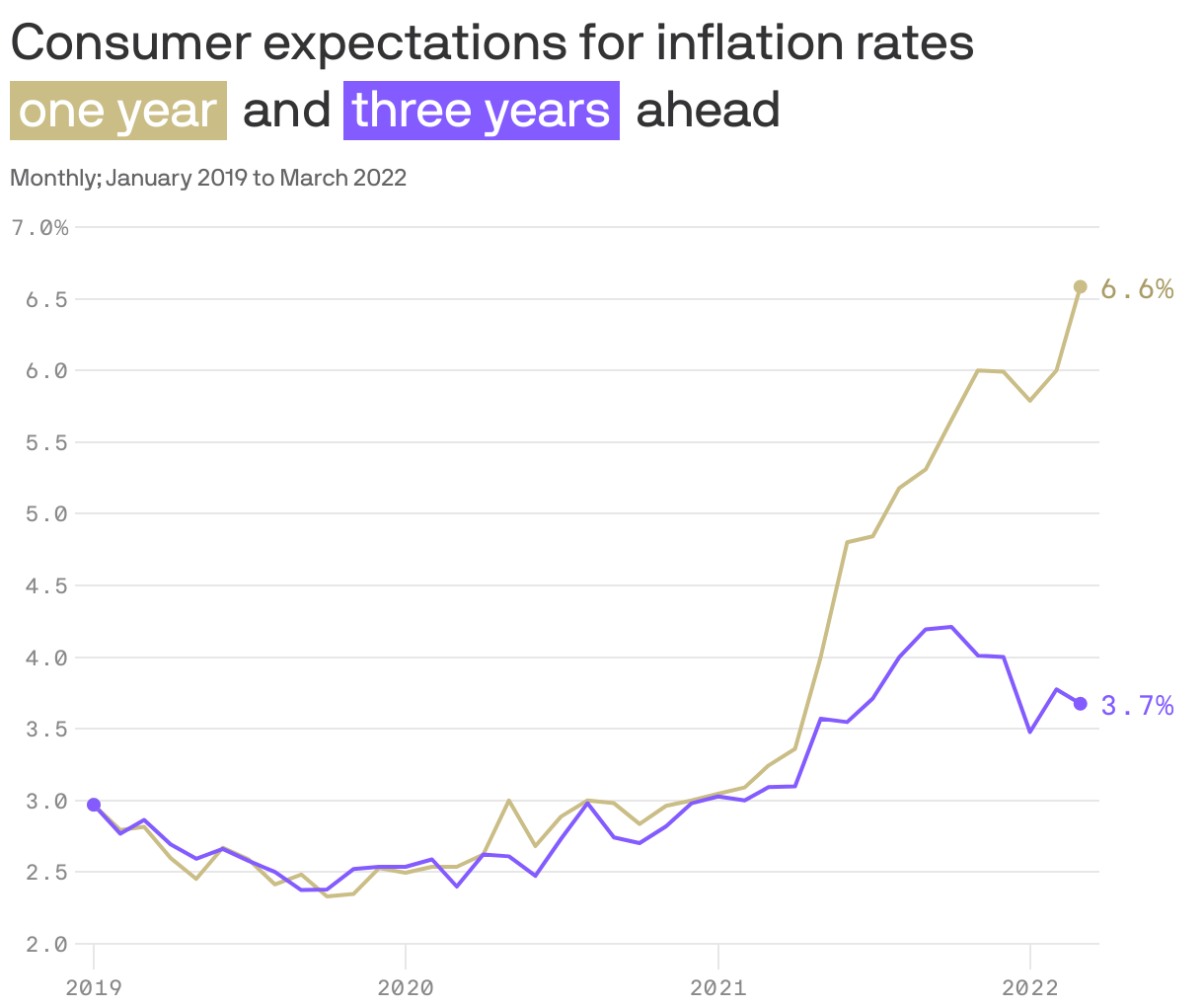 Data: New York Fed; Chart: Axios Visuals
- Everything Costs More, and That’s Disrupting Retirement for Many Signs are mounting that high inflation is helping propel more people—including retirees—back into the labor force, economists say.
(…) “We’re beginning to see the migration of the older cohort who expected to live on fixed income in a low interest-rate and low inflation environment,” said Joseph Brusuelas, chief economist at RSM US LLP. “That has not materialized; therefore they have to come back to the labor force to create the conditions so they can retire.” (…)
Roughly 2.6 million Americans retired earlier than expected between February 2020 and October 2021, according to estimates from Federal Reserve Bank of St. Louis senior economist Miguel Faria-e-Castro. Now many are returning to work at rates not seen since March 2020, according to jobs site Indeed. (…)

(GS)
HOUSING
From Almost Daily Grant’s:
Per data from Mortgage News Daily, the average 30-year fixed mortgage has reached 5.25%, up some 200 basis points over the last year and the highest since August 2009. As CNBC’s Diana Olick relays, the buyer of a $400,000 home with a 20% down payment is now obliged to shell out an additional $370 in monthly payments relative to spring 2021, never mind the fact that average purchase prices sit 15% to 20% higher than they were at this time last year.
Spiraling housing costs may finally be making a dent in that heretofore bulletproof bull market. Redfin deputy chief economist Taylor Marr observed in a Friday blog post that the national frequency of “homes for sale” Google searches dropped 7.9% from a year ago during the second week in March, with pronounced declines across a trio of high-cost markets (Boston searches down y 15%, San Francisco by 14% and Los Angeles by 13%).
Waning buyer interest wasn’t confined to internet search engines, as tours of for-sale houses across California declined by 21% in the week ended March 31 from the first week of the year, after that metric jumped by 76% in the same period of 2021. Then, too, the nationwide share of home sellers decreasing their list price is growing at the fastest pace in at least seven years.
- Inventory up 2.3% Week-over-week; Up 8.3% from Seasonal Bottom Currently it appears inventory will be up year-over-year sometime in the 3rd quarter of 2022.
China’s Li Issues Third Growth Warning as Covid Takes Toll
Authorities should “add a sense of urgency” when implementing existing policies, Li told local authorities at a seminar Monday. China will study and adopt stronger economic policies as needed to support the economy, he said.
The comments come days after similar warnings from Li, highlighting the toll the economy is taking from lockdowns and other virus control measures imposed to curb the latest wave of omicron outbreaks. Nomura Holdings Inc. said the risk is rising the economy may contract in the second quarter if lockdowns are extended after April.
The Nomura economists estimate that about 373 million people in 45 cities are now under full or partial lockdown, making up 40% of China’s gross domestic product. (…)
Li said Monday that pro-growth measures should be brought forward and accelerated, including tax and fee cuts, sales and usage of special bonds, and incentives to keep jobs.
Local governments should tap their own policy potential to tailor targeted supportive measures according to local conditions, he said. In the meantime, they should prevent introducing and correct policies that are unfavorable to market expectations. (…)


(GS)
- Lockdown Anger in Shanghai Won’t Fade Anytime Soon The accumulation of misery among the city’s thriving middle class is undermining faith in a government that’s spent decades improving Chinese living standards.
(…) Street-level frustration is also rising. Recently a video circulated showing residents of a Shanghai compound chanting, “We want to eat, we want to go to work, we want freedom!”
Even high-level national leaders aren’t immune from the protests. On Sunday, when Vice Premier Sun Chunlan, China’s Covid czar, visited Shanghai, residents shouted at her: “We want to have food to eat.” (…)
- China nudges listed firms, investors to buy stocks to stabilise market The government will also facilitate corporate financing in COVID-hit areas and urge state shareholders of listed firms to actively buy undervalued stocks, the country’s securities watchdog said in a statement on its website late on Monday.
(…) To boost investor confidence, CSRC said it will encourage listed firms to buy back their shares to stabilise prices. Major shareholders and senior executives are also encouraged to actively buy shares when prices fall sharply.
Meanwhile, state shareholders should actively buy undervalued stocks, and support share buy-back and cash dividend plans by listed firms, according to the statement, which was jointly published by the CSRC, China’s state assets supervisor, and the All-China Federation of Industry and Commerce.
China is also stepping up efforts to woo foreign investors, amid signs of capital outflows.
The Shanghai Stock Exchange said late on Monday that it had held a virtual roadshow with nearly 200 representatives from global investors including sovereign wealth funds and pension funds, to promote index investments tracking China.
The promotion came after Institute of International Finance (IIF) data showed outflows of $6.3 billion from China equities in March, and $11.2 billion out of China bonds. (…)
Nomura said late on Monday China is facing a rising risk of recession.
Sri Lanka unilaterally suspends external debt payments, says needs money for essentials, article with gallery Sri Lanka’s central bank said on Tuesday it had become “challenging and impossible” to repay external debt, as it tries to use its dwindling foreign exchange reserves to import essentials like fuel. Sri Lanka’s decision covers about $25 billion in bilateral and commercial debt, which includes about $12 billion of international sovereign bonds.
WEAK DEFENSE!
Staid Utility stocks make a historic run
(…) the Dow Jones Utility Average has enjoyed its 2nd-largest 30-day rate of change in 20 years.
The surge has been so great that more than 60% of them became overbought on an average day over the past 2 weeks. Since 1999, only 2 distinct occasions encompassing 10 days total have exceeded this. The Backtest Engine shows that all 10 days saw losses in XLU over the next couple of months.
The jump in overbought stocks pushed more than half of them to 52-week highs on an average day over the past 10 sessions, a 23-year record. The Backtest Engine shows that future returns are horrid when the 10-day average reaches even 40%. Of 24 days, only 1 barely eked out a positive return 2 months later.
Even more astounding, a 10-day period when more than half of Utility stocks hit a 52-week high is a record dating back 70 years. In other words, at no other time since 1952 have so many of these stocks hit new highs at the same time for such a long stretch.
If we put together a composite breadth indicator that incorporates 7 different factors, it just hit the 10th-highest reading since 1952. (…)
Out of the 16 signals, only 2007 and 2016 witnessed gains in these stocks during the usual soft spot from 1-6 months following the signal.
When we see markets hit true extremes, it’s typically a good bet that they will self-correct and mean-revert. The tired maxim “extreme can always get more extreme” exists because nothing is ever 100%, and sometimes there is a structural change. Or, sometimes, people simply get crazy, and it lasts a while. Mean reversion has been the best bet when we see upside extremes in staid stocks and sectors. It’s extremely rare to see groups like this extend momentum runs for very long.


Lowry’s Research pointed out last week that the DJ Utility Average has been making new highs nearly every day since March 24, against rising interest rates, highlighting investors’ defensive mood.
This Morningstar/CPMS chart shows how low Utes’ dividend yield is now vs bond yields and inflation, often a sign of market tops.

Investors are paying top P/B multiples while ROEs are declining…

…and top P/E multiples (24x!!!) for a sector growing EPS 0-8% per year and only 1.2% in the last 12 months:

Visa Expects to Make Up Lost Russia Revenue Within a Year Pulling out of Russia means a revenue loss of about 4%, making comparisons tough for the next couple of quarters, CFO says. Before the invasion, Ukraine represented 1% of Visa’s revenue.
Here come the EVs
The research firm BloombergNEF estimates that the number of plug-in vehicles on the world’s roads will top 20 million in June.
- “That’s remarkable growth from only 1 million EVs on roads in 2016,” writes Colin McKerracher, a top BloombergNEF transport analyst.
- He sees the number reaching over 26 million by the end of the year.
“The speed of growth is much faster than many incumbents in the automotive and oil industries were expecting just a few years ago,” McKerracher writes.
While China and Europe are the biggest markets, a separate report by the consultancy ERM notes the growing availability of models in the U.S.
- The number of fully electric and plug-in hybrid vehicles for sale under $100,000 will be well above 100 by mid-decade, per the analysis prepared for the Environmental Defense Fund.
- That includes a growing number of SUVs and pickups.




 China Limits Sales by Some Funds as Stocks Slide Again