The enemy of knowledge is not ignorance, it’s the illusion of knowledge (Stephen Hawking)

It ain’t what you don’t know that gets you into trouble. It’s what you know for sure that just ain’t so (Mark Twain)

Invest with smart knowledge and objective odds

THE DAILY EDGE: 21 MARCH 2022

Home Sales Fell in February Amid Tight Supply, Rising Mortgage Rates Sales of previously owned homes declined 7.2% as higher interest rates and a shortage of homes for sale made it difficult for buyers to compete.

Existing-home sales fell 7.2% in February from the prior month to a seasonally adjusted annual rate of 6.02 million, the National Association of Realtors said Friday. February sales fell 2.4% from a year earlier. (…)

The median existing-home price rose 15% in February from a year earlier, NAR said, to $357,300. (…) The typical monthly mortgage payment in February rose 28% from a year earlier, Mr. Yun said. The average rate on a 30-year fixed-rate mortgage was 4.16% as of Thursday, up from 3.09% a year earlier, according to Freddie Mac. (…)

The share of first-time buyers in the market fell to 29% in February, down from 31% a year earlier. (…)

A large number of cash buyers are pushing buyers using mortgages out of the market, she said.

About 25% of February existing-home sales were purchased in cash, up from 22% a year earlier, NAR said.

The typical home sold in February was on the market for 18 days, down from 19 days the prior month, NAR said. (…)

 image image

The right chat above illustrates the bifurcated U.S. housing market. The South is where most of the action is. The South is now 45.3% of the market from 42.9% in 2019 and 39.3% in 2011. The South is home to 38% of the U.S. population.

In fact, since 2016, existing home sales jumped 22% in the South compared with 8% in the Midwest, 6% in the West and 3% in the Northeast.

U.S. Industrial Production Rises in February

Industrial production increased 0.5% (7.5% y/y) during February after surging an unrevised 1.4% in January. The latest gain matched expectations in the Action Economics Forecast Survey. Manufacturing output surged 1.2% (7.4% y/y) in February after edging 0.1% higher in January. Utilities output fell by 2.7% (-1.2% y/y) following January’s 10.4% surge due to cold weather. Mining output edged 0.1% higher (17.3% y/y).

The February production increase was held back by a 3.5% decline in motor vehicle output which was unchanged y/y. Output of computers & electronic products offset the decline, strengthening 1.8% (8.9% y/y). Machinery production rose 0.8% (8.3% y/y) in February and electrical equipment & appliance production rose 0.5% (5.7% y/y). (…)

In the special factory classifications, factory output less the high technology sector rose 1.1% (7.4% y/y) in February while factory production excluding both high tech and autos rose 1.5% (7.9% y/y).

Capacity utilization rose to 77.6% last month from 77.3% in January. A 77.9% rate had been expected. Utilization in the factory sector rose to 78.0%, the highest rate since September 2018.

 image image

Remarkably, durable goods IP is up 7.2% YoY (+6.1% a.r. in the last 3 months) even though Motor Vehicles & Parts is unchanged (-21.1% a.r. in the last 3 months).

Also remarkable is that total manufacturing capacity utilization, at 78.2% is back to its mid-2018 high even though vehicle manufacturers are operating at only 66% of capacity, down from 80% in 2018. As the chip shortages abate, the U.S. manufacturing industry will be humming very profitably.

fredgraph - 2022-03-19T065602.781

ECB’s Lagarde Plays Down Concerns About Euro-Zone Stagflation

(…) Asked about the risk of stagflation, Lagarde said that “even in the bleakest scenario, with second-round effects, with a boycott of gas and petrol and a worsening of the war that goes on for a long time — even in those scenarios we have 2.3% growth.”

“We are not seeing elements of stagnation now,” she said. (…)

Some people are more concerned:

Gas Prices Upend Small Business Rising fuel prices are taking a toll on small businesses, prompting owners to trim services and revise contracts as they try to soften the financial hit.

(…) Fifty-two percent of small-business owners said that higher energy prices were affecting their businesses, according to a March survey of more than 780 small businesses for The Wall Street Journal by Vistage Worldwide Inc., a business coaching and peer advisory firm. (…)

“I am absolutely raising all my prices across the board and I am doing so aggressively,” said David Hastings, chief executive of Hastings Water Works Inc., a 30-year-old swimming-pool service, maintenance and management company.

Mr. Hastings expects to spend as much as $110,000 on gasoline this year, up from $50,000 in 2021. Pay for lifeguards employed by the company has climbed to as much as $17 an hour, up from $11 in May 2021. The cost of pool chemicals has increased by an average of 20% since November and is continuing to rise almost weekly, Mr. Hastings said.

The Brecksville, Ohio, company increased commercial rates by about 15% this year and residential rates by 10%. Mr. Hastings also has asked some customers in the middle of three-year contracts to accept interim price increases of as much as 20%. (…)

But don’t think larger companies are not suffering as well. Goldman Sachs says that “the outlook for ROE is more challenging in 2022 due to margin pressures from rising input costs and wage inflation.”

Ed Yardeni:

The only tool that Fed has ever had to bring down inflation is to raise the federal funds rate until it causes a credit crunch and a recession that brings inflation down. That’s the lesson of history. Inflation has always declined as a result of recessions, i.e. hard landings. If the plan is to slowly raise interest rates to gradually slow demand resulting in a soft landing, then good luck with that!

The yield curve spread tends to signal that monetary tightening is sufficient to cause a recession and bring down inflation when it inverts. The traditional yield curve spread between the 10-year bond and the federal funds rate is still widening. It is one of the 10 components of the Index of Leading Economic Indictors, which remained near its recent record high during February. The yield curve spread between the 10-year and 2-year Treasuries, on the other hand, has narrowed significantly so far from over 150bps at the start of this year to only 21bps on Friday.

Odds are that the Fed will tighten gradually. That reduces the risk of an imminent recession and increases the risk of higher-for-longer inflation.

No alternative text description for this image

MEGA CAPS AND MEGA P/Es

Ed Yardeni last week:

The MegaCap-8 (i.e., the eight highest-capitalization stocks in the S&P 500) accounted for much of the outperformance of the S&P 500 since 2017, especially during the pandemic years of 2020 and 2021. Now they are accounting for its underperformance.

The market capitalization of the MegaCap-8 fell 18.2% from the start of this year through March 11. Over the same period, the market cap of the S&P 500 with and without the MegaCap-8 fell 11.7% and 9.4%.

And over the same period, the collective forward P/E of the MegaCap-8 fell from 33.8 to 26.5, while the forward P/Es of the S&P 500 with and without these eight stocks fell from 21.4 to 18.1 and from 19.1 to 17.3.

image

So we have 492 stocks, 71.5% of the S&P 500 index, that are selling at 17.3x forward EPS, below their 17.9 median since 1990 and in line with the 1957-1972 average of 17.4.

image

The problem is the period between 1972 and 1989 when P/Es ranged between 6 and 15 and averaged 10.9. That period’s average inflation rate was 6.5% compared with 2.9% and 2.4% for the other two periods respectively.

The counterpoint is interest rates, both short and long. Ten-year Treasuries yielded 4.9% and 4.3% on average during the two higher P/E periods and 9.5% between 1972 and 1989.

The bet is thus that equity investors will keep discounting earnings at near current interest rates which really are where they are because of massive central bank manipulations since 2011. The Fed just stopped its bond purchases and will embark on its QT program in May, the details of which will be laid out when the Fed releases its minutes in mid-April.

fredgraph - 2022-03-20T071512.354

We know that the FOMC is focusing on slowing inflation through higher interest rates. It is likely that the Fed will seek to lift both short and long term rates in order to keep the yield curve positive. When investors realize that capital gains on their bond holdings are now a thing of the past, they will become more demanding on their real yields.

Watch inflation and LT rates.

tlt

Another way to incorporate interest rates into the valuation equation is through the Equity Risk Premium. Unfortunately, there are many ways to estimate the ERP and none of them offer stable long-term readings.

NYU Professor Aswath Damodaran has a 144-page article on ERP which I tried to summarize as follows:

The equity risk premium is the price of risk in equity markets, and it is not just a key input in estimating costs of equity and capital in both corporate finance and valuation, but it is also a key metric in assessing the overall market. Given its importance, it is surprising how haphazard the estimation of equity risk premiums remains in practice. (…)

The first and most critical factor, obviously, is the risk aversion of investors in the markets. (…)

The risk in equities as a class comes from more general concerns about the health and predictability of the overall economy. Put in more intuitive terms, the equity risk premium should be lower in an economy with predictable inflation, interest rates and economic growth than in one where these variables are volatile. (…)

A related strand of research examines the relationship between equity risk premium and inflation, with mixed results. (…)

Reconciling the findings, it seems reasonable to conclude that it is not so much the level of inflation that determines equity risk premiums but uncertainty about that level, and that some of the inflation uncertainty premium may be captured in the risk free rate, rather than in the equity risk premiums. (…)

When investing in equities, there is always the potential for catastrophic risk, i.e. events that occur infrequently but can cause dramatic drops in wealth. (…) While the possibility of catastrophic events occurring may be low, they cannot be ruled out and the equity risk premium has to reflect that risk. (…)

Do central banks affect equity risk premiums? While the conventional channel for the influence has always been through macroeconomic variables, i.e., the effects that monetary policy has on inflation and real growth, and through these variables, on equity risk premiums, increased activism on the part of central banks since the 2008 crisis has started on a debate on whether central banking policy can affect equity risk premiums. (…)

Peng and Zervou (2015) argue that monetary policy rules can have substantial effects on equity risk premiums and that an inflation-targeting policy will create more volatility in equity risk premiums and a higher equity risk premium than alternate rules that generate more stability. (…)

This is his chart on Implied ERP with the red dot at his March 1 5.37% estimate.

image

Here’s Goldman Sachs’ rendition of its ERP:image

What have we got currently?

  • rising inflation with very little confidence where it will be one or two years hence;
  • an increasingly hawkish Fed looking to raise rates across the yield curve;
  • rising uncertainty on the economic outlook;
  • a war in Ukraine and confrontation between all major powers.

What’s your risk aversion today?

EARNINGS WATCH

Q1’22 is almost over. Only 3 S&P 500 companies offered guidance last week, all negative. Of the last 25 pre-announcements, 18 were negative and 4 positive, a 4.5 N/P ratio.

image

It had no effect on analysts however: Q1 earnings are still seen up 6.5% (vs 7.5% on Jan. 1). Full year 2022: +8.7% (vs 8.4% on Jan. 1).

image

Smaller caps are getting the shaves:

image

TECHNICALS WATCH

My favorite technical analysis service says its core indicators are not showing the preconditions that would suggest a solid and durable recovery beyond the recent rebound. The strengthening in demand has not been accompanied by a decline in selling pressures other than in smaller caps. Long-term trends remain negative and inconsistent with historical market lows.

spy

iwm

Fingers crossed The 13-34 EMA chart failed to confirm the “cyclical bear” signal of earlier in the week:

image

Pointing up China Says Housing Prices Are Stable, but Developers See Significant Falls One main reason for the diverging picture is the composition of the country’s official data, economists and property analysts say.

According to government statistics, China’s housing market has cooled from its hot gains of years past but is still ticking along. The average new-home price rose 1.7% year over year in January and 1.2% in February.

Yet financial filings, marketing materials for apartments, property agents and analysts tell a different story: Debt-burdened developers are selling apartments at falling prices and in some cases providing big discounts to get cash in the door.

Since last summer, most residential real-estate developers in China have reported steep drops in contracted sales. Many have also disclosed substantial declines in average selling prices this year, according to a Wall Street Journal analysis of their monthly stock-exchange filings.

Industry giant Country Garden Holdings Co. , one of China’s financially stronger developers, reported a 14% decline in its average selling price in January and February from the same months in 2021. A midsize developer, Logan Group, said its average selling price tumbled close to 40% year over year in the first two months of 2022. (…)

Earlier this month, Soho China, a developer of mixed-use commercial and residential buildings, said it would sell nine projects in Beijing and Shanghai at a 30% discount and use all the proceeds to pay off its debts. (…)

Some developers have been offering big discounts to draw buyers. On social media, an apartment from China Vanke Co. —another stronger developer—that was listed at 21,500 yuan per square meter, roughly equivalent to $314 a square foot, last July, was recently marketed by agents at about a 19% discount. Some local home buyers, meanwhile, complained online last month about similar discounts being offered on a Country Garden project in Zhengzhou, saying that had a negative effect on the value of apartments they had recently purchased. (…)

The national index surveys property prices in 70 out of China’s nearly 700 cities, and the largest and richest cities like Beijing, Shanghai and Shenzhen have registered stronger price gains. (…) Those that have seen the biggest price drops are often not in the index. (…)

The government’s home-price data also serves as a measure to influence the market, and officials have an interest in smoothing out the data and keeping it relatively stable, some analysts say. Big price drops in the official numbers could make people even less eager to buy homes, which would worsen conditions in the property market. (…)

Unsold homes are piling up in tier-three and tier-four cities. According to a recent report from Shanghai E-House Real Estate Research Institute, the number has been growing for nearly 40 months.

To bring in sales, some developers have been giving out free cars, parking spots, decorations or household items to home buyers when they can’t lower their apartment prices, according to Chinese state media. (…)

Mega cities like Beijing, Shanghai and Shenzhen, where property values have risen the most, have imposed price limits and taxes to curb the prices. There are also cities that in recent months have imposed minimum prices to stop home prices from falling further. (…)

Still want to invest in China? Real estate supports about 25% of the economy there…

EU Set to Line Up With Biden to Warn China Against Helping Putin

China Will Work to De-Escalate War in Ukraine, Diplomat Says

Last Friday’s meeting between Xi and Biden

offered no apparent breakthrough nor indication of whether Mr. Xi is considering reassessing ties with Moscow. Mr. Xi, however, sought to present China as a neutral party to the conflict, and one that can facilitate negotiations to bring it to an end. (…) Beijing has now settled on a clearer strategy: It won’t oppose Russia, and it will support Ukraine—what is described in China as “benevolent neutrality.” (…)

And he [Xi] criticized Western sanctions against Russia, saying that “the ordinary people are the ones who suffer,” according the Chinese Foreign Ministry.

This is way beyond ridiculous. Why the sanctions, again? Did Xi criticize Russia for the unprovoked and indiscriminate bombing of Ukraine, the thousands of people killed and the millions forced to leave their homes and their country?

Interesting chart:
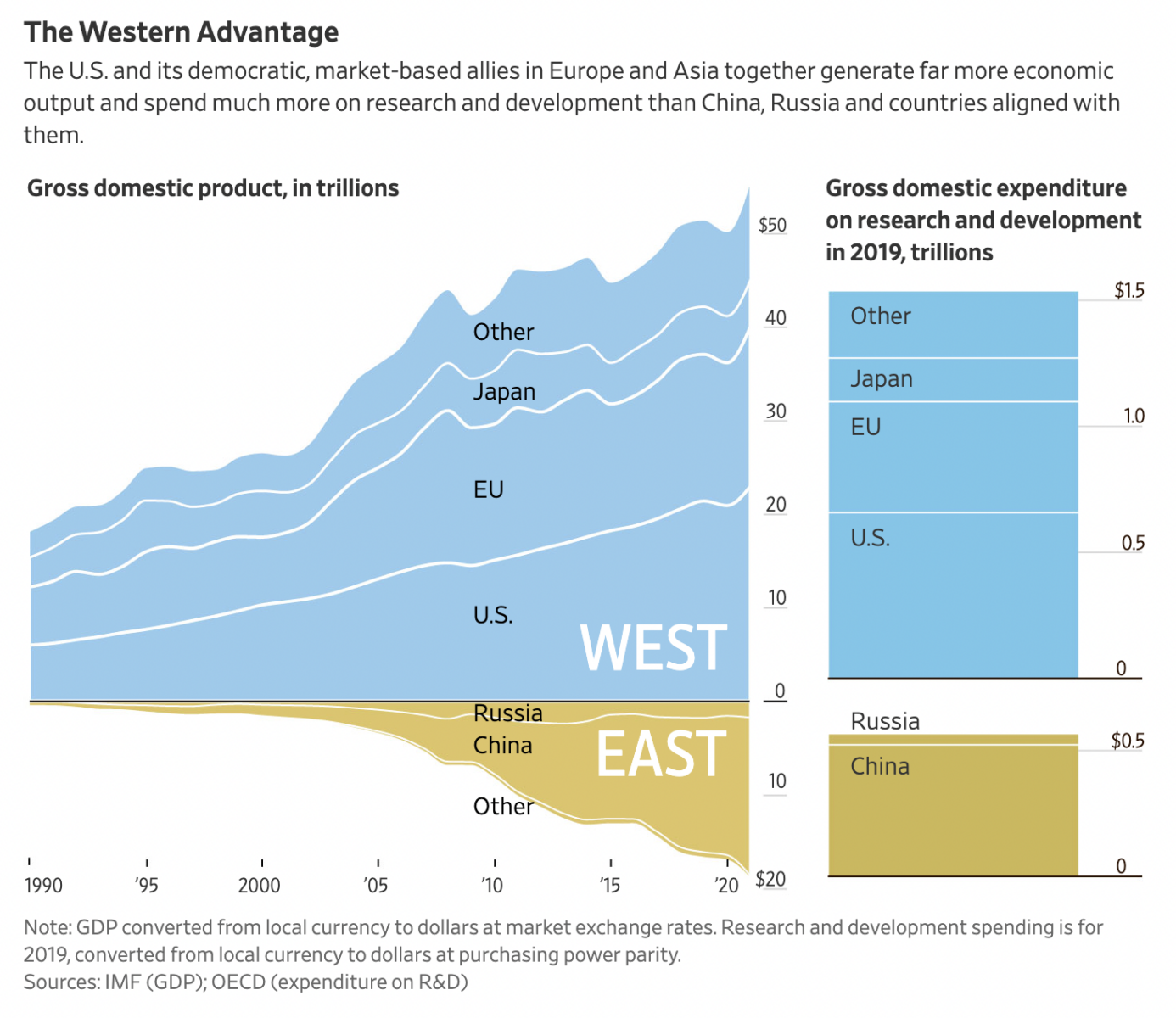
Wall Street Journal

U.S. Covid-19 Infections Likely to Rise Again, Fauci Says The BA.2 subvariant of omicron is driving up cases in Europe and Asia.

(…) BA.2 now makes up 23% of cases in the U.S. and we expect this to increase to 100% over time. We don’t know what BA.2 will look like in the U.S. We could see a second hump, like Europe, or no overall increase, like South Africa. Or, perhaps we may see an increase in only some states. (This is exactly what happened with Alpha and has my vote.)

BA.2 makes up the highest proportion of cases in the Northeast (see pie charts below; pink=BA.2; purple=BA.1). So, if we do see an uptick in cases, it would be in the Northeast first. (…)

New York is the only state that has an increasing case trend, with a 15% increase in the past 14 days. It’s an increase from a very small number to another small number, but we should keep an eye on it. (…)

THE DAILY EDGE: 18 MARCH 2022: Putin’s Demands

U.S. Unemployment Claims Decrease; Rate Hits Record Low

Initial claims for unemployment insurance were 214,000 in the week ended March 12 (-72.0% y/y) following 229,000 the week before. (…) The 4-week moving average of initial claims decreased to 223,250 from 231,750 in the prior week.

In the week ended March 5, continued weeks claimed for unemployment insurance were 1.419 million, down from 1.490 million in the previous week. These figures are below those immediately before the pandemic and are the lowest since 1970. The insured unemployment rate ticked down to 1.0% in the week ended March 5 from the 1.1% where it had been the three previous weeks. The March 5 amount is the lowest rate ever for this series, which began in 1971.

(…) Walmart’s average hourly rate is $16.40 an hour in the United States and the starting wage goes up to $30 an hour in select roles and markets, Chief People Officer Donna Morris said in a post on its corporate website.

The retailer said it had hired 5,500 pharmacists or pharmacy managers, over 13,000 pharmacy technicians and nearly 4,500 truck drivers last year. It also unveiled in September plans to hire 150,000 new U.S. store workers, most of them permanent.

Growing number of Canadians looking to cut back on spending as inflation rises, poll suggests

Four-fifths of respondents to the Leger poll had started or planned to buy cheaper items at the grocery store to save on food bills, and cut back on how much food they throw out to stretch every dollar.

Some three-quarters of respondents told the firm they planned to cut spending on household items and eat from local restaurants less frequently.

About one in two were already using their vehicles less to save on gasoline as prices at the pumps get pushed ever higher and a further one in five respondents planned to do the same in the near future.

Almost one-third were looking at buying an electric vehicle.

Overall, four-fifths of respondents said inflation was having a serious impact on their households, and the financial squeeze may only worsen as inflation rates are expected to go even higher.

The poll of 1,515 Canadians was taken between March 11 and March 13, but cannot be assigned a margin of error because online panels are not considered truly random samples.

Statistics Canada reported this week that the annual inflation rate in February was 5.7 per cent, a year-over-year increase in the consumer price index not seen in 31 years.

The headline rate is expected to rise closer to six per cent by the time March’s figure is calculated as Russia’s unprovoked invasion of Ukraine spikes global prices for oil and wheat.

Christian Bourque, Leger’s executive vice-president, said inflation and the situation in Ukraine have become top concerns for Canadians, supplanting COVID-19.

RBC Economics estimates that higher oil prices could cost Canadian households about $600 more per year, or $10-billion overall, to buy the same amount of gasoline that they did just a few weeks ago. (…)

While two-thirds of respondents to the Leger poll said their household finances were in good shape, almost as many noted that their earnings hadn’t kept up with the pace of price increases, creating a gap in purchasing power. (…)

Among respondents, almost two-thirds said rising interest rates would be a serious problem for their household to manage.

U.S. Housing Starts Rebound in February

Housing starts increased 6.8% (22.3% y/y) during February to 1.769 million (SAAR) and more than recovered the January decline to 1.657 million, revised from 1.638 million. It was the highest level of starts since June 2006. December starts also were revised up to 1.754 million from 1.708 million. The Action Economics Forecast Survey expected 1.700 million starts during February.

Starts of single-family units rose 5.7% (13.7% y/y) in February to 1.215 million after declining to 1.150 million in January. Multi-family housing starts improved 9.3% (46.6% y/y) to 554,000 from 507,000. (…)

Building permits fell 1.9% (+7.7% y/y) to 1.859 million from 1.895 million in January. Permits to build single-family homes eased 0.5% (+5.4% y/y) in February to 1.207 million units. Permits to build multi-family homes fell 4.4% (+12.2% y/y) to 652,000.

image

Traffic has declined from pandemic highs but remains on trend at a very high level.

image

U.S. Philly Fed Index Surprises to Upside in March

The Federal Reserve Bank of Philadelphia’s Manufacturing Business Conditions Index surprised market expectations in March, rebounding to 27.4, its highest reading in four months, from 16.0 in February. The Action Economics Forecast Survey looked for an unchanged reading of 16.0. The percentage of firms reporting improved conditions jumped up to 40.2%, the highest reading in four months, from 26.3% in February, while the share reporting weaker conditions increased to 12.7% from 10.3%. Responses to this month’s survey were collected from March 7 through March 14, that is, after the Russian invasion of Ukraine. (…)

Performance of the subindexes was almost universally stronger this month. The new orders index rose to 25.8 from 14.2 in February. The shipments index jumped up to 30.4 from 13.4 in February. The delivery times index soared to 39.7, its highest reading since May 2021, after having declined in each of the preceding three months. Nearly 46% of respondents reported longer delivery ties, up from 33% in February, while only 6% reported shorter delivery times, down from 10% in February. (…)

The employment subindexes pointed to further strengthening of labor-market conditions. The number of employees index rose to a new record of 38.9 from 32.3 in February. The average workweek reading jumped up to 21.4 from 10.8 in February.

Inflation pressures also remained intact. The prices paid reading jumped up to 81.0 in March, the highest reading since June 1979, from 69.3 in February. (…) These higher input prices are being passed through to higher output prices. The prices received index increased to 54.4 in March, the second highest reading since the mid-1970s, from 49.8 in February.

The Philadelphia Fed also surveys expectations for business activity in the coming six months. In contrast to the increase in the current conditions index, the expectations index for future activity eased to 22.7 in March from 28.1 in February. The decline in March was led by expected weaker new orders and shipments. Delivery times are expected to shorten while input prices are expected to continue to rise markedly.

image

Oil Market Faces Biggest Supply Crisis in Decades Unless OPEC Boosts Output, IEA Says Three million barrels a day of Russian oil output could be lost from April because of sanctions, agency says

The French president pledged to develop a state-sponsored EV leasing program for low-income households if he wins re-election next month.

Macron didn’t offer details on the leasing plan, but it would play into automakers’ strategies to promote long-term car rentals and sharing as the future of mobility. The government already offers subsidies to buy EVs.

Has the Fed Given Up on Fighting Inflation? It’s doing exactly the opposite of what’s needed to get prices under control.

Narayana Kocherlakota is a Bloomberg Opinion columnist. He is a professor of economics at the University of Rochester and was president of the Federal Reserve Bank of Minneapolis from 2009 to 2015.

(…) at their policy-making meeting earlier this week, Fed officials offered yet another benign forecast: Annual inflation will ease to 2.3% by the end of 2024.

What’s most troubling about such reassurances is how little they have to do with the Fed’s actions. The central bank can curb inflation only indirectly, by pursuing policies — such as increasing interest rates — that reduce demand for workers and slow economic growth. But its own projections show that it intends to do exactly the opposite: Officials’ median forecast is for the federal funds rate to peak at only 2.8% over the next three years, amid above-normal growth and associated reductions in the unemployment rate.

Why is the Fed not getting tougher on inflation? The answer seems to be that it thinks its monetary policy tools won’t have the desired effect. As Chair Jerome Powell noted in his last pre-Covid news conference, the relationship between macroeconomic slack and inflation has become very weak.

In other words, the Fed doesn’t think it will get much traction on inflation if it turns the economy toward slower growth. Still, this doesn’t explain why it’s actively turning in the wrong direction — the kind of mistake many a driver has made when hitting a patch of ice.

But Mr. Powell was adamant that the Fed would rise rates until inflation returns to its 2% target. This while acknowledging that they really don’t know how things will evolve. In all fairness, who actually knows?

David Rosenberg reminds us that, in fact, the Fed rarely knows:

Look at the accuracy of the Fed’s forecasts (a total of 110 data-points back to 2012):
• Fed funds rate: accurate 37% of the time
• Core inflation: accurate 29% of the time
• Unemployment rate: accurate 24% of the time
• Real GDP growth: accurate 17% of the time

(…) You have to consider that only 7% of the time in the past was the Fed too dovish on its rates forecast, which reveals bias, and two-thirds of the time it is too bullish on growth. So what I’m saying is that they say in the stock market never to bet against the Fed but in the bond market I can definitely tell you that it is perfectly safe to say that you can bet against the Fed’s forecasting ability — especially when it comes to the one thing the Fed can actually control, which is the policy rate.

China’s Great-Power Play Xi Jinping is standing by Russia on Ukraine, and the costs of doing so will mount.

The WSJ Editorial Board:

(…) Mr. Xi now finds himself embroiled in a global uproar that will be neither easy nor cheap for China. It deserves the global scorn it is receiving. (…)

While Beijing makes half-hearted bows toward neutrality in the war, Mr. Xi has exerted no pressure on Mr. Putin to stop it. China’s propaganda on Ukraine has a decided pro-Russia, anti-American tone. Beijing is resisting sanctions on Russia (as much as its banks can without jeopardizing their access to dollars). It may yet supply arms to Russia to support the war. (…)

By picking a side China by definition antagonizes those on the other side—including its own neighbors and economic partners.

Within days of Mr. Putin’s invasion, Japan renewed a debate about nuclear sharing with the U.S., South Korea elected a more pro-American president, and several traditionally neutral Asian countries joined Western sanctions on Russia in a signal to Beijing. Germany, long among China’s closest friends in Europe, is reconsidering its economic relationship. Mr. Xi’s alliance with Mr. Putin will also harden attitudes toward China in the United States. (…)

The pot boiled up briefly last week in an unusual public essay in which prominent think-tank scholar Hu Wei warned that Mr. Xi’s Russia policy may backfire by encouraging other countries to ally against China. Beijing now appears to have censored that essay, but the questions it raised are sure to linger in a year when Mr. Xi is set on securing another five-year term as the country’s leader.

(…) China has already assisted Russia—and betrayed Western Europe. Its acquiescence in Mr. Putin’s invasion has shown that it puts the desires of a marauding dictator above its trading and diplomatic relations with the West. China has picked the wrong horse, and it has shown again, as in Hong Kong, that it can’t be trusted.

The West should respond accordingly as it seeks to defend Taiwan and the free world’s interests from the Communist Party.

Speaking of trust:

Global Exodus From Chinese Markets Prompts Xi to Change Tack He may finally be heeding the concerns of international investors.

A sweeping set of promises this week from Xi’s government to make regulation more transparent and predictable — as well as a commitment to overseas markets including Hong Kong — suggests authorities are appealing to investors abroad. The ruling Communist Party is seeking to regain the trust of international funds and the global business community after the country was lumped in with Russia as an “uninvestable” destination.

China has more overtly distanced itself from Russia over the past week, saying it wants to avoid being impacted by U.S. sanctions and promising to “never attack” Ukraine. Xi is set to speak with U.S. President Joe Biden on Friday morning in Washington for the first time since Russia’s invasion. (…)

Among other notable developments this week, China’s securities watchdog is considering giving U.S. regulators access to company audits as soon as this year, people familiar with the matter said. This would be Beijing’s biggest concession since Chinese firms first listed in the U.S. more than two decades ago, and may help ease concern about forced delistings.

The State Council said a crackdown on internet platform companies would be completed “as soon as possible.” Increased regulation helped wipe as much as $661 billion off Alibaba Group Holding Ltd.’s shares alone since their 2020 peak.

The Finance Ministry said it won’t expand a property tax trial this year — a plan that had been floated in October. China’s cabinet said it would resolve risks around property developers. (…)

Xi’s government had until now displayed little concern for the rout in Chinese markets. State-directed campaigns like “common prosperity” limited private sector-growth and dragged the MSCI China Index of stocks down 22% last year — the biggest underperformance versus global shares since 1998. Investors in Chinese junk dollar bonds suffered their worst relative returns in more than a decade.

But with Xi set to seek a third term as president in a twice-decade leadership reshuffle later this year, the Communist Party is prioritizing stability above all else. (…)

Global confidence in Chinese financial markets was by some metrics the weakest since the financial crisis in 2008, with stocks cratering, credit plunging and record outflows from government bonds undermining the currency’s strength. Hong Kong’s reputation as an international finance hub has been called into question, after two years of closed borders spurred at least tens of thousands of residents to abandon the city. (…)

Western capital and technology are essential to China, despite recent efforts to make the country more self-sufficient. Foreign direct investment topped 1 trillion yuan last year, with about a third going into high-tech sectors, Chinese Commerce Minister Wang Wentao said this month.

The need to ensure global investors are on China’s side is unlikely to end any time soon.

“China can not develop in isolation of the world and nor can the world develop without China,” Vice President Wang Qishan said in a speech at the Bloomberg New Economy Forum in November. “China will keep its arms wide open, provide more market investment and growth opportunities to the world.”

This was from the International Business Times on November 7, 2012 just before the CPC National Congress appointed Xi Jinping as top leader.

A celebrated, if unofficial, motto of Bill Clinton’s first presidential campaign was, “It’s the economy, stupid.” With the Communist Party Congress meeting on Thursday just a day away, the Chinese population seems to be concerned about the same thing, as the country prepares for a once-in-a-decade transition to a new president and prime minister appointed by the ruling party. With, probably, a very local addition: it’s the reform, too.

A survey featured in China’s Global Times found that about 80 percent of the Chinese want political reform, and that the 18th National Congress of the Communist Party of China (CPC) is important in determining China’s future challenges. The survey of more than 1,200 people in seven major cities including China’s political capital, Beijing, and the business capital Shanghai, found that most people were mostly concerned with “economic development and people’s livelihoods,” according to the report.

If it was the economy then, how about now?

In 2011, 51.8% of the Chinese population lived in cities (700 million people). It’s now nearly two thirds, close to 1 billion people. Most of these people are dependent on the economy, many having become entrepreneurs, or are working for entrepreneurs exporting mainly to the E.U and North America. According to Trading Economics data, 48% of China’s exports are to North America and Europe. Russia: 2%.

If you doubt:

(…) In a Thursday meeting of the Politburo Standing Committee, the Communist Party’s top decision-making body, Mr. Xi asked officials to minimize the impact on the Chinese economy and people’s lives from Covid-19 control measures, according to the official Xinhua News Agency. (…)

Mr. Xi said China must “strive to achieve the biggest prevention and control effect with the smallest cost, and minimize the impact of the Covid situation on economic and social development,” Xinhua reported. (…)

Mr. Xi’s remarks came a day after senior officials moved to reassure investors rattled by the prospect of widespread factory closures and trade disruptions. (…)

[They also came] a month after Xi told local officials bringing the omicron outbreak under control was “a mission that overrides everything.”

An all-out lockdown of the city of Xi’an in western China imposed late last year marked a shift in the Chinese public’s patience with China’s Covid strategies. Since then, economists and ordinary people have been more outspoken about the human and economic costs of severe Covid-19 control measures.

Xi’an’s retail sales and fixed-asset investment tumbled 45% and 46% in December from a year earlier, respectively, according to estimates by Zhiwei Zhang, chief economist at Pinpoint Asset Management, based on official data.

Russia’s war is choking global supplies of the raw materials used to transport people and goods, make bread and keep the lights on. It’s driving up prices at the same time.

  • Russian exports range from oil and gas, which ordinarily bring the country more than $1 billion a day, to aluminum, nickel, palladium and wheat. It’s also a key low-cost shipper of every kind of crop fertilizer.
  • Costlier wheat and the risk of shortages will further drive up bread prices at a time when food has never been so expensive, exacerbating a global hunger crisis.
  • Winners and losers. The U.S. ban on imports of Russian oil means all producers will benefit from higher prices, but consumers from drivers to flyers must battle skyrocketing bills.

unnamed - 2022-03-18T085550.166

Call me Putin lays out his demands in Turkish phone call

(…) The Russian demands fall into two categories.

The first four demands are, according to Mr Kalin, not too difficult for Ukraine to meet.

Chief among them is an acceptance by Ukraine that it should be neutral and should not apply to join Nato. Ukraine’s President Volodymyr Zelensky has already conceded this.

There are other demands in this category which mostly seem to be face-saving elements for the Russian side.

Ukraine would have to undergo a disarmament process to ensure it wasn’t a threat to Russia. There would have to be protection for the Russian language in Ukraine. And there is something called de-Nazification.

This is deeply offensive to Mr Zelensky, who is himself Jewish and some of whose relatives died in the Holocaust, but the Turkish side believes it will be easy enough for Mr Zelensky to accept. Perhaps it will be enough for Ukraine to condemn all forms of neo-Nazism and promise to clamp down on them.

The second category is where the difficulty will lie, and in his phone call, Mr Putin said that it would need face-to-face negotiations between him and President Zelensky before agreement could be reached on these points. Mr Zelensky has already said he’s prepared to meet the Russian president and negotiate with him one-to-one.

Mr Kalin was much less specific about these issues, saying simply that they involved the status of Donbas, in eastern Ukraine, parts of which have already broken away from Ukraine and stressed their Russianness, and the status of Crimea.

Although Mr Kalin didn’t go into detail, the assumption is that Russia will demand that the Ukrainian government should give up territory in eastern Ukraine. That will be deeply contentious.

The other assumption is that Russia will demand that Ukraine should formally accept that Crimea, which Russia illegally annexed in 2014, does indeed now belong to Russia. If this is the case, it will be a bitter pill for Ukraine to swallow.

Nevertheless, it is a fait accompli, even though Russia has no legal right to own Crimea and actually signed an international treaty, after the fall of Communism but before Vladimir Putin came to power, accepting that Crimea was part of Ukraine.

Still, President Putin’s demands are not as harsh as some people feared and they scarcely seem to be worth all the violence, bloodshed and destruction which Russia has visited on Ukraine.

Given his heavy-handed control over the Russian media, it shouldn’t be too hard for him and his acolytes to present all this as a major victory.

For Ukraine, though, there are going to be serious anxieties.

If the fine details of any agreement aren’t sorted out with immense care, President Putin or his successors could always use them as an excuse to invade Ukraine again.

A peace deal could take a long time to sort out, even if a ceasefire stops the bloodshed in the meantime.

(…) Mr Putin had apparently been clear and concise in everything he said.

Yet even if he does manage to present an agreement with Ukraine as a glorious victory over neo-Nazism, his position at home must be weakened.

More and more people will realise that he overreached himself badly, and stories of the soldiers who have been killed or captured are already spreading fast.

Russia Keeps Rates at 19-Year High as War Fires Up Inflation

“The Russian economy is entering the phase of a large-scale structural transformation, which will be accompanied by a temporary but inevitable period of increased inflation,” policy makers said in a statement, warning output will contract over the coming quarters. (…)

The Bank of Russia’s statement on Friday didn’t include revisions to its forecasts for inflation and the economy after the invasion, but annual price growth reached an estimated 12.54% as of March 11, from just above 9% at end-February. Some economists expect it could soar to 20% in a matter of weeks.

(…) “This means that Sberbank will not be able to make transfers to other banks in U.S. dollars, Canadian dollars, pounds sterling, Danish crowns and Swedish krona.” Transfers of some currencies, including roubles, euros, Japanese yen and Swiss francs, remain possible at Sberbank branches. (…)

Russia Averts Default After Investors Receive Foreign Debt Payments Holders of two Russian dollar bonds said coupon payments arrived Thursday, a day late, but well within the 30-day grace period.
Fauci Warns of Potential Rise in U.S. Covid Cases as Funding Runs Dry The recent spike in cases in the U.K. is likely to happen in the U.S., the health adviser says.