The enemy of knowledge is not ignorance, it’s the illusion of knowledge (Stephen Hawking)

It ain’t what you don’t know that gets you into trouble. It’s what you know for sure that just ain’t so (Mark Twain)

Invest with smart knowledge and objective odds

THE DAILY EDGE: 15 MARCH 2022: Putin’s Dead End

MUST READ:

Possible Outcomes of the Russo-Ukrainian War and China’s Choice

This is from Hu Wei, a Chinese political scientist and national political adviser. He is the vice-chairman of the Public Policy Research Center of the Counselor’s Office of the State Council, the chairman of Shanghai Public Policy Research Association, the chairman of the Academic Committee of the Chahar Institute, a professor, and a doctoral supervisor. He is also a member of the 13th National Committee of the Chinese People’s Political Consultative Conference.

This article was submitted on March 5 by the author to the Chinese-language edition of the US-China Perception Monitor.

The article was censored in China and Hu Wei’s WeChat account was suspended.

Yet, it is a rational analysis of Putin’s situation and of China’s seemingly only alternative.

The Russo-Ukrainian War is the most severe geopolitical conflict since World War II and will result in far greater global consequences than September 11 attacks. At this critical moment, China needs to accurately analyze and assess the direction of the war and its potential impact on the international landscape. At the same time, in order to strive for a relatively favorable external environment, China needs to respond flexibly and make strategic choices that conform to its long-term interests.

Russia’s ‘special military operation’ against Ukraine has caused great controversy in China, with its supporters and opponents being divided into two implacably opposing sides. This article does not represent any party and, for the judgment and reference of the highest decision-making level in China, this article conducts an objective analysis on the possible war consequences along with their corresponding countermeasure options.

I. Predicting the Future of the Russo-Ukrainian War

1.  Vladimir Putin may be unable to achieve his expected goals, which puts Russia in a tight spot. The purpose of Putin’s attack was to completely solve the Ukrainian problem and divert attention from Russia’s domestic crisis by defeating Ukraine with a blitzkrieg, replacing its leadership, and cultivating a pro-Russian government. However, the blitzkrieg failed, and Russia is unable to support a protracted war and its associated high costs. Launching a nuclear war would put Russia on the opposite side of the whole world and is therefore unwinnable. The situations both at home and abroad are also increasingly unfavorable. Even if the Russian army were to occupy Ukraine’s capital Kyiv and set up a puppet government at a high cost, this would not mean final victory. At this point, Putin’s best option is to end the war decently through peace talks, which requires Ukraine to make substantial concessions. However, what is not attainable on the battlefield is also difficult to obtain at the negotiating table. In any case, this military action constitutes an irreversible mistake.

2.  The conflict may escalate further, and the West’s eventual involvement in the war cannot be ruled out. While the escalation of the war would be costly, there is a high probability that Putin will not give up easily given his character and power. The Russo-Ukrainian war may escalate beyond the scope and region of Ukraine, and may even include the possibility of a nuclear strike. Once this happens, the U.S. and Europe cannot stay aloof from the conflict, thus triggering a world war or even a nuclear war. The result would be a catastrophe for humanity and a showdown between the United States and Russia. This final confrontation, given that Russia’s military power is no match for NATO’s, would be even worse for Putin.

3.  Even if Russia manages to seize Ukraine in a desperate gamble, it is still a political hot potato. Russia would thereafter carry a heavy burden and become overwhelmed. Under such circumstances, no matter whether Volodymyr Zelensky is alive or not, Ukraine will most likely set up a government-in-exile to confront Russia in the long term. Russia will be subject both to Western sanctions and rebellion within the territory of Ukraine. The battle lines will be drawn very long. The domestic economy will be unsustainable and will eventually be dragged down. This period will not exceed a few years.

4. The political situation in Russia may change or be disintegrated at the hands of the West. After Putin’s blitzkrieg failed, the hope of Russia’s victory is slim and Western sanctions have reached an unprecedented degree. As people’s livelihoods are severely affected and as anti-war and anti-Putin forces gather, the possibility of a political mutiny in Russia cannot be ruled out. With Russia’s economy on the verge of collapse, it would be difficult for Putin to prop up the perilous situation even without the loss of the Russo-Ukrainian war. If Putin were to be ousted from power due to civil strife, coup d’état, or another reason, Russia would be even less likely to confront the West. It would surely succumb to the West, or even be further dismembered, and Russia’s status as a great power would come to an end.

II. Analysis of the Impact of Russo-Ukrainian war On International Landscape

1. The United States would regain leadership in the Western world, and the West would become more united. At present, public opinion believes that the Ukrainian war signifies a complete collapse of U.S. hegemony, but the war would in fact bring France and Germany, both of which wanted to break away from the U.S., back into the NATO defense framework, destroying Europe’s dream to achieve independent diplomacy and self-defense. Germany would greatly increase its military budget; Switzerland, Sweden, and other countries would abandon their neutrality. With Nord Stream 2 put on hold indefinitely, Europe’s reliance on US natural gas will inevitably increase. The US and Europe would form a closer community of shared future, and American leadership in the Western world will rebound.

2. The “Iron Curtain” would fall again not only from the Baltic Sea to the Black Sea, but also to the final confrontation between the Western-dominated camp and its competitors. The West will draw the line between democracies and authoritarian states, defining the divide with Russia as a struggle between democracy and dictatorship. The new Iron Curtain will no longer be drawn between the two camps of socialism and capitalism, nor will it be confined to the Cold War. It will be a life-and-death battle between those for and against Western democracy. The unity of the Western world under the Iron Curtain will have a siphon effect on other countries: the U.S. Indo-Pacific strategy will be consolidated, and other countries like Japan will stick even closer to the U.S., which will form an unprecedentedly broad democratic united front.

3. The power of the West will grow significantly, NATO will continue to expand, and U.S. influence in the non-Western world will increase. After the Russo-Ukrainian War, no matter how Russia achieves its political transformation, it will greatly weaken the anti-Western forces in the world. The scene after the 1991 Soviet and Eastern upheavals may repeat itself: theories on “the end of ideology” may reappear, the resurgence of the third wave of democratization will lose momentum, and more third world countries will embrace the West. The West will possess more “hegemony” both in terms of military power and in terms of values and institutions, its hard power and soft power will reach new heights.

4. China will become more isolated under the established framework. For the above reasons, if China does not take proactive measures to respond, it will encounter further containment from the US and the West. Once Putin falls, the U.S. will no longer face two strategic competitors but only have to lock China in strategic containment. Europe will further cut itself off from China; Japan will become the anti-China vanguard; South Korea will further fall to the U.S.; Taiwan will join the anti-China chorus, and the rest of the world will have to choose sides under herd mentality. China will not only be militarily encircled by the U.S., NATO, the QUAD, and AUKUS, but also be challenged by Western values and systems.

III. China’s Strategic Choice

1. China cannot be tied to Putin and needs to be cut off as soon as possible. In the sense that an escalation of conflict between Russia and the West helps divert U.S. attention from China, China should rejoice with and even support Putin, but only if Russia does not fall. Being in the same boat with Putin will impact China should he lose power. Unless Putin can secure victory with China’s backing, a prospect which looks bleak at the moment, China does not have the clout to back Russia. The law of international politics says that there are “no eternal allies nor perpetual enemies,” but “our interests are eternal and perpetual.” Under current international circumstances, China can only proceed by safeguarding its own best interests, choosing the lesser of two evils, and unloading the burden of Russia as soon as possible. At present, it is estimated that there is still a window period of one or two weeks before China loses its wiggle room. China must act decisively.

2. China should avoid playing both sides in the same boat, give up being neutral, and choose the mainstream position in the world. At present, China has tried not to offend either side and walked a middle ground in its international statements and choices, including abstaining from the UN Security Council and the UN General Assembly votes. However, this position does not meet Russia’s needs, and it has infuriated Ukraine and its supporters as well as sympathizers, putting China on the wrong side of much of the world. In some cases, apparent neutrality is a sensible choice, but it does not apply to this war, where China has nothing to gain. Given that China has always advocated respect for national sovereignty and territorial integrity, it can avoid further isolation only by standing with the majority of the countries in the world. This position is also conducive to the settlement of the Taiwan issue.

3. China should achieve the greatest possible strategic breakthrough and not be further isolated by the West. Cutting off from Putin and giving up neutrality will help build China’s international image and ease its relations with the U.S. and the West. Though difficult and requiring great wisdom, it is the best option for the future. The view that a geopolitical tussle in Europe triggered by the war in Ukraine will significantly delay the U.S. strategic shift from Europe to the Indo-Pacific region cannot be treated with excessive optimism. There are already voices in the U.S. that Europe is important, but China is more so, and the primary goal of the U.S. is to contain China from becoming the dominant power in the Indo-Pacific region. Under such circumstances, China’s top priority is to make appropriate strategic adjustments accordingly, to change the hostile American attitudes towards China, and to save itself from isolation. The bottom line is to prevent the U.S. and the West from imposing joint sanctions on China.

4. China should prevent the outbreak of world wars and nuclear wars and make irreplaceable contributions to world peace. As Putin has explicitly requested Russia’s strategic deterrent forces to enter a state of special combat readiness, the Russo-Ukrainian war may spiral out of control. A just cause attracts much support; an unjust one finds little. If Russia instigates a world war or even a nuclear war, it will surely risk the world’s turmoil. To demonstrate China’s role as a responsible major power, China not only cannot stand with Putin, but also should take concrete actions to prevent Putin’s possible adventures. China is the only country in the world with this capability, and it must give full play to this unique advantage. Putin’s departure from China’s support will most likely end the war, or at least not dare to escalate the war. As a result, China will surely win widespread international praise for maintaining world peace, which may help China prevent isolation but also find an opportunity to improve its relations with the United States and the West.

The only question is how long it will take China to sway Putin.

(…) The United States and its allies might be reluctant to have China play any role in this crisis, given that they view Beijing as a strategic rival. That’s foolish and shortsighted; the conflict’s immediate dangers far outweigh any competitive considerations. Ukraine itself sees the potential of Chinese-led conflict resolution.

So far, China has called for dialogue and says it supports humanitarian aid efforts. But Beijing’s interests in more proactive involvement are growing by the day.

China has a significant economic interest in a quick resolution to the Russian-Ukrainian war. China enjoys strong ties with Russia and Ukraine and is both countries’ largest single trading partner, though each trades more with the E.U. bloc than with China. Russia and Ukraine are crucial components of the Belt and Road infrastructure program as well as conduits for China’s trade with Europe. China-Europe rail transports have experienced a hundredfold increase since the beginning of the 2010s, but the ongoing conflict threatens to disrupt these trade flows.

China is also uniquely positioned to act as a neutral mediator between a Western-supported Ukraine and Russia. (…)

It is not in Beijing’s interests to rely solely on an anti-Western alliance with Moscow. Russia may possess a mighty military, but its economy is in long-term structural decline, with a G.D.P. not much larger than that of Spain. For all the talk of ties with Moscow, it is worth remembering that China’s economic interests with Russia are dwarfed by those it shares with the West. In 2021, trade between China and Russia may have jumped by 36 percent compared to the prior year, to $147 billion — but that’s still less than a tenth of the combined trade with the United States ($657 billion) and European Union ($828 billion). (…)

As Russia becomes isolated from the world economy, China will not want to shoulder Russia’s economic burden alone.

(…) from Mr. Putin’s perspective, (…) {as] he and his country face increasing isolation, he can’t afford to lose China, too.

There are also political reasons China wants this conflict to end in a way that is appealing to all involved. The longer the war lasts, the more it will reinvigorate the Western alliance around the idea of a values-based confrontation between East and West, bringing the United States and the European Union into even closer alignment while driving military budgets up around the globe. That is not good for China, which would prefer to maintain lucrative economic ties with the West and focus its resources on domestic development.

(…) Beijing has long striven to convince political and business elites in Europe and America that the rise of China does not present a threat. Support for Russian aggression — even perceived support — threatens to undermine that assertion. By contrast, playing a constructive role in ending the war could help cast China as a strategic and not just economic partner.

Ideologically, China has common ground with both Ukraine and Russia. China deeply values the principle of state sovereignty and has long opposed outside interference in what it considers internal affairs such as Taiwan. Last month, Foreign Minister Wang Yi of China once again called for a global respect of territorial integrity, saying, “Ukraine is no exception.” In this way, at least, Mr. Putin’s invasion directly undercuts one of China’s key values. (…)

The longer the war goes on, though, China may find itself in a position of diminishing returns in its close relationship with Russia. This makes the argument for Beijing to take on an active mediation role even more compelling.

What form could mediation take? Any serious resolution would have to involve the United States and the European Union as key actors in European security arrangements. Beijing could help to broker an immediate cease-fire as a prelude to talks among Russia, Ukraine, the United States, the European Union and China.

Beijing’s goal would be to find a solution that gives Mr. Putin sufficient security assurances that can be presented as a win to his domestic audience while protecting Ukraine’s core sovereignty and NATO’s open-door policy. Finding a landing zone for such an agreement is challenging but not impossible. Some creative diplomacy could solve this, such as a formula for NATO expansion that rules out Ukrainian membership in practice while preserving its sovereignty and NATO principles in theory.

Securing a multilateral resolution to the crisis in Ukraine will be a tough and risky challenge, but there is no country better placed to do so than China.

In today’s WSJ:

Beijing’s foreign-policy advisers say the fact that Mr. Xi, whose joint statement with Mr. Putin just a month ago brought the China-Russia relationship to its closest point in seven decades, dispatched his top diplomat for a meeting that would focus heavily on Ukraine showed Beijing’s growing interest in taking a more proactive role in de-escalating the crisis.

The advisers also point to recent remarks by Mr. Xi and other senior officials during phone calls with European leaders, in which they expressed desires to work with the international community for a cease-fire in Ukraine. (…)

“The U.S. needs to cut down bashing and sanctions on China,” said Wang Huiyao, an adviser to the Chinese government and president of the Center for China and Globalization, a Beijing think tank. “You can’t keep beating up China on one hand and then expect China to help.”

Bloomberg:

(…) “China is committed to promoting peace talks,” said Yang, a member of the Communist Party’s 25-seat Politburo. “And the international community should jointly support the Russia-Ukraine peace talks to achieve substantive results as soon as possible, and push the situation to cool down as soon as possible.”

During the “constructive” talks with Sullivan, Yang stressed Beijing’s opposition to Washington’s support for Taiwan, which “concerns China’s sovereignty and territorial integrity.” Beijing considers democratically ruled Taiwan to be part of its territory. (…)

George Friedman, who views the economic and financial sanctions winning it:

Saving Putin’s face in this situation is not a high priority. He gambled, he lost. Demonstrating what it means to lose, in a situation where the U.S. is involved, is more important because the next one who tries this should remember the lessons of Putin. (…) We have to force him backwards because we can’t give him what he wants, Ukraine.

CONSUMER WATCH

Goldman Sachs says that strong wage growth is now broad-based: “53% of (employment-weighted) industries saw annualized wage growth between 7% and 11% over the last six months (vs. 35% in July 2021), and the middle 60% of the wage distribution saw annualized wage growth averaging 7.4% (vs. 5.2% in July 2021).”

Employers are raising wages more aggressively to retain talent:

image

In the last 6 months, the middle 60% of the wage distribution saw annualized wage growth averaging 7.4%, up from 5.2% in July 2021. GS says that “the tightness of the labor market argues even more strongly for sustained strong wage growth than they did in the summer and fall.”

Yet, “we expect wage growth will remain very firm and only settle down to 5% by the end of the year.”

Why the settling down given that “the tightness of the labor market…”?

Nerd smile You’re too curious!

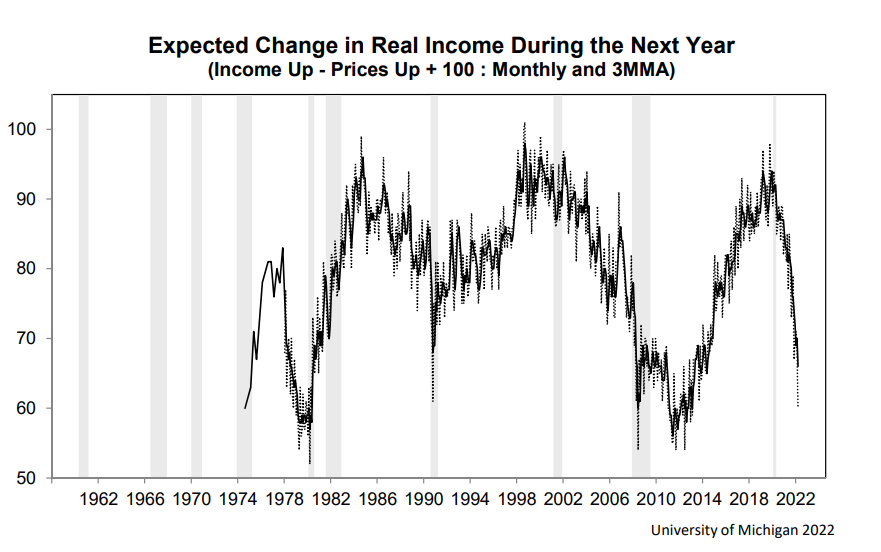
Consumer Spending Growth Expectations Spike, while Inflation Expectations Edge Back Up
  • Median one-year-ahead inflation expectations increased to 6.0% in February from 5.8% in January, matching its November 2021 series’ high. (…)
  • Median expectations about year-ahead price changes for food and gas increased by 3.3 and 1.5 percentage points to 9.2% and 8.8%, respectively. The median year-ahead expected change in the costs of medical care and college education increased to 9.6% and 9.0%, from 9.5% and 7.3%, respectively. The median expected one-year-ahead change in the price of rent increased to 10.1%, from 9.8%.
  • Median one-year-ahead expected earnings growth was unchanged for the second consecutive month at 3.0% in February and remains above its 12-month trailing average of 2.6%.
  • Median year-ahead household spending growth expectations increased sharply to 6.4% from 5.5% in January, reaching a new series high since the start of the series in June 2013. The increase was broad-based across age, income, and education groups.

Why Your Electric Bill Is Soaring—and Likely to Go Higher Surging natural-gas prices, stoked by the Ukraine crisis, are raising power costs for utilities, and in turn, customers: “My utility bill literally doubled overnight.”

(…) Already, the natural-gas supply crunch has made it substantially more expensive for utilities to purchase or produce electricity. As a result, some customers have seen winter power bills increase by 20% or more compared with the year before, in addition to seeing higher home-heating bills. (…)

U.S. Henry Hub gas prices on Friday reached about $4.73 per million British thermal units. That is up from about $2.66 per million British thermal units a year ago. (…)

Average retail electricity prices for residential customers rose 4.3% last year to 13.72 cents per kilowatt-hour, the largest annual increase since 2008, according to the Energy Information Administration. (…)

Eversource Energy, ES -0.70% a utility that serves 3.6 million electric and natural-gas customers in Connecticut, Massachusetts and New Hampshire, raised electricity rates at the start of January to account for higher wholesale prices. The company said an average residential customer could see bills increase by as much as 25% through the end of June. (…)

San Diego Gas & Electric, a unit of Sempra that serves about 1.5 million electric customers and 900,000 natural-gas customers, raised rates at the start of the year to account for higher supply costs. Average residential bills increased by 11.4%. (…)

Treasury Yields Rebound to New Multiyear Highs The yield on the 10-year Treasury note hit the highest close since June 2019 as investors worry the isolation of Russia will add to inflation by boosting commodity prices.

The yield on the benchmark 10-year U.S. Treasury note settled at 2.139%, up from 2.004% Friday and its highest close since June 2019. (…)

While some have thought that higher commodity prices could slow economic growth and therefore make the Fed cautious about raising interest rates, “our view is, that for the U.S., that the inflation impact will be higher than any negative impacts from growth,” she said. (…)

Rosenberg Research estimated the impact of food-and-energy-induced inflation for the U.S. using

a range of scenarios from agriculture price inflation staying right where it is at roughly 50% year-over-year (determined by underlying commodity food costs) and WTI oil prices increasing to $150 per barrel, to food prices doubling and oil prices increasing to $200 per barrel.

If the price shock were to persist, this would contribute anywhere from 2.6 to 4.4 percentage points to the year-over-year inflation print, and if core CPI were to sustain its current pace (6.4% YoY in February), then we could be looking at double-digit U.S. inflation figures in 2022.

RR estimates that GDP growth would be shaved between 1.1 to 1.7 percentage points as a result, getting the U.S. close to recession markers.

China’s Factories, Consumers Make High-Speed Start to Year Covid lockdowns and war in Ukraine threaten to slow growth

(…) Industrial output jumped 7.5% during the first two months from a year earlier, accelerating from December’s 4.3% pace and more than double the 3.5% expected by economists polled by The Wall Street Journal.

Retail sales, a gauge of household consumption, rose 6.7% during the same period from a year earlier, beating the 4.3% growth expected by the surveyed economists. Catering sales, including from restaurants, grew at a faster pace than goods sales for the first time since July.

China saw a strong recovery in fixed-asset investment, which rose 12.2% in the first two months from a year earlier, compared with 4.9% growth in the same period of last year. Economists surveyed had predicted a 5% gain.

Investment in infrastructure projects increased by 8.1% from a year earlier, an indicator that authorities plan to rely more on funded projects to drive growth as the contribution from exports wanes and the real-estate sector’s woes drag on. (…)

Broad credit expansion pulled back from 10.5% in January to 10.2% in February, slowing for the first time since September. In February, new medium- to long-term household loans, primarily mortgages, contracted for the first time since 2008, signaling that confidence remains weak even after authorities cut mortgage lending rates to spur demand.

Home sales by value slumped 22.1% in the first two months from a year earlier, the biggest decline since March 2020, when the initial eruption of the Covid-19 pandemic dealt a hammer blow to China’s economy. Real-estate investment during the first two months slowed to a 3.7% gain from a year ago, down from 4.4% growth in 2021.

China’s official unemployment rate edged up 0.4 percentage point to 5.5% in February from the end of 2021, while the youth jobless rate climbed to 15.3% in February from 14.3% in December. (…)

HALF A BEAR

From Horan Capital:

  • For the S&P 500 Index, almost half of the stocks in the index are down greater than 20% from their most recent 52-week high, in fact 44.8% are down an average of 31.9%. Another 29.7% are down 15.1% from their one-year high. The average stock in the index is down 20.1%.

S&P 500 Index stocks down from 52-week highs as of March 11, 2022

  • The S&P 400 Mid Cap Index is showing 82% of the index holdings are down greater than 10% from their 52-week highs. Just over 50% are down an average of 33.9% and the average stock in the Mid Cap Index is down 22.8%.

S&P 400 Mid Cap Index stocks down from 52-week highs. March 11, 2022

  • The S&P 600 Small Cap Index is exhibiting the greatest weakness among its holdings with 81.4% are down more than 10%. The small cap index has the largest number of stocks down more than 20% at 58.6%. The average stock in the small cap index is down 26.6% from their 52-week highs.

S&P 600 Small Cap Index holdings down from their 52-week highs. March 11, 2022

  • In total, 778 stocks, 52% of the combined 1500 large, mid and small cap indices, are down more than 32% from their 52-week high. This while the average index was down 23.2%.

Market bottoms normally happen when investors capitulate.

(…) capitulation bottoms have characteristics where trading volume spikes and the number of stocks making now lows spikes. As the below chart shows, 52-week new lows appear elevated but not at extremes, The number of new 52-week highs has declined and would be indicative of the weakness seen this year. The mixed trading and sentiment data are a few factors clouding the anticipated future direction of the market. However, with a large number of stocks down a lot, there are opportunities in individual stocks that are beginning to surface.

S&P 500 number of new highs versus number of new lows since 2018

SentimenTrader agrees:

Curiously, there have been no days with truly exhaustive selling pressure during this entire [10-week] stretch.

Despite the large (but not extreme) price swings, there have been zero days with more than 90% selling pressure. The NYSE Up Issues Ratio has remained above 10% the entire time, unlike the pandemic crash and its aftermath.

The suggestion is that investors are relatively complacent. Despite heavy and persistent losses, we haven’t yet seen a whoosh of panic selling pressure, something that always piques the interest of contrarians. While such behavior would certainly help more metrics reach compelling oversold levels, it’s not necessarily required. (…)

The persistent selling pressure is causing sentiment to stay weak. Or rather, weak sentiment is causing rally attempts to falter quickly: chicken and egg.

At least some investors seem to be stepping up. With commercial hedgers covering some of their historic short positions against major equity index futures, Smart Money Confidence has been able to rise. It has now surpassed the peak from the pandemic.

According to the Backtest Engine, the S&P 500 rallied during the next 2-4 weeks after 52 out of 57 days when the Smart Money was more than 85% confident in a rally.

As Jay recently noted, the spread between Smart and Dumb Money has been wide for a while, and the 20-day average just crossed above 47%. Again, the Backtest Engine shows excellent short- to medium-term returns after similar behavior. (…)

Basically, every metric I use to gauge the market environment is negative. For all intents and purposes, that requires truly extreme sentiment readings to have any confidence in a multi-week to multi-month rebound. There are always some outliers, but fewer than 10% of core indicators are in risk-on mode, and more than a third of a broader range of indicators have been in extreme pessimism territory. We’re seeing ample evidence of extremes, but not panic. Maybe we need that one final flush that finally triggers it. That would make a case for a sustained rebound easier from a contrary point of view. The tricky part is that a final flush is unnecessary for that rebound to occur.

BTW, the 13-34 EMA trend lines finally crossed yesterday:

image

Here’s the record since 2006:

THE DAILY EDGE: 14 MARCH 2022

CONSUMER WATCH

Chicago Fed Advance Retail Trade Summary

The Chicago Fed Advance Retail Trade Summary (CARTS) tracks the U.S. Census Bureau’s Monthly Retail Trade Survey (MRTS) on a weekly basis, providing an early snapshot of national retail spending.

In the fourth week of February, the Weekly Index of Retail Trade decreased 1.5% on a seasonally adjusted basis after increasing 0.1% in the previous week. For the month of February, retail & food services sales excluding motor vehicles & parts (ex. auto) are projected to increase 1.6% from January on a seasonally adjusted basis and to increase 0.9% when adjusted for inflation.

If so, February + January would be up 4.6% following -2.8% in December, or +7.4% annualized in the last 3 months. However, the Bureau of Economic Analysis estimates that inflation was 9.5% a.r. in the last 3 months and that inflation-adjusted retail sales ex-autos were actually down 1.2% in those 3 months.

The good news id that if we eliminate December, real sales jumped 3.1% in the last 2 months.

The not so good news is that February was strong until the fourth week, down 1.5% in nominal terms. That was the first week of the war in Ukraine.

png

Image

The agency says on a seasonally adjusted basis that household credit market debt as a proportion of household disposable income rose to 186.2 per cent in the fourth quarter, compared with a revised reading of 180.4 per cent for the third quarter. The reading means there was $1.86 in credit market debt for every dollar of household disposable income.

Statistics Canada says the ratio stood at 181.1 per cent at the end of 2019 before the pandemic, while the previous record high was in the third quarter of 2018 at 184.7 per cent.

The increase in the fourth quarter came as household credit market debt rose 1.9 per cent and household disposable income fell 1.3 per cent.

On a seasonally adjusted basis, households added $50.0-billion of debt in the fourth quarter including $46.3-billion in mortgages and $3.7-billion in non-mortgage loans.

The household debt service ratio, measured as total obligated payments of principal and interest on credit market debt as a proportion of household disposable income, rose to 13.84 per cent in the fourth quarter of 2021 compared with 13.55 per cent in the third quarter.

(…) Britons were already bracing for a 54% increase in the energy price cap from April, and now economists estimate the energy regulator will need to impose another similar rise from October, pushing average household energy bills to over 3,000 pounds annually, the FT said. (…)

The war looks set to push inflation up further as it sends key commodity prices higher, with the Times newspaper reporting British Steel lifted its prices by about 25%. Drivers are paying record levels for gasoline and diesel, taxpayers are due a 1.25 percentage-point increase in payroll taxes in April, and the Bank of England is expected to raise rates again on Thursday.

(…) Brazilians who took on debt during the pandemic are bearing the brunt of the central bank’s campaign to tame stubborn double-digit inflation. While policymakers in the U.S. and Europe dithered, monetary authorities in Latin America’s biggest economy were quick to respond to surging prices, prodded by memories of bouts of hyperinflation that stretched into the early 1990s.

Since March 2021, Brazil’s central bank has ratcheted up its benchmark interest rate, called the Selic, a total of 875 basis points. The strong medicine is starting to show results. Consumer prices rose 10.4% in January from a year earlier, an improvement on an 18-year high of almost 11% in November. (…)

Payments on consumer debt including mortgages, car loans, credit cards, and other types of revolving credit now gobble up about 52% of household income—a 9-percentage-point jump from 2020 and the highest rate recorded since the central bank began tracking the metric 17 years ago.

During the pandemic, more out-of-work or underemployed Brazilians began relying on credit cards or store cards to pay for such essentials as groceries and drugs. (…)

When Brazil’s central bank slashed the policy rate to 2% in August 2020 to support the economy during the Covid-19 crisis, many Brazilians jumped at the opportunity to sign up for credit cards or take out loans. A host of financial technology companies competed with banks to sign up new customers. By the end of 2020 there were 134 million active credit cards in circulation, according to the latest data available from the central bank, a 35% increase from 2018. (…)

Many Brazilians also took advantage of a three-and-a-half-year streak of single-digit interest rates, the longest in Brazil’s history, to buy a home. But because almost all mortgages in the country carry variable rates, many weren’t able to keep up with payments once the central bank began hiking. Brazil’s banking federation, known as Febraban, estimates that 18.7 million home loan contracts have been renegotiated since the beginning of the pandemic (…).

Rising interest rates helped tip Brazil into recession last year, and while the economy managed to eke out growth of 0.5% in the final quarter of 2021, tighter credit conditions will continue to act as a drag on the expansion. Economists are penciling in at least two more rate hikes in 2022, lifting the Selic to 12.25%. (…)

The West’s Economic War Plan Against Russia After invading Ukraine, Putin is now president of ‘North Korea on the Volga,’ says Edward Fishman, an expert on sanctions and a former State Department official.

(…) “The 2014 sanctions,” Mr. Fishman says, “may have made Putin complacent.” Imposed four months after Russia seized Crimea, they were “like a 2 out of 10 in intensity, whereas the ones that have been imposed in the last two weeks are more like an 8 out of 10.” Even the relatively mild 2014 sanctions “tanked the Russian economy. Although not as bad as it’s been in the last two weeks, the economy went into pretty steep recession.” Russia’s gross domestic product contracted by somewhere between 2.5% and 4% in 2015, and the ruble lost half its value. (…)

Mr. Putin was unprepared for the enormity of the hit on his central bank (…).

Mr. Fishman therefore expects sanctions to be ratcheted up. The U.S. has already banned Russian oil and gas imports, a potentially major escalation. “Oil is the lifeblood of Russia’s economy,” Mr. Fishman says. “It accounts for half of all export revenues. By banning Russian oil imports, the Biden administration has taken the first step in what I anticipate will be a global campaign to curb Russia’s oil sales.” The U.S. imports modest amounts of oil from Russia, so the significance “is in the signal—that Russia’s oil sales, like its central-bank reserves, will be in the crosshairs of Western sanctions so long as Putin’s war against Ukraine continues.”

Europe imports far more Russian energy than the U.S. Its reductions, Mr. Fishman says, “will, by necessity, need to come in phases. But the final destination is clear: The West is determined to wean itself off Russian energy in the months and years to come.”

The Iran oil sanctions offer a model for how sanctions against Russia might work, with the U.S. imposing so-called secondary sanctions against states that step in to buy oil from the targeted country. Washington could also insist that money due Russia for its oil be kept in escrow accounts in the purchasing country, putting it beyond the reach of Mr. Putin and his war effort.

(…) Could China come to Russia’s aid and buy all its oil, presumably at a significant discount? “This time, unlike with Iran—if it’s the U.S., Europe, Japan and other democratic powers jointly threatening consequences, I think the pressure would be pretty immense—even on China.”

It is “honestly shameful,” Mr. Fishman says, “to be seen to be paying Putin right now. There is the reputational cost to China. Does China want to be seen as bankrolling Russian imperialism in Ukraine? I think China is very cautious about being perceived as an imperialist power itself.”

But what if China and Russia collaborate to develop an alternative financial system that makes both countries sanctions-proof? Mr. Fishman thinks that’s unlikely. It would require a “dramatic reconfiguration” of the Chinese state and political economy, including the removal of capital controls. (…)

Russia, by contrast, has vulnerabilities the West has yet to exploit. Sberbank is Russia’s largest bank by far, the equivalent of “ Wells Fargo, Capital One, and Bank of America rolled into one.” Now it faces only the original debt sanctions from 2014, plus an additional transaction ban post-Feb. 24. Mr. Fishman foresees those being heightened to “full blocking sanctions in the weeks and months ahead.”

So far, the most significant Russian bank to be fully blocked is VTB, the country’s second-largest. But it’s only half the size of Sberbank. Blocking the latter would beggar the Russian people, which may be why full blocking sanctions haven’t been imposed. “It’s also an important escalation step, an arrow to keep in the West’s quiver to use later if necessary.” Sberbank has about a third of the banking sector’s assets in Russia and about 60% of all household deposits. Half of Russia’s wages are channeled through the bank. “There could be very broad-based, microlevel financial and economic dislocation” were Sberbank to be hit, Mr. Fishman says.

The bank, like VTB and others, is “majority state-owned, so there’s a Putin connection and Putin taint to all of them.” Mr. Putin views them as “parts of the commanding heights of the economy and as elements of the state that need to be kept under close Kremlin control.”

Mr. Fishman lists a range of other companies that could be fully blocked: Rosneft, the largest petroleum company; Rostec, the defense behemoth; Gazprom, the gas giant; Alrosa, the world’s leading diamond-mining company by volume; Russian Railways; Sovcomflot, the largest shipping company; and Rostelecom, the largest provider of digital services.

Russia is becoming “North Korea on the Volga,” Mr. Fishman says. It will be “a pariah state,” completely isolated from global economic and financial markets. “It’s not just the reality of economic isolation, it’s the shame of transacting with Russia.”

The danger—and the tragedy—is that Mr. Putin’s goal may be to turn Ukraine into “Syria on the Dnieper.”

(…) “The total volume of our reserves is about $640 billion, and about 300 billion are in such condition that we can’t use them now,” he told state television in an interview on Sunday.

“We see what pressure Western countries put on China” to limit access to reserves in yuan, he said. “But I think our partnership ties with China will let us not just preserve it but expand it.” (…)

China’s move to double the yuan trading band for the ruble showed little sign of boosting activity in the pair, with liquidity tightening further on Friday. (…)

(…) As sanctions threaten to reduce Russia to an economically isolated pariah, China will not ride to its rescue. The calculation for China is simple: its commercial ties with the US, European Union and their allies in Asia are much more important than those with Russia. (…)

Even though China’s government probably wishes to assist Russia, it cannot shield its companies from the potentially crippling punishments for violating sanctions. Officials are likely to follow their past practice of implicitly advising companies to obey sanctions by alerting them to risks. Beijing will not bust sanctions and risk losing access to markets in the developed world, which is united against Russia. (…)

image

The basic incentive for Chinese financial institutions to comply is the same as for their Western counterparts: self-preservation. The US Treasury Department has the legal authority through the Countering America’s Adversaries Through Sanctions Act to inflict secondary sanctions on non-US companies or individuals that “knowingly facilitate significant transactions” with blacklisted Russian entities. The US has repeatedly applied such secondary sanctions under other laws to enforce previous sanctions against North Korea, Iran, Russia or Venezuela. Losing access to the US financial system and the ability to conduct transactions with US counterparts is too big a risk for most Chinese banks. (…)

Chinese companies transacting with banned Russian banks still risk secondary sanctions no matter which settlement system or currency they use. Only institutions that have no need to transact with the US can actually ignore the risk of sanctions, and such institutions are few and insignificant (such as Bank of Dandong which deals with North Korea, and Bank of Kunlun which deals with Iran).

(…) if Russia deliberately cut down its natural-gas exports to squeeze Europe, China may be able to absorb some additional Russian supply at the margin, but not enough to offset the financial losses. China received roughly 10bn cubic meters of natural gas from Russia last year via the Power of Siberia pipeline, which began delivery late 2019 and is the sole natural gas route between the two countries.

That pipeline could theoretically carry as much as 38bn cubic meters per year—a fraction of sales to Europe, estimated to be about 175bn cubic meters in 2021 Furthermore, the pipeline is not connected to the fields that supply Europe, which makes it difficult in the short term for Russia to reroute to China natural gas previously intended for the West.

The existing structure of global trade and the logic of self-preservation mean that, despite the political alliance that Xi and Putin celebrated not long ago, China in practice will offer Russia little more than rhetorical solidarity with its sanctions woes.

Deutsche joins the ranks of Goldman Sachs (GS.N) and JPMorgan Chase (JPM.N), which were the first major U.S. banks to exit after Moscow’s invasion of Ukraine. Those moves put pressure on rivals to follow. (…)

A day earlier, Deutsche Bank’s Chief Executive Christian Sewing explained to staff why the bank was not withdrawing.

“The answer is that this would go against our values,” he wrote. “We have clients who cannot exit Russia overnight.” (…)

New index shows U.S. inflation expectations shifting higher

A new daily index released on Tuesday by the London-based ICE Benchmark Administration (IBA) showed the expected pace of consumer price increases over the next year rising from 3.5% on Feb. 1 to 5.24% as of March 7. The index is based on trading in the roughly $300 billion monthly market for inflation-protected U.S. Treasury securities and in the $100 billion monthly market for inflation swaps contracts.

Inflation anticipated over longer 10- and six-year horizons has also turned abruptly higher since the onset of the Ukraine war, with rates as of Monday around 2.43% and 2.73%, respectively, significantly above the Fed’s 2% annual price increase target, the index shows.

ICE inflation expectations indexReuters Graphics

No good breadth!unnamed - 2022-03-12T073659.206

Container Freight Rates Set to Rise on More China Lockdowns

Image

U.S. Housing Affordability Declines Sharply in January

The National Association of Realtors’ Fixed Rate Mortgage Housing Affordability Index fell 2.8% in January to 143.0 from 147.1 in December. Affordability has fallen 22.2% since its recent high of 183.8 in January 2021, which was revised from 187.8. The Housing Affordability Index equals 100 when median family income equals the amount required for an 80% mortgage on a median-priced existing single-family home.

In January, a 1.2% decline (+15.9% y/y) in the median sales price of a home to $357,100 was accompanied by a rise in mortgage rates to 3.51% in January, up from 2.79% twelve months earlier. As a result, the monthly mortgage payment rose 3.4% to a record $1,284 (27.0% y/y) from $1,242 in December.

Median family income in January rose 0.5% (-1.2% y/y) to $88,114 from $87,683 in December. Consequently, the standard mortgage payment as a percent of income rose to 17.5%, the highest level since August 2018. These figures are up from a recent low of 13.6% in January 2021.

 image 

A longer-term chart from Political Calculations:

Relative Affordability of New Home Prices | Annual: 1967-2020 | Monthly: December 2000 - January 2022

(…) the concept saw a major resurgence in the 1970s, a period marked by high inflation. Its resurgence was somewhat short-lived, and many lawmakers adopted the view that rent controls hurt housing markets more than they helped tenants, by discouraging new development and disincentivizing apartment maintenance.

More recently, some economists and politicians have reconsidered that thinking, pointing to rent control as one of the few ways to protect low-income renters, who often face the greatest hardships. In 2019, New York Congresswoman Alexandria Ocasio-Cortez proposed a national rent-control law. California and Oregon advanced rent-control bills the same year, now laws in both states. (…)

Federal Reserve Faces a Policy Dilemma of Its Own Design The central bank dug itself into a hole, and the way out means risking either a recession or future price and financial instability. (Mohamed A. El Erian)

(…) Finding itself far away from the world of first best policy responses — for that, the Fed should, and could, have started easing its foot off the stimulus accelerator last summer, as some of us advocated — the options that the central bank has are far from straightforward and satisfactory.

Just consider the two main policy alternatives for the Fed.

By taking bold actions upfront, it would minimize the risk of de-anchored expectations joining an existing set that is already driving up inflation (from higher commodity prices and rising wages to disrupted supply chains and costly transportation). This would involve starting the rate-hiking cycle with an increase of at least 50 basis points — signaling an aggressive set of increases to follow — and initiating the balance sheet runoff in the next couple of months.

This approach would allow the Fed to regain some of its inflation-fighting credibility and have better control of the policy narrative. I say only “some” because markets would still need to see follow-through, having witnessed the Fed grossly mischaracterize inflation as “transitory” until the end of November, continue to miss on its inflation estimates, repeatedly revise up forecasts (which it will still need to do again this week) and, as absurd as this sounds given how high inflation has been for many months, waiting until last week to halt completely its emergency liquidity injections.

The problem with this approach is that it risks sending the U.S. economy into recession. This is not a risk to be ignored, especially given that the most vulnerable segments of the population would be most at risk. Having already experienced a significant erosion of purchasing power because of significantly higher prices on food and gas, they could now face both the fear and reality of further income losses.

The other option is a “dovish tightening” cycle.

In this scenario, the Fed would raise rates by only 25 basis points on Wednesday, leave rather vague its forward policy guidance and retain flexibility on how and when it will embark on reducing its bloated $9 trillion balance sheet.

Again, this is not a highly attractive policy option. It would do too little to contain inflationary expectations, increasing the likelihood that workers and companies would seek to compensate more fully for past price increases and also start to take preemptive steps to protect against future inflation. (…)

The one certainty in this is that, even after the FOMC meeting concludes on Wednesday, the Fed will continue to find itself in the deep hole it has dug for itself.

Data: FactSet; Chart: Axios Visuals

PRICE = EPS x P/E

Goldman Sachs’ David Kostin:

A surge in commodity prices and a weaker outlook for US and global economic growth lead us to lower our EPS estimates. Our new 2022 EPS estimate of $221 reflects 5% year/year growth compared with our prior estimate of 8% growth to $226. Our forecast 2023 earnings growth rate remains unchanged at 6% but the EPS level is trimmed to $233 (from $240). A 12% upward revision to Energy sector EPS partially offsets headwinds to profits in other sectors from decelerating consumer spending and increased input cost pressures. Excluding Energy, we expect S&P 500 EPS will grow by just 2% in 2022 vs. 6% for consensus.

Nothing surprising there. In fact, this downward revision in growth and earnings could be the first of many. Who really knows?

But this part surprised me (my emphasis):

Our 4700 target embeds an expectation that the forward P/E multiple will rebound from 19x today to 20x by year-end as the Equity Risk Premium (ERP) compresses. Our year-end 2022 implied absolute valuation represents a 5% P/E decline from the 21x multiple at the start of 2022. In our base case, real yields climb from recent lows but remain negative through 2022 despite Fed tightening. At the same time, decelerating growth and inflation and reduced political uncertainty should compress the ERP from today’s elevated level.

The current 620 bp gap between the S&P 500 earnings yield and the real 10-year US Treasury yield is the widest since March 2020 and matches levels in 4Q 2018, underscoring the potential value opportunity in US stocks if the growth outlook improves. Because we expect the various sources of current investor uncertainty will take time to be resolved, most of the equity upside should come later in 2022. Our 3- and 6-month S&P 500 targets are 4300 and 4400, respectively.

Kostin is in a “business as usual” mode here. But this is not Syria, it’s not Afghanistan, it’s not even Irak. Ukraine is much more than a local conflict that will eventually pass et be forgotten in economic and financial history books.

Actually, history is being rewritten, backwards. Hopefully, soldiers and weapons will soon be withdrawn. But the world has just changed significantly, more so than after 9-11. The economic and financial warfare does not seem just passing. Trust and global cooperation are no more. Entering Cold War II featuring a modern day Russia befriended with dominant China.

If globalization has been so positive for growth, inflation, margins and profits, can we reasonably assume that regionalization and isolation will be similarly positive?

Earnings multiples are discount factors, influenced by interest rates but also by growth, confidence and visibility. Anybody currently displaying confidence about any economic and financial scenario lives in a fantasy world where sales and profits grow linearly and equities trade on wishful P/Es irrespective of how economic agents and investors behave.

Because nobody (other than Putin, maybe) has any clue on how and when (even where) this nonsense will stop, it would be futile to discuss commodity prices, inflation, supply chains and profit margins at this stage.

Let’s just simply use Goldman’s EPS numbers even if they assume that “decelerating growth and inflation” will unleash “value opportunity in US stocks if the growth outlook improves”.

Sell-side narrative to keep dance floors busy.

But we can discuss P/E multiples, this elusive component of stock prices that incorporates objective and subjective factors to compound earnings, more or less. Not totally trivial considering that 20 rather than 19 is actually a +5.3% difference.

The simple truth is that nobody really knows. All we can do is objectively look at the past (which rhymes as Mark Twain said) and try to rationally and reasonably apply our findings to the future to assess our investing odds.

A quick glance at this chart reveals the impact of inflation on earnings multiples. Between 1957 and 1995, the correlation between core inflation and earnings multiples was a very strong -0.77.

  • When inflation was below 6%, trailing P/Es hovered between 13 and 21. The median P/E was 17 and the median inflation 3% (17 + 3 = 20, the Rule of 20).
  • When inflation rose above 6% between 1974 and 1995, P/Es ranged between 7 and 13 (median = 10) with inflation between 6.5 and 13.5 (median = 10). The R20 again.

image

The Rule of 20 simply observes that, historically, the S&P 500 median (“fair”) P/E is 20 minus inflation with a very stable range of 15 (extreme undervaluation) to 25 (extreme overvaluation). The “20” equilibrium simply means that the 25% potential valuation upside (20 to 25) is equal to the valuation downside (20 to 15).

Since 1957, there have only been two periods of truly excessive valuations, the dot.com period and the recent QE-sponsored frenzy. The downside has been rather consistent at 15, with short-lived lows of 14.

image

Note that even in the most recent lowflation years the Rule of 20 successfully identified periods of attractive and less attractive equity valuations. Like all valuation tools, the Rule of 20 is not a timing aid. But it is a useful, objective measure of valuation risk, particularly since it always returns to its median.

As it stands at 4200 with Goldman’s EPS estimate of $221 and 6.5% inflation, “fair or equilibrium” value is 2983. If longer-term inflation is assumed at 3.5%: 3646. For 4200 to be “fair” value (R20 of 20), one need to assume 1.0% inflation. Can we get EPS of $221 then?

It has been suggested to swap inflation for 10Y Treasury yields to “better reflect today’s reality” of very low interest rates. On that basis, the S&P 500 has corrected to its 22 historical median within a 17-27 range and could be assessed “fair value”.

image

The problem is that “today’s reality” is significantly influenced by the Fed’s QE programs keeping real rates unusually low absent a recession. That influence will soon diminish as QE presumably becomes QT amid high inflation and great uncertainty. Can we see fair value in equities using real rates that look anything but fair value? I think not.

fredgraph - 2022-03-13T113125.174

EARNINGS WATCH

Perhaps the only positive last week is that there have been no new pre-announcements following the 3.7 N/P ratio of the previous 2 weeks.

image

Trailing EPS are $209.50 while full year 2022 estimates are $226.38, 8% higher (GS is at $221, +5.5%).

(…) As of Thursday, there were 523 aircraft leased to Russian carriers by companies outside the country, according to IBA, a consulting firm. Of those, 101 are on lease to S7 Airlines and 89 to Aeroflot. Both airlines have stopped flying internationally, eliminating any chance of repossessing the planes on foreign soil.

“The general consensus is: That’s it, we will not be able to recover them,” said Vitaly Guzhva, a finance professor at Embry-Riddle Aeronautical University.

Dr. Guzhva and others who attended a recent industry conference in San Diego said the predicament for the leasing companies was the talk of the event, held by the International Society of Transport Aircraft Trading. Experts there generally aligned around the view that the companies were facing the possibility of huge losses, they said. All told, the planes are worth as much as $12 billion, according to Ishka, an aviation consulting firm. (…)

The financial consequences of the planes’ being held in Russia could be far-reaching, too. Such aircraft are financed in a variety of ways, including funding from banks, leasing companies themselves, and investors in securitized debt.

Insurers and reinsurers may be on the hook, too, experts said. Aviation war insurers, in particular, are concerned and facing their biggest potential losses since the Sept. 11 terrorist attacks, according to Russell Group, a data and analytics company. Aircraft insurance premiums have been on the rise for years as the industry struggled to counter recent annual losses. (…)

There will be lasting consequences for Russia, too. The crisis is likely to drive up the cost of doing business there generally and may cause some leasing companies and insurers to swear off the Russian market.

And while nationalizing the planes may provide a short-term benefit to Russia in keeping domestic flights moving, it won’t be long before carriers there grow desperate for spare parts. With Boeing and Airbus refusing to offer parts and support to Russian airlines, those carriers are likely to start cannibalizing the planes they have on hand, devaluing those aircraft. (…)

TECHNICALS WATCH

The S&P 500 is clearly in a downtrend with lower highs and lower lows so far this year. Its 200dma has flattened while its 13-14 EMA trend is 0.2% from flashing a cyclical bear signal. Most other technical indicators are also negative, including the critical measures of supply.

(…) But the two-week slump since the war started hasn’t deterred retail investors from trying to time the end of the market’s drop. In the week up to March 9, Investors poured $8.8 billion into U.S.-focused equity funds, the most in a month, EPFR Global data compiled by Bank of America Corp. show. Retail investors purchased a net $1.7 billion of stocks in the week ended Thursday, extending a two-month spree that according to JPMorgan Chase & Co. was the largest at this point in at least five years. (…)

It seems that retail buying continues to be overwhelmed by widespread selling.

The only recent positive is that small caps (S&P 600 and the Russell 2000) have stabilized. The Russell 2000 is now down 18.9% from its November 8 peak after having lost 22.5%.

US officials say Russia has asked China for military help in Ukraine White House fears move is sign of ever closer ties between Beijing and Moscow
Chile’s Boric Becomes President With Vow to Redistribute Wealth

(…) Boric’s speech heralds the start of Chile’s most left-wing government in half a century that will be led by its youngest president ever. It is also the most feminist, with women taking charge of 14 of the 24 ministries. The former student protest leader won a decisive victory in December’s runoff on pledges to promote a more equal, tolerant and greener future for one of Latin America’s richest nations. Investors are hoping that doesn’t come at the cost of fiscal stability.

More broadly, his victory has galvanized the political left across Latin America, tapping into demands for a stronger government presence in the region that arguably suffered the most during the pandemic. Later this year, Colombia and Brazil will hold presidential elections and currently have leftist front-runners. (…)