The enemy of knowledge is not ignorance, it’s the illusion of knowledge (Stephen Hawking)

It ain’t what you don’t know that gets you into trouble. It’s what you know for sure that just ain’t so (Mark Twain)

Invest with smart knowledge and objective odds

THE DAILY EDGE: 3 MARCH 2022

COMPOSITE PMIs

Eurozone growth rebounds in February as output price inflation hits new survey high

Following January’s slowdown, economic growth regained momentum midway through the first quarter to reach its strongest pace since last September. Expansions were of equal strength across both manufacturing and services during February, with a more substantial rebound from January in the latter driving the resurgence in growth at the composite level.

However, the accelerated expansion in business activity was accompanied by a survey-record increase in prices charged for goods and services.

After slumping in January to an 11-month low, the seasonally adjusted IHS Markit Eurozone PMI® Composite Output Index rebounded from 52.3 to 55.5 in February. Overall, this signalled the strongest increase in combined manufacturing and services output since last September. The expansion was also faster than the series average, but was still weaker than the highs seen in the second half of last year as business capacity was constrained by supply shortages and poor staff availability.

image

By sector, rates of output growth were of equal strength at manufacturers and service providers. A notable improvement in service sector growth following January’s virus-driven slowdown drove the quicker overall upturn.

Supporting greater levels of business activity were rising intakes of new business, latest survey data showed. Demand for euro area goods and services increased for a twelfth successive month in February, with the expansion gathering pace to the quickest since last September. Stronger increases in new orders were seen at both sectors.

Business activity was also buoyed by demand conditions across external markets during February as new export orders rose. The upturn, albeit the fastest in four months, was slightly slower than that seen on average across the current 15-month expansion sequence.

To sustain activity levels, and accommodate for growing intakes of new business, private sector employment across the eurozone increased during February. The rate of job creation also gathered some momentum, accelerating to a three-month high. The increase in staffing levels was particularly sharp at manufacturers, although hiring at service providers was nevertheless solid in the context of historical data.

Employment growth also coincided with a stronger level of business optimism in February. The Future Output Index increased to an eight-month high.

Despite increased workforce numbers, latest survey data highlighted additional strain on operating capacities in February as backlogs of work grew. The rate of accumulation was the fastest in six months and among the strongest on record.

Finally, latest survey data pointed to an intensification of price pressures across the eurozone in February. For the second successive month, input costs increased at a faster rate. Moreover, the rate of inflation was the second-quickest on record, surpassed only by last November’s peak. Selling price inflation meanwhile hit a survey high during February.

The IHS Markit Eurozone PMI® Services Business Activity Index rose to 55.5 in February, signalling the strongest expansion in services output for three months and a notable turnaround from January’s nine-month low of 51.1.

Other key gauges of sectoral health also rose in a robust fashion during February, with new orders and employment growing at faster rates than at the beginning of the year. There was, however, a sharper rise in volumes of outstanding business, as backlogs accumulated to the strongest extent since last August.

Business confidence meanwhile strengthened from January. The level of optimism was historically elevated and the greatest in four months.

Meanwhile, service sector companies in the euro area recorded sharper inflationary pressures in February. Input costs and output prices rose at faster rates and in both cases, the increases were the sharpest on record.

Chris Williamson, Chief Business Economist at IHS Markit said:

The survey data for February depict a eurozone economy that was regaining robust growth momentum ahead of the invasion of Ukraine. Business activity accelerated to a pace commensurate with GDP growth in excess of 0.6%, buoyed by a relaxation of virus restrictions. (…)

Prices rose to the greatest extent yet recorded in almost a quarter of a century of data collection.

(…) the risks are heavily tilted towards inflation running even higher and persisting for longer than previously expected, squeezing household budgets. (…)

With inflation risks rising and growth prospects waning, the Ukraine conflict adds to business and household headwinds for the coming months, and exacerbates the difficult juggling act of the ECB in controlling inflation while sustaining a robust economic recovery.

China: Services activity expands at slowest rate for six months

Latest survey data signalled a further slowdown in business activity growth across China’s service sector in February. Output rose only slightly overall, while firms reported a renewed fall in overall new business, which was linked to the ongoing pandemic and measures to contain the virus. Employment meanwhile fell slightly for the second month in a row, and backlogs of work increased marginally. Cost pressures eased, with both input costs and output charges rising at slower rates than those seen at the start of the year.

Despite the recent slowdown in activity growth, businesses expressed stronger optimism for the year ahead, often linked to forecasts of a robust post-pandemic recovery.

The seasonally adjusted headline Business Activity Index slipped from 51.4 in January to 50.2 in February, to signal only a marginal rise in services activity. Notably, the expansion was the softest seen since the current period of growth began last September. According to panel members, the ongoing pandemic and measures to stem the spread of the virus had dampened business activity.

image

Measures to contain COVID-19 cases, including travel restrictions, also impacted client demand, which fell for the first time in six months. Though mild, it marked the quickest decline in total new work since April 2020. This was partly due to a further reduction in new export business, which was reportedly also dampened by the pandemic.

image

Capacity pressures moderated in February, as highlighted by a softer increase in outstanding workloads. Notably, the rate of accumulation was the slowest seen for four months and only marginal. When higher backlogs were reported, this was generally due to the pandemic and its impact on operations and logistics.

Service sector employment in China fell for the second month running in February. However, the rate of job shedding eased since January and was only slight. Firms that registered lower headcounts often linked this to relatively subdued demand conditions and challenges recruiting or replacing workers due to COVID-19.

Latest survey data showed a notable slowdown in the rate of input price inflation midway through the first quarter. The latest increase in input costs was the softest since August 2021 and mild overall. Where higher expenses were reported, they were often attributed to greater costs for raw materials, energy and labour.

The rate of prices charged inflation likewise slowed in February. Service providers raised their fees only modestly, with some firms choosing to raise their fees in order to pass on additional cost burdens to clients. However, there were reports that increased competition for new business had limited overall pricing power.

Although firms saw a further slowdown in growth momentum during February, optimism around the 12-month outlook for output improved to a three-month high. Service providers generally expect a strong post-pandemic recovery, improving customer demand and new product launches to drive activity growth over the next year.

image

Fed Beige Book Says U.S. Economy Grew Modestly Amid Omicron Surge Rising costs and difficulty hiring persist, companies say in the Fed’s periodic compilation of business anecdotes from around the country.

(…) The report contains information gathered through Feb. 18, after the Omicron variant drove up Covid-19 cases and hospitalizations to record highs the month before. (…)

Businesses across the country reported that the prices they charged customers rose robustly, mostly due to the rise of transportation costs. The increased costs of labor and continuing material shortages also contributed to the rise in consumer prices. These businesses expect consumer prices to rise “over the next several months as they continue to pass on input cost increases,” the report said. (…)

Companies across the country also indicated that they have raised or plan to raise wages for lower-paid workers, but many of them also expect those gains to eventually plateau this year. Staffing agents in the Federal Reserve System’s Cleveland district said that some businesses can’t afford to pay workers much more.

A bank in the Fed’s Dallas district reported that it raised its minimum wage to $18 an hour to address retention issues. One manufacturer in the Federal Reserve’s St. Louis district estimated that its labor costs increased 5% to 20% because of overtime and hazard pay. (…)

A manufacturing company in Arkansas said that it has tripled or plans to triple its number of robotic welders to cope with a difficulty in hiring workers. (…)

Schroders just published a piece on automation:

(…) the next decade looks set to herald a new cycle of capital expenditure (capex, or spending on buying, upgrading or improving physical assets).

Companies will lift long-term spending, with investment in automation spearheading this as it addresses both capacity and resilience concerns at the same time. (…)

604050-automation-capex-chart1.png

We now see very clear data points, as well as commentary from company management teams, illustrating that we have reached the tipping point for both reshoring and automation. As the chart below shows, we think the potential for automation remains huge.

604050-automation-chart2.png(…) 90% of respondents in a UBS Evidence Lab survey of companies in the US and North Asia said they expect to move production away from China within two years. Amid continued semiconductor shortages and tightness for logistics infrastructure, most management teams appear to be aiming to stabilise the supply chain.

For manufacturing moving out of China, popular destinations include Japan, South Korea and Taiwan. Southeast Asia appears to be a less popular destination than it was, maybe due to the impact of Covid lockdowns in various Southeast Asian countries like Vietnam and to concerns about supply chain risks. Nonetheless, we still think the region will prove attractive.

Critical industries like medical suppliers, automotive, semiconductors/technology, and aerospace look primed to reshore first. But as a crucial supplier to these industries, the capital goods sector is at the centre of this equation. Capital goods firms make machinery used to manufacture goods and products. (…)

Bank of Canada Raises Interest Rates to Curb Inflation Central bank said more rate increases are required, with inflation well above its 2% target and Ukraine conflict pushing prices upward

(…) Canada’s economy ended last year with what the central bank said was “very strong” fourth-quarter growth of 6.7% annualized, confirming that any spare capacity has disappeared. The level of gross domestic product is now above pre-pandemic levels. Despite a setback in January related to public-health restrictions tied to the Covid-19 Omicron variant, the central bank said household spending remains robust and it anticipates first-quarter growth to surpass expectations for a 2.4% advance. (…)

Russia’s invasion of Ukraine has thrown a curveball into central bankers’ plans, with the Bank of Canada describing it as “a major new source of uncertainty.” Canadian Finance Minister Chrystia Freeland said Tuesday that officials from the Group of Seven economies realize there will be economic collateral damage as Western allies aggressively impose sanctions on Russia.

In order for sanctions to really have an impact, Ms. Freeland said, “we are going to have to be prepared for there to be some adverse consequences for our own economies.”

One of those consequences, the Bank of Canada said, is hotter inflation. (…)

Powell yesterday:

to the extent inflation comes in higher or is more persistently high than that then we would be prepared to move more aggressively by raising the federal funds rate by more than 25bps at a meeting or meetings

Goldman Sachs last week:

Much of the inflation overshoot has been driven by pandemic-related supply-demand imbalances for durable goods, and a key reason that we and other forecasters expect inflation to fall is that as these imbalances fade, the prices of supply-constrained goods like cars should not only stop rising so quickly, but partially revert toward their pre-pandemic trends.

However, costs of production for these goods have also grown faster than usual, which means that prices are not elevated solely because of scarcity and we should therefore not expect full reversion.

Our updated analysis implies that there is still substantial durables goods inflation payback in the pipeline, but less than we previously estimated. Payback is unlikely to materialize until 2022H2, and prices of some durable goods are likely to rise further in the near term.

FYI, the BLS now has this category “Commodities less food, energy, and used cars and trucks”, i.e. core goods less used cars.

MoM monthly since October: +0.5%, +0.8%, +0.9%. YoY in January: +7.2%. Last 3 months annualized: +9.1%. Last 2 month annualized: +10.6%.

Same data but for Durables:  +1.4%, +1.6%, +1.2%. YoY in January: +18.4%. Last 3 months annualized: +17.9%. Last 2 month annualized: +18.0%.

Commodities on course for biggest gain since mid-1970s

Global Supply Chain Pressures Remain High but May Have Begun to Moderate

Sources: Bureau of Labor Statistics; Harper Petersen Holding GmbH; Baltic Exchange; IHS Markit; Institute for Supply Management; Haver Analytics; Bloomberg L.P.; authors’ calculations. Note: Each index is scaled by its standard deviation.

Recession watch

This is from NDR courtesy of CMG Wealth’s Steve Blumenthal who says to “focus on the data box in the lower right section of the chart.  When the reading is ‘Above 70’ recession has occurred 93.02% of the time.  When the reading is ‘Below 30’ recession has occurred just 17.65% of the time.”

PBOC Says Number of High-Risk Banks to Fall as It Cracks Down

By 2025, the number of lenders in the “high-risk” category in the PBOC’s quarterly reviews will likely drop below 200 from 316 in the fourth quarter of 2021, the central bank said in a statement Thursday. At the peak in the third quarter of 2019, there were 649 banks listed in the category, according to the statement.

High-risk banks accounted for only 1.04% of overall assets in the banking industry last year, indicating the sector’s stability, the PBOC said. China had 4,398 banking institutions in the last quarterly review, it said. (…)

FYI:
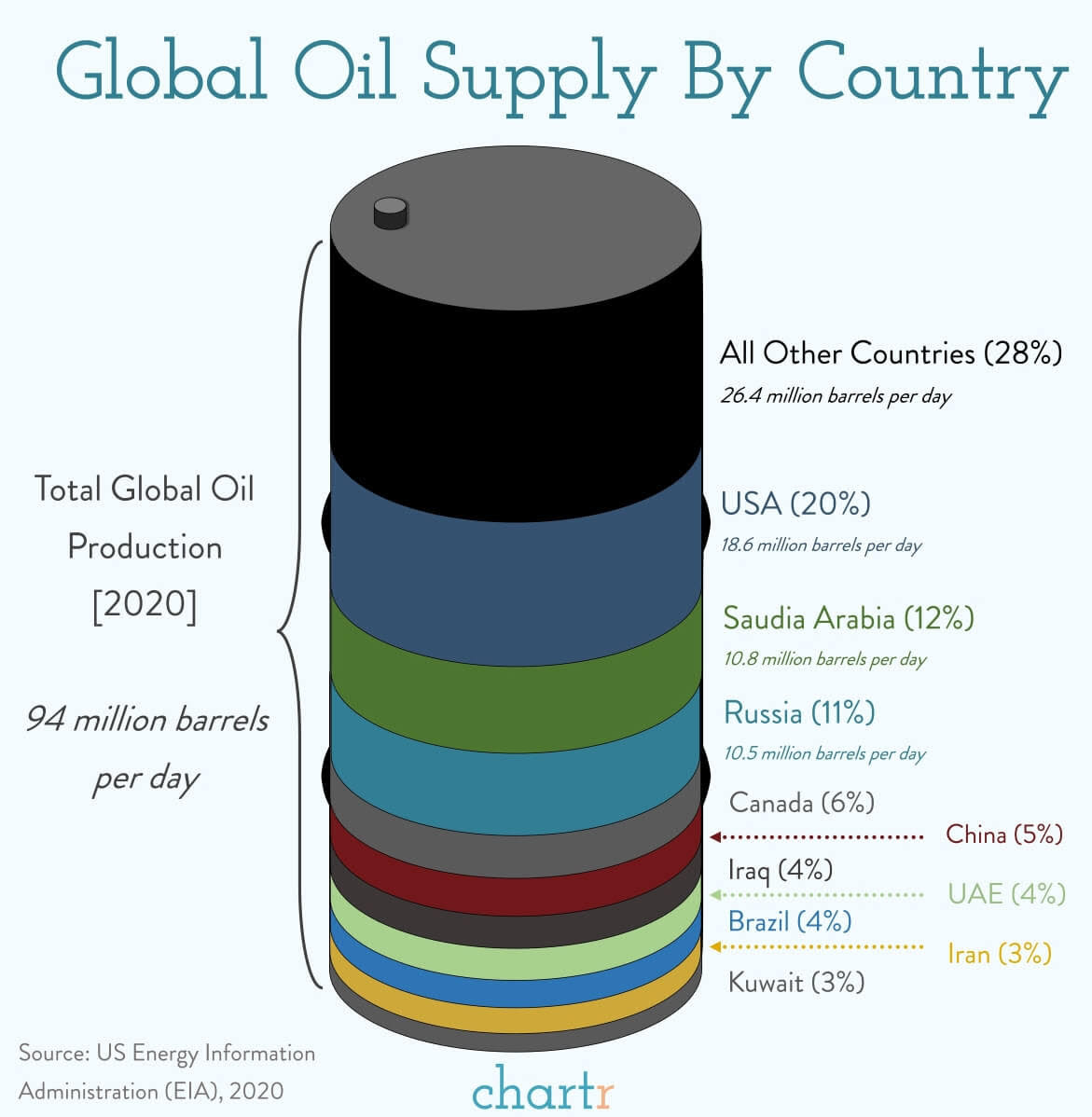
Chartr

  • Russian Foreign Minister Sergei Lavrov said he believed some foreign leaders were preparing for war against Russia and that Moscow would press on with its military operation in Ukraine until “the end”. Lavrov also said Russia had no thoughts of nuclear war. (Reuters)

THE DAILY EDGE: 2 MARCH 2022: Q1 GDP Contraction?

U.S. MANUFACTURING PMI

Output growth picks up amid stronger demand and easing supply disruption

The US manufacturing sector registered a stronger improvement in operating conditions midway through the opening quarter of 2022, according to February PMITM data from IHS Markit. Although only modest overall, output rose at a faster pace amid signs of easing supply chain disruption and the sharpest expansion in new orders since last October. Stronger new sales growth spurred manufacturers to increase staffing numbers and boost stocks of purchases. Pressure on capacity softened as backlogs rose at the slowest pace in a year as material shortages eased.

Although input costs increased at the slowest pace for nine months, selling prices ticked higher at the sharpest rate since last November.

The seasonally adjusted IHS Markit US Manufacturing Purchasing Managers’ Index™ (PMI™) posted 57.3 in February, up from 55.5 in January and only slightly lower than the earlier released ‘flash’ estimate of 57.5. The headline figure was below the peaks seen in 2021, but signalled a stronger upturn in the health of the manufacturing sector, with sharper output and new order expansions contributing to overall growth.

image

February data indicated a modest upturn in production across the manufacturing sector. The expansion was much softer in comparison with the marked rates of growth seen throughout 2021 due to ongoing material and labor shortages, but where a rise was noted this was reportedly driven by a steeper increase in new sales and efforts to clear backlogs.

Manufacturers recorded a sharper uptick in new orders midway through the first quarter, supported by stronger demand from new and existing customers. The rate of growth quickened from January’s 16-month low and was the quickest since last October. At the same time, foreign client demand also strengthened, as new export orders rose at the fastest pace for five months.

There was some reprieve for goods producers amid reports of softer deteriorations in supplier performance in February. Delivery delays were the least severe since last May. Firms often noted that although material shortages eased, transportation and logistics delays extended lead times.

Less severe supply disruption was reflected in a slower increase in input prices. The rate of cost inflation eased to the softest for nine months, but remained historically elevated amid higher material and transportation fees.

Despite a softer rise in input costs, firms were able to increase their selling prices at a sharper pace in February amid more accommodative demand conditions. Companies widely attributed the rise in output charges to the pass-through of greater costs to clients. The rate of charge inflation accelerated to a three-month high and was marked.

In line with stronger demand conditions, firms stepped up their purchasing activity. Input buying expanded at a steeper pace as firms sought to build safety stocks. Efforts to protect against future shortages and price hikes led to the fastest rise in pre-production inventories since last July. That said, stocks of finished goods were depleted at a quicker rate as manufacturers struggled to replenish inventories.

Increased new order inflows spurred greater optimism among manufacturing firms in February. Output expectations for the coming year were the strongest since November 2020, as firms were buoyed by hopes of a reduction in supply-chain disruption and a greater ability to retain employees.

The ISM report for February came in with the headline index rising to 58.6 from 57.6 (consensus 58.0) and new orders at 61.7 versus 57.9. The employment component slipped to 52.9 from 54.5, but it is still at least in expansion territory. Prices paid remain elevated at 75.6.

Indeed, inflation pressures are likely to remain elevated with customer inventories falling rapidly again (anything below 50 is a contraction), while order backlogs are rising again. This suggests that US manufacturers continue to hold significant pricing power – they have months and months worth of orders on their books and they know customers are desperate so they can easily pass on higher costs to customers.

ISM order backlogs and customer inventories suggest manufacturers have pricing powerunnamed - 2022-03-01T112524.789Source: Macrobond, ING

From the ISM: WHAT RESPONDENTS ARE SAYING
  • “Electronic supply chain is still a mess.” [Computer & Electronic Products]
  • “Strong sales growth as retail continues to return.” [Chemical Products]
  • “Demand for transportation equipment remains strong. Supply of transportation services continues to be a major issue for the supply chain.” [Transportation Equipment]
  • “Strong demand has continued beyond our traditional seasonality curves. Coupled with the continuing difficulties in procurement of ocean freight, operational planning and managing costs are our biggest challenges.” [Food, Beverage & Tobacco Products]
  • “We have seen year-over-year revenue growth of about 10 percent due to markets coming back. However, in the automotive area, the microchip shortage is causing slowness in growth.” [Machinery]
  • “Demand for steel products has increased to historic levels, driven by the automotive and energy industries.” [Fabricated Metal Products]
  • “We are expecting a year of strong demand, higher prices and continued supply chain challenges.” [Textile Mills]
  • “Demand continues to be strong, increasing our backlog. Production has been more consistent due to availability of parts, but we are not able to increase builds to cut into the backlog.” [Electrical Equipment, Appliances & Components]
  • “Business conditions are good, demand remains strong, and we continue to be challenged to keep up with demand.” [Miscellaneous Manufacturing]
  • “Business is still strong. Facing logistics and raw material supply chain issues with some products.” [Plastics & Rubber Products]

Sixteen of 18 manufacturing industries reported growth in new orders in January, up from 11 in January and 13 in December.

  • Commodities Up in Price: 33 vs 35 in January, 28 in December and 36 in November.
  • Commodities Down in Price: 6 vs 7 in January, 8 in December and 5 in November.
  • Commodities in Short Supply: 13 vs 16 in January, 10 in December and 21 in November.
U.S. Light Vehicle Sales Decline in February

The Autodata Corporation reported that light vehicle sales during February fell 6.9% (-12.3% y/y) to 14.15 million units (SAAR). Sales were 23.5% below the April ’21 peak of 18.50 million units.

Sales of light trucks declined 7.4% (-10.7% y/y) last month to 11.18 million units. Purchases of domestically-made light trucks weakened 8.3% in February (-12.2% y/y) to 8.62 million units. Adding to this decline was a 4.5% easing (-5.2% y/y) in sales of imported light trucks to 2.56 million units.

Trucks’ share of the light vehicle market slipped to 79.0% and remained below an 80.4% share in October.

Passenger car sales fell 4.5% (-17.5% y/y) in February to 2.98 million units. Purchases of domestically-produced cars declined 3.8% last month (-16.7% y/y) to 2.00 million units. Sales of imported autos eased 5.8% last month (-19.0% y/y) to 0.98 million units.

Imports’ share of the U.S. vehicle market rose in February to 25.0% but it was still below last September’s high of 27.9%. Imports’ share of the passenger car market fell to 32.9% last month. Imports’ share of the light truck market increased to 22.9%, the highest level since September.

(CalculatedRisk)

U.S. Construction Spending Posted Solid Increase in January

The value of construction put-in-place jumped up 1.3% m/m (8.2% y/y) in January after an upwardly revised 0.8% m/m increase in December (initially 0.2%) and an upwardly revised 1.0% m/m gain in November (previously 0.6% m/m). The Action Economics Forecast Survey has looked for a modest 0.3% m/m rise in January.

Private construction increased a solid 1.5% m/m (11.0% y/y) in January following upwardly revised increases in both December and November. The originally reported 0.7% m/m increase in December was revised up to 1.3% while the 0.8% rise previously reported for November was bumped up to a 1.3% m/m gain. Private residential construction increased 1.3% m/m (13.4% y/y) with increases in both single family construction (1.2% m/m) and home improvements (1.8% m/m) while multi-family construction edged down 0.1% m/m, their second monthly decline in the past three months.

Private nonresidential construction rose 1.8% (7.3% y/y) in January after having slipped 0.2% m/m in December. The January gain was concentrated in manufacturing construction, which rebounded 8.5% m/m following a 3.9% slump in December, power (2.7% m/m) and transportation (1.5% m/m). (…)

The value of public construction rose 0.6% m/m (-1.3% y/y) in January following a 1.0% m/m decline in December (revised up from a 1.6% m/m drop) and a 0.1% decrease in November. (…)

image

Q1 GDP contraction?

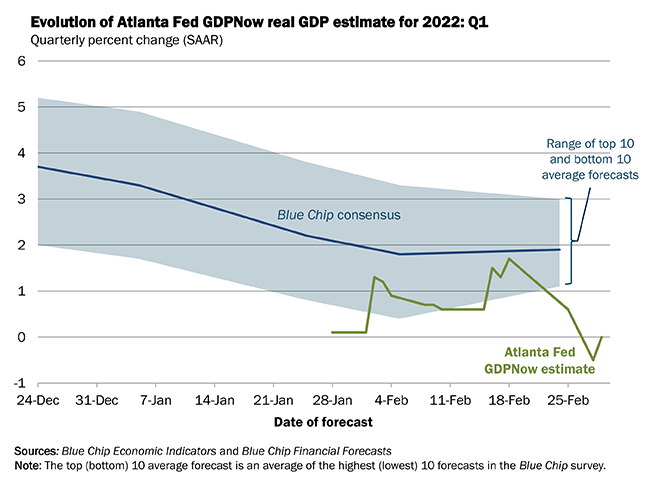
In spite of the above, the Atlanta Fed’s latest GDPNow model estimate is 0.0%, down from 0.6% on February 25.

And that came before the release of January’s trade deficit widening to a record $107.6B in January from $100.5B in December. January’s number is 15% above the Q4 average “which may just be enough to tip real GDP into contraction” per David Rosenberg.
Meanwhile, the Chase consumer spending tracker, with data through Feb. 25, suggests that control sales could decline 1.4% in February.

Recent comment from retailers suggest a cautious, if not squeezed, consumer.

Target reported Q4 same store sales up 8.9% but really only thanks to big market share gains as traffic grew 8.1%. TGT’s average ticket was up only 0.7% in Q4, well below inflation.

WMT’s Q4 SSS grew 5.6%.

Kohl’s, which also reported quarterly financial results Tuesday, forecast net sales in fiscal 2022 to increase 2% to 3%, compared with the nearly 22% increase the previous year.

Macy’s last week forecast 2022 sales flat to up 1%.

VW, BMW to Idle Plants on Parts Shortages From Ukraine

VW will idle some production lines in Wolfsburg, Germany — the world’s largest car plant — next week before a broader shutdown the following week, the company said Tuesday. BMW said in a separate statement it expects temporary shutdowns because of parts shortages, and announced it’ll suspend vehicle exports as well as local assembly in Russia because of the invasion. (…)

German automotive companies and suppliers maintain some 49 production sites in Russia and Ukraine, according to the German car lobby group VDA. (…)

White House Quietly Calls On U.S. Oil Companies To Increase Production “Prices are quite high, the price signal is strong. If folks want to produce more, they can and they should,” White House National Economic Council Deputy Director Bharat Ramamurti said in an interview today.

Morgan Stanley via The Market Ear

Eurozone Inflation Hits Fresh High as Ukraine Invasion Confronts ECB With Dilemma The eurozone’s inflation rate jumped to a new high in February, presenting the European Central Bank with a difficult choice between supporting flagging growth and clamping down on accelerating prices driven by the threat to energy supplies following Russia’s invasion of Ukraine.

(…) The European Union’s statistics agency Wednesday said consumer prices were 5.8% higher in February than a year earlier, an acceleration from the 5.1% rate of inflation recorded in January. (…)

Much of the pickup in inflation has been driven by energy prices, which were 31.7% higher than a year earlier, having been 28% higher in January. That was also the fastest annual increase in a series that goes back to 1997. (…)

Economists at Capital Economics now expect the annual rate of inflation to peak at more than 6% this month, and remain above 5% until the final three months of the year. (…)

JPMorgan said it now expects the eurozone economy to stagnate in the three months through March, having previously forecast an annualized increase in gross domestic product of 1%. It also lowered its growth forecasts for subsequent quarters. (…)

Germany’s statistics agency Tuesday said that annual pay rises negotiated by labor unions or similar groups amounted to just 1.1% in the three months through December. (…)

Good news? Not for consumers.

The Eurozone core CPI also accelerated, reaching 2.7%. Inflation on services is 2.5%.

Euro-area inflation unexpectedly accelerated to 5.8% in February

Nordea’s scenarios:

A significant damage to the Russian economy is unavoidable. This is due to the direct hit via the financial system due to the sanctions and the high level of uncertainty that we expect to continue and which will significantly harm both domestic and foreign fixed asset investments even in an optimistic scenario, where Ukraine and Russia come to a rapid agreement. Even a total collapse of the Russian economy cannot be excluded.

We expect the negative impact on the Euro area as a whole to remain limited as long as energy imports from Russia are allowed and the worries of an escalation beyond Ukraine remains limited. Ending those would likely cause a high amount of uncertainty and lead to a recession in the Euro area.

The ECB is probably ready to look through the near-term rise in energy price inflation but the worries towards upside inflation risks were real before the Russian attack and the central bankers are more likely to delay their policy tightening plans, if needed, rather than to abandon them altogether.

Unfortunately, we cannot exclude a possibility of even a worse outcome than presented in these scenarios.

Soaring Fertilizer Prices Are About to Increase the Cost of Food Russia is a major supplier of every crop nutrient, and higher supermarket bills will be a ripple effect of its invasion of Ukraine.

image

  • The White House eyes company profits in inflation battle The White House is targeting corporate profits as it grapples with inflation. Bharat Ramamurti, deputy director of the White House’s National Economic Council, said there are examples of companies outside of the meatpacking industry — which has particularly been in the White House’s crosshairs — increasing prices beyond their own climbing costs.

Russia ‘extremely likely’ to default on debts if Ukraine crisis worsens, IIF says

The IIF estimates that half of the foreign reserves of the central bank, which on Monday hiked interest rates and introduced some capital controls, are held in countries which have imposed asset freezes, severely shrinking the firepower policy-makers have to support the Russian economy.

The central bank would prioritize the protection of domestic savers with foreign investors “one of the last on the list.”

“If we stay here and this (the crisis) escalates, then default and restructuring is likely,” Elina Ribakova, the IIF’s deputy chief economist told reporters during a media call. She said default would be “extremely likely,” although the relatively small size of foreign holdings – at around $60-billion – of Russian debt would limit the fallout.

Default on domestically held bonds was far less likely, she added. (…)

The IIF’s Ribakova said the sanctions, which could yet be toughened even further, were “the most severe economic sanctions imposed on a country” ever and would send the Russian economy into a tailspin, with a low double-digit contraction this year likely and inflation soaring by a double digit amount too. (…)

China ready to ‘play a role’ in Ukraine ceasefire

China Holds Talks With Ukraine, Further Edging Away From Russia

China is “extremely concerned” about the harm to civilians in Ukraine, Foreign Minister Wang Yi told his Ukrainian counterpart in a call, in the latest indication of Beijing’s desire to prevent the war’s further escalation.

Wang said the world’s second largest economy also “deplores the outbreak of conflict between Ukraine and Russia,” according to a statement posted on the Ministry of Foreign Affairs website. The remarks were published after a call between Wang and Ukrainian Foreign Minister Dmytro Kuleba, the most senior exchange since Russia’s Vladimir Putin launched the invasion Thursday.

Wang also acknowledged the conflict was a “war,” rather than a “special military operation” as described by Russia. Kuleba said Ukraine was willing to strengthen communication with China and that it looked forward to China’s “mediation for the realization of the ceasefire,” according to the statement. (…)

The war is testing Chinese President Xi Jinping’s commitment last month to a “no limits” relationship with Putin, as the U.S. and its allies pile on sanctions and press Beijing to take as stand against military aggression. In recent days, Xi has urged Putin to pursue negotiations and China’s United Nations ambassador abstained from, rather than opposing, a Security Council resolution condemning the attack. (…)

Still, China has refrained from publicly calling for a ceasefire or describing the war as an “invasion,” and thus a violation of the UN-guaranteed sovereignty Beijing frequently vows to uphold. China hasn’t criticized Russia, and continues to voice support its security concerns and blame the U.S. for precipitating the crisis. (…)

Ray Dalio: The Changing World Order: Focusing on External Conflict and the Russia-Ukraine-NATO Situation