The enemy of knowledge is not ignorance, it’s the illusion of knowledge (Stephen Hawking)

It ain’t what you don’t know that gets you into trouble. It’s what you know for sure that just ain’t so (Mark Twain)

Invest with smart knowledge and objective odds

THE DAILY EDGE: 16 DECEMBER 2021: “Really Strong!” Really?

Fed Officials Project Three Rate Increases Next Year Most Federal Reserve officials signaled they were prepared to raise their short-term benchmark rate at least three times next year to cool high inflation. They also approved plans to more quickly scale back pandemic stimulus efforts, opening the door to rate increases starting next spring.

(…) They approved plans that will more quickly scale back their Covid-19 pandemic stimulus efforts, ending a program of asset purchases by March instead of June. That opens the door for them to start raising rates at their second scheduled meeting next year, in mid-March. (…)

“There’s a real risk now, I believe, that inflation may be more persistent and…the risk of higher inflation becoming entrenched has increased,” said Mr. Powell at a news conference Wednesday afternoon. “That’s part of the reason behind our move today, is to put ourselves in a position to be able to deal with that risk.” (…)

“We’re making rapid progress toward maximum employment,” he said. (…)

In economic projections released Wednesday, most Fed officials project core inflation to reach 4.4% at the end of this year before declining to 2.7% next year and 2.1% by the end of 2024. That is up from projections in September that inflation would slow from 3.7% to 2.3% at the end of next year. (…)

When the pandemic hit, it “looked at the beginning like it might cause a global depression, and so we threw a lot of support at it,” Mr. Powell said. “What’s coming out now is really strong growth, really strong demand, high incomes…. People will judge in 25 years whether we overdid it or not, but we are where we are.” (…)

So how strong is the U.S. economy?

  • Excluding inventory accumulation, real final demand is not back on its most recent trend, itself slower than previous ones:

image

  • Powell said that “The labor market is by so many measures hotter than it ever ran in the last expansion.” But, by one important measure, employment is well below its pre-pandemic level:

image

  • The proportion of the population working is also well below its pre-pandemic and previous pre-recession levels:

image

  • Monthly job gains are erratic, rather low on average since September 2020 and trending down since the summer:

fredgraph - 2021-12-15T155926.105

One could easily qualify the economy as rather weak, not “really strong” as Powell says: areas of strength are goods demand from expired stimulus money and inventory accumulation to protect against shortages and price increases.

Gary Shilling talked about “a false picture of underlying demand”, warning that it may “soon become apparent if consumers’ pre-buying and heavy inventories collide.”

It so happened that yesterday saw the release of November retail sales:

U.S. Retail Sales Trail Forecast, Suggesting Drag From Inflation

The value of overall retail purchases increased 0.3%, the smallest advance in four months after a revised 1.8% gain in October, Commerce Department figures showed Wednesday. Excluding gas and motor vehicles, sales climbed 0.2% in November. The figures aren’t adjusted for inflation. (…)

The softer-than-expected report may also reflect the pulling forward of holiday sales as many Americans, aware of supply-chain slowdowns, shopped earlier than usual. In October, the sales increase was the strongest in seven months. (…)

Five of the 13 retail categories showed declines in receipts last month, led by a drop at electronics and appliances merchants. Sales at non-store retailers, which includes e-commerce, were little changed in November.

Rising prices could be driving some of the increases in categories like gasoline stations and grocery stores. Receipts at restaurants and bars, the lone services-oriented category in the data, climbed 1%.

So-called control group sales — which are used to calculate gross domestic product and exclude food services, auto dealers, building materials stores and gasoline stations — fell 0.1% in November from a month earlier.

Real retail sales actually declined 0.5% in November after rising 0.8% in October and 0.3% in September. Last 3 months: +2.4% annualized, not bad but not “really strong”, especially if there actually was some pre-buying as Shilling (and I) have warned.

In effect, real retail sales (goods demand) peaked last March and are down 2.5% since. They remain 12.9% above their pre-pandemic level and 8% above trend. By comparison, gradually recovering real expenditures on services are 1.3% below their pre-pandemic level and 5% below trend.

image

ING illustrates how Americans have used their extraordinary rescue money along with super easy credit conditions to splurge on goods:

US versus eurozone retail sales performanceunnamed - 2021-12-15T113337.721

Mr. Powell never mentioned the possibility of this Shilling’s scenario materializing:

I suspect that Christmas sales during December may disappoint, forcing heaving discounting and inventory liquidations early in the new year. At the same time, all that floating inventory from China and other Asian countries will arrive, exacerbating the overhang. Also, many hidden inventories may be revealed, adding further to supplies. Economic softness in early 2022 could be exacerbated by the renewed spread of Covid-19. (…)

I’m not forecasting a 2022 recession  — yet — but excessive inventories are a warning. Huge inventory build-ups that precipitated gigantic cuts in production resulted in the serious recession after World War I and in the early 1970s.

Listening to Powell’s presser, I got the impression that he was justifying, actually selling, the Fed’s new early tightening program, often using rising inflation as the proof for solid demand. That holds for many goods categories, but for some others (e.g. cars, cell phones), for housing, for many services and for wages, the problem is supply.

Mr. Powell also said that there were no indications that higher wages were contributing to inflation. This Haver Analytics chart, and most corporate surveys, suggest otherwise:

image

The Atlanta Fed yesterday released its Business Expectations survey with these charts. Note that unit costs keep rising in spite of flattening non-labor costs pressures and that inflation expectations have reached 3.4% from 3.0% just a few months ago. Labor costs are pushing unit costs up, inciting biz people to raise prices to protect margins.

Year-Ahead Inflation Expectations (6)

Year-over-Year Unit Costs (5)

Future Influence of Labor Costs on Prices (2)

Future Influence of Non-Labor Costs on Prices (2)

We also know that wage pressures have been strongest among the lower salary rungs (services, minimum wages), pressuring smaller businesses much more than larger ones. Here’s how they plan to react per the latest NFIB survey (courtesy of ING):

unnamed - 2021-12-12T103521.662

Labor is the primary input to most of what consumers buy, in particular services. A key factor in Mr. Powell’s pivot was a report that hourly wage costs surged at about a 6% annual rate in the third quarter. That sort of labor cost growth would only be compatible with the Fed’s 2% inflation target if worker productivity grew 4% a year, roughly twice its historical rate. As it is, productivity actually declined in the year through September. (WSJ’s Greg Ip)

The fact that lower salary rungs are rising faster than others is a warning that the whole comp scale will likely rise in coming quarters, pushed up from the bottom like normally happens.

Mr. Powell often referred to the ECI as a measure of labor costs: total comp for private cos. has skyrocketed to 4.1% in Q3 with salaries at +4.6% from the 3% range pre-pandemic.

fredgraph - 2021-12-16T071032.852

Meanwhile, corporate margins are near their all-time highs. Any more evidence needed that rising labor costs are feeding inflation?

Perhaps pressure will diminish if, as and when labor participation recovers but Mr. Powell listed a number of reasons explaining why it is not recovering, most reasons likely remaining in effect unless the economy and financial markets turn sour.

The Chase consumer card tracker through December 10 suggests that the last 2-3 weeks have been slower at retail:

image

Here’s the trend for the holiday shopping season. Not really strong:

image

“Transitory” is gone, unlike “stagflation”… But no worries, “Pivot Powell” is there.

BOE Surprises With First Hike in Crisis to Curb Inflation

The Bank of England unexpectedly raised interest rates for the first time since the pandemic struck, setting aside the threat to the U.K. economy posed by record coronavirus cases to become the highest profile central bank to take on surging inflation.

Officials led by Governor Andrew Bailey voted 8-1 to lift borrowing costs by 15 basis points to 0.25%, delivering an increase that no other Group of Seven central bank has made since the start of the crisis. Silvana Tenreyro was the sole dissenter. Policy makers said more “modest” tightening is likely to be needed as inflation heads toward a peak likely to be around 6% in April. (…)

“Another hike in February of 25 basis points is well in the cards,” said Fabrice Montagne, chief U.K. economist at Barclays. “If delivered, the MPC would also be in a position to start running down its balance sheet with bonds starting to mature out of its portfolio in early March.” (…)

The decision to move now is all the more remarkable since the country is in the grips of a new coronavirus wave driven by the more infectious omicron variant, which has pushed daily case loads in the U.K. to the highest recorded total since the pandemic began.

ECB announces cautious taper

Here is what the ECB has just announced:

  • The Pandemic Emergency Purchase Programme (PEPP) will be reduced in Q1 2022 and will definitely be ended by March 2022.
  • The reinvestments from PEPP will continue until at least the end of 2024 and PEPP could be restarted at any time if deemed necessary by the ECB
  • The ‘old’ Asset Purchase Programme (APP) will be increased from 20bn euro to 40bn euro in Q2 2022, reduced to 30bn euro in Q3 2022 and brought back to the current 20bn euro in Q4 2022
  • All policy rates remain on hold

With today’s decision, the ECB has entered into a very cautious tapering process. This is less clear-cut than we had expected – the ECB chose to ensure the same level of PEPP flexibility in the asset purchases, including allowing it to purchase Greek bonds, and with a transition programme and not the reinvestment of PEPP purchases. Rate hikes are still far off. (…)

Canadian home prices rise 25% in November to hit record high

The national home price index, which adjusts for pricing volatility, rose 2.7 per cent to $790,600 from October to November on a seasonally adjusted basis, according to the Canadian Real Estate Association or CREA. That marks the second straight month of gains at that elevated level.

Compared with last November, the home price index (HPI) across the country is 25 per cent higher, a record year-over-year price jump. In Ontario, the HPI is up 30 per cent, with values soaring in the province’s most expensive region of Toronto. (…)

The pandemic’s real estate boom has been mostly driven by buyers seeking bigger properties in more affordable cities. That has propelled prices higher in smaller cities that have traditionally been unaccustomed to strong demand. (…)

Now, the Toronto region is seeing values jump significantly. In the Oakville-Milton area, just west of the city of Toronto, the typical price of a house reached $1,645,100 in November. That is $200,000 higher than in August, according to the HPI. In the Greater Toronto Area, the typical price of a single-family house was $1,403,800 last month, a $145,000 increase over August. (…)

China Price Inflation Close to 9-Year High in November Sales Managers Survey shows rampant inflation and a large fall in manufacturing activity.

  • The Manufacturing Prices Index was close to a 9 year high in November.
  • Business Confidence fell to 20-month low.
  • Sales Growth Index to 18-month low.
  • Profit Index at all-time survey low.

China Manufacturing: Headline Sales Managers Index

unnamed - 2021-12-15T114127.543

China Manufacturing: Prices Charged SMIunnamed - 2021-12-15T113933.869

What happens when sales slow down while costs keep rising?

China Manufacturing: Profit Margins Index

unnamed - 2021-12-15T114051.271

Can the Santa rally start now?

After all, everybody has been well prepared and hedged for the downside risks…

THE DAILY EDGE: 15 DECEMBER 2021: Sales Disappoint

ADVANCE MONTHLY SALES FOR RETAIL AND FOOD SERVICES, NOVEMBER 2021

Advance estimates of U.S. retail and food services sales for November 2021, adjusted for seasonal variation and holiday and trading-day differences, but not for price changes, were $639.8 billion, an increase of 0.3 percent (±0.5 percent)* from the previous month [street expectations +0.8%], and 18.2 percent (±0.9 percent) above November 2020. Total sales for the September 2021 through November 2021 period were up 16.2 percent (±0.7 percent) from the same period a year ago.

The September 2021 to October 2021 percent change was revised from up 1.7 percent (±0.5 percent) to up 1.8 percent (±0.2 percent).

U.S. Producer Prices Climbed Sharply in November Prices that suppliers charge businesses and other customers jumped 9.6% last month from a year ago, the most on record

The so-called core PPI, which excludes often volatile food and energy components, climbed 7.7% from a year ago, also the highest on record. (…)

The index, which generally reflects supply conditions in the economy, rose 0.8% from October, an acceleration from the 0.6% gain in each of the previous three months. Higher prices for energy, wholesale food, and transportation and warehousing contributed to the pickup in inflation. (…)

Prices for goods, excluding food and energy, climbed 0.8% in November from October, faster than the 0.6% increase the previous month. The services index advanced 0.7% on the month, up from 0.2% in October, driven in part by a pickup in hotel room rates and airfares. (…)

Haver Analytics’ table provides the best snapshot of the key trends:

image

  • Core final demand PPI (yellow) is furiously accelerating;
  • Core goods PPI is up 9.3% YoY in November. Last 3 months annualized: +7.8%. Last 2 months: +8.7% a.r..
  • Services are also accelerating, now +7.1% YoY after +1.9% on average in the last 3 years.

image

U.S. manufacturers are enjoying a rare period when they can easily pass their costs increases on to their customers. For how long?

fredgraph - 2021-12-15T073949.482

FIBER: Industrial Commodity Prices Improve Slightly

image

image

The Conference Board’s latest Measure of CEO Confidence reveals that “79% of CEOs expect to increase wages by 3% or more over the next year, up from 66% in Q3.”

Wirecutter Union, New York Times Agree to Contract Three-year deal after Black Friday strike includes average wage increases of about $5,000; lowest paid staffers to get 18% raises immediately, union says.

The three-year contract also includes minimum guaranteed pay increases of between 2% to 2.5% a year, according to the union.

Increases on union members’ healthcare costs are also capped and the agreement includes a ban on nondisclosure agreements referencing harassment or discrimination, the union said. (…)

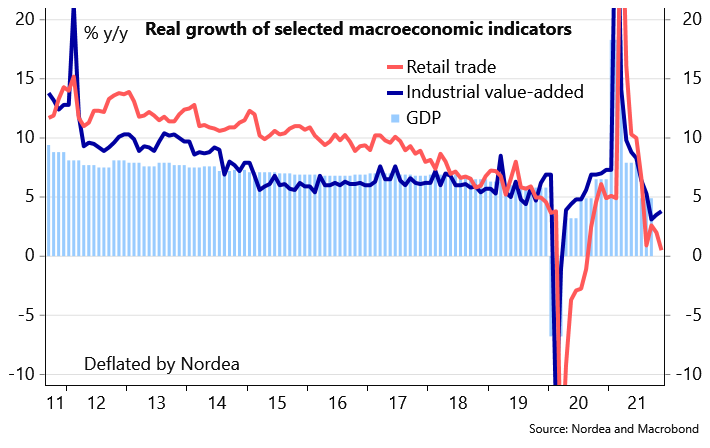
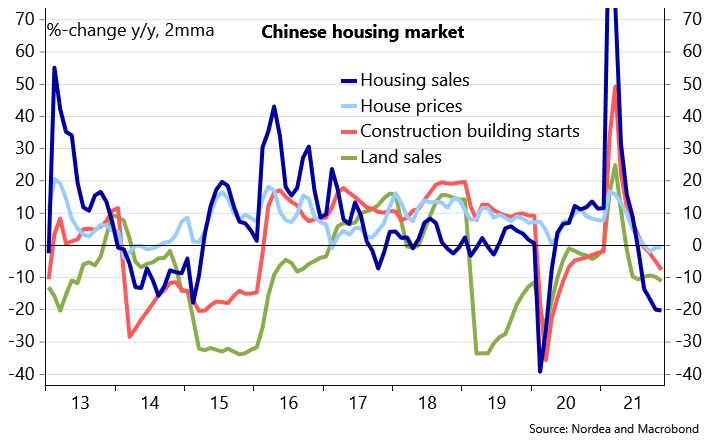
China’s Economic Activity Slows on Property Slump, Weak Consumption The latest economic data point to a further slowdown in China’s economy that began to sputter in the third quarter on the back of a power crunch that curbed factory output, and sporadic Covid-19 outbreaks that hit consumption.

(…) Industrial production expanded by 3.8% in November from a year ago, accelerating from 3.5% growth in October, a rare bright spot in China’s economy as efforts to alleviate electricity shortages led to increased coal output in recent weeks. (…)

Fixed-asset investment increased 5.2% in the January-to-November period, down from the 6.1% pace recorded in the first 10 months, official data showed. The reading was in line with the expectations of economists polled. (…)

New-home prices dropped 0.33% in November from October across 70 cities, the biggest month-over-month decline in about six years, according to calculations by The Wall Street Journal based on official data released Wednesday.

New-construction starts by property developers, which provide jobs for migrant workers and boost China’s demand for commodities, dropped 9.1% in the January-to-November period from a year earlier, widening from a 7.7% on-year decline in the first 10 months of the year.

Retail sales, a proxy for China’s consumption, rose just 3.9% last month from a year ago, down from October’s 4.9% year-over-year growth and lower than the 4.5% expected increase among economists polled by the Journal. China’s strict Covid-19 restrictions affected sectors including catering, where sales fell 2.7% in November, a larger decrease from a fall of 2% in October. (…)

At least 20 manufacturers based in Zhejiang, a large manufacturing region producing a range of products including textiles and LED lights, halted production over the past week after local officials imposed lockdowns, according to the companies’ filings. Most companies didn’t disclose when the factories will reopen but said they expected the disruptions to be short-lived. (…)

(Bloomberg)

The recent news about the first Omicron case in China and the possibly low efficiency of the Chinese vaccinations to tackle the Omicron mutation increases the worries on that front, and the recent report by the Beijing University explicitly showed that the scale of virus cases in an environment of looser restrictions could be such that the Chinese healthcare system simply cannot handle it. (Nordea)

13

China has been pouring money into residential construction for years: the excess stock of housing is far larger than we previously thought. In addition to the stock of housing ‘under construction’, it seems that there is a rapidly growing stock of housing whose construction has been ‘paused’ and not restarted. Some of this stock will have been demolished, though it is unclear how much.

The opacity of the data means that we also do not know and cannot estimate the starting level of the ‘paused’ stock of housing, but we do know how much it has contributed to the overall housing excess in recent years.

Consequently, it seems likely that the combined stock of housing under construction and housing paused but not restarted is in the order of 9 billion square metres, enough to house over 200 million people (roughly the population of Brazil) in comfort. Someone, somewhere, thought that was an investment: they will be disappointed or bailed out — the Evergrande crisis so far suggests the latter for homebuyers at least.

SENTIMENT WATCH

Knowing LAZR is down 70% this year, anybody would be impressed by the above. But read beyond the headline (my emphasis):

Luminar Technologies, Inc. (Nasdaq: LAZR), with support of its CEO, board members, and management, today announced its authorization and intent to purchase $250 million or more of its Class A common stock, which is anticipated to commence today after market open. The company plans to use a portion of the proceeds from a proposed private financing transaction for the share repurchase. (…)

The timing and number of shares repurchased will depend on a variety of factors, including stock price, trading volume, and general business and market conditions. The repurchase program has no time limit, does not obligate Luminar to acquire any particular amount of Class A common stock and may be modified, suspended or discontinued at any time at the company’s discretion. The Board has authorized an increase in the size of the repurchase program to 50% of the aggregate principal amount of the company’s recently proposed private financing, if greater than $250 million.

Almost Daily Grant writes:

The text of the press release conveyed a slightly less compelling message. Turns out it’s Luminar, the company, more than Luminar, the executives, that will do most of the buying, funded not by the insiders’ after-tax income but by a $500 million convertible note offering. The CEO, board, and management instead lend their “support” to the effort, while conducting unspecified purchases of company stock “as part of pre-arranged trading plans.”

CEO Austin Russell, who stated in the press release that today’s repurchase announcement shows that “we are putting our money where our mouth is,” personally sold 10.5 million shares of LAZR in July at a 40% premium to current price levels, cashing out $221 million.  The 26-year old executive has been putting those funds to work, shelling out $83 million for a Pacific Palisades mansion, real estate publication Variety Dirt reported last week. 

Some day, LAZR will amend its release with “…putting your money where our mouth is”.

ADG notes that LAZR is still selling at 40 times 2023 expected revenues.

And near the end of the year likely to become known as “the year of the suckers”, ADG also informs us that

Meanwhile, a founding member of the great 2021 meme stonk revolution looks for its own blockchain-based share price salvation. AMC Entertainment Holdings, Inc. announced last week that it will gift an “exclusive, one-time” non-fungible token for all members of AMC Investor Connect, a self-identified cadre of shareholders in the company.  The NFT, which depicts a glimmering gold-colored medallion embossed with the words “I Own AMC,” follows the theater chain’s Nov. 29 NFT offer for members who purchased a ticket to the upcoming Spider Man: No Way Home (the fourth Spider Man film since 2017 and the ninth in the past 20 years).

AMC shares sit 62% below their June 2 highs, though the company still commands a $12.8 billion market cap, up from less than $1 billion on the eve of the pandemic despite a cumulative $3.5 billion net loss since the start of 2020. 

Needless to say, that charmed status as a bulwark of the Reddit retail army has not escaped management’s attention:  Last week, CEO Adam Aron and CFO Sean Goodman disclosed the sale of 312,500 shares and 18,316 shares, respectively, netting the pair about $10 million in proceeds. After those transactions, Aron, who disclosed plans to sell 1.25 million shares in an early November filing, now holds fewer than 100,000 shares in AMC, while Goodman no longer holds any shares on a discretionary basis (the executive is periodically granted shares according to continued employment and performance incentives).

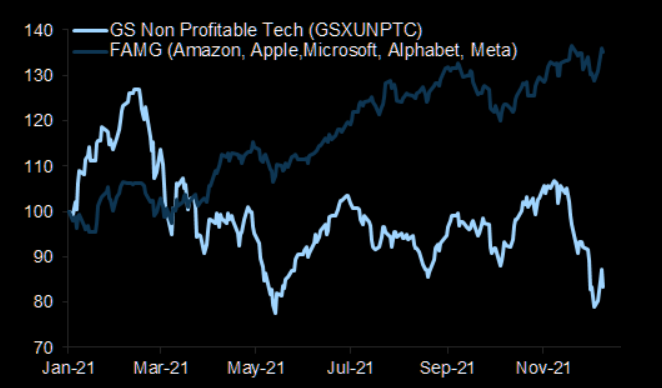
unnamed - 2021-12-14T075502.686

(Goldman Sachs via The Market Ear)

Trouble under the surface of the Nasdaq 100

unnamed - 2021-12-15T081146.509

“When we zoom out over the past 20 years, we can see that there have been 4 relatively similar periods. All preceded a tough market for the index over the next year or so.” (SentimenTrader)

  • Bloomberg: “ Some of the richest Americans—think Elon Musk, Jeff Bezos, Mark Zuckerberg—are unloading shares in the very companies that made their fortunes. They’ve sold $42.9 billion in stock this year, more than double the $20.2 billion they sold in 2020.”
  • But here’s your dose of optimism from JPM’s Marko Kolanovic:

Our view is that 2022 will be the year of a full global recovery, an end of the pandemic, and a return to normal economic and market conditions we had prior to the COVID-19 outbreak. In our view, this is warranted by achieving broad population immunity and with the help of human ingenuity, such as new therapeutics expected to be broadly available in 2022. This would result in a strong cyclical recovery, a return of global mobility, and a release of pent-up demand from consumers (e.g. travel, services) and corporates (in particular inventory, capex, and buyback recovery). We stress that this demand would happen in a backdrop of still-easy monetary policy (zero rates and incrementally smaller but positive quantitative easing). For these reasons, we remain positive on equities, commodities and emerging markets, and negative on bonds.

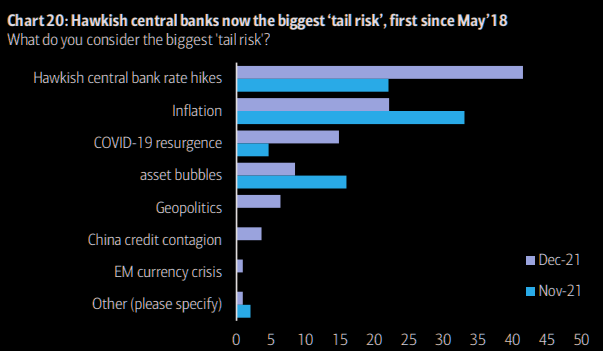
  • Bank Of America’s clients are more circumspect:

Xi Told Putin China, Russia Are Better Than Allies, Kremlin Says Vladimir Putin and Xi Jinping made a show of solidarity amid rising tensions between Moscow and the West.