The enemy of knowledge is not ignorance, it’s the illusion of knowledge (Stephen Hawking)

It ain’t what you don’t know that gets you into trouble. It’s what you know for sure that just ain’t so (Mark Twain)

Invest with smart knowledge and objective odds

THE DAILY EDGE: 28 JUNE 2021

Consumer Spending Is Primed to Fuel Summer Growth Household spending leveled off last month as consumers pulled back on big-ticket goods purchases and spent more on services.

Spending was flat last month as consumers cut back on purchases of big-ticket items and rotated more of their money toward in-person services. Still, this spring shaped up to be a solid one for spending: April expenditures were upwardly revised to a 0.9% increase from a previously reported 0.5% rise. Overall spending in May was well above pre-pandemic levels, with spending on goods up nearly 20% from February 2020 and services down about 1%. (…)

The core personal-consumption expenditures price index, which excludes often-volatile food and energy items, rose 0.5% in May from a month earlier. Core prices increased 3.4% from a year earlier, the fastest pace since 1992. (…)

The personal saving rate eased to 12.4% in May from 14.5% a month earlier. The saving rate remains higher than in February 2020, when it was 8.3%. The relatively elevated saving rate signals consumers have more room to spend. (…)

Friday’s report also showed personal income fell 2% in May from April, as the impact faded from government stimulus checks sent out earlier in the year. Incomes fell in April after rising sharply in March due to the government’s disbursement of $1,400 stimulus checks to many households. (…)

This chart from ING details the income side of he equation. “Note the big improvements in income from wages and other private sources (the blue bar). With jobs coming back and wages ticking higher this, in addition to improved finances, can continue to provide really strong impetus to booming consumer demand.”

unnamed (56)

With data indexed to February 2020 = 100, we can see that Aggregate Payrolls (employment x hours x wages) are up 2.6% from their pre-pandemic level (even with 7.6 million (-5.0%) fewer workers) while Retail Sales are 18% higher and total Consumer Expenditures 5.3% higher.

fredgraph - 2021-06-26T063554.772

Breaking down expenditures, spending on Services is gradually recovering but is still 1.2% below its Feb. 2020 level. Spending on Goods remains very strong with Durable Goods 33% above their pre-pandemic level and Non-Durables 12.7% above. Objectively, there are no visible signs that Americans are spent-up just yet.

fredgraph - 2021-06-26T064755.187

The various pandemic rescue payments are creating tremors in Disposable Income (still up 9.3% from Feb. 2020), but the key data is Wages and Salaries which continue to improve and are now 5.1% above their pre-pandemic levels and, importantly, above the PCE deflator (+3.3%).

fredgraph - 2021-06-26T070047.419

As this Haver Analytics table shows, Wages and Salaries have increased at a 11.7% annualized rate in the last 3 months, significantly outpacing total employment growth of 4.6% a.r.. Per employed American, Wages and Salaries are now 10.6% above their pre-pandemic level and up 4.4% YoY in May. Markit’s June flash PMIs released last week included the first mentions of “wage inflation”, in both manufacturing and services and in both the U.S. and the eurozone.

image

Speaking of inflation, FOMC members could elect to conveniently focus on the 2.5% annualized PCE inflation rate since February 2020, but it is hard, and potentially dangerous, to dismiss that the PCE and the Core PCE deflators, up 0.4% and 0.5% MoM respectively in May, have risen at +5.7% and +6.6% annualized rates respectively in the last 3 months. No base effects there.

image

Minneapolis Fed chief Neel Kashkari was quick to downplay the data, citing the recent decline in lumber costs in predicting that spikes will “return down to normal.” What that “return to normal” is was not specified. If “normal” is the February 2020 price, that implies another 40% drop in lumber costs.

Taking a broader look at commodities, industrial metal prices are still 144% above their pre-pandemic level and, sorry to mention these rather significant components of our daily lives, Agriculture and Livestock and Energy prices are 133% and 120% of their pre-pandemic levels respectively, per Goldman Sachs’ numbers.

Goldman is very much in Jerome Powell’s transitory camp: even though recent numbers were higher than expected, GS keeps its 2021 year-end core PCE number at +3.0% which implies that core inflation is contained to +1.0% during the next 6 months, arguing that “a higher peak also likely means greater payback later”. Likely?

From Goldman’s analysis, I would highlight a few key items:

  • its Shelter Inflation Tracker has suddenly spiked up to +2.7% YoY, unlike the official PCE Shelter Index stuck at 2% from 3.0-3.5% pre-pandemic. That could be another kind of transitory phenomenon.

image

Zumper’s national index for June shows a 4.9 percent rise in median one-bedroom rent year-over-year and an astounding 6.5 percent rise in two-bedroom rents. This is significant because for much of 2019, rents nationally were flat. In 2020, rent growth consistently hovered around 1 percent, even as the home sales market was on fire.

That all changed in the early months of 2021. In February, rent growth for one-bedrooms jumped to 2 percent year-over-year and has been rising steadily every month since.

Collectively, the eight most expensive cities in the country — New York, San Francisco, Los Angeles, Boston, Oakland, San Jose, Washington, and Seattle — bottomed out in January when rents were down 20.1 percent relative to where they were in January 2020. Those cities are now down 15.6 percent. The next eight most expensive cities — San Diego, Miami, Chicago, Fort Lauderdale, Santa Ana, Long Beach, Anaheim, and Honolulu — were down 8.7 percent as recently as March. Those cities are now up 1.2 percent compared to January 2020.  The bottom 92 cities were up by as much as 7.5 percent in July 2020 and are now up by 5.9 percent.

While the growth in the bottom 92 cities certainly contributes, it’s clear that national rent growth is being driven by the most expensive cities in the country making up some or all of the ground they lost after the pandemic hit in March 2020. Of the 100 cities Zumper includes in this report, only 24 are now down year-over-year. Of those 24, half are down by less than 5 percent.

  • “Recent dollar weakness points to further moderate upward pressure on import prices.” Imports include most commodities as well as a large percentage of goods consumed by Americans. Goldman’s work suggests that inflation on imports of Consumer Goods ex-Autos could soon reach 2.0-3.0% from less than 1.0% currently.
  • “Business Inflation Expectations Have Increased to the Highest Level in at Least Two Decades”. It’s now +3.1% and rising.

In the current inflation guessing game dominated by rear-view mirror analysis and wishful thinking, I give the most weight to business expectations since biz people are right in the action: not only are they witnessing what’s really happening here and now, they also have the best reading of what’s in the cost/price pipeline and of the competitive dynamics in the marketplace. GS’ measures of Business Inflation Expectations confirm the various PMI reports: costs are broadly rising and strong demand is allowing easy pass-throughs.

image

It may be, as Goldman suggests, that business expectations only reflect a short term view of inflation. The fact is that business people’s real world analysis strongly suggests that inflation will likely remain high in the next few quarters, seemingly higher than what pundits and policy makers currently expect or hope for.

  • The last part of Goldman’s inflation analysis worth highlighting is the GS Wage Tracker: “Our composition-corrected wage tracker edged up to
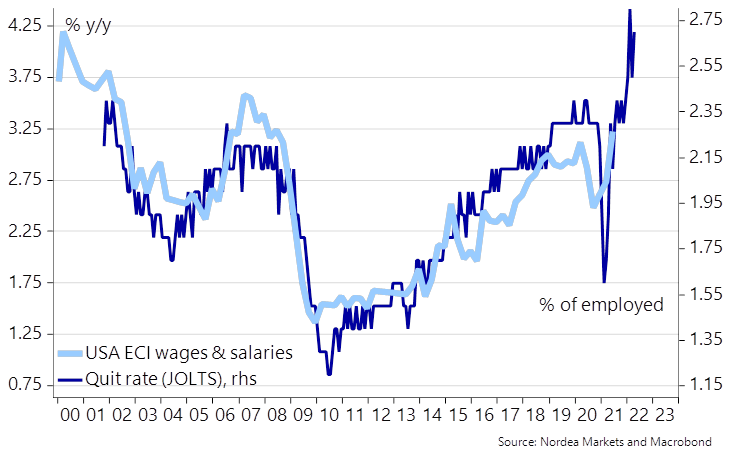
    +3.2% year-on-year — slightly above the pre-pandemic level — and our wage survey leading indicator has rebounded to +3.5%.” Most of the recent wage gains seem concentrated at the lower end of the pay scale, namely in the Food Services area, but shortages seem widespread amid booming demand and anecdotes abound of businesses boosting wages to attract workers (see below).

That wage inflation is currently concentrated at the lower rungs is no consolation: rising pay at the lower end can only push the whole pay scale up, eventually, even more so if inflation, including food and energy, is accelerating, prompting workers to request adjustments. Given that revenues and profits are recovering strongly, businesses seem inclined to more favorably abide to attract/retain desperately needed workers.

S&P 500 companies revenues grew 13.5% in Q1’21 and are expected to jump 18.4% in Q2. Earnings exploded 52.8% in Q1 and are seen up 65% in Q2. S&P 500 trailing EPS are now $158.37, only 2.8% shy of their 2019 level of $162.93. They could reach $191 this year, 17% higher than in 2019.

Just a few days before quarter end, analysts keep raising their estimates while corporate pre-announcements are slightly more positive than at the same time during Q1. Corporate margins don’t seem in danger so far.

image

That wage gains would be stronger than their pre-pandemic level even with an apparent 5% “labor slack” should actually warn policy makers that their conventional measures of labor cost pressures, few of which are currently flashing yellow or red, may not adequately catch what is actually going on given the numerous disruptions of the past 15 months.

To repeat: “Per employed American, Wages and Salaries are now 10.6% above their pre-pandemic level and up 4.4% YoY in May. Markit’s June flash PMIs released last week included the first mentions of “wage inflation”, in both manufacturing and services and in both the U.S. and the eurozone.”

Walt Disney Co. is offering $1,000 bonuses to recruit new housekeepers and select kitchen staff at its Florida theme parks, just months after laying off some 32,000 employees.

Housekeepers, making $16 an hour, and line cooks, earning $18, can receive the money if they stay on the job for at least 90 days, according to the company’s website. (…)

The overall unemployment rate in Orlando was 5.6% in April, a third of what it was a year ago.

At Florida’s Walt Disney World — which includes four theme parks and a couple dozen hotels — about 33,000 of the more than 41,000 members of the Service Trades Council Union have returned to work, according to Matt Hollis, president of that worker coalition. About 15,000 of the 32,000 workers at California’s Disneyland resort have returned, the company said. (…)

Enhanced federal unemployment benefits, enacted in the wake of the pandemic, may be one reason employees aren’t returning to work. They were set to end June 26 in Florida, which opted not to continue them, but will last until September in California. (…)

Six Flags Entertainment Corp. is offering higher wages and bonuses of up to $1,000 for employees who join by July 1. SeaWorld Entertainment Inc.’s website lists dozens of open positions, from animal trainer to overnight cleaning crew supervisor.

Southwest Airlines Co. said Friday it was increasing its minimum wage to $15 an hour and boosting compensation for 7,000 workers. (…)

A “Transitory” Selloff in Commodities

Perhaps anticipating reactions like Neel Kashkari’s above, Crescat Capital offers a divergent viewpoint:

What if we told you that the only transitory move we likely had was in the recent selloff in commodity prices? We think the hoarding of tangible assets by investors is just getting started.

It is a striking contradiction that the Fed decided to pivot the market narrative to its openness to tapering, though not raising interest rates until 2023. Meanwhile, it just reported that it added the largest amount of assets to its balance sheet in over a year. Nearly $200 billion in the last 4 weeks. Per their own statement:

“The Federal Reserve will continue to increase its holdings of Treasury securities by at least $80 billion per month and of agency mortgagebacked securities by at least $40 billion per month until substantial further progress has been made toward the Committee’s maximum employment and price stability goals.”

It looks like the “at least” part came in handy this time around. It was the opposite of a taper. If we could use the perfect analogy to describe their message for raising interest rates into plain words, it would be the “we are debating if we should start a diet 2 years from now”.

(…) the fact that nominal yields rose recently in the face of larger purchases of Treasuries by the Fed tells you why policy makers are truly trapped.

Surprised smile The recent growth in US government debt relative to economic growth has been astonishing. To put this into perspective, since January 2020, real GDP grew by $114 billion. Meanwhile, during the same time, government debt increased 43x that amount. This was perhaps the most unproductive use of capital that we have seen in history. (…)

  • BTW on commodities (via The Transcript):
    •  US shale patch resists temptation for new drilling rush Oil output languishing despite high crude price as companies opt to return capital to investors
    • “We’ve developed most of the easy projects and now we go into the more difficult regions of the world where there isn’t infrastructure, it’s a harder political environment and I think the mining industry is not ready to add massive new tonnes to the market. With green energy demand, I believe the mining industry will struggle to keep pace.” – Glencore (GLNCY) CEO Ivan Glasenber
  • BTW on supply chains disruptions (via The Transcript):
    • “My comment at this point is that the supply chain environment is stable in terms of its inconsistencies. I would not classify it as getting better, and I would not classify it as getting worse. It is consistently inconsistent…But I cannot predict for you today when the supply chain will improve back to normal, but I’m not also predicting that it is getting worse. It just continues to be a daily, weekly, monthly quarterly challenge now present in our business.” – Winnebago Industries (WGO) CEO Michael Happe
    • “There’s substantive disruption occurring in the supply chain. I think we are going to see it this way for quite some time as we migrate through the second half of the year. This is going to be an issue for us for the foreseeable future. It’s our obligation to try to keep the prices as low as we can…even as we navigate this inflationary environment that we are in that I suspect is more structural than transient, despite some of the other rhetoric. There is inflation in the market across almost all facets”- Tractor Supply (TSCO) CEO Hal Lawton
    • “I don’t expect the chip industry is back to a healthy supply-demand situation until 2023. For a variety of industries, I think it’s still getting worse before it gets better.” – Intel (INTC) CEO Patrick Gelsinger
U.S. Durable Goods Orders Rebound in May

The factory sector remains on a firm footing. Manufacturers’ orders for durable goods jumped 2.3% (41.6% y/y) during May following a 0.8% April decline, revised from -1.3%. A 3.0% rise had been expected in the Action Economics Forecast Survey.

Strength in transportation equipment orders propelled last month’s increase with a 7.6% jump, more than doubling y/y. The gain was driven by a surge in nondefense aircraft orders as well as a 2.1% increase (95.6% y/y) in orders for motor vehicles & parts. Excluding transportation, orders improved 0.3% (25.2% y/y) following a 1.7% rise in April, revised from 1.0%.

Orders for nondefense capital goods orders excluding aircraft eased 0.1% (22.7% y/y) following a 2.7% April gain, revised from 2.3%. (…)

Unfilled orders for durable goods rose 0.8% (-1.4% y/y). Order backlogs excluding transportation rose 1.6% (11.9% y/y).

It took a global pandemic to break this 20-year barrier:

image

Total U.S. manufacturing production is almost back to its pre-pandemic level but remains 7.2% below its 2007 peak.

fredgraph - 2021-06-26T081204.442

Nonresidential fixed investment, a proxy for business spending, rose at a seasonally adjusted annual rate of 11.7% in the first quarter, led by growth in software and tech-equipment spending, according to the Commerce Department. Business investment also logged double-digit gains in the third and fourth quarters last year after falling during pandemic-related shutdowns. It is now higher than its pre-pandemic peak. (…)

Rising business investment helps fuel economic output. It also lifts worker productivity, or output per hour. That metric grew at a sluggish pace throughout the last economic expansion but is now showing signs of resurgence.

The recovery in business investment is shaping up to be much stronger than in the years following the 2007-09 recession. “The events especially in late ’08, early ’09 put a lot of businesses really close to the edge,” said Phil Suttle, founder of Suttle Economics. “I think a lot of them said, ‘We’ve just got to be really cautious for a long while.’”

Businesses appear to be less risk-averse now, he said.

After the financial crisis, businesses grew by adding workers, rather than investing in capital. Hiring was more attractive than capital spending because labor was abundant and relatively cheap. Now the supply of workers is tight. Companies are raising pay to lure employees. As a result, many firms have more incentive to grow by investing in capital. (…)

The pandemic forced companies to minimize contact between consumers and workers, resulting in a rapid increase in spending on productivity-enhancing digital technology that many economists predict will endure.

“Every part of the service economy is using technology more aggressively,” said Mr. Suttle. “Obviously it’s hard to do that without buying more product.”

Bloomberg’s Joe Weisenthal found these comments from the latest Kansas City Fed Manufacturing Survey:

  • “With the lack of willing and able entry level workers, we are choosing to invest more in equipment and automation, which over time, should lead to our company to have a lower number of workers with a higher level of skills.”

  • “Business activity has picked up and we are in need of upgrades to certain productive assets to maintain and increase capacity.”

  • “We are looking for ways to automate and reduce the need for employees.”
PRODUCTIVITY TO THE RESCUE?

Bob Philips, CTO at 3EDGE Asset Management explains in this video how productivity could prevent a wage/price spiral.

Bob displays this chart to highlight how productivity has accelerated during the pandemic.

image

I would only signal that productivity seems to always accelerate during recessions so I would wait a little before concluding that Zoom and others have created a new productivity era.

Unit labor costs have also sharply accelerated since 2019. Will they drop in coming quarters like they did in the previous two recessions?

image

FED TALK

(…) One option suggested at the [FOMC] meeting was to start scaling back the mortgage-bond purchases earlier or more quickly than the Treasury debt purchases, officials said. Call it a two-speed taper. (…)

Other Fed officials argue against the idea, saying the combined purchases of mortgage and Treasury securities lower long-term interest rates overall—not just mortgage rates. They say other factors are contributing to the hot housing market, including a dearth of homes for sale relative to strong demand. (…)

New York Fed President John Williams, said last month that the mortgage-bond purchases, “dollar for dollar, have pretty powerful spillovers into other financial conditions such as corporate bond rates and other kinds of similar securities.” He reiterated this past week that the Fed’s asset purchases aren’t “specifically targeted to the housing market.” (…)

Fed Chairman Jerome Powell hasn’t publicly weighed in on the debate. (…)

The purpose of the Fed’s asset purchases is to support the entire economy rather than a specific sector. Slowing the mortgage-bond buying before the Treasury purchases would undermine that rationale by tailoring it according to the condition of the housing sector. It would also suggest the Fed is using monetary policy to address a concern about the stability of the financial system arising from elevated home prices—something Fed officials have long been reluctant to do, said Roberto Perli, head of global policy at Cornerstone Macro. (…)

If that survey is any realistic, housing demand is about to collapse on its own price weight…

(The Market Ear)

… unless investors keep investing. John Burns Real Estate Consulting reckons that investors accounted for 24% of recent purchases in Houston, Tx..

(…) “But it wouldn’t surprise me based on the current projections of what we’re seeing in the data that that criteria could be met as soon as the end of next year,” he said during an interview with Yahoo Finance.

Rosengren said he expects the U.S. economy to grow by about 7% this year, and for inflation to be slightly above 2% next year. While there is currently still slack in the labor market, the U.S. economy could approach full employment by the end of this year or the beginning of next year, he said. (…)

Rosengren said he thinks the “substantial further progress” goal has been met for inflation, which he expects will slow down going into next year as supply imbalances are resolved. He said the labor market may reach the Fed’s standard for tapering asset purchases before the start of next year. (…)

(…) In March, just five of 18 Federal Open Market Committee participants thought risks to inflation were weighted to the upside. In June, that had risen to 13. In other words, a solid majority of Fed officials think inflation is more likely to turn out higher rather than lower than projected. (…)

As long as this increase really is transitory, the Fed should be fine. And on that, the Fed has an important ally: the bond market, which thinks inflation is going to fall back. But if these supply shocks push up public expectations of inflation, which tend to be self-fulfilling, the Fed has a problem. It could no longer stick to its plan of waiting for full employment to return before tightening monetary policy. While Mr. Powell said the rise in expectations hadn’t yet reached worrisome levels, “We don’t in any way dismiss the chance.” And in that event, he said, “We wouldn’t hesitate to use our tools to address that. Price stability is half our mandate.”

(The Market Ear)

Delta Outbreaks Prompt Limits in Australia, Israel, as India Warns of New Mutation The developments underscore how the morphing pathogen continues to challenge a return to pre-pandemic life world-wide.

Authorities in Israel and Australia imposed new Covid-19 restrictions in response to the spread of the highly infectious Delta variant of the coronavirus, while India warned of a worrying new mutation, emphasizing how the morphing pathogen continues to challenge a return to pre-pandemic life world-wide.

In Israel, the government on Friday reimposed an indoor-mask requirement and other measures, and parts of Sydney, Australia’s largest city, will go into a rare lockdown for at least a week as officials seek to curb outbreaks of the variant that fueled India’s ferocious Covid-19 surge in April and May.

The Delta variant is now in dozens of countries world-wide, and public-health officials in the U.S. say the variant, also known as B.1.617.2, is likely to become dominant in the country next month. (…)

The WHO says the variant is spreading rapidly among unvaccinated populations, including in Africa, where it has been detected in 14 countries, including in most samples detected in Uganda and the Democratic Republic of Congo.

Indian officials say B.1.617.2 has itself mutated in a way that is causing concern. The versions of Delta that contain the new mutation, designated K417N, have been detected in at least 11 countries, including the U.S., U.K. and Japan, according to government health agency Public Health England.

Indian officials are calling the new versions Delta Plus, and scientists say there is no evidence that Delta Plus is significantly more transmissible or that anyone who catches it is more likely to die than with the Delta variant. But studies done on other variants containing the mutation indicate it might help the virus sidestep some of the body’s immune response. Lab research also indicates that the mutation might diminish the effectiveness of some monoclonal antibody treatments. (…)

India has fully vaccinated about 4% of its population of more than 1.3 billion.

(…) the [Israel] government delayed allowing foreign nationals to enter into the country for tourism from July 1 to Aug. 1. The government this week expanded its vaccination campaign to include all 12- to 15-year-olds after a jump in infections among schoolchildren in a town in central Israel. The outbreak has since quickly spread geographically and to other groups of the population. (…)

About half of adults infected in the outbreak of the Delta variant of Covid-19 in Israel were fully inoculated. These so-called breakthrough cases—defined as positive Covid-19 test results received at least two weeks after patients receive their final vaccine dose—are broadly expected as the Pfizer vaccine is highly effective but not 100% foolproof, according to Mr. Balicer.

Israeli health officials are optimistic that even if the variant does spread, evidence from countries such as the U.K. indicate the vaccine will prevent a large increase in severe illness and hospitalizations that plagued the country’s health system in previous outbreaks.

The rapid spread of Delta in the U.K., where it accounts for well over 90% of new infections, has already led to a one-month postponement of the planned ending of Covid-19 restrictions until July 19. In the past seven days, the number of people testing positive for the virus has increased by 50% compared with the previous week, to an average of almost 13,000 daily.

The increase has mainly been in younger, unvaccinated groups, and data show the variant is making very little headway among older, vaccinated adults. (…) The U.K. has one of the highest vaccination rates in the world, with 83% of adults with at least one dose and 61% with two.

Covid-19 has staged a U.K. comeback, despite widespread vaccination(…) One alarming implication of the U.K. experience, however, is that even a massive vaccination campaign doesn’t get us to herd immunity. At one point there were optimistic projections that only about a quarter of people needed to be infected or vaccinated. Now it looks as though that number is much, much higher. And the longer we wait for herd immunity, the longer the virus has a chance to develop new variants, which may prove resistant to vaccines.

As it stands, the base scenario, which many are beginning to regard as a certainty, is that the pandemic is on its last legs. That is still a reasonable prospect. But the British experience has already had real world economic effects. Reopening has been postponed for a month, and the Bank of England might well have tapered its support for markets last month had it not been for this renewed outbreak. There is no reason for terror, but every reason for investors to keep a close eye on Covid figures, particularly for now in the U.K.

TECHNICALS WATCH

My favorite technical analysis firm says that the latest high in the S&P 500 was mainly the result of another rotation and was not accompanied with stronger buying nor lesser selling; the next few days should provide those missing ingredients before a clear “ok to buy” signal is given.

THE DAILY EDGE: 25 JUNE 2021

Personal Income and Outlays, May 2021

Just out this a.m.:

Expenditures for March and April were revised up. No meaningful slowdown in May, Americans are still spending merrily. The savings rate was 12.4% in May, down from 14.5% in April. Core PCE inflation is 3.4% but last 3 months annualized: +6.6%. Last 2 months: +7.4% a.r.. No base effect there.

More analysis on Monday.image

U.S. Initial Unemployment Insurance Claims Edged Down

Initial claims for unemployment insurance fell 7,000 in the week ended June 19 to 411,000 from an upwardly revised 418.000 in the previous week (initially (412,000). The Action Economics Forecast Survey panel expected new claims to decline to 380,000. The 4-week moving average edged up to 397,750 last week from 396,250 the previous week, a pandemic low.

Initial claims for the federal Pandemic Unemployment Assistance (PUA) program rose for the second consecutive week, increasing to 104,682 in the week ended June 19 from a downwardly revised 97,762 in the previous week (initially 118,025). The PUA program provides benefits to individuals who are not eligible for regular state unemployment insurance benefits, such as the self-employed. Given the brief history of this program, these and other COVID-related series are not seasonally adjusted.

Continuing claims for regular state unemployment insurance fell 144,000 to a new pandemic low of 3.390 million in the week ended June 12. The insured rate of unemployment slipped 0.1%-point to 2.4%, also a new pandemic low. This rate reached a high of 15.9% in the week of May 9, 2020.

Continuing claims for PUA fell to 5.950 million in the week ended June 5, the lowest since the week ended April 25, 2020, from 6.126 in the previous week. By contrast, continuing PEUC claims rose to 5.273 million in the week ended June 5 from 5.165 million in the previous week. The Pandemic Emergency Unemployment Compensation (PEUC) program covers people who have exhausted their state unemployment insurance benefits.

The total number of all state, federal, and PUA and PEUC continuing claims was 14.845 million in the week ended June 5, an increase in 3,756 from the previous week. The level of total continuing claims in the week ended May 29 was the lowest since early April 2020. These figures are not seasonally adjusted.

(Bespoke)

U.S. inflation likely to remain elevated for up to four years – BofA

BofA expects U.S. inflation to remain elevated for two to four years, against a rising perception of it being transitory, and said that only a financial market crash would prevent central banks from tightening policy in the next six months.

It was “fascinating so many deem inflation as transitory when stimulus, economic growth, asset/commodity/housing inflations (are) deemed permanent”, the investment bank’s top strategist Michael Hartnett said in a note on Friday. (…)

Good read: The Ghost of Arthur Burns along with my own THE INFLATION DEBATE: JFK, LBJ, JOE AND JAY

Related, from Grant’s Interest Rate Observer:

(…) The inflation horse was out of the barn, Martin admitted to his fellow FOMC committeemen in December 1967, and, to complicate matters, to quote Martin’s paraphrased words in the FOMC minutes, “many observers apparently had become convinced that the Committee would not move toward restraint under almost any conditions. The existence of that attitude, particularly abroad, was unfortunate.”

History is only a sometime friend to the forward-looking investor. Its study reveals the constancy of human behavior but also the variety of human experience. The Great Inflation that Martin unwittingly cultivated, and which he failed to prune, was one thing. Today’s pop-up inflation, which Powell is inclined to discount, is something else. Financial circumstances are different. Demographic, geopolitical and policy settings are especially different.

As inflation is unpredictable, we make no attempt to predict it, only to observe that the stars are aligning in a potentially inflationary pattern. From supply chains to globalization, from monetary policy to fiscal policy, from wage rates to the political zeitgeist, the forces of entitlement and demand might be gaining ground on the forces of production and supply.

Assume that what’s supposed to be transitory instead proves persistent. And assume that a stagflationary economy hands the Powell Fed the unwelcome choice of combating joblessness or attacking inflation. What would the FOMC elect to do? The new operating format isn’t much help:

The Committee’s employment and inflation objectives are generally complementary. However, under circumstances in which the Committee judges that the objectives are not complementary, it takes into account the employment shortfalls and inflation deviations and the potentially different time horizons over which employment and inflation are projected to return to levels judged consistent with its mandate.

Which, translated into English, with a little editorial license, means: “Because we control events, we won’t have to make that choice. But if we did, we would favor employment over price stability because, after all, we want to promote a higher rate of inflation to compensate for the embarrassing post-2008 decade in which the core PCE never got to 2%. Besides, we have the tools to reverse any unwanted deviation from 2%.” (…)

Drought indicators in Western U.S. flash warnings of the “big one.” Summer in the U.S. begins with widespread drought already at historic levels across 11 states. Experts warn of worsening conditions once wildfires start.

(…) Swain terms this process the aridification of the West—a complete shift in the region’s climate. “It is hard to call it drought anymore because it is a permanent state of being,” he says. “Things are moving in one direction rather than going back and forth.” (…)

The pressure is mounting on agriculture, which consumes 80% of California’s water. California’s Central Valley alone accounts for 17% of all irrigated land in the U.S. But the problem reaches far beyond the Golden State. (…)

FedEx shares fall as labor woes weigh on 2022 outlook

Shares in U.S. delivery firm FedEx Corp (FDX.N) shed more than 4% on Thursday after hiring difficulties tempered its 2022 earnings forecast that missed Wall Street expectations.

FedEx founder and CEO Fred Smith told analysts that operations at the Memphis-based company are being crimped by an inability to find enough workers.

Widespread labor shortages are hitting FedEx in the form of “higher wage rates and lower productivity, particularly in the (current fiscal) first quarter, and this is reflected in our overall outlook for the year,” Chief Financial Officer Mike Lenz said.

FedEx expects 2022 earnings, excluding some items, of $18.90 to $19.90 per share – less than analysts’ average estimate of $20.37, according to Refinitiv data. That sent its shares down $13.31 to $290.38 in extended trading. (…)

The pandemic created so much demand for package delivery and freight services that FedEx and rival United Parcel Service Inc (UPS.N) are turning away some business.

That means customers are less likely to push back when the carriers raise fees and add surcharges, said Edward Jones analyst Matt Arnold.

Still, Arnold said labor could continue to be an issue going into the holidays. (…)

Biden, Senators Agree to $1 Trillion Infrastructure Plan President Biden and a group of senators agreed to a roughly $1 trillion infrastructure plan, securing a long-sought bipartisan deal that lawmakers and the White House will now attempt to shepherd through a closely divided Congress.

While the latest deal falls far short of what the White House and progressives want to see in a broader economic agenda, most of the remaining priorities — including spending related to the environment, child care and elder care — may move through Congress in the legislative vehicle of budget reconciliation. That will let Democrats bypass Republican support, assuming the party remains unified in its thin majorities. (…)

Thursday’s agreement lists a hodgepodge of sources for funding the infrastructure spending while steering clear of raising taxes — something Republicans made clear was a red line. They range from repurposing other pandemic relief funds to investing in tougher Internal Revenue Service tax collection and selling oil from the Strategic Petroleum Reserve.

The plan avoids an increase in the 18.4-cents-per-gallon federal gas tax that infrastructure supporters have sought to provide a dedicated funding source for long-range construction projects.

Biden’s proposals to raise taxes on corporations and high-earning Americans remain firmly on the table, however. The administration is likely counting on most of its suite of tax proposals ending up in the reconciliation legislation, providing financing for the trillions in social spending that the bill is expected to include.

Companies drop plans to sublease space as more workers want to return to the office

TMX Group, Intelex Technologies Inc. and other companies trying to get rid of their downtown Toronto office space are reversing course, anticipating more of their employees will return to the workplace after more than a year at home. (…)

Downtown Toronto’s office vacancy rate was nearly 10 per cent at the end of March, the highest level since the global financial crisis, due to many companies trying to sublease some of their space.

Now some are rethinking those plans and taking space off the market as employees report they want to return to the office, at least for a few days a week.

“A lot of them have decided that they need an office presence and that is what is driving some of the decisions,” said Juana Ross, Toronto market research director for Cushman & Wakefield, a commercial real estate company. (…)

Space available to sublet, which is included in calculating the office vacancy rate, is declining, according to commercial real estate company Avison Young. (…)

Banks Pass the Fed’s Stress Tests. It’s Buyback Time.

unnamed - 2021-06-25T075157.669

Spac boom is creating ‘castles in the sky’, Jim Chanos warns Veteran short seller is betting against some Spac companies as market draws scrutiny from regulators
The U.S. is the country most vulnerable to a new financial crisis, Nomura warns

(…) The Singapore-based economics research team at Nomura built a model around five different early warning signs: the ratio of private credit to GDP, the debt service ratio, real equity prices, real property prices and the real effective exchange rate. Nomura says Cassandra correctly signalled two-thirds of the past 53 crises in 40 countries since the early 1990s, and it is currently warning that six economies – the U.S., Japan, Germany, Taiwan, Sweden and Netherlands – appear vulnerable to financial crises over the next 12 quarters.

Nomura also tested for interest-rate and climate change risk — and adding those to the model, the overall scores rose but the number of countries at the threshold to crisis vulnerability actually fell, as Sweden would drop out.

“I’m totally screwed.” WD My Book Live users wake up to find their data deleted Storage-device maker advises customers to unplug My Book Lives from the Internet ASAP.

Western Digital, maker of the popular My Disk external hard drives, is recommending customers unplug My Book Live storage devices from the Internet until further notice while company engineers investigate unexplained compromises that have completely wiped data from devices around the world.

The mass incidents of disk wiping came to light in this thread on Western Digital’s support forum. So far, there are no reports of deleted data later being restored. (…)

The My Book is a popular storage device for consumers and businesses. It plugs into computers, typically through USB. The affected model here, known as My Book Live, uses an ethernet cable to connect to a local network. From there, users can remotely access their files and make configuration changes through Western Digital cloud infrastructure. Western Digital stopped supporting the My Book Live in 2015. The support forum thread was first reported by Bleeping Computer.

On its website, Western Digital advised customers to disconnect their My Book Live devices to prevent further attacks while the company investigates the mass wiping. (…)

Scary stuff, particularly for the Internet Of Things industry.