The enemy of knowledge is not ignorance, it’s the illusion of knowledge (Stephen Hawking)

It ain’t what you don’t know that gets you into trouble. It’s what you know for sure that just ain’t so (Mark Twain)

Invest with smart knowledge and objective odds

THE DAILY EDGE: 28 JULY 2020

QUICK HOMEWORK

When Nestlé launched its Nestle Quick chocolate powder mix in 1948, the name meant exactly what the product was. If you did not know what “quick” meant, the time it took to say it was enough to enlighten you. So when the Bangalore technician told me yesterday morning that he needed to do “quick” maintenance work on my site, I was quick to say “sure”. Too quick, it turned out. Five covid-obliged home-working technicians later, i.e. 9 hours later, the site was back up.

If you reached the blog early or late yesterday, today’s post will be a quick read. ‘Cause most of today’s post is yesterday’s, ‘cause I humbly think most of yesterday’s post deserves not to go unseen.

Sorry to all of you locked out from the blog yesterday. Hopefully, you will learn something from today’s mostly yesterday’s post.

***

Coronavirus Is Back With a Vengeance in Places Where It Had All but Vanished. Hong Kong, Japan and Australia have all reported new highs for daily infections, showing how difficult it can be to keep Covid-19 at bay—even in places lauded for taking early and decisive action.

image_thumb[24](…) In Australia, the southeastern state of Victoria recorded 484 new cases on Jul. 22, eclipsing a nationwide high set in March. By Monday, the state’s daily infections had climbed to 532—with most in the capital, Melbourne.

“We reported only two cases on June 9, less than six weeks ago, and this shows how quickly outbreaks can occur and spread,” Australia’s deputy chief medical officer Michael Kidd said. Victoria has accumulated some 7,000 new cases since June 9. (…)

The seven-day average for daily new cases in Tokyo more than quadrupled this month to 258 as of Sunday. Across Japan, there were a record 981 cases recorded Thursday. (…)

On June 16, city authorities lifted restrictions on indoor gatherings, restaurants and gyms. New local infections ceased—until July 5. Since then, Hong Kong has racked up more than 1,300 new cases, 87% of them locally transmitted. (…)

“Pretending that it is [over] because we all want it to be over is not the answer,” he said. “It is indeed part of the problem.” (WSJ)

  • Spain takes aim at nightclubs and beaches as coronavirus rebounds

These charts from the Washington Post clearly show the rather exceptional trends in the Americas, North and South, although Canada’s numbers are much lower.

WORLD CASES POPULATION ADJUSTED

image_thumb[21]

WORLD DEATHS POPULATION ADJUSTED

image_thumb[23]

The world hot spots in cases per capita for the last week per the NYT. Brazil leads the world with 22 new daily cases per 100k, equivalent to 8.0% of its population on an annual basis. The U.S. follows at 22 (7.3%). Almost twice as many countries have reported a significant rise in new cases over the past two weeks as have reported significant declines, according to a New York Times database.

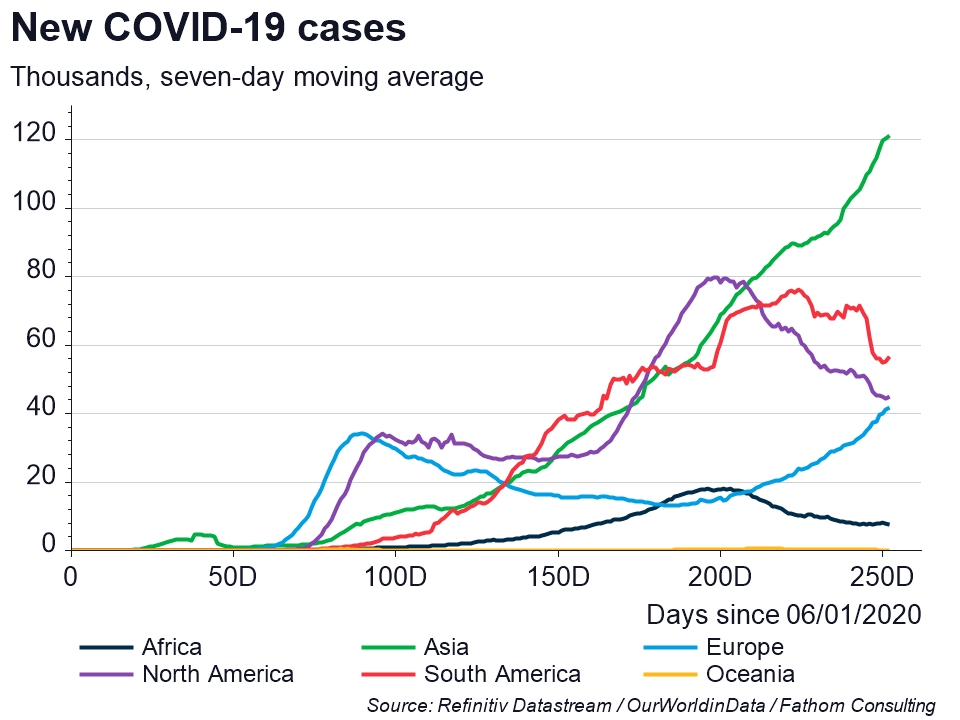
Ex-China, world new cases per day keep rising at an accelerating rate:

image_thumb[16]

In terms of confirmed cases per million pop., the U.S. is way above Italy’s worst point, when the world really woke up:

image_thumb[18]

Recent U.S. hot spots like Louisiana, Texas and Arizona are showing more encouraging trends, but new case per capita are now rising (last 14 days) in 37 states. The R factor is above 1.0 in most states:

US coronavirus deaths surpass 1,000 for fourth day in a row Friday’s fatality count caps grim week in which Donald Trump conceded seriousness of outbreak

Part of the problem in the U.S. is that Republicans remain in denial as Bruce Mehlman (Mehlman Castagnetti) illustrates. Perhaps, Trump’s recent epiphany, following many republican governors breaking rank and bad polls, will help change that.

image_thumb[19]

It is rather scary to see how so many people can be influenced, one way or the other, by media-savvy leaders.

This Pew Research poll result is puzzling in many respects. While everybody sees the threat to the economy, Republicans are largely unconcerned for everything else, including their own financial health. Democrats are worried about everybody but themselves…

BTW: Bahamas closes borders to U.S. tourists after COVID-19 cases spike; others still welcome

PANDENOMICS
Flash PMIs
U.S. private sector output stabilises in July but demand falters

U.S. private sector firms indicated a stabilisation of business activity at the start of the third quarter, with the contraction in service sector output slowing further and manufacturers signalling a modest upturn in production. Growth was impeded, however, by an increased rate of decline of new orders, linked in part to renewed coronavirus disease 2019 (COVID-19) containment measures

Adjusted for seasonal factors, the IHS Markit Flash U.S. Composite PMI Output Index posted 50.0 in July, up from 47.9 at the end of the second quarter, signalling a stabilisation in private sector output. The latest data thereby indicated an end to the five-month sequence of decline that began in February.

image_thumb[3]

Despite some states reversing or pausing their decision to reopen the economy due to a sharp uptick in new COVID-19 cases, both manufacturers and service providers continued to move on an improving trajectory.

New business, however, was weighed down by reports of challenging demand conditions, especially among service providers, with some struggling with the reintroduction of lockdown measures. Service sector firms registered a faster decline in new orders in July. In contrast, manufacturing firms signalled the strongest expansion in new orders since January.

New export orders fell only fractionally in July, with manufacturers recording a marginal rise in foreign client demand. Travel restrictions continued to hamper new business from abroad at services firms.

Nevertheless, private sector firms increased their workforce numbers in July, bringing to an end a four-month sequence of job shedding. The slight rise in workforce numbers was linked to the emergence of pressure on capacity, with backlogs of work increasing at a marginal pace.

Meanwhile, inflationary pressures intensified at the start of the third quarter. Input costs and output charges rose at the sharpest rates since October 2018, as supplier prices were hiked. Some firms linked this to higher transportation costs and an increase in demand for raw materials following the reopening of many businesses, plus higher costs associated with safeguarding against COVID-19.

Output expectations continued on an upward trajectory in July, with the degree of optimism for the year ahead the highest since April 2019. Both manufacturers and service providers were more confident of an increase in activity over the coming year. Positive sentiment was largely linked to expectations that the recovery in client demand will continue amid hopes of an end to the pandemic.

The seasonally adjusted IHS Markit Flash U.S. Services PMIâ„¢ Business Activity Index registered 49.6 in July, up from 47.9 in June. This indicated that the rate of decline eased to the slowest in the current six-month sequence of contraction, and was only fractional overall.

Although the pace of decrease in business activity softened, new business fell at a slightly quicker rate in July. The faster downturn was commonly linked to the resurgence in the virus outbreak and weaker client demand. Nonetheless, pressure on capacity led to a slight increase in workforce numbers.

Service providers indicated a sharp uptick in the rate of input price inflation in July, as supplier prices were hiked, especially for sanitising products. Firms were, however, able to partly pass higher costs onto clients through the fastest rise in selling prices since October 2018.

Business confidence continued to improve among service providers amid hopes of an end to the pandemic.

Manufacturers signalled the first improvement in operating conditions since February in July, as the IHS Markit Flash U.S. Manufacturing Purchasing Managers’ Index™ (PMI™) posted above the 50.0 neutral mark at 51.3, up from 49.8 in June.

Overall growth was driven by the first upturns in both output and new orders for five months. Firms noted that the rise in production was due to greater new business inflows. Some companies also stated that higher new orders stemmed from the gradual return of customers and stronger underlying demand.

Workforce numbers in the manufacturing sector were broadly unchanged in July, as the rate of backlog depletion eased further. Although some firms noted the return of furloughed workers and the hiring of new employees, others remained cautious due to historically muted demand conditions and the ongoing uncertainty surrounding the pandemic. Nonetheless, output expectations strengthened to the highest since February amid hopes of a recovery once the pandemic situation improves.

Finally, input costs and output charges rose at quicker rates in July, as suppliers hiked their prices due to higher transportation costs. Greater input prices were partially passed on to clients through greater output charges.

Chris Williamson, Chief Business Economist at IHS Markit:

While the stabilisation of business activity in July is welcome news, the lack of growth is a disappointment. Moreover, a renewed acceleration in the rate of loss of new business raises concerns that demand is faltering. Many companies, notably in consumer-facing areas of the service sector, linked falling sales to re-imposed lockdowns.

Firms’ costs have meanwhile spiralled higher, surging at the steepest rate for seven years in the service sector, in part due to the additional burdens of safeguarding against the coronavirus.

Moody’s:

Most areas of the country had reopened by Memorial Day weekend, ushering in the return to restaurants, retail and recreation venues in late May. Two weeks after the holiday, the number of new cases in states that eased restrictions early surpassed that in those with longer lockdown periods. In the weeks since, places that remained closed for longer have experienced increases of their own. It is clear that reopenings lead to disease spread in lenient and deliberate states alike.

However, that trend was far less pronounced in states that had comprehensive mask requirements in place upon reopening. About half of U.S. states were closed in early May, and about half of those states had mandated face coverings in public by Memorial Day. Only one state that reopened early—Maine—enacted a mask mandate by that time. The outcome was that the state mask mandates acted as a safety net for states when they reopened, leading to far milder increases in new COVID-19 cases compared with other states.

image_thumb[25]

Outbreaks that remained relatively contained resulted in more consumer mobility and spending and thus fewer layoffs by businesses. Policy certainty and consistency also support consumer and business confidence and promote longer-term planning.

image_thumb[26]

Google to Keep Employees Home Until Summer 2021 Amid Coronavirus Pandemic Search-engine giant pushes back return to normalcy

Google will keep its employees home until at least next July, making the search-engine giant the first major U.S. corporation to formalize such an extended timetable in the face of the coronavirus pandemic.

The move will affect nearly all of the roughly 200,000 full-time and contract employees across Google parent Alphabet Inc., GOOG 1.21% and adds pressure to other technology giants that have slated staff to return as soon as January. (…) Until now, Google had told its employees to expect a return to the office beginning in January. (…)

Facebook Inc. founder Mark Zuckerberg has said he expects half of the social network’s employees to work from home in the next decade. (…)

In New York, fewer than one-tenth of Manhattan office workers are back to the workplace, a full month after the city gave businesses the green light to reoccupy buildings vacated in March. (…)

New Home Sales Strengthen Unexpectedly in June

Sales of new single-family homes increased 13.8% (6.9% y/y) during June to 776,000 (AR) from 682,000 in May, revised up from 676,000. The increase followed May’s 19.4% rise and left sales at the highest level since July 2007. The Action Economics Forecast Survey expected sales of 700,000 during June.

The rise in home sales occurred against the backdrop of a decline in the 30-year fixed-rate mortgage to an average 3.16% in June from 3.23% averaged in May. Rates have since fallen to an average 3.02% so far this month.

Sales in the Northeast rose 89.7% to 55,000 and have more-than-doubled y/y. Sales in the West strengthened 18.0% (4.1% y/y) to 203,000. Sales in the Midwest improved 10.5% (33.3% y/y) to 84,000 while sales in the South rose 7.2% (-1.8% y/y) to 434,000.

The median price of a new home increased 6.1% (5.6% y/y) to $329,200 in June while the average price of a new home improved 6.2% (6.3% y/y) to $384,700. Home prices, which are not seasonally adjusted, have been range-bound for the past few years.

 image_thumb[6] image_thumb[7]

  • Wells Fargo Tightens Purse Strings to Ride Out Pandemic The fourth-largest U.S. bank is slashing costs, cutting staff and tightening up on lending to ride out the coronavirus recession. Its rivals might not be too far behind.
    • (…) Mr. Scharf said this month that Wells Fargo needed to trim at least $10 billion in annual costs to line up with its peers, a move that executives say will include layoffs in nearly every corner of the bank. Layoff counts haven’t been finalized and likely won’t take place all at once, but are expected to number in the tens of thousands in all, according to people familiar with the matter. At the end of 2019, Wells Fargo had almost 260,000 employees, the most of the four largest U.S. banks, despite having the least in assets. (…)
  • Ascena Retail Group, the parent company of Ann Taylor, Lane Bryant and other chains, plans to cut the number of its retail locations by nearly 60%, to about 1,200 from about 2,800.
  • Boeing to delay 777X as demand drops for big jets
  • Schlumberger eyes deeper cost cuts as oil rout triggers $3.7 billion charge
  • Desperate hunt for yield forces investors to take ‘extreme risk’ More than 60 per cent of the global bond market now yields less than 1 per cent
  • For now, economic activity in China remains below last year’s levels. (The Daily Shot)

Source: @adam_tooze, @FT; Read full article

Overbuilding was already a growing problem in China.

Source: @markets; Read full article (via The Daily Shot)

From American to European Exceptionalism An overvalued US dollar is ripe for a sharp decline, owing to America’s rapidly worsening macroeconomic imbalances and a government that is abdicating all semblance of global – or even domestic – leadership. And the European Union’s approval of a joint rescue fund is likely to accelerate the euro’s rise.

Interesting op-ed in Project Syndicate from Stephen Roach. Some excerpts:

(…) And now the EMU stool finally has all three legs: a common currency, one central bank, and a credible commitment to a unified fiscal policy. (…)

While the devil could lurk in the details, the bottom line is clear: the Next Generation EU plan will draw critical support from large-scale issuance of pan-European sovereign bonds. That finally puts Europe on the map as the backer of a new risk-free asset in a world that up until now has only known only one: US Treasuries. (…)

With the US entering the COVID crisis with a much thinner saving cushion and moving far more aggressively on the fiscal front, the net-saving and current-account differentials will continue to shift in Europe’s favor – putting significant downward pressure on the dollar. (…)

The COVID containment disparity is equally striking. New cases in the US soared to a record daily high of 67,000 in the week ending July 21 – up a staggering 208% from mid-June. In the EU-27, the daily count of newly confirmed infections has remained roughly stable since mid-May, at a little over 5,000. Given that the EU’s population is 35% larger, America’s abysmal failure at containing the coronavirus is all the more glaring on a per capita basis. Moreover, the expansion of coronavirus testing in the US is actually decelerating just as the infection rate is exploding, undermining the Trump administration’s vacuous justification that more testing is driving the rise in infections. With Europe’s much deeper commitment to public-health policy and enforcement, whose currency would you rather own?

American exceptionalism has long been the icing on the cake for the Teflon-like US dollar. Those days are gone. As the world’s most unloved major currency, the euro may well be headed for an exceptional run of its own. Downward pressure on the dollar will only intensify as a result.

“Exceptionalism” from the Collins dictionary:

an attitude to other countries, cultures, etc based on the idea of being quite distinct from, and often superior to, them in vital ways.

Some might says that American exceptionalism is still present, but without the “often superior” part.

Timothy Snyder, a professor of history at Yale University, goes a step, actually several steps further in Foreign Policy:

In Portland, the Baby Fascists Have Shown Their Face Fascism can happen in America. Some of it has already happened, and more will happen as Trump fights to stay in power.

Fascism was never about actual people and their predicaments but about a glorious imaginary collective that had died but would be reborn. In the 1920s and 1930s, the idea was everywhere the same: At some point in the past, the nation or the race had been greater, purer, more beautiful. That ancient perfection could be seen in ruins, poems, monuments. Then, so the story went, another group, some inferior race, some cabal had come along and inexplicably ruined the people’s destiny. If only that group could be removed, then the race could be restored, made great again. (…)

Consider what would have happened had the president expressed as much concern for people in February and March as for statues in June and July. There was no call earlier this year for haste, for sudden action, for interagency cooperation, for an expansion of the role of the federal government to defeat a pandemic. On the contrary: The states were told to deal with the coronavirus themselves, and individuals were left to sort through the confusion and contradictions of statements from the White House. But when statues are threatened, then, it seems, exceptional action is called for. What if all the men (and, yes, they are nearly always men) swinging batons now had been passing out masks a few months ago?

Who are the miniature stormtroopers now appearing in Portland and soon in other cities? That the men in mismatched shoes and ill-fitting uniforms lack identification and insignia recalls virtually every authoritarian regime. It is a basic feature of a state under the rule of law that a citizen can recognize legal authority and tell the police from the thugs. It is the nightmare moment of repression to be seized by unknown men. When the government itself elides the distinction between those who protect the law and those who break it, when it makes itself into a paramilitary wearing the wrong kind of camouflage, it invites others to do the same. It is not so hard, after all, to rent a van, play dress up, and start hurting people. When citizens do not know whether they are being intimidated by governmental or nongovernmental forces, the situation is rife for the kind of escalation that fascists liked.

Fascists thrived in crises and indeed sought them out. The unforgettable example is the Reichstag fire, which Adolf Hitler recognized right away as his great opportunity. As the German parliament burned, the Nazis mischaracterized the event, speaking of a vast left-wing conspiracy to destroy the country, the race, and so on. Something not so dissimilar is taking place now, as Attorney General William Barr and acting Secretary of Homeland Security Chad Wolf rationalize the use of force against Americans on the basis of a dark fairy tale about what the protests mean. The Nazis claimed that their main rival, the Social Democrats, were ultimately to be blamed for a terrorist act; Trump’s fundraising messages say the same about his own political rivals. By deliberately provoking protesters, Trump and his allies are working to create their own Reichstag moment. The difference this time, of course, is that everyone knows that this is what is going on. (…)

All of this is a dry run for November. Republics do not usually collapse because one day one man declares a revolution. They collapse because men inside the regime look for loopholes in the law—as can be seen very clearly in the formation of these deployment groups—and then seek to expand the loopholes until the law itself has no meaning. A crisis is found and expanded until the leader (which is all the word Führer means) can claim that a state of emergency is necessary. Friendly lawyers and judges find some provision of some law that seems to justify this, making the idea of law itself all the less credible. The men who have already learned by running the camps that exception is now the rule thrive as agents of chaos. Elections are of course held, as they were in Nazi Germany, but with the violent men in the mismatched uniforms standing by. The outcome is known in advance. (…)

Trump cannot take fascism all the way, not because he has any virtues but because he has too many vices. He is highly skilled at creating division, as the fascists were, but less good at supplying an ideal for which risks are to be taken and sacrifices made. His ultimate idea is not racial struggle but personal fulfilment. His administration needs enough fascism to get by, enough to weaken the state and society so that the people Trump admires, be they in the Kremlin or in his circle, can stay out of prison and do well for themselves. Oligarchs are good at destroying democracies but not at imagining or building anything new. There is easily enough malice and neglect in the Trump administration to pervert a republic but not enough energy and purpose to build a fascist empire. (…)

Yet to learn from the history of fascism is to understand something painful: Americans have been wrong to think themselves exceptional, and have much to learn about democracy, including from others who have fought harder and longer.

When we look evil in the eye, we see a reflection of ourselves, and that is the moment we react and grow. There will likely be a fight in November, of the sort that Americans have never seen before, but it is a winnable fight. It is right to see fascism and call it by its name. It is also right to mock it, resist it, and overcome it.

Snyder has been crying wolf for a while but recent events, including the troubling interventions in Portland, justify at least listening.

Meanwhile, dissatisfaction with democracy is soaring as Martin Wolf pointed out in this free-to-read FT piece.

EARNINGS WATCH

From Refinitiv/IBES:

Through Jul. 24, 128 companies in the S&P 500 Index have reported earnings for Q2 2020. Of these companies, 80.5% reported earnings above analyst expectations and 18.0% reported earnings below analyst expectations. In a typical quarter (since 1994), 65% of companies beat estimates and 21% miss estimates. Over the past four quarters, 71% of companies beat the estimates and 22% missed estimates.

In aggregate, companies are reporting earnings that are 11.9% above estimates, which compares to a long-term (since 1994) average surprise factor of 3.3% and the average surprise factor over the prior four quarters of 4.3%.

Of these companies, 68.8% reported revenue above analyst expectations and 31.3% reported revenue below analyst expectations. In a typical quarter (since 2002), 60% of companies beat estimates and 40% miss estimates. Over the past four quarters, 59% of companies beat the estimates and 41% missed estimates.

In aggregate, companies are reporting revenue that are 2.6% above estimates, which compares to a long-term (since 2002) average surprise factor of 1.5% and the average surprise factor over the prior four quarters of 0.7%.

The estimated earnings growth rate for the S&P 500 for 20Q2 is -40.3%. If the energy sector is excluded, the growth rate improves to -34.6%.

The estimated revenue growth rate for the S&P 500 for 20Q2 is -10.6%. If the energy sector is excluded, the growth rate improves to -7.4%.

The estimated earnings growth rate for the S&P 500 for 20Q3 is -23.4%. If the energy sector is excluded, the growth rate improves to -19.9%.

image_thumb[27]

image_thumb[28]

From Factset:

FactSet searched for comments on annual EPS guidance in the Q2 earnings releases, presentations, and conference call transcripts of the 128 S&P 500 companies that had reported actual results for the second quarter through July 24. Of these 128 companies, 60 (47%) commented on EPS guidance for the current year.

Of these 60 companies, 32 (53%) stated that they were not providing EPS guidance or confirmed a previous withdrawal of EPS guidance for either FY 2020 or FY 2021. Almost all of these companies cited the uncertainty of the future economic impacts of COVID-19 as the reason for not providing or withdrawing EPS guidance for the full year. At the sector level, the Industrials (10) and Consumer Staples (7) sectors had the highest number of companies withdrawing or not providing EPS guidance for the year.

On the other hand, 28 S&P 500 companies provided EPS guidance for FY 2020 or FY 2021. Of these 28 companies, 13 provided annual EPS guidance that was higher than the previous guidance issued y the company, 6 maintained previous (annual) EPS guidance, 8 provided annual EPS guidance that was lower than the previous guidance issued by the company, and 1 initiated annual EPS guidance (no prior guidance issued). At the sector level, the Health Care (8) and Industrials (6) sectors had the highest number of companies issuing EPS guidance for the year.

Thus, slightly more S&P 500 companies are not providing annual EPS guidance (32) than providing annual EPS guidance (28) at this point in time in the Q2 earnings season.

USD IMPACT from Goldman Sachs:

The trade-weighted USD has declined by 4.1% from its May 14 high. The USD dropped by 3% during a 3-day span in March as panic struck a thin-liquidity market, but the recent weakness is more fundamental in nature. The magnitude of the sell-off since May ranks in the 2nd historical percentile of 2-month moves since 1973. Our FX strategists believe valuation is partly responsible, with the team’s model indicating that the trade-weighted dollar was about 20% overvalued before its recent decline.

Looking forward, our FX strategists forecast the trade-weighted USD will weaken by an additional 5.3% during the next 12 months.

From a fundamental perspective, S&P 500 earnings have a negative relationship with changes in the USD. Our top-down earnings model shows that a 10% fall/(rise) in the trade-weighted dollar would increase/(decrease) 2020 S&P 500 EPS by about 3%. From a price performance standpoint, since 1980 S&P 500 has returned a median of 2.6% in months with a sharp USD move lower vs. 0.7% during months with a sharp dollar appreciation.

The trajectory of the trade-weighted USD also has important implications for the supply and demand of US equities. A weakening US dollar has historically been the biggest catalyst for foreign investor demand for US stocks.

Sectors with a high percentage of international sales typically outperform alongside a weakening USD.

Europe’s Banks Told to Hold Off on Dividends The European Central Bank said lenders should refrain from paying dividends and buying back shares until next year, suggesting several would face a capital shortfall if the eurozone economy deteriorated further.
TECHNICALS WATCH

Lowry’s Research tries to remain constructive in the face of a continued lack of demand that I pointed out last week. Lowry’s notes that “market breadth continued to improve, despite sideways trading in the S&P 500” seeing that “smaller, and likely more speculative, issues are participating in the rebound”. But “even with the strong breadth environment, the spark that would reignite the intermediate-term uptrend was still not there.” Lowry’s concludes with “patience will be a virtue until enthusiastic buying returns.” I would rephrase that with “caution will be a virtue”.

There are many ways to measure breadth…

Some investors are clearly out of breadth:

The NYSE trading volume hit the lowest level since mid-March. (The Daily Shot)

Good or bad breadth?image_thumb[29]

Bianco Research looks forward:

unnamed (34)_thumb[1]

Does that Barron’s chart leave you breathless?

Insider Transactions Ratio

Even the techies seem to be smelling bad breath from their sector. The Nasdaq Composite has diverged from insider sentiment (The Daily Shot).

Breathtaking:

Chinese carmaker BYD Co. Ltd. secured a $316 million contract to supply 420 million facemasks to California as the most populous U.S. state struggles amid the resurgent Covid-19 pandemic.

THE DAILY EDGE: 24 JULY 2020

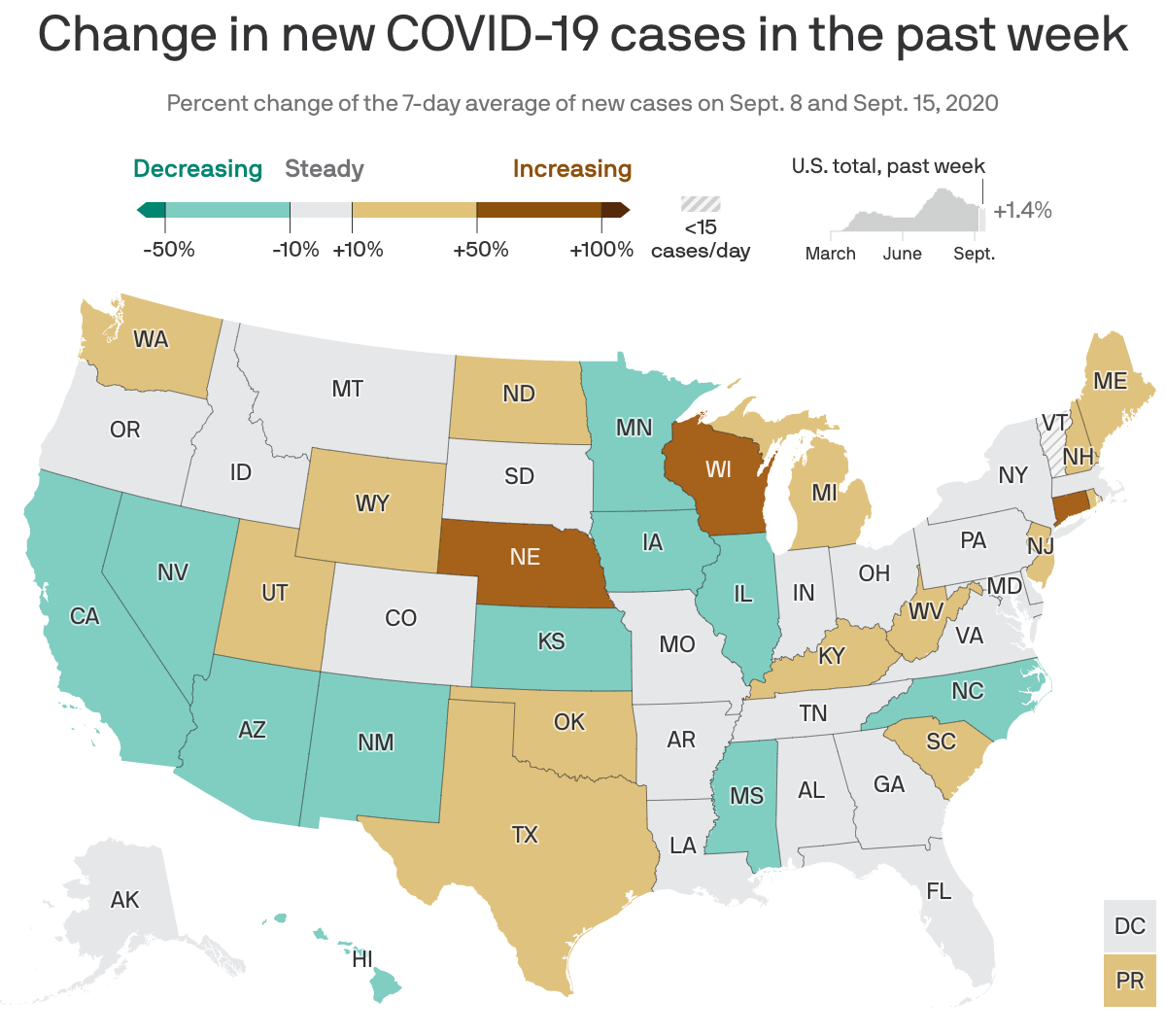
The number of new cases per day is very high but apparently flattening in a few states that experienced significant virus resurgence over the past week, including Arizona, Florida, and South Carolina. Meanwhile, the number of new cases per day is elevated and surging higher in a handful of other states including Nevada, Alabama, Louisiana, Mississippi, Idaho, and Tennessee. Nationally, new cases continue to rise further on average and remain on upward trajectories in a majority of states. (GS)

0_All Key Metrics (10)

Apparently flattening? Thanks to NYC…

3R_Reg PosperMill

…and to reduced testing at several hot states:

                                                                                                                ARIZONA                                          CALIFORNIA 

 image image 

                                                                                                   FLORIDA                                              TEXAS

 image  image

Meanwhile, Axios finds that

Virus sinks GOP governors in hard-hit states

It took the U.S. a little more than three months to get to 1 million coronavirus cases, then two weeks to add the most recent 1 million.

China Says It Will Have a Covid-19 Vaccine Ready This Year China’s state-owned Sinopharm, one of the first Chinese projects to start testing its Covid-19 vaccine candidates overseas, said it would have a vaccine ready for the public before the end of the year.

(…) Chinese authorities are eager to show they can help the world overcome a pandemic that has infected millions. Being first with a vaccine would go a long way toward that goal while at the same time aiming to revive confidence at home and get the domestic economy back to full speed. (…)

Sinopharm, CanSino and a private Chinese company, Sinovac Biotech Ltd., are behind three of five experimental vaccine candidates that are in the final stage of testing on people, according to the World Health Organization. (…)

Mr. Liu, the Sinopharm chairman and an engineer by training, told CCTV that he had tested CNBG’s vaccine on himself in late March, before clinical trials even kicked off in China. He said that the first two phases of testing in China showed the company’s vaccines to be 100% effective and with no cases of serious side effects.

“In the next step, everyone should be able to use it with peace of mind,” he said.

Hmmm…that will get heavily politicized, to say the least…

PANDENOMICS

In Pandemonium on March 16, I discussed the importance of strong leadership in periods of crisis. Investors may not know or understand everything happening and how and when the crisis will end, but they want reassurance that there is someone, some people, fully in charge to surely steer the ship to safety. After throwing money all over the ocean to keep the ship afloat, American politicians now need to keep it stable while maneuvering it towards calmer waters. The WSJ today argues that this ship’s crew has no clear vision about where it needs to go next.

A Phase-Four Flop The latest proposals have everything but a growth agenda.

As Washington debates how many more trillions of dollars to borrow and spend, we are in a familiar political spot. Democrats want to spend as much as they can on everything, while Republicans have no idea what they want. Guess how this is likely to turn out?

Democrats are united behind the $3 trillion Heroes Act that passed the House in May. This is on top of the nearly $3 trillion that Congress has already passed. Much of the latter hasn’t even been spent so far. But we are told Congress must double that amount or the economy will fall off a cliff on Aug. 1 when extra federal jobless benefits expire. (…)

In any case there’s almost nothing in the “phase four” proposals that would spur faster growth. The Senate GOP’s draft proposals contain Covid-specific liability protection for businesses that reopen. That would help, assuming it isn’t watered down in negotiations with Democrats. More money for testing and health care is arguably pro-growth if it helps Americans feel more secure in returning to work and school. That’s about it on the supply-side.

The rest of the GOP proposal is a $1 trillion spending bonanza on all and sundry. Public schools would get tens of billions whether they reopen or not. The White House on Thursday dropped its support for a payroll tax cut, which would have reduced the cost of hiring.

Instead the GOP wants another round of payments to individuals like the previous $1,200 checks. This is hugely expensive but does nothing for growth. The savings rate is already above 20% and most consumers have money. What they need is the economic confidence to spend it, which means the sense that the economy is growing and businesses are hiring again.

The worst idea is to extend the federal unemployment bonus for several more months. The GOP at least wants to cut the bonus from the current $600 a week that pays millions of workers more to stay at home. But the GOP draft still refers to a formula that could pay workers up to 100% of what they make by working. (…)

The goal is to keep the public feeling good about the politicians who are writing the checks. But the good feeling will expire when the money runs out, and then people will want either more checks or a stronger economy that is creating private jobs. Even the U.S. can’t borrow forever to replace the incomes lost from a buoyant economy. (…)

The larger problem here is that Republicans in the age of Donald Trump don’t know what they stand for on economics. Treasury Secretary Steven Mnuchin is a Keynesian whose idea of compromise is half of whatever Mrs. Pelosi wants. And Mrs. Pelosi’s bill is essentially a down payment on her election agenda. She’ll take what she can get now and campaign on the rest and more.

Republicans have no discernible economic agenda beyond paying people to feel better during the pandemic. They need to offer voters alternative policies that would return the economy in 2021 to its pre-Covid prosperity. That should be their phase-four offer. If Democrats reject it, as they probably would, then take it to the voters. As of now Republicans are running as Pelosi Lite.

  • The Mnuchin Follies With his help, Pelosi keeps outmaneuvering Republican senators on coronavirus bills.

The concerted Republican effort to fritter away both policy and principle in these pandemic times continued apace this week—indeed, it leapt forward. Who needs Nancy Pelosi demanding more spending, more unemployment benefits and more union payoffs when Steven Mnuchin and Mitch McConnell will do it for her?

Five months after the coronavirus’s arrival, Washington has settled into a predictable loop. Speaker Pelosi’s House unveils sweeping virus legislation with vast dollar figures and progressive policy demands. Republicans argue among themselves. Treasury Secretary Mnuchin crashes in to “negotiate” the GOP back to their own 5-yard line. Senate Majority Leader McConnell reminds his caucus it is an election year and provides Mrs. Pelosi her touchdown. America goes another trillion dollars, or two, into debt. (…)

Some spending might be justified in aid of economic growth. But as the White House and appropriators now view this as a vote-buying exercise, the proposals focus on handouts and income transfers that would, if anything, prolong closures. (…)

But what about the $25 billion more the Senate would give to testing, or the $26 billion for vaccine research and distribution? Surely we need that, right? Previous legislation allocated $25 billion for testing. Some $13 billion hasn’t been used. A full $10 billion was set aside for states, localities and tribes; they’ve so far spent less than $100 million. Much of the new money for vaccines would go to the Centers for Disease Control and Prevention, still sitting on $5 billion of virus cash. And the administration already has funding for Operation Warp Speed, which covers the cost of vaccine distribution.

The mystery is who in the White House keeps deputizing Mr. Mnuchin as lead congressional envoy, given Mrs. Pelosi’s flawless record at schooling him in the art of the deal. The Treasury secretary remains relentlessly focused on what House Democrats want, rather than on what the economy or the Trump White House needs. His malleability eggs on the big spenders. His fickleness has additionally discouraged the Senate GOP from drawing lines in this debate, for fear of being undercut by Mr. Mnuchin—and inevitably Donald Trump. What’s the point of warning Mrs. Pelosi that it will never renew enhanced unemployment benefits when Mr. Mnuchin has already invited her to begin the bidding?

Republicans overall fear political fallout if they don’t act, but they put themselves in this situation. They might have spent the past two months talking about the money that has already been allocated, the huge sums that still sit in reserve, and the need to correct the mistakes of prior, hasty bills. But that would require familiarizing themselves with figures, then delivering a consistent message. Which is apparently asking a great deal.

So the default is to proceed on the precarious notion that the way to hold the White House and Senate this fall is to join Democrats in a spendathon. In fact, conservative voters are increasingly unhappy about the lasting damage Washington’s aid bills are doing to both the balance sheet and the underpinnings of the private economy. Republicans more than anything need a fired-up base this fall. Another $2 trillion blowout—one that will do little to help the economy—is hardly the way to move them to the ballot box.

Rise in Unemployment Claims Points to Faltering Jobs Recovery New applications for unemployment benefits rose for the first time in nearly four months to 1.4 million as some states rolled back reopenings because of the pandemic, a sign the jobs recovery could be faltering.

(…) Taken together, claims and benefits totals suggest new layoffs are being offset by hiring and employers recalling workers, though at a slower pace than a few weeks ago. (…)

A decreasing number of Americans receiving benefits indicates that recalls and new hiring are outpacing fresh layoffs—suggesting U.S. employers are likely to add jobs to total payrolls for the third straight month in July. (…)

The elevated level of claims indicate many workers are being laid off, perhaps for a second time, and that parents who want to work are unable to access child care, Ms. Holder said. (…)

John Authers in Bloomberg:

For a simple gauge of how the recovery is progressing, try the following chart. It includes the Atlanta Federal Reserve’s GDPNow forecast, which aims to pull together recent data to show at what annualized rate the GDP is growing or rising at any one time.  On the other scale is the total of both initial and continuing jobless claims, which are both announced weekly and give us a crude real-time measure of how the labor market is progressing. In both cases we see a spectacular fall, the beginning of what looks as though it could be a V-shaped rebound, and then a slowing into something that looks more like a Nike “Swoosh” logo.

Simple measurements suggest recovery is slower than the downturn

Authers also points to declining real T-yields and the weakening dollars as signs of increasing wariness on the U.S. economy.

Goldman Sachs’ trackers “suggest that current household employment is roughly unchanged from the June survey, and that as of July 7 the unemployment rate had risen back up to 10.8% after falling to 10.5% in late June (vs. 11.1% in the June survey).”

image

NBF adds:

(…) our in-house mobility index based on google data is showing an undesirable stagnation in movements since mid-June. That said, the stagnation doesn’t seem to be limited to the United States. To the contrary, today’s Hot chart shows mobility is plateauing in several other places, with no less than 5 countries among G-7 in such a situation since the beginning of the month.

image

A survey by Fortune Analytics, done in conjunction with SurveyMonkey, makes it pretty clear most are not. The survey found:
–Only 43% of Americans are comfortable to return to dine-in restaurants;
–Only 27% of frequent flyers are ready to board a flight again;
–Only 26% are willing to return to bars;
–And only 20% would feel comfortable attending a large public gathering.
Meanwhile, mask-wearing is up. Some 67% now say they wear masks when in public, compared to 54% back in May.

Tech companies are also suffering as Knoema reveals:

During the pandemic period, 524 startups around the world cut staff – a loss of 69,514 jobs. Around two-thirds of these job losses were in the United States.

Data indicates that coronavirus boosts robotization in Japan. For jobs that could be easily automated, there was a more than 30% year-on-year decline in availability in May and June 2020, while jobs that were not easily automated declined by just 10%. Nikkei

According to recent research 32-42% of COVID-induced layoffs in the US will be permanent, and one-tenth of all work days (one-fifth for office workers) will shift from business premises to residences in the post-pandemic world relative to the pre-pandemic situation. The Becker Friedman Institute for Economics

Changing priorities and the significant shift toward Americans working from home are driving more than a quarter of users on online real estate portal Redfin.com to search for a major change of scenery, according to the firm’s latest migration report released Thursday.

A record 27.4%—the highest level recorded since Redfin began reporting net migration data in early 2017—of the website’s surveyed users looked to move to another metro area in the second quarter of 2020, a three-month period that saw the coronavirus pandemic take hold in the U.S. and unprecedented lockdowns nationwide. (…)

“With the pandemic, there are a ton of out-of-towners planning to work remotely who’d like a big backyard and office space, which didn’t used to be so high on their priority lists. (…)”

FLASH PMIs

Eurozone businesses report strongest growth for two years in July

Business activity across the eurozone rose for the first time since February, according to provisional PMI® survey data, growing at the sharpest rate for just over two years as economies continued to reopen after lockdowns implemented to prevent the spread of the coronavirus disease 2019 (COVID-19). Output expectations improved, while new order inflows also picked up and job losses eased, albeit with job cutting remaining widespread as many firms continued to scale back capacity.

The flash IHS Markit Eurozone Composite PMI rose further in July from the all-time low of 13.6 seen back in April, climbing from 48.5 in June to 54.8. This was the first reading above the 50.0 no-change level since February and indicated the largest monthly gain in output since June 2018.

 image image

Both manufacturing and services returned to growth (the latter recording the slightly stronger performance), with growth hitting 23- and 25-month highs respectively. While the rise in service sector output was the first since February, the increase in factory production was the first reported since January 2019.

Demand was also reported to have revived alongside the lifting of lockdowns, with new order inflows likewise rising for the first time since February and increasing to an extent not seen since October 2018. However, the upturn in new orders was less marked than that recorded for output, thanks in part to a further loss of export sales, leading to an ongoing depletion of backlogs of work during the month.

Although the drop in outstanding business was smaller than witnessed in prior months, a resulting surfeit of capacity relative to order books prompted many companies to continue to reduce staffing numbers. Headcounts consequently fell for a fifth straight month. While the rate of job cutting eased compared to the prior four months, it nevertheless remained faster than at any time since the start of 2013.

Job losses remained especially severe in the manufacturing sector where, besides the prior three months, the rate of job cutting was quicker than at any time since 2009. A far more modest rate of employment decline was seen in the service sector, though even here the drop in headcounts was the greatest for seven years, barring the height of the pandemic.

Looking ahead, expectations of future output continued to improve from the low plumbed in March, rising to five-month highs in both manufacturing and services, the latter reporting relatively greater prospects. Hopes of improved performance over the coming year often reflected expectations of a further opening up of economies, though companies also often warned that any gains were from historically low bases, due to business volumes having been hit hard by the pandemic.

Average prices charged for goods and services meanwhile fell for a fifth month running as firms commonly reported the need to offer discounts to stimulate sales, though the rate of decline continued to moderate from April’s near-11-year record.

The easing in price deflation was linked to rising costs: average input prices increased for a second month running, albeit only modestly. While raw material prices continued to fall, higher staff and PPE or other COVID-19 protection costs were widely reported.

By country, French companies led the upturn, reporting a second successive month of output gains, with growth surging to the fastest since January 2018. Both manufacturing and services reported the best output growth for two-and-a-half years. While French service sector companies reported the first rise in new orders since February, factory orders edged back into decline, led by a sharp drop in exports. Employment continued to fall, but the loss of jobs was the smallest seen over the past five months.

In Germany, output rose for the first time since February, increasing to an extent not seen for almost two years. A surge in service sector activity (which showed the largest gain for two-and-a-half years) was accompanied by a more modest manufacturing output increase. The factory output gain was nonetheless the best seen for nearly two years, fueled by a marked jump in new orders, including exports. Employment continued to fall, however, with overall job losses centred on the manufacturing sector.

The rest of the region outside of France and Germany also saw output return to growth, led by manufacturing, though the overall gain was more modest than seen in France and Germany. While new orders stabilised and job cutting moderated, the pace of job shedding remained marked, especially in services.

JAPAN: Downturn remains substantial despite easing further

The Japanese economy continued to struggle at the start of the third quarter, with the latest flash PMI data indicating a further sharp contraction in business activity during July. While the easing of emergency measures provided some relief, especially to the domestic sector, Japan’s growth continued to be adversely affected by subdued global trade flows and restrictions on travel. All of these factors continued to weigh heavily on demand, with total new orders falling further, dragged down by a substantial decline in new exports.

As the economy remained mired in a downturn, companies sought to contain costs and survive the pandemic by cutting jobs. Employment continued to fall in July, with factory jobs reduced at a sharper rate than seen in the service sector. Rising unemployment adds to fears that consumption may weaken in the coming months.

Any hopes of a robust recovery need to be tempered as business sentiment about the year-ahead outlook remained pessimistic on balance.

 image

EARNINGS WATCH

We have 113 reports in, a 77% beat rate and a +12.-% surprise factor. Those 113 companies show an aggregate earnings decline of 40.5% on a 7.4% drop in revenues.

Trailing EPS are $140.58.

PANDEMONIUM
Pompeo Urges Chinese People to Change Communist Party Top U.S. diplomat urges allied countries, Chinese people to work with the U.S. to transform the party’s behavior

Secretary of State Mike Pompeo called on the Chinese people to alter the ruling Communist Party’s direction in a speech explaining the Trump administration’s full-throttle response to an assertive China.

Chinese leader Xi Jinping is a “true believer in a bankrupt, totalitarian ideology,” Mr. Pompeo said. He stopped shy of explicitly calling for regime change, urging allied countries and the people of China to work with the U.S. to change the Communist Party’s behavior.

The Communist Party “fears the Chinese people’s honest opinions more than any foe,” Mr. Pompeo said in a speech at the Richard Nixon Presidential Library and Museum in Yorba Linda, Calif. The U.S. “must also engage and empower the Chinese people,” he said.

The speech, called “Communist China and the Free World’s Future,” caps a series of addresses by senior officials in recent weeks focusing on what the Trump administration sees as the challenge posed by China and its expanding global reach. The uncompromising rhetoric has been accompanied by an uptick in administration pressure on Beijing—from sanctions to military exercises and indictments—as relations between the countries spiral downward to the lowest point in decades. (…)

Mr. Pompeo has previously made direct appeals to foreign citizens while attacking their governments, in speeches on Iran in 2018 and Venezuela in March.

Many world leaders have criticized the Trump administration’s foreign policy as unilateralist. But in recent weeks, Washington has seen key allies embrace its harder-edged approach to China. (…)

In the speech, Mr. Pompeo urged like-minded countries to exert coordinated pressure on the Chinese Communist Party. “We must induce China to change in more creative and assertive ways, because Beijing’s actions threaten our people and our prosperity,” he said. (…)

“The only way to truly change Communist China is to act not on the basis of what Chinese leaders say but how they behave,” Mr. Pompeo said. “Distrust and verify.” (…)

“Communists always lie, but the biggest lie is that the Chinese Communist Party speaks for 1.4 billion people who are surveilled, oppressed and scared to speak out,” Mr. Pompeo plans to say. (…)

How about Russia?

Russia Tests an Anti-Satellite Weapon, U.S. Officials Say Russia conducted an unusual anti-satellite test earlier this month, provoking concern that Moscow is working to improve its capability to attack American space-based systems, the U.S Space Command said.