The enemy of knowledge is not ignorance, it’s the illusion of knowledge (Stephen Hawking)

It ain’t what you don’t know that gets you into trouble. It’s what you know for sure that just ain’t so (Mark Twain)

Invest with smart knowledge and objective odds

YOUR DAILY EDGE: 25 September 2025

CONSUMER WATCH

From the Bank of America Institute yesterday:

Consumer spending growth has built momentum over the last few months, with three back-to-back monthly increases in seasonally adjusted credit and debit card spending, according to Bank of America aggregated card data.
Looking across US Census Bureau regions, we see a pickup in spending growth throughout the country.

image

Containerized imports through American ports are set to take an historic plunge in September, an analyst predicts, as President Donald Trump’s China tariffs take a toll on the busiest trans-Pacific trade route. (…)

McCown said that without the spike from frontloading, the U.S. would have seen a drop in y/y volume in July “at least as high as the Far East’s positive number.” [+6.3%] (…)

He quoted a revised forecast by the National Retail Federation that shows import volumes falling 3.4% for the year.

“That translates into the remaining four months of 2025 being down 15.7% compared to the same four months in 2024,” said McCown.

The Port of Los Angeles expects inbound volumes to fall 10% in September y/y; McCown agrees that the busiest U.S. container port will see a double-digit decline for the month. (…)

Moreover, bookings for containers moving from China to the U.S. the first week of September were down 26% from the same week a year ago. Backhaul moves westbound to China were off by 18% despite the latest tariff pause. (…)

A year-on-year decline in inbound volume is a rarity in the more than six decades of container shipping, McCown noted, matched only by drops during the 2009 financial crisis and the pandemic, which were short-lived. Imports have reliably grown at a rate two, three or more times that of of the GDP. “The downward turn will be due solely to tariffs and unfortunately, there is nothing at present that suggests it will be short-lived,” McCown said.

The Big Three West Coast Ports reported combined containerized import growth of -7.0% MoM in August, below historical August seasonality of +1% MoM which comes after above-seasonal performances in June and July. (GS)

Strong consumer demand vs declining supply?

US New-Home Sales Unexpectedly Jump Over 20% in Broad Advance

New-home sales in the US unexpectedly surged in August to the fastest pace since early 2022, likely lifted by builders’ rampant price cuts and sales incentives.

Sales of new single-family homes increased 20.5% to a 800,000 annualized rate in a broad advance, according to a government report issued Wednesday. (…)

The data suggest US homebuilders are successfully luring buyers off the sidelines with aggressive sales incentives. This month, 39% of builders reported cutting prices in a survey by the National Association of Home Builders and Wells Fargo, a post-pandemic high.

Homebuilder Lennar Corp. recently reported offering sales incentives equal to 14.3% of its average sale price, more than double its usual 5% or 6%, Bloomberg Intelligence analyst Drew Reading said in a note. (…)

More demand for durable goods…

Sky-High S&P 500 Signals ‘New Normal,’ Not Bubble, BofA Says

US stocks are screamingly expensive when viewed from a historical perspective. But dig into the details, and the sky-high valuations may well be warranted, say strategists at Bank of America Corp.

The S&P 500 Index is trading at statistically rich levels based on 19 of 20 in-house metrics tracked by BofA, with four hitting all-time highs, a team led by Savita Subramanian said Wednesday in a note to clients.

Yet the attributes inherent in the current mix of members — including less financial leverage, lower earnings volatility, increased efficiency and more stable margins than in decades past — help to support the towering valuations, she argues. (…)

“The index has changed significantly from the 80s, 90s and 2000s,” Subramanian, BofA’s head of equity and quantitative strategy, wrote. “Perhaps we should anchor to today’s multiples as the new normal rather than expecting mean reversion to a bygone era.” (…)

This week, the S&P 500’s 12-month forward price-to-earnings ratio touched a high of 22.9, a level that this century was exceeded in just two prior instances: the dot-com bust and the pandemic rally in the summer of 2020 when the Federal Reserve reduced interest rates to near zero. (…)

“Buying stocks at these multiples feels bad,” Subramanian wrote, but a boom in sales, earnings and GDP would “resolve this seemingly untenable situation” by justifying those pricey levels, she added. “With major regions in easy fiscal mode, and with the Fed cutting against a backdrop of broadening and accelerating profits, it’s not hard to argue” for such a boom, Subramanian added.

“This is the higher probability ‘tail’ in 2026 than stagflation or recession, in our view,” she said.

China’s Boost to Argentine Soy Buying Sidelines US Farmers

China ramped up buying of soybeans from Argentina this week after the South American country abruptly suspended export taxes, sidelining US farmers who usually dominate the trade at this point of the year.

Importers in China have expanded purchases to at least 35 cargoes, up from an earlier tally of 20 shipments, according to people familiar with the matter, who asked not to be identified as they’re not authorized to speak to the media. Most of the soybeans are slated to be loaded in November, they added. (…)

The world’s largest importer typically turns to US supplies between October and February following the American harvest, while the new Brazilian crop is in the process of growing for collection in March.

But as of Sept. 11 — almost two weeks into the new marketing season for the US — China hadn’t booked a single American cargo. That’s the first time in records going back to 1999, according to US Department of Agriculture data.

The American Soybean Association urged President Donald Trump to secure an “immediate deal” with China following reports of the Argentine purchases. In a statement on Wednesday, the group said “the farm economy is suffering.” (…)

(…) “Tonight we recognize President Javier Milei for his tireless efforts to make Argentina great again,” said Bessent, introducing Milei to receive an award at an Atlantic Council dinner on Wednesday. He hailed Milei’s “visionary leadership,” saying the Argentinian leader “recognized government is not the solution, it is the problem.” (…)

With Argentina, Bessent is trying to support a currency under threat. In so doing, he’s effectively moving to prop up one of Trump’s closest allies on the world stage in a region where China has been making inroads with other nations, including neighboring Brazil. (…)

The Treasury secretary earlier Wednesday said the US plans to extend a $20 billion swap line to Argentina, and stands ready to buy the country’s foreign bonds. That provided much-needed financial support to Milei as he tries to regain investor confidence and stem a run on his nation’s currency. (…)

He made clear in an interview on Fox News that the financing was meant to help Milei ahead of next month’s crucial vote. (…)

Bessent’s overture also marks an extraordinary turnabout for a US president who was elected on a promise to limit American military and financial interventions overseas in favor of focusing on domestic concerns. Since taking office, Trump has slashed billions in foreign aid. (…)

And in Trump and Bessent, Milei has found a pair of financial backers from the world’s largest economy, ready to intervene in order to stave off a collapse of his nation’s currency caused by doubts about Milei’s own economic plans. And all of that comes just ahead of key midterm elections next month in Argentina, as polls show the more liberal opposition gaining support. (…)

Trump has stoked conflict with leftists in Latin America, slapping tariffs on Brazil, whose President Luiz Inacio Lula da Silva is an elder statesman in the region. He’s also hit Mexican President Claudia Sheinbaum’s nation with duties, repeatedly clashed with Colombia’s Gustavo Petro and ordered strikes on boats belonging to alleged drug traffickers in the Caribbean as a warning to Venezuela’s Nicolas Maduro.

By contrast, Milei has carved out a friendly path with Trump, making multiple trips to the US, including for Trump’s inauguration in January. Bessent also made Argentina one of his first trips as Treasury Secretary in April to show support for Milei’s economic program days after the nation won a new loan from the International Monetary Fund.

From the FT:

One of biggest obstacles to Milei rethinking his political strategy may be his sister and life-long confidante, Karina. As presidential chief of staff, she has tried to build electoral support for Milei’s upstart political party La Libertad Avanza.(…)

Karina is also embroiled in a corruption scandal that hurt Milei’s reputation as an outsider determined to break with Argentina’s notoriously venal politics. The former head of the government’s disability agency and Milei’s former lawyer, Diego Spagnuolo, was heard on recordings discussing commissions of 3 per cent on medicines being funnelled to Karina.

Milei’s response has failed to quell voters’ doubts, analysts say. The president stayed silent for a week, then dismissed Spagnuolo as a liar, then claimed the recordings were AI-generated.

On Saturday he told local media the claims were improbable because 3 per cent was a low figure: “Would you take 3 per cent when you could take 100 per cent?”

The Extraordinary Rise of Electric Cars in Developing Countries Colin McKerracher, head of transport for BloombergNEF

(My emphasis)

(…) from 2019 till now, the size of the fleet forecast has gone up a fair bit. But actually in the last three years, it’s been level and even slightly down. So 2025 was the very first year where our global forecast went down, and that’s because we were anticipating, and starting to see now, a very strong drop in the US. It’s not dropping yet, but the policy levers going away under the Trump administration will absolutely have an impact.

And this is an important thing to mention, is that policy still really matters. You still get the policies that you vote for, and those policies have an impact on the market.

But zooming out and sort of taking the long view, I think the biggest reason why it’s gone up over a five or six year time horizon is that we reached the point of organic consumer demand takeoff in China about three years sooner than we thought we would. So our general view before was that China and most of the markets are policy push markets for the next few years, and then around 2025 it takes off.

What happened in China is that around 2021-2022, organic consumer demand vastly outstripped what the government targets were. Over 50% of sales have a plug, the largest auto market in the world, half of the sales are electric, and that is way ahead of what the government targets were. What that means is that that kink in the curve where you get organic consumer adoption has come about three years sooner than we thought (…).

Battery costs have come down dramatically. (…) as soon as you started to look at battery costs and battery prices, you sort of concluded, ‘whoa, there’s something really dramatic going on here.’ And eventually you’re going to get to price parity between electric vehicles and combustion cars, and that’s largely what’s played out.

Not everywhere, like an EV is still significantly more expensive in the US, and depending on where you are in parts of Europe, than a combustion car. But in China, it is cheaper. And again, that’s part of why you’ve seen that organic consumer demand take off. (…)

So you do need competitively priced EVs. We’re getting more and more of those around the world, and that’s a big part of why you’ve seen adoption take off. And underlying that is the battery story. And batteries do keep getting cheaper, and they do keep getting better.

(…) we have revised our US EV adoption forecast dramatically down in this year’s outlook. And the biggest thing behind that is that the federal tax credit is going away. So at the end of September, it’s gone. And then the other thing is that the fuel economy regulations, the CAFE regulations, are being rolled back, and both of those were set to be big drivers, along with some parts of the Inflation Reduction Act that were incentivizing the supply side. So virtually all of those are under threat.

Now the other big pillar of US EV adoption has been California, and the standards that California sets for vehicles and the zero emissions vehicle mandate in California that exists because of the waiver that California has to set its own standards. Trump has gone after that waiver. (…) Our outlook this year assumes that California retains some ability to set its own air quality standards, and that things like the ZEV mandate in California may be revised, but not fully eliminated. That could go down further. So we already reduced our outlook pretty significantly between last year’s and this year’s for US EVs in 2030. We could revise it further if that California ability is confirmed to be removed.

You said that China is now selling more than half of all its new car sales as electric. But there’s a more shocking stat in the report that this will be the first year when China will sell more electric cars than the total number of cars sold in the US whether that’s electric or those massive gas guzzling pickup trucks. What is that going to do to the competitiveness of US automakers?

(…) in Q4, we think there’ll be more EVs sold of all types, not including two and three wheelers, but cars and trucks versus combustion vehicles and all types of vehicles in the US, which is pretty remarkable. So it’s going from very few sales a few years ago to overtaking the entire size of the US vehicle market, which is part of the reason we say as well that combustion vehicle sales peaked in 2017. (…)

And not only are they selling a lot of electric vehicles within China, but the amount of vehicles they’re exporting is also rising really quickly. So China has become the largest vehicle exporter in the world, overtaking Japan last year and Germany the year before. There is a real risk right now in the US, and US consumers are not able to access these vehicles that the Chinese automakers are producing because of 100% tariff, which basically makes it impossible for an automaker to sell there profitably.

There is a real risk that the US market is sort of evolving as its own island, if you will. If you think of evolutionary life forms, these islands that get cut off from other parts of the world, they grow different species within them. And there was always a bit of that within the US and North American market. But it starts to look like a stronger effect if the rest of the world is moving much more forcefully towards electrification.

And you don’t have to go very far from the US, or from Canada even to see that. If you look at Latin America, other parts of the Americas, you’re seeing really strong growth in electric vehicles coming from mostly Chinese manufacturers.

So there is a competitiveness risk, I will say (…). About 25% of global car sales this year are going to be plug-ins, and the majority of those are battery electric. So maybe it’s not so early in the transition anymore, but there is still room for this to turn around, and companies like Tesla, though their sales have fallen a little bit in the last little while in some markets, they are still leaders in electric vehicles globally, so there is still room to compete and to be at the forefront of this.

But it does look more and more like under the Trump administration, the US will fall further behind on electrification and on batteries, and it is unclear yet whether that’s something they’ll be able to recover from if that set of policies lasts four years or longer. (…)

If you’re sat in the US, this might sound surprising, but you’re getting higher rates of EV adoption in many emerging economies than you have in the US, than you have even in some European countries. And the list is getting longer. So it used to be maybe one or two countries, but now you say, ‘Okay, actually, we’ve got quite high rates in Brazil, in Uruguay, in Costa Rica, in big parts of Southeast Asia, Vietnam, Thailand, Nepal, Ethiopia.’

These are not places that are doing this for some sort of obligation around CO2 emissions, or some sense of moral obligation to other countries. Primarily, those factors can play a role, but they’re primarily doing it because it’s the lowest cost economic choice.

Now, I think there is a bit of a pushback from some of these countries if they make automobiles themselves to say — and India is a good example of this — ‘We want more of it made here. We don’t want to import technology.’ But what you’re seeing in places that don’t make a lot of vehicles of any type within the countries, they’re saying, ‘we’re importing this either way, we may as well import the one that cleans up local air quality and is cheaper to buy.’ (…)

And again, not just in a few countries, in many countries, and in many different segments, two wheelers, buses, delivery vans, cars, all those are really moving in a lot of emerging economies. Then the whole thing goes a lot faster.

So India is probably the most interesting one to watch, to be honest, because the numbers are starting to go up quite quickly. You do have domestic manufacturing, so the model choice is going up very fast. (…)

The fastest growth rates are all in countries where Chinese vehicles are part of the mix, they’re forcing competition. They’re bringing down costs for consumers. And sometimes I hear in the US people say, ‘no, no, consumers don’t want to buy these.’ And I say, ‘well, let’s take out that 100% tariff and see what happens. Let the consumer decide.’ (…)

Nepal, 70% of all new cars are electric. Thailand, 60%. Vietnam, 40%. No developing country can quite match your resident country of Norway, where 100% cars that are sold are EVs. But barring that exception, we are now at that place where many developing countries have begun to leapfrog developed countries when it comes to new sales of cars. (…)

And the last time I was in San Francisco, I took one [autonomous car] in a rainstorm, a full on downpour, and it handled everything really, really smoothly. So the technology is getting better. The number of trips is going up exponentially. You’re seeing their first permits approved to pick up at airports. And again, if you look at shared mobility patterns, airport pickups are a really big part of Uber and Lyft earnings, and things like that. So there’s a lot of trips available there.

(…) 90% of all the kilometers traveled in autonomous vehicles today are electric. So that’s happening. It’s not hypothesized anymore. That market is electric, but it’s probably more like the 2040s or say the late 2030s and onwards, where it starts to make a material impact in global transit patterns and global energy use from transport.

So we think about 25% of cars this year will be electric. That’s battery electrics and plug-in hybrids combined. If you go down from there, light commercial vehicles, about 10% will be electric this year, medium and heavy, about 4%. So passenger cars are ahead of those two segments, but they’re actually behind the two leading segments, which is two and three wheeled vehicles, which is 39% of global sales this year will be electric, and buses, about 43% of sales will be electric.

So when you think particularly about emerging economies, think of this combined ecosystem of different vehicle types. It’s not all about passenger cars, but you’re seeing progress, rapid progress, on electrification in multiple segments at once. (…)

And actually, what’s interesting in the oil displacement story is that early on a lot of it was driven by buses and two and three wheeled vehicles, and just now you’re starting to see passenger cars start to make a material dent. It’s about 2 million barrels per day being displaced right now by electric vehicles of all types. Now that’s against over 100 million barrels per day of oil demand globally.(…)

But I think where it gets quite interesting is the markets where you’re seeing higher levels of EV adoption, because there you are starting to get significant displacement. (…) So places like Norway, you’re getting about three to 4% drop in liquid fuel demand for road transport every year, and that’s just as the fleet turns over.

In China, which has been the biggest driver of oil demand growth over the last two decades, various groups, including Sinopec, the largest fuel distributor in the country, has said they think gasoline demand is either peaking this year or has already peaked. Diesel demand, they see growing for a little bit longer because of heavy trucks, but you’re actually also starting to see pretty rapid uptake of electric trucks, about 16% right now, of heavy truck sales are electric, much higher for vans.

So that’s starting to displace as well. When we add that all together, we at BloombergNEF see global road oil demand, or road fuel demand, which is a contributor to global oil demand, peaking around 2029, so within four years. Now that doesn’t mean overall transport demand peaks. That’s just road transport with shipping and aviation. You could see that growing for another couple of years. But then our view is that the sort of weight of that road fuel part, which is still the biggest consumer of oil, biggest single consumer of oil in the world, starts to outweigh both the rising shipping and aviation part around 2031.

And then you start to get a peak around there. Now this is a hotly debated topic, but I would say that you can look a little bit just at the fleet of vehicles like the biggest thing driving oil, global oil demand is the fleet of combustion engine vehicles on the road. It is still growing, therefore oil demand is still growing, but it’s not going to grow for much longer, because we passed the peak of sales in 2017. It takes above 10 years for that to fully flow through the fleet, and then that flows through to gasoline and oil demand. (…)

  • Climate change is “the greatest con job ever perpetrated on the world.” (Trump)
  • “Green and low-carbon transition is the trend of our time”. (Xi)

Europe Car Sales Keep Rising as EVs, Hybrids Lure Consumers

New-car registrations across the region rose 4.7% last month from a year earlier to 791,349 units, the European Automobile Manufacturers’ Association said Thursday. Germany and Spain gained more than 5%, while demand in the UK and Italy dwindled.

Even as electric-vehicle sales pick up pace in Europe, automakers are grappling with a slower uptake than had been predicted. While volume players are starting to gain traction with more affordable EVs, luxury-car makers such as Porsche AG are rolling back their electric ambitions due to weaker demand and high costs. (…)

For car manufacturers, plug-in hybrids are a bright spot, with a 56% rise in registrations last month for cars combining electric driving with a combustion engine. Sales of fully electric vehicles increased 27%. (…)

image

US EV pioneer Tesla Inc. continued its downward spiral. European sales of the brand led by Elon Musk dropped 22% in August, giving it a market share of just 1.9%.

Volkswagen, BMW and Mercedes-Benz Group AG all gained, while BYD outshone them all as it more than tripled deliveries, though sales still remain relatively low.

US shale bosses decry ‘chaos’ in Donald Trump’s energy policy Oil executives tell survey that administration support for low prices and levies on crucial goods is scaring investors and raising costs

Donald Trump’s tariffs and drive to slash oil prices are “kneecapping” the US shale sector, chilling investment and risking reprisal against the industry, executives have warned.

Immediately after entering the White House, the president declared a “national energy emergency”, pledging to “drill, baby, drill” and pass on lower energy costs for consumers.

But bosses told a survey by the Federal Reserve Bank of Dallas that the administration’s support for low prices, levies on crucial goods and chaotic decision-making is scaring off investors and increasing costs. The report is often a source of surprisingly frank assessments of US energy policy because executives are allowed to provide responses anonymously.

“The noise and chaos is deafening! Who wants to make a business decision in this unstable environment?” wrote one exploration and production executive.

The government “operate[s] with little understanding of shale economics”, said another. “They’ve effectively aligned with Opec — using supply tactics to push prices below economic thresholds, kneecapping US producers in the process.”

Since January the price of West Texas Intermediate, the benchmark for US crude, has declined 18 per cent. Respondents said drilling becomes a money-losing proposition below $60 a barrel.

“The administration is pushing for $40 per barrel,” said one executive. “Drilling is going to disappear.”

Trump’s trade policy featured heavily among concerns because of 50 per cent tariffs placed on steel and aluminium since June. A boss in the oil and gas support services sector said it was suffering from “increased cost[s] due to tariffs”.

Another responded that the subsector was “bleeding”. (…)

The report showed activity declined 6.5 per cent in the third quarter, a slight uptick from the previous quarter’s dip of 8.1 per cent.

However, negative outlook nearly tripled, slumping 17.6 per cent among the 139 companies that responded. (…)

But lower oil prices are keeping inflation low, sustains discretionary income and making voters happy.

YOUR DAILY EDGE: 24 September 2025

US FLASH PMI

Business growth slows in September, but selling price inflation also cools

The headline S&P Global US PMI Composite Output Index fell from 54.6 in August to 53.6 in September, according to the ‘flash’ reading (based on about 85% of usual survey responses). However, although signaling a weakened rate of growth for a second successive month, the still-elevated PMI reading indicates that the third quarter a whole has seen the strongest average monthly expansion since the end quarter of 2024. Output has now grown continually for 32 months.

image

While the services economy provided the main driving force behind September’s rise in business activity, the sector registered a slowing of growth for a second successive month to the weakest since June. Inflows of new orders for services likewise showed the smallest rise for three months as weaker domestic demand growth offset the first rise in exports since March.

Higher output was meanwhile reported in the manufacturing sector for a fourth consecutive month, but the expansion was much weaker than the strong gain (a 39-month high) seen in August. New order inflows in the goods-producing sector also weakened to only a marginal pace, in part due to an increased rate of loss of exports due to tariffs.

image

Employment rose for a seventh straight month in September, though the rate of job creation slowed. Lower job gains were seen across both manufacturing and service sectors.

Although service companies continued to take on extra staff in response to rising workloads and improved confidence, the September survey saw a higher incidence of companies unable or unwilling to fill vacant positions. In manufacturing, the survey saw more of a focus on job losses due to cost cutting.

Although September saw a sixth successive month of rising backlogs of work, the build-up was focused on the service sector, with manufacturing reporting the fastest decline in backlogs of uncompleted orders since April.

With backlogs of work falling, manufacturers cut back on their input buying in September for the first time since April. More supply chain delays were also reported, inhibiting purchasing, often linked to tariffs and imports. September’s lengthening of delivery times was the second-largest recorded for nearly three years, exceeded only by that recorded in May after April’s tariff announcements had disrupted shipments. Stocks of purchases consequently rose less than in August.

Pointing up Higher production at a time of slowing sales growth was meanwhile commonly cited as the underlying cause of the largest build up of finished goods inventories in over 18 years of manufacturing PMI data collection. Inventories have now also risen in four of the past five months.

Tariffs were again overwhelmingly cited as the principal cause of further cost increases in September, most evidently in the manufacturing sector. Manufacturing input price inflation remained elevated at one of the highest rates since the pandemic, albeit dipping slightly since August. Service sector inflation meanwhile hit the second-highest recorded over the past 27 months (surpassed only by May 2025).

Although overall input cost inflation consequently accelerated to its highest since May and therefore the second highest level for just over two-and-a-half years, average prices charged for goods and services rose at the slowest rate since April. Firms across both manufacturing and services often reported difficulties passing higher costs on to customers due to weak demand and growing competition. Goods price inflation cooled especially sharply, down to its lowest since January whilst selling prices in the service sector rose at the weakest rate since April.

Looking ahead, companies’ expectations about output in the year ahead improved to a four-month high in September yet remained below the survey’s long-run averages in both manufacturing and services.

Service sector sentiment picked up to the highest level since May, while a three-month high was recorded in manufacturing.

Outlook concerns continued to center on government policies, notably tariffs, and broader political uncertainty, though in manufacturing tariffs were again often cited as hopefully providing a stimulus to domestic production in the coming year. Both sectors saw business confidence improve on the back of lower interest rates.

Chris Williamson, Chief Business Economist at S&P Global Market Intelligence:

“Further robust growth of output in September rounds off the best quarter so far this year for US businesses. PMI survey data are consistent with the economy expanding at a 2.2% annualized rate in the third quarter.

“However, the monthly profile is one of growth having slowed from its recent peak back in July, and September saw companies also pull back on their hiring. Softening demand conditions are also becoming more widely reported, curbing pricing power. Although tariffs were again cited as a driver of higher input costs across both manufacturing and services, the number of companies able to hike selling prices to pass these costs on to customers has fallen, hinting at squeezed margins but boding well for inflation to moderate.

“The survey data are nevertheless still indicative of consumer inflation remaining above the central bank’s 2% target in the coming months. However, in manufacturing,there are also signs that disappointing sales growth has caused inventories to accumulate at an unprecedented rate, which could also further help soften inflation in the coming months.

“The inventory build-up of course also hints at some downside risks to future production. While growth expectations across both manufacturing and services also continue to be dogged by concerns over the political environment, and especially tariffs, September encouragingly saw business sentiment improve in part due to the anticipated beneficial impact of lower interest rates.”

image

Quite a report:

  • Business activity was reasonably good but:
  • New orders at service providers “showed the smallest rise for three months on weaker domestic demand growth”. Some are “unwilling” to fill vacant positions
  • New orders at goods producers grew marginally triggering cost cutting efforts as backlogs fall and inventories swell (in spite of strong retail sales reported last week).
  • Overall cost inflation is accelerating to levels not seen since the pandemic largely due to tariffs.
  • Overall selling price inflation slowed to its slowest since April as firms “reported difficulties passing higher costs on to customers due to weak demand and growing competition”.
  • Sentiment remained positive on lower interest rates and hopes that tariffs will boost production next year.

Meanwhile

OpenAI Unveils Plans for Seemingly Limitless Expansion of Computing Power In Texas prairie, startup showcases ground zero of AI boom and its plans to shepherd $1 trillion in infrastructure spending

OpenAI laid out its vision for a vast, $1 trillion build-out of computing warehouses across the U.S. and abroad Tuesday, showcasing the development of a Central Park-sized complex about 180 miles west of Dallas. (…)

OpenAI disclosed that it would ultimately need more than 13 times the computing power of its first nascent site, which is rising out of the Texas brushland.

Frenzied construction here has turned a sea of red dirt into eight hyper-futuristic data centers bringing online roughly 900 megawatts of capacity. More than 6,000 workers labor on the project each day, including electricians, plumbers, and steel welders, alternating between two 10-hour shifts, seven days a week. Grey towers of gas turbines have dotted the landscape since the spring, offering backup power.

On a tour with reporters Tuesday, Oracle and OpenAI executives showcased the 1,100-acre site, calling it the largest AI supercomputing complex in the world. (…)

OpenAI also announced five new data-center sites across the U.S. built with Oracle and the Japanese tech conglomerate SoftBank. It said the new facilities would help bring online nearly 7 gigawatts of power, enough for almost eight million homes.

Company executives made clear that the Abilene site was just the beginning, noting that they envision a need for more than 20 gigawatts of computing capacity to meet the explosive demand for ChatGPT, which now has more than 700 million weekly users.

Each gigawatt of capacity is expected to cost roughly $50 billion, meaning the company is laying the groundwork for at least $1 trillion in infrastructure spending. Demand is likely to eventually reach closer to 100 gigawatts, one company executive said, which would be $5 trillion. That exceeds the annual GDP of Japan or Germany.

“I don’t think we’ve figured out yet the final form of what financing for compute looks like,” OpenAI Chief Executive Officer Sam Altman said. (…)

Three new sites, one located near Abilene, another north of El Paso in New Mexico and a yet-to-be-announced Midwest location, combined with an expansion to the Abilene complex, will be capable of delivering 5.5 gigawatts of capacity. Those will be built with Oracle. Two other smaller sites—one in Lordstown, Ohio, and the other near Austin, Texas—will be built in partnership with SoftBank and generate 1.5 gigawatts over the next 18 months. (…)

Proponents of the infrastructure boom say it will bring hundreds of thousands of jobs and revive American manufacturing. In January, OpenAI unveiled a $500 billion data-center project alongside President Trump at the White House called Stargate, promising to support “the re-industrialization of the United States.”

The reality is more mixed. While data centers provide plentiful temporary construction jobs, far fewer people are needed once they are built. Abilene Mayor Weldon W. Hurt said residents had “mixed feelings” about the site and its power and water usage, though some of the concerns had been assuaged. An Oracle executive said there will be roughly 1,700 permanent jobs on-site once construction ends. (…)

Chief Executive Officer Eddie Wu anticipates overall investment in artificial intelligence accelerating to some $4 trillion worldwide over the next five years — and Alibaba needs to keep up. The company will soon add to a plan laid out in February to spend more than 380 billion yuan ($53 billion) developing AI models and infrastructure over three years, he said. His cloud division, which already operates services from the US to Australia, intends to launch its first data centers in Brazil, France and the Netherlands in the coming year.

Wu made his projections while outlining plans to roll out Qwen models and “full-stack” AI technology, reflecting Alibaba’s growing ambitions to both develop services and the infrastructure — such as chips — that underpin the technology. (…)

“The industry’s development speed far exceeded what we expected, and the industry’s demand for AI infrastructure also far exceeded our anticipation,” Wu told a developer conference in Hangzhou on Wednesday. “We are actively proceeding with the 380 billion investment in AI infrastructure, and plan to add more.” (…)

Total capital expenditure on AI infrastructure and services by Alibaba, Tencent, Baidu Inc. and JD.com Inc. could top $32 billion in 2025 alone, according to Bloomberg Intelligence. That’s a big jump from just under $13 billion in 2023.

All of China’s internet majors are developing AI models and services at a rapid clip, including Tencent’s Hunyuan and Baidu’s Ernie. On Wednesday, Alibaba unveiled its new Qwen3-Max large language model and a series of other improvements to its suite of AI offerings. (…)

In the most recent quarter, the Hangzhou-based company reported triple-digit growth in its AI-related products. Its cloud division also posted a better-than-expected 26% jump in sales, making it the group’s fastest-growing unit. (…)

“Companies only gain confidence to invest more when the visibility of the returns improves,” said Vey-Sern Ling, managing director at Union Bancaire Privée. “So when they say they are raising investments in AI, it indicates good demand from customers and good ROI.” (…)

On Wednesday, Wu talked about hardware innovations that Alibaba is working on, including chips and faster computers and networking — all pivotal components of data centers. It’s secured a high-profile customer for its AI chips: Chinese state media reported last week the country’s No. 2 wireless carrier China Unicom would deploy the Pingtouge or “T-Head” AI accelerators. (…)

The Chinese company revealed Wednesday it’s integrating Nvidia’s suite of development tools for physical AI into its cloud software platform, giving clients the chance to build services for products in the real world such as robots and driverless cars.

Powell’s Irrational Exuberance Moment

Ed Yardeni:

During a speech in Providence, Rhode Island today, Fed Chair Jerome Powell was asked whether he and his colleagues give any weight to the impact of their monetary policies on financial markets. He responded: “We do look at overall financial conditions, and we ask ourselves whether our policies are affecting financial conditions in a way that is what we’re trying to achieve.” Then he opined that “by many measures, for example, equity prices are fairly highly valued.” However, he then added that this is “not a time of elevated financial stability risks.”

We are inclined to agree with the Fed chair, although he triggered our contrary instincts with that last statement. Financial crises tend to be Black Swans, i.e., events that occur unexpectedly, especially when irrational exuberance is widespread and intensifying. (…)

Currently, the weekly S&P 500 forward price-to-sales ratio is at a record high of 3.19 (chart). The S&P 500 forward price-to-earnings ratio is at a near record high of 22.8. The Tech Bubble burst after it reached a peak of 25.0 in late 1999.

During the Tech Bubble, the market-cap share of the S&P 500 Information Technology and Communication Services sectors combined rose to 40%, while the earnings share peaked at 23% (chart). This time, the former is at a record 44% with the latter also at a record high, of 37%.

The good news for now is that weekly S&P 500 forward earnings per share has been rising at a faster pace in recent weeks (chart). This suggests that Q3 earnings will rise to another record high.

Meanwhile, the recent jump in the breadth of positive three-month changes in forward revenues is remarkable (chart). It belies the widespread perception that the economy is slowing.

The same can be said for the recent big jump in the percent of S&P 500 companies with positive three-month percent changes in forward earnings (chart).

Ed could have inserted these other charts:

Carney Touts Trade Opportunities With China, Aims to Meet With Xi

Canadian Prime Minister Mark Carney said after a meeting with China’s premier that he sees major opportunities for the countries to expand energy and agricultural trade, and expects to eventually sit down with President Xi Jinping.

Carney has sought to ease tensions with the Asian superpower that flared up under his predecessor, Justin Trudeau. US protectionism under President Donald Trump has brought Canada’s need to diversify trading relationships into sharp focus (…).

“There is a very broad range of commercial relationships that already exist and a much larger range of opportunities for both countries,” Carney said Tuesday following the meeting with Li Qiang on the sidelines of the United Nations General Assembly meetings in New York. (…)

While the EV tariffs are currently undergoing a review, removing them now may threaten delicate trade talks with the US, ahead of an upcoming review of the US-Mexico-Canada Agreement.

That leaves the question of what Canada can realistically offer China as it seeks relief from agricultural import taxes.

Carney on Tuesday emphasized that Canada has only aligned with “some” US tariffs on China, and he did not specifically highlight the EV levies in his remarks. (…)

Foreign Affairs Minister Anita Anand plans to meet with her counterparts in China and India in the coming weeks. Canada must “ensure we have a bilateral relationship with significant economic powers in the Indo-Pacific,” Anand said in an interview.

China is Canada’s second-largest trading partner after the US, and canola is worth tens of billions of dollars annually to the Canadian economy. Anand said she spoke about the sector with the foreign minister of Pakistan, the world’s third-largest canola importer.

“We will be ensuring that there are alternative trade routes for canola exporters in our country,” she said. (…)

Bank of Canada Says Trump Trade Policy May Hurt Greenback’s Safe-Haven Status

Bank of Canada Governor Tiff Macklem suggested the US dollar’s status as a “global safe asset” may be hurt by President Donald Trump’s trade policies.

In a speech Tuesday, Macklem said global investors are considering whether US dominance in global financial flows will ebb as the world’s largest economy pulls back from global trade and runs large fiscal deficits.

“Providing safe assets to the world has its benefits. The United States can borrow money to finance growing fiscal deficits at a lower rate than it could otherwise,” Macklem said in prepared remarks of a speech in Saskatoon, Saskatchewan.

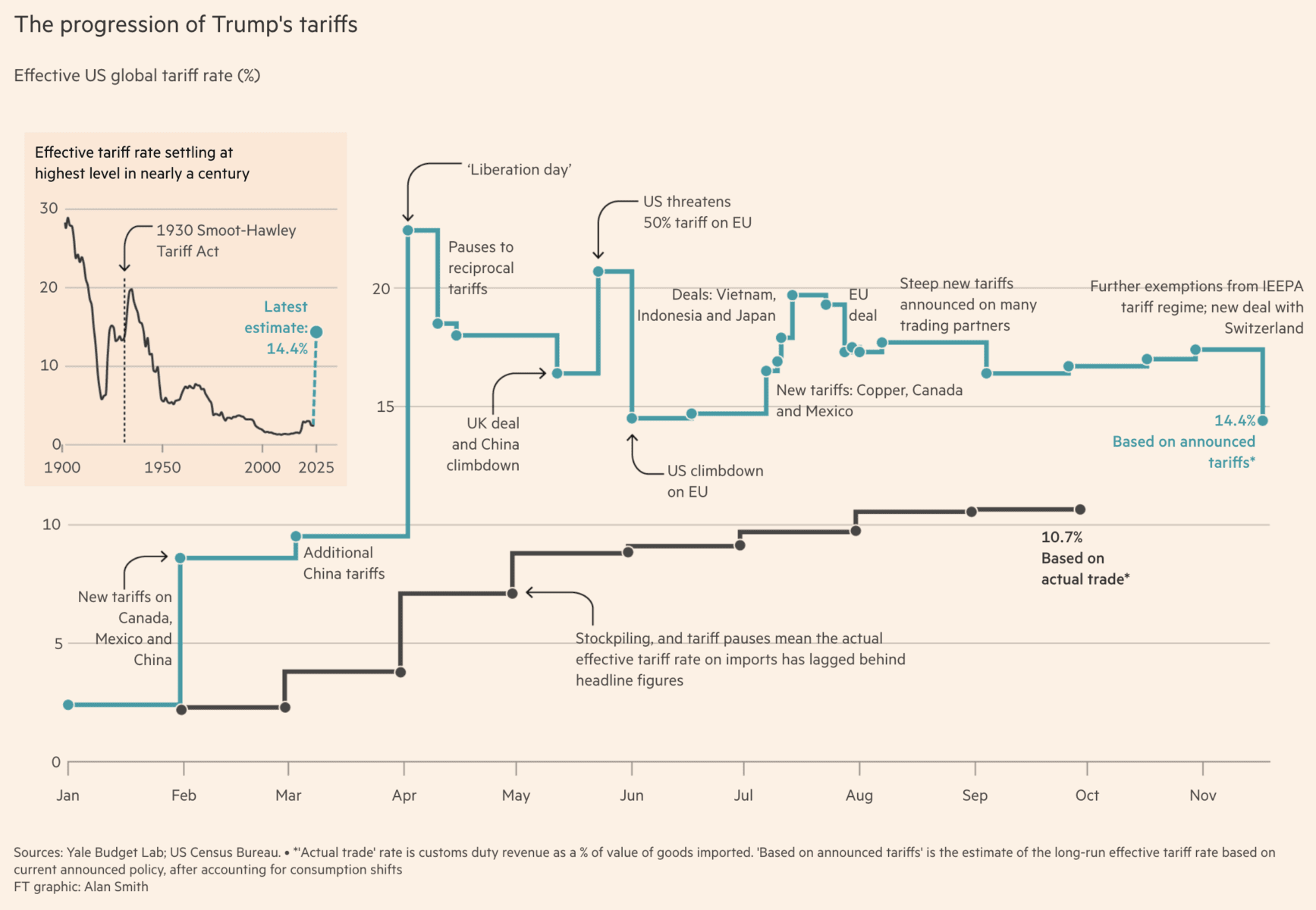
But “President Trump’s ‘Liberation Day’ shook global confidence,” Macklem said, referring to the president’s April 2 announcement the the US would put new tariffs on dozens of trading partners.

Investors would have expected tariffs to support the US currency, but instead the greenback has depreciated while the price of gold has risen, Macklem said. With the dollar weakened by about 10% against other major currencies since the start of the year, its “safe-haven role was called into question,” he said.

“It’s too early to know if this is the start of a new era,” the governor said. While the greenback will likely remain the global reserve currency for the foreseeable future, “for many, its value as a hedge in times of stress has been dented.”

Trump’s attempts to influence the Federal Reserve are also “raising questions about the continued independence of US monetary policy,” Macklem said. (…)

“The US has swerved sharply to protectionism,” he said. “The large increase in US tariffs is weakening global demand, disrupting supply chains, raising prices and putting the Canadian and global economies on permanently lower paths.” (…)

“Increased trade friction with the US means our economy will work less efficiently, with added costs and less income,” Macklem said. “There is no better time than now to deepen investment, improve productivity and expand our market.” (…)

Macklem said Canada needs to leverage existing trade agreements with 50 countries beyond the US.

“Canadians have embraced the power of economic patriotism — elbows up,” Macklem said, referring to a hockey term that has become synonymous with the Buy Canada movement since the US tariff war began. “But now we need to roll up our sleeves and do the hard work to be more competitive.”

Goldman Sachs:

The Dollar will not be replaced anytime soon, but it should still depreciate. Even though there are few alternatives to the multiple roles that the Dollar plays in the international financial system, we think Dollar overvaluation will diminish as the US economy’s less exceptional performance makes it harder for the US to attract unhedged capital flows.

Limited evidence of de-dollarization in recent years. Lower US interest rates, tariffs, and trade policies have weighed on the Dollar, but evidence of true de-dollarization is still limited. While the Dollar’s share of central bank reserves has declined, it remains dominant in global debt issuance, cross-border transactions and loans, and in spot FX trading volumes. And recent data show no significant shift away from the Dollar so far this year – Dollar dominance persists, with only small signs of erosion on the margins.

What would it take to displace the Dollar? Structural factors like the US’s share of global debt, GDP, and global trade matter more for Dollar internationalization than shorter-term financial swings – and inertia in currency choice typically means these changes are slow, and can often be nonlinear. The US’s shrinking share of global trade could gradually erode Dollar dominance, but displacement appears to be a long way off. Meanwhile, the rise of Dollar-pegged stablecoins and a lack of credible alternative global currencies should act as reinforcing mechanisms for the Dollar’s current global standing.

The TINA factor. Attempts to diversify away from Dollar dominance—especially following the freezing of reserves post the Russia-Ukraine war—are stymied by the unmatched scale, liquidity, and network effects of the Dollar. Alternatives such as the Euro struggle with fiscal unity, while the Renminbi is held back by capital controls; bilateral currency initiatives also face hurdles. As a result, the near future will likely feature a patchwork of currency zones, with the Dollar remaining central.

Our forward-looking Dollar view. The Dollar is poised to depreciate further in coming months, because less exceptional economic and market performance no longer warrants its high valuation. While we expect Dollar dominance to erode only slowly, Europe’s growth-supportive fiscal shift and China’s robust export sector argue for Euro and Yuan strength. At the same time, investors concerned about institutional governance and FX risks are likely to further hedge against US asset exposure, pushing the currency weaker.

Failing Schools Are Why We Need H-1B Visas

(…) The latest results from the National Assessment of Education Progress were released earlier this month, and they weren’t pretty. High-school seniors recorded the worst reading scores since 1992, and math scores were the lowest since the current test began two decades ago. Elementary-school students have also lost ground. Just 31% of eighth-graders scored at or above the proficient level on the science assessment.

According to an analysis of the NAEP findings by Brandon Wright of the Thomas B. Fordham Institute, an education-policy think tank, the percentage of students scoring at the highest level has stalled or decreased. “Math performance at the Advanced achievement level and the 90th percentile is flat,” he writes, while aptitude in reading fell. “And the decline, rather puzzlingly, seems to have been driven mostly by girls and kids whose families are middle class or higher—groups that historically have done better than their less affluent and male peers, respectively.”

Covid didn’t help, but these trends predate school closings, Zoom instruction and mask mandates. The ramifications extend far beyond our borders. The Program for International Student Assessment exam is a global assessment of 15-year-old pupils. In 2018 only 8% of U.S. test-takers scored in the top tier in mathematics, compared with 15% in Canada, 18% in Japan and 29% in Hong Kong. Today’s students will populate tomorrow’s labor force, and employers who rely on workers with math, science and engineering backgrounds have been complaining for decades that too many Americans are uninterested or ill-prepared to fill these jobs. (…)

Why US Used Magnitsky Act to Sanction Wife of Brazilian Supreme Court Justice

The law known as the Global Magnitsky Act authorizes the US president to impose sanctions on non-Americans identified as engaging in human rights violations or corruption. It’s been wielded against, among others, Russian prison authorities, officers in Myanmar’s military, prominent South African business leaders, and Chinese government officials responsible for the Xinjiang region.

On Sept. 22, the administration of President Donald Trump used the law to sanction Viviane Barci de Moraes, the wife of Brazilian Supreme Court Justice Alexandre de Moraes. The judge was targeted under the act in July for his role in the prosecution of former Brazilian President Jair Bolsonaro. A political ally of Trump’s, Bolsonaro was convicted on Sept. 11 of plotting a coup and sentenced to 27 years in prison.

The Department of the Treasury, whose Office of Foreign Assets Control (OFAC) imposes the majority of US sanctions, accused Justice Moraes of responsibility for “an oppressive campaign of censorship, arbitrary detentions and politicized prosecutions” including against Bolsonaro. The department said it targeted his wife and the Lex Institute of Legal Studies, which it said she heads, for “its support” of him.

My emphasis above to highlight … well, you might have figured that out already.

But just in case, the FT’s Edward Luce wrote yesterday:

(…) A few months before the 250th anniversary of the declaration of independence, Donald Trump is pulverising the country’s founding principles with astonishing ease. His war on speech is no drill. Late-night comedians are being targeted. Corporations like Paramount are meekly submitting to his will. Ivy League presidents and globally renowned law firms act as though the First Amendment no longer holds. Outspoken business leaders have suddenly lost their tongues. Since they have the most to lose, those with power and wealth are among the softest targets. 

Trump misses no opportunity to punish dissent, and Kirk’s assassination is his biggest so far. Last week he claimed that 97 per cent of network coverage of him was negative and should be illegal. The federal state’s vast powers are being used to pursue private vendettas. Officials have been forced to take polygraphs to test their loyalties. FBI agents who investigated Trump have been fired. Morale at US spy agencies has never been lower. Trump has publicly instructed the US attorney-general to prosecute three named opponents. 

That his economic ratings are in freefall should be a source of alarm not complacency. Less than a year after Trump was elected, the separation of powers is not working. Congress is irrelevant. The Supreme Court is quiescent. The media is punch drunk. Democrats are fragmented. Independent federal agencies are losing autonomy. The markets are high on the AI gold rush, crypto deregulation and the prospect of a return to easy money.

Stephen Miller, Trump’s most influential domestic adviser — prime minister to Trump’s king — calls the Democratic party a domestic extremist organisation and wants to suspend America’s constitutional habeas corpus right to due process. He is a true American autocrat. 

It has been widely observed that the speed of America’s democratic slide surpasses that of other “elective autocracies” such as Narendra Modi’s India and Recep Tayyip Erdoğan’s Turkey. But that understates Trump’s impatience. Others have shifted to authoritarianism with relatively fast-growing economies, which makes it easier to sustain public support.

Trump’s trade war and his “big beautiful [budget] bill” will rob most Americans of income growth. The idea that the disaffected middle will therefore clip Trump’s wings in next year’s midterm elections is quixotic. Having silenced most institutional dissent within his first nine months, what could Trump accomplish in the next 14? 

At the huge religious revival-style memorial for Kirk in Arizona on Sunday, his widow, Erika, struck a courageous note of dissent from the dominant spirit of vengeance. In the spirit of the Christian gospels, she forgave her husband’s killer. Speaking straight afterwards, Trump corrected her. He could not forgive his enemies, he said. Indeed, he hated them. Trump’s wrath produced cheers from tens of thousands of “Christians” in the stadium. To put it in terms churchgoers would understand, Trump’s America is swapping the New Testament for the Old.

FYI:

President Trump warned last night on Truth Social: “I think we’re going to test ABC out on this. Let’s see how we do. Last time I went after them, they gave me $16 Million Dollars. This one sounds even more lucrative.” (Axios)