U.S. Consumer Prices Increased 0.1% in January The consumer-price index rose in January, a sign of slightly firmer inflation, as prices for shelter, food and medical-care services all advanced during the month. Consumer prices were up 2.5% from a year earlier, the largest year-over-year increase since October 2018.
Prices were up 2.5% in January from a year earlier, the largest year-over-year increase since October 2018. (…) Core prices, excluding the often volatile food and energy categories, were up 0.2% in January and 2.3% from a year earlier (…)
First Death in Japan; China Cases Jump by 15,000: Virus Update
New cases in China jumped by almost 15,000 after Hubei province, the epicenter of the coronavirus outbreak, revised its method for counting infections.
- China death toll at 1,367, up 254; cases rise to 59,804
- Hubei infections jump by 14,840; death toll 242.
U.S. Government Budget Balance Deteriorates
The Congressional Budget Office projects that the U.S. government will run a deficit between 4.6% to 5.4% of GDP for the next ten years. The current budget picture already has worsened. The U.S. Treasury Department reported that the federal government ran a $32.59 billion budget deficit during January compared to a $8.68 billion surplus twelve months earlier. An $11.5 billion surplus had been expected in the Action Economics Forecast Survey. For the first four months of this fiscal year, the budget deficit rose to $389.19 billion from $310.25 billion one year earlier.
So far this fiscal year, federal government receipts rose 6.1% y/y. Personal income tax revenues grew 5.5% y/y while corporate tax receipts improved 19.9% y/y. Social insurance taxes grew 5.5% y/y this fiscal year and customs duties, which include tariffs, jumped by 14.8% y/y.
In FY 2020, total federal government outlays have risen 10.3% y/y. Growth in Medicare outlays strengthened to 23.3% y/y so far this fiscal year, more than double last year’s growth. Outlays on national defense programs grew 8.9% this fiscal year and have been growing at roughly that rate since early in 2019. Spending on Social Security increased 5.6% y/y during the first four months of FY 2020. Spending on income security programs grew 6.8% so far in FY 2020. Outlays on health programs grew 5.3% y/y in FY 2020 after a 6.1% y/y gain in FY 2019. Outlays on interest grew 1.7% so far this fiscal year after a 15.7% rise last year.

From The White House, February 10, 2020 (my emphasis)
TO THE CONGRESS OF THE UNITED STATES:
I am transmitting an alternative plan for pay adjustments for civilian Federal employees covered by the General Schedule and certain other pay systems in January 2021.
Title 5, United States Code, authorizes me to implement alternative plans for pay adjustments for civilian Federal employees covered by the General Schedule and certain other pay systems if, because of “national emergency or serious economic conditions affecting the general welfare,” I view the increases that would otherwise take effect as inappropriate.
Under current law, locality pay increases averaging 20.67 percent, costing $21 billion in the first year alone, would go into effect in January 2021, in addition to a 2.5 percent across-the-board increase for the base General Schedule.
We must maintain efforts to put our Nation on a fiscally sustainable course; Federal agency budgets cannot sustain such increases. Accordingly, I have determined that it is appropriate to exercise my authority to set alternative pay adjustments for 2021 pursuant to 5 U.S.C. 5303(b) and 5 U.S.C. 5304a.
Specifically, I have determined that for 2021 the across-the-board base pay increase will be limited to 1.0 percent and locality pay percentages will remain at their 2020 levels. This alternative pay plan decision will not materially affect our ability to attract and retain a well‑qualified Federal workforce. (…)
TECHNICAL RECESSIONS


Retail car sales fell 22% to 1.71 million units, the biggest-ever drop for the month of January, the China Passenger Car Association said Thursday. The group predicted a worsening outlook, saying February sales may drop more than 30%. (…)
The outbreak has also endangered component supply. Parts manufacturers across China have suspended production through last week and in the case of Wuhan city and the surrounding Hubei province, factories are still largely closed. Some parts suppliers may face bankruptcy, said Xu Haidong, a vice chief engineer at CAAM.
That leaves car plants at risk also outside China: South Korea’s Hyundai Motor Co. and Japan’s Nissan Motor Co. are among carmakers that have halted some production in their home countries because of component shortages caused by the virus.
U.S. Student Debt Forgiveness to Total $207 Billion in Next Decade The U.S. government will forgive $207.4 billion in student debt for Americans who take out loans over the next decade, the Congressional Budget Office said, with the biggest benefits going to borrowers who attend graduate or professional school.
(…) The CBO projects the government will originate $1.05 trillion in new loans from 2020 to 2029. Much of that will end up in income-driven repayment plans, which set monthly payments as a share of a borrower’s income and then forgive balances that remain after 20 to 25 years, or 10 years for workers in public-sector jobs.
The biggest benefits will go to Americans who borrow for graduate school, the CBO said in a report. The government will likely forgive $167.1 billion for such borrowers, or 56% of the amount extended. The forgiven amount includes the original loan amounts, or principal, as well as unpaid interest. (…)
The U.S. government is the nation’s primary lender for college and graduate students. About 43 million Americans owe $1.51 trillion in federal student loans. Current law requires that any balances forgiven for private-sector workers will be taxed as ordinary income. (…)
SENTIMENT WATCH
Investors see stocks overvalued, recession looming
An overwhelming majority of the world’s asset managers think stocks are overvalued and expect a recession this year or in 2021, according to a survey released Wednesday by the Boston Consulting Group. Many say “the current bull market is running on borrowed time.” (…)
“The survey, conducted in November and December 2019, found that, on average, respondents’ outlook is similar to what it was just before the market correction in late 2018.” (…)
73% of respondents say they see markets as currently overvalued, up from 67% in the 2018 survey. (…) The 71% of respondents expecting a recession in the next two years is down from 74% in the 2018 survey. (Axios)
Hence, maybe
- A less greedy high per CNN’s Fear & Greed index as interpreted and analysed by SentimenTrader. ST’s model “varies slightly from theirs since we use a slightly different bond index in order to calculate more than 20 years of history for the model.”
(…) This kind of behavior suggests less interest in chasing the latest round of high prices. Rising bullishness is a good thing, until it reaches an extreme. When it does reach that extreme and then we see less buying interest on subsequent pushes, it rarely turns out well.

- 13/34–Week EMA Trend Chart (CMG Wealth)

Another interesting technicality:
Big Technology Stocks Dominate ESG Funds
Funds that market themselves as sustainable investments aren’t necessarily focused on companies that fight climate change, develop wind turbines or promote diverse boards.
Instead, many of them look a lot like a portfolio of big technology stocks.
The five most commonly held S&P 500 stocks in actively managed sustainable equity funds last fall were Microsoft Corp., MSFT 0.15% Alphabet Inc., GOOG 0.63% Visa Inc., V 1.72% Apple Inc. and Cisco Systems Inc., CSCO 1.63% according to an RBC Capital Markets analysis.
Companies focused on issues that the environmental, social and governance movement has come to be associated with, such as renewable energy, clean water, and racial and gender diversity, are relatively underrepresented among such funds.
(…) the institutions behind the biggest ESG funds often follow another playbook: They try to minimize how much their fund deviates from the broader market by creating a portfolio that, for the most part, looks like today’s technology-dominated S&P 500—just stripped of the companies with the worst ESG practices within each industry.
Sustainable funds in the U.S. pulled in a record $21 billion in 2019, according to Morningstar Inc., nearly quadrupling their net inflows from 2018. (…)
- Are massive inflows into sustainable funds lifting tech shares? (The Daily Shot)


EARNINGS WATCH
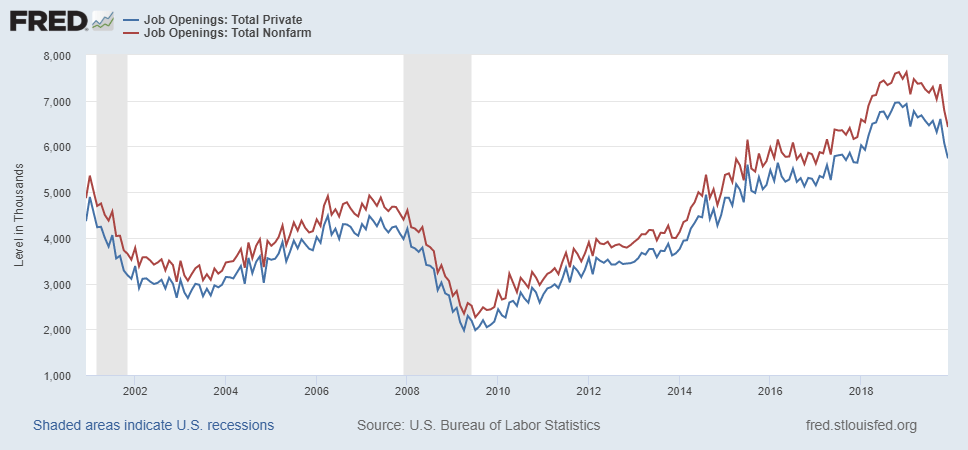
Yesterday, I stumbled onto a chart from Crescat Capital linking Russell 3000 EPS growth with U.S. job openings discussed yesterday.
- Why would job openings decline as much in this rather vibrant economy?

Source: @TaviCosta
Rather interesting given the recent sharp drop (-14.1% YoY!) in job openings and the rather good Q4’19 earnings reports from S&P 500 companies. While correlation (73%) ain’t causation, the fit is intriguing…and just as much with S&P 500 EPS:

A First Look Inside Amazon’s New Grocery Store
(…) “I don’t think they’re going to reinvent how food is sold,” said Neil Stern, a partner with McMillanDoolittle, a retail consulting firm. “That may be just a giant fake for everybody, but the plans look pretty stunningly conventional.” (…)
It has expanded its chain of Amazon Go stores to 25 locations in major U.S. cities and will soon open a larger, 10,000-square-foot version in Seattle, where Amazon employees have been test-shopping. A similarly sized store, with signage bearing the name “Go Grocery,” is planned for the U.S. capital, according to blueprints filed with the city. But so far, the Go stores haven’t been the sensation some analysts expected when Amazon revealed the concept. (…)
The company has leased a former Ralph’s supermarket in the Los Angeles neighborhood of Encino. In Irvine, Amazon is renovating a former Babies “R” Us and last month applied for a liquor license for the space under the name “Amazon Fresh,” the same name as the company’s grocery delivery service. (…)