The enemy of knowledge is not ignorance, it’s the illusion of knowledge (Stephen Hawking)

It ain’t what you don’t know that gets you into trouble. It’s what you know for sure that just ain’t so (Mark Twain)

Invest with smart knowledge and objective odds

THE DAILY EDGE: 10 DECEMBER 2019

NY Fed Survey Finds Inflation Expectations Rise, Spending Plans Drop

(…) the New York Fed said that households have a mixed view on future income and earnings, and are expecting lower spending over time. In November, median one-year ahead expected earnings gains ticked down 0.1 percentage point to 2.2%, while median expected household income growth ticked up to 2.9%, from 2.8% in October.

Expected spending fell “sharply” to 2.8% in November, from an expected 3.3% rise the prior month. November’s reading was the lowest since September 2017 and the New York Fed said “the decline was broad based across age, income and education groups.” (…)

Three years from now, households see inflation at 2.5%, from 2.4% in October, while one year from now, those surveyed see inflation at 2.4%, little changed from the prior month.

China’s Declining Car Sales Sputter Into 17th Month

Auto sales fell 3.6% last month from a year earlier to 2.46 million vehicles, the government-backed China Association of Automobile Manufacturers said Tuesday. It marked a slight improvement from October’s 4.0% year-over-year drop. (…)

Through the first 11 months of the year, the combined market share for American companies—most notably Ford Motor Co. and General Motors Co. —shrank by 1.5 percentage points, while those of German and Japanese car makers grew, CAAM data showed. Chinese auto makers’ combined share fell 3 percentage points during the same period.

Chen Shihua, deputy secretary-general of the auto industry association, said the recent easing in the pace of the sales decline is a sign that car makers have been able to adjust their production to meet a tougher emissions standard that was introduced in many areas across the country in July.

The shift to the new standard was a messy transition for auto manufacturers and caused confusion for dealers, many of whom tried to sell off vehicles that didn’t meet the new standards. (…)

Another factor behind the continued decline is weak sales of new-energy vehicles, a category that includes electric cars, after the government halted most subsidies at the end of June. Sales of new-energy vehicles dropped for the fifth consecutive month, by 43.7% to 95,000 vehicles, in November.

While January-November new energy vehicle sales rose 1.3% from the same period last year, CAAM’s Mr. Chen said full-year sales are likely to be lower compared with 2018. (…)

China November CPI peaking Inflation in China in November rose further to 4.5%YoY, but there are clear signs that it is peaking

Newswires running headlines like “China November inflation highest since 2012” entirely miss the point. Inflation in China has been driven higher by rising pork and consequently other meat prices. This is fallout from the African Swine Fever (AFS) epidemic that has killed half of the hog population in China.

In November, pork prices rose 3.8% MoM. But this was way down from the 20.1% increase in October, the 19.7%MoM increase in September, and the 23.1% increase in August. In fact, it was the lowest increase since June (3.6%MoM).

The reasons for this moderation are various but include:

  1. Higher pork imports, including from the US alleviating supply shortages
  2. Mobilisation of the strategic pork reserves (frozen pork warehoused for emergencies)
  3. A decrease in new reports of African Swine Fever (AFS) and rebuild of stocks

(…) the peak of the AFS pandemic has passed. Pork prices may even start to decline next month, and in the coming months, dragging down other meat prices along the way. Inflation rates should now have peaked, and the coming months will see measured inflation drop steadily.

More than that, household spending will get a lift from the additional purchasing power following the decline in meat prices, which will provide a broader lift to the domestic economy at a difficult time for the economy.

There are no specific policy implications from this. The improvement in purchasing power reduces the urgency of additional supportive fiscal measures, and the People’s Bank of China was, in any case, looking through this food price spike in terms of its monetary policy settings, so it does not need to shift its stance.

Possibly, the improvement in China’s domestic food situation reduces the incentive to give more ground in trade talks with the US, especially in terms of commitments to buy agricultural produce. Though there may be broader reasons for making concessions to secure tariff rollbacks. (…)

Congress Wants to Ban Chinese Buses, Railcars in Defense Bill Congress is taking aim at China in a must-pass defense-policy bill at the same time that the Trump administration is seeking to negotiate an interim trade pact with Beijing.

House and Senate Republicans and Democrats have reached agreement on language in the National Defense Authorization Act that would bar the use of federal funds to buy Chinese buses and railcars, congressional aides familiar with the matter told The Wall Street Journal, adding that the ban excludes pre-existing contracts.

The legislation would affect the U.S. subsidiaries of two Chinese companies. One is China’s state-owned CRRC Corp. , which has been making significant inroads into the U.S. market for railcars, estimated at $18 billion annually. The other is BYD Co. , a Chinese company that sells electric buses for the U.S. market through unit BYD Motors LLC.

The U.S. electric-bus market is expected to grow from $745 million in 2018 to about $1.95 billion in 2024, according to Prescient & Strategic Intelligence Pvt. Ltd., a market-research and consulting firm. (…)

The companies have previously warned that a ban is unfair and would hurt U.S. workers at their factories in California, Illinois and Massachusetts. (…)

“It’s absolutely clear that the Chinese government has a strategic and tactical plan to dominate the rail and transit industry—both rail and bus—and have executed that in Australia and are clearly in the process of executing that in the United States,” Mr. Garamendi said. (…)

Lawmakers also are poised to ban the U.S. military from buying Chinese drones as U.S. officials grow worried the Chinese devices may be spying on Americans and putting critical U.S. infrastructure at risk. (…)

The defense bill also would prohibit the removal until certain conditions are met of Chinese telecom giant Huawei Technologies Co. from an export blacklist kept by the Commerce Department. (…)

The bill contains a number of other China-related provisions, including one intended to reduce reliance on foreign sources of rare-earth minerals, another that requires reports on Chinese military activities in the Arctic and Chinese foreign direct investment in the Arctic, and another that creates new reporting requirements for national security academic research.

Additional language supports improving Taiwan’s defense capabilities by expanding joint training, foreign military sales, and senior level military-to- military engagements. And the legislation would order the Secretary of Defense to review Chinese military, economic, information, diplomatic, and digital influences in Taiwan.

Drowning in uncertainty: Trade questions slow investment, squeeze profits across U.S.

Real world impact from Reuters. The smaller, the worse.

THE DAILY EDGE: 9 DECEMBER 2019: Going Bananas!

Strong U.S. Hiring Eases Concerns About Economy The U.S. job market strengthened in November, as hiring jumped and unemployment fell to a half-century low, adding fuel to the economic expansion.

Employers added 266,000 jobs last month—the fastest pace since 312,000 in January—and the jobless rate dipped to 3.5%, matching September as the lowest level since 1969, the Labor Department said Friday. Wages also advanced, up 3.1% from a year earlier. (…)

Jobs grew by an average of 205,000 a month in the three months through November, a pickup from the pace earlier in the year but less than the average growth of 223,000 a month of 2018. (…)

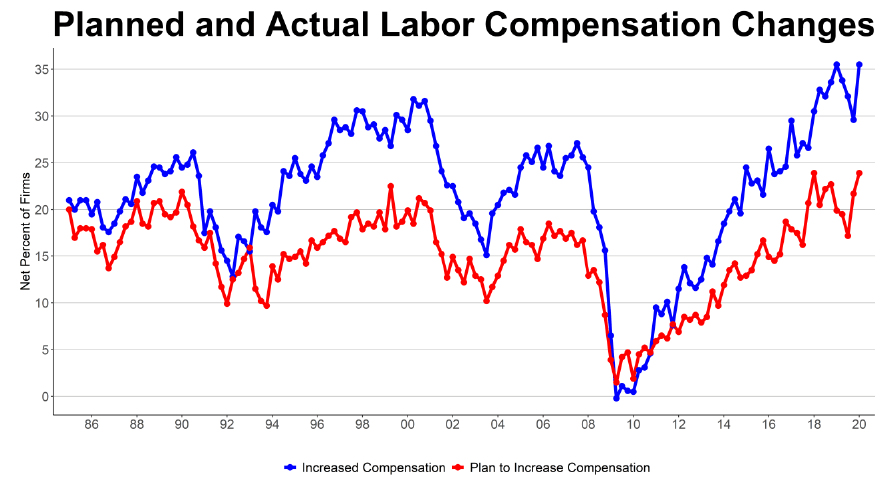
Historically low unemployment hasn’t translated into an acceleration in wage gains. Wages were up 3.1% from a year earlier, down from a recent peak of 3.4% in February. (…)

But wages of production and nonsupervisory employees, 80% of the work force, are indeed accelerating, reaching +3.7% YoY in November and +3.9% annualized in the last 3 months and +4.1% in the last 2 months.

fredgraph (15)

This next chart compares growth in wages with that of Business Sales, down to +0.5% YoY in September, highlighting the margin squeeze underway:

fredgraph (16)

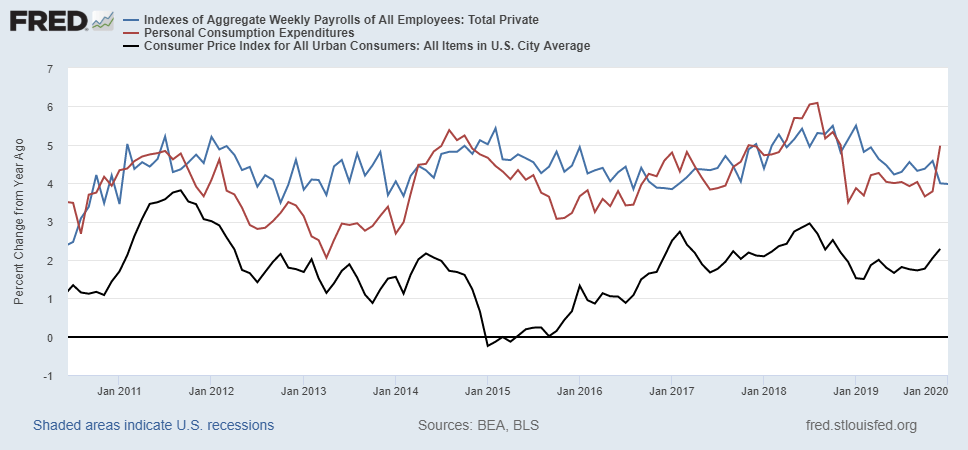
The good news is that Americans’ payrolls are reaccelerating as a result. Aggregate weekly payrolls were up 4.8% YoY in November, from +4.4% last summer while inflation remains very quiet below 2.0%. Last 2 months, payrolls jumped at a +5.6% annualized rate.

image

It is thus reasonable to expect retail sales to remain healthy and, in time, drag wholesale and manufacturing sales growth back up (each series is roughly 33% of total Business Sales). We will get November retail sales data next Friday.

fredgraph (17)

fredgraph (18)

The WSJ editorial adds interesting color to the employment situation (my emphasis):

(…) The number of Americans who were marginally attached to the labor force—i.e., those able to work but who are not actively seeking employment—fell by 432,000 from last November to 1.2 million. That’s a whopping 27% year-over-year decline.

About 460,000 fewer workers are employed part-time for economic reasons than a year ago. More than 80% of folks who work part time do so for noneconomic reasons, and the share has been increasing as the economy has gained strength. Second earners in two-income households have the luxury to work less when their spouses are earning more.

Even in a strong economy, workers will lose jobs and there’s no denying President Trump’s trade brawl has caused casualties. But the good news is that most laid-off workers can find work relatively quickly. Only 20.8% of the unemployed have been out of work for 27 weeks or more compared to 24.7% in December 2016 and a peak of 45.2% in September 2011.

All told, the share of the unemployed, marginally attached and workers employed part time for economic reasons has fallen to 6.9% from 7.6% a year ago and is the lowest since 2000. Unemployment for black men (5.1%) and teens (12%) is also at a 50-year low. (…)

In Ames, Iowa, the unemployment rate is 1.3%. Cleveland’s unemployment rate has fallen to 3.2% from 4.5% a year ago. Most job growth over the past year has been in services, especially health care (414,000) and leisure (420,000). Rust Belt cities like Cleveland are attracting investment in health care and related industries. (…)

As this continues, more low-income workers join the middle class, and more in the middle-class become what progressives like to call “the rich.” The index of aggregate weekly payrolls, which is a good proxy for household income, has risen 4.8% in the last year.

Higher earnings are fueling consumption that is keeping the economy humming despite flagging business investment. Americans also have more money to spend thanks to the GOP tax reform. Low energy prices and lower inflation are also stretching worker paychecks.

The National Retail Federation reported this week that Americans during the five shopping days between Thanksgiving and “Cyber Monday” spent 16% more on average than last year. This isn’t because billionaires are buying more yachts. This is because Americans in Ames and Cleveland are faring better and spending more. All of this should ease fears of recession anytime soon.

It also marks a political irony of our times. Even as deregulation, tax reform and energy exploration are lifting up more workers, our political classes want to raise taxes, harass tech companies, eliminate fossil fuels, and let the government set prices in health care and determine investment for even more of the economy. Socialism has more cachet even as capitalism is delivering the goods. Somewhere Joseph Schumpeter is saying he told us so.

It can also provides powerful ammo to the Trump 2020 campaign, particularly if the economy accelerates in spite of trade wars and all other Trump-related noise.

These latest stats reduce the probability of a recession for most observers but not David Rosenberg who sees enough statistical noise and calendar aberrations in November employment numbers to actually restate the +266k print to “closer to 100k”. Adding several other details talking his book, Rosenberg concludes that

if you do the entire forensic data analysis instead of a knee-jerk response from the seemingly bullish headline figure, the only conclusion that can be drawn is that we are seeing a classic late-cycle weakening in labor market trends.

Not a word on this other stat from another source that David used in early 2019 to support his recession call. Initial unemployment claims remain comfortably within their 2y box and at a 50y low:

image

Initial claims generally rise prior to recessions.

fredgraph (19)

The odds or a recession have diminished. The yield curve also seems to think so. Fed loosening is out. Watch inflation.

U.S. Consumer Credit Usage Accelerates

Consumer Credit Outstanding increased $18.90 billion (4.8% y/y) during October following a $9.60 billion September gain, revised from $9.52 billion. It was the strongest rise in three months. (…)

Nonrevolving credit usage increased $11.00 billion (5.1% y/y) during October after a $9.40 billion September rise. Borrowing by the federal government, which issues over 40% of nonrevolving credit, rose a steady 7.3% y/y. Depository institutions lending (25% of credit) gained an accelerated 7.0% y/y. It was the strongest y/y advance since December 2016 and roughly double the pace late in 2017. (…)

Revolving credit usage posted a $7.90 billion increase (3.8% y/y) after a $0.20 billion September rise. Credit provided by banks, which makes up 90% of revolving balances, rose a reduced 3.9% y/y. It was growing at a 7.5% y/y pace during the summer of last year. (…)

image

China’s Unexpected Export Drop Shows Why It Wants a Trade Deal

Total exports in November dropped 1.1% from a year ago, and to the U.S. they were down 23%, the customs administration said Sunday. That was the worst result for exports to the U.S. since February and the 12th straight monthly decline. Overall shipments had been expected to rise 0.8%, as retailers and companies stock up before the Christmas shopping season. (…)

The rebound in imports shows there is a short-term stabilization in the Chinese economy, according to Larry Hu, head of China economics at Macquarie Securities Ltd. in Hong Kong.

Some of that rise is due to a 2.7% increase in imports from the U.S., which might be linked to increased goodwill purchases of American farm products ahead of a deal. The value of soybean imports was up 41% from a year ago, although the government did not release information on which nations these were from.

Exports to the U.S. are down 23% and China’s total exports only decline 1.1%!!

Beijing orders removal of foreign computers and software Communist party directive aims to boost domestic tech supply chain

The FT is the only one with this story. It says that “Beijing has ordered all government offices and public institutions to remove foreign computer equipment and software within three years”. The directive to switch to domestic technology vendors “echoes efforts by the Trump administration to curb the use of Chinese technology in the US and its allies”.  (…)

Trade war, tech war, decoupling! Does that sound any good? Trump will want to retaliate to this retaliation…

US business fears weakening of Nafta trade revamp Trump administration considers USMCA provisions to gain Democratic support
EARNINGS WATCH

From Refinitiv/IBES:

Through Dec. 6, 498 companies in the S&P 500 Index have reported earnings for Q3 2019. Of these companies,
75.1% reported earnings above analyst expectations and 18.3% reported earnings below analyst expectations. In a
typical quarter (since 1994), 65% of companies beat estimates and 20% miss estimates. Over the past four quarters,
74% of companies beat the estimates and 18% missed estimates.

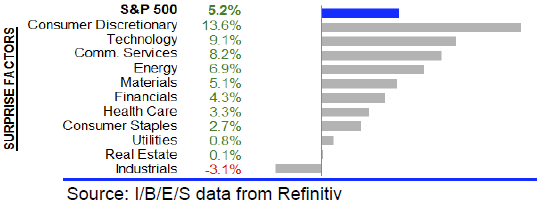
In aggregate, companies are reporting earnings that are 4.5% above estimates, which compares to a long-term (since
1994) average surprise factor of 3.3% and the average surprise factor over the prior four quarters of 5.3%.

Of these companies,
57.8% reported revenue above analyst expectations and 42.2% reported revenue below analyst expectations. In a
typical quarter (since 2002), 60% of companies beat estimates and 40% miss estimates. Over the past four quarters,
59% of companies beat the estimates and 41% missed estimates.

In aggregate, companies are reporting revenue that are 0.9% above estimates, which compares to a long-term (since
2002) average surprise factor of 1.5% and the average surprise factor over the prior four quarters of 0.9%.

The estimated earnings growth rate for the S&P 500 for 19Q3 is -0.4%. If the energy sector is excluded, the growth
rate improves to 2.2%. The estimated revenue growth rate for the S&P 500 for 19Q3 is 3.8%. If the energy sector is excluded, the growth rate improves to 5.2%.

The estimated earnings growth rate for the S&P 500 for 19Q4 is -0.2%. If the energy sector is excluded, the growth
rate improves to 2.1%.

Revisions are well balanced in large caps but getting more positive in smaller caps:

image

image

Speaking of small caps, we now have 562 S&P 600 company reports in. Their earnings beat rate is 64%(revenues: 52%) with a surprise factor of +1.4% (revenues –0.3%). Q3 earnings are seen down 11.3%, ex-Energy –1.7%. Q3 revenues is expected up 2.3%, ex-E +3.1%.

S&P 600 earnings are expected to decline 6.2% YoY in Q4, ex-E –8.4%. Seven of the eleven sectors are expected to show negative earnings growth, up from 5 in Q3’19.

S&P 500 pre-announcements are roughly in line with Q3’19 but worse than Q4’18.

image

Trailing EPS are now $163.89, still below their June level but hanging in. Rising P/Es are lifting the S&P 500 Index…

image

…but higher earnings and/or lower inflation will need to kick in at some point:

image

image
TECHNICALS WATCH

Lowry’s Research says that “the market’s strong rally on December
6, 2019, likely alleviated some of the concerns
that the recent 3-day decline (November 29-
December 3) represented the start of a more
substantial pullback. The December 6 rally was
broad-based (…) effectively negating
any possible significant divergences with new
highs in the major price indexes. On a short-term
basis, however, investors should remain alert for
ongoing signs of selectivity and weak Demand
that could be reflected in lagging performances
in the percentage of Lowry stocks trading above
their 10- and 30-day moving averages, as well as
in nominal gains in Buying Power Index. The
failure of these key measures to keep up with
gains in the price indexes would likely suggest
that the risk of a renewed near-term pullback
remains high.

Investors Bail on Stock Rally, Fleeing Funds in Droves The S&P 500 is having its best run in six years, but individual investors are fleeing stock funds at the fastest pace in decades, according to data from Refinitiv Lipper.

(…) For the week ended Dec. 4, for example, investors put nearly $5 billion back into U.S. stock funds—the biggest weekly inflows in three months—on trade optimism, to help somewhat stem the tide of withdrawals. (…)

Maybe it has to do with little buying power:

NDR Total Stock Market Value vs. Money Market Funds

Source: Ned Davis Research

Swelling U.S. IPO backlog points to crowded 2020 field
Nerd smile Banana Hanging on a Wall Sells for $120,000 at Miami Basel Art Fair

relates to Banana Hanging on a Wall Sells for $120,000 at Miami Basel Art Fair(…) Artist provocateur Maurizio Cattelan, maker of the golden toilet that was stolen in September, has done it again. This time, by attaching a banana from a local grocery store to a wall of Galerie Perrotin’s booth. The asking price: $120,000.

According to Artnet, there was an immediate purchase. And then another. At which point the price increased to $150,000, and that sold. Two more bananas went to museums, the gallery confirmed, declining to specify the buyers or the price.

What the buyers got was not the quickly decaying fruit, but rather a certificate of authenticity and, importantly, a definitive, 14-page manual on how to install the work.

It should be hung about 175 centimeters (68.9 inches) from the ground, fixed to the wall at a 37-degree angle and the banana should be changed, “depending on its aesthetic appearance,” about every seven or 10 days. About the only specification omitted is the optimum length or bendiness of said banana.

The work is “very Duchamp,” said critic Linda Yablonsky, referring to Marcel Duchamp, the French artist whose famous 1917 sculpture, “The Fountain,” transformed a urinal into a work of art. (…)

Transforming a urinal into a piece of art probably was also the idea of the Guggenheim’s curator who, in 2016, received a request from the White House to borrow Vincent Van Gogh’s 1888 painting “Landscape with Snow”; instead, the institution’s curator offered the golden toilet, referred above, that was stolen from Blenheim Palace, in Oxfordshire, England, last September 12. The curator must have sensed some purpose given that the 18-carat-gold artwork is named “America” and is valued at around $6 million. Pure MAGA stuff!

It’s safe to think that billionaires going bananas and throwing $150k down the drain will piss off everybody already convinced inequality has really gone too far. BTW, the golden toilet is still missing.

High five Incredibly, this happened last Friday at the White House:

The president on Friday said he ordered a federal review of water efficiency standards in bathroom fixtures and complained that “people are flushing toilets 10 times, 15 times as opposed to once” in homes with low-flow appliances. (…)

The president said it was “common sense” to review standards he said resulted in showers with water “quietly dripping out” and toilets that “end up using more water” because of repeat flushing.

Trump has championed rolling back regulations since taking office in 2017, with a focus on environmental rules imposed or proposed during the Obama administration. (…)

Trump has similarly complained about light bulb energy efficiency requirements imposed under President Barack Obama, and the administration announced earlier this fall it would roll back the rules.

The president mentioned that effort during Friday’s event, complaining that new energy-efficient bulbs made him appear orange.

Orange is the new black.