U.S. Existing-Home Sales Wrapped Up 2019 on Solid Note Home sales rose 3.6% in December as low unemployment and rates support demand for home buying
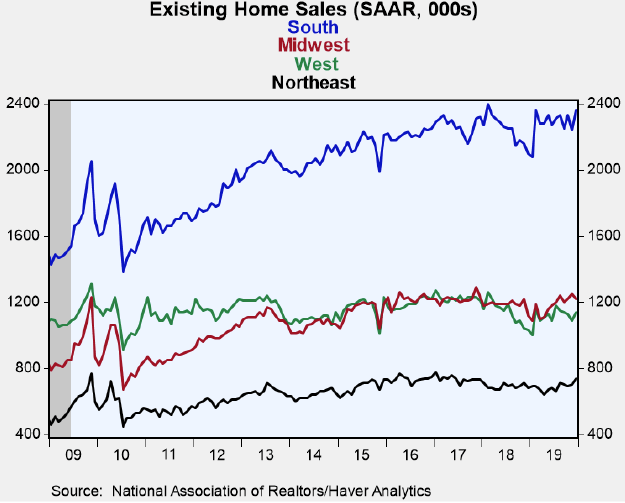
Sales of previously owned homes increased 3.6% in December compared with November to reach a seasonally adjusted annual rate of 5.54 million, the National Association of Realtors said Wednesday.
Compared with a year earlier, December sales of existing homes were up 10.8%, though December 2018 was a particularly weak month for sales and economic uncertainty around the federal government shutdown caused some buyers to delay purchases, NAR found. (…)
December’s inventory was the lowest for NAR records tracing back two decades. That limited housing stock is contributing to higher home prices, with the median sales price for an existing home in December up 7.8% on year to $274,500. Inventory has been particularly tight at the cheaper end of the market, restraining sales. Inventory for homes priced below $100,000 declined 14.3% in December from a year earlier. (…)
The strongest markets were the Northeast and the South, while in the Midwest sales actually decreased 1.5%.

Chicago Fed National Activity Index Points to Below Trend Growth in Q4
The Federal Reserve Bank of Chicago’s National Activity Index decreased to -0.35 in December from a downwardly-revised 0.41 in November (was 0.56). The three-month moving average, which smooths out volatility in the monthly figures, improved to -0.23 from -0.31. The negative reading for the quarter suggests below-trend growth in the fourth quarter of 2019. During the last 20 years there has been a 70% correlation between the Chicago Fed Index and the quarter-on-quarter real GDP growth. However, during the last 10 years that correlation has dropped to just 25%.
Three out of four of the contributing sectors decreased in December led by the production and income indicators, which contributed -0.26 points to the decline. The diffusion index, which measures the breadth of movement in the monthly series, edged down to -0.27 as 56 out of the 85 components deteriorated.
The CFNAI is a weighted average of 85 monthly indicators of national economic activity. It is constructed to have an average value of zero and a standard deviation of one. Since economic activity tends toward trend growth rate over time, a positive index reading corresponds to growth above trend and a negative index reading corresponds to growth below trend.
The next chart from Advisor Perspectives highlights the -0.7 level.

Wuhan Virus Could Hit China’s Economy Harder Than SARS The new consumer-led economy has many advantages—but it is also more vulnerable to a SARS-like epidemic
Bank of Canada Opens Door to Rate Cut on Persistent Slowdown
-
Bank of Canada holds rates steady, sees weak fourth quarter spilling into early 2020
Facing Pushback From Allies, U.S. Set for Broader Huawei Effort The U.S. is preparing for a longer and broader campaign to banish Huawei Technologies from next-generation 5G cellular networks around the world, as Washington faces resistance on the front line of its lobbying campaign.
U.K. officials have indicated they would restrict but not forbid the use of Huawei equipment. (…)
The U.S. campaign against Huawei has forced countries to weigh their relationships with Washington against the risk of upsetting Beijing. Foreign leaders also say building 5G networks could be costlier and slower without Huawei equipment. (…)
“The appetite for a U.S.-U.K. trade agreement could be diminished by the U.K. making the wrong decision on Huawei,” a senior Trump administration official said. (…)
A Chinese foreign-ministry spokesman said China hopes the U.K. can make an independent decision regarding Huawei. (…)
A U.S. official said Washington is “engaged in all countries” and plans to give financial assistance to developing countries to use alternative suppliers in 5G networks via newly empowered government agencies and initiatives. (…)
Separately, a German decision on Huawei will come later this year. Chancellor Angela Merkel had said she was opposed to blocking an individual company from German 5G networks, and German wireless carriers have warned that excluding Huawei will add costs and time to rolling out 5G in a country with outdated telecom networks. (…)
US and France agree deal on digital tax Le Maire and Mnuchin reach truce in talks to transform how multinationals are taxed
The only deal agreed upon is that the U.S. dropped its ridiculous insistence that any international taxation should be optional and France agreed to delay collecting the tax until a global accord is reached.
Mr Le Maire said: “I want to be very clear. [There has been] no suspension of the French taxation, no withdrawal of the French taxation. Either there is an international agreement in 2020 and in that case the international agreement will replace the national taxation, or there is no agreement at the OECD, and in that case, since the French taxation remains in place, the companies will have to pay.” “In any case, digital companies in France will have to pay their due taxes in 2020.”
EARNINGS WATCH
We now have 58 reports in, a low 67% beat rate, a high 24% miss rate, and a +4.2% surprise factor. Financials account for 21 of the 58 reports and their beat rate is only 57% against a 33% miss rate.
At about the same time during Q3, with 63 companies having reported, the beat rate was 83%, the miss rate was 14%, and the surprise factor +4.4%. Financials had 18 reports in with a 72% beat rate and a 28% miss rate.
The 58 companies having reported show a combined +0.7% earnings gain, bettering the –1.4% total of the 63 companies that had reported 3 months ago.
Q4’19 earnings are now see declining 0.8% (+1.9% ex-Energy) vs –0.3% on Jan. 1.
Q1’20 earnings are forecast up 5.7% (+5.1% ex-E) vs +6.3% on Jan. 1.
Trailing EPS are now $163.16.
Factset’s data say that S&P 500 companies should see a 2.1% decline in earnings in Q4’19 along with a 10.7% net profit margin.
If 10.7% is the actual net profit margin for the quarter, it will mark the first time the index has reported four straight quarters of year-over-year declines in net profit margin since Q4 2008 through Q3 2009.
Eight of the 11 sectors are reporting a year-over-year decline in their net profit margins in Q4 2019, led by the Energy (4.7% vs. 7.4%), Information Technology (21.4% vs. 22.7%), and Consumer Discretionary (5.9% vs. 7.0%) sectors.
TECHNICALS WATCH
Via CMG Wealth:
- 13/34–Week EMA Trend Chart:

- NDR Crowd Sentiment Poll: Extreme Optimism (S/T Bearish for Equities)


Mnuchin says Thunberg can tell us what to do ‘after she goes and studies economics in college’
Speaking at a press briefing at the World Economic Forum in Davos, Switzerland, Mnuchin was asked whether the world’s largest economy needed to completely and immediately divest from fossil fuels.
“Is she the chief economist or who is she? I’m confused,” Mnuchin said, before adding this was “a joke. That was funny.”
“After she goes and studies economics in college she can come back and explain that to us,” Mnuchin said. (…)
Hmmm…
 I started a joke which started the whole world crying
But I didn’t see that the joke was on me oh no
I started to cry which started the whole world laughing
Oh If I’d only seen that the joke was on me
I looked at the skies running my hands over my eyes
And I fell out of bed hurting my head from things that I said
‘Till I finally died which started the whole world living
Oh if I’d only seen that the joke was on me (Bee Gees)
The global under-30 population has been rising since 2012 and today accounts for more than half of the more than 7.5 billion people on the planet. (…) As youth the world over force us to confront the perils of our inaction—and show us the possibilities from recognizing that life doesn’t have to be as it is—we are beginning to see some answers. (Time)
“In general, the science and the voice of the young people is not at the center of the conversation, and it needs to be,” she said. “Because this is about us and our future, and future generations, and of course those who are already being affected today.” (Greta T)
Blaise Pascal’s wager applies fully in the debate about global warming. Pascal argued that “a rational person should live as though God exists and seek to believe in God. If God does not actually exist, such a person will have only a finite loss (some pleasures, luxury, etc.), whereas he stands to receive infinite gains (as represented by eternity in Heaven) and avoid infinite losses (eternity in Hell).” (Wikipedia)
So, a rational person, indeed every human being, should live and act as though global warming is real and seek to stop it. If it does not actually exist or is not as threatening as most scientists say, the world will have only a finite economic loss fighting it, whereas it stands to exterminate itself if science proves right.
No need to study economics in college to understand that. This is no joke!


