MANUFACTURING PMIs
USA: Manufacturing Contraction Spreads as Slump Stretches into Eighth Month
In the absence of hard data during the government shutdown, we can turn to purchasing managers to put a finger on the pulse of the underlying dynamics impacting businesses in the current environment. As a reminder the shutdown began on October 1, and the manufacturing ISM was released this morning and the service sector ISM report is due out on Wednesday—both measure economic activity during the month of October.
The ISM manufacturing index slipped 0.4 points to 48.7 and has now been consistent with contraction for eight straight months.The manufacturing sector remains under pressure with demand still weak, the contraction in employment is still underway, and price increases are still present, if somewhat less widespread. In some instances, the pace of contraction was not as broadly based as it was in September, although the respondent comments offered no such indication of diminished headwinds for the manufacturing sector.
Earlier this year, comments regarding tariffs focused more on uncertainty rather than apprehension. That is no longer the case, as is evident in the response from someone in the chemical products space who noted: “Wonder has turned to concern regarding how the tariff threats are affecting our business. Orders are down across most divisions, and we’ve lowered our financial expectations for 2025.”
Source: Institute for Supply Management and Wells Fargo Economics
One of the biggest challenges continues to be around pricing. While a smaller share of manufacturers reportedly paid higher prices for inputs last month, 27.3% versus 32.5% the month prior, at 58.0 the overall prices-paid index is still consistent with a broad expansion of input prices with 14 of the 18 overall industries reporting higher raw material prices in October.
Despite relatively sustained consumer inflation to date, manufacturers are dealing with a challenging pricing environment and comments also suggest future price gains are still likely to be realized. A respondent in the machinery industry commented, “We are trying to keep up with the wild fluctuations and pass along what costs we can to our customers.” Someone from the food, beverage & tobacco industry said, “Tariffs continue to remain difficult to quantify, manage and deal with in general...” And someone from the computer & electronic industry said, “The unpredictability of the tariff situation continues to cause havoc and uncertainty on future pricing/cost…“
Other industry comments focused on realized demand challenges. A respondent from the petroleum & coal industry mentioned decreased domestic demand as did those in the transportation equipment industry, while another from the machinery industry highlighted lower export demand weighing on farm equipment demand.
In many ways the narrative hasn’t changed. Persistent uncertainty around tariff policy is constraining activity, while at the same time, initial anxiety has given way to pricing decisions and demand conditions that will likely keep both inflation sticky and capex orders subdued for some time.


 S&P Global’s PMI: Steady growth of US manufacturing sector in October

The performance of the US manufacturing economy improved again in October, with both output and new orders rising at stronger rates. However, growth was domestic led as new exports fell due to tariffs reportedly negatively impacting international trade. (…)
Growth in new work has been registered consistently throughout the year to date, albeit to varying degrees, and panelists noted in October
an uplift in market demand and success in securing new contracts. However, October’s growth was increasingly reliant on the domestic market as new export orders faltered. Exports declined for a fourth successive month and to the greatest degree since July.Tariffs reportedly remained the primary driver behind the drop in exports, with sales declining to key markets such as Canada, China, Europe and Mexico. (…)
Finally, tariffs remained a key source of higher input costs during October with latest data showing another round of historically elevated inflation – albeit the lowest since February. Selling prices were raised markedly in response, and to a quicker degree than September’s recent low.

The Atlanta Fed’s GDPNow model estimate for real GDP growth in Q3-2025 is 4.0% (saar) today, up from 3.9% on October 27 (chart). After this morning’s Manufacturing ISM Report on Business from the Institute for Supply Management, the nowcast of Q3 real gross private domestic investment growth increased from 4.4% to 4.6%. (…)
Before the shutdown, the Bureau of Economic Analysis revised the growth rate in Q2’s real GDP up to 3.8%. Also before the shutdown, the Bureau of Labor Statistics revised payroll employment down significantly, with the result that it rose just 29,000 per month on average during the three months through August. Together, this suggests that whenever the government reports productivity, its growth rates for Q2 and Q3 should be very strong.
The US economy may not be as strong as it looks, warns Harvard economist Jason Furman. According to his latest analysis, almost all of America’s economic growth in the first half of 2025 came from one source, data centers and information processing technology, as per a report.
Furman shared his findings in a post on social media platform X (formerly Twitter), revealing that if investment in data centers and related technology were excluded, US GDP growth would have been just 0.1% on an annualized basis, as per a Fortune report.
His findings were supported by financial analysts, including Robert Armstrong of the Financial Times’ Unhedged, who have noted the sharp rise in data center buildouts to GDP growth in 2025 had, for the first time, surpassed US consumer spending, which usually makes up two-thirds of GDP, as per the report.
Furman pointed out that investment in information-processing equipment and software made up only 4% of total US GDP in the first half of 2025 but accounted for 92% of the country’s GDP growth during that period, according to Fortune. He said it’s unlikely the economy would have completely stalled without this boom, saying that “absent the AI boom we would probably have lower interest rates [and] electricity prices, thus some additional growth in other sectors. In very rough terms that could maybe make up about half of what we got from the AI boom,” as quoted by Fortune. (…)
The tech-driven expansion comes as other parts of the economy struggle, as per the report. Job creation has slowed, and sectors such as manufacturing, real estate, retail, and services have contributed little or even detracted from total output in early 2025, as per the Fortune report.
In an interview with CNN’s “State of the Union” on Sunday, Bessent said he believed the economy was in a “transition period,” noting that the Trump administration has cut government spending, which he blamed for high inflation after the COVID-19 pandemic.
Bessent told CNN’s Jake Tapper he believes “we are in good shape,” despite some sectors of the economy being “in recession,” which he blamed on Federal Reserve policies.
The treasury secretary gave the housing market as an example, insisting “if the Fed brings down mortgage rates, they can end this housing recession.”
From the Q3 earnings and corporate comments (see below), larger companies are not seeing any signs of recession, yet.
CONSUMER WATCH
- “U.S. payments volume was up 8%…reflecting resilience in consumer spending…we saw a broad-based strength, including improvements in retail services and goods, travel and fuel. Both discretionary and nondiscretionary spend were up from Q3. And growth across consumer spend bands remained relatively consistent with Q3 with the highest spend band continuing to grow the fastest.” — Visa (V ) CFO Christopher Suh
- “We continue to see healthy consumer and business spending in the quarter with the macroeconomic environment still generally supportive. What we’re seeing is continued steady growth, both across affluent and mass market, through in the U.S. through across the globe. So overall, the consumer continues to spend. And really, everything we’re seeing so far is manifesting itself in the drivers which we’re talking about right here.” — Mastercard (MA ) CFO Sachin Mehra
- “We expect our December quarter total company revenue to grow by 10% to 12% year‑over‑year, which will be our best quarter ever. We expect iPhone revenue to grow double digits year‑over‑year, which would be our best iPhone quarter ever.” — Apple (AAPL ) CFO Kevan Parekh
- “During this whole time, the underlying transaction trend remained under pressure. And in recent weeks has softened even further… A particularly challenged cohort is the 25‑ to 35‑year‑old age group.” — Chipotle Mexican Grill (CMG ) CEO Scott Boatwright
- 25% of the US Population Are Subprime (Apollo)
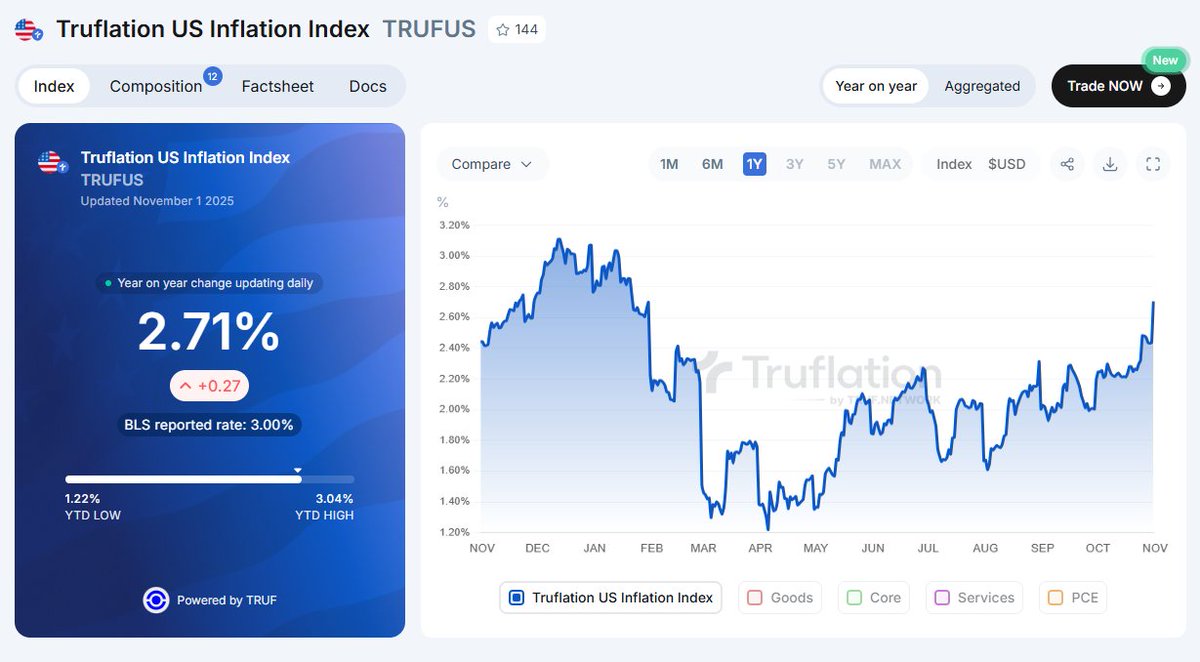
- Since last week, inflation has increased from 2.30% to 2.71%. This change in inflation was mainly driven by the following categories: – Health, Household & Daily Items, Clothing, Education, Recreation & Culture, Others (Truflation)
AI WATCH
From The Transcript and others:
- “We are adding capacity at an unprecedented scale. We will increase our total AI capacity by over 80% this year and roughly double our total data center footprint over the next 2 years, reflecting the demand signals we see. Just this quarter, we announced the world’s most powerful AI data center, Fairwater in Wisconsin, which will go online next year and scale to 2 gigawatts alone.” Microsoft (MSFT ) CEO Satya Nadella
- “With accelerating demand and a growing RPO balance, we’re increasing our spend on GPUs and CPUs. Therefore, total spend will increase sequentially, and we now expect the FY ‘26 growth rate to be higher than FY ‘25.” “This quarter, demand again exceeded supply across workloads, even as we brought more capacity online…we now expect to be capacity constrained through at least the end of our fiscal year…we are not demand constrained, we are supply constrained.” “This quarter, roughly half of our spend was on short-lived assets, primarily GPUs and CPUs…The remaining spend was for long-lived assets that will support monetization for the next 15 years and beyond.” “Microsoft had $400 billion in future sales under contract. That’s for booked business. Today. The number did not include the $250 billion in computing power that OpenAI committed to buy this week” .Microsoft (MSFT ) CFO Amy Hood
- “On the capacity side, we brought in quite a bit of capacity, as I mentioned in my opening comments, 3.8 gigawatts of capacity in the last year with another gigawatt plus coming in the fourth quarter and we expect to double our overall capacity by the end of 2027. So we’re bringing in quite a bit of capacity today, overall in the industry, maybe the bottleneck is power. I think at some point, it may move to chips, but we’re bringing in quite a bit of capacity. And as fast as we’re bringing in right now, we are monetizing it.” “Backlog grew to $200 billion by Q3 quarter end and doesn’t include several unannounced new deals in October, which together are more than our total deal volume for all of Q3.” “We’ve recently brought Project Rainier online, our massive AI compute cluster spanning multiple U.S. data centers and containing nearly 500,000 of our Trainium2 chips. Anthropic is using it now to build and deploy its industry-leading AI model cloud, which we expect to be on more than 1 million Trainium2 chips by year-end. Trainium2 continues to see strong adoption, is fully subscribed, and is now a multibillion-dollar business that grew 150% quarter-over-quarter.” “We’ve been focused on accelerating capacity the last several months, adding more than 3.8 gigawatts of power in the past 12 months, more than any other cloud provider. To put that into perspective, we’re now double the power capacity that AWS was in 2022, and we’re on track to double again by 2027. In the last quarter of this year alone, we expect to add at least another 1 gigawatt of power.” Amazon (AMZN ) CEO Andrew Jassy
- “Looking ahead, we expect our full year cash CapEx to be approximately $125 billion in 2025, and we expect that amount will increase in 2026.” — Amazon (AMZN ) CFO Brian Olsavsky
- “We now expect CapEx to be in the range of $91 billion to $93 billion in 2025, up from our previous estimate of $85 billion…Looking out to 2026, we expect a significant increase in CapEx, and we’ll provide more detail on our fourth quarter earnings call.” Alphabet (GOOGL ) CFO Anat Ashkenazi
- “Cloud had another great quarter of accelerating growth with AI revenue as a key driver. Cloud backlog grew 46% quarter-over-quarter to $155 billion.” “Our highly sought-after TPU portfolio is led by our 7-generation TPU, Ironwood, which will be generally available soon. We are investing in TPU capacity to meet the tremendous demand we are seeing from customers and partners, and we are excited that Anthropic recently shared plans to access up to 1 million TPUs.” Alphabet (GOOGL ) CEO Sundar Pichai
- “We’ve been building TPUs for 10 years, so we now have seven generations in production for internal and external use. Our seven- and eight-year-old TPUs have a hundred percent utilization, right? And that just shows what the demand is. Everyone, of course, prefers to be on the latest generation, but they’ll take whatever they can get. So this tells me that the demand is tremendous.” “The challenge here though, is as you said, that we’re limited by power. We’re limited by transforming land. We’re limited by permitting…I heard in the previous session some of the discussions of the trillions of dollars that we’re gonna be spending, which I think is accurate. I’m not sure that we’re gonna be able to cash all those checks. In other words, literally you all have some money. You can’t spend it all as fast as you want. I think that’s going to extend for 3, 4, 5 years.” Alphabet (GOOGL ) VP and GM of AI & Infrastructure Amin Vahdat
- “Our current expectation is that CapEx dollar growth will be notably larger in 2026 than 2025…We currently expect 2025 capital expenditures, including principal payments on finance leases to be in the range of $70 billion to $72 billion, increased from our prior outlook of $66 billion to $72 billion.” Meta Platforms (META ) CFO Susan Li
- “But to date, we keep on seeing this pattern where we build some amount of infrastructure to what we think is an aggressive assumption. And then we keep on having more demand to be able to use more compute.” Meta Platforms (META ) Founder Mark Zuckerberg
- “We’re definitely really excited about the prime power opportunity with data centers and more broadly, just the demand for power that data centers and broader trends in the industry are putting onto the grid. We’re going to see a lot more of this.” Caterpillar (CAT ) CEO Joseph Creed
- “Our load growth forecast is big, conservative, and drives our capital strategy. First, it is big. In this quarter alone, approximately 2 gigawatts of data center load came online, roughly equivalent to two large-scale nuclear power plants. For the 28 gigawatts of forecasted additions, this is equivalent to almost doubling our current system. Customers behind this growth are substantial, with approximately 80% coming from data processors, including large hyperscalers such as Google, AWS, and Meta.” American Electric Power (AEP ) CFO Revor Mihalik
- “We continue to see robust demand from data centers. We now have approximately 47 gigawatts in various stages of contracting as of September 2025, which compares to around 40 gigawatts as of December 2024, an increase of 7 gigawatts or 17%… There are also now about 9 gigawatts of data center demand that have executed construction letters of authorization… This compares to just over 5 gigawatts in December 2024 and represents an approximately 73% increase.” Dominion Energy (D ) CEO Robert Blue
- “I would say right now that because there’s not enough power singularly in one location, data centers are being built where the power is available rather than power being brought to where the data centers are. And that’s why you’re seeing a lot of projects that are being built out all throughout the world.” Cisco (CSCO ) CPO Jeetu Patel
- “Look, I think the supply-demand mismatch is so large that everybody who has a solution that’s viable today has a market out there for them to address. You are going to see data center developers, hyperscalers wanting any and every solution that they can find.” “Look, I have been to these capitals, whether it is Frankfurt, whether it’s Munich, whether it’s Dublin, whether it’s Taipei. They all have a power shortage problem, and they all clearly recognize that their central power plants along with transmission distribution cannot keep up with AI speed. That’s across the board. This is true in Delhi. This is true in Mumbai. What is happening in Europe, Asia, if you take as an example? I was just recently in Tokyo, and what I heard there is finally the sentiment of natural gas not just being a short-term bridge, but a long-term solution. The agreements the U.S. is reaching with our friendly countries, our friendly allies, to say, ‘We will supply you long-term LNG,’ is now making them take a very different look at natural gas.” — Bloom Energy (BE ) CEO KR Sridhar
- “Demand for scalable connected infrastructure remains robust across a wide range of customer segments from global cloud platforms to regional service providers and multinational enterprises. Meeting this demand within our markets, however, is becoming increasingly challenging. Power availability, permitting challenges and infrastructure constraints are making it harder to bring new supply online at the pace our customers require.” — Digital Realty Trust (DLR ) CFO Andrew Power
- “Well, [power] is without a doubt the constraint, and it’s become more of a constraint. It’s a constraint for anybody that’s doing land work in data centers. It’s a constraint for the co-locators. It’s a constraint for the hyperscalers as they try to expand.” — CBRE Group (CBRE ) CEO Robert Sulentic
- “This rapid growth in power demand in the US will tighten local power markets, which have been facing increased utilization rates of existing infrastructure. While we do not expect the US power market to reach critical tightness on a national level before 2030, rapid growth and sustained geographic concentration in data centers support our view that major US regional power markets are likely to become critically tight in the coming years, which in turn could constrain future data center and total power demand growth until infrastructure bottlenecks are resolved.” (Goldman Sachs)

BUBBLE WATCH
- “At the peak of the telecom bubble, 97% of fiber optic cables were “dark” i.e. not being used. There are no dark GPUs today.” Gavin Baker, Managing Partner and CIO of Atreides Management
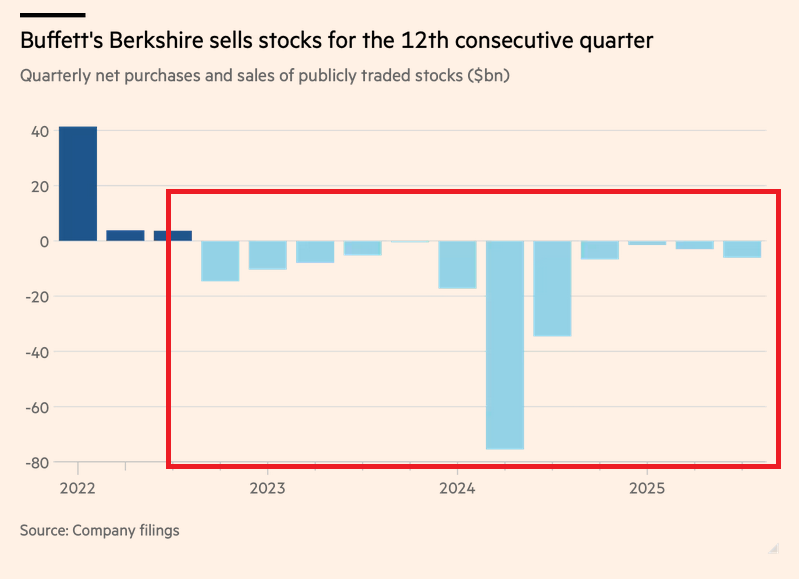
- In the FT:

-
Berkshire’s Cash Pile Hits A Record $382 Billion Amid Continued Stock Sales As T-Bill Purchases Soar (ZeroHedge). Does that fit in this section?

EARNINGS WATCH
Super-Duper Earnings (Ed Yardeni)
S&P 500 companies’ aggregate forward earnings per share rose to yet another record high during the week of October 30 of $299.61. It is nearly at the $300 we have been predicting it would reach by the end of this year; clearly, the year-end level will be higher than that. We expect forward earnings to rise to $350 per share by the end of 2026.
The Q3 earnings season is beating expectations, even though industry analysts didn’t lower their estimates as they did before the Q1 and Q2 earnings seasons, which also beat expectations significantly.
At the start of the current earnings season, industry analysts projected an increase of just over 6%. The blended growth rate is over 10% so far.

Super-Duper is understatement. The 315 companies having reported so far showed earnings up 15.7% on revenues up 8.4%.
Here’s LSEG IBES:
315 companies in the S&P 500 Index have reported earnings for Q3 2025. Of these companies, 83.2% reported earnings above analyst expectations and 12.4% reported earnings below analyst expectations. In a typical quarter (since 1994), 67% of companies beat estimates and 20% miss estimates. Over the past four quarters, 77% of companies beat the estimates and 18% missed estimates.
In aggregate, companies are reporting earnings that are 8.3% above estimates, which compares to a long-term (since 1994) average surprise factor of 4.3% and the average surprise factor over the prior four quarters of 7.1%.
Of these companies, 80.1% reported revenue above analyst expectations and 19.9% reported revenue below analyst expectations. In a typical quarter (since 2002), 62% of companies beat estimates and 38% miss estimates. Over the past four quarters, 67% of companies beat the estimates and 33% missed estimates.
In aggregate, companies are reporting revenues that are 2.2% above estimates, which compares to a long-term (since 2002) average surprise factor of 1.3% and the average surprise factor over the prior four quarters of 1.5%.
The estimated earnings growth rate for the S&P 500 for 25Q3 is 13.8%. If the energy sector is excluded, the growth rate improves to 14.7%.
The estimated revenue growth rate for the S&P 500 for 25Q3 is 7.5%. If the energy sector is excluded, the growth rate improves to 8.2%.
The estimated earnings growth rate for the S&P 500 for 25Q4 is 7.7%. If the energy sector is excluded, the growth rate improves to 8.1%.
Analysts are trying to catch up:


Goldman Sachs’ David Kostin makes 8 observations from the earnings season so far:
- The frequency of earnings “beats” has been unprecedented: 64% of S&P 500 companies that have reported results have beaten consensus EPS forecasts by at least a standard deviation of estimates. In our 25-year data history, this frequency of earnings surprises has been surpassed only during the COVID reopening period in 2020-2021.


- Earnings beats have been driven by both sales and margins.
- Investors are not rewarding most earnings beats. One explanation for the mediocre reward for beats is that investors view results this quarter as less informative for the forward earnings outlook than in the typical quarter.
- S&P 500 Q3 2025 EPS growth is tracking at 8% year/year, a continued deceleration. Although reported earnings growth has indeed exceeded the consensus forecast so far, the 8% run-rate of S&P 500 EPS growth in 3Q represents a deceleration relative to the 11% growth rate reported in 2Q and a smaller EPS beat than during the last few quarters. [This 8% does not jive with LSEG data above but GS uses median earnings, very different from S&P’s]. Since the start of the earnings season, the consensus estimate for 2026 EPS has been revised higher by 2% and now registers $308. [$305 officially. Yardeni’s $350 forward EPS by the end of 2026 is already in].
- Company guidance and analyst earnings revisions have been solid. So far, 49 companies have provided guidance for 4Q earnings. Of these, 43% have guided quarter-ahead EPS above consensus estimates, above the quarterly average of 40% during the past decade.


- Mega-cap AI capex spending continues to exceed expectations. Consensus estimates for hyperscaler capex spending in 2026 have risen from $314 billion at the start of the year to $458 billion at the start of the earnings season to $518 billion today. Current consensus estimates show the hyperscalers boosting capex spending by 29% in 2026, compared with an estimate of 19% expected at the start of the reporting season. The post-earnings share price performance of the mega-cap tech stocks reporting this week suggests investor willingness to accept capex spending growth is dependent on the strength of earnings growth and the perceived ability to monetize AI investments. For example, while GOOGL and META each signaled above-consensus plans for 2026 capex spending this week, GOOGL shares rallied following its report as 3Q 2025 beat estimates and analysts raised 2026 EPS expectations, while META shares declined as EPS missed estimates and 2026 estimates remained relatively steady.
- Large-cap US companies are increasingly focused on labor efficiency. A wave of S&P 500 layoff announcements has broken during the past two weeks. Nine S&P 500 companies have announced layoff plans during the past two weeks, bringing the total number of S&P 500 firms announcing layoffs since the start of September to 17. Total announced layoffs for these companies amounts to roughly 82,000 jobs. This represents only 2% of these companies’ collective workforces, but has reinvigorated some investors’ concerns about the broad US labor market slowdown that has taken place in 2025. Our economists’ have found little empirical evidence that AI adoption has weighed meaningfully on the overall labor market so far but expect adoption will eventually displace roughly 7% of the US workforce at its peak. 49% of S&P 500 companies reporting so far this quarter have mentioned the potential for AI-related efficiency gains on their conference calls. This represents a modest increase from the 45% rate during 2Q and falls in the range of other survey measures of AI adoption such as surveys from the Census Bureau and a recent survey of Goldman Sachs investment bankers on how clients are using AI.
- Bank lending and the corporate credit cycle are under scrutiny.

About profit margins (Callum Thomas)
The black line is the median profit margin across 45 countries, and again this chart helps understand a couple of things.
First is the USA has generally been outperforming the median global profit margin over the past decade (helps explain the US vs global stocks relative stock price outperformance). Second, global has been turning up off the 2024 lows; which helps explain the better performance from global stocks over the past year.
But it also goes to show how extraordinary the current run in US profit margins is both vs history and vs the global experience. And that along with those issues around circular funding in the AI space may prompt some to ponder about the sustainability of the current surge in US profit margins (especially given how profit margins tend to be highly cyclical and have a long-running tendency to mean revert).

But, maybe we should not be talking of US profit margins but rather US tech profit margins:
Interestingly while US tech stock profit margins are at a cyclical + structural high, non-tech stock profit margins on the other hand peaked a few years back and have reverted back to trend.
Source: Topdown Charts Professional

“While earnings are bullish, sentiment is bearish in the very short term. There are too many bulls (Ed Yardeni).


