Flash US PMI signals strong start to fourth quarter
The headline S&P Global US PMI Composite Output Index rose from 53.9 in September to 54.8 in October, according to the ‘flash’ reading (based on about 85% of usual survey responses). The latest reading is the highest since July and signals an acceleration of growth to a pace just above the third quarter average. Output has now risen continually for 33 months.
The service sector continued to report especially robust growth, posting the fastest expansion since July and the second-strongest increase so far this year. Inflows of new orders for services likewise improved, rising at the steepest rate seen in 2025 to date. While service providers reported signs of improving domestic demand, exports of services fell back into decline after modest growth in September.
Higher output was also reported in manufacturing, where production volumes rose for a fifth consecutive month. The expansion of factory output was the largest since August, and the second steepest since February, buoyed by the sharpest influx of new orders for just over one-and-a-half years.
However, the upturn in orders was driven by the domestic market, as export orders for manufactured goods fell sharply, dropping at the sharpest rate since February. Companies reported falling sales to markets including China and Europe, often blamed on tariff policies.
Employment rose for the tenth time in the past 11 months, with the rate of job creation improving on September’s recent low and broadly in line with the average for the year to date. An upturn in service sector job creation, albeit remaining only modest, was accompanied by slower job gains in manufacturing.
In both cases, employment growth was curtailed by a lack of suitable candidates to replace leavers but also reflected concerns over staffing needs given current sales levels and uncertainty over the demand outlook. Manufacturers reported the steepest drop in backlogs of work recorded so far this year, hinting at excess production capacity. In the service sector, outstanding business rose at the slowest rate for six months.
With backlogs of work falling, manufacturers reduced their input buying in October, though some factories continued to accumulate inventories to avoid potential price rises linked to future tariffs. Inventories of purchases rose only marginally as a result, increasing at a much-reduced rate compared to the strong tariff-related stock building reported earlier in the year.
Inventories of inputs were also again used to produce more finished goods stock, which rose at an unprecedented rate in the survey’s 18-year history during October. Warehouse stocks have now risen five times in the past six months.
Input cost inflation remained elevated in October, running below the highs seen earlier in the year but picking up slightly since September. Despite being the lowest since February, manufacturing input price inflation remained especially high, once again widely attributed to tariffs.
Service sector cost inflation meanwhile was the highest for three months, registering one of the steepest increases seen over the past two years. Higher wage costs reportedly often added to the inflationary impact of tariffs on purchased input costs.
Although overall input cost inflation accelerated slightly in October, overall average prices rose at the slowest rate since April. Firms across both manufacturing and services often reported difficulties passing higher costs on to customers in the face of subdued demand and intense competition.
In terms of prices charged, while service sector inflation eased especially sharply, to its lowest since April, goods price inflation accelerated since September but remained below rates seen in the preceding six months.
Expectations about year ahead output fell from September’s four-month high, dropping to one of the lowest seen over the past three years. Manufacturing optimism sank to the second lowest since June 2024, with only April having witnessed lower business sentiment. Service sector optimism also deteriorated and remained well below the survey’s long-run average.
Outlook concerns again centered on the detrimental impact of government policies, notably tariffs, and broader political uncertainty, though some manufacturers again often cited tariffs as a possible stimulus to domestic production. Both sectors also saw business growth expectations supported by lower interest rate policy.
Chris Williamson, Chief Business Economist at S&P Global Market Intelligence:
“October’s flash PMI data point to sustained strong economic growth at the start of the fourth quarter, with business activity picking up momentum across both manufacturing and services despite some reports of businesses being adversely impacted by the government shutdown. The survey data are consistent with the economy expanding at a 2.5% annualized rate in October after a similar rise was signalled for the third quarter.
“However, business confidence in the outlook for the coming year has deteriorated further, and is at one of the lowest levels seen over the past three years as companies worry about the impact of policies, most notably tariffs. Companies are also concerned over disappointing export sales, especially in manufacturing, and factories are seeing an unprecedented rise in unsold stock. Having bought excess inputs earlier in the year to front-run tariffs, producers are making more goods to use up these inputs but are often struggling to sell the end product to customers.
“Hence, although input costs continued to rise sharply again in October, principally reflecting the pass-through of tariffs, average selling price inflation has cooled to the lowest since April as firms compete on price to win sales.”


Puzzling report:
- The flash PMI “signals an acceleration of growth to a pace just above the third quarter average” (2.5%)
- Manufacturers saw the “sharpest influx of new orders for just over one-and-a-half years.”
- New orders at service providers are “rising at the steepest rate seen in 2025 to date.”
- Yet, manufacturers reported the “steepest drop in backlogs of work recorded so far this year, hinting at excess production capacity.”
- Finished goods inventories, up in 5 of the last 6 months, “rose at an unprecedented rate in the survey’s 18-year history during October”.
- “Firms across both manufacturing and services often reported difficulties passing higher costs on to customers in the face of subdued demand and intense competition.”
So, how strong is the economy when backlogs are dropping steeply, finished goods inventories are exploding and businesses can’t pass “higher costs on to customers in the face of subdued demand and intense competition.”
Could it be that the tariffs saga disrupted the purchasing/production/selling process so much that it created an illusion of demand growth that was really only inventory accumulation now facing slow domestic demand and declining exports?
Indeed Job Postings keep falling through October 17, down almost 4% since August 23rd, and 3.4% since the latest official JOLTS report (August).

September CPI: An Oasis in the Data Desert
An unusual CPI Friday came in softer-than-expected for the month of September. CPI growth moderated to a 0.3% increase over the month, which was still strong enough to lift the year-over-year rate to 3.0%, the highest reading since January. A 4% monthly jump in gasoline prices kept the heat turned up on headline inflation. Despite the gain in gas prices, prices for electricity and utility gas services declined 0.7%, continuing a streak of three months of decline and tempering the rise in overall energy prices. Food inflation remained on its moderating trend, with grocery prices rising 0.3%, down from a 0.6% gain in August. (…) Forward-looking measures of commodity prices suggest food inflation will continue to cool in the coming months, as stronger yields and softer export demand have reduced food producers’ pricing power.
Source: U.S. Department of Labor and Wells Fargo Economics
Source: U.S. Department of Labor and Wells Fargo Economics
Excluding food and energy, the core CPI rose 0.2% in September (0.23% unrounded). (…) Core goods inflation moderated a touch, rising 0.22%, sightly softer than the 0.28% advance in August. The pullback was driven by used vehicle prices, which fell 0.4% after a 1% gain the prior month. New vehicle prices were firmer at +0.2%, while apparel prices posted the second consecutive robust reading at +0.7%.
The three-month annualized rate for apparel prices has now risen to 5.3%, the highest since April 2024 in a potential sign of tariffs having an impact on prices for imported goods. Through the month-to-month noise, core goods inflation continues to creep higher.
Services inflation showed clearer signs of moderation. Core services prices rose 0.24%, down from 0.35% in August. The slowdown was led by primary shelter, which receded to a 0.15% gain from an unexpectedly strong reading in August. Owners’ equivalent rents in particular were soft, rising just 0.1%, the softest reading since November 2020. Looking through the monthly volatility, the slowdown in primary shelter inflation has played a key role in the disinflation of the past couple years, and price growth in this sector is nearly back to its pre-pandemic pace where we expect it to stick going forward.
Elsewhere in core services it was a mixed bag, with airfares (+2.7%) and lodging away from home (+1.3%) coming in a bit hotter than we expected but motor vehicle insurance (-0.4%) coming in weaker than expected. (…)
Source: U.S. Department of Labor and Wells Fargo Economics
Source: U.S. Department of Labor and Wells Fargo Economics
Inflation appears to be neither spiraling out of control nor imminently returning to 2%. The year-over-year change in the core CPI held steady at 3.0% (3.1% NSA) in September, and the three-month annualized rate also held firm at 3.6%. The disinflation of 2023-2024 seems to have stalled out this year, and the underlying pace of consumer price growth appears stuck around 3%.
We are probably not yet past the peak impact on price growth from tariffs, which in our view will not be in the rear view mirror until sometime in the first half of next year.


EARNINGS WATCH
143 companies in the S&P 500 Index have reported earnings for Q3 2025. Of these companies, 87.4% reported earnings above analyst expectations and 10.5% reported earnings below analyst expectations. In a typical quarter (since 1994), 67% of companies beat estimates and 20% miss estimates. Over the past four quarters, 77% of companies beat the estimates and 18% missed estimates.
In aggregate, companies are reporting earnings that are 8.2% above estimates, which compares to a long-term (since 1994) average surprise factor of 4.3% and the average surprise factor over the prior four quarters of 7.1%.
Of these companies, 81.9% reported revenue above analyst expectations and 18.1% reported revenue below analyst expectations. In a typical quarter (since 2002), 62% of companies beat estimates and 38% miss estimates. Over the past four quarters, 67% of companies beat the estimates and 33% missed estimates.
In aggregate, companies are reporting revenues that are 2.4% above estimates, which compares to a long-term (since 2002) average surprise factor of 1.3% and the average surprise factor over the prior four quarters of 1.5%.
The estimated earnings growth rate for the S&P 500 for 25Q3 is 10.4%. If the energy sector is excluded, the growth rate improves to 11.2%.
The estimated revenue growth rate for the S&P 500 for 25Q3 is 6.7%. If the energy sector is excluded, the growth rate improves to 7.3%.
The estimated earnings growth rate for the S&P 500 for 25Q4 is 7.9%. If the energy sector is excluded, the growth rate improves to 8.2%.
Actually, the 143 companies having reported so far logged earnings up 17.0% on revenues up 7.6%.
Revenue growth is more than twice actual inflation and much above wage growth rates, hence the extraordinary jump in margins.
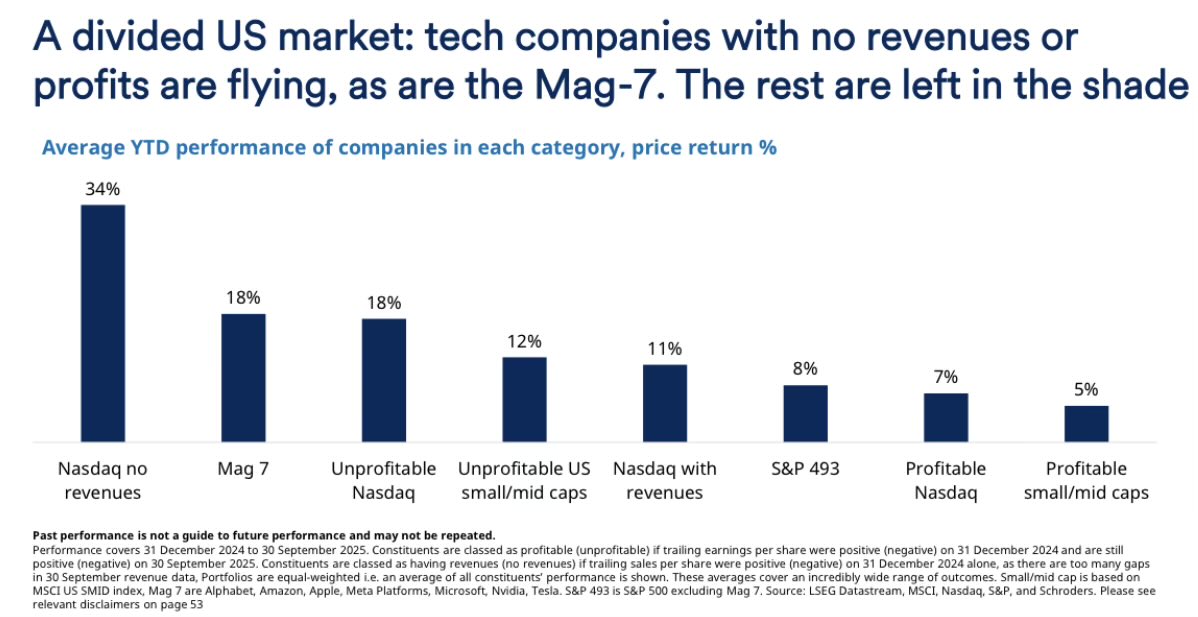
S&P Global’s PMI covers a full spectrum of company sizes. Obviously, the comments above about subdued demand and squeezed margins must not apply to the cohort of larger companies.
This is confirmed by this chart from Ed Yardeni showing that the smaller companies are not experiencing a profit boom, are they?

Eurozone new order growth hits two-and-a-half year high in October
The seasonally adjusted HCOB Flash Eurozone Composite PMI Output Index, based on approximately 85% of usual survey responses and compiled by S&P Global, rose to 52.2 in October from 51.2 in September, posting above the 50.0 no-change mark for the tenth consecutive month and signalling a solid monthly increase in business activity. The rate of expansion was the joint-fastest in just under two-and-a-half years, equal with that seen in May 2024.
Growth was recorded across both monitored sectors, and led by services where the latest increase in business activity was the strongest since August 2024. Manufacturing production rose for the eighth month running. The latest expansion was slight, but marginally quicker than that seen in September.
A solid increase in output was registered in Germany, where the pace of growth hit a 29-month high. Similarly, the euro area excluding Germany and France posted the fastest rise in activity for two-and-a-half years. Bucking the wider trend, France posted a fourteenth consecutive monthly reduction in output, and one that was the sharpest since February.
Companies often raised their business activity in response to a steeper increase in new orders during October as the pace of growth in new business reached the highest since April 2023. Here too, the overall expansion was led by the services sector, but manufacturing new orders broadly stabilised following a fall in September. While overall new orders increased at a faster pace at the start of the final quarter, new business from abroad continued to decrease. New export orders (which include intra-Eurozone trade) declined only slightly, however, and at one of the slowest rates since the current sequence of contraction began in March 2022
Encouraging trends in output and new orders contributed to a renewed increase in staffing levels during October, following a marginal fall in September. Employment has now risen in seven of the past eight months, with the increase in October the joint-fastest in 16 months, equal with that seen in August. Jobs growth was centred on the services sector, where the pace of job creation was the sharpest since June 2024. Meanwhile, manufacturing employment decreased at the fastest pace in four months.
Backlogs of work stabilised in October, thereby ending a period of depletion stretching back to April 2023. Service providers posted the first accumulation of outstanding business for a year-and-a-half, while manufacturing backlogs decreased slightly. Notably, Germany posted a first rise in work-in-hand since July 2022
The rate of input cost inflation eased for the second month running in October, dipping to a three-month low and coming in below the series average. Services input prices increased at a softer pace, while manufacturers posted a renewed rise in their cost burdens, albeit one that was only marginal.
While input costs increased at a slower pace at the start of the fourth quarter, the opposite was true with regards to output prices, which rose at the fastest pace in seven months. Manufacturers increased their selling prices for the first time in six months, joining the services sector in recording inflation. Service providers raised charges at a solid pace that was sharper than seen in September. Solid increases in output prices were registered in Germany and the euro area excluding the largest two economies, but French companies raised their charges only slightly amid deteriorating customer demand
Although Eurozone manufacturers continued to scale back their purchasing activity in October, the pace of decline eased from that seen in September. This was also the case with regards to stocks of inputs, but holdings of finished goods decreased at a faster pace than in the previous month. Meanwhile, suppliers’ delivery times lengthened solidly. Moreover, the rate of deterioration in vendor performance intensified for the fourth consecutive month and was the most pronounced for three years. Delivery delays were still much less marked than seen in the period following the COVID-19 pandemic, however
Despite stronger expansions in output and new orders in October, business confidence waned to a five-month low and was weaker than the series average. Weaker optimism in the 12-month outlook for output was signalled across both the manufacturing and services categories. Sentiment was relatively muted in Germany and France, but firms in the rest of the eurozone remained strongly confident that output will rise over the coming year
Commenting on the flash PMI data, Dr. Cyrus de la Rubia, Chief Economist at Hamburg Commercial Bank, said:
“France is increasingly becoming a drag on the eurozone economy. While the economic situation in Germany brightened significantly in October, the rate of contraction has accelerated for two months in a row in France. As a result, economic growth in the eurozone, even though accelerating a bit, has been much weaker than it otherwise could have been. Uncertainty about whether the current government under Sebastien Lecornu can remain in power for much longer in view of the disputes over the 2026 budget is causing unease and contributing significantly to the weak economic situation in France. As an important buyer of products and services from other eurozone countries, France’s weakness contributes to the fragility of the recovery in the rest of the eurozone.
Industry in the eurozone has been stagnating for practically six months. The marginal improvement in the headline PMI to 50 offers little hope of a turnaround. This is all the more true given that new orders have been similarly weak. In this environment, manufacturing companies have accelerated their workforce reductions in an effort to adapt to weaker demand conditions and become more efficient at the same time. Although companies have been able to pass through slightly higher prices to their customers, input prices have also risen somewhat, meaning that profit margins are unlikely to have increased significantly.
Inflation in the eurozone services sector remains moderate. The rate of inflation for sales prices has risen slightly, but remains close to the long-term average. Cost increases were slightly lower in October, so there is little danger from this side in the short term. The European Central Bank, which pays particular attention to inflation in the service sector, is likely to see this data as confirmation of its stance not to implement further interest rate cuts.”


Japanese business activity increases at slowest rate in five months amid renewed drop in sales
The headline seasonally adjusted S&P Global Flash Japan PMI Composite Output Index fell from 51.3 in September to 50.9 in October, to signal a further increase in overall private sector output across Japan. However, the rate of growth was the softest recorded in five months and only marginal.
Underlying data highlighted that the service sector continued to drive the overall upturn in output, as manufacturing production continued to contract. That said, the rate of services activity growth slipped to a four-month low in October, while factory output declined at a slightly faster pace.
At the composite level, overall new business declined for the first time in 16 months, albeit marginally. This was due to a combination of weaker sales growth in the service sector and the steepest reduction in new orders placed with manufacturers since February 2024. Foreign demand for Japanese goods and services meanwhile fell again in October, though the overall rate of decline was the slowest seen in four months and modest.
Japanese companies continued to increase their staff numbers in September, thereby stretching the current sequence of payroll growth to just over two years. That said, the rate of job creation was weaker than the average seen over this period, with both service providers and manufacturers recording only marginal increases in headcounts. Overall levels of outstanding business at Japanese firms meanwhile declined for the first time since May.
The latest survey pointed to stronger cost pressures across Japan’s private sector, with average input prices rising at a sharp and accelerated pace in October. Notably, operating expenses increased at quicker rates across both the manufacturing and service sectors, with panellists often linking this to higher labour, raw material and fuel costs and a weaker yen.
Consequently, both goods producers and service providers raised their average selling prices again in October. Overall, charges increased at a solid pace that was the quickest in three months.
Although firms across Japan remained generally confident that output will increase over the next 12 months, the degree of optimism edged down from September and was below the survey’s long-run average. Trends diverged by sector, as services companies were less upbeat about the year ahead while manufacturers were more confident.

China Commerce Minister Says US and China Can Find Solutions
(…) “The economic and trade consultations between China and the US fully demonstrate that based on mutual respect and equal consultation, China and the US can find solutions to address each other’s concerns,” Commerce Minister Wang Wentao said during a briefing on China’s next five-year plan. Wang also reiterated that China opposed decoupling and disrupting supply chains. (…)
- China Says Dutch Nexperia Seizure Places Supply Chain at Risk
China’s Commerce Minister warned that the Dutch state’s move to take control of Chinese-owned chipmaker Nexperia has “seriously affected” the stability of the global supply chain.
The minister, Wang Wentao, urged the Dutch to urgently resolve the issue, according to a Chinese government readout of a call with Dutch Economic Affairs Minister Vincent Karremans.
The Dutch government, separately, said it would remain in contact with Chinese authorities to work “toward a constructive solution.”
Talks between the two governments come a week after the Dutch state seized control of Nexperia using an emergency Cold-War era law. The company is a subsidiary of China’s Wingtech Technology Co. Ltd and a key supplier of mature chips used by the automotive and consumer electronics industries. The move heightened European trade tensions with Beijing, which retaliated by blocking Nexperia from exporting products from the company’s Chinese plant.
Chip shortages are likely to hit key suppliers within a week, while the impact could spread across the entire sector within 10 to 20 days, Bloomberg has reported, according to people familiar with the matter. (…)
Both parties “are fully aware the time is of the essence here as well,” he said. (…)
On Beijing’s recent measures to curb rare earth exports, Wang said it was a “normal practice to improve its export controls system, according to the ministry. He said China has consistently facilitated export approvals for EU companies.
China Vows to Double Down on Tech Self-Reliance as U.S. Rivalry Heats Up Beijing remains determined to hit the annual goal of around 5% growth in gross domestic product
The elites of China’s ruling party set out the goal in a communique issued after a four-day political gathering centered around charting the course for the world’s second-largest economy over the rest of the decade.
China will aim to “significantly improve” its autonomy in technology over the next five years, officials said after the high-level meeting—known as the fourth plenum—wrapped up Thursday.
The readout of the closed-door conclave also included a pledge to step up high-end manufacturing, another measure viewed as part of Beijing’s efforts to hold its own against the U.S.
As China’s population shrinks and ages, Beijing is betting on leapfrogging technological advance and innovation to boost productivity. Policymakers are increasingly seeing technological prowess as key to national security as geopolitical tensions rise.
Other key targets in the new five-year policy blueprint included forging a unified national market, bolstering domestic consumption, improving social welfare and modernizing the armed forces. (…)
They also pledged to step up policy support for the economy when necessary. (…)
Overseas renminbi lending surges as China steps up campaign to de-dollarise Beijing’s push for renminbi trade and investment will speed move from dollar-based to multi-polar monetary system, analysts say
(…) External renminbi loans, deposits and bond investments by Chinese banks quadrupled to more than Rmb3.4tn ($480bn) over the past five years, as policymakers more aggressively pursue their long-term goal of reducing the centrality of the dollar in global financial flows.
As part of this campaign, China is also opening more channels for foreign investors to buy renminbi-denominated bonds.
But officials have focused their efforts on boosting the renminbi’s role in trade, partly as a defence against policies enacted in the US and elsewhere that weaponise the dollar — such as this week’s EU sanctions targeting Chinese banks accused of helping Russia to secure weapons parts overseas.
“From China’s perspective, [settlement in renminbi] is important because it shows that no matter what happens, it can still trade,” said Adam Wolfe, emerging markets economist at Absolute Strategy Research in London. Recent data from China’s State Administration of Foreign Exchange shows the external fixed-income assets of Chinese banks more than doubling over the past decade to more than $1.5tn, with the share denominated in renminbi expanding rapidly to almost $484bn at the end of June. This includes $360bn of renminbi loans and deposits, up from $110bn in 2020.
Similarly, the Bank for International Settlements estimates that overseas bank lending in renminbi to borrowers in developing countries rose by $373bn in the four years to the end of March. (…)
With interest rates in China relatively low, sovereign borrowers including Kenya, Angola and Ethiopia have converted old dollar debts into renminbi this year. Indonesia and Slovenia recently announced plans to issue renminbi bonds, and last month Kazakhstan’s development bank sold a Rmb2bn offshore bond at a yield of just 3.3 per cent.
A big part of the expansion in renminbi lending has been in trade finance. Data from cross-border payments system provider Swift shows that the renminbi’s share of global trade finance quadrupled over the past three years to 7.6 per cent in September, making it the second most-used currency in trade finance after the US dollar.
China has further bolstered the use of the renminbi overseas through a network of offshore clearing banks, both Chinese and foreign, and through swap lines with trading partners around the world. It comes as Beijing has pushed the use of its own cross-border payments system, Cips, where the value of transactions has risen from a negligible amount a decade ago to more than Rmb40tn in every quarter since the start of last year. Cips transactions have expanded even as the renminbi’s share of global payments on the Swift system has fallen.
Bert Hoffman, a professor at the National University of Singapore’s East Asian Institute, said this most likely indicated a migration of payments to the Chinese system — furthering Beijing’s desire to move away from a dollar-based global monetary system to a multi-polar one. Chinese officials believe that “a dollar-based system is inherently unstable and has disadvantages that a multicurrency system would not have,” Hoffman said.
Chinese customs data suggests such plans are advancing. It shows the value of Chinese trade transacted in renminbi soaring to more than Rmb1tn a month over the past decade, with about 30 per cent of China’s trade and more than half of its cross-border transactions now settled in renminbi.
China’s capital controls, however, have long hindered the renminbi’s international appeal — according to the IMF, it made up just 2.1 per cent of official reserves at the start of this year. One problem is a lack of readily available renminbi assets. Policymakers are moving to address this.
Hong Kong authorities have embarked on a plan to make the city a hub for fixed income and currency trading. Simultaneously, Beijing has opened its domestic interbank repo market to foreign investors, allowing them to use renminbi fixed-income assets as collateral for renminbi loans. The repo initiative “deals with some of the pain points for foreign investors”, said Karen Lam, head of Hong Kong securitisation and derivatives at law firm Simmons & Simmons. “It only makes sense for investors to allocate more into these assets if they are able to use them for more than just holding and generating an income.”
Last month, Hong Kong authorities announced a “road map” to bolster the city’s markets by supporting issuance and liquidity, particularly in renminbi. “It’s as significant as what Hong Kong did with the stock connect programmes,” said Paul Smith, head of markets for Japan, north Asia and Australia at Citi, referring to the channel connecting the Hong Kong stock exchange to mainland bourses. “Ultimately, it will accelerate the renminbi as a funding currency.”
Over the summer, Beijing broadened the scope of its bond connect programme to allow more mainland Chinese investors to invest in Hong Kong’s fixed income market, which Smith said connects offshore issuers of renminbi debt with a “deep pool of renminbi liquidity”.
Experts agree that China has little interest in the renminbi taking the place of the US dollar in the global financial system. But by boosting the renminbi’s involvement in international trade and investment, “China may get the best of both worlds,” said Smith at Citi. Beijing’s policies are bringing that target into view, analysts say. “The policy is moving very gradually, but all of the elements that would make a much more rapid internationalisation work — they’re falling into place,” said Hoffman.

Trump Terminates Trade Talks With Canada Over Reagan Tariff Ad
The ad in question comprises excerpts from an address Reagan gave in 1987 in which he defended the principles of free trade and slammed tariffs as an outdated idea that stifles innovation, drives up prices and hurts US workers.
Funded by the government of Ontario, the ad seeks to sow doubt among Republican voters by using one of the party’s most iconic voices.
Trump, however, said the move appears timed to interfere with a looming Supreme Court case challenging the legality of much of his signature foreign economic policy. The president has warned of disaster if the high court overturns his country-based tariffs, including forcing the government to refund companies billions of dollars in already-paid duties.
The court is scheduled to hear oral arguments in the case on Nov. 5.
The Ronald Reagan Presidential Foundation and Institute had criticized Ontario for running the ad, saying that they didn’t seek permission to use the remarks, and that “selective audio and video” in the ad “misrepresents” Reagan’s full address.
The remarks from Reagan backed his decision to tariff Japanese imports, while defending free trade and warning of the long-term effects from tariffs. (…)
Canada to Take ‘Bold’ Risks to Reset Economy, PM Carney Says The Canadian economy contracted in the second quarter on a deep drop in exports
(…) “To confront a more dynamic, competitive, and hostile world, we must chart a new course,” Carney said in remarks before students at the University of Ottawa on Wednesday. “We used to take big, bold risks in this country. It is time to swing for the fences again. That’s what the upcoming budget will be about.”
Carney revealed one of the budget plan’s ambitious targets—to double the level of exports to non-U.S. markets within a decade. About three-quarters of Canadian exports are U.S.-bound, and about one-fifth of the country’s gross domestic product is tied to trade with the U.S.
The budget plan, to be unveiled Nov. 4, represents Carney’s policy response to position the economy for growth in the face of a protectionist U.S. (…)
- U.S. Trade War Drives Canada to Fast-Track Port Expansion Officials say upgrade of Montreal’s port will help Canadian importers and exporters find alternatives to the U.S.
Prime Minister Mark Carney is fast-tracking the expansion at the Port of Montreal as Canada seeks to grow trade outside of the U.S. Port officials say the new container-handling terminal will cost about 1.6 billion Canadian dollars, the equivalent of $1.15 billion, and that it is crucial for strengthening Canada’s overseas trade.
“Our economy in Canada was really built north-south,” said Montreal Port Authority Chief Executive Julie Gascon. “But we are a maritime nation. So reconnecting with our roots as a maritime nation and improving our trade balance with other nations with whom we have trade agreements is part of the strategy.”
Carney selected Montreal as one of five projects of national importance, in addition to a liquefied natural gas facility, a nuclear power project and two copper mines, that will be fast-tracked by a newly created Major Projects Office. Montreal port officials say the designation will accelerate regulatory approvals and financing. (…)
Montreal grew into a logistics hub because of its proximity to major metropolitan areas in Quebec and Ontario as well as its connections via rail and the St. Lawrence Seaway to factories and farms in the U.S. Midwest. But the river limits the size and weight of vessels that can call at the port.
North American ports, including Canada’s East Coast gateways at Halifax, Nova Scotia, and Saint John, New Brunswick, have spent millions of dollars dredging harbors and berths to accommodate the enormous containerships that increasingly ply major ocean trade lanes. The St. Lawrence River’s depth of about 37 feet means that even smaller containerships, which carry the equivalent of about 6,500 containers, can’t always sail fully laden to Montreal. (…)
Canada’s leaders are betting demand at Montreal will surge as Canadian exporters stung by U.S. tariffs turn to Europe, the Middle East and South Asia to grow trade ties.
The U.S. accounts for about 80% of Canadian exports. More than half of Canadian exporters expect tariffs to hurt their business, according to a recent survey by Canada’s national statistics office. Almost one-quarter of those businesses said they plan to seek customers outside the U.S.
Canada’s three busiest eastern container ports are well-positioned to pick up more trans-Atlantic business, especially with free trade partners such as the European Union.
Trump Pardons Convicted Binance Founder Pardon follows months of efforts by Changpeng Zhao to boost the Trump crypto company
President Trump has pardoned Changpeng Zhao, the convicted founder of the crypto exchange Binance, following months of efforts by Zhao to boost the Trump family’s own crypto company.
The president signed the pardon on Wednesday, people familiar with the matter said. Trump recently indicated to advisers that he was sympathetic to arguments of political persecution related to Zhao and others, one of the people said.
White House press secretary Karoline Leavitt said that Trump had “exercised his constitutional authority by issuing a pardon for Mr. Zhao, who was prosecuted by the Biden Administration in their war on cryptocurrency.” She added: “The Biden Administration’s war on crypto is over.” (…)
A pardon will likely pave the way for Binance, the world’s largest crypto exchange, to return to the U.S. after the company pleaded guilty in 2023 to violating U.S. anti-money-laundering requirements and was barred from operating in the country. (…)
Since Trump’s election, Binance has also been a key supporter of his family’s World Liberty Financial crypto venture, a business that has driven a huge leap in the president’s personal wealth.
The Justice Department imposed a record $4.3 billion fine and burdensome oversight on Binance, which the department said had become a colossal money-laundering hub through which sanctioned groups and criminal organizations laundered billions of dollars in illicit funds.
The pardon may also prematurely end the Justice Department’s three-year Binance monitorship, set up to ensure the company complies with U.S. financial crime laws. However, it likely won’t end a separate monitorship established by the Treasury Department without the additional approval of Trump or the Treasury secretary. (…)
World Liberty has generated significantly more income for the Trump family in the past year than their property portfolio ever has annually.
Binance has been one of the main drivers of the growth of World Liberty’s dollar-pegged cryptocurrency, called USD1. It delivered World Liberty’s first big break this spring when it accepted a $2 billion investment from an outside investor paid in USD1. Binance has also incentivized trading in USD1 across platforms it controls.
World Liberty has said that Zhao is friends with Zach Witkoff, a World Liberty co-founder whose father Steve Witkoff is Trump’s special envoy, but the venture hasn’t struck any business deal with Binance. (…)