China’s Xi Signals Approval for Trump’s Trade War Demands He pledged to address state subsidies and protect intellectual property rights.
(…) Xi spent a large portion of his speech Friday addressing Chinese domestic reforms, pledging to address state subsidies, protect intellectual property rights, allow foreign investment in more sectors and avoid competitive devaluation of the yuan. All four are issues the U.S. is addressing in trade talks with Beijing.
“We will establish a binding enforcement system for international agreements,” Xi said, adding that China will standardize all levels of government in terms of issuing administrative licenses and market regulation, and also “eliminate improper rules, subsidies and practices that impede fair competition and distort the market.” (…)
China won’t engage in currency depreciation that “harms other countries,†Xi said on Friday, adding the yuan will be kept at a “reasonable, equilibrium level,†and the market will play a bigger role in setting the exchange rate. (…)
The Trump administration may concede to a Chinese proposal that would give less protection for U.S. pharmaceutical products than they receive at home, according to people familiar with the matter, a move that could draw opposition from the American drug industry.
Under the Chinese offer being discussed as part of wider trade talks, U.S. pharmaceutical companies would get eight years of regulatory data protection in China for the biologics they develop, said two people, who spoke on condition of anonymity because the discussions are private.
That compares with the 10 years of protection they get in the new Nafta, which Congress hasn’t yet approved, and the 12 years they receive in the U.S. The move raises the possibility that, in the middle of a fierce U.S. debate over drug prices, the Trump administration would give China a stronger mechanism to force down prices for some of the world’s most expensive drugs than the U.S. has. (…)
-
Trump says Xi will visit White House soon, as U.S. and China seek end to trade war
-
The source told the South China Morning Post that Xi was open to the idea of travelling to the US immediately after the two sides reached a deal, so that he and Trump could sign the pact face to face. “June is an option but it could be later,†said the source, who declined to be named because of the sensitivity of the issue.
U.S. Durable Orders Rose 2.7% in March, Faster Than Expected The civilian-aircraft category rose 31.2% and orders for motor vehicles increased 2.1%
(…) A decline in durable-goods bookings in February was revised to 1.1%, smaller than the 1.6% drop that was initially reported. Through the first three months of 2019, demand for durable products was up 3%, compared with the same period a year earlier. (…)
A closely watched proxy for business investment—new orders for nondefense capital goods excluding aircraft—was up 1.3% in March after increasing 0.1% in February. The business investment measure rose 2.8% in the first three months of this year compared with the same period in 2018. (…)
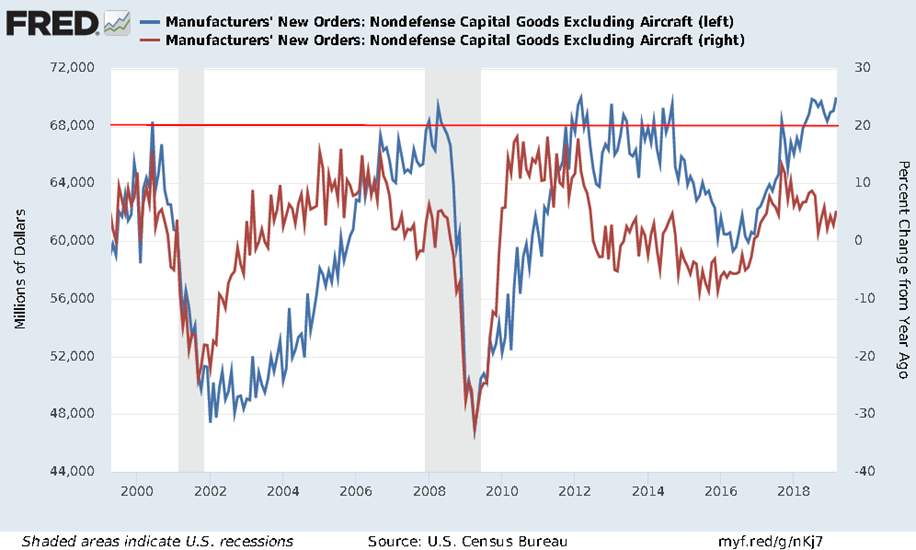
Capex finally seem about to break out of the $68B peak of the past 20 years. They were up at a 9.5% annualized rate in Q1 and are up 5.3% YoY in March. Will productivity growth follow?
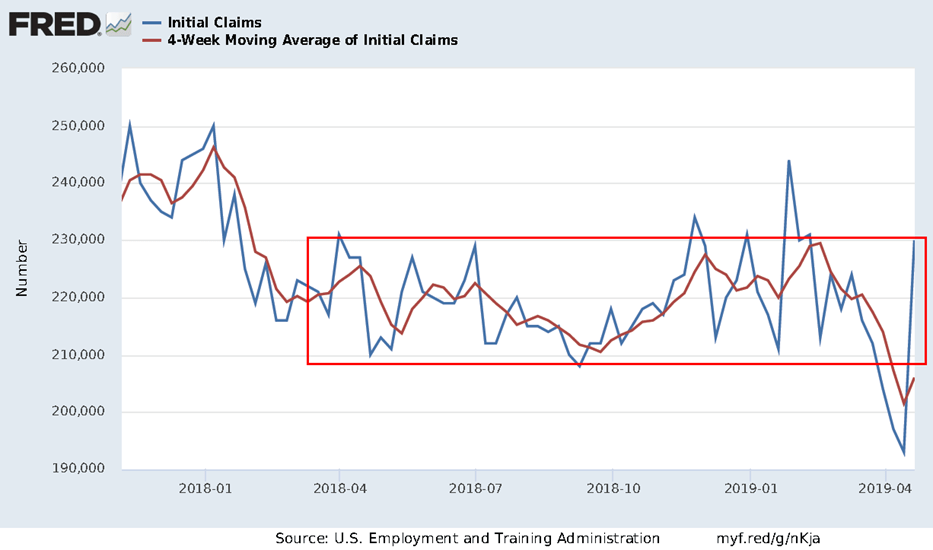
Speaking of employment, to keep track of David Rosenberg’s concerns about “forward-looking initial claimsâ€. The 4-wk m.a. is at the bottom of the 2018 channel after the shutdown:
From a Merrill Lynch research note:
We look for nonfarm payroll employment growth of 250k in the April Bureau of Labor Statistics (BLS) employment report, to be released on May 3rd.
From Markit’s flash U.S. PMI:
April also saw firms become more reluctant to hire as a result of weaker order book growth, pushing jobs growth to a two-year low. The survey’s headline employment index is indicative of non-farm payrolls growing by 130,000 in April, well below the 198,000 average indicated in the first quarter.
David Rosenberg: Don’t let the stock market fool you – a recession is almost here
(…) “The Fed has murdered every cycle. And I believe the Fed has murdered this one,†Mr. Rosenberg said. (…)
But some data suggest enduring economic weakness, Mr. Rosenberg pointed out.
The Citi Economic Surprise Index has declined steadily over the past three months, suggesting that U.S. economic performance has failed to meet economists’ expectations.
In March, an indicator produced by the Federal Reserve Bank of New York based on bond yields showed the probability of a U.S. recession over the next 12 months hitting its highest level since 2008.
Meanwhile, U.S. unemployment is showing signs of increasing after hitting a low last September, Mr. Rosenberg said. That kind of job market inflection tends to predate a recession by an average of nine months.
An inverted yield curve, which was seen in the United States and Canada in late March, also tends to signal an economic recession.
“When the yield curve inverts, it’s the bond market’s way of saying, ‘Mr. Fed, you’ve gone too far,’†Mr. Rosenberg said.
Of the 13 previous Fed rate-hiking cycles since the Second World War, 10 of them landed the economy in a recession, Mr. Rosenberg said.
If rate hikes already implemented do prove to be excessive, there is little that can be done about it now, Mr. Rosenberg said.
“Can the Fed stave off a recession? Too late.â€
Amazon to roll out one-day shipping worldwide Online retailer beats estimates as profits more than double in first quarter
High-School Graduates Flock to College Even in Strong Job Market The share of recent high-school graduates who enrolled in college rebounded last year, showing the strongest labor market in decades has yet to entice young Americans away from pursuing more education.
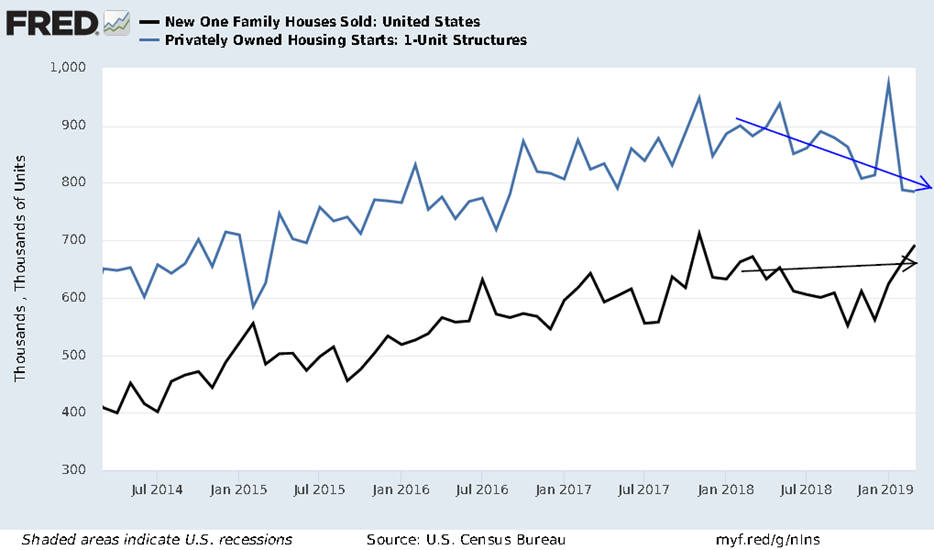
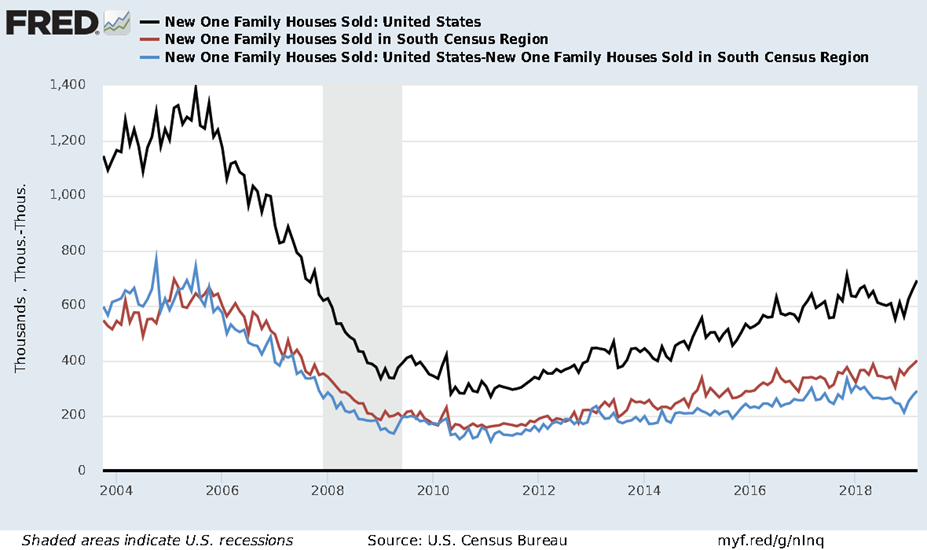
- Household formation remains near multi-year highs, which is a tailwind for the housing market. (The Daily Shot)

EARNINGS WATCH
As of Wednesday night, we had 178 reports in, a beat rate of 78% and a big +5.9% surprise factor (sector median +6.3%). The 178 companies having reported: +7.1% earnings growth.
The blended earnings growth rate is 0.0% (vs –2.0% on April 1) with 5 sectors in the red including Materials (-14.8%) and Energy (-27.2%). The blended growth ex-Energy is +1.4%.
Blended revenue growth is 5.0% (5.4% ex-E) on a 56% beat rate and a +0.8% surprise factor.
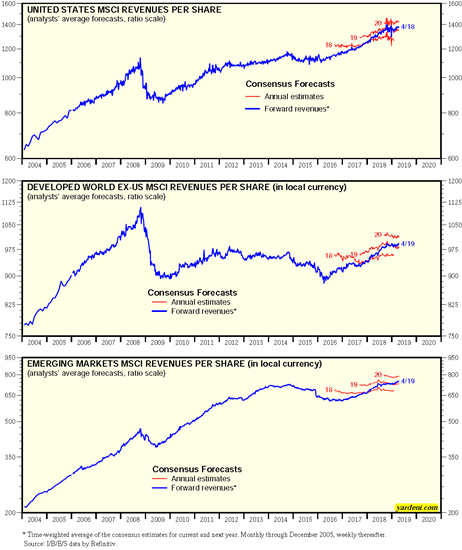
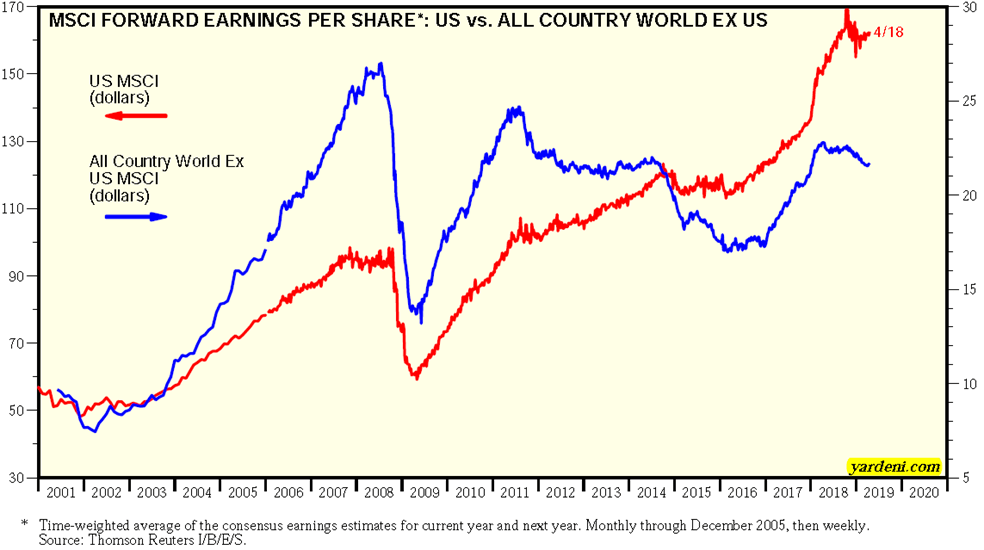
Trailing EPS are $162.41. Q2 estimates: +2.2% vs 2.8% Apr. 1. Q3: +2.3% vs 2.7%. Full year 2019: +3.3% unchanged.
Daimler Earnings Slump as Weaker China Sales Hits Mercedes The German luxury car maker reported a 37% drop in first-quarter earnings in its core car division, citing weak sales in China and a rapidly slowing global economy that hit its business in major markets.
Daimler on Friday said profits at the Mercedes-Benz car division, the company’s biggest, were hit by a 3% drop in China sales and an increase in the share of low-margin models in the company’s overall product mix. The return on Mercedes-Benz cars sales fell to 6.1% from 9% a year earlier.
(…) the results underlined the headwinds that have converged on global auto makers and Germany’s flagship industry in particular—from the softer economy in China, global trade tensions, the costs of moving to electric vehicles and the difficulties in adapting to new emission rules in Europe. (…)
New Mercedes-Benz car sales fell 7% to 555,312 vehicles in the first three months of the year. (…) During the news conference, Mr. Uebber wouldn’t provide any details on planned cuts or confirm that as many as 10,000 jobs could be shed.
Uber Lowers Target IPO Valuation Again Uber ratcheted down its target valuation to a range of about $80 billion to $90 billion for its initial public offering, following rival Lyft’s struggles after listing last month.
The ride-hailing giant is seeking to price its shares between $44 and $50 apiece, the people said. It aims to raise $8 billion to $10 billion in the IPO, one of the people said. Uber had previously given documentation to holders of its convertible notes outlining a potential price of $48 to $55 a share, which would have been a valuation between $90 billion and $100 billion on a fully diluted basis, The Wall Street Journal previously reported. (…)
Lead underwriters Morgan Stanley and Goldman Sachs Group Inc. had pitched a possible valuation of as much as $120 billion last year. (…)
Lyft’s IPO priced at $72 a share last month, well above its last private funding round and higher than the initial range targeted by the company and its underwriters. (…) On Thursday, Lyft’s stock declined 2.6% to $56.34, putting it 22% below its IPO price. (…)
BTW: In the filing, Uber also reported a net loss attributable to the company for the first quarter of 2019 of around $1 billion and revenues of roughly $3 billion. (Reuters)