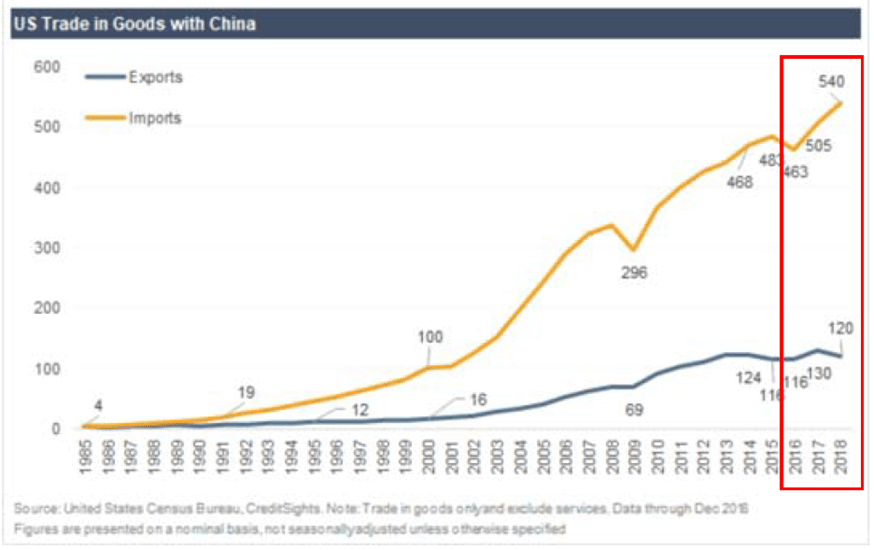
U.S. Bid to Maintain Tariffs Snarls Trade Talks With China The Trump administration’s demand that punitive tariffs remain to ensure Beijing enacts genuine overhauls has emerged as one of the biggest sticking points as U.S. and Chinese trade negotiators opened new talks.
(…) China trade envoy Liu He’s priority is to persuade his U.S. counterparts to remove tariffs on $250 billion of Chinese goods immediately on signing a deal, Chinese officials said. In exchange, Beijing is ready to eliminate retaliatory tariffs on $110 billion of U.S. goods.
In a sign that Mr. Liu may be making progress, Mr. Trump is looking to announce on Thursday the date of a summit with Mr. Xi, said an administration official. That’s a big signal the two sides are on the cusp of a deal, trade experts say, and a resolution of the tariff issue. But the official cautioned that the situation is fluid, and plans could change. (…)
U.S. business leaders support China’s demand to completely lift tariffs. (…)
Although Mr. Trump has declared himself “a Tariff Man,†he has made conflicting statements on China levies. On March 20, he said tariffs would remain for “a substantial period of time†after a deal. Two days later, he suggested that may only apply to the first round of U.S. tariffs, which targeted $50 billion of Chinese imports. (…)
The trade deal that the U.S. and China are crafting would give Beijing until 2025 to meet commitments on commodity purchases and allow American companies to wholly own enterprises in the Asian nation, according to three people familiar with the talks. (…)
Under the proposed agreement, China would commit by 2025 to buy more U.S. commodities, including soybeans and energy products, and allow 100 percent foreign ownership for U.S. companies operating in China as a binding pledge that can trigger retaliation from the U.S. if left unfulfilled, the people said on condition of anonymity because the talks are private. (…)
The White House is particularly focused on purchases commitments through the second quarter of 2020, in an effort to narrow the trade balance ahead of Trump’s re-election bid. People familiar with the talks said for that reason, the U.S. is pushing for China to front-load a big chunk of the commodities purchases in the first two years the agreement is in place. (…)

Source: CreditSights via The Daily Shot
Now that political calculations are taking center stage, a “deal†is imminent with the buck passed on to the next President.
Meanwhile, China’s economy is showing a better pulse as Markit reveals:
Business conditions across the Chinese economy improved at the fastest rate for nine months during March, according to the latest Caixin PMI surveys, providing evidence to suggest that recent fiscal support measures are beginning to work. The Caixin China Composite PMI (which covers both manufacturing and services), compiled by IHS Markit, indicated the largest increase in output since mid-2014. The ‘all-sector’ output index rose to 52.9 in March from 50.7 in February.
The strongest growth in manufacturing output for seven months was accompanied by a surge in service sector business activity, its fastest gain in just over a year. Manufacturing conditions improved for the first time in four months, supported by firmer demand, including a slight rise in exports.


This other “deal†is still not a deal:
Democrats are demanding trade negotiations be reopened to change labour, environmental and pharmaceutical provisions, even as the Trump administration, Canada and Mexico say they will not revisit the terms of the pact.
Efforts to have Mr. Trump lift steel and aluminium tariffs on Canada and Mexico, meanwhile, are also stalled. Canada, Mexico and some members of Congress have said they will not ratify USMCA until the tariffs are gone, but the White House has refused to budge. (…)
At the same time, Canada faces a time crunch. Parliament will rise in June and not reconvene until after the October election, meaning ratification could be delayed by months if it does not happen soon. (…)
Deal making:
Few Winners, Many Losers From Trade Tariffs, IMF Finds A 25% tariff on all Chinese imports to U.S. would cut U.S. GDP by 0.3%–0.6% and global growth by 0.1%–0.2%
(…) China would be hit even harder, with its GDP declining 0.5% to 1.5%, the IMF study found, because China’s exports to the U.S. are a larger share of its economy than vice versa. But Mexico, Canada, Europe and other parts of Asia would actually benefit somewhat, in the short run, as trade is diverted through their economies to avoid the tariffs. (…)
For much of the world, trade bounces across borders more than ever before, and thus an increase in tariffs “would have a larger negative effect today than in 1995,†the IMF report said. (…)
Synchronized downshift:

Source: @biancoresearch
A clear loser in this:
The data on Thursday showed orders fell 4.2 percent in February from January, and 8.4 percent from a year earlier — the most since 2009. The Economy Ministry added further gloom, saying that manufacturing momentum will “continue to be subdued in the coming months, particularly due to a lack of external demand.â€
The big drag in February was exports, which fell 6 percent. Trade tensions and Brexit woes are two factors likely behind the slump, while there’s also weaker demand, particularly in China, for cars and other German products.
The bad news from the Economy Ministry was followed just hours later by new forecasts for 2019 that predicted the weakest growth in six years. The country’s five leading research institutes see expansion of 0.8 percent, just half the pace previously anticipated.

This is a one-year free fall that is accelerating!
Markit’s recent German PMI offers no hope for now:

The deterioration in performance was underpinned by a sharp and accelerated decrease in new orders, which was in turn partly driven a further slump in export sales. Both total order books and new business from abroad fell at the fastest rate since April 2009. (…) Manufacturers’ backlogs of work fell for the seventh straight month and at the fastest rate since mid-2009. (…) Manufacturing output fell markedly and at the fastest rate since 2012, with the consumer goods sector joining intermediate and capital goods producers in contraction.
U.S. HOUSING
Homebuyers are taking advantage of the recent decline in mortgage rates. Loan applications for house purchase are the highest in years for this time of the year. (The Daily Shot)

TECHNICALS WATCH
CMG Wealth’s trade signals are all flashing green:
Equity Trade Signals
- Ned Davis Research CMG U.S. Large Cap Long/Flat Index: Buy Signal – 100% U.S. Large Cap Equity Exposure
- Long-term Trend (13/34-Week EMA) on the S&P 500 Index: Buy Signal – Bullish for Equities
- Volume Demand (buyers) vs. Volume Supply (sellers): Buy Signal – Bullish for Equities
- S&P 500 Index 200-day Moving Average Trend: Buy Signal – Bullish for Equities
- S&P 500 Index 50-day vs. 200-day Moving Average Cross: Buy Signal – Bullish for Equities
- NASDAQ Index 200-day Moving Average Trend: Buy Signal – Bullish for Equities
- Don’t Fight the Tape or the Fed: Indicator Reading = +1 (Bullish Signal for Equities)
Just for fun, I went back to check the same signals at the end of January 2018 and in early October 2018. CMG Wealth was then only displaying the first 3 and the last above. In both periods, the first 3 indicators were green and the last was neutral. Just so you know…
BTW, the Rule of 20 P/E was 23.5 (17.5% overvalued) in January 2018 and 21.2 (6.2% overvalued) at the end of September. It is currently 19.7 (1.5% undervalued) after reaching 16.8 (19% undervalued) last December 26 during the recession scare.
Also know that investor sentiment gauges are currently generally positive. This is a contrarian indicator.
CMG Wealth also offers several recession indicators:
Economic Indicators
- Global Recession: High Recession Risk (97% probability)
- U.S. Recession: Low U.S. Recession Risk (Next Six Months)
- Inflation Watch: Low Inflation Pressures
- Global Recession Probability Indicator: High Recession Risk
- The Economy Based on the Stock Market Indicator: High U.S. Recession Risk
- Recession Probability Based on Employment Trends: Low U.S. Recession Risk
- Credit Conditions – Recession Indicator: Low U.S. Recession Risk*
- U.S. Economy vs. Yield Curve: Low U.S. Recession Risk
* Nearing change in signal
Ned Davis Research says that “The Economy Based on the Stock Market Indicator†has had correct signals 80% of the time since 1950. My own observations are that it had correct recession signals 60% of the time and correct expansion signals 53% of the time.
NDR also says its “Recession Probability Based on Employment Trends†has ben correct 100% of the times since 1980. Very true.
“The unequal sharing of blessings” vs. “the equal sharing of miseries.”
Democratic candidates seem to be leaning seriously left ahead of the next elections to the delight of the GOP. Including the “Don’t know for sureâ€, Sanders, Harris and Warren have pretty solid backing, exceeding 50% and even 60% when including the “Have some reservationsâ€.

Source: @WSJ; Read full article
The “comfiesâ€, the “Don’t know for sure†and people with “some reservations†should all read Howard Marks’ latest memo before settling their views: GROWING THE PIE



 Germany Suffers Double Blow on Factory Slump, Downgrade