U.S. PMI slips to 15-month low in December
December data indicated a slower, albeit still solid improvement in the health of the U.S. manufacturing sector. The headline PMI dipped to a 15-month low amid a weaker rise in new business and the joint-softest expansion in output since September 2017. At the same time, the pace of job creation eased to an 18-month low, despite a further rise in backlogs. Notably, business confidence among manufacturers fell again in December, with the degree of optimism dipping to the lowest since October 2016. Meanwhile, inflationary pressures eased at the end of 2018.
The seasonally adjusted IHS Markit final U.S. Manufacturing Purchasing Managers’ Index™ (PMI™) posted 53.8 in December, down from 55.3 in November. The latest headline figure suggested a weaker, but still strong, improvement in operating conditions across the goods producing sector. Although ending the year with a softer overall expansion, the final quarterly average of 2018 was strong and quicker than that seen in 2017.
Production growth remained solid in December, and at a rate that matched that seen in November. The rise in output was attributed to greater new order volumes. That said, the upturn was nonetheless the joint-weakest in 15 months. Following a slight pick up in November, new order growth eased in December. Though strong, the pace of expansion was the weakest since September 2017. Although some firms stated that the upturn was driven by new order inflows from newly acquired clients, others cited concerns surrounding a drop in client demand compared to earlier in the year.
Conversely, new export business grew at an accelerated pace in December. New orders from abroad increased for the fifth successive month and at the fastest rate since January amid stronger foreign client demand. That said, a weaker overall rise in new orders led to a drop in business confidence among manufacturing firms in December. The degree of optimism was strong, but well below the long-run series average. Positive sentiment was dampened by concerns surrounding the longevity of new business growth. Moreover, future output expectations were at their lowest since October 2016.
Growth was led by strengthening demand for consumer goods, and robust growth was also reported for investment goods such as plant and machinery. But producers of intermediate goods – who supply inputs to other manufactures – reported the weakest rise in new orders for over two years, hinting at increased destocking by their customers.
A shift to inventory reduction was highlighted by purchasing activity in the manufacturing sector rising at the weakest rate for one and a half years in December, providing further evidence that companies have become increasingly cautious about spending amid rising uncertainty about the outlook.
Despite a moderate rise in backlogs in December, the rate of job creation softened to an 18-month low. Although firms noted an increase in workforce numbers following greater production requirements, others suggested that low rates of employee retention had weighed on growth. Meanwhile, rates of both input price and output charge inflation eased in December. Greater cost burdens were reportedly due to raw material stockpiling among manufacturers, shortages of electronics components and the ongoing impact of tariffs. Just over two thirds of manufacturers reporting higher costs attributed the rise in prices to tariffs.
That said, the rate of inflation dipped to an 11-month low. Factory gate prices meanwhile rose at the weakest rate in 2018.

-
Key Fed Yield Gauge Points to Rate Cuts for First Time Since 2008 The market indicator is seen as a proxy for traders’ outlook on Federal Reserve policy.
CHINA MANUFACTURING PMI IN CONTRACTION TERRITORY
Chinese manufacturing production increased slightly at the end of 2018, after stagnating in the prior two months. However, there were signs of softer demand conditions, as total new orders fell marginally, and companies reduced their output charges for the second month running. The latter was supported by the first drop in input costs for just over a year-and-a-half.
Looking ahead, business confidence was relatively subdued, and companies reduced their headcounts for the sixty-second month running.
The headline seasonally adjusted Purchasing Managers’ Index™ (PMI™) fell from 50.2 in November to 49.7 at the end of 2018, to signal a renewed deterioration in overall operating conditions. Though only slight, it was the first time that the health of the sector worsened since May 2017.
After stagnating in the prior two months, production rose slightly during December. Notably, the rate of expansion was much softer than those seen earlier in 2018. Concurrently, latest data signalled a renewed fall in total new work received by Chinese manufacturers during December. Although the pace of reduction was fractional, it was the first time that new orders had fallen since June 2016. A number of surveyed companies mentioned that relatively subdued market conditions had hampered sales. New export business meanwhile fell for the ninth month in a row, albeit at a softer pace than in November.
That showed external demand remained subdued due to the trade frictions between China and the U.S., while domestic demand weakened more notably.
Efforts to reduce operating costs alongside decisions to not replace voluntary leavers meant that manufacturing employment in China continued to fall in December. The rate of job shedding was modest and similar to that seen in November. At the same time, unfinished workloads continued to increase, with some firms mentioning difficulties with production equipment.
Firms expanded their purchasing activity for the third month running, though the rate of growth remained marginal. Some firms indicated that buying activity rose due to forecasts of rising costs in 2019. Inventories of inputs were meanwhile little-changed from the previous month, while stocks of finished goods rose slightly.
December data indicated that pressures on supply chains eased, as vendor performance stabilised following a 27-month period of deterioration. Average input costs fell for the first time in just over a year-and-a-half at the end of 2018. Though modest, the rate of reduction was the quickest since February 2016. At the same time, reports of a general drop in market prices led firms to discount their output charges for the second month in a row.
Confidence towards the 12-month outlook for production edged up to a three-month high, but remained subdued overall. Concerns largely stemmed from softer client demand and restrictive national policies around production.
(…) It is looking increasingly likely that the Chinese economy may come under greater downward pressure.

(… ) “Downward pressure of market demand further increased as companies’ expectations became more cautious,” said Zhao Qinghe, an economist with China’s statistics bureau. (…)
A subindex of the purchasing managers’ gauge measuring total new orders fell into contractionary territory, to 49.7 in December, and the subindex for new exports—an indicator of external demand for Chinese goods—fell to 46.6, its seventh straight month below 50. Another subindex measuring factories’ production also pointed down in December, though stayed on the expansionary side at 50.8.
On a more positive note, the official nonmanufacturing purchasing managers index, which includes services and construction, rose to 53.8 in December from 53.4 in November, in part due to recent government efforts to stabilize infrastructure investment, said Mr. Zhao, the statistics bureau economist. (…)
China’s legislature said over the weekend that it will allow local governments to issue bonds without having to wait for the approval of the annual fiscal budget in March 2019. That should allow some infrastructure and other projects to move ahead, boosting employment and stimulus. (…)
-
Given the recent weakness in China’s economic activity, a further slowdown in US durable goods orders is expected (especially if trade tensions with China escalate). (The Daily Shot)
Source: Pantheon Macroeconomics
-
China Struggles to Limit Surging Corporate Debt Beijing’s goal has taken a back seat to propping up short-term growth as trade tensions fuel investors’ anxiety

(…) China’s central-bank governor Yi Gang defended China’s stance in December, saying “relatively loose” monetary policy is required to stabilize the economy in a downward cycle.
Easy credit to state-owned companies helped propel China’s economic boom, particularly after the global financial crisis prompted authorities to pump half a trillion dollars of stimulus to keep the economy moving. Between 2008 and 2016, total credit to nonfinancial companies grew from less than 95% of gross domestic product to more than 150%, according to the Bank for International Settlements.
Amid tightening regulations on risky lending, that figure declined to about 147% at the end of 2017 before rising in the first half of 2018, according to the latest data. G-20 countries, by comparison, stood at about 94% of GDP at the end of 2017. China’s total social financing—a broad measure of credit that also includes nonbank debt—continued to grow in 2018, although more slowly. (…)
By some measures, corporate health in China has improved. Solvency ratios increased at listed companies across a number of sectors, including automobiles and steel, according to data provider Wind Information Co. Profits at companies owned by the central government also grew at a double-digit rate. (…)
Growth of eurozone manufacturing economy continues to falter
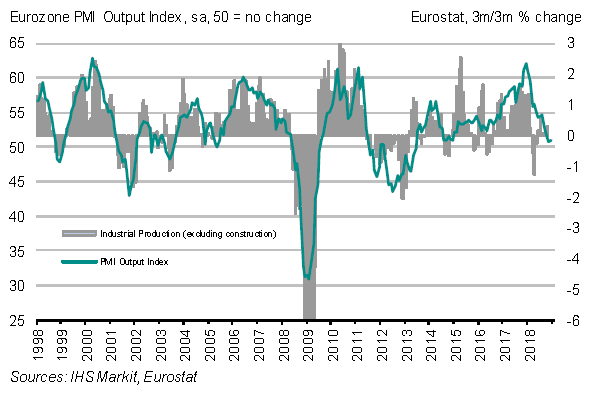
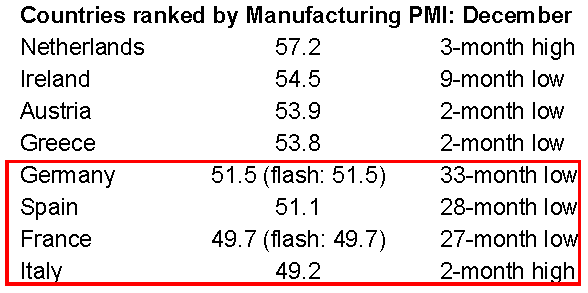
The slowdown of growth in the euro area’s manufacturing economy, seen throughout much of 2018, carried on until the end of the year in December. After accounting for seasonal factors, the IHS Markit Eurozone Manufacturing PMI recorded a final reading of 51.4, unchanged from the flash estimate but down from 51.8 in November. Although extending the current run of expansion to five-and-a-half years, the latest PMI reading was the lowest seen since February 2016.
Latest data showed divergent trends by market group. Whilst growth in the consumer goods sector accelerated to a solid level, there was a deterioration of operating conditions for intermediate goods producers. Marginal growth was recorded in the capital goods category.
Once again, it was the euro area’s ‘big-four’ economies that posted the lowest manufacturing PMI readings of all countries monitored during December. Latest data showed that Italy remained in contraction territory and was also joined by France, where PMI data showed a first deterioration in operating conditions for 27 months. Manufacturing growth in both Germany and Spain was modest, easing in each case to the weakest in around two-and-a-half years. Slower growth was seen elsewhere except for the Netherlands, where the rate of expansion improved to its best in three months.
In line with the recent trend, underlying the slowdown in overall growth was further softness in new orders. For the third successive month, total new work placed with eurozone manufacturers fell and, although modest, the contraction was the greatest in over four years amid reports of ongoing challenges in the autos industry plus wider political and economic instabilities. December’s survey also saw a net fall in export trade, led by the sharpest decline for six years in Germany.
Nonetheless, eurozone manufacturers were able to eke out further growth of output. The modest increase in production, combined with a fall in new order flows, meant that firms were able to make inroads into their work outstanding. Backlogs declined for a fourth successive month and to the greatest degree since November 2014. Warehouse inventories also increased for a third successive month.
Meanwhile, job creation was sustained at the end of 2018, although growth was little changed on November’s 26-month low. Manufacturers also showed a growing degree of pessimism about the future. Business confidence regarding output in a year’s time was the lowest recorded by the survey since the end of 2012. Continued worries over global trade, ongoing political uncertainties and tightening financial conditions all served to undermine confidence during December.
There was some relatively positive news on the price front during December. Input cost inflation was down notably, easing back to its lowest level for 17 months. There were reports of reduced prices for oil based products, although rising costs for metals (especially steel) and ongoing supply-side shortages ensured that overall inflation remained strong.
Manufacturers continued to pass on their higher costs wherever possible. However, in line with the trend for input prices, the rate of output charge inflation continued to soften and was the weakest recorded by the survey since July 2017. The strongest rises in prices were again seen in Germany and the Netherlands. In contrast, there was little change signalled in both Spain and Ireland, whilst an outright decline was recorded in Greece.
(…) The last three months of 2018 saw manufacturers report the worst quarterly performance in terms of production since the second quarter of 2013. Worryingly, current production levels were achieved only by firms eating into backlogs of orders received in prior months and a dearth of new orders means capacity will be cut back in coming months unless demand revives. December saw a third consecutive monthly drop in new orders.
More encouragingly, some of the recent weakness could prove temporary, being the result of protests in France and the auto sector struggling to adjust to new emissions regulations. However, the undercurrent of weak demand and growing risk aversion evident across the surveys suggests that any rebound could prove modest at best, with Brexit representing a particularly worrying unknown for the outlook.
(…) Unwanted apartments are weighing on China’s economy — and, by extension, dragging down growth around the world. Property sales are dropping. Apartments are going unsold. Developers who bet big on continued good times are now staggering under billions of dollars of debt. (…)
More than one in five apartments in Chinese cities — roughly 65 million — sit unoccupied, estimates Gan Li, a professor at Southwestern University of Finance and Economics in Chengdu. (…)
Some property developers have slashed prices on new apartments to gin up business or cut corners to save money. That undercuts the property values of earlier buyers, who increasingly are taking to the streets to protest. (…)
Housing is key to China’s well-being. It accounts for roughly one-fifth to one-third of China’s economic growth, depending on whether ancillary industries like construction and furniture-making are included. (…)
Sales in terms of gross floor area on the market have dropped sharply since September. The share of apartments in new developments that are being sold has plunged since the summer. The number of failed land auctions has doubled this year, indicating that property developers are unwilling or unable to buy land for new developments. (…)
In recent months, they have loosened mortgage requirements, eased restrictions on when homeowners can resell their properties and made it easier for university students to continue living in the cities where they are studying after they graduate, potentially increasing housing demand. In some cities, property developers have cut deals with home buyers to give them back the difference between the current price and the one they originally paid. (…)
In 2016, some 49,000 apartments were sold in Jurong, a remarkable number for a city where the annual average is closer to 4,000, according to Huifeng Li, a research director at the Purple Mountain Digital New Media Research Institute in Nanjing. The majority of the new buyers these days are speculators, he said. (…)

